
Responsive Leadership Seminars Responsive Management Systems Creating Excellence
- Slides: 29
Responsive Leadership Seminars® Responsive Management Systems® Creating Excellence in Line-Level Leaders … helping to create productive and preferred work environments Since 1985 5704 N. E. 71 st Street • Seattle, WA 98115 • Telephone/FAX (206) 523 -4603 Responsive Management Systems®
Responsive Leadership Seminars® WELCOME www. responsivemgt. com 5704 N. E. 71 st Street • Seattle, WA 98115 • Telephone/FAX (206) 523 -4603 Responsive Management Systems®
Responsive Leadership Seminars® Responsive Management®: Line-Level Leadership CORE COMPETENCIES FOR DEVELOPING QUALITY OPERATIONS “Where Theory Meets the Road” 5704 N. E. 71 st Street • Seattle, WA 98115 • Telephone/FAX (206) 523 -4603 • Richard. Baron@responsivemgt. com Responsive Management Systems® www. responsivemgt. com
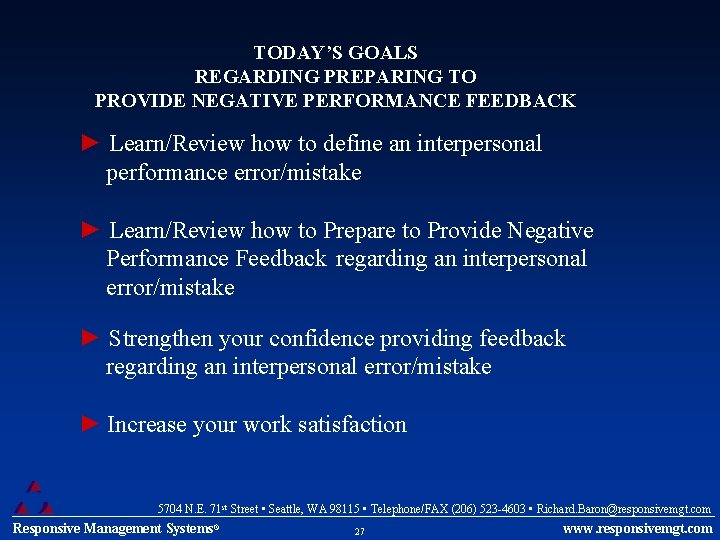
TODAY’S GOALS REGARDING PREPARING TO PROVIDE NEGATIVE PERFORMANCE FEEDBACK ► Learn/Review how to define an interpersonal performance error/mistake ► Learn/Review how to Prepare to Provide Negative Performance Feedback regarding an interpersonal error/mistake ► Strengthen your confidence providing feedback regarding an interpersonal error/mistake ► Increase your work satisfaction 5704 N. E. 71 st Street • Seattle, WA 98115 • Telephone/FAX (206) 523 -4603 • Richard. Baron@responsivemgt. com Responsive Management Systems® 27 www. responsivemgt. com
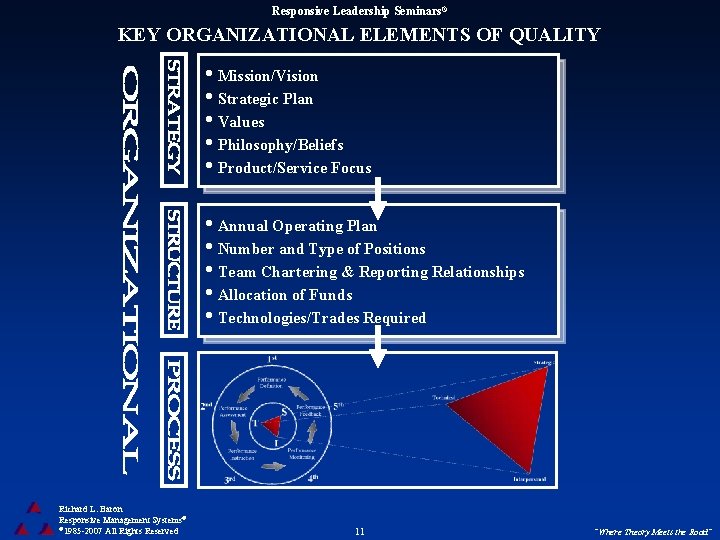
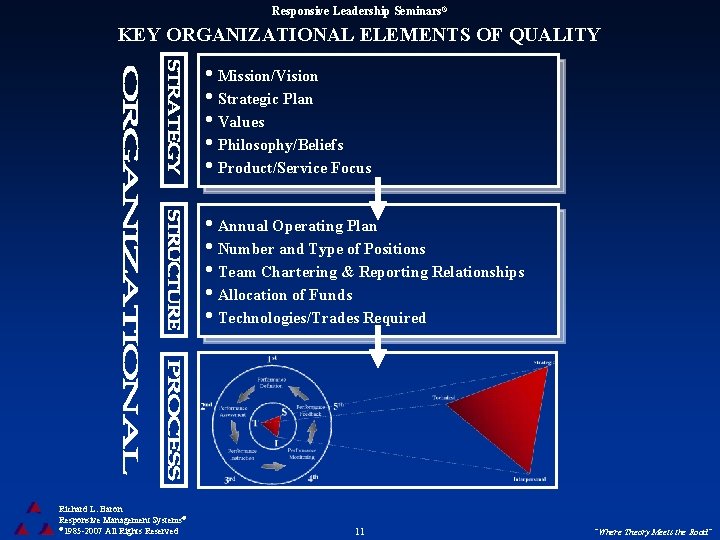
Responsive Leadership Seminars® KEY ORGANIZATIONAL ELEMENTS OF QUALITY • Mission/Vision • Strategic Plan • Values • Philosophy/Beliefs • Product/Service Focus • Annual Operating Plan • Number and Type of Positions • Team Chartering & Reporting Relationships • Allocation of Funds • Technologies/Trades Required Richard L. Baron Responsive Management Systems® © 1985 -2007 All Rights Reserved 11 “Where Theory Meets the Road”
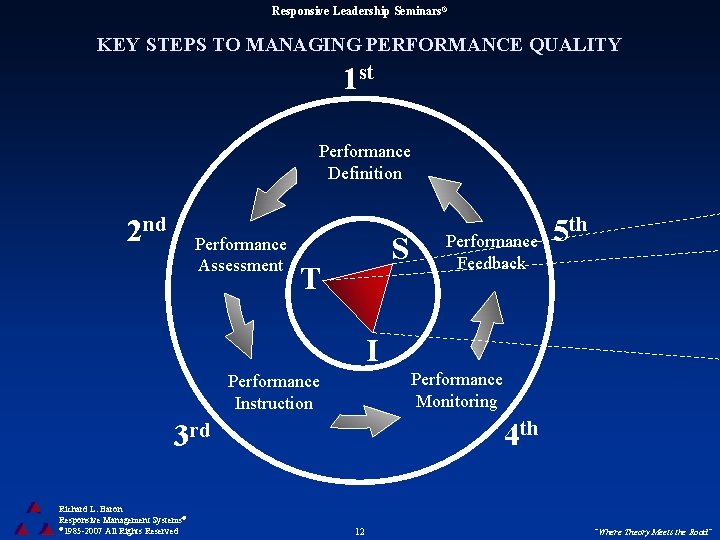
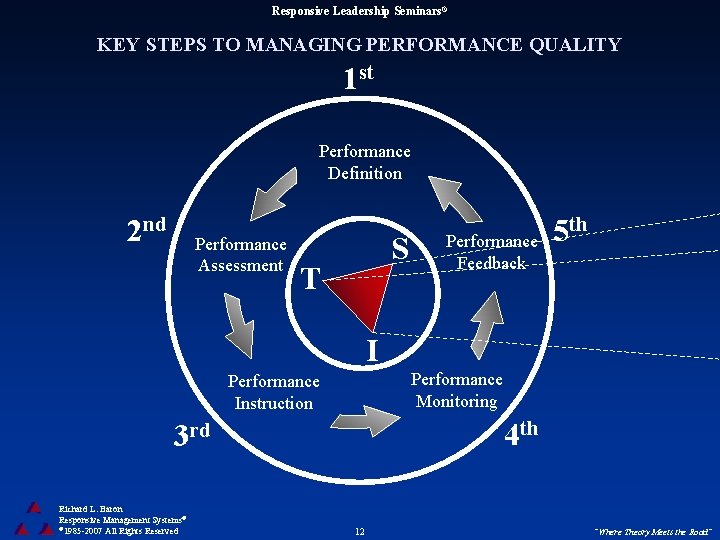
Responsive Leadership Seminars® KEY STEPS TO MANAGING PERFORMANCE QUALITY 1 st Performance Definition 2 nd Performance Assessment S T Performance Feedback 5 th I Performance Monitoring Performance Instruction 4 th 3 rd Richard L. Baron Responsive Management Systems® © 1985 -2007 All Rights Reserved 12 “Where Theory Meets the Road”
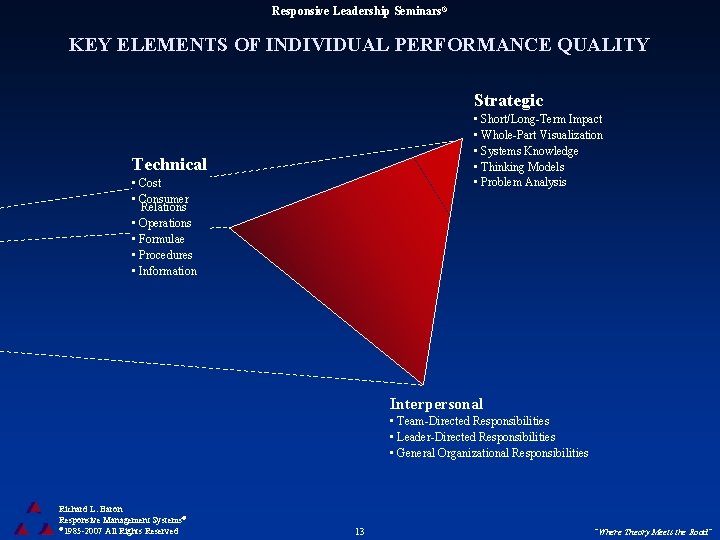
Responsive Leadership Seminars® KEY ELEMENTS OF INDIVIDUAL PERFORMANCE QUALITY Strategic • Short/Long-Term Impact • Whole-Part Visualization • Systems Knowledge • Thinking Models • Problem Analysis Technical • Cost • Consumer Relations • Operations • Formulae • Procedures • Information Interpersonal • Team-Directed Responsibilities • Leader-Directed Responsibilities • General Organizational Responsibilities Richard L. Baron Responsive Management Systems® © 1985 -2007 All Rights Reserved 13 “Where Theory Meets the Road”
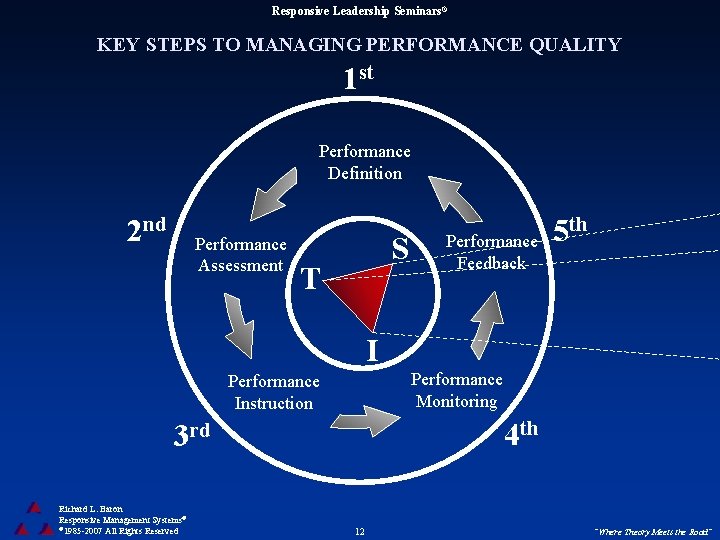
Responsive Leadership Seminars® KEY STEPS TO MANAGING PERFORMANCE QUALITY 1 st Performance Definition 2 nd Performance Assessment S T Performance Feedback 5 th I Performance Monitoring Performance Instruction 4 th 3 rd Richard L. Baron Responsive Management Systems® © 1985 -2007 All Rights Reserved 12 “Where Theory Meets the Road”
Responsive Leadership Seminars® Confidentiality & Respect Richard L. Baron Responsive Management Systems® © 1985 -2007 All Rights Reserved “Where Theory Meets the Road”
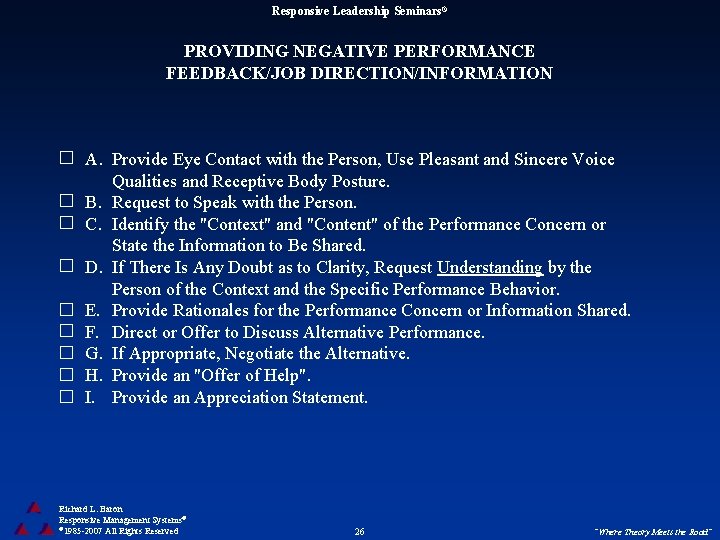
Responsive Leadership Seminars® PROVIDING NEGATIVE PERFORMANCE FEEDBACK/JOB DIRECTION/INFORMATION A. Provide Eye Contact with the Person, Use Pleasant and Sincere Voice Qualities and Receptive Body Posture. B. Request to Speak with the Person. C. Identify the "Context" and "Content" of the Performance Concern or State the Information to Be Shared. D. If There Is Any Doubt as to Clarity, Request Understanding by the Person of the Context and the Specific Performance Behavior. E. Provide Rationales for the Performance Concern or Information Shared. F. Direct or Offer to Discuss Alternative Performance. G. If Appropriate, Negotiate the Alternative. H. Provide an "Offer of Help". I. Provide an Appreciation Statement. Richard L. Baron Responsive Management Systems® © 1985 -2007 All Rights Reserved 26 “Where Theory Meets the Road”
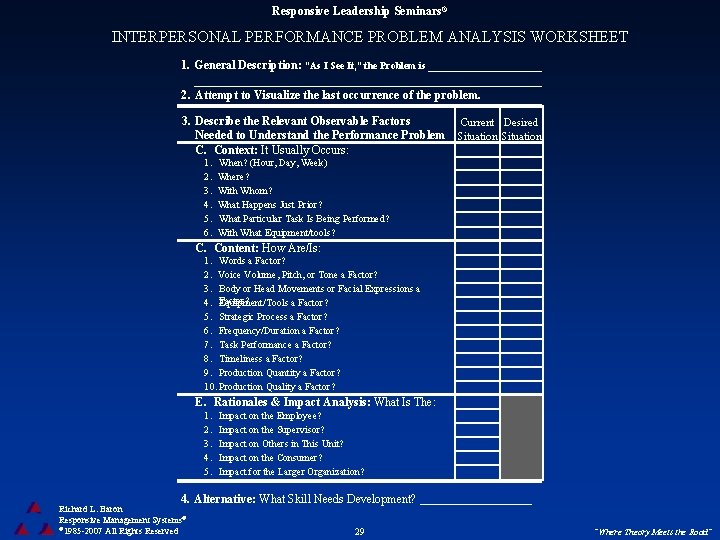
Responsive Leadership Seminars® INTERPERSONAL PERFORMANCE PROBLEM ANALYSIS WORKSHEET 1. General Description: “As I See It, ” the Problem is _______________________________________ 2. Attempt to Visualize the last occurrence of the problem. 3. Describe the Relevant Observable Factors Current Desired Needed to Understand the Performance Problem Situation C. Context: It Usually Occurs: 1. 2. 3. 4. 5. 6. When? (Hour, Day, Week) Where? With Whom? What Happens Just Prior? What Particular Task Is Being Performed? With What Equipment/tools? C. Content: How Are/Is: 1. Words a Factor? 2. Voice Volume, Pitch, or Tone a Factor? 3. Body or Head Movements or Facial Expressions a 4. Factor? Equipment/Tools a Factor? 5. Strategic Process a Factor? 6. Frequency/Duration a Factor? 7. Task Performance a Factor? 8. Timeliness a Factor? 9. Production Quantity a Factor? 10. Production Quality a Factor? E. Rationales & Impact Analysis: What Is The: 1. 2. 3. 4. 5. Impact on the Employee? Impact on the Supervisor? Impact on Others in This Unit? Impact on the Consumer? Impact for the Larger Organization? 4. Alternative: What Skill Needs Development? ______________ Richard L. Baron Responsive Management Systems® © 1985 -2007 All Rights Reserved 29 “Where Theory Meets the Road”
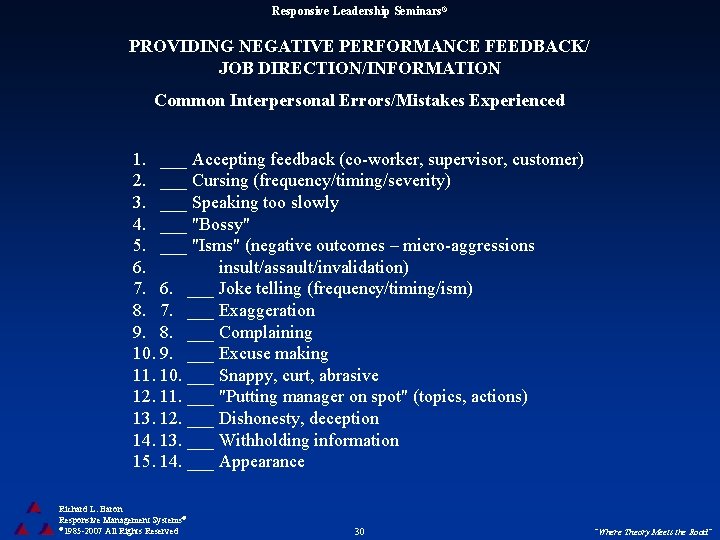
Responsive Leadership Seminars® PROVIDING NEGATIVE PERFORMANCE FEEDBACK/ JOB DIRECTION/INFORMATION Common Interpersonal Errors/Mistakes Experienced 1. ___ Accepting feedback (co-worker, supervisor, customer) 2. ___ Cursing (frequency/timing/severity) 3. ___ Speaking too slowly 4. ___ "Bossy" 5. ___ "Isms" (negative outcomes – micro-aggressions 6. insult/assault/invalidation) 7. 6. ___ Joke telling (frequency/timing/ism) 8. 7. ___ Exaggeration 9. 8. ___ Complaining 10. 9. ___ Excuse making 11. 10. ___ Snappy, curt, abrasive 12. 11. ___ "Putting manager on spot" (topics, actions) 13. 12. ___ Dishonesty, deception 14. 13. ___ Withholding information 15. 14. ___ Appearance Richard L. Baron Responsive Management Systems® © 1985 -2007 All Rights Reserved 30 “Where Theory Meets the Road”
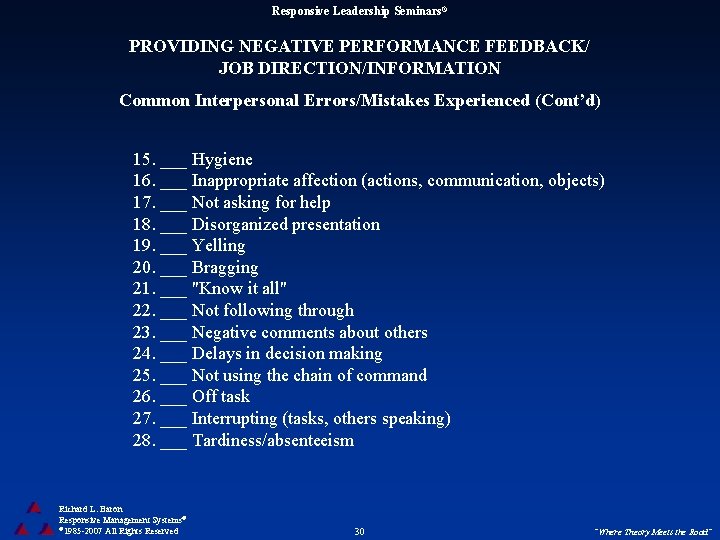
Responsive Leadership Seminars® PROVIDING NEGATIVE PERFORMANCE FEEDBACK/ JOB DIRECTION/INFORMATION Common Interpersonal Errors/Mistakes Experienced (Cont’d) 15. ___ Hygiene 16. ___ Inappropriate affection (actions, communication, objects) 17. ___ Not asking for help 18. ___ Disorganized presentation 19. ___ Yelling 20. ___ Bragging 21. ___ "Know it all" 22. ___ Not following through 23. ___ Negative comments about others 24. ___ Delays in decision making 25. ___ Not using the chain of command 26. ___ Off task 27. ___ Interrupting (tasks, others speaking) 28. ___ Tardiness/absenteeism Richard L. Baron Responsive Management Systems® © 1985 -2007 All Rights Reserved 30 “Where Theory Meets the Road”
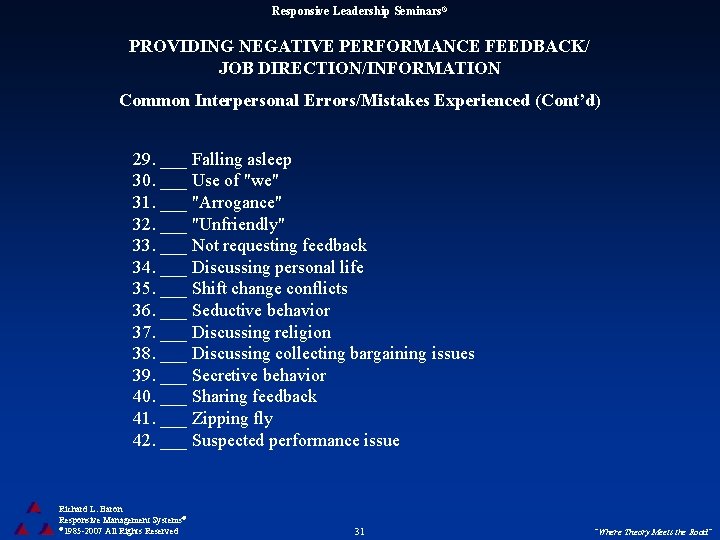
Responsive Leadership Seminars® PROVIDING NEGATIVE PERFORMANCE FEEDBACK/ JOB DIRECTION/INFORMATION Common Interpersonal Errors/Mistakes Experienced (Cont’d) 29. ___ Falling asleep 30. ___ Use of "we" 31. ___ "Arrogance" 32. ___ "Unfriendly" 33. ___ Not requesting feedback 34. ___ Discussing personal life 35. ___ Shift change conflicts 36. ___ Seductive behavior 37. ___ Discussing religion 38. ___ Discussing collecting bargaining issues 39. ___ Secretive behavior 40. ___ Sharing feedback 41. ___ Zipping fly 42. ___ Suspected performance issue Richard L. Baron Responsive Management Systems® © 1985 -2007 All Rights Reserved 31 “Where Theory Meets the Road”
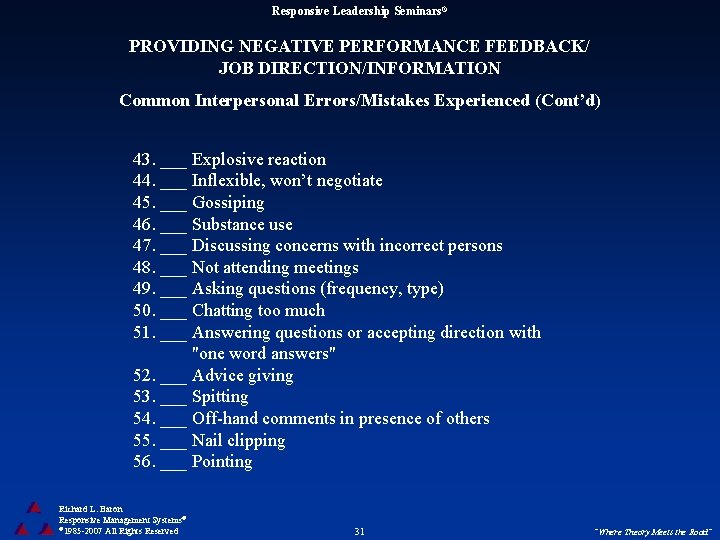
Responsive Leadership Seminars® PROVIDING NEGATIVE PERFORMANCE FEEDBACK/ JOB DIRECTION/INFORMATION Common Interpersonal Errors/Mistakes Experienced (Cont’d) 43. ___ Explosive reaction 44. ___ Inflexible, won’t negotiate 45. ___ Gossiping 46. ___ Substance use 47. ___ Discussing concerns with incorrect persons 48. ___ Not attending meetings 49. ___ Asking questions (frequency, type) 50. ___ Chatting too much 51. ___ Answering questions or accepting direction with "one word answers" 52. ___ Advice giving 53. ___ Spitting 54. ___ Off-hand comments in presence of others 55. ___ Nail clipping 56. ___ Pointing Richard L. Baron Responsive Management Systems® © 1985 -2007 All Rights Reserved 31 “Where Theory Meets the Road”
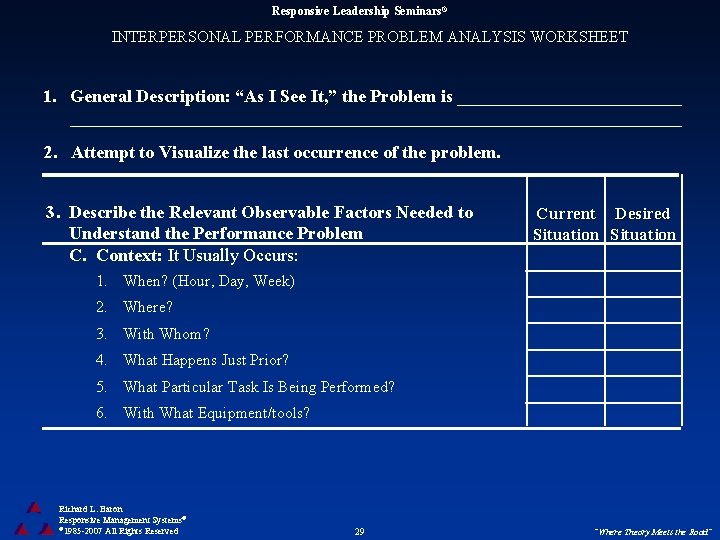
Responsive Leadership Seminars® INTERPERSONAL PERFORMANCE PROBLEM ANALYSIS WORKSHEET 1. General Description: “As I See It, ” the Problem is _______________________________________________ 2. Attempt to Visualize the last occurrence of the problem. 3. Describe the Relevant Observable Factors Needed to Understand the Performance Problem C. Context: It Usually Occurs: Current Desired Situation 1. When? (Hour, Day, Week) 2. Where? 3. With Whom? 4. What Happens Just Prior? 5. What Particular Task Is Being Performed? 6. With What Equipment/tools? Richard L. Baron Responsive Management Systems® © 1985 -2007 All Rights Reserved 29 “Where Theory Meets the Road”
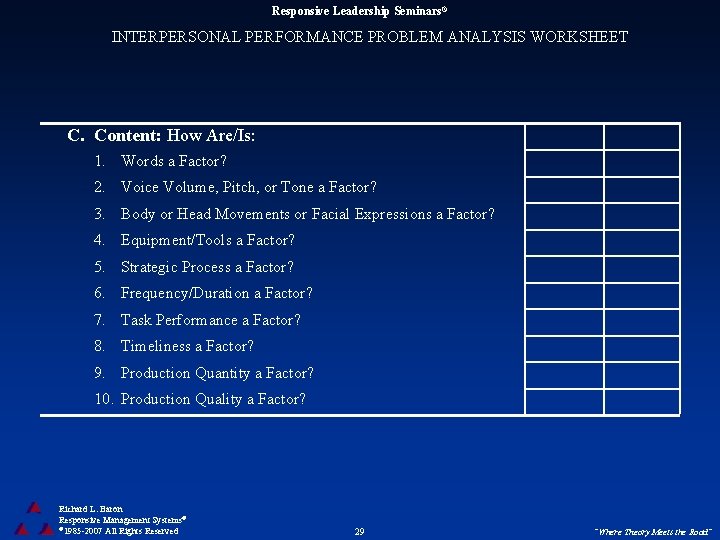
Responsive Leadership Seminars® INTERPERSONAL PERFORMANCE PROBLEM ANALYSIS WORKSHEET C. Content: How Are/Is: 1. Words a Factor? 2. Voice Volume, Pitch, or Tone a Factor? 3. Body or Head Movements or Facial Expressions a Factor? 4. Equipment/Tools a Factor? 5. Strategic Process a Factor? 6. Frequency/Duration a Factor? 7. Task Performance a Factor? 8. Timeliness a Factor? 9. Production Quantity a Factor? 10. Production Quality a Factor? Richard L. Baron Responsive Management Systems® © 1985 -2007 All Rights Reserved 29 “Where Theory Meets the Road”
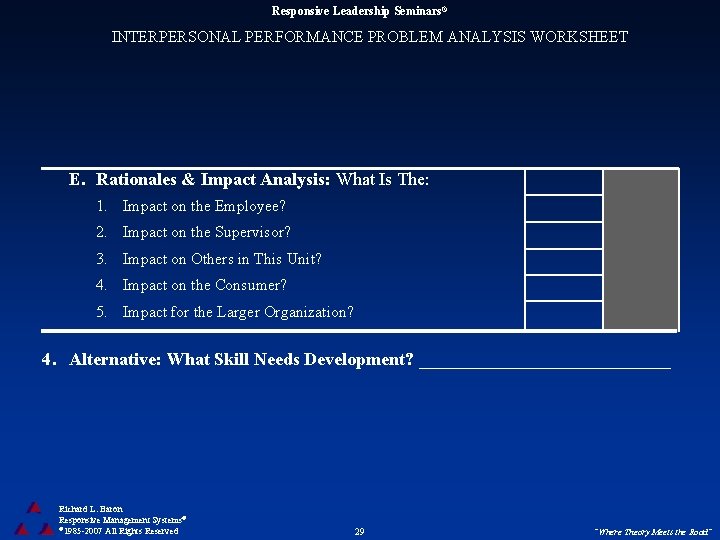
Responsive Leadership Seminars® INTERPERSONAL PERFORMANCE PROBLEM ANALYSIS WORKSHEET E. Rationales & Impact Analysis: What Is The: 1. Impact on the Employee? 2. Impact on the Supervisor? 3. Impact on Others in This Unit? 4. Impact on the Consumer? 5. Impact for the Larger Organization? 4. Alternative: What Skill Needs Development? ______________ Richard L. Baron Responsive Management Systems® © 1985 -2007 All Rights Reserved 29 “Where Theory Meets the Road”
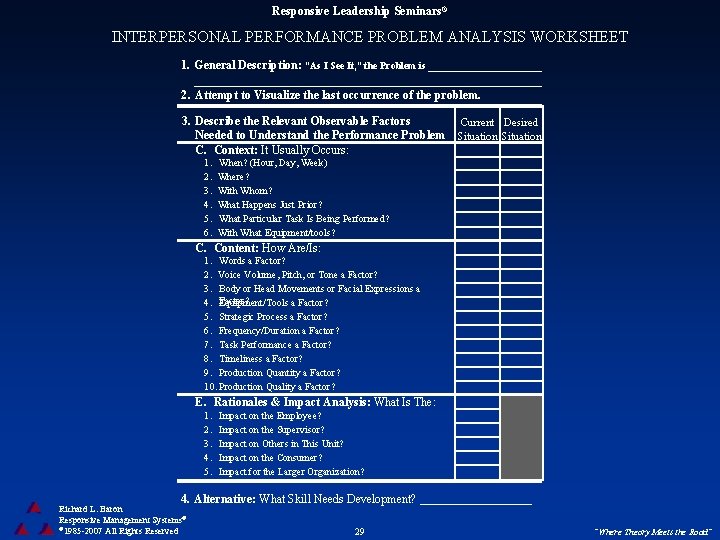
Responsive Leadership Seminars® INTERPERSONAL PERFORMANCE PROBLEM ANALYSIS WORKSHEET 1. General Description: “As I See It, ” the Problem is _______________________________________ 2. Attempt to Visualize the last occurrence of the problem. 3. Describe the Relevant Observable Factors Current Desired Needed to Understand the Performance Problem Situation C. Context: It Usually Occurs: 1. 2. 3. 4. 5. 6. When? (Hour, Day, Week) Where? With Whom? What Happens Just Prior? What Particular Task Is Being Performed? With What Equipment/tools? C. Content: How Are/Is: 1. Words a Factor? 2. Voice Volume, Pitch, or Tone a Factor? 3. Body or Head Movements or Facial Expressions a 4. Factor? Equipment/Tools a Factor? 5. Strategic Process a Factor? 6. Frequency/Duration a Factor? 7. Task Performance a Factor? 8. Timeliness a Factor? 9. Production Quantity a Factor? 10. Production Quality a Factor? E. Rationales & Impact Analysis: What Is The: 1. 2. 3. 4. 5. Impact on the Employee? Impact on the Supervisor? Impact on Others in This Unit? Impact on the Consumer? Impact for the Larger Organization? 4. Alternative: What Skill Needs Development? ______________ Richard L. Baron Responsive Management Systems® © 1985 -2007 All Rights Reserved 29 “Where Theory Meets the Road”
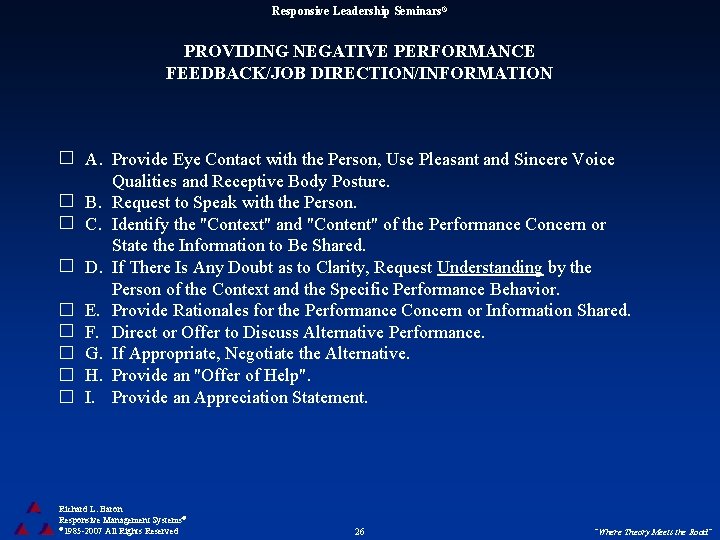
Responsive Leadership Seminars® PROVIDING NEGATIVE PERFORMANCE FEEDBACK/JOB DIRECTION/INFORMATION A. Provide Eye Contact with the Person, Use Pleasant and Sincere Voice Qualities and Receptive Body Posture. B. Request to Speak with the Person. C. Identify the "Context" and "Content" of the Performance Concern or State the Information to Be Shared. D. If There Is Any Doubt as to Clarity, Request Understanding by the Person of the Context and the Specific Performance Behavior. E. Provide Rationales for the Performance Concern or Information Shared. F. Direct or Offer to Discuss Alternative Performance. G. If Appropriate, Negotiate the Alternative. H. Provide an "Offer of Help". I. Provide an Appreciation Statement. Richard L. Baron Responsive Management Systems® © 1985 -2007 All Rights Reserved 26 “Where Theory Meets the Road”
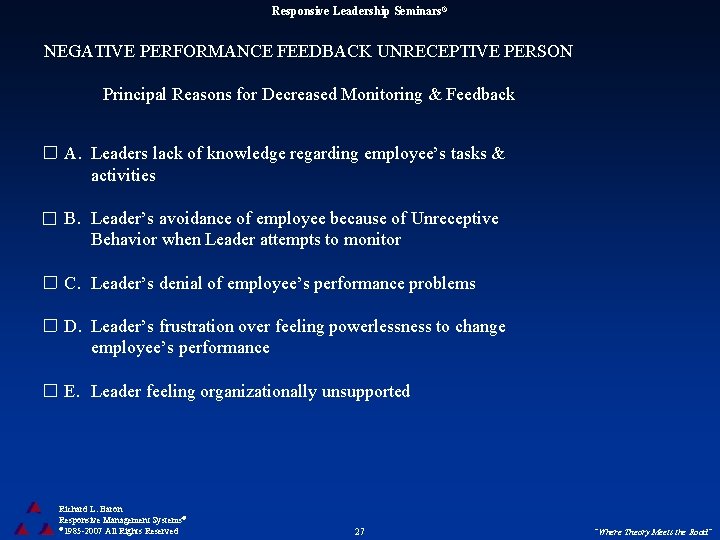
Responsive Leadership Seminars® NEGATIVE PERFORMANCE FEEDBACK UNRECEPTIVE PERSON Principal Reasons for Decreased Monitoring & Feedback A. Leaders lack of knowledge regarding employee’s tasks & activities B. Leader’s avoidance of employee because of Unreceptive Behavior when Leader attempts to monitor C. Leader’s denial of employee’s performance problems D. Leader’s frustration over feeling powerlessness to change employee’s performance E. Leader feeling organizationally unsupported Richard L. Baron Responsive Management Systems® © 1985 -2007 All Rights Reserved 27 “Where Theory Meets the Road”
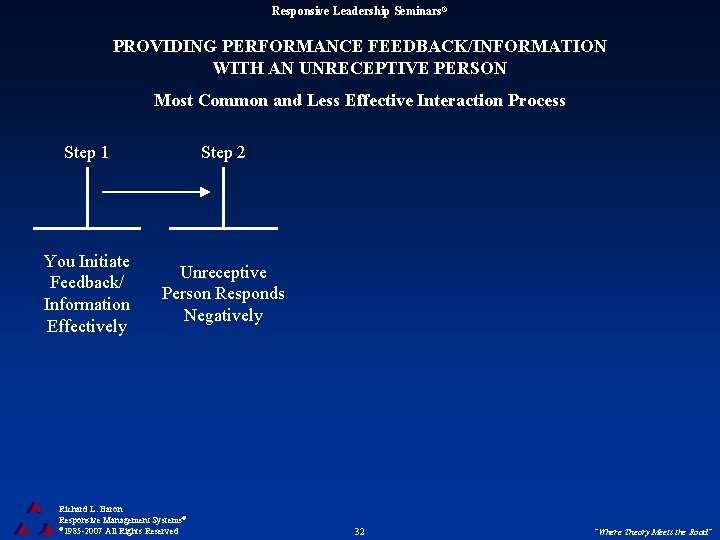
Responsive Leadership Seminars® PROVIDING PERFORMANCE FEEDBACK/INFORMATION WITH AN UNRECEPTIVE PERSON Most Common and Less Effective Interaction Process Step 1 Step 2 You Initiate Feedback/ Information Effectively Unreceptive Person Responds Negatively Richard L. Baron Responsive Management Systems® © 1985 -2007 All Rights Reserved 32 “Where Theory Meets the Road”
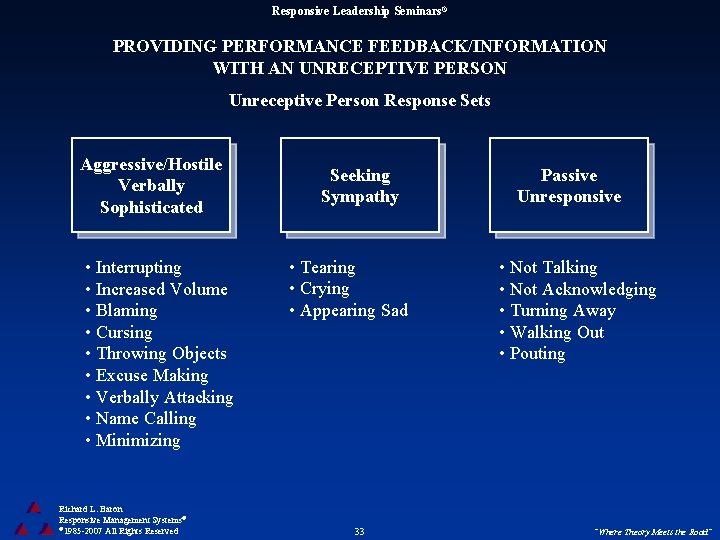
Responsive Leadership Seminars® PROVIDING PERFORMANCE FEEDBACK/INFORMATION WITH AN UNRECEPTIVE PERSON Unreceptive Person Response Sets Aggressive/Hostile Verbally Sophisticated • Interrupting • Increased Volume • Blaming • Cursing • Throwing Objects • Excuse Making • Verbally Attacking • Name Calling • Minimizing Richard L. Baron Responsive Management Systems® © 1985 -2007 All Rights Reserved Seeking Sympathy • Tearing • Crying • Appearing Sad 33 Passive Unresponsive • Not Talking • Not Acknowledging • Turning Away • Walking Out • Pouting “Where Theory Meets the Road”
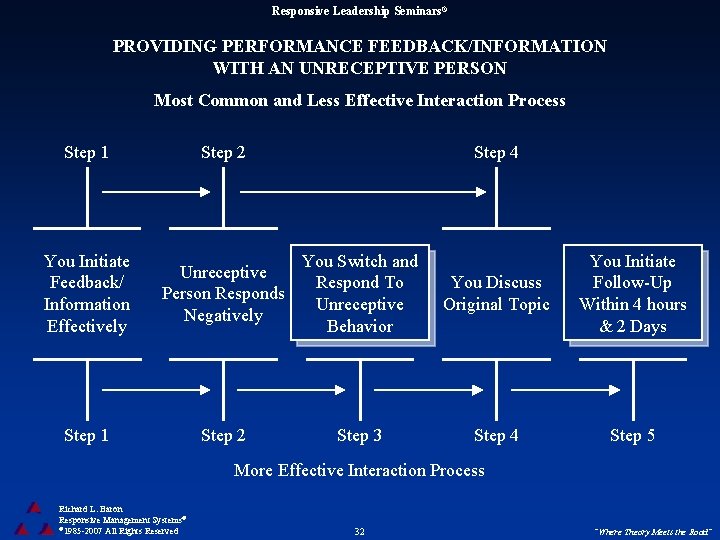
Responsive Leadership Seminars® PROVIDING PERFORMANCE FEEDBACK/INFORMATION WITH AN UNRECEPTIVE PERSON Most Common and Less Effective Interaction Process Step 1 Step 2 Step 4 You Initiate Feedback/ Information Effectively Unreceptive Person Responds Negatively You Switch and Respond To Unreceptive Behavior You Discuss Original Topic You Initiate Follow-Up Within 4 hours & 2 Days Step 1 Step 2 Step 3 Step 4 Step 5 More Effective Interaction Process Richard L. Baron Responsive Management Systems® © 1985 -2007 All Rights Reserved 32 “Where Theory Meets the Road”
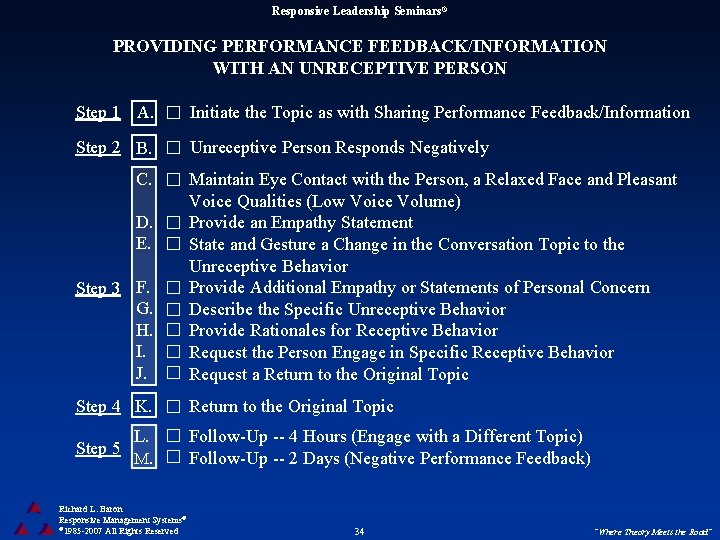
Responsive Leadership Seminars® PROVIDING PERFORMANCE FEEDBACK/INFORMATION WITH AN UNRECEPTIVE PERSON Step 1 A. Initiate the Topic as with Sharing Performance Feedback/Information Step 2 B. Unreceptive Person Responds Negatively C. Step 3 F. G. H. I. J. Maintain Eye Contact with the Person, a Relaxed Face and Pleasant Voice Qualities (Low Voice Volume) Provide an Empathy Statement State and Gesture a Change in the Conversation Topic to the Unreceptive Behavior Provide Additional Empathy or Statements of Personal Concern Describe the Specific Unreceptive Behavior Provide Rationales for Receptive Behavior Request the Person Engage in Specific Receptive Behavior Request a Return to the Original Topic Step 4 K. Return to the Original Topic D. E. Step 5 L. M. Richard L. Baron Responsive Management Systems® © 1985 -2007 All Rights Reserved Follow-Up -- 4 Hours (Engage with a Different Topic) Follow-Up -- 2 Days (Negative Performance Feedback) 34 “Where Theory Meets the Road”
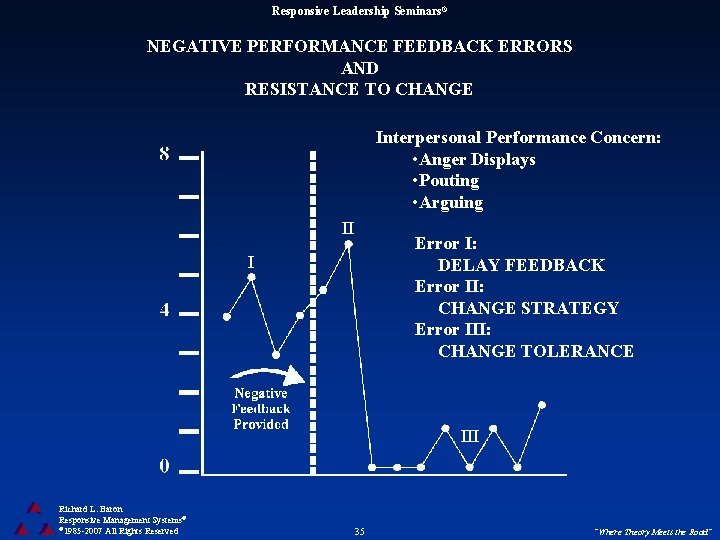
Responsive Leadership Seminars® NEGATIVE PERFORMANCE FEEDBACK ERRORS AND RESISTANCE TO CHANGE Interpersonal Performance Concern: • Anger Displays • Pouting • Arguing II Error I: DELAY FEEDBACK Error II: CHANGE STRATEGY Error III: CHANGE TOLERANCE I III Richard L. Baron Responsive Management Systems® © 1985 -2007 All Rights Reserved 35 “Where Theory Meets the Road”
Responsive Leadership Seminars® KEY ORGANIZATIONAL ELEMENTS OF QUALITY • Mission/Vision • Strategic Plan • Values • Philosophy/Beliefs • Product/Service Focus • Annual Operating Plan • Number and Type of Positions • Team Chartering & Reporting Relationships • Allocation of Funds • Technologies/Trades Required Richard L. Baron Responsive Management Systems® © 1985 -2007 All Rights Reserved 11 “Where Theory Meets the Road”
Responsive Leadership Seminars® KEY STEPS TO MANAGING PERFORMANCE QUALITY 1 st Performance Definition 2 nd Performance Assessment S T Performance Feedback 5 th I Performance Monitoring Performance Instruction 4 th 3 rd Richard L. Baron Responsive Management Systems® © 1985 -2007 All Rights Reserved 12 “Where Theory Meets the Road”
Responsive Leadership Seminars® THANK YOU www. responsivemgt. com 5704 N. E. 71 st Street • Seattle, WA 98115 • Telephone/FAX (206) 523 -4603 • Richard. Baron@responsivemgt. com Responsive Management Systems® www. responsivemgt. com