
Responsible Leadership With great power comes great responsibility
Responsible Leadership “With great power comes great responsibility” ― Voltaire 19 th February 2014 Saskia Freund Joseph Richardson Benoit Mars Saliha Sahin Amani Alkaddah David Huckschlag Devendra Bhandari
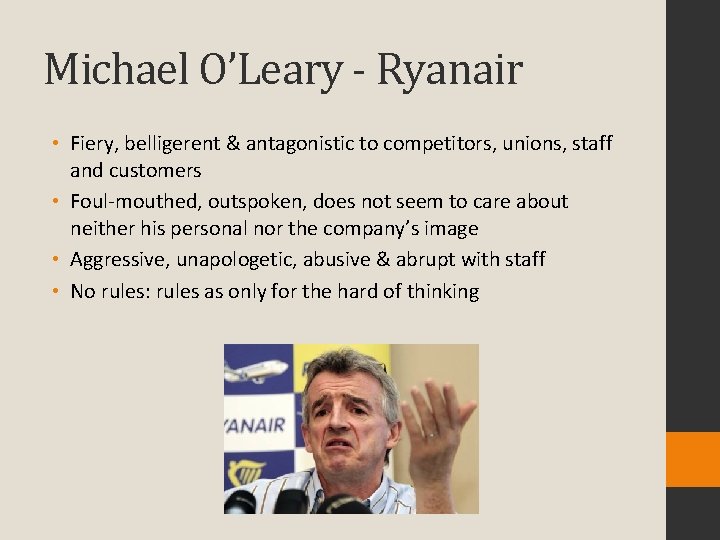
Michael O’Leary - Ryanair • Fiery, belligerent & antagonistic to competitors, unions, staff and customers • Foul-mouthed, outspoken, does not seem to care about neither his personal nor the company’s image • Aggressive, unapologetic, abusive & abrupt with staff • No rules: rules as only for the hard of thinking
What is Irresponsible Leadership? “Behaviours conducted and decisions made by organizational leaders that are illegal and/or violate moral standards, and those that impose processes and structures that promote unethical conduct by followers. ” (Brown and Mitchell, 2010)
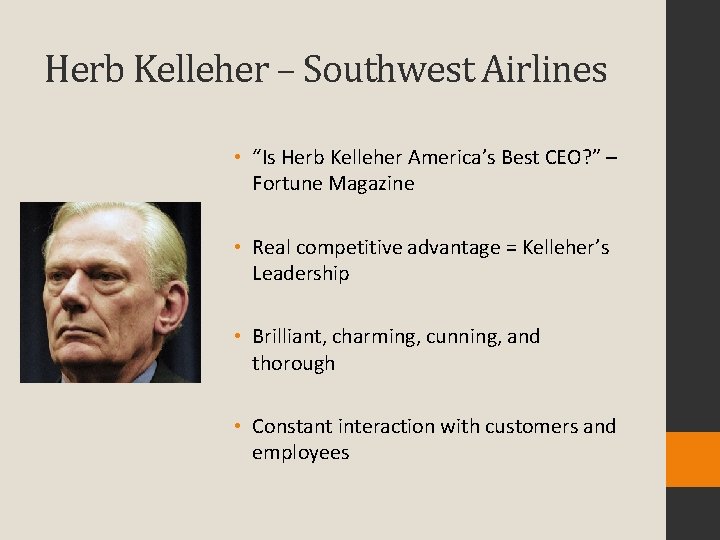
Herb Kelleher – Southwest Airlines • “Is Herb Kelleher America’s Best CEO? ” – Fortune Magazine • Real competitive advantage = Kelleher’s Leadership • Brilliant, charming, cunning, and thorough • Constant interaction with customers and employees
What is Responsible Leadership? • “The art of motivating, communicating, empowering and convincing people to engage in a new vision of sustainable development and the necessary change. ” (The United Nations Global Compact and European Foundation for Management Development, 2008) • An ethical act of inspiring others toward effecting positive change through the accomplishment of a common goal. (Riggo and Tan, 2014)
Ethical leadership = Responsible leadership? • Leaders are responsible for implementing ethics develop, monitor and enforce ethical behaviour • “The demonstration of normatively appropriate conduct through personal actions and interpersonal relationships, and the promotion of such conduct to followers through two-way communication, reinforcement, and decision-making. ” (Brown, Trevino & Harrison, 2005: 120).
The quest for responsible leadership • Leaders have both power and potential for contributing to the betterment of the world • Responsible leaders require a mindset that cares for the needs of others and act as responsible citizens • Multitude of stakeholder claims necessitate mutually beneficial relationships (Maak, 2007)
Why business leaders should be responsible? The importance of responsible leadership • Renewed interest in ethics due to scandals. • “Increasing pressures to make a positive contribution to society. ” (Wilson, 2007: 7) • Number of irresponsible leaders exceeds the number of responsible leaders great need for more responsible leadership
Why business leaders should be responsible? The importance of responsible leadership • Source of competitive advantage (Southwest Airlines) • Satisfies the follower’s needs • THEREFORE, responsible leadership is an URGENT imperative, NOT a luxury or even an option.
Challenges responsible leaders face • New demands on leaders Complexity of interconnected and intercultural environment, diversity of interests and needs of multiple stakeholders • Ethical challenge Creating common standards while respecting moral differences
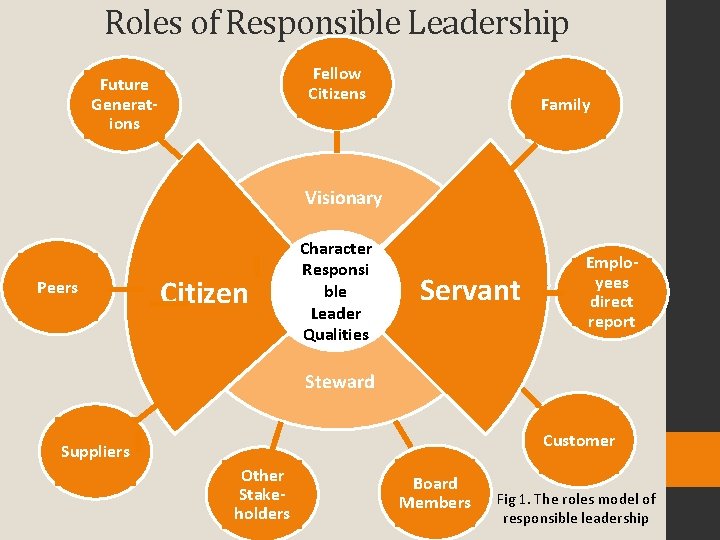
Roles of Responsible Leadership Fellow Citizens Future Generations Family Visionary Peers Citizen Character Responsible Leader Qualities Servant Employees direct report Steward Customer Suppliers Other Stakeholders Board Members Fig 1. The roles model of responsible leadership
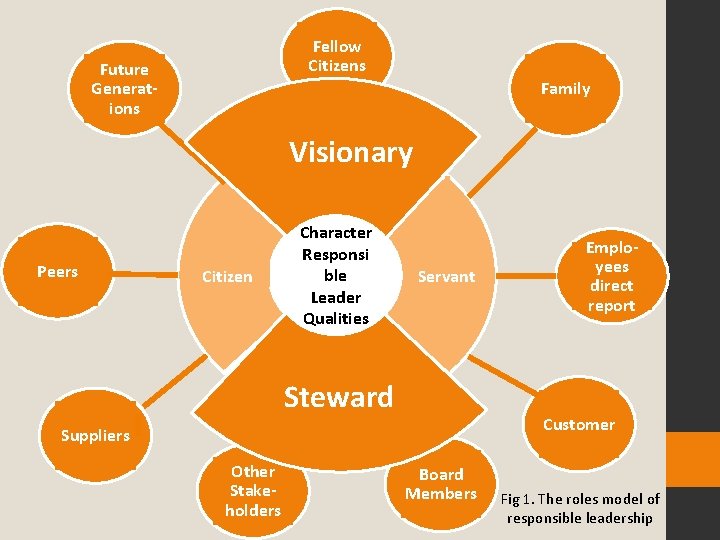
Fellow Citizens Future Generations Family Visionary Peers Citizen Character Responsible Leader Qualities Servant Employees direct report Steward Customer Suppliers Other Stakeholders Board Members Fig 1. The roles model of responsible leadership
Attributes of a Responsible Leader • Integrity • Open-mindedness • Taking a long-term perspective • Demonstrating ethical behaviour • Care for people • Communications
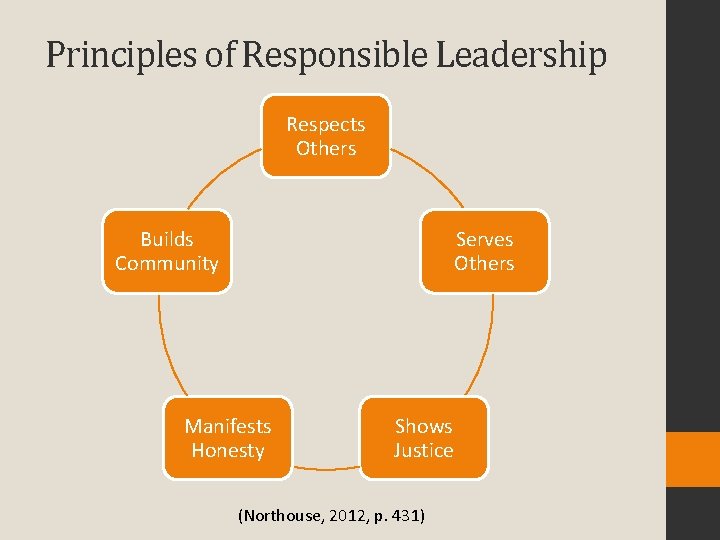
Principles of Responsible Leadership Respects Others Builds Community Serves Others Manifests Honesty Shows Justice (Northouse, 2012, p. 431)
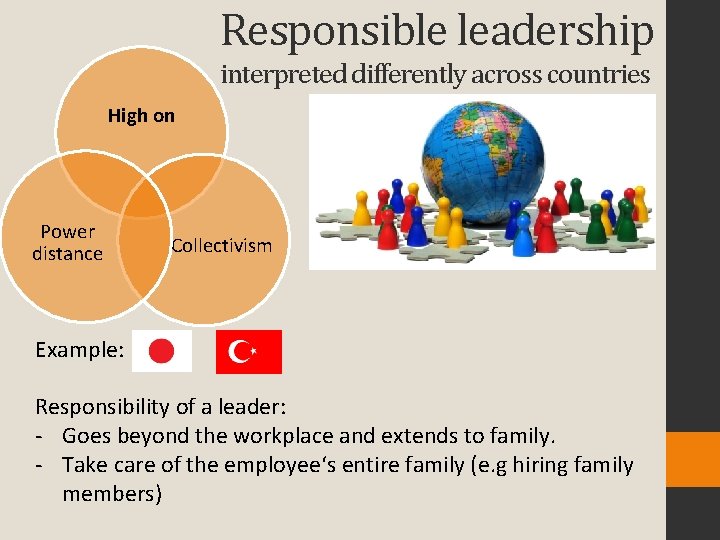
Responsible leadership interpreted differently across countries High on Power distance Collectivism Example: Responsibility of a leader: - Goes beyond the workplace and extends to family. - Take care of the employee‘s entire family (e. g hiring family members)
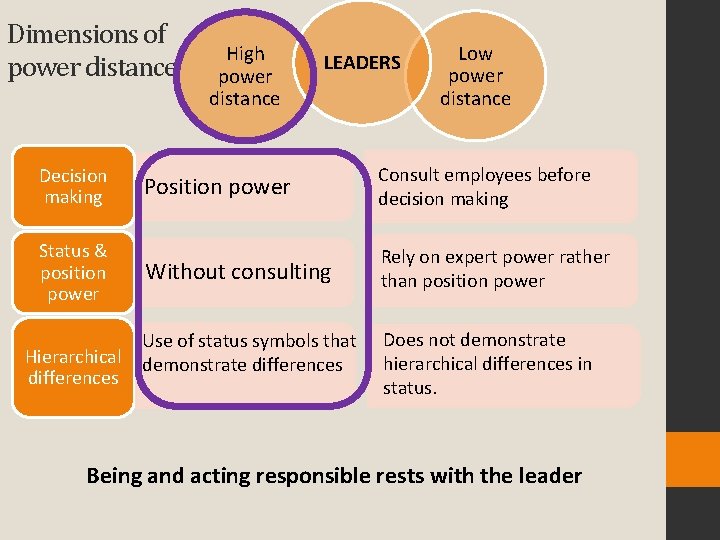
Dimensions of power distance Decision making Status & position power High power distance LEADERS Low power distance Position power Consult employees before decision making Without consulting Rely on expert power rather than position power Use of status symbols that Hierarchical demonstrate differences Does not demonstrate hierarchical differences in status. Being and acting responsible rests with the leader
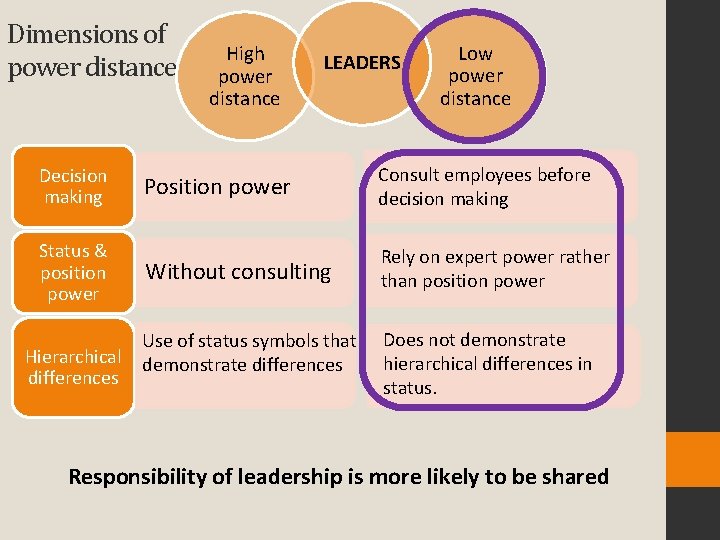
Dimensions of power distance Decision making Status & position power High power distance LEADERS Low power distance Position power Consult employees before decision making Without consulting Rely on expert power rather than position power Use of status symbols that Hierarchical demonstrate differences Does not demonstrate hierarchical differences in status. Responsibility of leadership is more likely to be shared
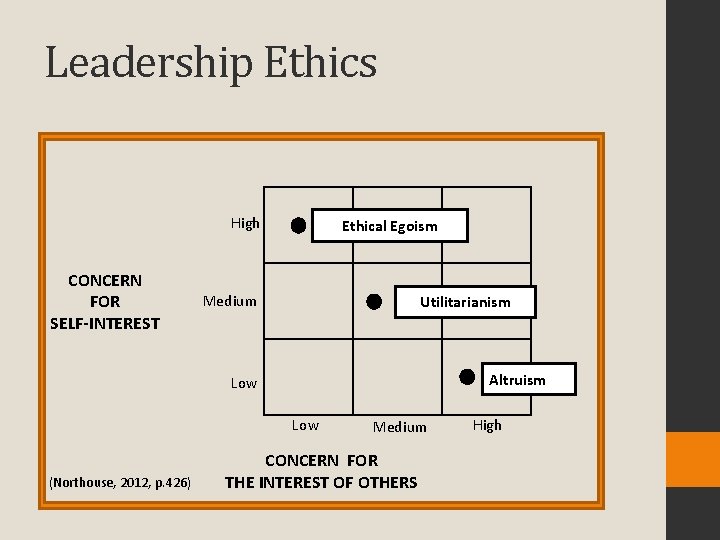
Leadership Ethics High CONCERN FOR SELF-INTEREST Ethical Egoism Medium Utilitarianism Altruism Low (Northouse, 2012, p. 426) Medium CONCERN FOR THE INTEREST OF OTHERS High
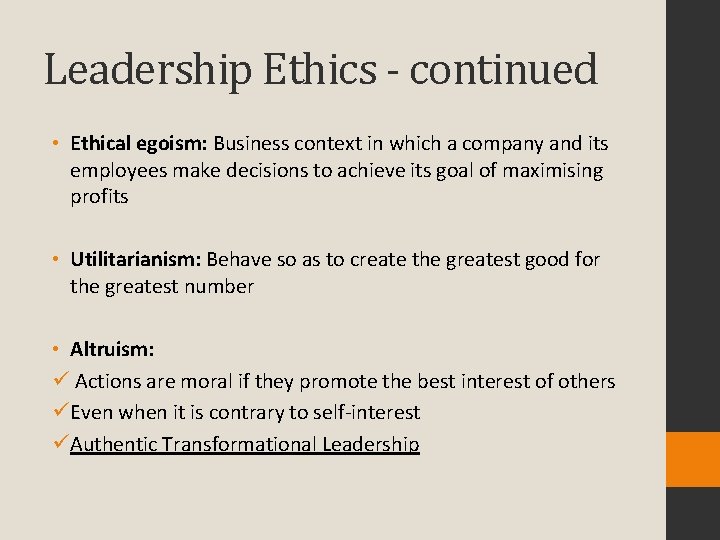
Leadership Ethics - continued • Ethical egoism: Business context in which a company and its employees make decisions to achieve its goal of maximising profits • Utilitarianism: Behave so as to create the greatest good for the greatest number • Altruism: ü Actions are moral if they promote the best interest of others üEven when it is contrary to self-interest üAuthentic Transformational Leadership
Conclusion • Responsible leadership increasingly important • Currently limited information & research on the topic; likely to be more research done in the future (Northouse, 2012) • There is a number of attributes that responsible leaders must share • Trade-off between concern for self-interest and concern for the interests of others
References • Blanding, M. 2014. Responsible Leadership in an Unforgiving World — HBS Working Knowledge. [online] Available at: http: //hbswk. hbs. edu/item/7244. html [Accessed: 17 Feb 2014]. • Brown, M. E. , Trevino, L. K. , & Harrison, D. A. 2005. Ethical leadership: A social learning theory perspective for construct development. Organizational Behavior and Human Decision Processes. Elsevier • Ciulla, J. B. 1998. Ethics, the heart of leadership. Westport, Conn. : Quorum Books. • Doh, J. P. and Stumpf, S. A. 2005. Handbook on responsible leadership and governance in global business. Cheltenham, UK: Edward Elgar. • Lexicon. ft. com. 2014. Responsible Leadership Definition from Financial Times Lexicon. [online] Available at: http: //lexicon. ft. com/Term? term=responsible-leadership [Accessed: 16 Feb 2014]. • Maak, T. , 2007. Responsible Leadership, Stakeholder Engagement, and the Emergence of Social Capital. (pdf) Journal of Business Ethics 74: 329 -343. • Maak, T. and Pless, N. 2006. Responsible leadership. London: Routledge. • Murray, A. 2014. What Makes a Great Leader? . [online] Available at: http: //online. wsj. com/news/articles/SB 10001424052748704878904575031112276749120 [Accessed: 17 Feb 2014]. • Northouse, P. 2012. Leadership : theory and practice. Sage Publications. • Pruzan, P. 2009. Rational, ethical, and spiritual perspectives on leadership. Oxford: Peter Lang. • Riggio, R. E. and Tan, S. J. n. d. Leader interpersonal and influence skills. • The Guardian. 2004. A bruiser in the f****** boardroom. [online] Available at: http: //www. theguardian. com/business/2004/nov/07/theairlineindustry. observerbusiness [Accessed: 16 Feb 2014].
- Slides: 21