
Responsibility for Radiation Safety Organization and Implementation of
Responsibility for Radiation Safety
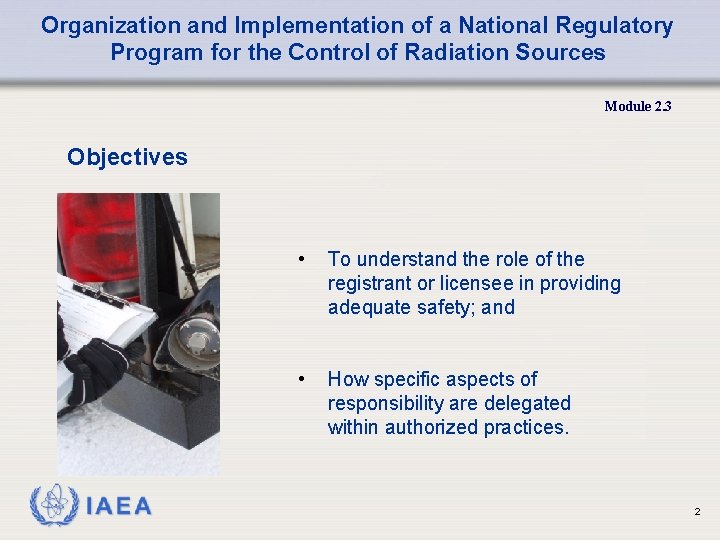
Organization and Implementation of a National Regulatory Program for the Control of Radiation Sources Module 2. 3 Objectives • To understand the role of the registrant or licensee in providing adequate safety; and • How specific aspects of responsibility are delegated within authorized practices. 2

Organization and Implementation of a National Regulatory Program for the Control of Radiation Sources Responsibility for Safety Module 2. 3 Responsibilities are held by: • the registrant or licensee who holds a licence or • • registration; Radiation Protection Officers (RPO); workers; employers, in relation to occupational exposure; suppliers; qualified experts; Medical physicists; medical practitioners; ethical review committees. 3
Organization and Implementation of a National Regulatory Program for the Control of Radiation Sources Module 2. 3 Primary Responsibility for Safety Primary responsibility rests with: • the registrant or licensee who holds the registration or licence; and • employers of occupationally exposed workers. 4
Organization and Implementation of a National Regulatory Program for the Control of Radiation Sources Module 2. 3 Subsidiary Responsibility for Safety Subsidiary responsibility • The registrant or licensee may appoint other parties or people to carry out certain actions and tasks; • However, overall responsibility for protection and safety always remains with the registrant or licensee. 5
Organization and Implementation of a National Regulatory Program for the Control of Radiation Sources Module 2. 3 Responsibilities of Registrants and Licensees and employers shall: • establish radiation safety objectives; • develop, implement and document a protection and safety Program; • ensure compliance with the requirements set out in the legislation and the regulations. 6
Organization and Implementation of a National Regulatory Program for the Control of Radiation Sources Module 2. 3 Responsibilities of Registrants and Licensees (cont) The Protection and Safety Program: • shall be subject to regular review of the measures needed to achieve radiation safety objectives; • shall have sufficient resources (financial and personnel) to implement required safety requirements; • should be verified at regular intervals to ensure that the radiation safety objectives are being achieved. 7
Organization and Implementation of a National Regulatory Program for the Control of Radiation Sources Module 2. 3 Responsibilities of Registrants and Licensees (cont) The Protection and Safety Program: • shall identify, prevent and prompt corrective actions or any failures or shortcomings in the radiation safety measures; • will provide for consultation and cooperation between all relevant parties with respect to radiation safety; • will ensure that appropriate records are maintained regarding the discharge of responsibilities. 8
Organization and Implementation of a National Regulatory Program for the Control of Radiation Sources Module 2. 3 Responsibilities of Registrants and Licensees (cont) Registrants and Licensees are also responsible for: • radiation protection performance requirements; • verification of protection and safety; • occupational, public and medical exposure protection; • management requirements; • safety of sources. 9
Organization and Implementation of a National Regulatory Program for the Control of Radiation Sources Module 2. 3 Responsibilities of the RPO The RPO shall: • have received radiation protection training in accordance with any qualification and / or training criteria required by the Regulatory Body for the type of radiation practice; • be formally appointed by the registrant or licensee; • be formally approved by the Regulatory Body; • have appropriate authority within the registrant or licensee’s organization to take care of the allocated responsibilities and duties. 10
Organization and Implementation of a National Regulatory Program for the Control of Radiation Sources Module 2. 3 Duties of the RPO The RPO’s duties include: • monitoring radiation protection and safety; • issuing instructions and ensuring that workers are trained to work safely; • ensuring that appropriate protective equipment and radiation survey meters are available and used; 11
Organization and Implementation of a National Regulatory Program for the Control of Radiation Sources Module 2. 3 Duties of the RPO (cont) The RPO’s duties include: • ensuring that licence details and safety arrangements are updated as necessary; • providing information and notifications to the Regulatory Body as may be required by the legislation; • keeping the registrant or licensee informed. 12
Organization and Implementation of a National Regulatory Program for the Control of Radiation Sources Module 2. 3 Responsibilities of Workers shall be directed to: • follow applicable rules and procedures for protection and safety; • appropriately use the monitoring devices, protective equipment and protective clothing provided by the employer / registrant or licensee; • cooperate with the employer with respect to protection and safety and the operation of radiological health surveillance and dose assessment Programs; 13
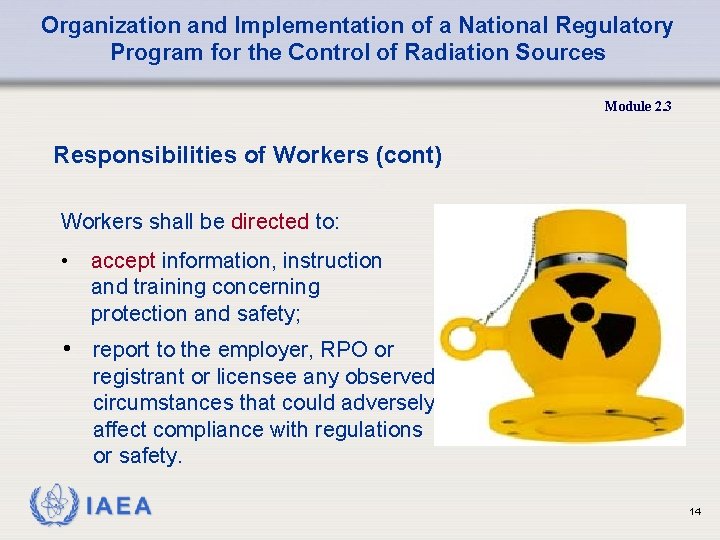
Organization and Implementation of a National Regulatory Program for the Control of Radiation Sources Module 2. 3 Responsibilities of Workers (cont) Workers shall be directed to: • accept information, instruction and training concerning protection and safety; • report to the employer, RPO or registrant or licensee any observed circumstances that could adversely affect compliance with regulations or safety. 14
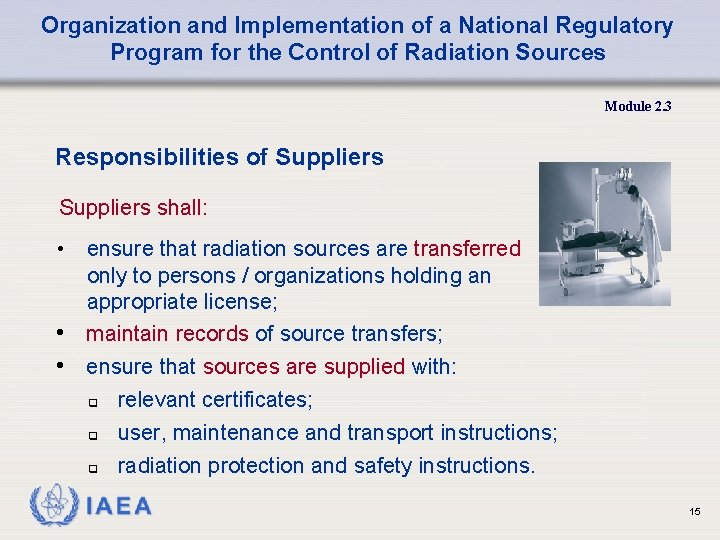
Organization and Implementation of a National Regulatory Program for the Control of Radiation Sources Module 2. 3 Responsibilities of Suppliers shall: • ensure that radiation sources are transferred only to persons / organizations holding an appropriate license; • maintain records of source transfers; • ensure that sources are supplied with: q relevant certificates; q user, maintenance and transport instructions; q radiation protection and safety instructions. 15
Organization and Implementation of a National Regulatory Program for the Control of Radiation Sources Module 2. 3 Responsibilities of Qualified Experts Qualified experts may be: • appointed to advise the registrant or licensee or the employer on the observance of regulations; • responsible for tasks related to assessing radiation protection of workers, the public and patients, training, development of procedures and emergency response. 16
Organization and Implementation of a National Regulatory Program for the Control of Radiation Sources Module 2. 3 Responsibilities of Medical Practitioners Justification of medical exposures • medical exposures shall be prescribed by a medical practitioner; • protection shall be optimized e. g. use of guidance levels; • medical practitioners are responsible for ensuring overall patient protection related to medical exposures. 17
Organization and Implementation of a National Regulatory Program for the Control of Radiation Sources Module 2. 3 Responsibilities of Medical Practitioners (cont) Health surveillance of workers • to ensure initial and continuous fitness of workers for their intended tasks; • to assess the consequences of possible over exposure and to deliver opinion on the continuity of work; • the medical treatment of persons who have received high radiation doses. 18
Organization and Implementation of a National Regulatory Program for the Control of Radiation Sources Module 2. 3 Responsibilities of Ethical Review Committees An Ethical Review Committee shall assess: • the justification of, and define dose constraints for, medical research purposes not producing a direct benefit to exposed individuals; • the justification of screening procedures (e. g. chest screening, mammography screening); • the justification of examinations undertaken for occupational, legal or health insurance purposes. 19
Organization and Implementation of a National Regulatory Program for the Control of Radiation Sources Module 2. 3 References • Radiation Protection and Safety of Radiation Sources: International Basic Safety Standards. General Safety Requirements Part 3. SR (IAEA Safety Standard Series No. GSR Part 3 (Interim)), Vienna 2011. • Governmental, Legal and Regulatory Framework for Safety. General Safety Requirements Part 1 (IAEA Safety Standard Series No. GSR Part 1). Vienna 2010. 20
- Slides: 20