
Response to Primary Health Care SPHC vertical programs

- Slides: 42
Response to Primary Health Care: SPHC, vertical programs, and the role of donors GH 101 Stephen Gloyd January 2015
Class exercise In class, we will watch sections of the video clip "Child Survival: The silent emergency. " Consider these questions about the video. 1. What are the central advocacy messages of the video? How does the advocacy message relate to Primary Health Care? 2. In what way does the Child Survival strategy lay the groundwork for vertical programs? Please share and discuss your ideas regarding these questions with your section subgroup (4 -6 students) (5 minutes). Make sure that everybody in the group participates and contributes ideas regarding the questions. Then share your group's ideas with your entire quiz section. (5 minutes) Several quiz sections will be asked to share their thoughts with the entire class. (10 -15 minutes)
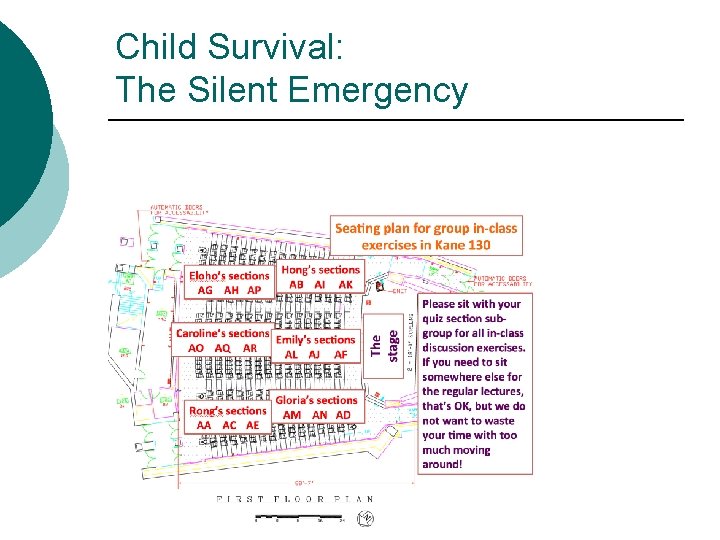
Child Survival: The Silent Emergency
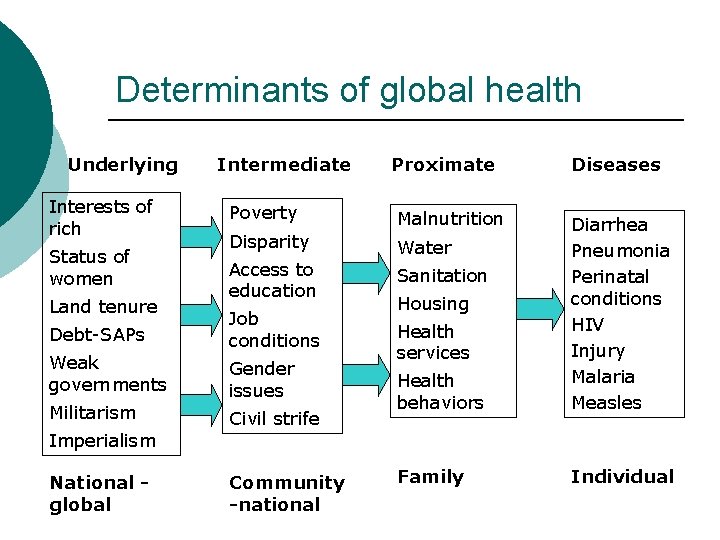
Determinants of global health Underlying Interests of rich Status of women Land tenure Intermediate Proximate Poverty Malnutrition Disparity Water Access to education Sanitation Debt-SAPs Job conditions Weak governments Gender issues Militarism Civil strife Diseases Health behaviors Diarrhea Pneumonia Perinatal conditions HIV Injury Malaria Measles Family Individual Housing Health services Imperialism National global Community -national
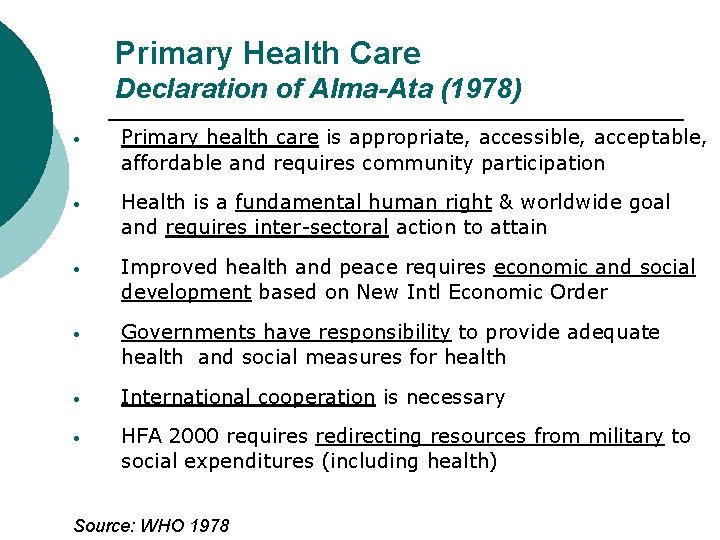
Primary Health Care Declaration of Alma-Ata (1978) • Primary health care is appropriate, accessible, acceptable, affordable and requires community participation • Health is a fundamental human right & worldwide goal and requires inter-sectoral action to attain • Improved health and peace requires economic and social development based on New Intl Economic Order • Governments have responsibility to provide adequate health and social measures for health • International cooperation is necessary • HFA 2000 requires redirecting resources from military to social expenditures (including health) Source: WHO 1978
“Essential components” of Primary Health Care 1. Health education 2. Environmental sanitation, especially food and water 3. The employment of community or village health workers 4. Maternal and child health programs, including immunization and family planning 5. Prevention of local endemic diseases 6. Appropriate treatment of common diseases and injuries 7. Provision of essential drugs 8. Promotion of nutrition 9. Traditional medicine Source: Alma-Ata Conference documents.
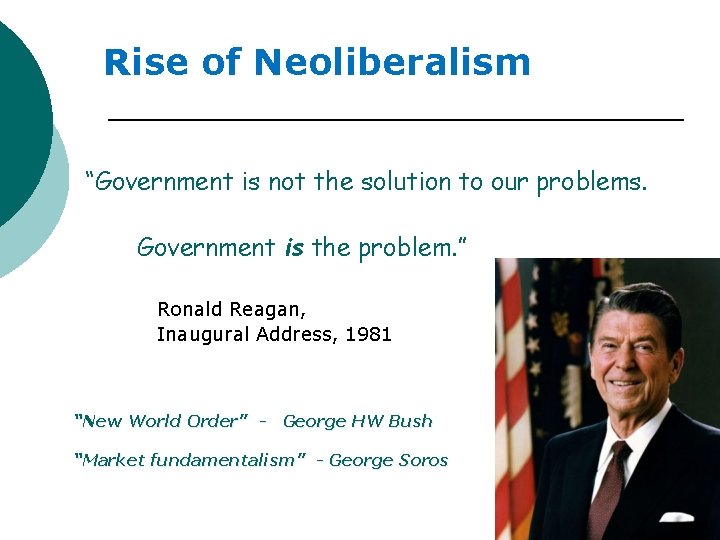
Rise of Neoliberalism “Government is not the solution to our problems. Government is the problem. ” Ronald Reagan, Inaugural Address, 1981 “New World Order” - George HW Bush “Market fundamentalism” - George Soros
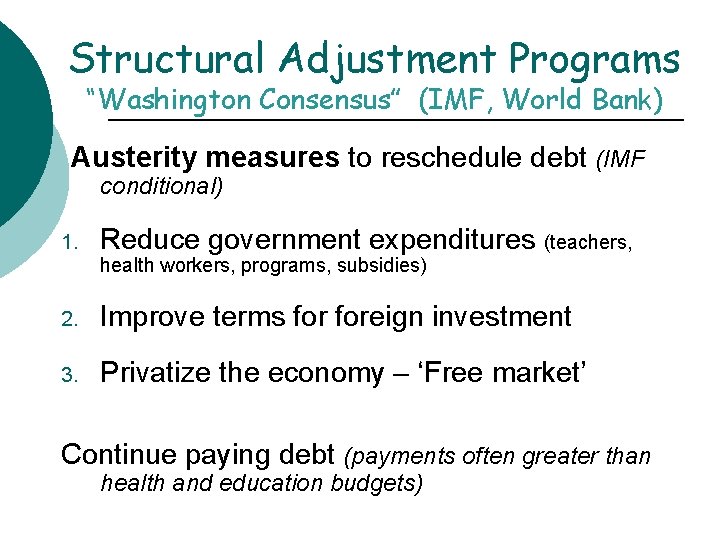
Structural Adjustment Programs “Washington Consensus” (IMF, World Bank) Austerity measures to reschedule debt (IMF conditional) 1. Reduce government expenditures (teachers, health workers, programs, subsidies) 2. Improve terms foreign investment 3. Privatize the economy – ‘Free market’ Continue paying debt (payments often greater than health and education budgets)
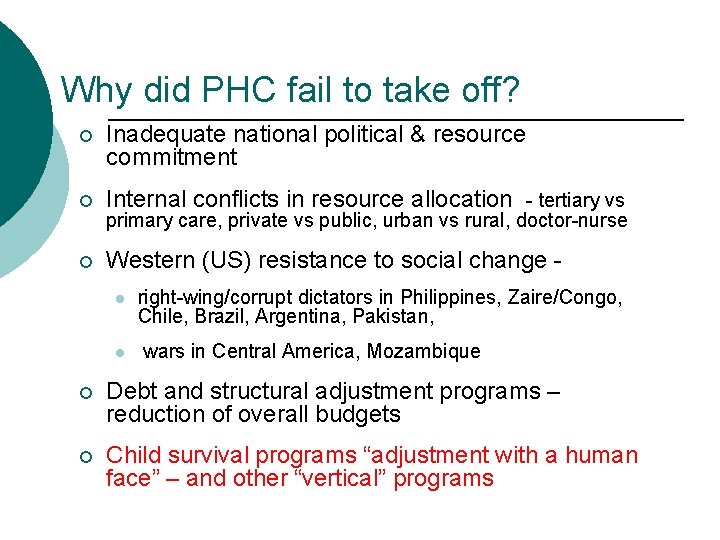
Why did PHC fail to take off? ¡ Inadequate national political & resource commitment ¡ Internal conflicts in resource allocation - tertiary vs ¡ Western (US) resistance to social change - primary care, private vs public, urban vs rural, doctor-nurse l l right-wing/corrupt dictators in Philippines, Zaire/Congo, Chile, Brazil, Argentina, Pakistan, wars in Central America, Mozambique ¡ Debt and structural adjustment programs – reduction of overall budgets ¡ Child survival programs “adjustment with a human face” – and other “vertical” programs
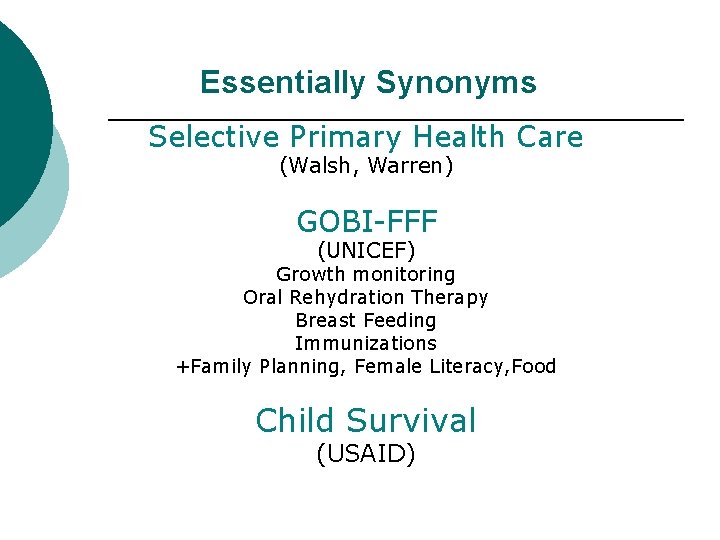
Essentially Synonyms Selective Primary Health Care (Walsh, Warren) GOBI-FFF (UNICEF) Growth monitoring Oral Rehydration Therapy Breast Feeding Immunizations +Family Planning, Female Literacy, Food Child Survival (USAID)
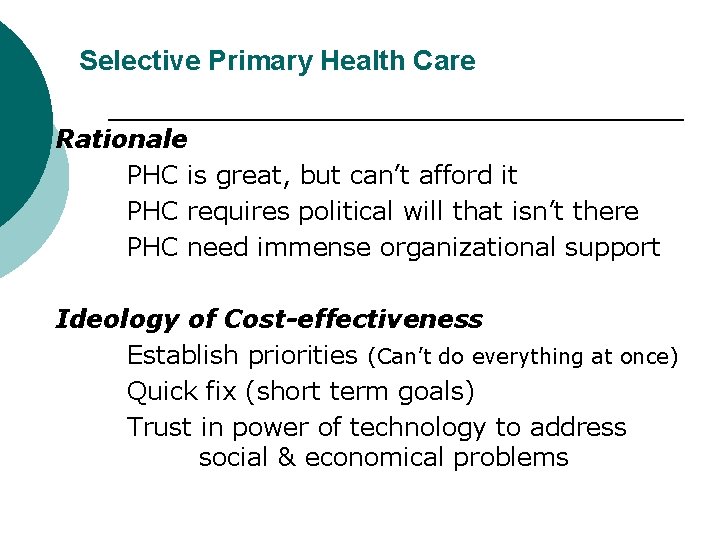
Selective Primary Health Care Rationale PHC is great, but can’t afford it PHC requires political will that isn’t there PHC need immense organizational support Ideology of Cost-effectiveness Establish priorities (Can’t do everything at once) Quick fix (short term goals) Trust in power of technology to address social & economical problems
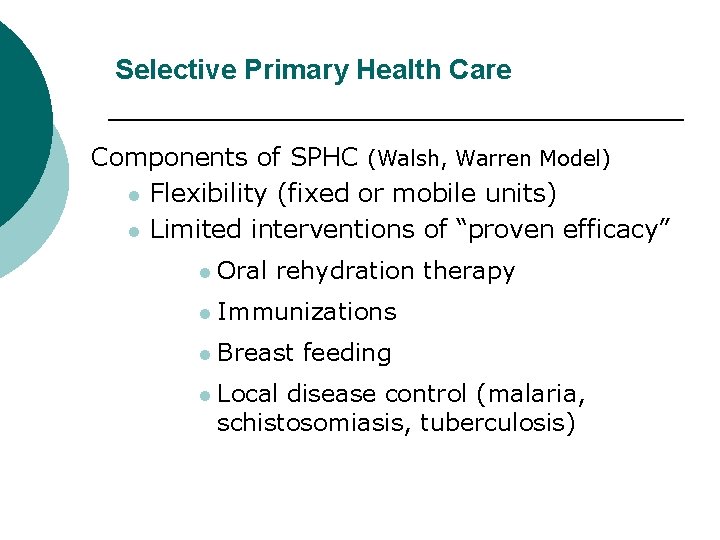
Selective Primary Health Care Components of SPHC (Walsh, Warren Model) l Flexibility (fixed or mobile units) l Limited interventions of “proven efficacy” l Oral rehydration therapy l Immunizations l Breast feeding l Local disease control (malaria, schistosomiasis, tuberculosis)
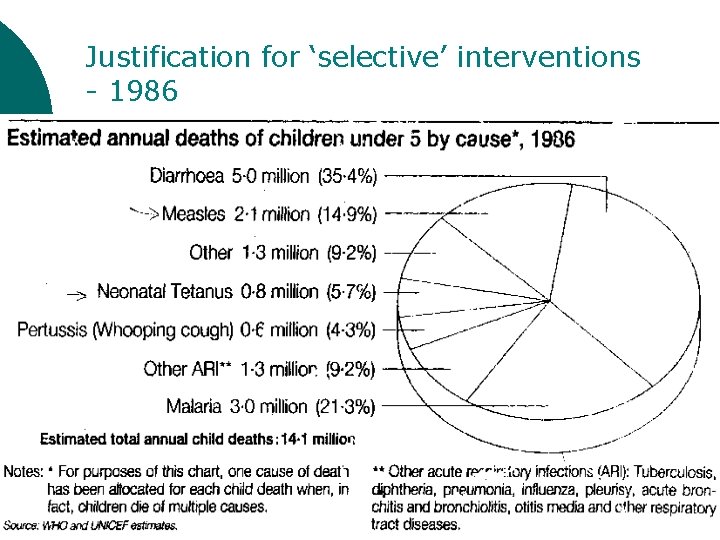
Justification for ‘selective’ interventions - 1986
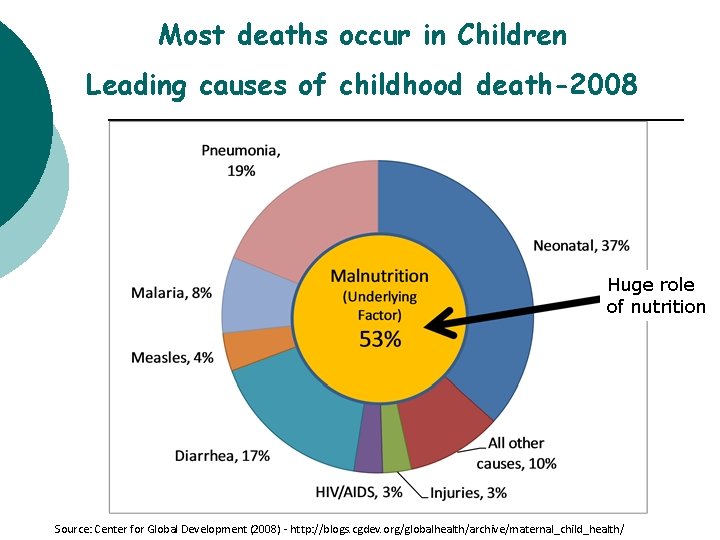
Most deaths occur in Children Leading causes of childhood death-2008 Huge role of nutrition Source: Center for Global Development (2008) - http: //blogs. cgdev. org/globalhealth/archive/maternal_child_health/
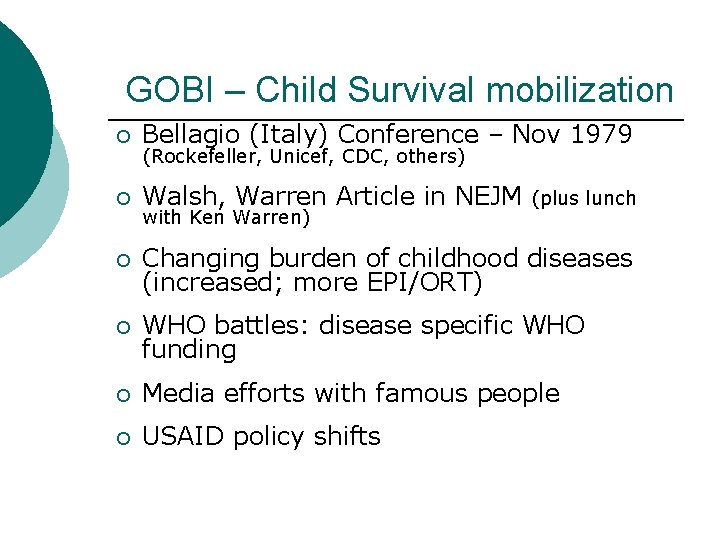
GOBI – Child Survival mobilization ¡ Bellagio (Italy) Conference – Nov 1979 ¡ Walsh, Warren Article in NEJM (plus lunch ¡ Changing burden of childhood diseases (increased; more EPI/ORT) ¡ WHO battles: disease specific WHO funding ¡ Media efforts with famous people ¡ USAID policy shifts (Rockefeller, Unicef, CDC, others) with Ken Warren)
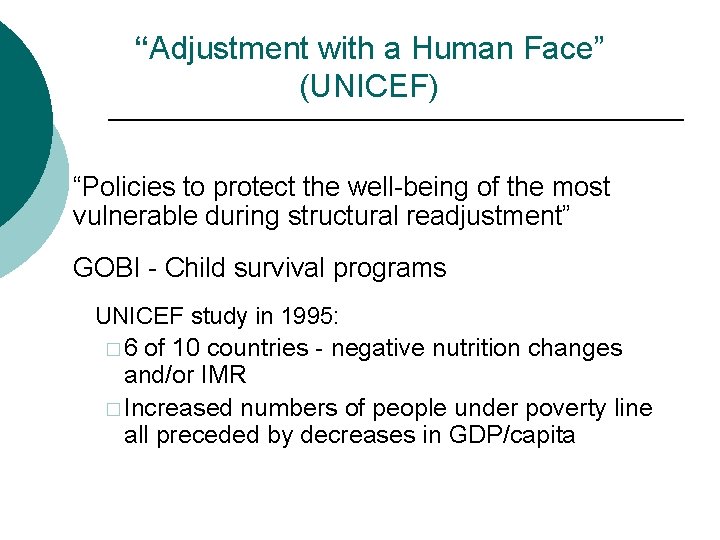
“Adjustment with a Human Face” (UNICEF) “Policies to protect the well-being of the most vulnerable during structural readjustment” GOBI - Child survival programs � UNICEF study in 1995: � 6 of 10 countries - negative nutrition changes and/or IMR � Increased numbers of people under poverty line all preceded by decreases in GDP/capita
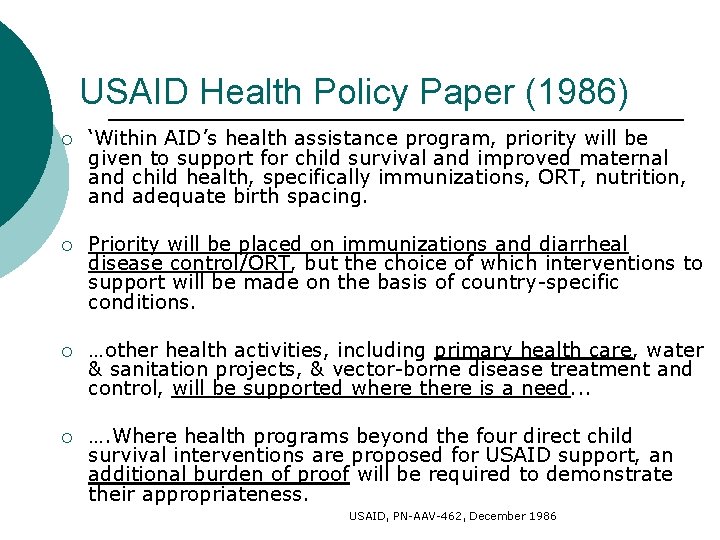
USAID Health Policy Paper (1986) ¡ ‘Within AID’s health assistance program, priority will be given to support for child survival and improved maternal and child health, specifically immunizations, ORT, nutrition, and adequate birth spacing. ¡ Priority will be placed on immunizations and diarrheal disease control/ORT, but the choice of which interventions to support will be made on the basis of country-specific conditions. ¡ …other health activities, including primary health care, water & sanitation projects, & vector-borne disease treatment and control, will be supported where there is a need. . . ¡ …. Where health programs beyond the four direct child survival interventions are proposed for USAID support, an additional burden of proof will be required to demonstrate their appropriateness. USAID, PN-AAV-462, December 1986
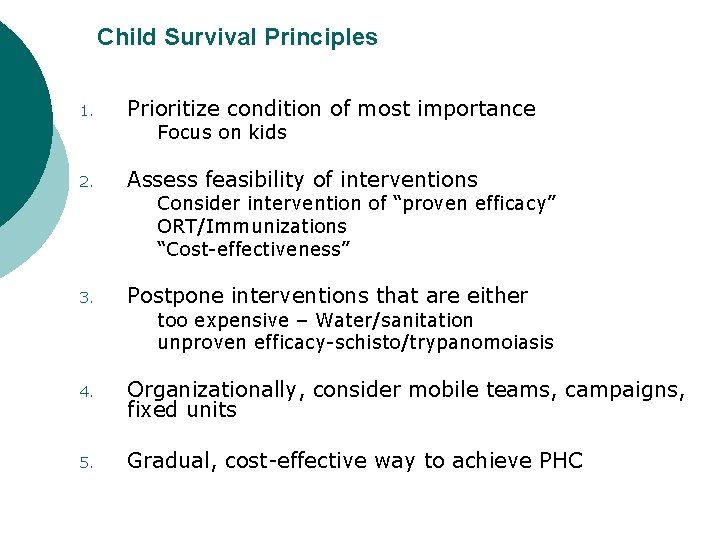
Child Survival Principles 1. Prioritize condition of most importance Focus on kids 2. Assess feasibility of interventions Consider intervention of “proven efficacy” ORT/Immunizations “Cost-effectiveness” 3. Postpone interventions that are either too expensive – Water/sanitation unproven efficacy-schisto/trypanomoiasis 4. Organizationally, consider mobile teams, campaigns, fixed units 5. Gradual, cost-effective way to achieve PHC
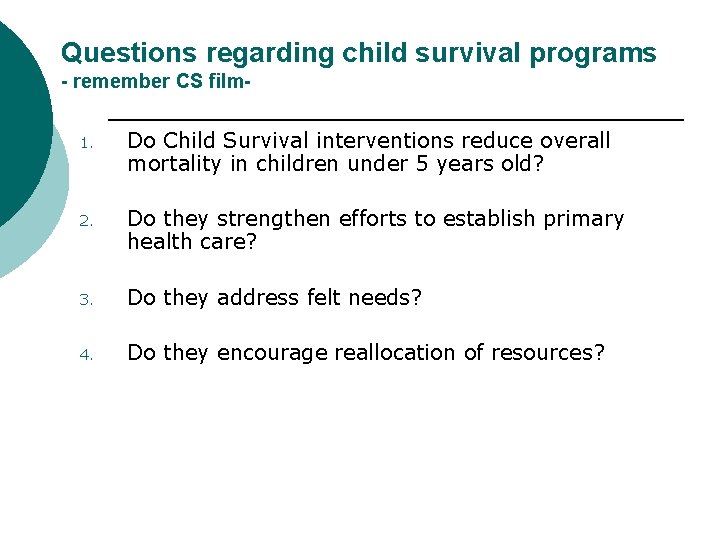
Questions regarding child survival programs - remember CS film 1. Do Child Survival interventions reduce overall mortality in children under 5 years old? 2. Do they strengthen efforts to establish primary health care? 3. Do they address felt needs? 4. Do they encourage reallocation of resources?
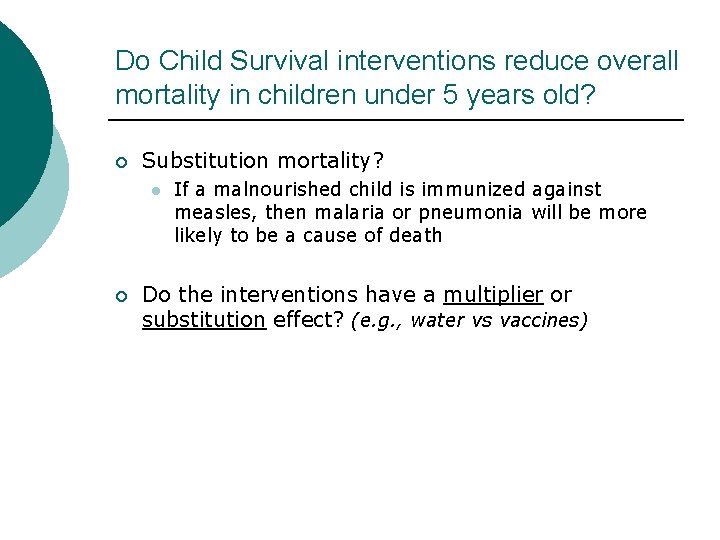
Do Child Survival interventions reduce overall mortality in children under 5 years old? ¡ Substitution mortality? l ¡ If a malnourished child is immunized against measles, then malaria or pneumonia will be more likely to be a cause of death Do the interventions have a multiplier or substitution effect? (e. g. , water vs vaccines)
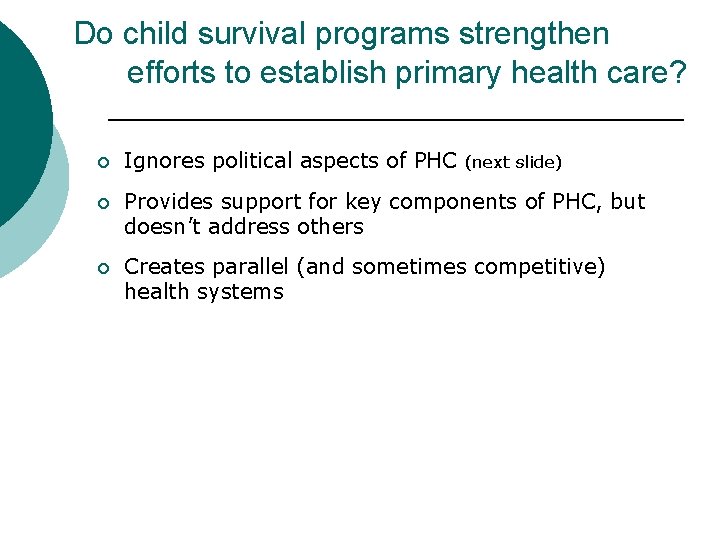
Do child survival programs strengthen efforts to establish primary health care? ¡ Ignores political aspects of PHC (next slide) ¡ Provides support for key components of PHC, but doesn’t address others ¡ Creates parallel (and sometimes competitive) health systems
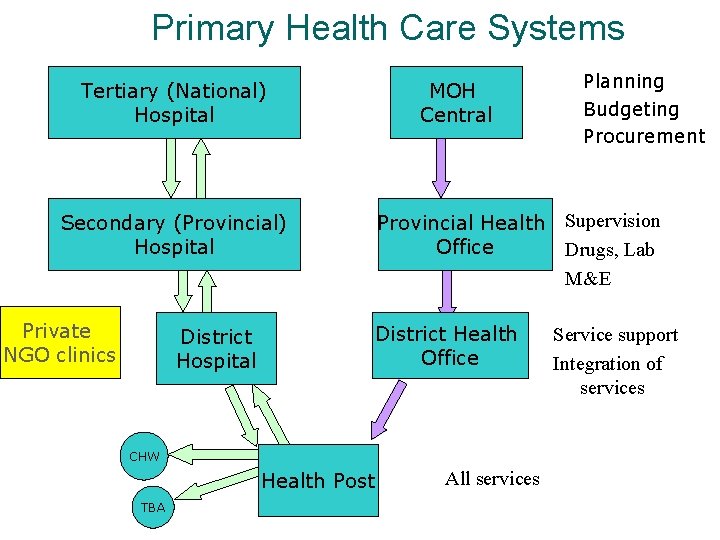
Primary Health Care Systems Tertiary (National) Hospital MOH Central Provincial Health Supervision Office Drugs, Lab M&E Secondary (Provincial) Hospital Private NGO clinics District Hospital District Health Office CHW Health Post TBA Planning Budgeting Procurement All services Service support Integration of services
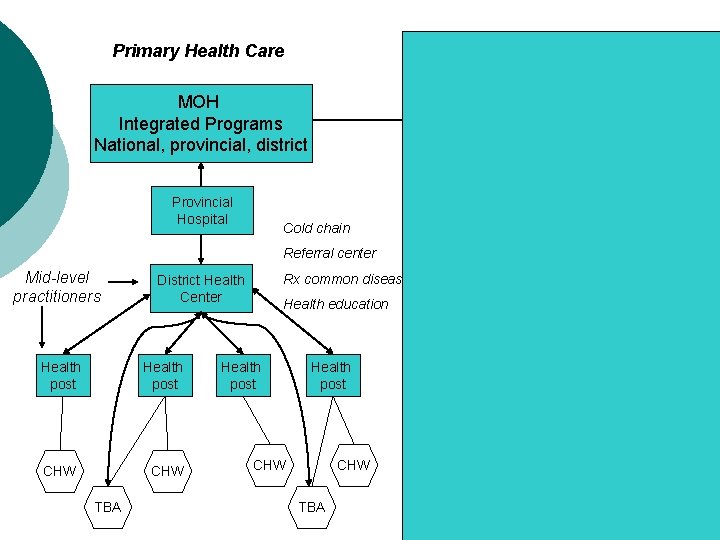
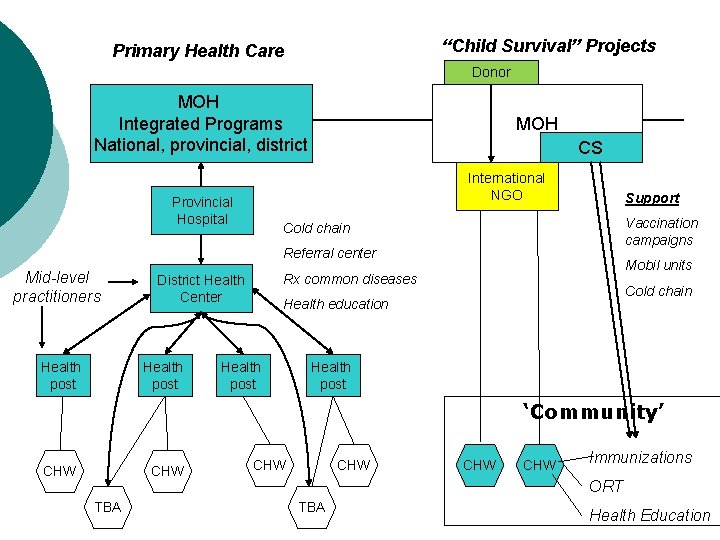
“Child Survival” Projects Primary Health Care Donor MOH Integrated Programs National, provincial, district MOH CS International NGO Provincial Hospital Support Vaccination campaigns Cold chain Referral center Mid-level practitioners Health post District Health Center Health post Mobil units Rx common diseases Cold chain Health education Health post ‘Community’ CHW TBA CHW CHW Immunizations ORT TBA Health Education
“Child Survival” Projects Primary Health Care Donor MOH Integrated Programs National, provincial, district MOH CS International NGO Provincial Hospital Support Vaccination campaigns Cold chain Referral center Mid-level practitioners Health post District Health Center Health post Mobil units Rx common diseases Cold chain Health education Health post ‘Community’ CHW TBA CHW CHW Immunizations ORT TBA Health Education
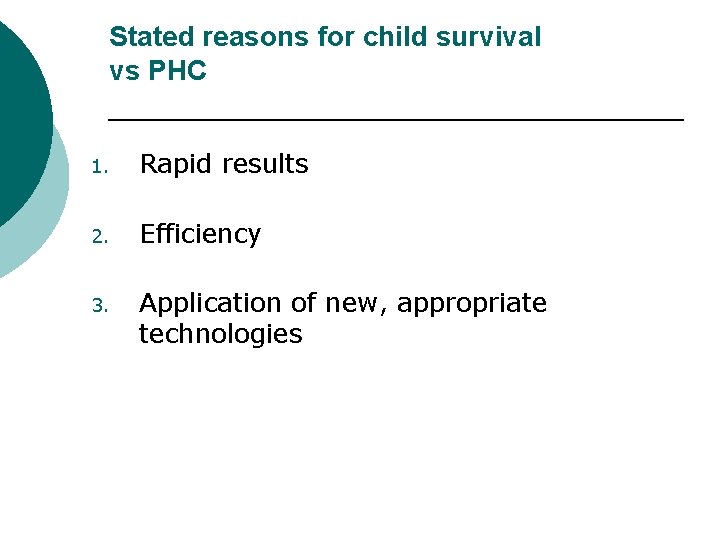
Stated reasons for child survival vs PHC 1. Rapid results 2. Efficiency 3. Application of new, appropriate technologies
Stated reasons for child survival (1) Rapid Results • Donor agencies tired of big programs with little chance of measurable impact • Need for short-term results (3 -5 years) • Funding cycle, tenure of administrations is also short • Single outcome, measurable results (EPI vs water)
Underlying reasons for child survival (2) Efficiency Change organizational structure to achieve goals ( e. g. immunization programs often work better outside of the usual MOH structure; cold chain, distribution) Thus, there is a tendency for: l Independent organizational structure (usually within MOH) l Singular focus l Mobile teams/campaigns l CHWs (esp for ORT, mobilization for Immuniz) supported by NGOs l LESS NEED FOR complex organization of PHC (e. g. , training of mid-level health providers, distribution system, referral network, link with hospitals)
Stated reasons for child survival (3) Application of new, appropriate technologies ¡ ¡ ¡ faith in capacity of vaccines, ORT less faith in organizational structure to cope with diseases magic bullet ideology
Evolution of disease-specific (vertical) approaches – donor driven ¡ Family Planning (pre-Child Survival) – 1970 s ¡ ORT-Immunizations (Child Survival, Gobi) - 1979 ¡ Vitamin A -1983 ¡ Maternal mortality, TBAs - 1986 ¡ ALRI (Acute lower respiratory diseases) - 1986 ¡ HIV-AIDS prevention and care - 1988 ¡ Polio eradication ~1990 ¡ Roll Back Malaria ~ 1999 ¡ Integrated management of childhood illnesses (IMCI) - 2000 ¡ Tuberculosis ~1995, MDR ~ 2000
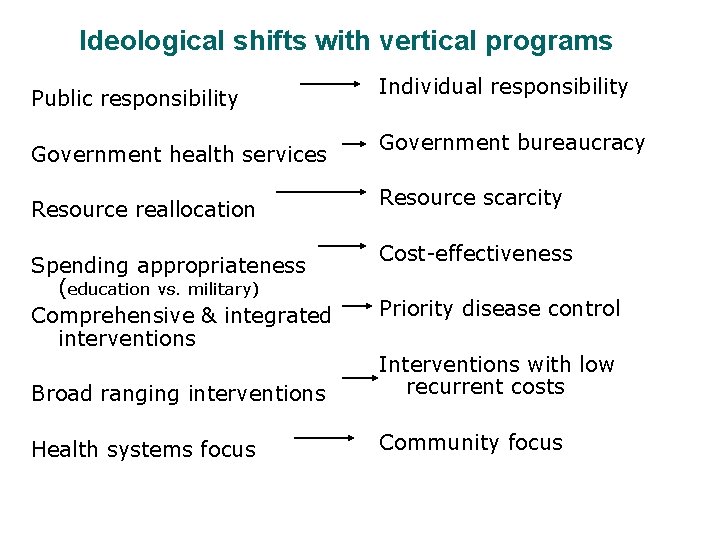
Ideological shifts with vertical programs Public responsibility Government health services Resource reallocation Spending appropriateness (education vs. military) Comprehensive & integrated interventions Individual responsibility Government bureaucracy Resource scarcity Cost-effectiveness Priority disease control Broad ranging interventions Interventions with low recurrent costs Health systems focus Community focus
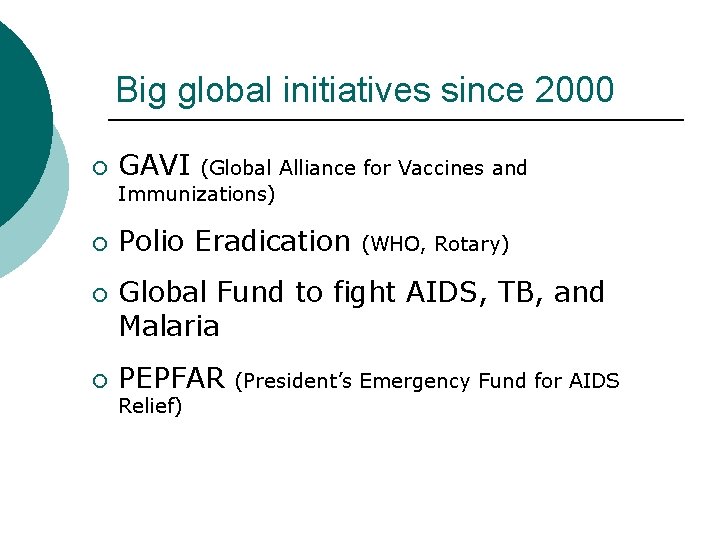
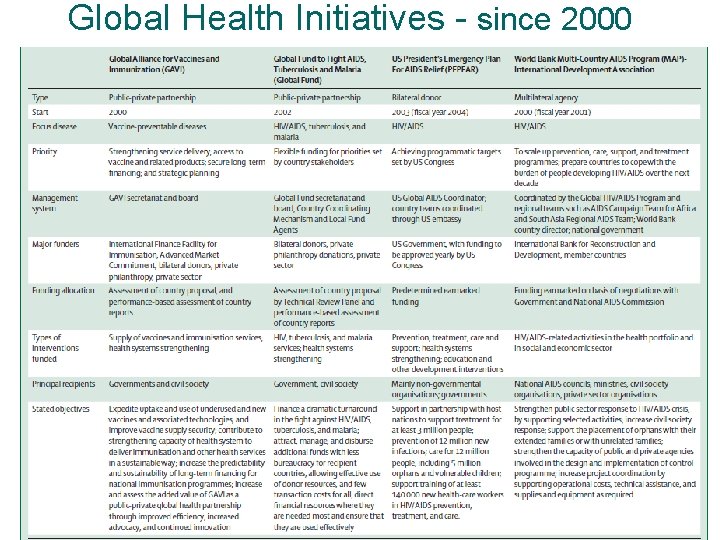
Big global initiatives since 2000 ¡ GAVI (Global Alliance for Vaccines and Immunizations) ¡ ¡ ¡ Polio Eradication (WHO, Rotary) Global Fund to fight AIDS, TB, and Malaria PEPFAR (President’s Emergency Fund for AIDS Relief)
Global Health Initiatives - since 2000
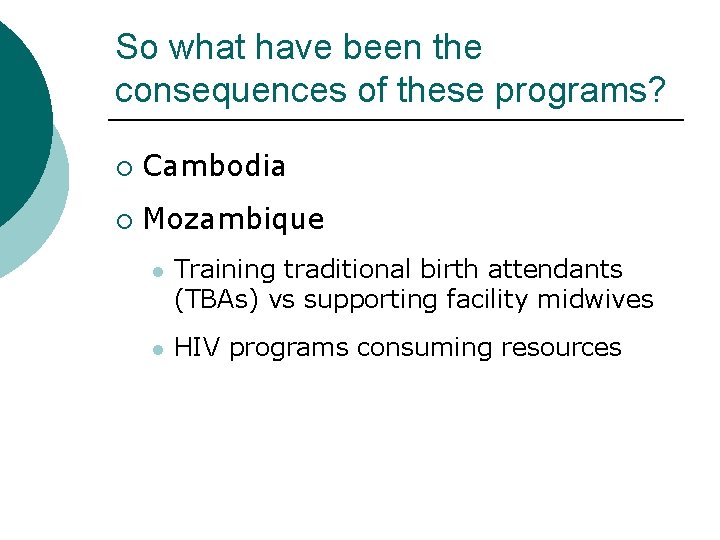
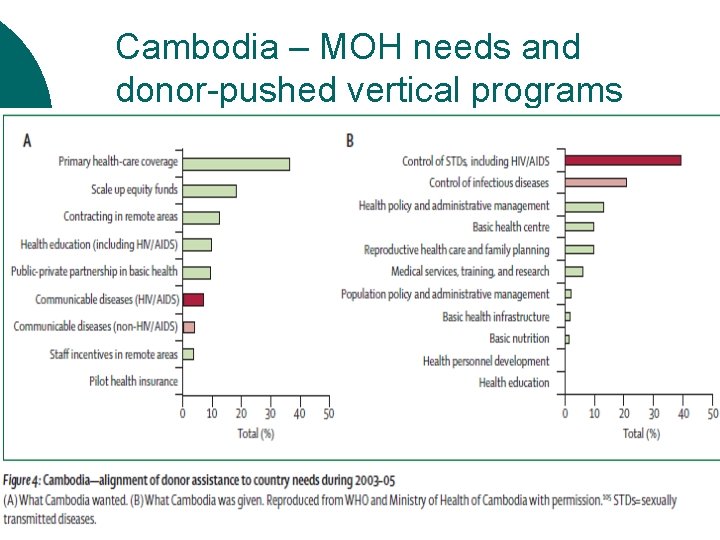
So what have been the consequences of these programs? ¡ Cambodia ¡ Mozambique l Training traditional birth attendants (TBAs) vs supporting facility midwives l HIV programs consuming resources
Cambodia – MOH needs and donor-pushed vertical programs
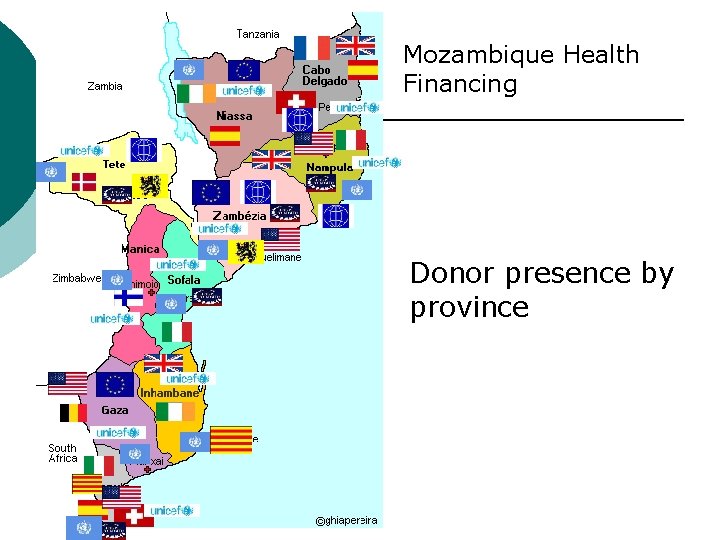
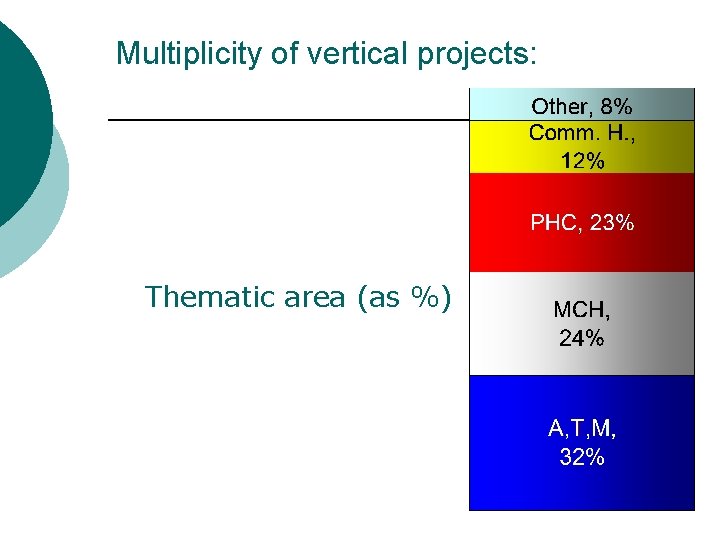
Vertical programs in Mozambique ¡ Provide bulk of funding ¡ 1985 -2000 CHW/TBA programs ¡ 2000+ PEPFAR expanded vertical programs ¡ ‘NGOs and donors budgets exceed MOH ¡ Neocolonization’ by province ¡ Confusing multiplicity of vertical projects, diseases, inputs ¡ Not likely to change soon
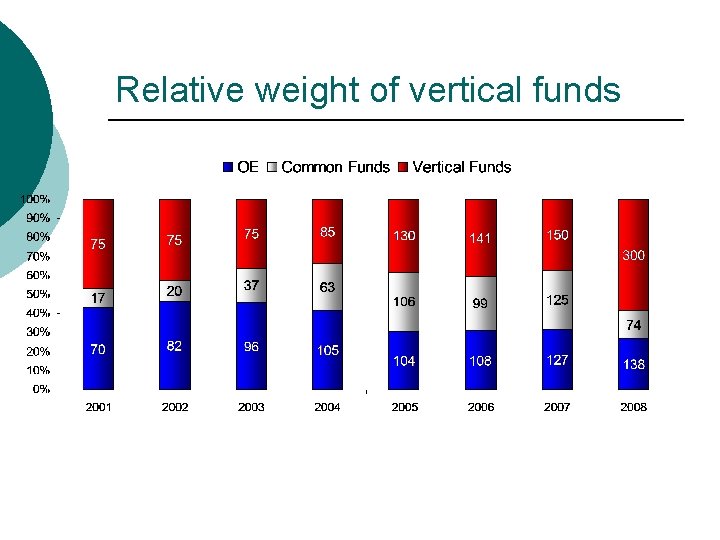
Relative weight of vertical funds
Mozambique Health Financing Donor presence by province
Multiplicity of vertical projects: Thematic area (as %)
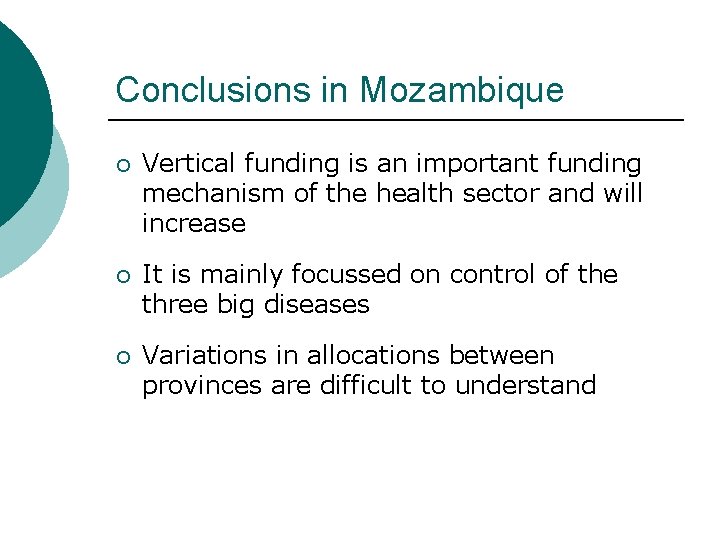
Conclusions in Mozambique ¡ Vertical funding is an important funding mechanism of the health sector and will increase ¡ It is mainly focussed on control of the three big diseases ¡ Variations in allocations between provinces are difficult to understand
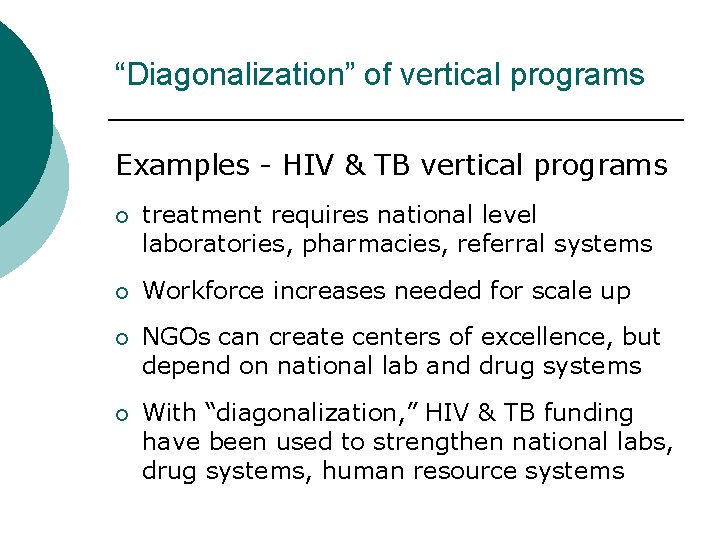
“Diagonalization” of vertical programs Examples - HIV & TB vertical programs ¡ treatment requires national level laboratories, pharmacies, referral systems ¡ Workforce increases needed for scale up ¡ NGOs can create centers of excellence, but depend on national lab and drug systems ¡ With “diagonalization, ” HIV & TB funding have been used to strengthen national labs, drug systems, human resource systems
Another aspect of Vertical Programs… Vertical programs were often implemented by international NGOs Will discuss in next lecture…….
Thank you!