
Response to InterventionMultiTier System of Supports Big Ideas
Response to Intervention/Multi-Tier System of Supports Big Ideas in Behavior Management. What key concepts can lay the groundwork for teacher success in managing challenging behaviors? www. interventioncentral. org 1
Response to Intervention/Multi-Tier System of Supports “ Problems are an unacceptable discrepancy between what is expected and what is observed. ” -Ted Christ Source: Christ, T. (2008). Best practices in problem analysis. In A. Thomas & J. Grimes (Eds. ), Best Practices in School Psychology V (pp. 159 -176). Bethesda, MD: National Association of School Psychologists. www. interventioncentral. org 2
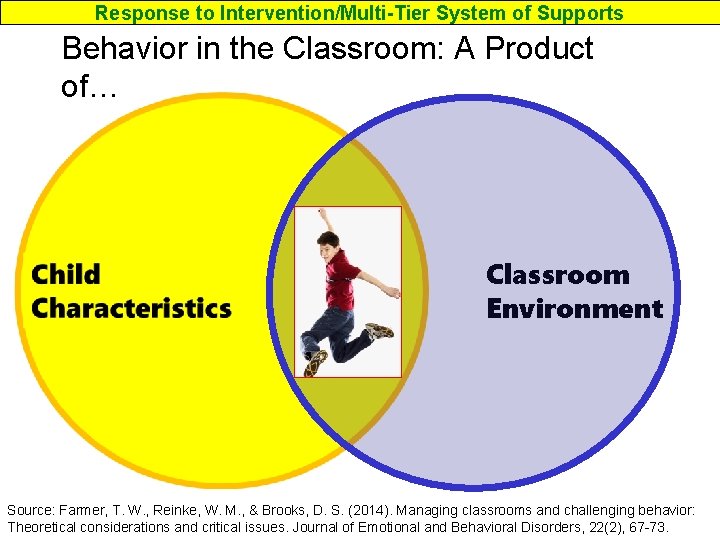
Response to Intervention/Multi-Tier System of Supports Behavior in the Classroom: A Product of… Classroom Environment Source: Farmer, T. W. , Reinke, W. M. , & Brooks, D. S. (2014). Managing classrooms and challenging behavior: Theoretical considerations and critical issues. Journal of Emotional and Behavioral Disorders, 22(2), 67 -73. www. interventioncentral. org
Response to Intervention/Multi-Tier System of Supports Interventions: Scheduled or Contingency. Driven? One of the elements that separate academic from behavioral interventions is that: • academic interventions can often be scheduled (e. g. , reading group meets for 30 minutes 3 times per week), while • behavioral interventions are often contingency-driven (administered contingent on the occurrence or possibility of a student behavior), such Source: Barnett, D. W. , Daly, E. J. , Jones, K. M. , & Lentz, F. E. (2004). Response to intervention: Empirically based specialas service decisions single-case designs of increasing and decreasing intensity. Journal of use offrompraise or pre-correction. www. interventioncentral. org 4
Response to Intervention/Multi-Tier System of Supports • ‘Big Ideas’ in Behavior Management… Teach expected behaviors. Students need to be explicitly taught expected behaviors. They should then be acknowledged and reinforced when they show positive behaviors. In other words, schools should treat behavior as part of the curriculum: teach it and reinforce it! www. interventioncentral. org 1 5
Response to Intervention/Multi-Tier System of Supports • ‘Big Ideas’ in Behavior Management… Check for academic problems. The connection between classroom misbehavior and poor academic skills is high. Educators should routinely assess a student's academic skills as a first step when attempting to explain why a particular behavior is occurring. If academics contribute to problem behaviors, the student needs an academic support plan as part of his or her behavior plan. www. interventioncentral. org 2 6
Response to Intervention/Multi-Tier System of Supports • ‘Big Ideas’ in Behavior Management… Identify the underlying function of the behavior. Problem behaviors occur for a reason. Such behaviors serve a function for the student. When an educator can identify the probable function sustaining a student’s challenging behaviors, the educator can select successful intervention strategies that match the function—and meet the student’s needs. www. interventioncentral. org 3 7
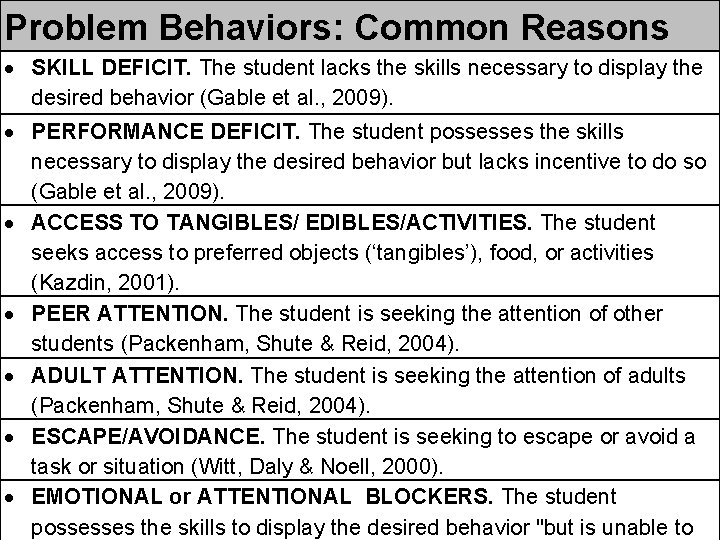
Response to Intervention/Multi-Tier System of Supports Problem Behaviors: Common Reasons SKILL DEFICIT. The student lacks the skills necessary to display the desired behavior (Gable et al. , 2009). PERFORMANCE DEFICIT. The student possesses the skills necessary to display the desired behavior but lacks incentive to do so (Gable et al. , 2009). ACCESS TO TANGIBLES/ EDIBLES/ACTIVITIES. The student seeks access to preferred objects (‘tangibles’), food, or activities (Kazdin, 2001). PEER ATTENTION. The student is seeking the attention of other students (Packenham, Shute & Reid, 2004). ADULT ATTENTION. The student is seeking the attention of adults (Packenham, Shute & Reid, 2004). ESCAPE/AVOIDANCE. The student is seeking to escape or avoid a task or situation (Witt, Daly & Noell, 2000). EMOTIONAL or ATTENTIONAL BLOCKERS. The student possesses the skills to display the desired behavior "but is unable to www. interventioncentral. org
Response to Intervention/Multi-Tier System of Supports • ‘Big Ideas’ in Behavior Management… Eliminate behavioral triggers. Problem behaviors are often set off by events or conditions within the classroom. Sitting next to a distracting classmate or being handed an academic task that is too difficult to complete are two examples of events that might trigger student misbehavior. When the educator is able to identify and eliminate triggers of negative conduct, such actions tend to work quickly and--by preventing class disruptions--result in more time available for instruction. www. interventioncentral. org 4 9
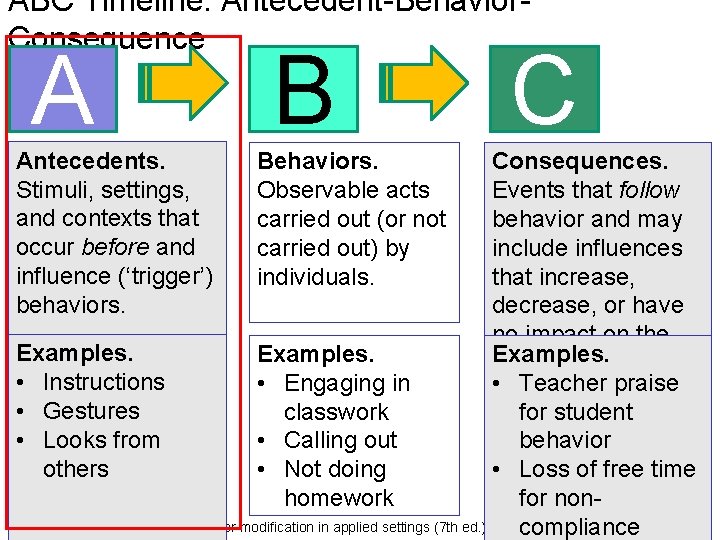
ABC Timeline: Antecedent-Behavior. Response to Intervention/Multi-Tier System of Supports Consequence A Antecedents. Stimuli, settings, and contexts that occur before and influence (‘trigger’) behaviors. B Behaviors. Observable acts carried out (or not carried out) by individuals. C Consequences. Events that follow behavior and may include influences that increase, decrease, or have no impact on the Examples. behavior. • Instructions • Engaging in • Teacher praise • Gestures classwork for student • Looks from • Calling out behavior others • Not doing • Loss of free time homework for non. Source: Kazdin AE. (2013). Behavior modification in applied settings (7 th ed. ). Longcompliance Grove, IL: Waveland Press. www. interventioncentral. org
Response to Intervention/Multi-Tier System of Supports • ‘Big Ideas’ in Behavior Management… Focus on factors within the school’s control. Educators recognize that students often face significant factors outside of the school setting--e. g. , limited parental support -- that can place them at heightened risk for academic failure and problem behaviors. Schools can best counteract the influence of negative outside factors and promote student resilience by focusing on what can be provided within the educational setting such as skills instruction, tutoring, mentoring, and use of positive behavior management www. interventioncentral. org 5 11
Response to Intervention/Multi-Tier System of Supports • ‘Big Ideas’ in Behavior Management… Be flexible in responding to misbehavior. Educators have greater success in managing the full spectrum of student misbehaviors when they respond flexibly-evaluating each individual case and applying strategies that logically address the likely cause(s) of that student's problem conduct. www. interventioncentral. org 6 12
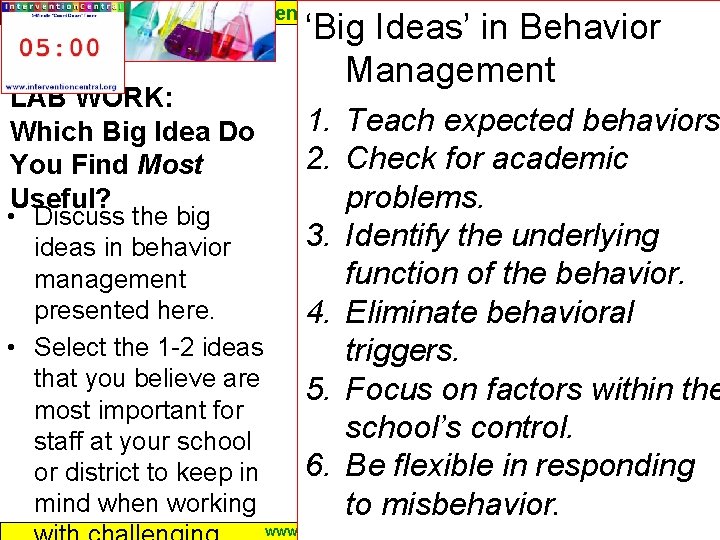
Response to Intervention/Multi-Tier System of Supports LAB WORK: Which Big Idea Do You Find Most Useful? • Discuss the big ideas in behavior management presented here. • Select the 1 -2 ideas that you believe are most important for staff at your school or district to keep in mind when working ‘Big Ideas’ in Behavior Management 1. Teach expected behaviors 2. Check for academic problems. 3. Identify the underlying function of the behavior. 4. Eliminate behavioral triggers. 5. Focus on factors within the school’s control. 6. Be flexible in responding to misbehavior. www. interventioncentral. org 13
- Slides: 13