
Response to Intervention RTI Teams Following a Structured

- Slides: 24
Response to Intervention RTI Teams: Following a Structured Problem-Solving Model Jim Wright www. interventioncentral. org
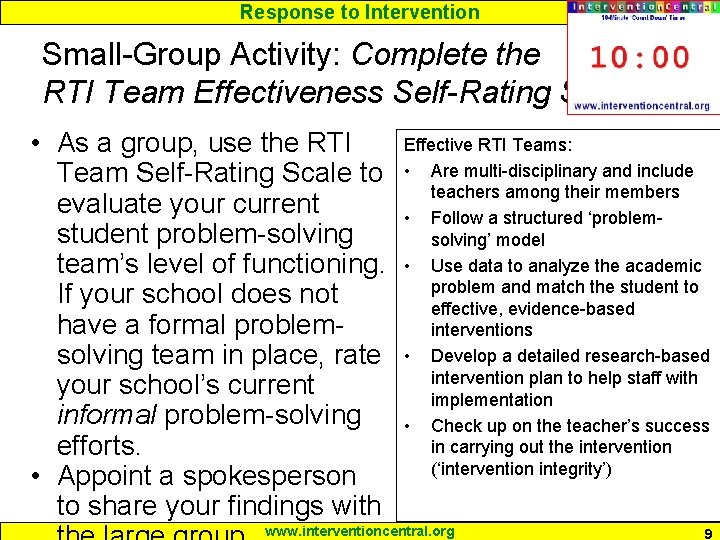
Response to Intervention Tier 3 Interventions Are Developed With Assistance from the School’s RTI (Problem-Solving) Team Effective RTI Teams: • Are multi-disciplinary and include classroom teachers among their members • Follow a structured ‘problem-solving’ model • Use data to analyze the academic problem and match the student to effective, evidence-based interventions • Develop a detailed research-based intervention plan to help staff with implementation • Check up on the teacher’s success in carrying out the intervention (‘intervention integrity’) www. interventioncentral. org 2
Response to Intervention The Problem-Solving Model & Multi-Disciplinary Teams A school consultative process (‘the problemsolving model’) with roots in applied behavior analysis was developed (e. g. , Bergan, 1995) that includes 4 steps: – Problem Identification – Problem Analysis – Plan Implementation – Problem Evaluation Originally designed for individual consultation with teachers, the problem-solving model was later Source: Bergan, J. R. (1995). Evolution of a problem-solving model of consultation. Journal of Educationaladapted and Psychological 6(2), forms 111 -123. to multi-disciplinary in. Consultation, various www. interventioncentral. org 3
Response to Intervention The RTI Team: Definition • Teams of educators at a school are trained to work together as effective problem-solvers. • RTI Teams are made up of volunteers drawn from general- and special-education teachers and support staff. • These teams use a structured meeting process to identify the underlying reasons that a student might be experiencing academic or behavioral difficulties • The team helps the referring teacher to put together practical, classroom-friendly interventions to address those student problems. www. interventioncentral. org 4
Response to Intervention Teachers may be motivated to refer students to your RTI Team because they… • can engage in collegial conversations about better ways to help struggling learners • learn instructional and behavior-management strategies that they can use with similar students in the future • increase their teaching time • are able to access more intervention resources and supports in the building than if they work alone • feel less isolated when dealing with challenging kids • have help in documenting their intervention efforts www. interventioncentral. org 5
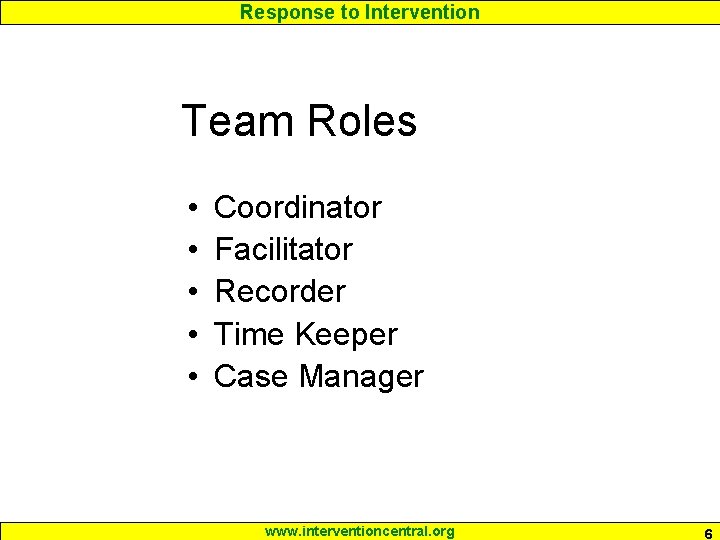
Response to Intervention Team Roles • • • Coordinator Facilitator Recorder Time Keeper Case Manager www. interventioncentral. org 6
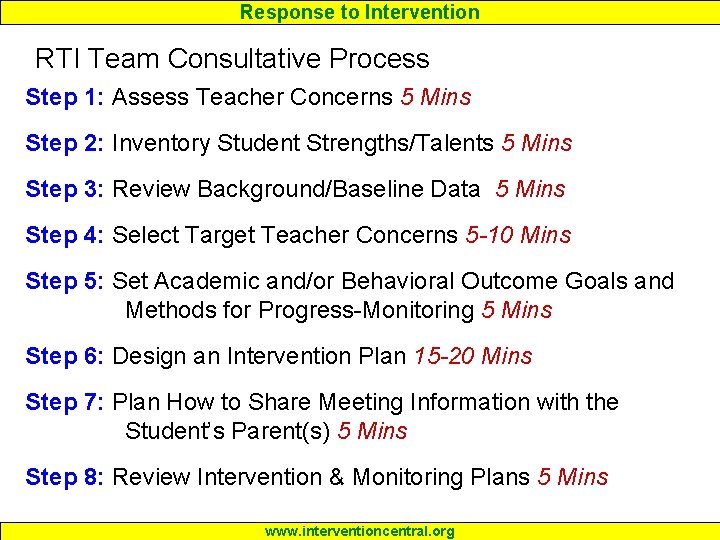
Response to Intervention RTI Team Consultative Process Step 1: Assess Teacher Concerns 5 Mins Step 2: Inventory Student Strengths/Talents 5 Mins Step 3: Review Background/Baseline Data 5 Mins Step 4: Select Target Teacher Concerns 5 -10 Mins Step 5: Set Academic and/or Behavioral Outcome Goals and Methods for Progress-Monitoring 5 Mins Step 6: Design an Intervention Plan 15 -20 Mins Step 7: Plan How to Share Meeting Information with the Student’s Parent(s) 5 Mins Step 8: Review Intervention & Monitoring Plans 5 Mins www. interventioncentral. org
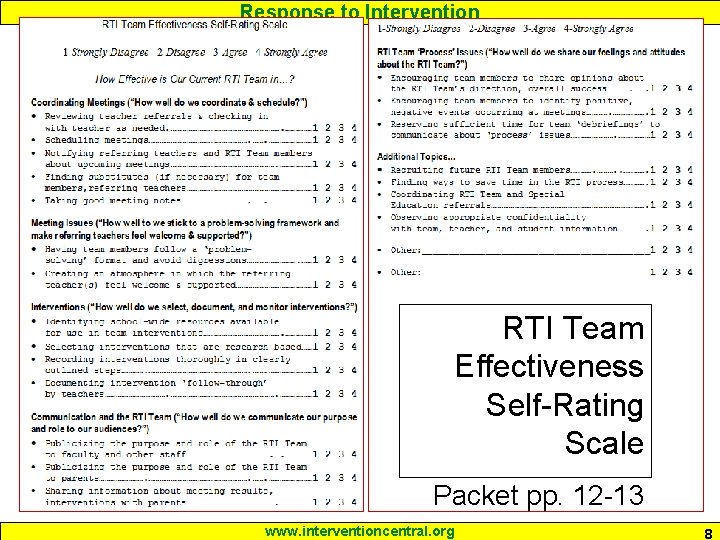
Response to Intervention RTI Team Effectiveness Self-Rating Scale Packet pp. 12 -13 www. interventioncentral. org 8
Response to Intervention Small-Group Activity: Complete the RTI Team Effectiveness Self-Rating Scale • As a group, use the RTI Team Self-Rating Scale to evaluate your current student problem-solving team’s level of functioning. If your school does not have a formal problemsolving team in place, rate your school’s current informal problem-solving efforts. • Appoint a spokesperson to share your findings with Effective RTI Teams: • Are multi-disciplinary and include teachers among their members • Follow a structured ‘problemsolving’ model • Use data to analyze the academic problem and match the student to effective, evidence-based interventions • Develop a detailed research-based intervention plan to help staff with implementation • Check up on the teacher’s success in carrying out the intervention (‘intervention integrity’) www. interventioncentral. org 9
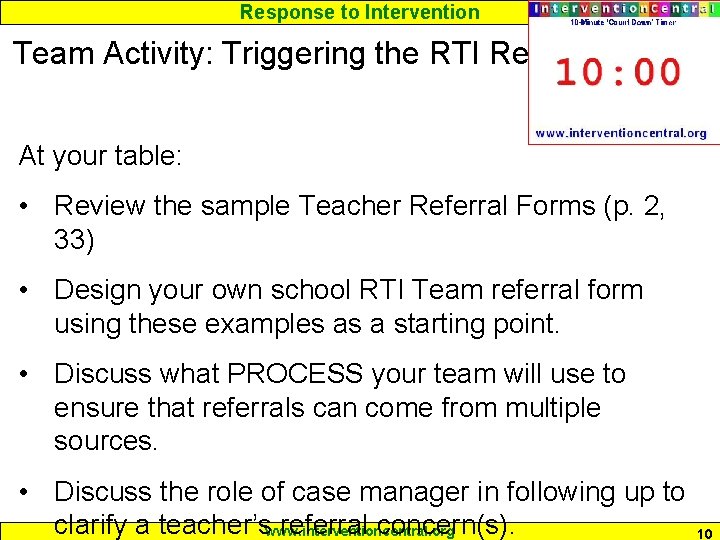
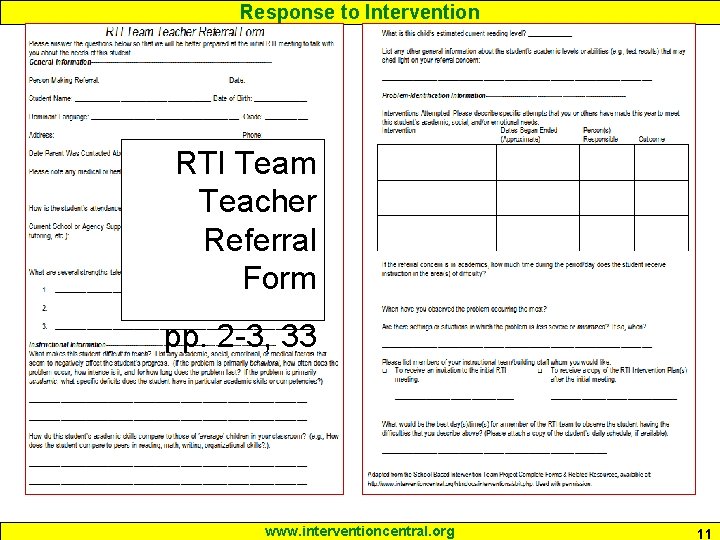
Response to Intervention Team Activity: Triggering the RTI Referral At your table: • Review the sample Teacher Referral Forms (p. 2, 33) • Design your own school RTI Team referral form using these examples as a starting point. • Discuss what PROCESS your team will use to ensure that referrals can come from multiple sources. • Discuss the role of case manager in following up to clarify a teacher’swww. interventioncentral. org referral concern(s). 10
Response to Intervention RTI Team Teacher Referral Form pp. 2 -3, 33 www. interventioncentral. org 11
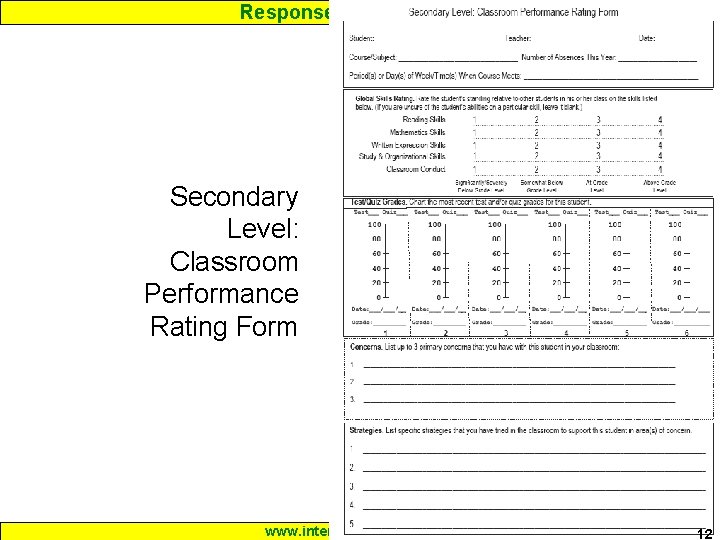
Response to Intervention Secondary Level: Classroom Performance Rating Form www. interventioncentral. org 12
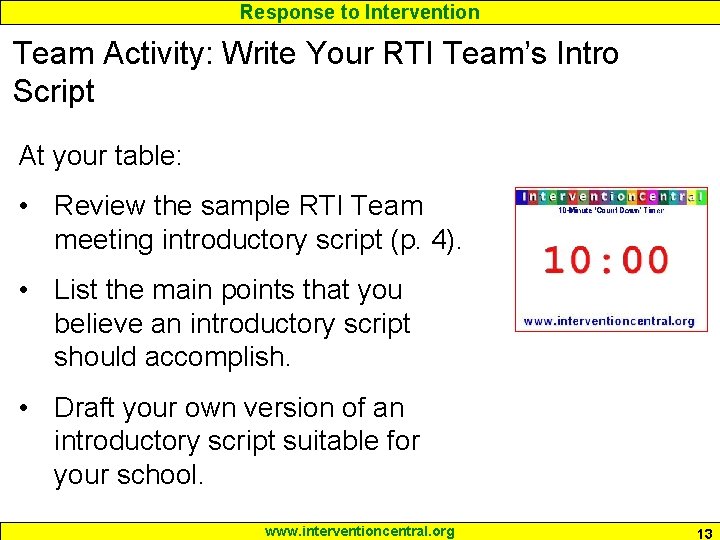
Response to Intervention Team Activity: Write Your RTI Team’s Intro Script At your table: • Review the sample RTI Team meeting introductory script (p. 4). • List the main points that you believe an introductory script should accomplish. • Draft your own version of an introductory script suitable for your school. www. interventioncentral. org 13
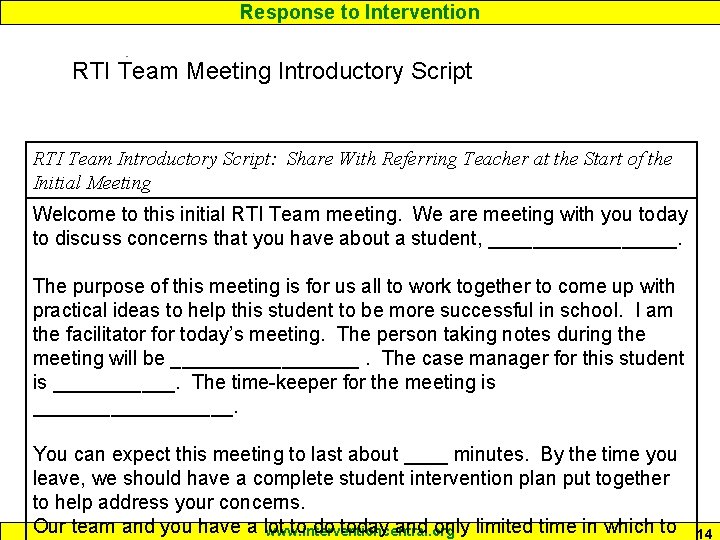
Response to Intervention RTI Team Meeting Introductory Script RTI Team Introductory Script: Share With Referring Teacher at the Start of the Initial Meeting Welcome to this initial RTI Team meeting. We are meeting with you today to discuss concerns that you have about a student, _________. The purpose of this meeting is for us all to work together to come up with practical ideas to help this student to be more successful in school. I am the facilitator for today’s meeting. The person taking notes during the meeting will be _________. The case manager for this student is ______. The time-keeper for the meeting is _________. You can expect this meeting to last about ____ minutes. By the time you leave, we should have a complete student intervention plan put together to help address your concerns. Our team and you have a lot to do today and only limited time in which to www. interventioncentral. org 14
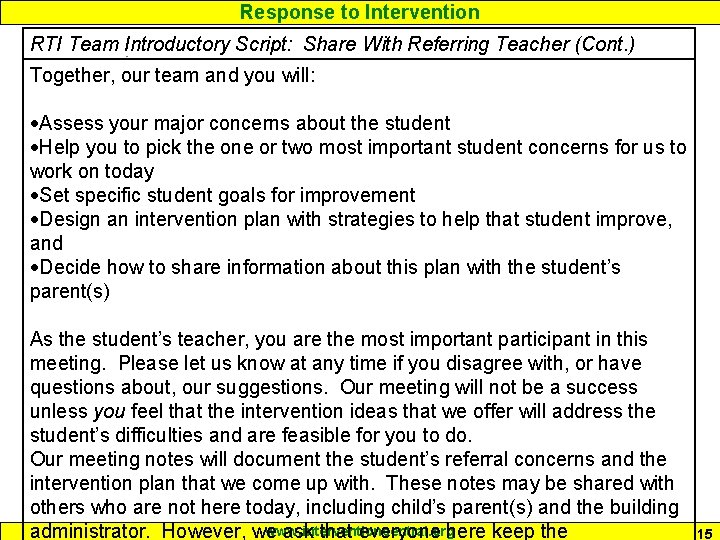
Response to Intervention RTI Team Introductory Script: Share With Referring Teacher (Cont. ) Together, our team and you will: Assess your major concerns about the student Help you to pick the one or two most important student concerns for us to work on today Set specific student goals for improvement Design an intervention plan with strategies to help that student improve, and Decide how to share information about this plan with the student’s parent(s) As the student’s teacher, you are the most important participant in this meeting. Please let us know at any time if you disagree with, or have questions about, our suggestions. Our meeting will not be a success unless you feel that the intervention ideas that we offer will address the student’s difficulties and are feasible for you to do. Our meeting notes will document the student’s referral concerns and the intervention plan that we come up with. These notes may be shared with others who are not here today, including child’s parent(s) and the building www. interventioncentral. org administrator. However, we ask that everyone here keep the 15
Response to Intervention RTI Team: Demonstration Video www. interventioncentral. org 16
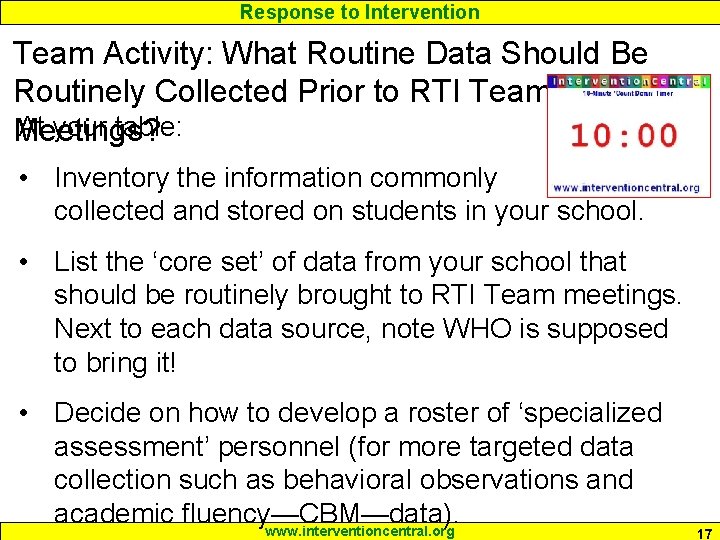
Response to Intervention Team Activity: What Routine Data Should Be Routinely Collected Prior to RTI Team At your table: Meetings? • Inventory the information commonly collected and stored on students in your school. • List the ‘core set’ of data from your school that should be routinely brought to RTI Team meetings. Next to each data source, note WHO is supposed to bring it! • Decide on how to develop a roster of ‘specialized assessment’ personnel (for more targeted data collection such as behavioral observations and academic fluency—CBM—data). www. interventioncentral. org 17
Response to Intervention Team Activity: What Problem-Solving Process With Your RTI Team Follow? At your table: • Discuss how your RTI Team will select a problem-solving structure to be followed at team meetings. • How will your team shape your forms and data collection to conform to this problemsolving process? www. interventioncentral. org 18
Response to Intervention RTI Teams: Managing Those ‘RTI Emergencies’ Jim Wright www. interventioncentral. org
Response to Intervention Managing Those ‘RTI Emergencies’… The initial teacher referral suggested that the student’s classroom needs are primarily behavioral. At the RTI Team meeting, it becomes clear that ACADEMIC concerns are probably driving the behavioral problems. You have little targeted information about the student’s academic skills. How can your team respond (or avoid www. interventioncentral. org 20
Response to Intervention Managing Those ‘RTI Emergencies’… The referring teacher appears highly reluctant to participate in the RTI Team meeting. At one point, he says, “I am only here because the principal said that I had to refer this student. ” How can your team respond (or avoid this situation in the first place)? www. interventioncentral. org 21
Response to Intervention Managing Those ‘RTI Emergencies’… When asked to state her main referral concern, the referring teacher at the RTI Team meeting declares that “The problem is that the student just can’t do the work. We need to find a better placement for him than my classroom!” How can your team respond (or avoid this situation in the first place)? www. interventioncentral. org 22
Response to Intervention Managing Those ‘RTI Emergencies’… Your RTI Team feels ‘stuck’ in selecting an intervention (Step 6: Design an Intervention Plan) for a student whose referral concerns have been identified as “poor reading comprehension” and “disruptive behavior. ” How can your team respond (or avoid this situation in the first place)? www. interventioncentral. org 23
Response to Intervention Managing Those ‘RTI Emergencies’… Duirng the RTI Team meeting, the team recommends a number of researchbased intervention ideas for a student with academic delays. For each idea, the teacher says, “I’ve already tried that. ” How can your team respond (or avoid this situation in the first place)? www. interventioncentral. org 24