
Response to Intervention RTI Intervention Planning Best Practices
Response to Intervention RTI & Intervention Planning: Best Practices Jim Wright www. interventioncentral. org
Response to Intervention “RTI: How sloppy can we be and still be effective? ” What is your reaction to this statement? www. interventioncentral. org 2
Response to Intervention Essential Elements of RTI (Fairbanks, Sugai, Guardino, & Lathrop, 2007) 1. A “continuum of evidence-based services available to all students" that range from universal to highly individualized & intensive 2. “Decision points to determine if students are performing significantly below the level of their peers in academic and social behavior domains" 3. “Ongoing monitoring of student progress" 4. “Employment of more intensive or different interventions when students do not improve in response" to lesser interventions 5. “Evaluation for special education services if students do not respond to intervention Source: Fairbanks, S. , Sugai, G. , Guardino, S. , & Lathrop, M. (2007). Response to intervention: instruction" Examining classroom behavior support in second grade. Exceptional Children, 73, p. 289. www. interventioncentral. org 3
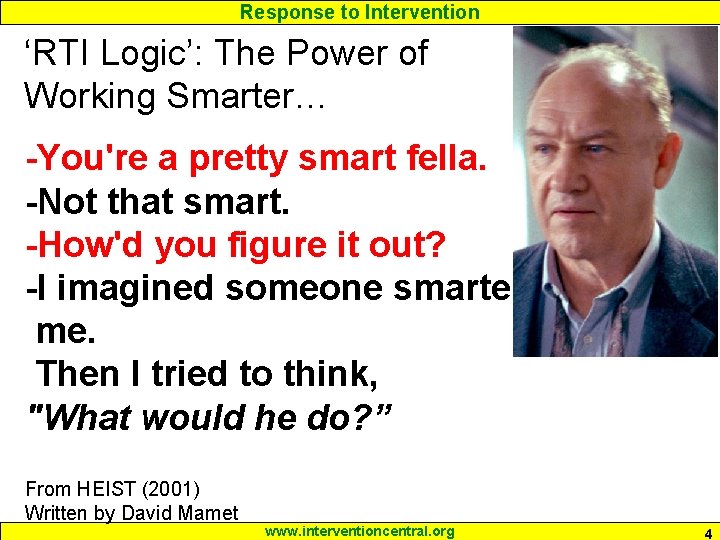
Response to Intervention ‘RTI Logic’: The Power of Working Smarter… -You're a pretty smart fella. -Not that smart. -How'd you figure it out? -I imagined someone smarter than me. Then I tried to think, "What would he do? ” From HEIST (2001) Written by David Mamet www. interventioncentral. org 4
Response to Intervention What does RTI look like when applied to an individual student? A widely accepted method for determining whether a student has a Learning Disability under RTI is the ‘dual discrepancy model’ (Fuchs, 2003). – Discrepancy 1: The student is found to be performing academically at a level significantly below that of his or her typical peers (discrepancy in initial skills or performance). – Discrepancy 2: Despite the implementation of one or more well-designed, well-implemented interventions tailored specifically for the student, he or she fails to ‘close the gap’ with classmates (discrepancy in rate of learning relative to peers). www. interventioncentral. org 5
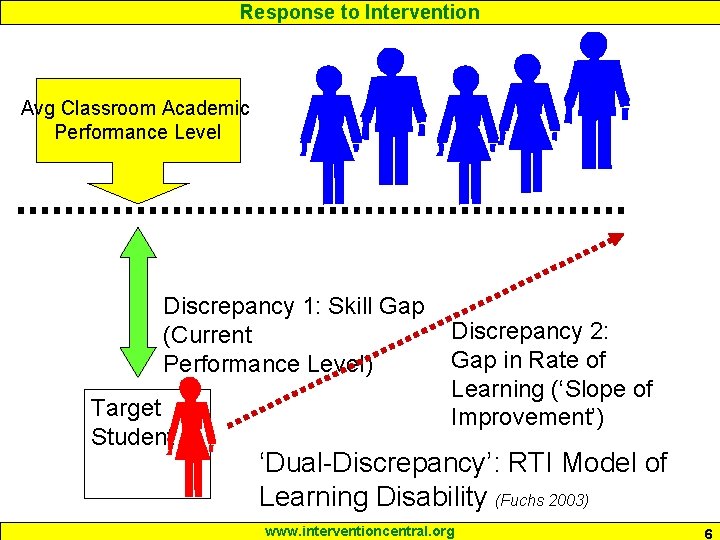
Response to Intervention Avg Classroom Academic Performance Level Discrepancy 1: Skill Gap (Current Performance Level) Target Student Discrepancy 2: Gap in Rate of Learning (‘Slope of Improvement’) ‘Dual-Discrepancy’: RTI Model of Learning Disability (Fuchs 2003) www. interventioncentral. org 6
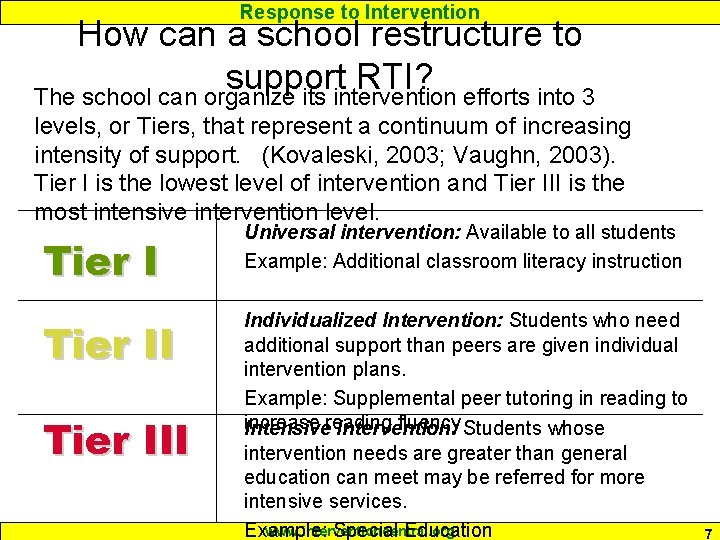
Response to Intervention How can a school restructure to support RTI? The school can organize its intervention efforts into 3 levels, or Tiers, that represent a continuum of increasing intensity of support. (Kovaleski, 2003; Vaughn, 2003). Tier I is the lowest level of intervention and Tier III is the most intensive intervention level. Tier III Universal intervention: Available to all students Example: Additional classroom literacy instruction Individualized Intervention: Students who need additional support than peers are given individual intervention plans. Example: Supplemental peer tutoring in reading to increase fluency Students whose Intensivereading Intervention: intervention needs are greater than general education can meet may be referred for more intensive services. www. interventioncentral. org Example: Special Education 7
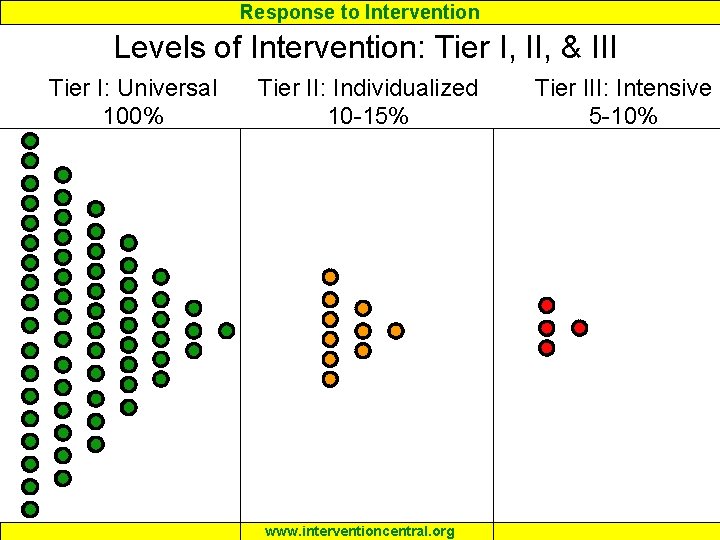
Response to Intervention Levels of Intervention: Tier I, II, & III Tier I: Universal 100% Tier II: Individualized 10 -15% www. interventioncentral. org Tier III: Intensive 5 -10%
Response to Intervention RTI: We’re in Dragon Country Now! Jim Wright www. interventioncentral. org
![Response to Intervention Hic sunt dracones. [Latin for “Here be dragons…”] Phrase appearing on](http://slidetodoc.com/presentation_image_h2/62816b3277d4fd6061bb510018c715a6/image-10.jpg "Response to Intervention Hic sunt dracones. [Latin for “Here be dragons…”] Phrase appearing on")
Response to Intervention Hic sunt dracones. [Latin for “Here be dragons…”] Phrase appearing on the Lenox Globe circa 1503, denoting unknown dangers on the unexplored east coast of Asia. This term now is used to describe any instance in which decision-making or action is difficult because the situation is so complex or because so many variables are unknown. Source: Wikipedia: http: //en. wikipedia. org/wiki/Here_be_dragons#Dragons_on _maps www. interventioncentral. org 10
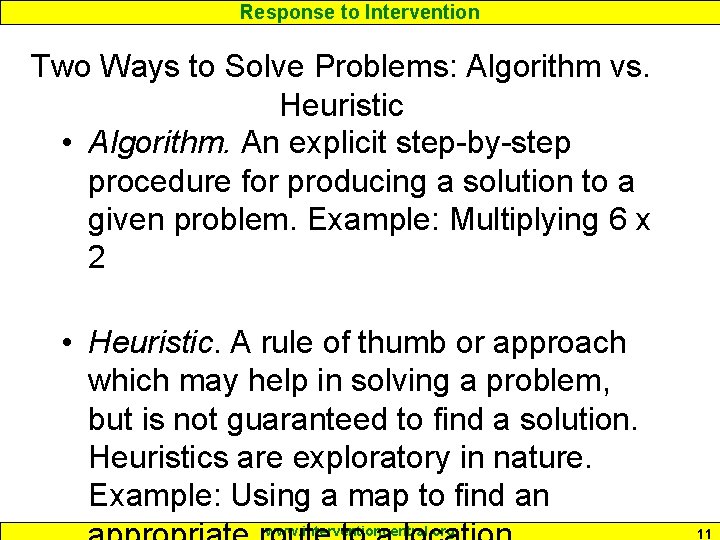
Response to Intervention Two Ways to Solve Problems: Algorithm vs. Heuristic • Algorithm. An explicit step-by-step procedure for producing a solution to a given problem. Example: Multiplying 6 x 2 • Heuristic. A rule of thumb or approach which may help in solving a problem, but is not guaranteed to find a solution. Heuristics are exploratory in nature. Example: Using a map to find an www. interventioncentral. org 11
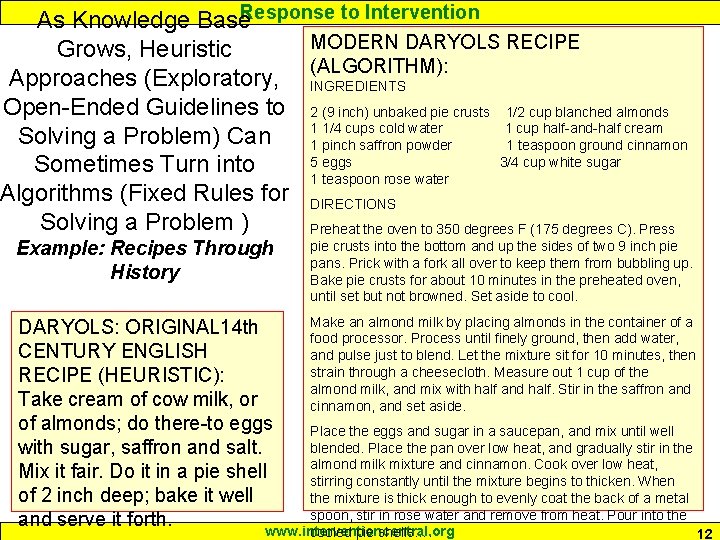
As Knowledge Base. Response to Intervention MODERN DARYOLS RECIPE Grows, Heuristic (ALGORITHM): Approaches (Exploratory, INGREDIENTS Open-Ended Guidelines to 2 (9 inch) unbaked pie crusts 1/2 cup blanched almonds 1 1/4 cups cold water 1 cup half-and-half cream Solving a Problem) Can 1 pinch saffron powder 1 teaspoon ground cinnamon 5 eggs 3/4 cup white sugar Sometimes Turn into 1 teaspoon rose water Algorithms (Fixed Rules for DIRECTIONS Solving a Problem ) Preheat the oven to 350 degrees F (175 degrees C). Press Example: Recipes Through History pie crusts into the bottom and up the sides of two 9 inch pie pans. Prick with a fork all over to keep them from bubbling up. Bake pie crusts for about 10 minutes in the preheated oven, until set but not browned. Set aside to cool. DARYOLS: ORIGINAL 14 th CENTURY ENGLISH RECIPE (HEURISTIC): Take cream of cow milk, or of almonds; do there-to eggs with sugar, saffron and salt. Mix it fair. Do it in a pie shell of 2 inch deep; bake it well and serve it forth. Make an almond milk by placing almonds in the container of a food processor. Process until finely ground, then add water, and pulse just to blend. Let the mixture sit for 10 minutes, then strain through a cheesecloth. Measure out 1 cup of the almond milk, and mix with half and half. Stir in the saffron and cinnamon, and set aside. Place the eggs and sugar in a saucepan, and mix until well blended. Place the pan over low heat, and gradually stir in the almond milk mixture and cinnamon. Cook over low heat, stirring constantly until the mixture begins to thicken. When the mixture is thick enough to evenly coat the back of a metal spoon, stir in rose water and remove from heat. Pour into the www. interventioncentral. org cooled pie shells…. 12
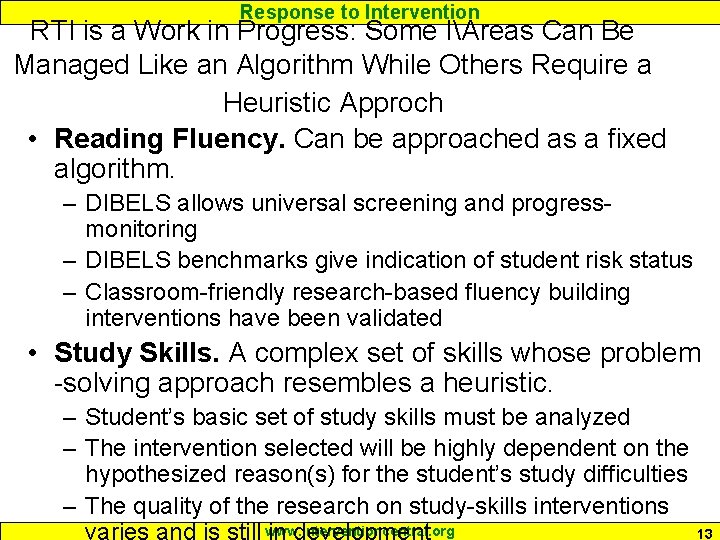
Response to Intervention RTI is a Work in Progress: Some IAreas Can Be Managed Like an Algorithm While Others Require a Heuristic Approch • Reading Fluency. Can be approached as a fixed algorithm. – DIBELS allows universal screening and progressmonitoring – DIBELS benchmarks give indication of student risk status – Classroom-friendly research-based fluency building interventions have been validated • Study Skills. A complex set of skills whose problem -solving approach resembles a heuristic. – Student’s basic set of study skills must be analyzed – The intervention selected will be highly dependent on the hypothesized reason(s) for the student’s study difficulties – The quality of the research on study-skills interventions varies and is still www. interventioncentral. org in development 13
to Intervention What Are. Response 5 ‘dragon regions’ of RTI? Scarcity of research demonstrating the effectiveness of RTI vs. traditional methods of special education identification (Fuchs, Mock, Morgan, & Young, 2003) Indeterminate decision rules for length of time an intervention should be implemented, number of intervention trials required, etc. (Barnett, Daly, Jones, & Lentz, 2004; Gresham 2001) Gaps in the intervention literature—limited information about effective interventions for certain target concerns (e. g. , reading comprehension) and for higher age-groups (e. g. , high school) (Gresham 2001; Gresham, 1998; Kratochwill & Shernoff, 2003; Vaughn & Fuchs, 2003) Questions of how scalable and cost-effective the RTI model is (Gresham 2001; Gresham, 1998; Kratochwill & Shernoff, 2003; Vaughn & Fuchs, 2003) Lack of clarity regarding how RTI fits in to the Special Education referral process (34 C. F. R. 300 & 301, 2006) www. interventioncentral. org 14
Response to Intervention Six ‘Big Ideas’ About Student Learning & Behavior www. interventioncentral. org
Response to Intervention Big Ideas: Student Social & Academic Behaviors Are Strongly Influenced by the Instructional Setting (Lentz & Shapiro, 1986) • Students with learning problems do not exist in isolation. Rather, their instructional environment plays an enormously important role in these students’ eventual success or failure Source: Lentz, F. E. & Shapiro, E. S. (1986). Functional assessment of the academic environment. School Psychology Review, 15, 346 -57. www. interventioncentral. org 16
Response to Intervention Big Ideas: Learn Unit (Heward, 1996) The three essential elements of effective student learning include: 1. Academic Opportunity to Respond. The student is presented with a meaningful opportunity to respond to an academic task. A question posed by the teacher, a math word problem, and a spelling item on an educational computer ‘Word Gobbler’ game could all be considered academic opportunities to respond. 2. Active Student Response. The student answers the item, solves the problem presented, or completes the academic task. Answering the teacher’s question, computing the answer to a math word problem (and showing all work), and typing in the correct spelling of an item when playing an educational computer game are all examples of active student responding. 3. Performance Feedback. The student receives timely feedback about whether his or her response is correct—often with praise and encouragement. A teacher exclaiming ‘Right! Good job!’ when a student gives an response in class, a student using an answer key Source: to Heward, W. L. (1996). Three to low-tech strategies for problem, increasing theand frequency of active student check her answer a math word a computer response during group instruction. In R. Gardner, D. M. S ainato, J. O. Cooper, T. E. Heron, W. L. Heward, J. message You get 2 on points for correctly W. Eshleman, & T. A. that Grossisays (Eds. ), ‘Congratulations! Behavior analysis in education: Focus measurably superior spelling this word!” are all examples of performance feedback. instruction (pp. 283 -320). Pacific Grove, CA: Brooks/Cole. www. interventioncentral. org 17
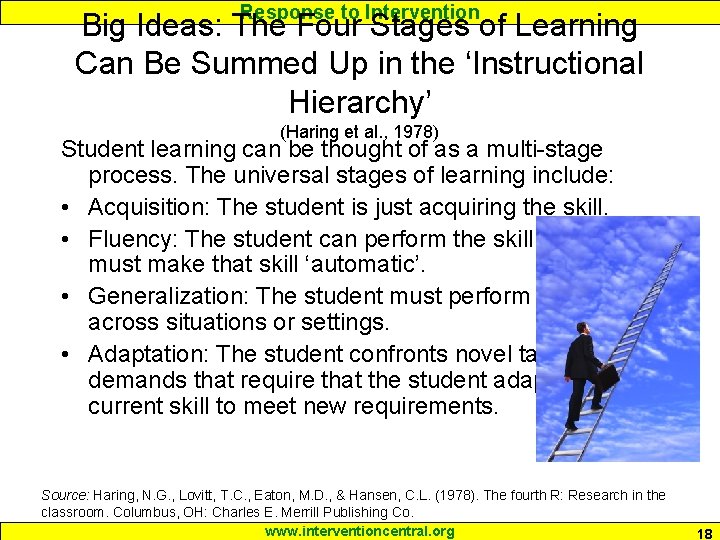
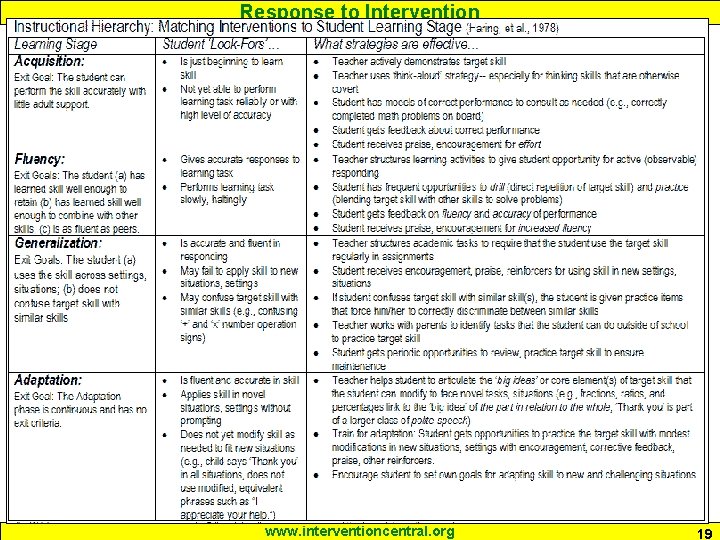
Response to Intervention Big Ideas: The Four Stages of Learning Can Be Summed Up in the ‘Instructional Hierarchy’ (Haring et al. , 1978) Student learning can be thought of as a multi-stage process. The universal stages of learning include: • Acquisition: The student is just acquiring the skill. • Fluency: The student can perform the skill but must make that skill ‘automatic’. • Generalization: The student must perform the skill across situations or settings. • Adaptation: The student confronts novel task demands that require that the student adapt a current skill to meet new requirements. Source: Haring, N. G. , Lovitt, T. C. , Eaton, M. D. , & Hansen, C. L. (1978). The fourth R: Research in the classroom. Columbus, OH: Charles E. Merrill Publishing Co. www. interventioncentral. org 18
Response to Intervention www. interventioncentral. org 19
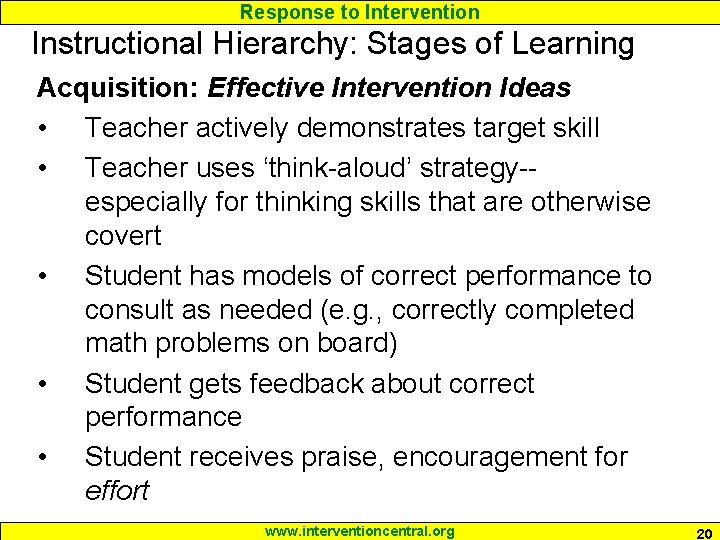
Response to Intervention Instructional Hierarchy: Stages of Learning Acquisition: Effective Intervention Ideas • Teacher actively demonstrates target skill • Teacher uses ‘think-aloud’ strategy-especially for thinking skills that are otherwise covert • Student has models of correct performance to consult as needed (e. g. , correctly completed math problems on board) • Student gets feedback about correct performance • Student receives praise, encouragement for effort www. interventioncentral. org 20
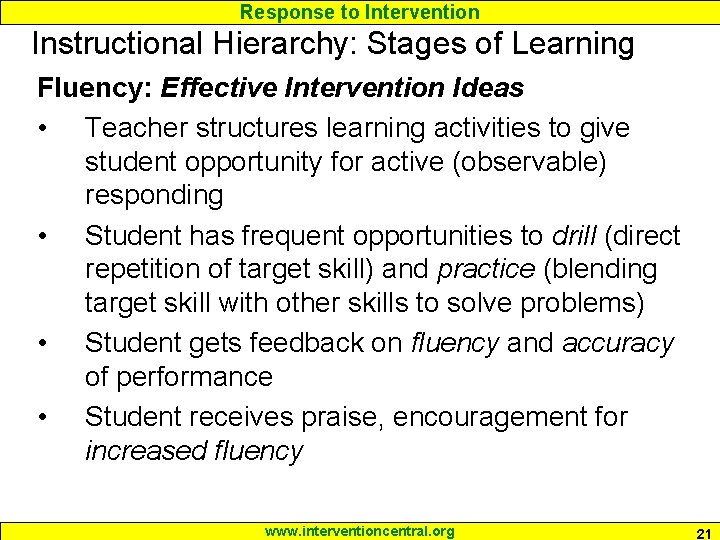
Response to Intervention Instructional Hierarchy: Stages of Learning Fluency: Effective Intervention Ideas • Teacher structures learning activities to give student opportunity for active (observable) responding • Student has frequent opportunities to drill (direct repetition of target skill) and practice (blending target skill with other skills to solve problems) • Student gets feedback on fluency and accuracy of performance • Student receives praise, encouragement for increased fluency www. interventioncentral. org 21
Response to Intervention Instructional Hierarchy: Stages of Learning Generalization: Effective Intervention Ideas • Teacher structures academic tasks to require that the student use the target skill regularly in assignments. • Student receives encouragement, praise, reinforcers for using skill in new settings, situations • If student confuses target skill with similar skill(s), the student is given practice items that force him/her to correctly discriminate between similar skills • Teacher works with parents to identify tasks that the student canwww. interventioncentral. org do outside of school to practice 22
Response to Intervention Instructional Building Blocks… Adaption: Effective Intervention Ideas • Teacher helps student to articulate the ‘big ideas’ or core element(s) of target skill that the student can modify to face novel tasks, situations (e. g. , fractions, ratios, and percentages link to the ‘big idea’ of the part in relation to the whole; ‘Thank you’ is part of a larger class of polite speech) • Train for adaptation: Student gets opportunities to practice the target skill with modest modifications in new situations, settings with encouragement, corrective feedback, praise, other reinforcers. • Encourage student to set own goals for adapting www. interventioncentral. org 23
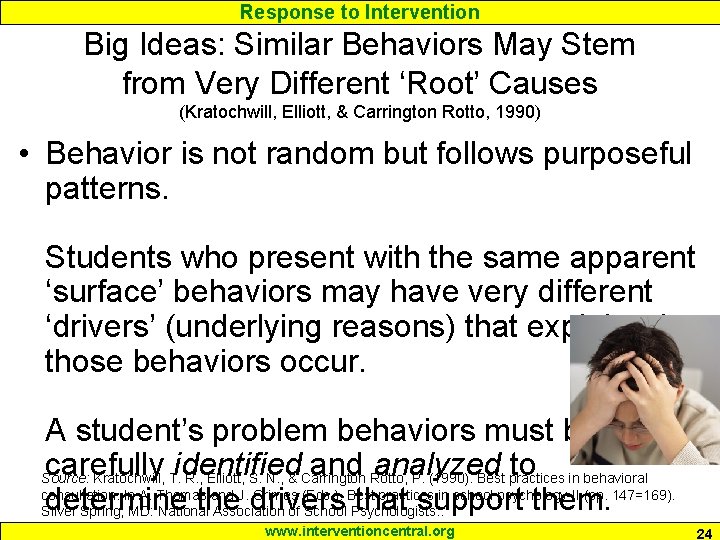
Response to Intervention Big Ideas: Similar Behaviors May Stem from Very Different ‘Root’ Causes (Kratochwill, Elliott, & Carrington Rotto, 1990) • Behavior is not random but follows purposeful patterns. Students who present with the same apparent ‘surface’ behaviors may have very different ‘drivers’ (underlying reasons) that explain why those behaviors occur. A student’s problem behaviors must be carefully identified analyzed to Source: Kratochwill, T. R. , Elliott, S. N. , & Carrington Rotto, P. (1990). Best practices in behavioral consultation. In A. Thomas and J. Grimes (Eds. ). Best practices in school psychology-II (pp. 147=169). determine the drivers that support them. Silver Spring, MD: National Association of School Psychologists. . www. interventioncentral. org 24
Response to Intervention Common ‘Root Causes’ or ‘Drivers’ for Behaviors Include… • Social attention (adult or peer) • Escape or avoidance • Access to tangibles or rewards or privileges (‘pay-offs’) • [Inattention or impulsivity] www. interventioncentral. org 25
Response to Intervention Teacher Referral Example… “Showed disrespect towards me when she yelled inappropriately regarding an instruction sheet. I then asked her to leave the room. She also showed disrespect when I called her twice earlier in the class to see her report card grade. ” www. interventioncentral. org 26
Response to Intervention Teacher Referral Example… “I gave out a test. After a few minutes, he crunched it and threw it on the floor. If he were not prepared, he could have talked to me and I would have allowed him to take it on a different date, as I usually do. ” www. interventioncentral. org 27
Response to Intervention Teacher Referral Example… “ 1 st ) During the beginning of English class, Z. continued to drink her soda. I gave her a warning and she answered me back. 2 nd) She began to talk to other students behind her during quiet reading. When I told her to stop talking, she began to get mouthy and nasty to me. She will do anything to get sent out of the room or to distract from my teaching. ” www. interventioncentral. org 28
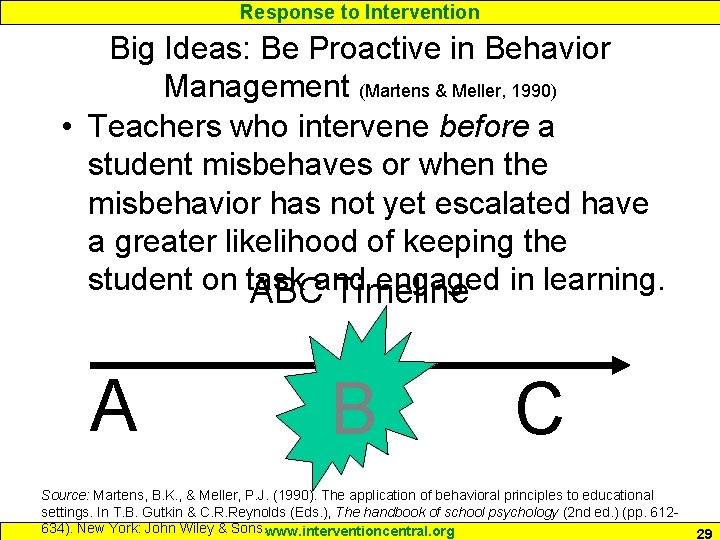
Response to Intervention Big Ideas: Be Proactive in Behavior Management (Martens & Meller, 1990) • Teachers who intervene before a student misbehaves or when the misbehavior has not yet escalated have a greater likelihood of keeping the student on task engaged in learning. ABCand Timeline A B C Source: Martens, B. K. , & Meller, P. J. (1990). The application of behavioral principles to educational settings. In T. B. Gutkin & C. R. Reynolds (Eds. ), The handbook of school psychology (2 nd ed. ) (pp. 612634). New York: John Wiley & Sons. www. interventioncentral. org 29
Response to Intervention Teacher Referral Example… “C. and T. were horsing around in the classroom. In the process, they knocked down an overhead projector and crushed it. ” www. interventioncentral. org 30
Response to Intervention Big Ideas: Behavior is a Continuous ‘Stream’ (Schoenfeld & Farmer, 1970) • Individuals are always performing SOME type of behavior: watching the instructor, sleeping, talking to a neighbor, completing a worksheet (‘behavior stream’). • When students are fully engaged in academic behaviors, they are less likely to get off-task and display problem behaviors. • Academic tasks that are clearly understood, elicit student interest, provide a high rate of student success, and include teacher encouragement and feedback are most likely to effectively ‘capture’ the student’s ‘behavior stream’. Source: Schoenfeld, W. N. , & Farmer, J. (1970). Reinforcement schedules and the ‘‘behavior stream. ’’ In W. N. Schoenfeld (Ed. ), The theory of reinforcement schedules (pp. 215– 245). New York: Appleton. Century-Crofts. www. interventioncentral. org 31
Response to Intervention ‘Elbow Group’ Activity: What Are Your School’s Top Intervention Needs? In your group: 1. Have each participant list the top 3 intervention concerns in his or her building or district. Those concerns can be behavioral or academic. 2. Note any common themes of intervention needs that were identified by multiple members of your group. www. interventioncentral. org 32
- Slides: 32