
Response to Intervention RTI Best Practices in Writing
Response to Intervention RTI: Best Practices in Writing & Math Interventions Jim Wright www. interventioncentral. org
Response to Intervention RTI: Best Practices in Writing and Math Interventions RTI & Academic Interventions: Overview Writing Interventions & Progress. Monitoring Academic Intervention ‘Critical Components’ Math Interventions & Progress. Monitoring Ideas for Measuring Integrity of Math & Writing Interventions Web Resources to Support Academic Interventions www. interventioncentral. org
Response to Intervention RTI Assumption: Struggling Students Are ‘Typical’ Until Proven Otherwise… RTI logic assumes that: – A student who begins to struggle in general education is typical, and that – It is general education’s responsibility to find the instructional strategies that will unlock the student’s learning potential Only when the student shows through welldocumented interventions that he or she has ‘failed to respond to intervention’ does RTI begin to investigate the possibility that the student may have a learning disability or other special education condition. www. interventioncentral. org 3
Response to Intervention Use Time & Resources Efficiently By Collecting Information Only on ‘Things That Are Alterable’ “…Time should be spent thinking about things that the intervention team can influence through instruction, consultation, related services, or adjustments to the student’s program. These are things that are alterable. …Beware of statements about cognitive processes that shift the focus from the curriculum and may even encourage questionable educational practice. They can also promote writing off a student because of Source: the rationale that the student’s insufficient Howell, K. W. , Hosp, J. L. , & Kurns, S. (2008). Best practices in curriculum-based evaluation. In A. Thomas & J. Grimes (Eds. ), Best practices in school psychology V (pp. 349 -362). Bethesda, MD: National Association of School Psychologists. performance is due to a limited and fixed www. interventioncentral. org 4
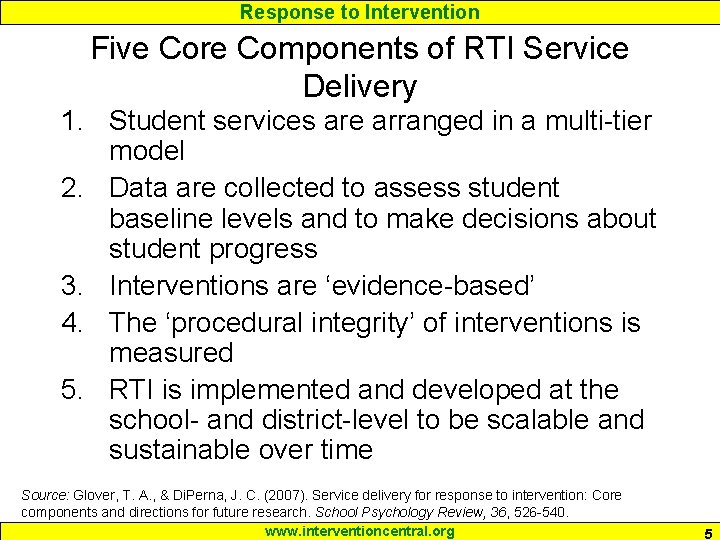
Response to Intervention Five Core Components of RTI Service Delivery 1. Student services are arranged in a multi-tier model 2. Data are collected to assess student baseline levels and to make decisions about student progress 3. Interventions are ‘evidence-based’ 4. The ‘procedural integrity’ of interventions is measured 5. RTI is implemented and developed at the school- and district-level to be scalable and sustainable over time Source: Glover, T. A. , & Di. Perna, J. C. (2007). Service delivery for response to intervention: Core components and directions for future research. School Psychology Review, 36, 526 -540. www. interventioncentral. org 5
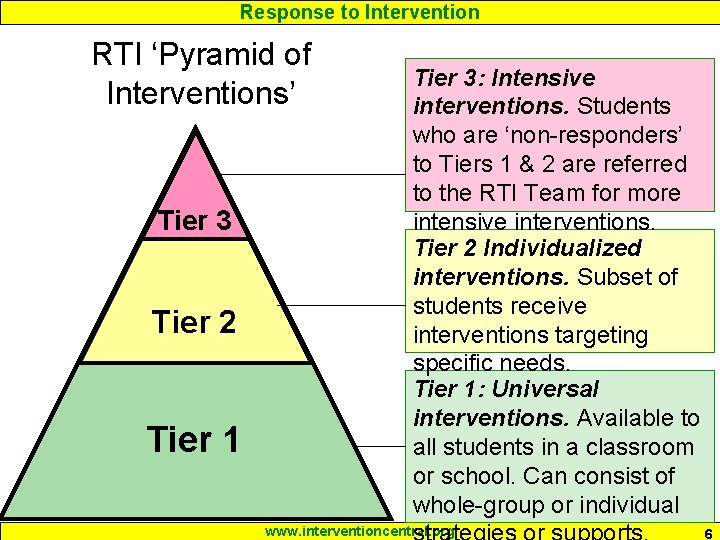
Response to Intervention RTI ‘Pyramid of Interventions’ Tier 3 Tier 2 Tier 1 Tier 3: Intensive interventions. Students who are ‘non-responders’ to Tiers 1 & 2 are referred to the RTI Team for more intensive interventions. Tier 2 Individualized interventions. Subset of students receive interventions targeting specific needs. Tier 1: Universal interventions. Available to all students in a classroom or school. Can consist of whole-group or individual www. interventioncentral. org 6
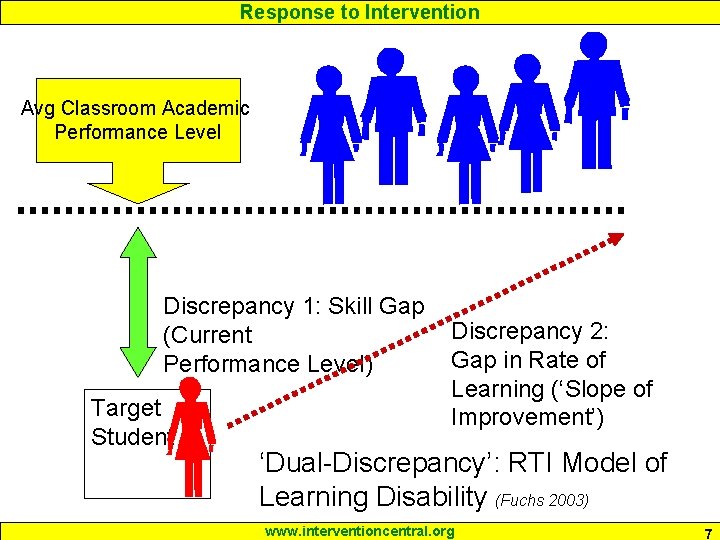
Response to Intervention Avg Classroom Academic Performance Level Discrepancy 1: Skill Gap Discrepancy 2: (Current Gap in Rate of Performance Level) Learning (‘Slope of Target Improvement’) Student ‘Dual-Discrepancy’: RTI Model of Learning Disability (Fuchs 2003) www. interventioncentral. org 7
Response to Intervention Research & Development: A Work in Progress www. interventioncentral. org
Response to Intervention Tier 1: What Are the Recommended Elements of ‘Core Curriculum’? : More Research Needed “In essence, we now have a good beginning on the evaluation of Tier 2 and 3 interventions, but no idea about what it will take to get the core curriculum to work at Tier 1. A complicating issue with this potential line of research is that many schools use multiple materials as their core program. ” p. 640 Source: Kovaleski, J. F. (2007). Response to intervention: Considerations for research and systems change. School Psychology Review, 36, 638 -646. www. interventioncentral. org 9
Response to Intervention Limitations of Intervention Research… “…the list of evidence-based interventions is quite small relative to the need [of RTI]…. Thus, limited dissemination of interventions is likely to be a practical problem as individuals move forward in the application of RTI models in applied settings. ” p. 33 Source: Kratochwill, T. R. , Clements, M. A. , & Kalymon, K. M. (2007). Response to intervention: Conceptual and methodological issues in implementation. In Jimerson, S. R. , Burns, M. K. , & Van. Der. Heyden, A. M. (Eds. ), Handbook of response to intervention: The science and practice of assessment and intervention. New York: Springer. www. interventioncentral. org 10
Response to Intervention Schools Need to Review Tier 1 (Classroom) Interventions to Ensure That They Are Supported By Research There is a lack of agreement about what is meant by ‘scientifically validated’ classroom (Tier I) interventions. Districts should establish a ‘vetting’ process—criteria for judging whether a particular instructional or intervention approach should be considered empirically based. Source: Fuchs, D. , & Deshler, D. D. (2007). What we need to know about responsiveness to intervention (and shouldn’t be afraid to ask). . Learning Disabilities Research & Practice, 22(2), 129– 136. www. interventioncentral. org 11
Response to Intervention What Are Appropriate Content-Area Tier 1 Universal Interventions for Secondary Schools? “High schools need to determine what constitutes high-quality universal instruction across content areas. In addition, high school teachers need professional development in, for example, differentiated instructional techniques that will help ensure student access to instruction interventions that are effectively implemented. ” Source: Duffy, H. (August 2007). Meeting the needs of significantly struggling learners in high school. Washington, DC: National High School Center. Retrieved from http: //www. betterhighschools. org/pubs/ p. 9 www. interventioncentral. org 12
Response to Intervention RTI & Intervention: Key Concepts www. interventioncentral. org
Response to Intervention Essential Elements of Any Academic or Behavioral Intervention (‘Treatment’) Strategy: • Method of delivery (‘Who or what delivers the treatment? ’) Examples include teachers, paraprofessionals, parents, volunteers, computers. • Treatment component (‘What makes the intervention effective? ’) Examples include activation of prior knowledge to help the student to make meaningful connections between ‘known’ and new material; guide practice (e. g. , Paired Reading) to increase reading fluency; www. interventioncentral. org periodic review of material to aid 14
Response to Intervention Core Instruction, Interventions, Accommodations & Modifications: Sorting Them Out • Core Instruction. Those instructional strategies that are used routinely with all students in a general-education setting are considered ‘core instruction’. Highquality instruction is essential and forms the foundation of RTI academic support. NOTE: While it is important to verify that good core instructional practices are in place for a struggling student, those routine practices do not ‘count’ as individual student interventions. www. interventioncentral. org 15
Response to Intervention Core Instruction, Interventions, Accommodations & Modifications: Sorting Them Out • Intervention. An academic intervention is a strategy used to teach a new skill, build fluency in a skill, or encourage a child to apply an existing skill to new situations or settings. An intervention can be thought of as “a set of actions that, when taken, have demonstrated ability to change a fixed educational trajectory” (Methe & Riley-Tillman, 2008; p. 37). www. interventioncentral. org 16
Response to Intervention Core Instruction, Interventions, Accommodations & Modifications: Sorting Them Out • Accommodation. An accommodation is intended to help the student to fully access and participate in the general-education curriculum without changing the instructional content and without reducing the student’s rate of learning (Skinner, Pappas & Davis, 2005). An accommodation is intended to remove barriers to learning while still expecting that students will master the same instructional content as their typical peers. – Accommodation example 1: Students are allowed to supplement silent reading of a novel by listening to the book on tape. – Accommodation example 2: For unmotivated students, the instructor breaks larger assignments into smaller ‘chunks’ and providing students with www. interventioncentral. org 17
Response to Intervention Core Instruction, Interventions, Accommodations & Modifications: Sorting Them Out • Modification. A modification changes the expectations of what a student is expected to know or do—typically by lowering the academic standards against which the student is to be evaluated. Examples of modifications: – Giving a student five math computation problems for practice instead of the 20 problems assigned to the rest of the class – Letting the student consult course notes during a test when peers are not permitted to do so www. interventioncentral. org – Allowing a student to select a much easier book for a 18
Response to Intervention RTI: Writing Interventions Jim Wright www. interventioncentral. org
Response to Intervention www. interventioncentral. org 20
Response to Intervention Defining Student Writing Problems www. interventioncentral. org
Response to Intervention "If all the grammarians in the world were placed end to end, it would be a good thing. " – Oscar Wilde www. interventioncentral. org 22
Response to Intervention Domains of writing to be assessed (Robinson & Howell, 2008): • • • Fluency/Text Generation: Facility in getting text onto paper or typed into the computer. (NOTE: This element can be significantly influenced by student motivation. ) Syntactic Maturity: This skill includes the: – Ability to discern when a word string meets criteria as a complete sentence – Ability to write compositions with a diverse range of sentence structures Semantic Maturity: Writer’s use of vocabulary of range and sophistication Source: Robinson, L. K. , & Howell, K. W. (2008). Best practices in curriculum-based evaluation & written expression. In A. Thomas & J. Grimes (Eds. ), Best practices in school psychology V (pp. 439 -452). Bethesda, MD: National Association of School Psychologists. www. interventioncentral. org 23
Response to Intervention Domains of writing to be assessed (Robinson & Howell, 2008) : 5 -Step Writing Process: (Items in bold are iterative): 1. Planning. The student carries out necessary prewriting planning activities, including content, format, and outline. 2. Drafting. The student writes or types the composition. 3. Revision. The student reviews the content of the composition-in-progress and makes changes as needed. After producing an initial written draft, the student considers revisions to content before turning in for a grade or evaluation. 4. Editing. The student looks over the composition and corrects any mechanical mistakes Source: Robinson, L. K. , & Howell, K. W. (2008). Best practices in curriculum-based evaluation & written (capitalization, punctuation, etc. ). expression. In A. Thomas & J. Grimes (Eds. ), Best practices in school psychology V (pp. 439 -452). Bethesda, MD: National Association of School Psychologists. 5. Publication: The student submits the composition in www. interventioncentral. org 24

Response to Intervention Graham, S. , & Perin, D. (2007). Writing next: Effective strategies to improve writing of adolescents in middle and high schools – A report to Carnegie Corporation of New York. Washington, DC Alliance for Excellent Education. Retrieved from http: //www. all 4 ed. org/files/ Writing. Next. pdf www. interventioncentral. org 25
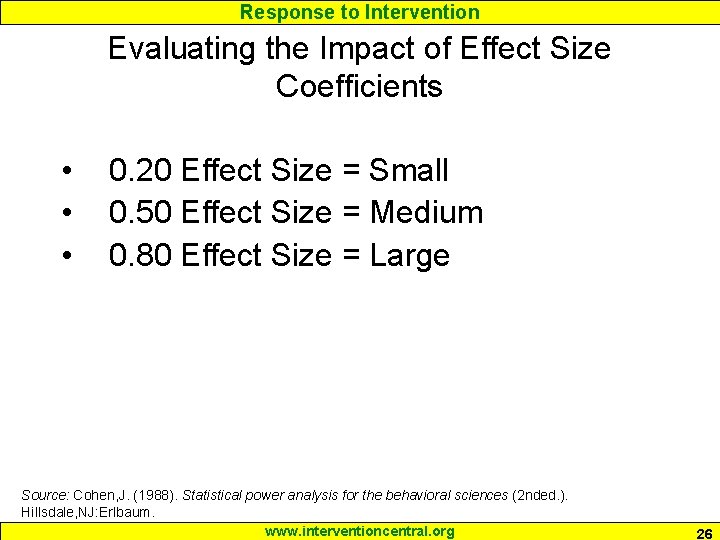
Response to Intervention Evaluating the Impact of Effect Size Coefficients • • • 0. 20 Effect Size = Small 0. 50 Effect Size = Medium 0. 80 Effect Size = Large Source: Cohen, J. (1988). Statistical power analysis for the behavioral sciences (2 nded. ). Hillsdale, NJ: Erlbaum. www. interventioncentral. org 26
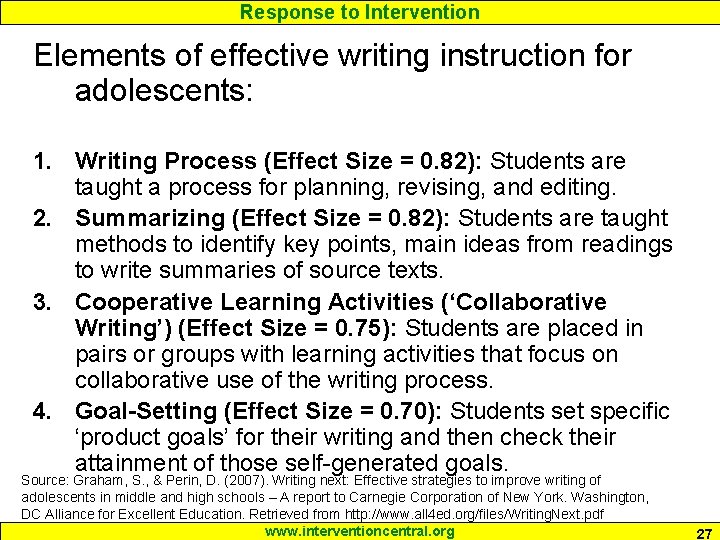
Response to Intervention Elements of effective writing instruction for adolescents: 1. Writing Process (Effect Size = 0. 82): Students are taught a process for planning, revising, and editing. 2. Summarizing (Effect Size = 0. 82): Students are taught methods to identify key points, main ideas from readings to write summaries of source texts. 3. Cooperative Learning Activities (‘Collaborative Writing’) (Effect Size = 0. 75): Students are placed in pairs or groups with learning activities that focus on collaborative use of the writing process. 4. Goal-Setting (Effect Size = 0. 70): Students set specific ‘product goals’ for their writing and then check their attainment of those self-generated goals. Source: Graham, S. , & Perin, D. (2007). Writing next: Effective strategies to improve writing of adolescents in middle and high schools – A report to Carnegie Corporation of New York. Washington, DC Alliance for Excellent Education. Retrieved from http: //www. all 4 ed. org/files/Writing. Next. pdf www. interventioncentral. org 27
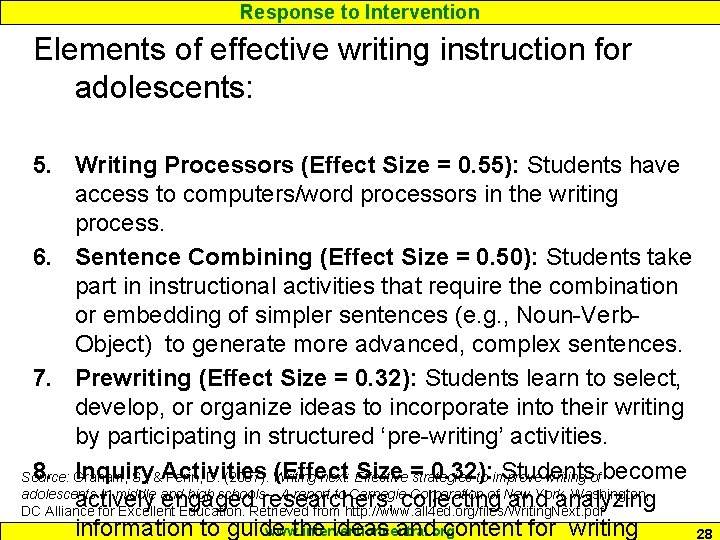
Response to Intervention Elements of effective writing instruction for adolescents: 5. Writing Processors (Effect Size = 0. 55): Students have access to computers/word processors in the writing process. 6. Sentence Combining (Effect Size = 0. 50): Students take part in instructional activities that require the combination or embedding of simpler sentences (e. g. , Noun-Verb. Object) to generate more advanced, complex sentences. 7. Prewriting (Effect Size = 0. 32): Students learn to select, develop, or organize ideas to incorporate into their writing by participating in structured ‘pre-writing’ activities. 8. Graham, S. , & Perin, D. (2007). Writing Inquiry Activities (Effect Size = 0. 32): Students become Source: next: Effective strategies to improve writing of adolescents in middle and high schools – A report to Carnegie Corporation of New York. Washington, actively engaged researchers, collecting and analyzing DC Alliance for Excellent Education. Retrieved from http: //www. all 4 ed. org/files/Writing. Next. pdf information to guide the ideas and content for writing www. interventioncentral. org 28
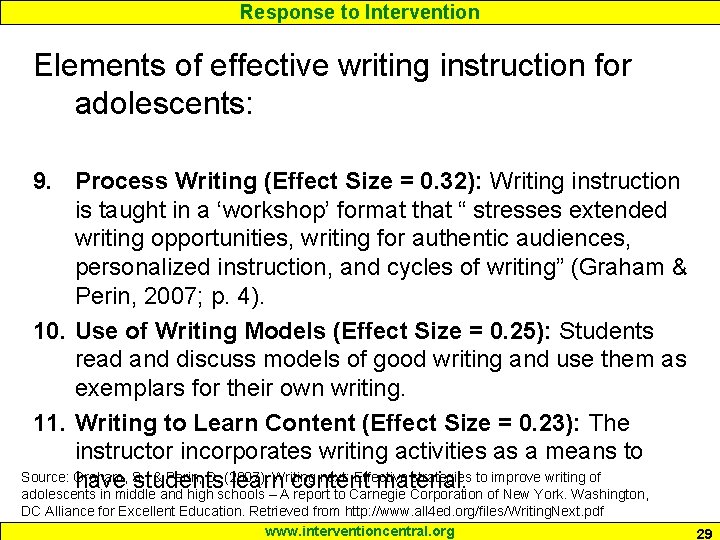
Response to Intervention Elements of effective writing instruction for adolescents: 9. Process Writing (Effect Size = 0. 32): Writing instruction is taught in a ‘workshop’ format that “ stresses extended writing opportunities, writing for authentic audiences, personalized instruction, and cycles of writing” (Graham & Perin, 2007; p. 4). 10. Use of Writing Models (Effect Size = 0. 25): Students read and discuss models of good writing and use them as exemplars for their own writing. 11. Writing to Learn Content (Effect Size = 0. 23): The instructor incorporates writing activities as a means to Source: Graham, S. , & Perin, D. (2007). Writing next: Effective strategies to improve writing of have students learn content material. adolescents in middle and high schools – A report to Carnegie Corporation of New York. Washington, DC Alliance for Excellent Education. Retrieved from http: //www. all 4 ed. org/files/Writing. Next. pdf www. interventioncentral. org 29
Response to Intervention The Effect of Grammar Instruction as an Independent Activity “Grammar instruction in the studies reviewed [for the Writing Next report] involved the explicit and systematic teaching of the parts of speech and structure of sentences. The meta-analysis found an effect for this type of instruction for students across the full range of ability, but …surprisingly, this effect was negative…Such findings raise serious questions about some educators’ enthusiasm for traditional grammar instruction as a focus of writing instruction for adolescents…. Overall, the findings on grammar instruction suggest that, although teaching grammar is important, alternative procedures, such as sentence combining, are more effective than Source: Graham, S. , & Perin, D. (2007). Writing next: Effective strategies to improve writing of traditional approaches for improving the quality of adolescents in middle and high schools – A report to Carnegie Corporation of New York. Washington, DC Alliance for Excellent Education. www. interventioncentral. org 30
Response to Intervention Challenge: How Do Schools Stop the Use of ‘Zombie’ Instructional Practices? “In their rush to promote use of evidence-based instructional practices under RTI… schools should not forget that research cuts both ways. It can illuminate new approaches to effectively teach struggling learners. But research also sometimes reveals instructional or intervention strategies that should be reformed or eliminated altogether. Despite the fact that educators may have developed a sentimental attachment to such outmoded practices, schools should provide the appropriate support to help these teachers to discard them and adopt more effective instructional tools. Otherwise, these Source: Wright, J. (2010). Killing off ‘zombie' interventions: The need to root out ineffective instructional obsolete, zombie methods of instruction and strategies. Retrieved from http: //www. interventioncentral. org 31
Response to Intervention Question: How Does a School Use Research Information to Influence Classroom Practice? • In this workshop, we reviewed recommendations from the Writing Next manual, a metaanalysis of effective writing instructional elements. • How might your school use information sources like this to influence classroom practice? www. interventioncentral. org 32
Response to Intervention "The difference between the right word and the almost right word is the difference between lightning and the lightning bug. " – Mark Twain www. interventioncentral. org 33
Response to Intervention "Your manuscript is both good and original. But the part that is good is not original, and the part that is original is not good. " – Samuel Johnson www. interventioncentral. org 34
Response to Intervention Selected Writing Interventions www. interventioncentral. org
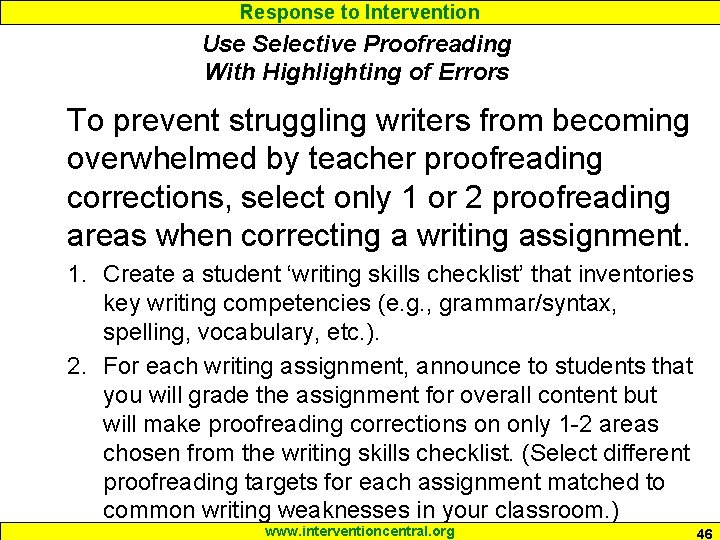
Response to Intervention Use Selective Proofreading With Highlighting of Errors To prevent struggling writers from becoming overwhelmed by teacher proofreading corrections, select only 1 or 2 proofreading areas when correcting a writing assignment. 1. Create a student ‘writing skills checklist’ that inventories key writing competencies (e. g. , grammar/syntax, spelling, vocabulary, etc. ). 2. For each writing assignment, announce to students that you will grade the assignment for overall content but will make proofreading corrections on only 1 -2 areas chosen from the writing skills checklist. (Select different proofreading targets for each assignment matched to common writing weaknesses in your classroom. ) www. interventioncentral. org 46
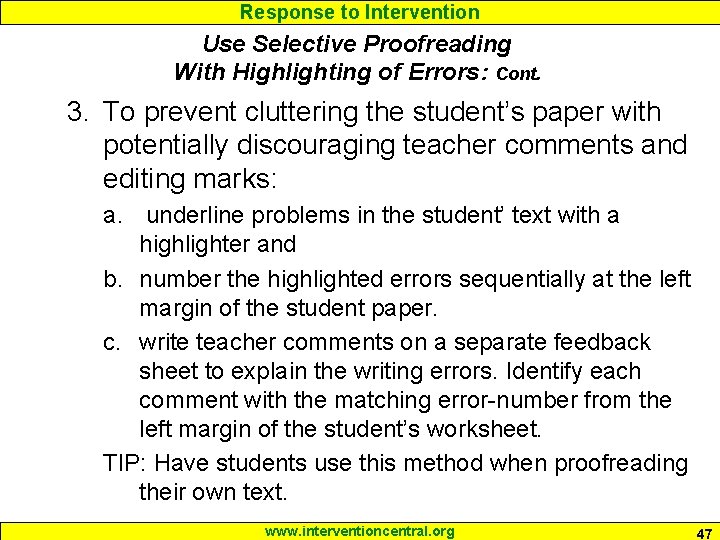
Response to Intervention Use Selective Proofreading With Highlighting of Errors: Cont. 3. To prevent cluttering the student’s paper with potentially discouraging teacher comments and editing marks: a. underline problems in the student’ text with a highlighter and b. number the highlighted errors sequentially at the left margin of the student paper. c. write teacher comments on a separate feedback sheet to explain the writing errors. Identify each comment with the matching error-number from the left margin of the student’s worksheet. TIP: Have students use this method when proofreading their own text. www. interventioncentral. org 47
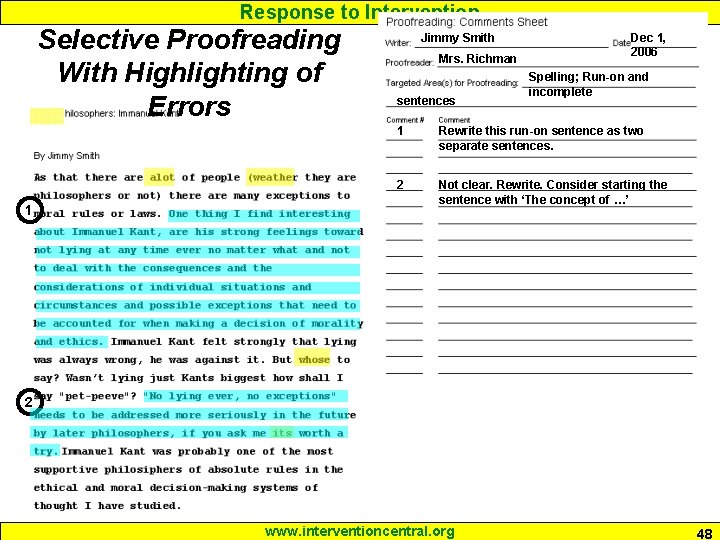
Response to Intervention Selective Proofreading With Highlighting of Errors 1 Jimmy Smith Mrs. Richman sentences Dec 1, 2006 Spelling; Run-on and incomplete 1 Rewrite this run-on sentence as two separate sentences. 2 Not clear. Rewrite. Consider starting the sentence with ‘The concept of …’ 2 www. interventioncentral. org 48
Response to Intervention "A ratio of failures is built into the process of writing. The wastebasket has evolved for a reason. " – Margaret Atwood www. interventioncentral. org 49
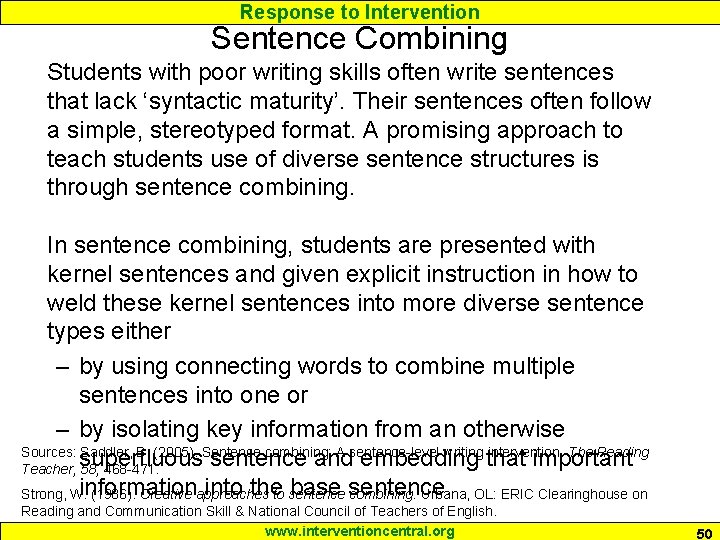
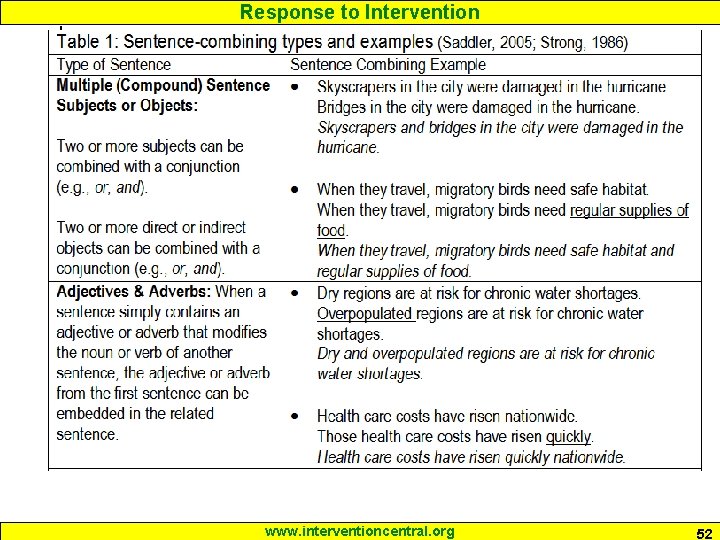
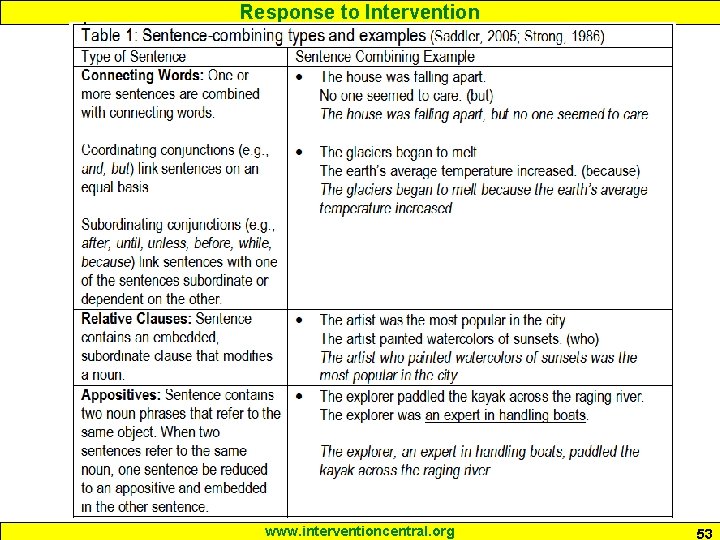
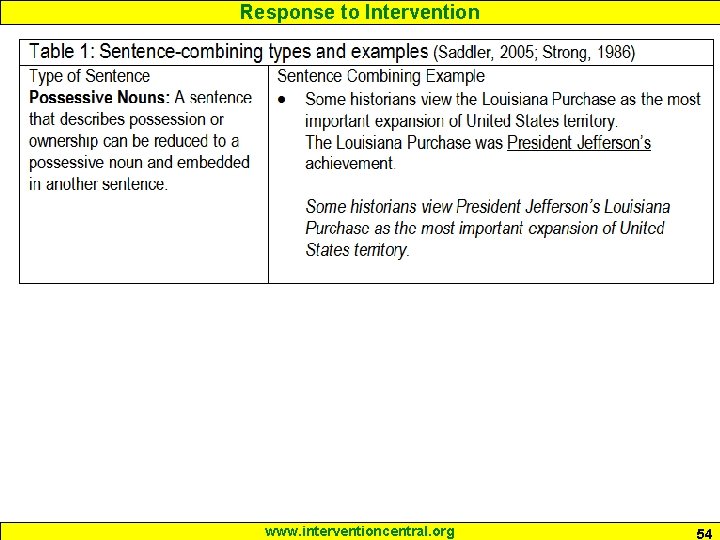
Response to Intervention Sentence Combining Students with poor writing skills often write sentences that lack ‘syntactic maturity’. Their sentences often follow a simple, stereotyped format. A promising approach to teach students use of diverse sentence structures is through sentence combining. In sentence combining, students are presented with kernel sentences and given explicit instruction in how to weld these kernel sentences into more diverse sentence types either – by using connecting words to combine multiple sentences into one or – by isolating key information from an otherwise Sources: Saddler, B. (2005). Sentence combining: A sentence-level writing intervention. The Reading superfluous sentence and embedding that important Teacher, 58, 468 -471. information into the base sentence. Strong, W. (1986). Creative approaches to sentence combining. Urbana, OL: ERIC Clearinghouse on Reading and Communication Skill & National Council of Teachers of English. www. interventioncentral. org 50
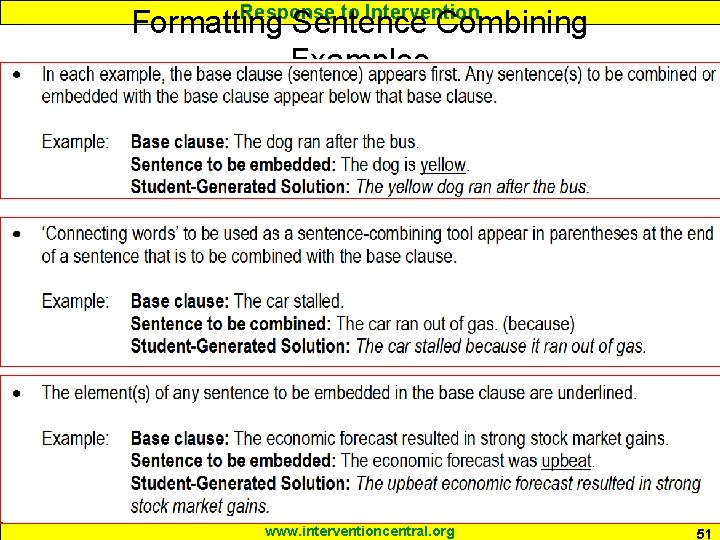
Response to Intervention Formatting Sentence Combining Examples www. interventioncentral. org 51
Response to Intervention www. interventioncentral. org 52
Response to Intervention www. interventioncentral. org 53
Response to Intervention www. interventioncentral. org 54
Response to Intervention Academic Interventions ‘Critical Components’ Checklist www. interventioncentral. org
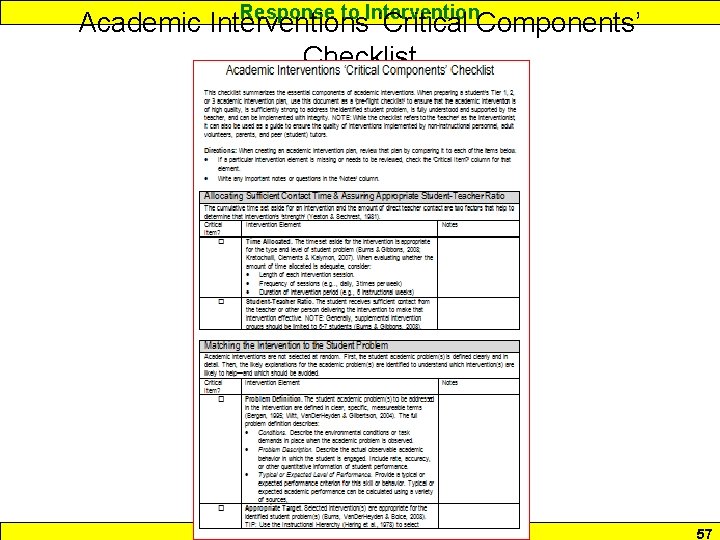
Response to Intervention Academic Interventions ‘Critical Components’ Checklist www. interventioncentral. org 57
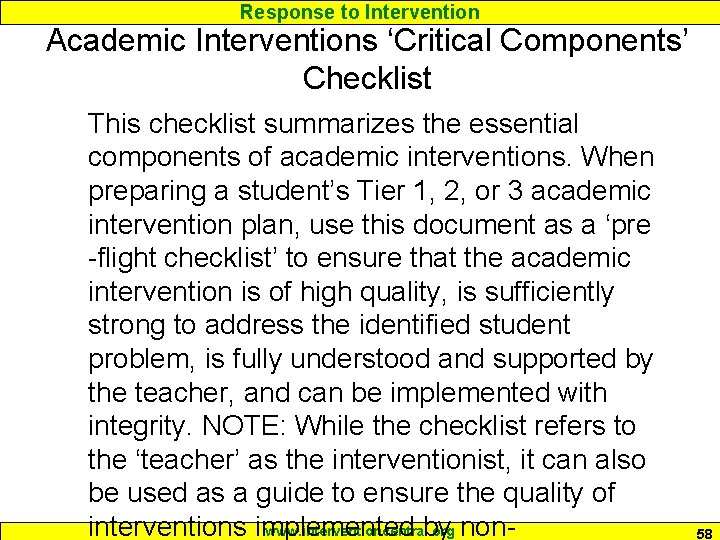
Response to Intervention Academic Interventions ‘Critical Components’ Checklist This checklist summarizes the essential components of academic interventions. When preparing a student’s Tier 1, 2, or 3 academic intervention plan, use this document as a ‘pre -flight checklist’ to ensure that the academic intervention is of high quality, is sufficiently strong to address the identified student problem, is fully understood and supported by the teacher, and can be implemented with integrity. NOTE: While the checklist refers to the ‘teacher’ as the interventionist, it can also be used as a guide to ensure the quality of interventions implemented by nonwww. interventioncentral. org 58
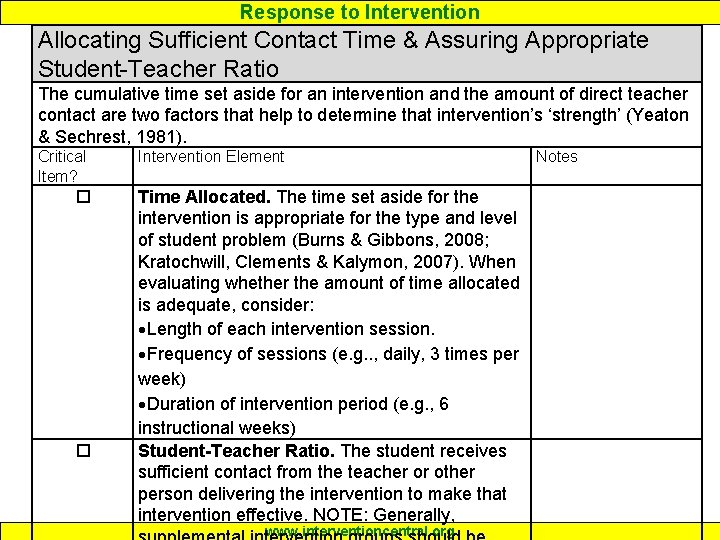
Response to Intervention Allocating Sufficient Contact Time & Assuring Appropriate Student-Teacher Ratio The cumulative time set aside for an intervention and the amount of direct teacher contact are two factors that help to determine that intervention’s ‘strength’ (Yeaton & Sechrest, 1981). Critical Item? Intervention Element Time Allocated. The time set aside for the intervention is appropriate for the type and level of student problem (Burns & Gibbons, 2008; Kratochwill, Clements & Kalymon, 2007). When evaluating whether the amount of time allocated is adequate, consider: Length of each intervention session. Frequency of sessions (e. g. . , daily, 3 times per week) Duration of intervention period (e. g. , 6 instructional weeks) Student-Teacher Ratio. The student receives sufficient contact from the teacher or other person delivering the intervention to make that intervention effective. NOTE: Generally, www. interventioncentral. org Notes
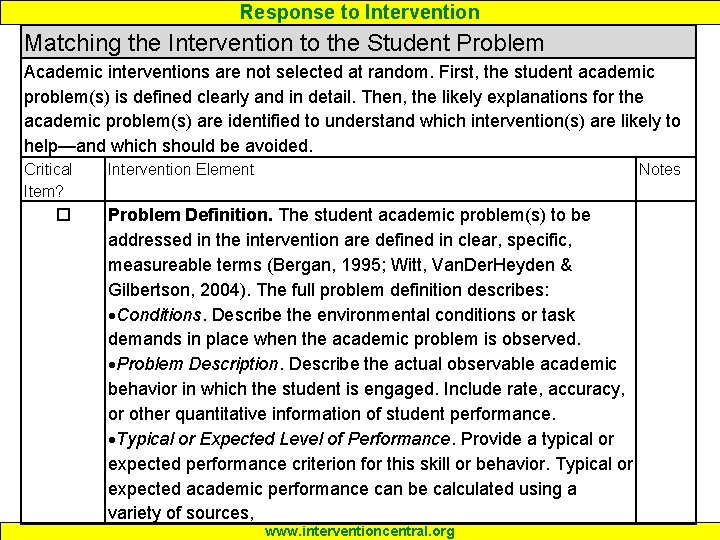
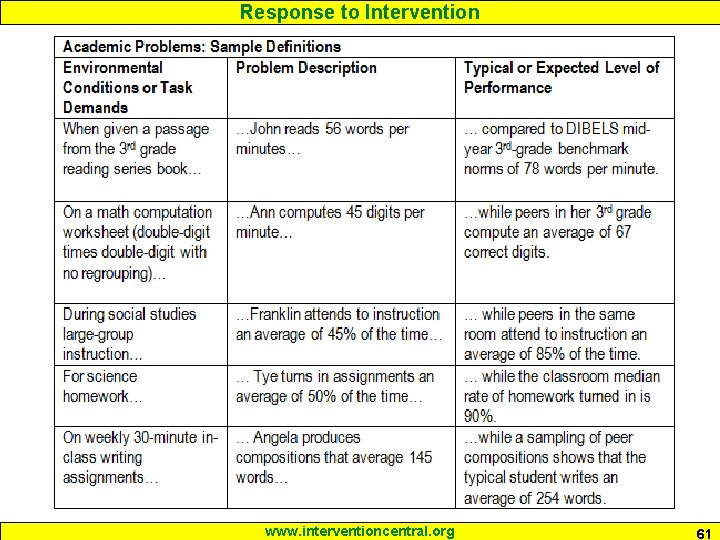
Response to Intervention Matching the Intervention to the Student Problem Academic interventions are not selected at random. First, the student academic problem(s) is defined clearly and in detail. Then, the likely explanations for the academic problem(s) are identified to understand which intervention(s) are likely to help—and which should be avoided. Critical Item? Intervention Element Notes Problem Definition. The student academic problem(s) to be addressed in the intervention are defined in clear, specific, measureable terms (Bergan, 1995; Witt, Van. Der. Heyden & Gilbertson, 2004). The full problem definition describes: Conditions. Describe the environmental conditions or task demands in place when the academic problem is observed. Problem Description. Describe the actual observable academic behavior in which the student is engaged. Include rate, accuracy, or other quantitative information of student performance. Typical or Expected Level of Performance. Provide a typical or expected performance criterion for this skill or behavior. Typical or expected academic performance can be calculated using a variety of sources, www. interventioncentral. org
Response to Intervention www. interventioncentral. org 61
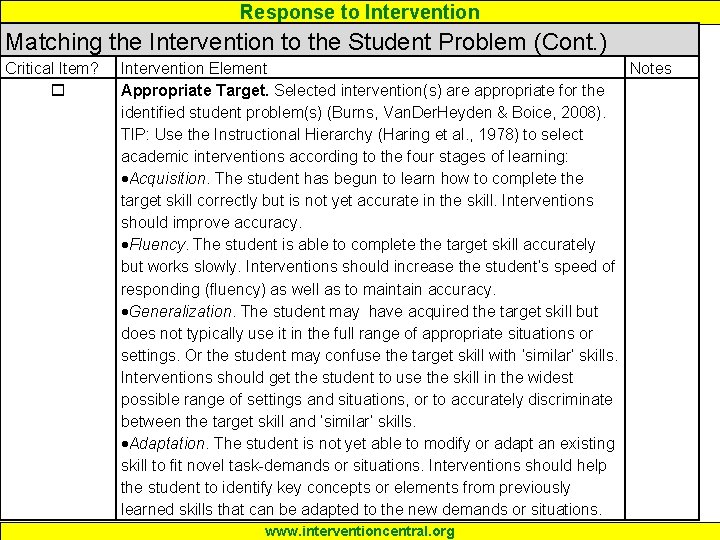
Response to Intervention Matching the Intervention to the Student Problem (Cont. ) Critical Item? Intervention Element Notes Appropriate Target. Selected intervention(s) are appropriate for the identified student problem(s) (Burns, Van. Der. Heyden & Boice, 2008). TIP: Use the Instructional Hierarchy (Haring et al. , 1978) to select academic interventions according to the four stages of learning: Acquisition. The student has begun to learn how to complete the target skill correctly but is not yet accurate in the skill. Interventions should improve accuracy. Fluency. The student is able to complete the target skill accurately but works slowly. Interventions should increase the student’s speed of responding (fluency) as well as to maintain accuracy. Generalization. The student may have acquired the target skill but does not typically use it in the full range of appropriate situations or settings. Or the student may confuse the target skill with ‘similar’ skills. Interventions should get the student to use the skill in the widest possible range of settings and situations, or to accurately discriminate between the target skill and ‘similar’ skills. Adaptation. The student is not yet able to modify or adapt an existing skill to fit novel task-demands or situations. Interventions should help the student to identify key concepts or elements from previously learned skills that can be adapted to the new demands or situations. www. interventioncentral. org
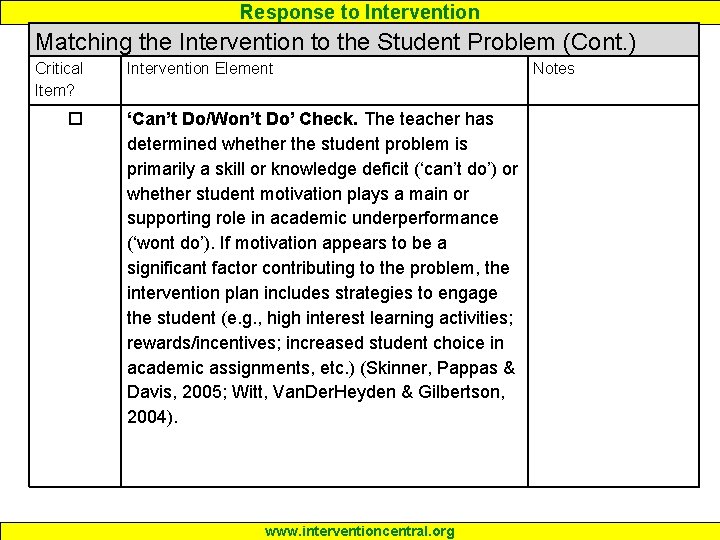
Response to Intervention Matching the Intervention to the Student Problem (Cont. ) Critical Item? Intervention Element ‘Can’t Do/Won’t Do’ Check. The teacher has determined whether the student problem is primarily a skill or knowledge deficit (‘can’t do’) or whether student motivation plays a main or supporting role in academic underperformance (‘wont do’). If motivation appears to be a significant factor contributing to the problem, the intervention plan includes strategies to engage the student (e. g. , high interest learning activities; rewards/incentives; increased student choice in academic assignments, etc. ) (Skinner, Pappas & Davis, 2005; Witt, Van. Der. Heyden & Gilbertson, 2004). www. interventioncentral. org Notes
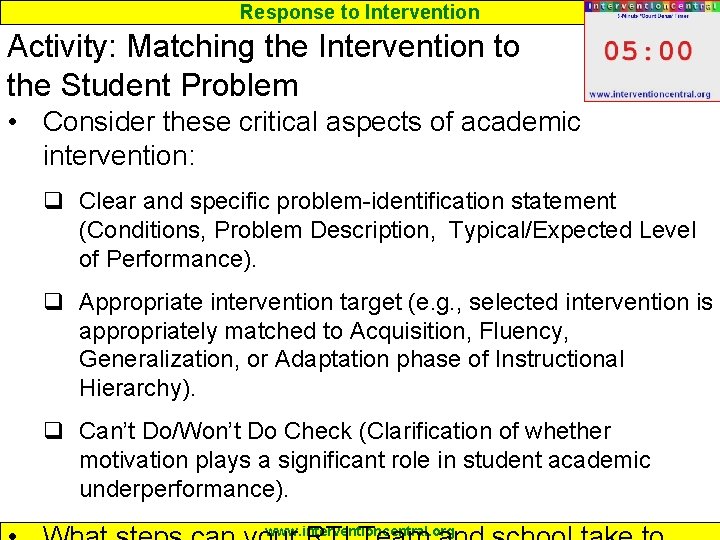
Response to Intervention Activity: Matching the Intervention to the Student Problem • Consider these critical aspects of academic intervention: q Clear and specific problem-identification statement (Conditions, Problem Description, Typical/Expected Level of Performance). q Appropriate intervention target (e. g. , selected intervention is appropriately matched to Acquisition, Fluency, Generalization, or Adaptation phase of Instructional Hierarchy). q Can’t Do/Won’t Do Check (Clarification of whether motivation plays a significant role in student academic underperformance). www. interventioncentral. org
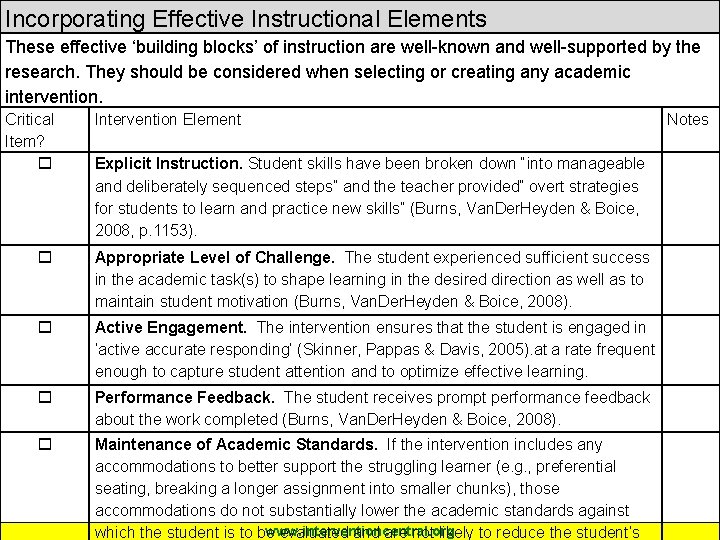
Response to Intervention Incorporating Effective Instructional Elements These effective ‘building blocks’ of instruction are well-known and well-supported by the research. They should be considered when selecting or creating any academic intervention. Critical Item? Intervention Element Explicit Instruction. Student skills have been broken down “into manageable and deliberately sequenced steps” and the teacher provided“ overt strategies for students to learn and practice new skills” (Burns, Van. Der. Heyden & Boice, 2008, p. 1153). Appropriate Level of Challenge. The student experienced sufficient success in the academic task(s) to shape learning in the desired direction as well as to maintain student motivation (Burns, Van. Der. Heyden & Boice, 2008). Active Engagement. The intervention ensures that the student is engaged in ‘active accurate responding’ (Skinner, Pappas & Davis, 2005). at a rate frequent enough to capture student attention and to optimize effective learning. Performance Feedback. The student receives prompt performance feedback about the work completed (Burns, Van. Der. Heyden & Boice, 2008). Maintenance of Academic Standards. If the intervention includes any accommodations to better support the struggling learner (e. g. , preferential seating, breaking a longer assignment into smaller chunks), those accommodations do not substantially lower the academic standards against www. interventioncentral. org which the student is to be evaluated and are not likely to reduce the student’s Notes
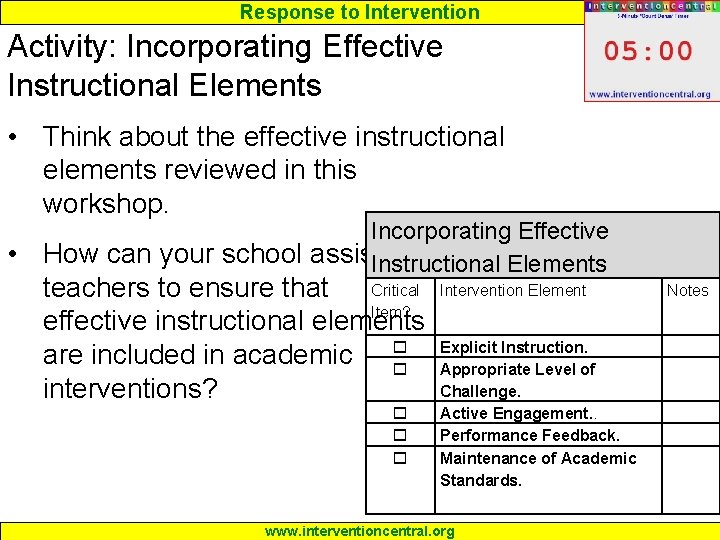
Response to Intervention Activity: Incorporating Effective Instructional Elements • Think about the effective instructional elements reviewed in this workshop. • Incorporating Effective How can your school assist Instructional Elements teachers to ensure that Critical Intervention Element Item? effective instructional elements Explicit Instruction. are included in academic Appropriate Level of Challenge. interventions? Active Engagement. . Performance Feedback. Maintenance of Academic Standards. www. interventioncentral. org Notes
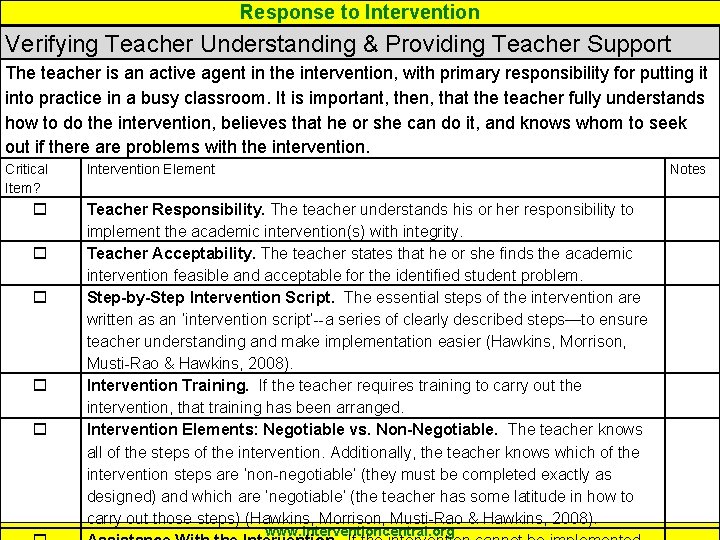
Response to Intervention Verifying Teacher Understanding & Providing Teacher Support The teacher is an active agent in the intervention, with primary responsibility for putting it into practice in a busy classroom. It is important, then, that the teacher fully understands how to do the intervention, believes that he or she can do it, and knows whom to seek out if there are problems with the intervention. Critical Item? Intervention Element Notes Teacher Responsibility. The teacher understands his or her responsibility to implement the academic intervention(s) with integrity. Teacher Acceptability. The teacher states that he or she finds the academic intervention feasible and acceptable for the identified student problem. Step-by-Step Intervention Script. The essential steps of the intervention are written as an ‘intervention script’--a series of clearly described steps—to ensure teacher understanding and make implementation easier (Hawkins, Morrison, Musti-Rao & Hawkins, 2008). Intervention Training. If the teacher requires training to carry out the intervention, that training has been arranged. Intervention Elements: Negotiable vs. Non-Negotiable. The teacher knows all of the steps of the intervention. Additionally, the teacher knows which of the intervention steps are ‘non-negotiable’ (they must be completed exactly as designed) and which are ‘negotiable’ (the teacher has some latitude in how to carry out those steps) (Hawkins, Morrison, Musti-Rao & Hawkins, 2008). www. interventioncentral. org
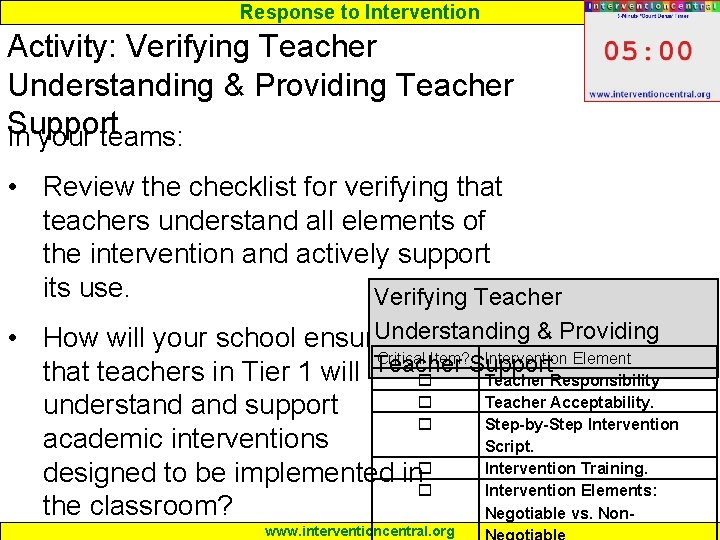
Response to Intervention Activity: Verifying Teacher Understanding & Providing Teacher Support In your teams: • Review the checklist for verifying that teachers understand all elements of the intervention and actively support its use. Verifying Teacher Understanding & Providing • How will your school ensure Critical Item? Intervention Element Teacher Support that teachers in Tier 1 will Teacher Responsibility Teacher Acceptability. understand support Step-by-Step Intervention academic interventions Script. Intervention Training. designed to be implemented in Intervention Elements: the classroom? Negotiable vs. Nonwww. interventioncentral. org
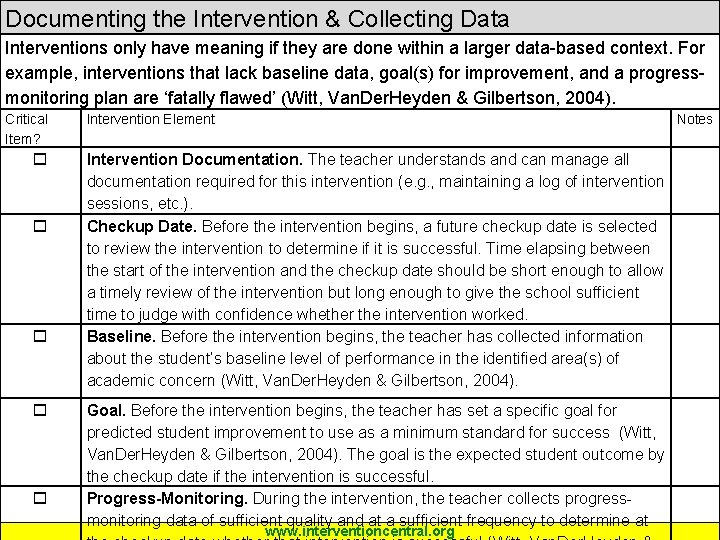
Response to Intervention Documenting the Intervention & Collecting Data Interventions only have meaning if they are done within a larger data-based context. For example, interventions that lack baseline data, goal(s) for improvement, and a progressmonitoring plan are ‘fatally flawed’ (Witt, Van. Der. Heyden & Gilbertson, 2004). Critical Item? Intervention Element Notes Intervention Documentation. The teacher understands and can manage all documentation required for this intervention (e. g. , maintaining a log of intervention sessions, etc. ). Checkup Date. Before the intervention begins, a future checkup date is selected to review the intervention to determine if it is successful. Time elapsing between the start of the intervention and the checkup date should be short enough to allow a timely review of the intervention but long enough to give the school sufficient time to judge with confidence whether the intervention worked. Baseline. Before the intervention begins, the teacher has collected information about the student’s baseline level of performance in the identified area(s) of academic concern (Witt, Van. Der. Heyden & Gilbertson, 2004). Goal. Before the intervention begins, the teacher has set a specific goal for predicted student improvement to use as a minimum standard for success (Witt, Van. Der. Heyden & Gilbertson, 2004). The goal is the expected student outcome by the checkup date if the intervention is successful. Progress-Monitoring. During the intervention, the teacher collects progressmonitoring data of sufficient quality and at a sufficient frequency to determine at www. interventioncentral. org
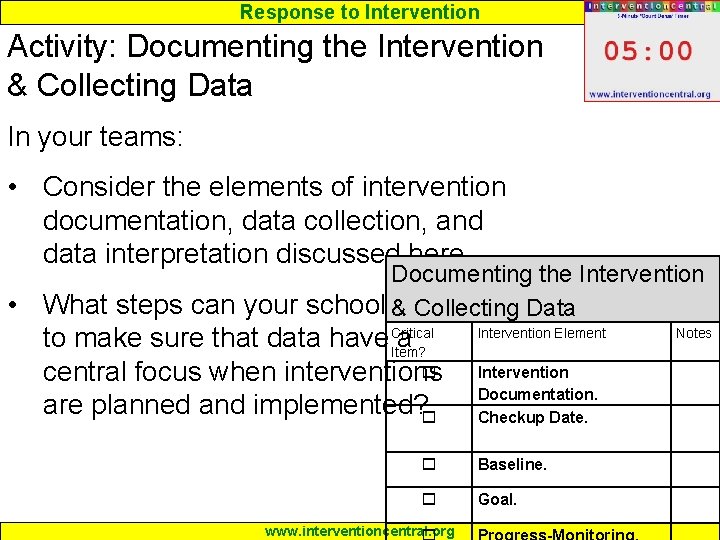
Response to Intervention Activity: Documenting the Intervention & Collecting Data In your teams: • Consider the elements of intervention documentation, data collection, and data interpretation discussed here. • Documenting the Intervention What steps can your school take & Collecting Data Critical to make sure that data have a Item? central focus when interventions are planned and implemented? Intervention Element Intervention Documentation. Checkup Date. Baseline. Goal. www. interventioncentral. org Notes
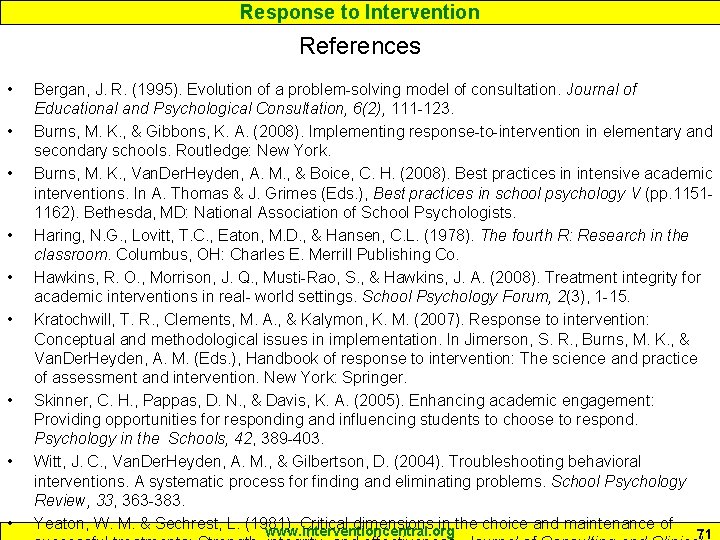
Response to Intervention References • • • Bergan, J. R. (1995). Evolution of a problem-solving model of consultation. Journal of Educational and Psychological Consultation, 6(2), 111 -123. Burns, M. K. , & Gibbons, K. A. (2008). Implementing response-to-intervention in elementary and secondary schools. Routledge: New York. Burns, M. K. , Van. Der. Heyden, A. M. , & Boice, C. H. (2008). Best practices in intensive academic interventions. In A. Thomas & J. Grimes (Eds. ), Best practices in school psychology V (pp. 11511162). Bethesda, MD: National Association of School Psychologists. Haring, N. G. , Lovitt, T. C. , Eaton, M. D. , & Hansen, C. L. (1978). The fourth R: Research in the classroom. Columbus, OH: Charles E. Merrill Publishing Co. Hawkins, R. O. , Morrison, J. Q. , Musti-Rao, S. , & Hawkins, J. A. (2008). Treatment integrity for academic interventions in real- world settings. School Psychology Forum, 2(3), 1 -15. Kratochwill, T. R. , Clements, M. A. , & Kalymon, K. M. (2007). Response to intervention: Conceptual and methodological issues in implementation. In Jimerson, S. R. , Burns, M. K. , & Van. Der. Heyden, A. M. (Eds. ), Handbook of response to intervention: The science and practice of assessment and intervention. New York: Springer. Skinner, C. H. , Pappas, D. N. , & Davis, K. A. (2005). Enhancing academic engagement: Providing opportunities for responding and influencing students to choose to respond. Psychology in the Schools, 42, 389 -403. Witt, J. C. , Van. Der. Heyden, A. M. , & Gilbertson, D. (2004). Troubleshooting behavioral interventions. A systematic process for finding and eliminating problems. School Psychology Review, 33, 363 -383. Yeaton, W. M. & Sechrest, L. (1981). Critical dimensions in the choice and maintenance of www. interventioncentral. org 71
Response to Intervention RTI: Best Practices in Mathematics Interventions Jim Wright www. interventioncentral. org
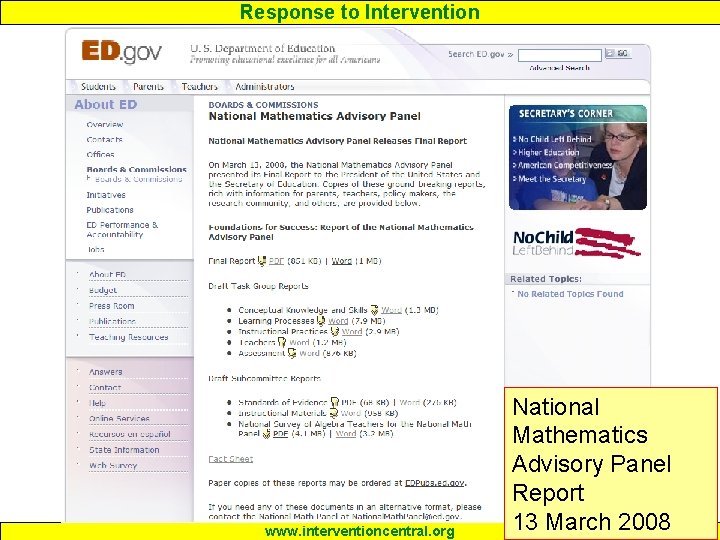
Response to Intervention www. interventioncentral. org National Mathematics Advisory Panel Report 13 March 2008 73
Response to Intervention Math Advisory Panel Report at: http: //www. ed. gov/mathpanel www. interventioncentral. org 74
Response to Intervention 2008 National Math Advisory Panel Report: Recommendations • “The areas to be studied in mathematics from pre-kindergarten through eighth grade should be streamlined and a well-defined set of the most important topics should be emphasized in the early grades. Any approach that revisits topics year after year without bringing them to closure should be avoided. ” • “Proficiency with whole numbers, fractions, and certain aspects of geometry and measurement are the foundations for algebra. Of these, knowledge of fractions is the most important foundational skill not developed among American students. ” • “Conceptual understanding, computational and procedural fluency, and problem solving skills are equally important and mutually reinforce each other. Debates regarding the relative importance of each of these components of mathematics are misguided. ” Source: National Math Panel Fact Sheet. (March 2008). Retrieved on March 14, 2008, from • “Students should develop immediate recall of arithmetic facts http: //www. ed. gov/about/bdscomm/list/mathpanel/report/final-factsheet. html to free the “working memory” for solving more complex www. interventioncentral. org 75
Response to Intervention An RTI Challenge: Limited Research to Support Evidence-Based Math Interventions “… in contrast to reading, core math programs that are supported by research, or that have been constructed according to clear research-based principles, are not easy to identify. Not only have exemplary core programs not been identified, but also there are no tools available that we know of that will help schools analyze core math programs to determine their alignment with Source: Clarke, B. , Baker, S. , & Chard, D. (2008). Best practices in mathematics assessment and clear research-based principles. ” p. 459 intervention with elementary students. In A. Thomas & J. Grimes (Eds. ), Best practices in school psychology V (pp. 453 -463). www. interventioncentral. org 76
Response to Intervention Who is At Risk for Poor Math Performance? : A Proactive Stance “…we use the term mathematics difficulties rather than mathematics disabilities. Children who exhibit mathematics difficulties include those performing in the low average range (e. g. , at or below the 35 th percentile) as well as those performing well below average…Using higher percentile cutoffs increases the likelihood that young children who go on to have serious math problems will be picked up in the screening. ” p. 295 Source: Gersten, R. , Jordan, N. C. , & Flojo, J. R. (2005). Early identification and interventions for students with mathematics difficulties. Journal of Learning Disabilities, 38, 293 -304. www. interventioncentral. org 77
Response to Intervention The Elements of Mathematical Proficiency: What the Experts Say… www. interventioncentral. org
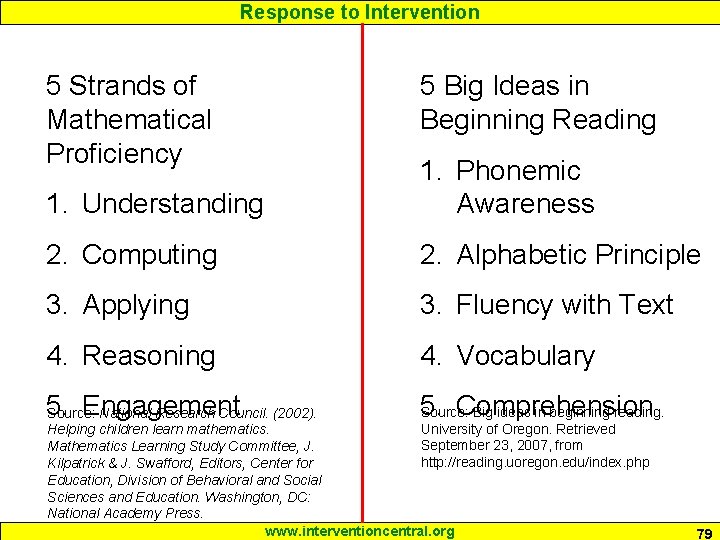
Response to Intervention 5 Strands of Mathematical Proficiency 5 Big Ideas in Beginning Reading 1. Understanding 1. Phonemic Awareness 2. Computing 2. Alphabetic Principle 3. Applying 3. Fluency with Text 4. Reasoning 4. Vocabulary 5. Engagement Source: National Research Council. (2002). 5. Comprehension Source: Big ideas in beginning reading. University of Oregon. Retrieved Helping children learn mathematics. September 23, 2007, from Mathematics Learning Study Committee, J. http: //reading. uoregon. edu/index. php Kilpatrick & J. Swafford, Editors, Center for Education, Division of Behavioral and Social Sciences and Education. Washington, DC: National Academy Press. www. interventioncentral. org 79
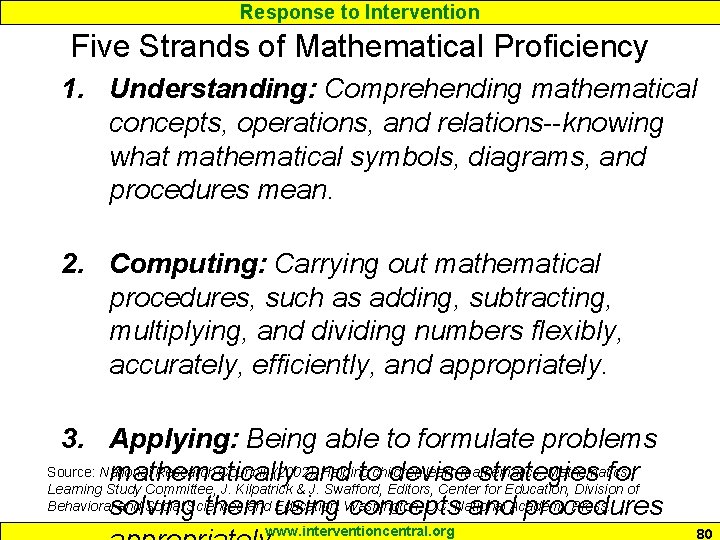
Response to Intervention Five Strands of Mathematical Proficiency 1. Understanding: Comprehending mathematical concepts, operations, and relations--knowing what mathematical symbols, diagrams, and procedures mean. 2. Computing: Carrying out mathematical procedures, such as adding, subtracting, multiplying, and dividing numbers flexibly, accurately, efficiently, and appropriately. 3. Applying: Being able to formulate problems Source: National Research Council. (2002). Helping children learn mathematics. Mathematics mathematically and to devise strategies for Learning Study Committee, J. Kilpatrick & J. Swafford, Editors, Center for Education, Division of Behavioralsolving and Social Sciences and using Education. Washington, DC: National Press. them concepts and. Academy procedures www. interventioncentral. org 80
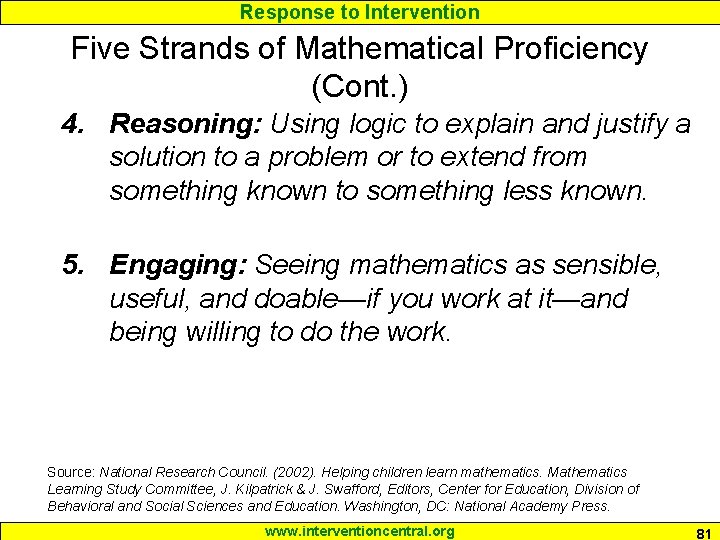
Response to Intervention Five Strands of Mathematical Proficiency (Cont. ) 4. Reasoning: Using logic to explain and justify a solution to a problem or to extend from something known to something less known. 5. Engaging: Seeing mathematics as sensible, useful, and doable—if you work at it—and being willing to do the work. Source: National Research Council. (2002). Helping children learn mathematics. Mathematics Learning Study Committee, J. Kilpatrick & J. Swafford, Editors, Center for Education, Division of Behavioral and Social Sciences and Education. Washington, DC: National Academy Press. www. interventioncentral. org 81
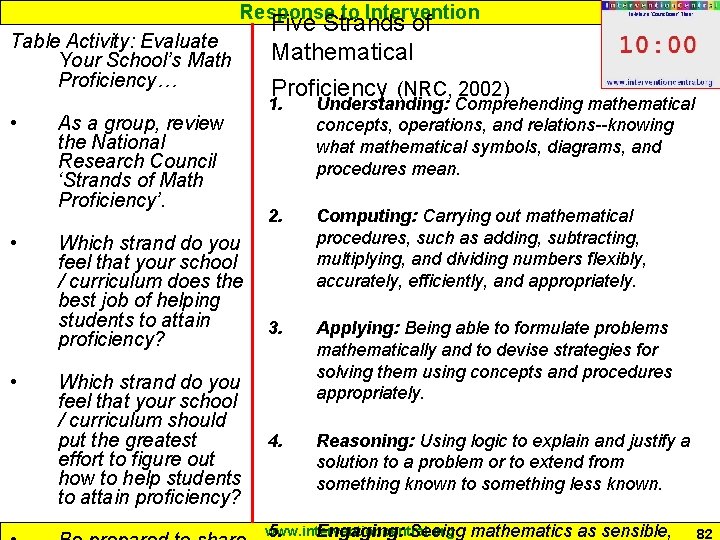
Response to Intervention Table Activity: Evaluate Your School’s Math Proficiency… • • • As a group, review the National Research Council ‘Strands of Math Proficiency’. Which strand do you feel that your school / curriculum does the best job of helping students to attain proficiency? Which strand do you feel that your school / curriculum should put the greatest effort to figure out how to help students to attain proficiency? Five Strands of Mathematical Proficiency (NRC, 2002) 1. Understanding: Comprehending mathematical concepts, operations, and relations--knowing what mathematical symbols, diagrams, and procedures mean. 2. Computing: Carrying out mathematical procedures, such as adding, subtracting, multiplying, and dividing numbers flexibly, accurately, efficiently, and appropriately. 3. Applying: Being able to formulate problems mathematically and to devise strategies for solving them using concepts and procedures appropriately. 4. Reasoning: Using logic to explain and justify a solution to a problem or to extend from something known to something less known. www. interventioncentral. org 5. Engaging: Seeing mathematics as sensible, 82
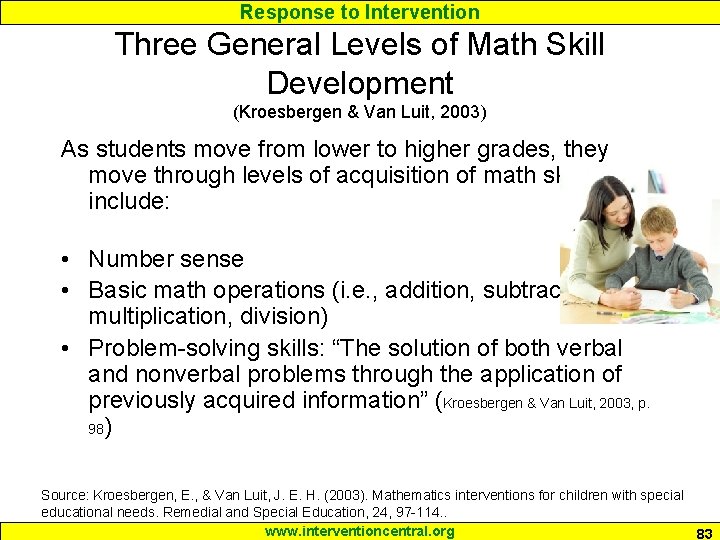
Response to Intervention Three General Levels of Math Skill Development (Kroesbergen & Van Luit, 2003) As students move from lower to higher grades, they move through levels of acquisition of math skills, to include: • Number sense • Basic math operations (i. e. , addition, subtraction, multiplication, division) • Problem-solving skills: “The solution of both verbal and nonverbal problems through the application of previously acquired information” (Kroesbergen & Van Luit, 2003, p. 98) Source: Kroesbergen, E. , & Van Luit, J. E. H. (2003). Mathematics interventions for children with special educational needs. Remedial and Special Education, 24, 97 -114. . www. interventioncentral. org 83
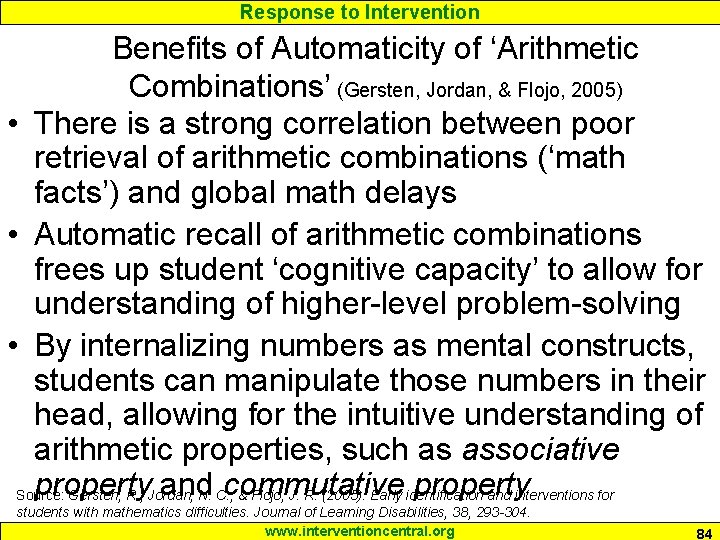
Response to Intervention Benefits of Automaticity of ‘Arithmetic Combinations’ (Gersten, Jordan, & Flojo, 2005) • There is a strong correlation between poor retrieval of arithmetic combinations (‘math facts’) and global math delays • Automatic recall of arithmetic combinations frees up student ‘cognitive capacity’ to allow for understanding of higher-level problem-solving • By internalizing numbers as mental constructs, students can manipulate those numbers in their head, allowing for the intuitive understanding of arithmetic properties, such as associative property and commutative property Source: Gersten, R. , Jordan, N. C. , & Flojo, J. R. (2005). Early identification and interventions for students with mathematics difficulties. Journal of Learning Disabilities, 38, 293 -304. www. interventioncentral. org 84
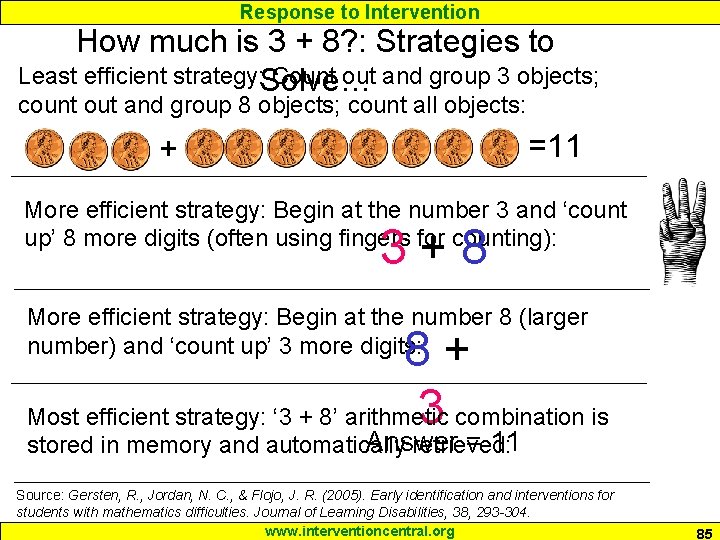
Response to Intervention How much is 3 + 8? : Strategies to Least efficient strategy: Count out and group 3 objects; Solve… count out and group 8 objects; count all objects: =11 + More efficient strategy: Begin at the number 3 and ‘count up’ 8 more digits (often using fingers for counting): 3 + 8 More efficient strategy: Begin at the number 8 (larger number) and ‘count up’ 3 more digits: 8 + 3 Most efficient strategy: ‘ 3 + 8’ arithmetic combination is Answer = 11 stored in memory and automatically retrieved: Source: Gersten, R. , Jordan, N. C. , & Flojo, J. R. (2005). Early identification and interventions for students with mathematics difficulties. Journal of Learning Disabilities, 38, 293 -304. www. interventioncentral. org 85
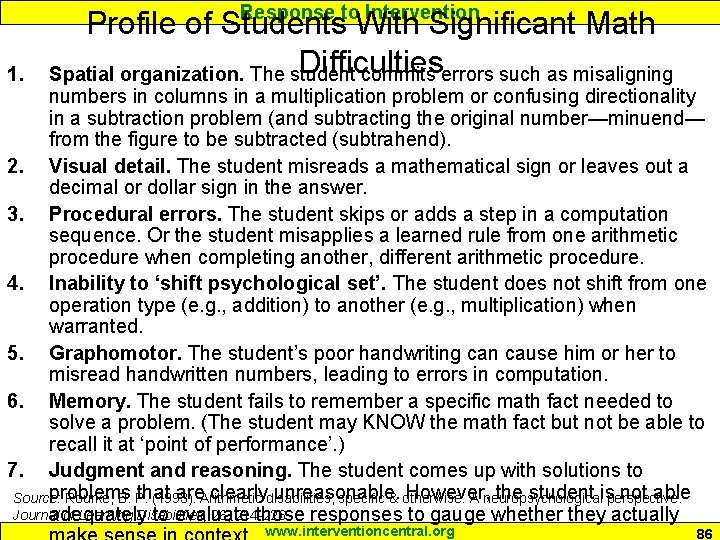
Response to Intervention 1. Profile of Students With Significant Math Difficulties Spatial organization. The student commits errors such as misaligning numbers in columns in a multiplication problem or confusing directionality in a subtraction problem (and subtracting the original number—minuend— from the figure to be subtracted (subtrahend). 2. Visual detail. The student misreads a mathematical sign or leaves out a decimal or dollar sign in the answer. 3. Procedural errors. The student skips or adds a step in a computation sequence. Or the student misapplies a learned rule from one arithmetic procedure when completing another, different arithmetic procedure. 4. Inability to ‘shift psychological set’. The student does not shift from one operation type (e. g. , addition) to another (e. g. , multiplication) when warranted. 5. Graphomotor. The student’s poor handwriting can cause him or her to misread handwritten numbers, leading to errors in computation. 6. Memory. The student fails to remember a specific math fact needed to solve a problem. (The student may KNOW the math fact but not be able to recall it at ‘point of performance’. ) 7. Judgment and reasoning. The student comes up with solutions to problems that are clearly unreasonable. However, the student is not able Source: Rourke, B. P. (1993). Arithmetic disabilities, specific & otherwise: A neuropsychological perspective. Journal of Learning Disabilities, 26, 214 -226. adequately to evaluate those responses to gauge whether they actually www. interventioncentral. org 86
Response to Intervention Math Interventions www. interventioncentral. org
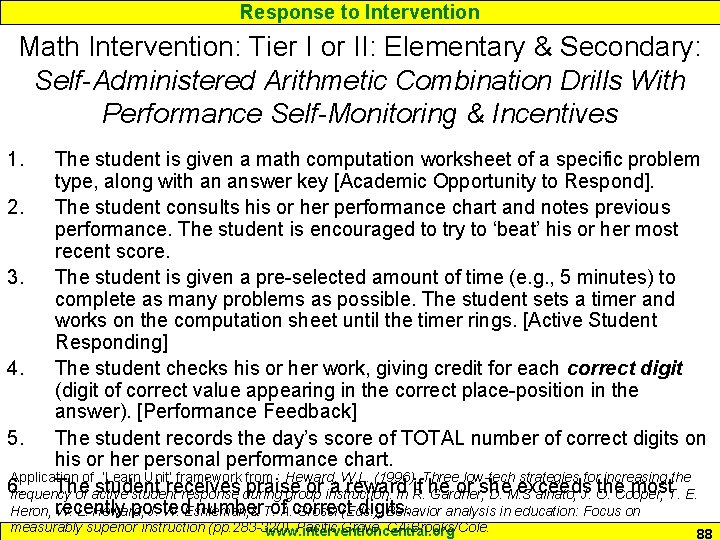
Response to Intervention Math Intervention: Tier I or II: Elementary & Secondary: Self-Administered Arithmetic Combination Drills With Performance Self-Monitoring & Incentives 1. The student is given a math computation worksheet of a specific problem type, along with an answer key [Academic Opportunity to Respond]. 2. The student consults his or her performance chart and notes previous performance. The student is encouraged to try to ‘beat’ his or her most recent score. 3. The student is given a pre-selected amount of time (e. g. , 5 minutes) to complete as many problems as possible. The student sets a timer and works on the computation sheet until the timer rings. [Active Student Responding] 4. The student checks his or her work, giving credit for each correct digit (digit of correct value appearing in the correct place-position in the answer). [Performance Feedback] 5. The student records the day’s score of TOTAL number of correct digits on his or her personal performance chart. Application of ‘Learn Unit’ framework from : Heward, W. L. (1996). Three low-tech strategies for increasing the 6. The student receives praise or a reward if he or she exceeds the most frequency of active student response during group instruction. In R. Gardner, D. M. S ainato, J. O. Cooper, T. E. Heron, recently posted number of correct digits. W. L. Heward, J. W. Eshleman, & T. A. Grossi (Eds. ), Behavior analysis in education: Focus on measurably superior instruction (pp. 283 -320). Pacific Grove, CA: Brooks/Cole. www. interventioncentral. org 88
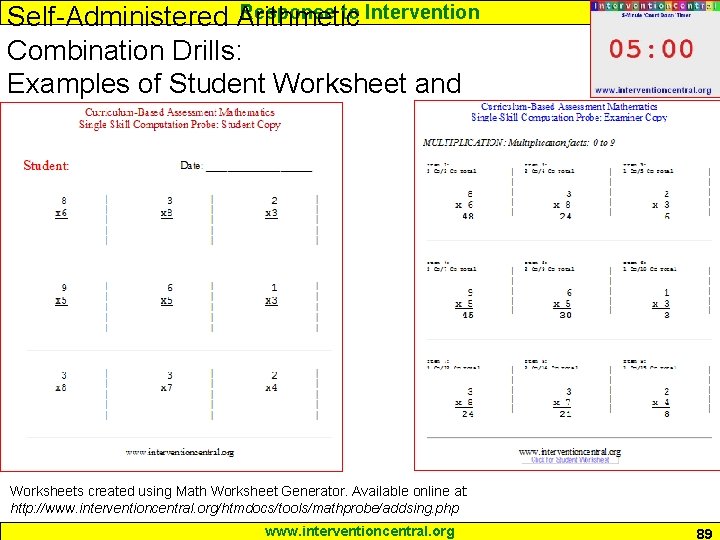
Response to Intervention Self-Administered Arithmetic Combination Drills: Examples of Student Worksheet and Answer Key Worksheets created using Math Worksheet Generator. Available online at: http: //www. interventioncentral. org/htmdocs/tools/mathprobe/addsing. php www. interventioncentral. org 89
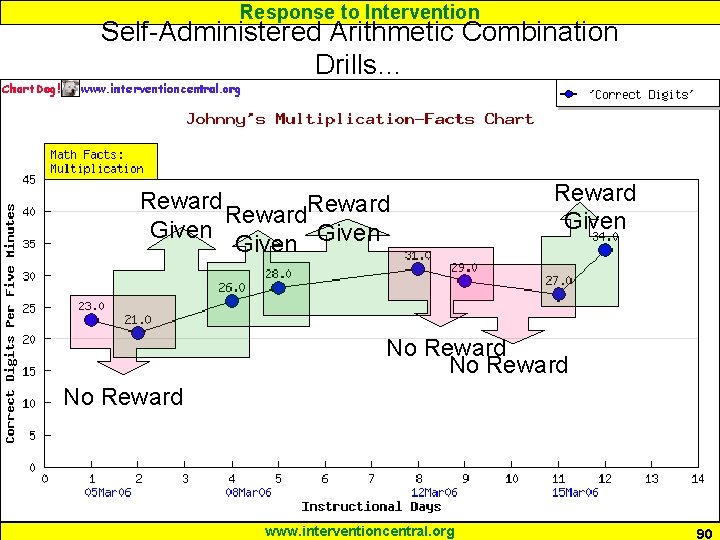
Response to Intervention Self-Administered Arithmetic Combination Drills… Reward Given Reward Given No Reward www. interventioncentral. org 90
Response to Intervention Cover-Copy-Compare: Math Computational Fluency-Building Intervention The student is given sheet with correctly completed math problems in left column and index card. For each problem, the student: – – – studies the model covers the model with index card copies the problem from memory solves the problem uncovers the correctly completed model to check answer Source: Skinner, C. H. , Turco, T. L. , Beatty, K. L. , & Rasavage, C. (1989). Cover, copy, and compare: A method for increasing multiplication performance. School Psychology Review, 18, 412 -420. www. interventioncentral. org 91
Response to Intervention • Math Computation: Problem Interspersal Technique The teacher first identifies the range of ‘challenging’ problem-types (number problems appropriately matched to the student’s current instructional level) that are to appear on the worksheet. • Then the teacher creates a series of ‘easy’ problems that the students can complete very quickly (e. g. , adding or subtracting two 1 -digit numbers). The teacher next prepares a series of student math computation worksheets with ‘easy’ computation problems interspersed at a fixed rate among the ‘challenging’ problems. • If the student is expected to complete the worksheet independently, ‘challenging’ and ‘easy’ problems should be interspersed at a 1: 1 ratio (that is, every ‘challenging’ problem in the worksheet is preceded and/or followed by an ‘easy’ problem). • If the student is to have the problems read aloud and then asked to solve the problems mentally and write Source: Hawkins, J. , Skinner, C. H. , & Oliver, R. (2005). The effects of task demands and additive interspersaldown only the answer, the items should appear on the ratios on fifth-grade students’ mathematics accuracy. School Psychology Review, 34, 543555. . www. interventioncentral. org 92
Response to Intervention Interpreting Math Graphics: A Reading Comprehension Intervention www. interventioncentral. org

Response to Intervention Housing Bubble Graphic: New York Times 23 September 2007 Housing Price Index = 171 in 2005 Housing Price Index = 100 in 1987 www. interventioncentral. org 94
Response to Intervention Classroom Challenges in Interpreting Math Graphics When encountering math graphics, students may : • expect the answer to be easily accessible when in fact the graphic may expect the reader to interpret and draw conclusions • be inattentive to details of the graphic • treat irrelevant data as ‘relevant’ • not pay close attention to questions before turning to graphics to find the answer • fail to use their prior knowledge both to extend the information on the graphic and to act as a possible ‘check’ on the information that it Source: Mesmer, H. A. E. , & Hutchins, E. J. (2002). Using QARs with charts and graphs. The Reading Teacher, 56, 21– 27. www. interventioncentral. org presents. 95
Response to Intervention Using Question-Answer Relationships (QARs) to Interpret Information from Math Graphics Students can be more savvy interpreters of graphics in applied math problems by applying the Question-Answer Relationship (QAR) strategy. Four Kinds of QAR Questions: • RIGHT THERE questions are fact-based and can be found in a single sentence, often accompanied by 'clue' words that also appear in the question. • THINK AND SEARCH questions can be answered by information in the text but require the scanning of text and making connections between different pieces of factual information. • AUTHOR AND YOU questions require that students take information or opinions that appear in the text and combine them with the reader's own experiences or opinions to formulate an answer. • ON MY OWN questions are based on the students' own experiences and do not require knowledge of the text to answer. Source: Mesmer, H. A. E. , & Hutchins, E. J. (2002). Using QARs with charts and graphs. The Reading Teacher, 56, 21– 27. www. interventioncentral. org 96
Response to Intervention Using Question-Answer Relationships (QARs) to Interpret Information from Math Graphics: 4 -Step Teaching Sequence 1. DISTINGUISHING DIFFERENT KINDS OF GRAPHICS. Students are taught to differentiate between common types of graphics: e. g. , table (grid with information contained in cells), chart (boxes with possible connecting lines or arrows), picture (figure with labels), line graph, bar graph. Students note significant differences between the various graphics, while the teacher records those observations on a wall chart. Next students are given examples of graphics and asked to identify which general kind of graphic each is. Finally, students are assigned to go on a ‘graphics hunt’, locating graphics in magazines and newspapers, labeling Source: Mesmer, H. A. E. , & Hutchins, E. J. (2002). Using QARs with charts and graphs. The Reading them, and bringing to class to review. Teacher, 56, 21– 27. www. interventioncentral. org 97
Response to Intervention Using Question-Answer Relationships (QARs) to Interpret Information from Math Graphics: 4 -Step Teaching Sequence 2. INTERPRETING INFORMATION IN GRAPHICS. Students are paired off, with stronger students matched with less strong ones. The teacher spends at least one session presenting students with examples from each of the graphics categories. The presentation sequence is ordered so that students begin with examples of the most concrete graphics and move toward the more abstract: Pictures > tables > bar graphs > charts > line graphs. At each session, student pairs examine graphics and discuss questions such as: “What information does this graphic present? What are strengths of this graphic for presenting data? What are possible weaknesses? ” Source: Mesmer, H. A. E. , & Hutchins, E. J. (2002). Using QARs with charts and graphs. The Reading Teacher, 56, 21– 27. www. interventioncentral. org 98
Response to Intervention Using Question-Answer Relationships (QARs) to Interpret Information from Math Graphics: 4 -Step Teaching Sequence 3. LINKING THE USE OF QARS TO GRAPHICS. Students are given a series of data questions and correct answers, with each question accompanied by a graphic that contains information needed to formulate the answer. Students are also each given index cards with titles and descriptions of each of the 4 QAR questions: RIGHT THERE, THINK AND SEARCH, AUTHOR AND YOU, ON MY OWN. Working in small groups and then individually, students read the questions, study the matching graphics, and ‘verify’ the answers as correct. They then identify the type question being asked using their QAR index cards. Source: Mesmer, H. A. E. , & Hutchins, E. J. (2002). Using QARs with charts and graphs. The Reading Teacher, 56, 21– 27. www. interventioncentral. org 99
Response to Intervention Using Question-Answer Relationships (QARs) to Interpret Information from Math Graphics: 4 -Step Teaching Sequence 4. USING QARS WITH GRAPHICS INDEPENDENTLY. When students are ready to use the QAR strategy independently to read graphics, they are given a laminated card as a reference with 6 steps to follow: A. B. C. D. E. F. Read the question, Review the graphic, Reread the question, Choose a QAR, Answer the question, and Locate the answer derived from the graphic in the answer choices offered. Students are strongly encouraged NOT to read the answer choices offered until they have first derived their own answer, so that those choices don’t short-circuit Source: Mesmer, H. A. E. , & Hutchins, E. J. (2002). Using QARs with charts and graphs. The Reading Teacher, 56, 21– 27. www. interventioncentral. org 100
Response to Intervention Developing Student Metacognitive Abilities www. interventioncentral. org
Response to Intervention Importance of Metacognitive Strategy Use… “Metacognitive processes focus on selfawareness of cognitive knowledge that is presumed to be necessary for effective problem solving, and they direct and regulate cognitive processes and strategies during problem solving…That is, successful problem solvers, consciously or unconsciously (depending on task demands), use self-instruction, selfquestioning, and self-monitoring to gain access to strategic knowledge, guide execution of strategies, and regulate use of Source: Montague, M. (1992). The effects of cognitive and metacognitive strategy instruction on the mathematical problem solving of middle school students with learning disabilities. Journal of Learning strategies and problem-solving Disabilities, 25, 230 -248. www. interventioncentral. org 102
Response to Intervention Elements of Metacognitive Processes “Self-instruction helps students to identify and direct the problem-solving strategies prior to execution. Self-questioning promotes internal dialogue for systematically analyzing problem information and regulating execution of cognitive strategies. Self-monitoring promotes appropriate use of specific strategies and encourages students to monitor general performance. [Emphasis added]. ” p. 231 Source: Montague, M. (1992). The effects of cognitive and metacognitive strategy instruction on the mathematical problem solving of middle school students with learning disabilities. Journal of Learning Disabilities, 25, 230 -248. www. interventioncentral. org 103
Response to Intervention Combining Cognitive & Metacognitive Strategies to Assist Students With Mathematical Problem Solving an advanced math problem independently requires the coordination of a number of complex skills. The following strategies combine both cognitive and metacognitive elements (Montague, 1992; Montague & Dietz, 2009). First, the student is taught a 7 -step process for attacking a math word problem (cognitive strategy). Second, the instructor trains the student to use a three -part self-coaching routine for each of the seven problem-solving steps (metacognitive strategy). www. interventioncentral. org 104
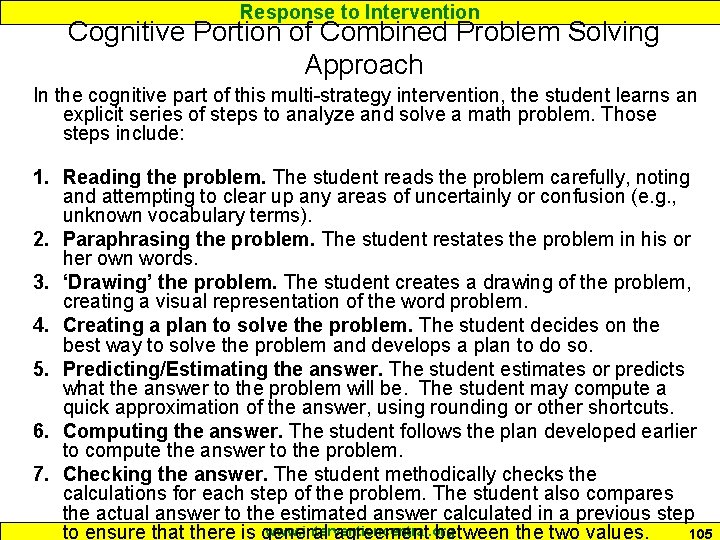
Response to Intervention Cognitive Portion of Combined Problem Solving Approach In the cognitive part of this multi-strategy intervention, the student learns an explicit series of steps to analyze and solve a math problem. Those steps include: 1. Reading the problem. The student reads the problem carefully, noting and attempting to clear up any areas of uncertainly or confusion (e. g. , unknown vocabulary terms). 2. Paraphrasing the problem. The student restates the problem in his or her own words. 3. ‘Drawing’ the problem. The student creates a drawing of the problem, creating a visual representation of the word problem. 4. Creating a plan to solve the problem. The student decides on the best way to solve the problem and develops a plan to do so. 5. Predicting/Estimating the answer. The student estimates or predicts what the answer to the problem will be. The student may compute a quick approximation of the answer, using rounding or other shortcuts. 6. Computing the answer. The student follows the plan developed earlier to compute the answer to the problem. 7. Checking the answer. The student methodically checks the calculations for each step of the problem. The student also compares the actual answer to the estimated answer calculated in a previous step www. interventioncentral. org to ensure that there is general agreement between the two values. 105
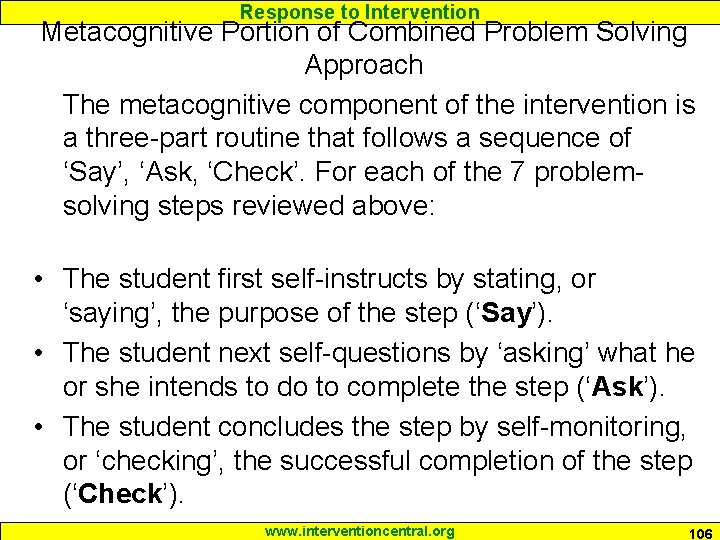
Response to Intervention Metacognitive Portion of Combined Problem Solving Approach The metacognitive component of the intervention is a three-part routine that follows a sequence of ‘Say’, ‘Ask, ‘Check’. For each of the 7 problemsolving steps reviewed above: • The student first self-instructs by stating, or ‘saying’, the purpose of the step (‘Say’). • The student next self-questions by ‘asking’ what he or she intends to do to complete the step (‘Ask’). • The student concludes the step by self-monitoring, or ‘checking’, the successful completion of the step (‘Check’). www. interventioncentral. org 106
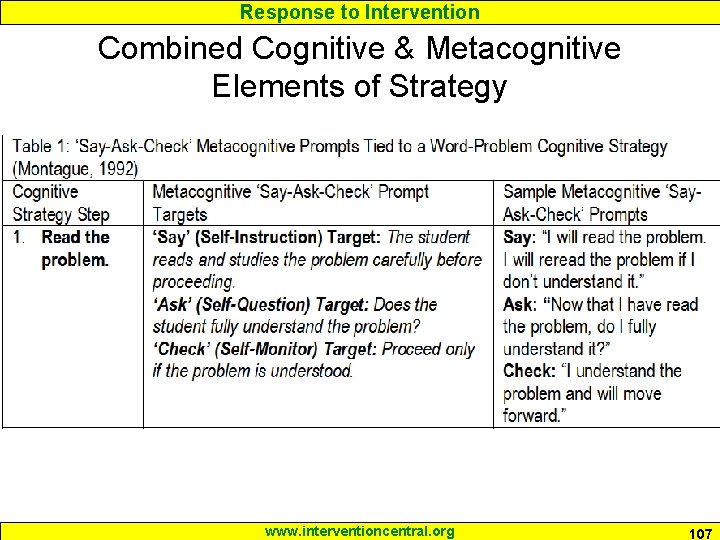
Response to Intervention Combined Cognitive & Metacognitive Elements of Strategy www. interventioncentral. org 107
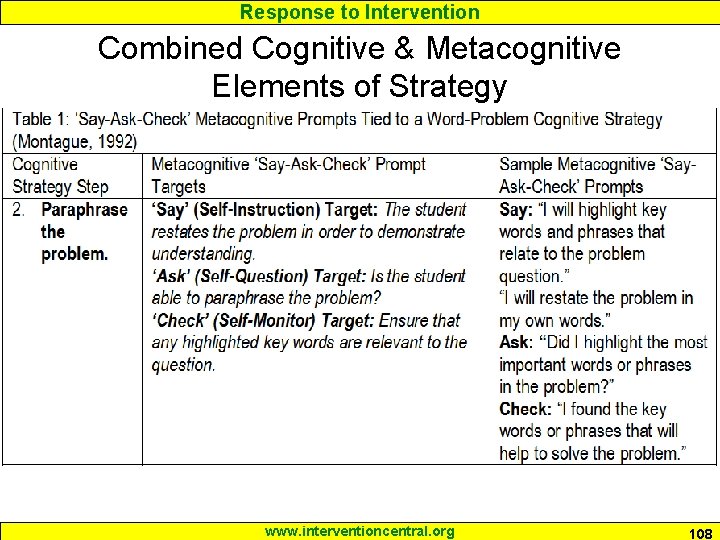
Response to Intervention Combined Cognitive & Metacognitive Elements of Strategy www. interventioncentral. org 108
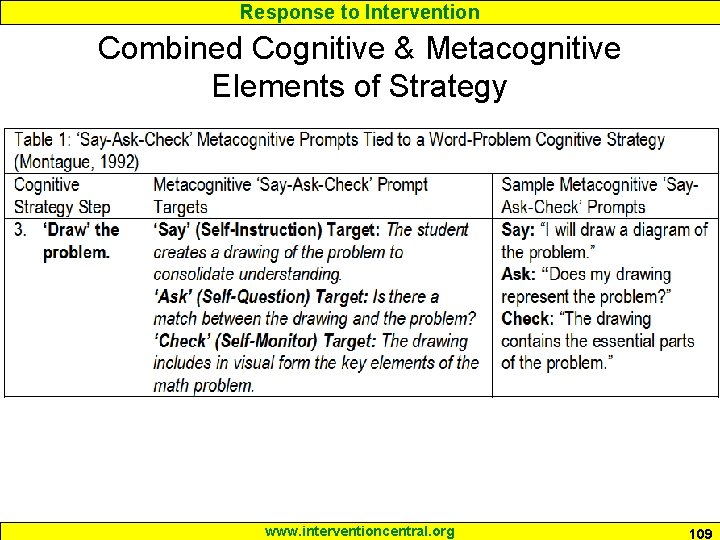
Response to Intervention Combined Cognitive & Metacognitive Elements of Strategy www. interventioncentral. org 109
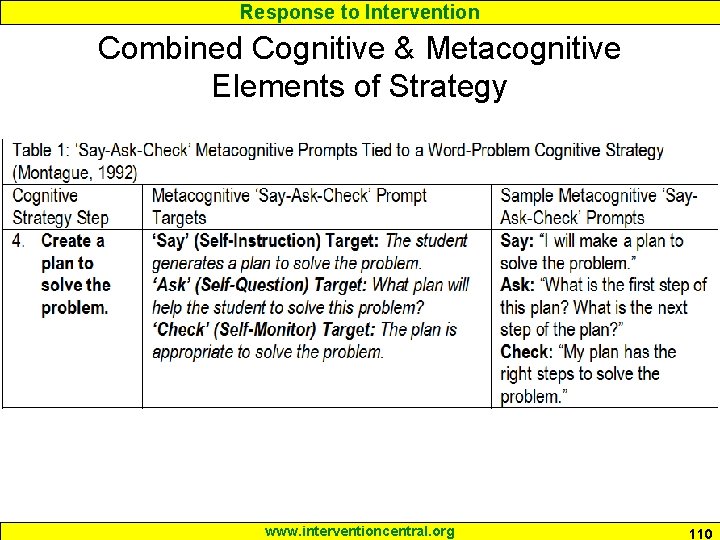
Response to Intervention Combined Cognitive & Metacognitive Elements of Strategy www. interventioncentral. org 110
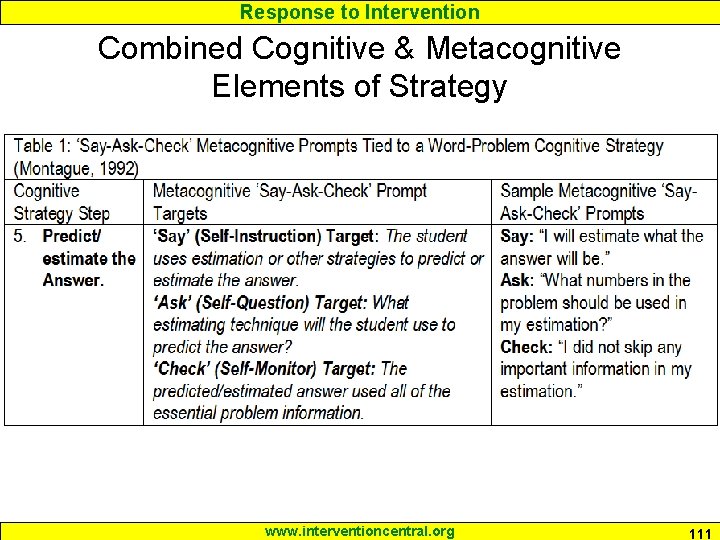
Response to Intervention Combined Cognitive & Metacognitive Elements of Strategy www. interventioncentral. org 111
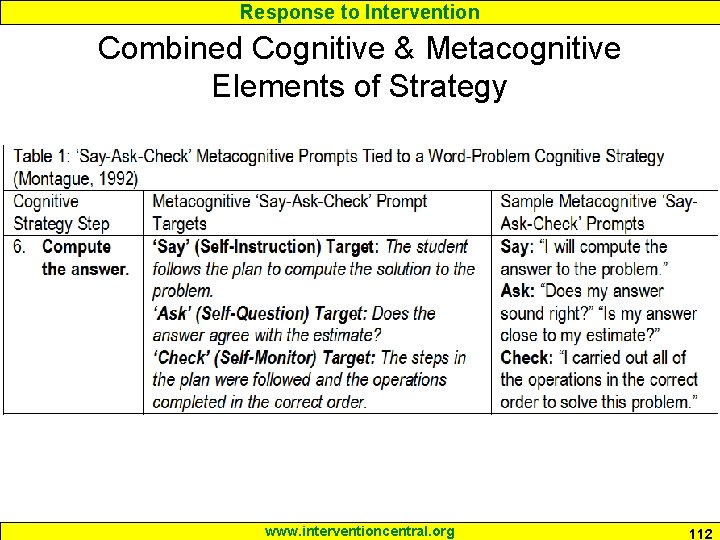
Response to Intervention Combined Cognitive & Metacognitive Elements of Strategy www. interventioncentral. org 112
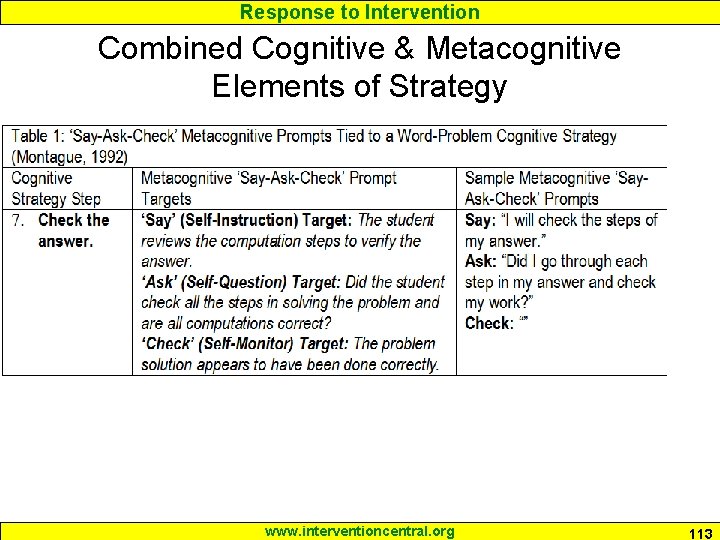
Response to Intervention Combined Cognitive & Metacognitive Elements of Strategy www. interventioncentral. org 113
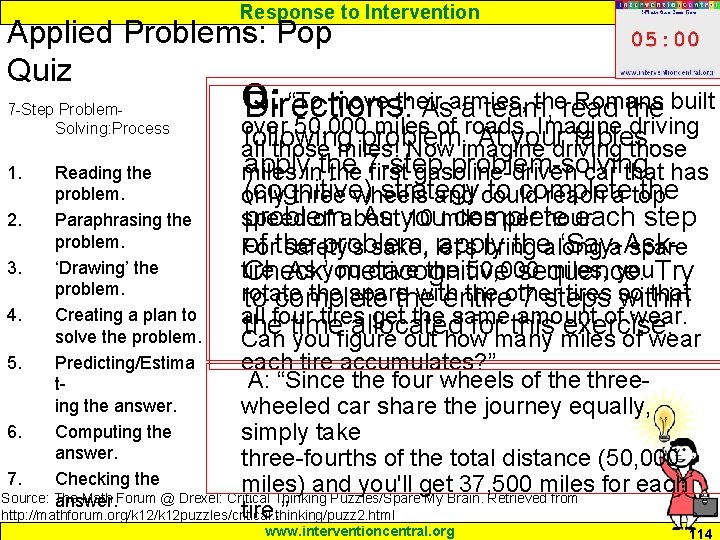
Response to Intervention Applied Problems: Pop Quiz 7 -Step Problem. Solving: Process Q: “To move their armies, the Romans built Directions: As a team, read the over 50, 000 miles of roads. Imagine driving following problem. At your tables, all those miles! Now imagine driving those apply the 7 -step problem-solving 1. Reading the miles in the first gasoline-driven car that has (cognitive) strategy to complete the problem. only three wheels and could reach a top 2. Paraphrasing the speed of about 10 miles per hour. problem. As you complete each step problem. of the problem, apply the ‘Say-Ask. For safety's sake, let's bring along a spare 3. ‘Drawing’ the tire. As you drive the 50, 000 miles, you Check’ metacognitive sequence. Try problem. rotate the spare with the other tires so that to complete the entire 7 steps within 4. Creating a plan to all four tires get the same amount of wear. the time allocated for this exercise. solve the problem. Can you figure out how many miles of wear 5. Predicting/Estima each tire accumulates? ” A: “Since the four wheels of the threeting the answer. wheeled car share the journey equally, 6. Computing the simply take answer. three-fourths of the total distance (50, 000 7. Checking the miles) and you'll get 37, 500 miles for each Source: The Math Forum @ Drexel: Critical Thinking Puzzles/Spare My Brain. Retrieved from answer. tire. ” http: //mathforum. org/k 12 puzzles/critical. thinking/puzz 2. html www. interventioncentral. org 114
Response to Intervention Secondary Group-Based Math Intervention Example www. interventioncentral. org
Response to Intervention Identifying and Measuring Complex Academic Problems at the Middle and High School Level: Discrete Categorization • Students at the secondary level can present with a range of concerns that interfere with academic success. • One frequent challenge for these students is the need to reduce complex global academic goals into discrete subskills that can be individually measured and tracked over time. www. interventioncentral. org 116
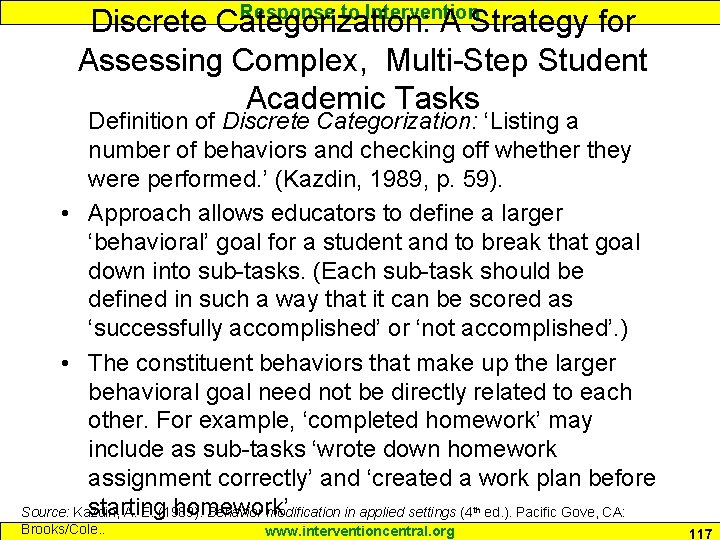
Response to Intervention Discrete Categorization: A Strategy for Assessing Complex, Multi-Step Student Academic Tasks Definition of Discrete Categorization: ‘Listing a number of behaviors and checking off whether they were performed. ’ (Kazdin, 1989, p. 59). • Approach allows educators to define a larger ‘behavioral’ goal for a student and to break that goal down into sub-tasks. (Each sub-task should be defined in such a way that it can be scored as ‘successfully accomplished’ or ‘not accomplished’. ) • The constituent behaviors that make up the larger behavioral goal need not be directly related to each other. For example, ‘completed homework’ may include as sub-tasks ‘wrote down homework assignment correctly’ and ‘created a work plan before starting homework’ Source: Kazdin, A. E. (1989). Behavior modification in applied settings (4 ed. ). Pacific Gove, CA: th Brooks/Cole. . www. interventioncentral. org 117
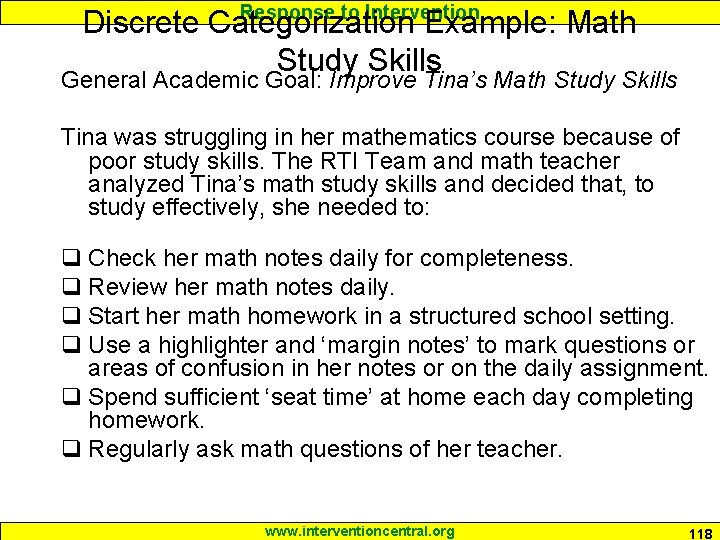
Response to Intervention Discrete Categorization Example: Math Study Skills General Academic Goal: Improve Tina’s Math Study Skills Tina was struggling in her mathematics course because of poor study skills. The RTI Team and math teacher analyzed Tina’s math study skills and decided that, to study effectively, she needed to: q Check her math notes daily for completeness. q Review her math notes daily. q Start her math homework in a structured school setting. q Use a highlighter and ‘margin notes’ to mark questions or areas of confusion in her notes or on the daily assignment. q Spend sufficient ‘seat time’ at home each day completing homework. q Regularly ask math questions of her teacher. www. interventioncentral. org 118
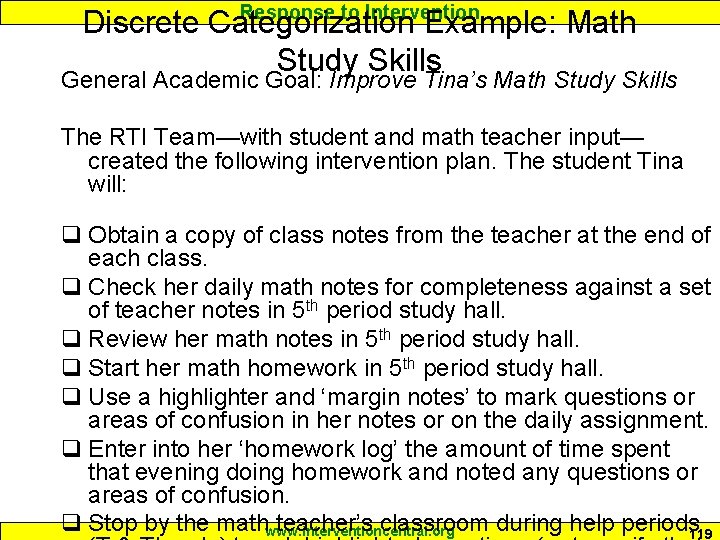
Response to Intervention Discrete Categorization Example: Math Study Skills General Academic Goal: Improve Tina’s Math Study Skills The RTI Team—with student and math teacher input— created the following intervention plan. The student Tina will: q Obtain a copy of class notes from the teacher at the end of each class. q Check her daily math notes for completeness against a set of teacher notes in 5 th period study hall. q Review her math notes in 5 th period study hall. q Start her math homework in 5 th period study hall. q Use a highlighter and ‘margin notes’ to mark questions or areas of confusion in her notes or on the daily assignment. q Enter into her ‘homework log’ the amount of time spent that evening doing homework and noted any questions or areas of confusion. q Stop by the math teacher’s classroom during help periods www. interventioncentral. org 119
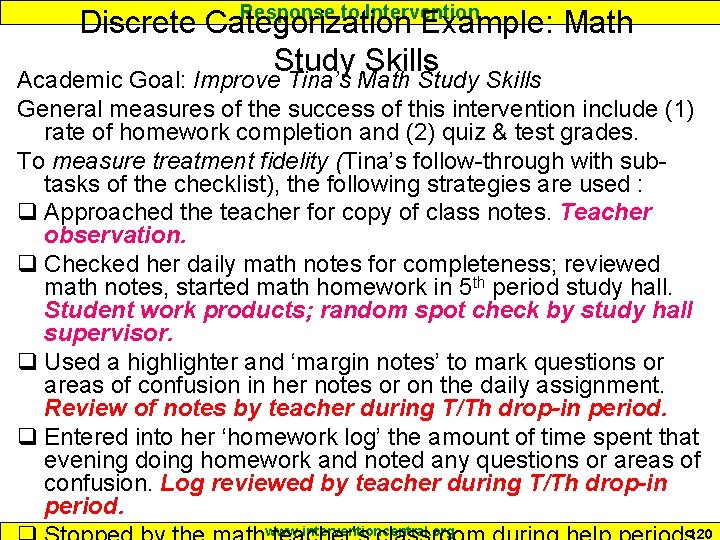
Response to Intervention Discrete Categorization Example: Math Study Skills Academic Goal: Improve Tina’s Math Study Skills General measures of the success of this intervention include (1) rate of homework completion and (2) quiz & test grades. To measure treatment fidelity (Tina’s follow-through with subtasks of the checklist), the following strategies are used : q Approached the teacher for copy of class notes. Teacher observation. q Checked her daily math notes for completeness; reviewed math notes, started math homework in 5 th period study hall. Student work products; random spot check by study hall supervisor. q Used a highlighter and ‘margin notes’ to mark questions or areas of confusion in her notes or on the daily assignment. Review of notes by teacher during T/Th drop-in period. q Entered into her ‘homework log’ the amount of time spent that evening doing homework and noted any questions or areas of confusion. Log reviewed by teacher during T/Th drop-in period. www. interventioncentral. org 120
Response to Intervention Assessing Intervention Integrity Jim Wright www. interventioncentral. org
Response to Intervention Why Assess Intervention Integrity? When a struggling student fails to respond adequately to a series of evidence-based interventions, that student is likely to face significant and potentially negative consequences, such as failing grades, long-term suspension from school, or even placement in special education. It is crucial, then, that the school monitor the integrity with which educators implement each intervention plan so that it can confidently rule out poor or limited intervention implementation of the intervention as a possible explanation for www. interventioncentral. org 122
Response to Intervention Integrity Check: Direct Observation Intervention integrity is best assessed through direct observation (Roach & Elliott, 2008). – The key steps of the intervention are defined and formatted as an observational checklist. – An observer watches as the intervention is conducted and checks off on the checklist those steps that were correctly carried out. The observer then computes the percentage of steps correctly carried out. www. interventioncentral. org 123
Response to Intervention Limitations of Direct Observation as an Intervention Integrity Check • Direct observations are time-consuming to conduct. • Teachers who serve as interventionists may at least initially regard observations of their intervention implementation as evaluations of their job performance, rather than as a childfocused RTI “quality check”. • An intervention-implementation checklist typically does not distinguish between--or differentially weight--those intervention steps that are more important from those that are less so. If two teachers implement the same 10 -step intervention plan, for example, with one instructor omitting a critical step and the Source: Gansle, K. A. , & Noell, G. H. (2007). The fundamental role of intervention implementation in assessing response to intervention. In S. R. Jimerson, M. K. Burns, & A. M. Van. Der. Heyden (Eds. ), other omitting a fairly trivial step, both can still Response to intervention: The science and practice of assessment and intervention (pp. 244 -251). attain the same implementation score of steps www. interventioncentral. org 124
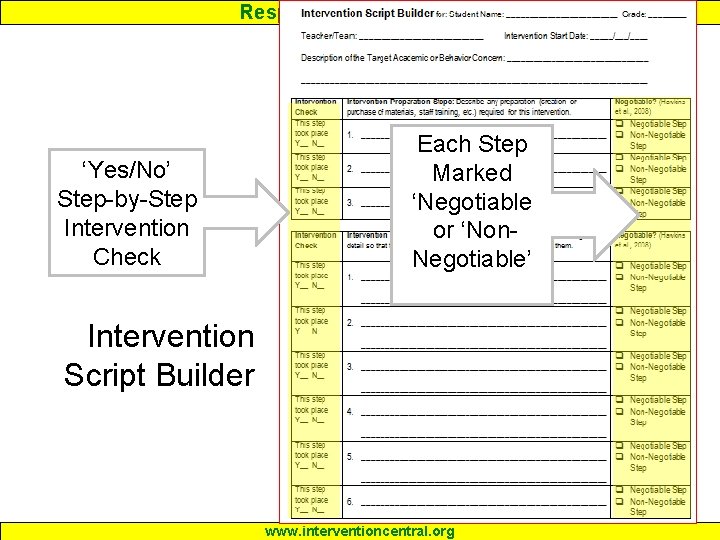
Response to Intervention ‘Yes/No’ Step-by-Step Intervention Check Each Step Marked ‘Negotiable or ‘Non. Negotiable’ Intervention Script Builder www. interventioncentral. org
Response to Intervention Supplemental Methods to Collect Data About Intervention Integrity Teacher Self-Ratings: As a form of selfmonitoring, directing interventionists to rate the integrity of their own interventions may prompt higher rates of compliance (e. g. , Kazdin, 1989). However, because teacher self-ratings tend to be ‘upwardly biased (Gansle & Noell, 2007, p. 247), they should not be relied upon as the sole rating of intervention integrity. One suggestion for collecting regular teacher reports on intervention implementation in a convenient manner is to use Daily Behavior Reports (DBRs; Chafouleas, Riley-Tillman, , & Sources: Chafouleas, S. , Riley-Tillman, T. C. , & Sugai, G. (2007). School-based behavioral assessment: Informing Sugai, 2007). intervention and instruction. New York: Guilford Press. Gansle, K. A. , & Noell, G. H. (2007). The fundamental role of intervention implementation in assessing response to intervention. In S. R. Jimerson, M. K. Burns, & A. M. Van. Der. Heyden (Eds. ), Response to intervention: The science and practice of assessment and intervention (pp. 244 -251). Kazdin, A. E. (1989). Behavior modification in applied settings (4 th ed. ). Pacific Gove, CA: Brooks/Cole. . www. interventioncentral. org 126
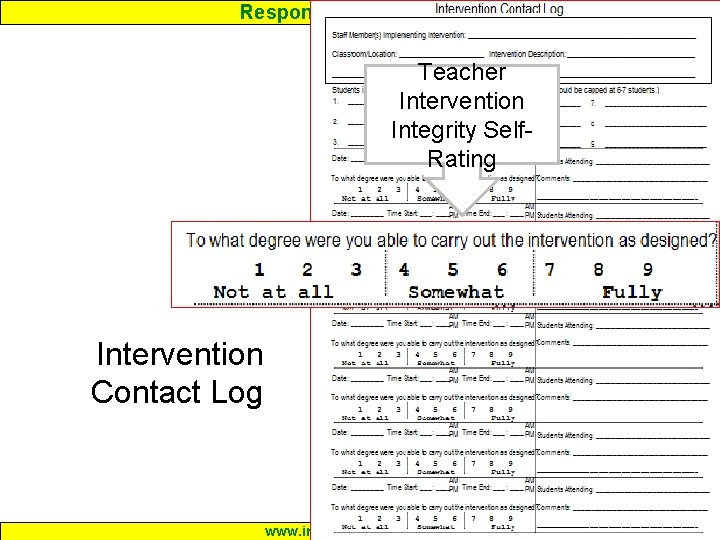
Response to Intervention Teacher Intervention Integrity Self. Rating Intervention Contact Log www. interventioncentral. org 127
Response to Intervention Supplemental Methods to Collect Data About Intervention Integrity Intervention Permanent Products: If an intervention plan naturally yields permanent products (e. g. , completed scoring sheets, lists of spelling words mastered, behavioral sticker charts), these products can be periodically collected and evaluated as another indicator of intervention integrity (Gansle Source: & Noell, 2007). Gansle, K. A. , & Noell, G. H. (2007). The fundamental role of intervention implementation in assessing response to intervention. In S. R. Jimerson, M. K. Burns, & A. M. Van. Der. Heyden (Eds. ), Response to intervention: The science and practice of assessment and intervention (pp. 244 -251). www. interventioncentral. org 128
Response to Intervention Integrity: Verify Through a Mix of Information Sources Schools should consider monitoring intervention integrity through a mix of direct and indirect means, including direct observation and permanent products (Gansle & Noell, 2007), as well as interventionist selfratings (Roach & Elliott, 2008). Source: Gansle, K. A. , & Noell, G. H. (2007). The fundamental role of intervention implementation in assessing response to intervention. In S. R. Jimerson, M. K. Burns, & A. M. Van. Der. Heyden (Eds. ), Response to intervention: The science and practice of assessment and intervention (pp. 244 -251). Roach, A. T. , & Elliott, S. N. (2008). Best practices in facilitating and evaluating intervention integrity. In A. Thomas & J. Grimes (Eds. ), Best practices in school psychology V (pp. 195 -208). www. interventioncentral. org 129
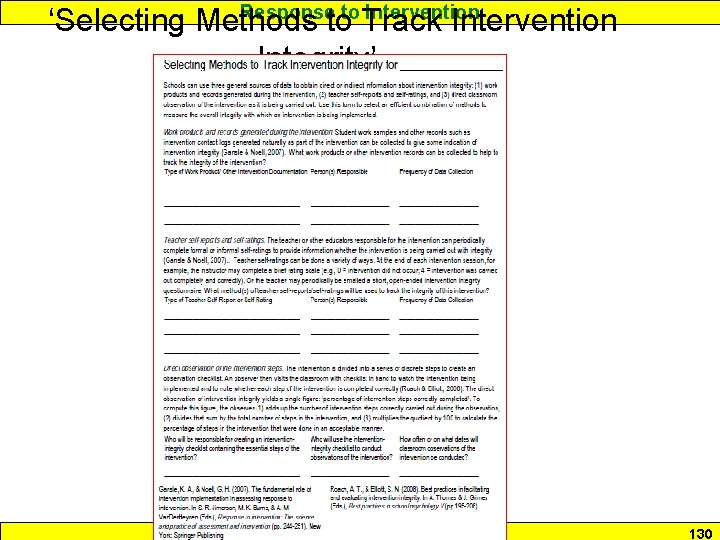
Response to Intervention ‘Selecting Methods to Track Intervention Integrity’… www. interventioncentral. org 130
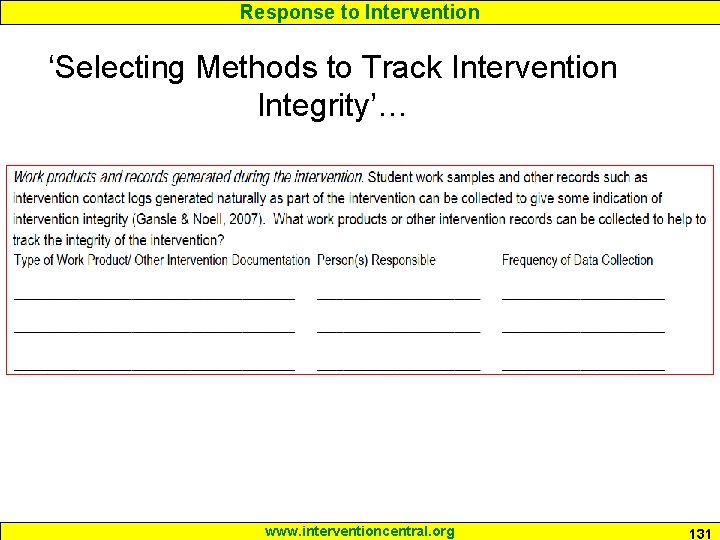
Response to Intervention ‘Selecting Methods to Track Intervention Integrity’… www. interventioncentral. org 131
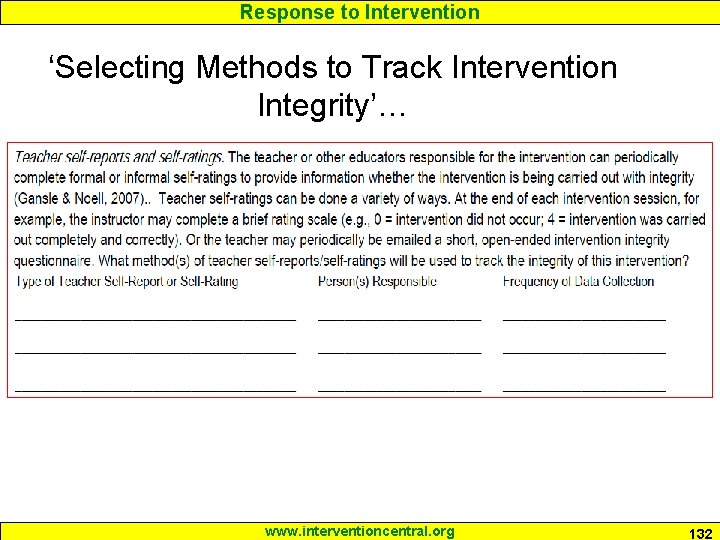
Response to Intervention ‘Selecting Methods to Track Intervention Integrity’… www. interventioncentral. org 132
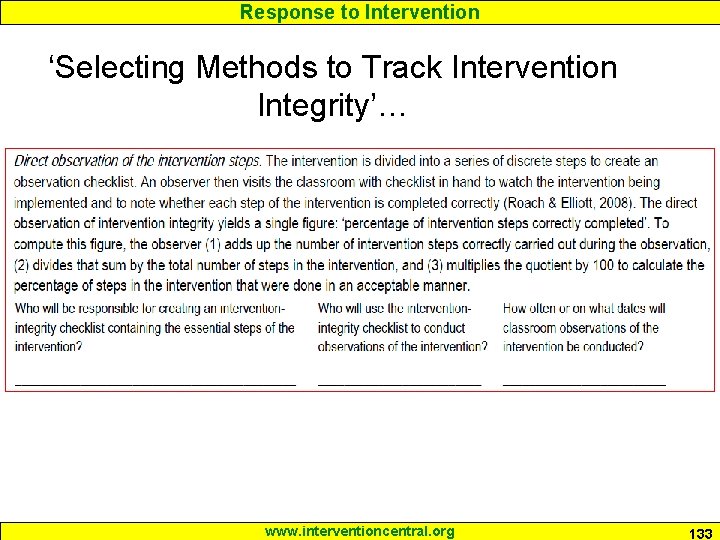
Response to Intervention ‘Selecting Methods to Track Intervention Integrity’… www. interventioncentral. org 133
Response to Intervention Team Activity: Measuring ‘Intervention Follow. Through’ At your table: • Brainstorm ways that your RTI Team will use to measure intervention integrity for math and writing interventions. • What preparations are necessary to introduce these methods for measuring ‘intervention followthrough’ to your faculty? www. interventioncentral. org 134
- Slides: 123