
Response to Intervention RTI at Tier 1 Universal
- Slides: 51
Response to Intervention RTI at Tier 1: Universal Instruction & Classroom Intervention Jim Wright www. interventioncentral. org
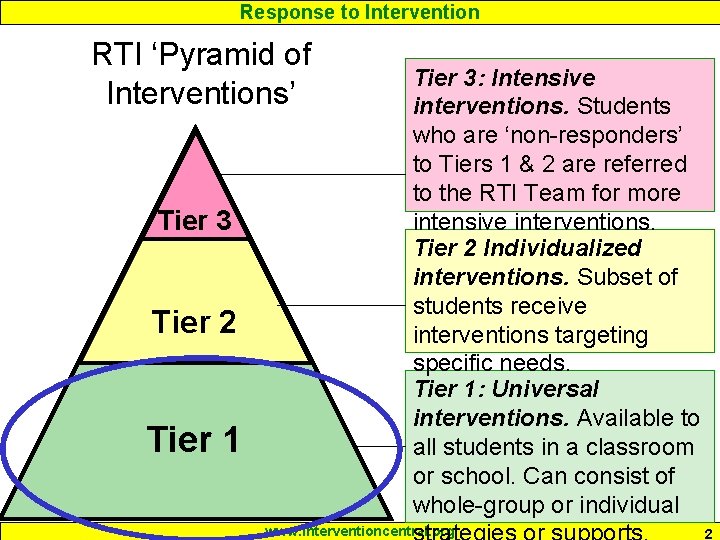
Response to Intervention RTI ‘Pyramid of Interventions’ Tier 3 Tier 2 Tier 1 Tier 3: Intensive interventions. Students who are ‘non-responders’ to Tiers 1 & 2 are referred to the RTI Team for more intensive interventions. Tier 2 Individualized interventions. Subset of students receive interventions targeting specific needs. Tier 1: Universal interventions. Available to all students in a classroom or school. Can consist of whole-group or individual www. interventioncentral. org 2
Response to Intervention Tier 1: Universal Instruction & Classroom Intervention RTI & Classwide Instruction. What does Response to Intervention look like at the classroom (Tier 1: Core Instruction) level? www. interventioncentral. org 3
Response to Intervention RTI Plan: Tier 1 Core Instruction Tier 1: High-Quality Core Instruction. The student receives high-quality core instruction in the area of academic concern. ‘High quality’ is defined as at least 80% of students in the classroom or grade level performing at or above grade-wide academic screening benchmarks through classroom instructional support alone (Christ, 2008). www. interventioncentral. org 4
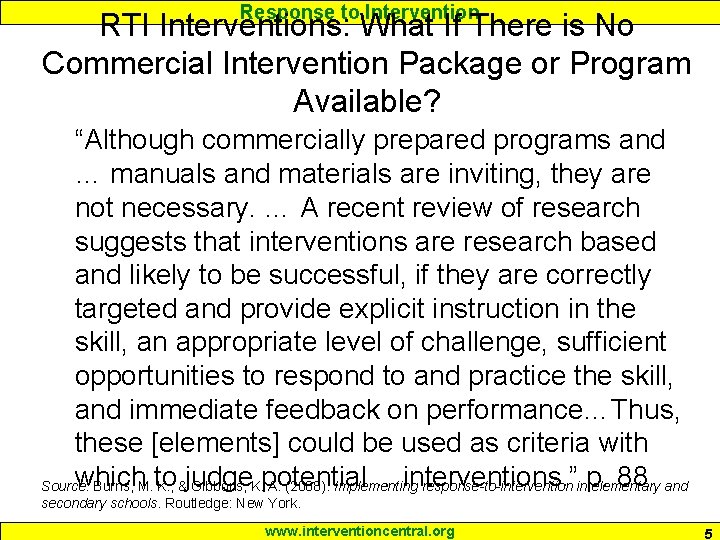
Response to Intervention RTI Interventions: What If There is No Commercial Intervention Package or Program Available? “Although commercially prepared programs and … manuals and materials are inviting, they are not necessary. … A recent review of research suggests that interventions are research based and likely to be successful, if they are correctly targeted and provide explicit instruction in the skill, an appropriate level of challenge, sufficient opportunities to respond to and practice the skill, and immediate feedback on performance…Thus, these [elements] could be used as criteria with which …interventions. ” 88 and Source: Burns, M. to K. , &judge Gibbons, K. potential A. (2008). Implementing response-to-intervention inp. elementary secondary schools. Routledge: New York. www. interventioncentral. org 5
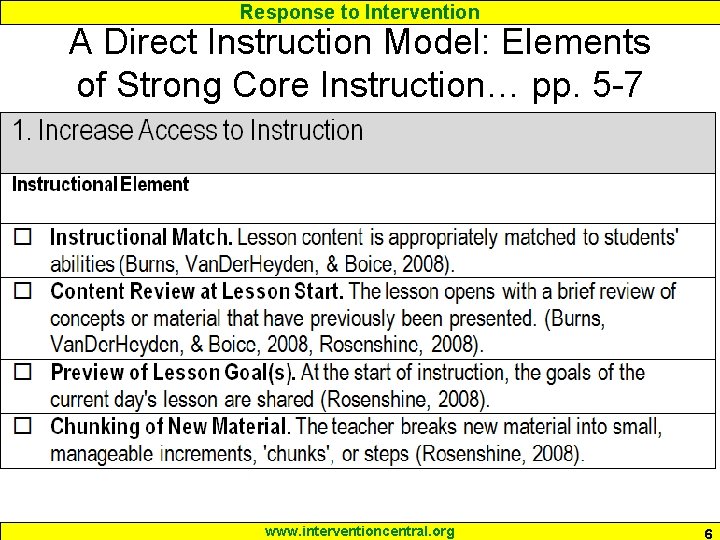
Response to Intervention A Direct Instruction Model: Elements of Strong Core Instruction… pp. 5 -7 www. interventioncentral. org 6
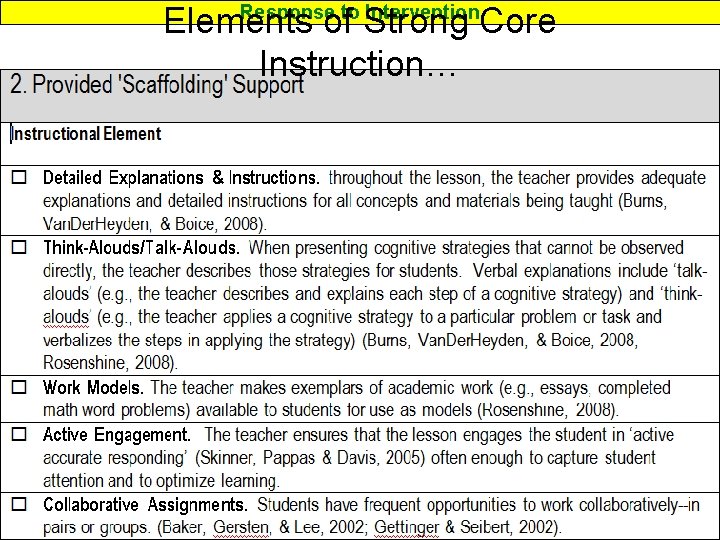
Elements of Strong Core Instruction… Response to Intervention www. interventioncentral. org 7
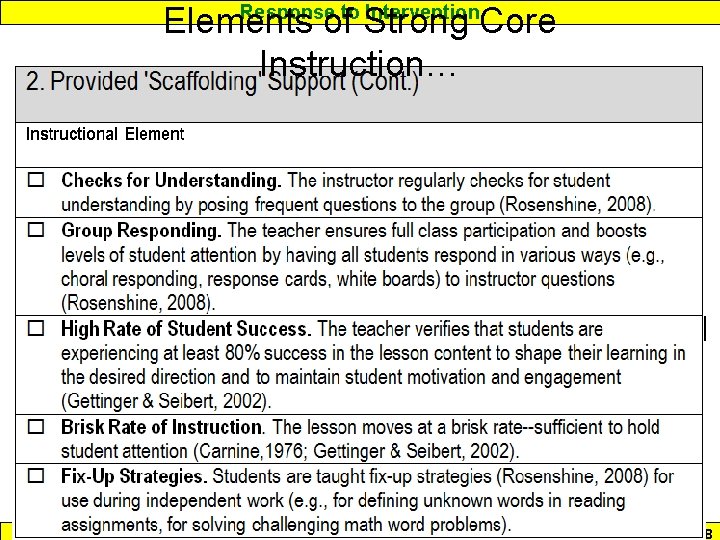
Elements of Strong Core Instruction… Response to Intervention www. interventioncentral. org 8
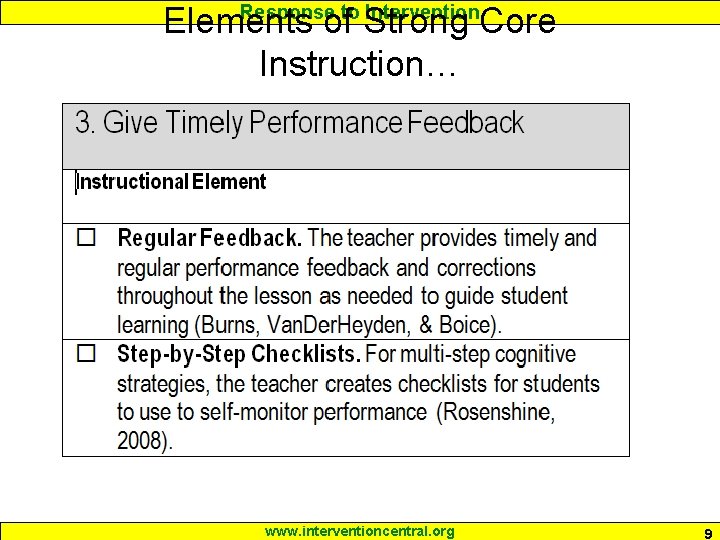
Elements of Strong Core Instruction… Response to Intervention www. interventioncentral. org 9
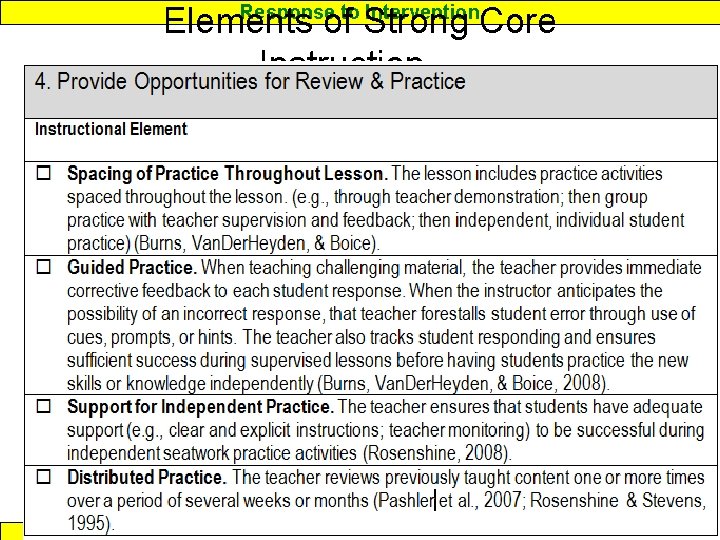
Elements of Strong Core Instruction… Response to Intervention www. interventioncentral. org 10
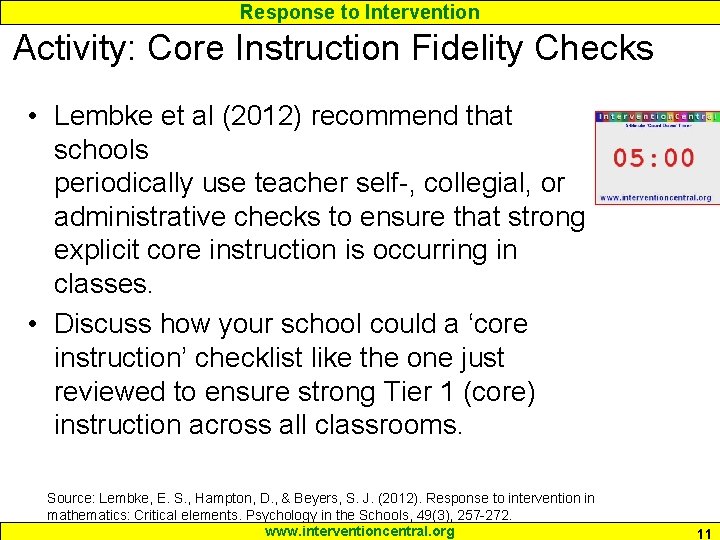
Response to Intervention Activity: Core Instruction Fidelity Checks • Lembke et al (2012) recommend that schools periodically use teacher self-, collegial, or administrative checks to ensure that strong explicit core instruction is occurring in classes. • Discuss how your school could a ‘core instruction’ checklist like the one just reviewed to ensure strong Tier 1 (core) instruction across all classrooms. Source: Lembke, E. S. , Hampton, D. , & Beyers, S. J. (2012). Response to intervention in mathematics: Critical elements. Psychology in the Schools, 49(3), 257 -272. www. interventioncentral. org 11
Response to Intervention Tier 1: Universal Instruction & Classroom Intervention RTI & Individual Classroom Interventions. What does Response to Intervention look like for an individual student (Tier 1: Intervention)? www. interventioncentral. org 12
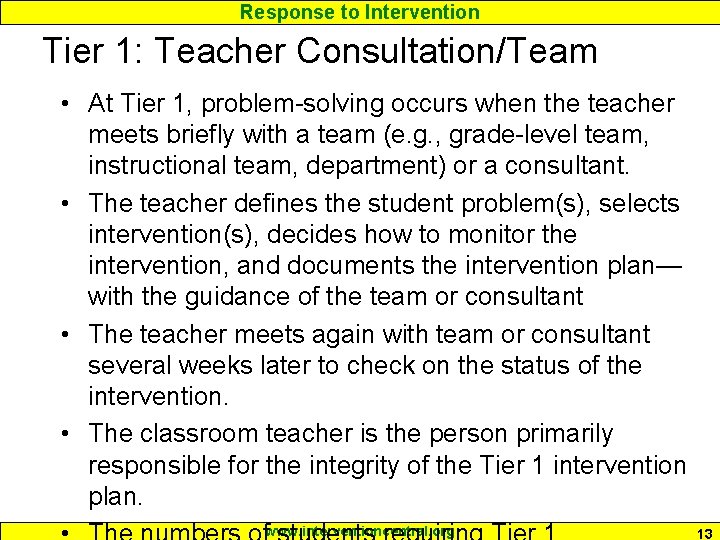
Response to Intervention Tier 1: Teacher Consultation/Team • At Tier 1, problem-solving occurs when the teacher meets briefly with a team (e. g. , grade-level team, instructional team, department) or a consultant. • The teacher defines the student problem(s), selects intervention(s), decides how to monitor the intervention, and documents the intervention plan— with the guidance of the team or consultant • The teacher meets again with team or consultant several weeks later to check on the status of the intervention. • The classroom teacher is the person primarily responsible for the integrity of the Tier 1 intervention plan. www. interventioncentral. org 13
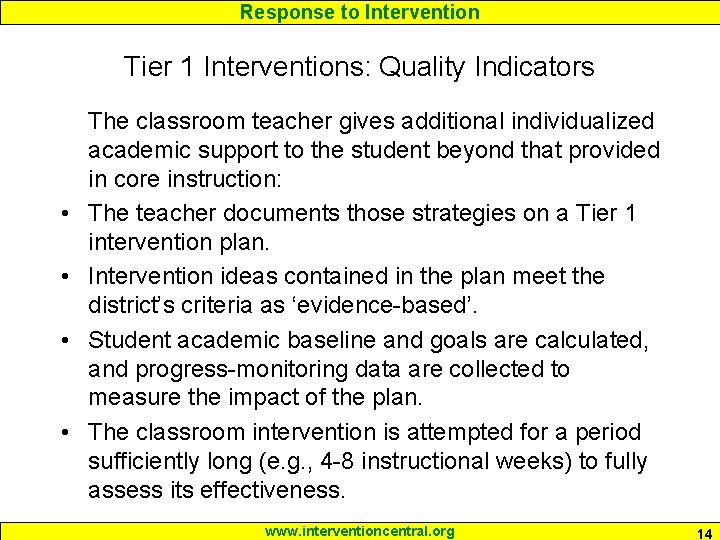
Response to Intervention Tier 1 Interventions: Quality Indicators • • The classroom teacher gives additional individualized academic support to the student beyond that provided in core instruction: The teacher documents those strategies on a Tier 1 intervention plan. Intervention ideas contained in the plan meet the district’s criteria as ‘evidence-based’. Student academic baseline and goals are calculated, and progress-monitoring data are collected to measure the impact of the plan. The classroom intervention is attempted for a period sufficiently long (e. g. , 4 -8 instructional weeks) to fully assess its effectiveness. www. interventioncentral. org 14
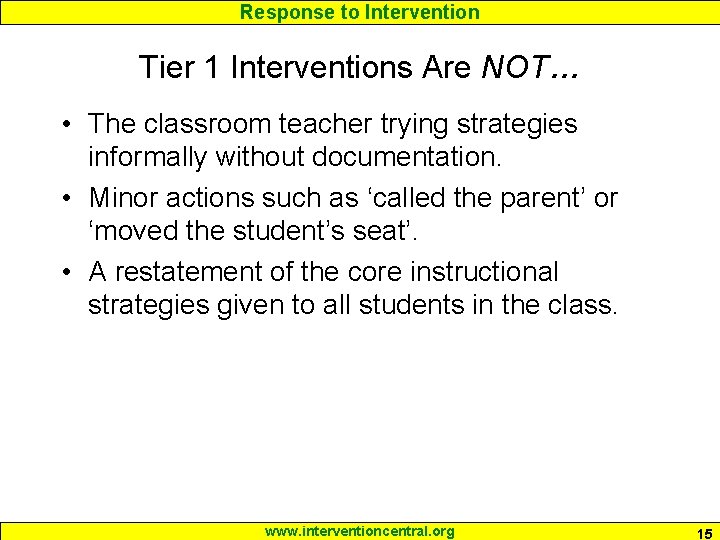
Response to Intervention Tier 1 Interventions Are NOT… • The classroom teacher trying strategies informally without documentation. • Minor actions such as ‘called the parent’ or ‘moved the student’s seat’. • A restatement of the core instructional strategies given to all students in the class. www. interventioncentral. org 15
Response to Intervention Making RTI Work at the Middle and High School Level Defining Intervention-Related Terms. What are the definitions for different types of student instruction and support ? pp. 16 -17 www. interventioncentral. org 16
Response to Intervention Core Instruction, Interventions, Instructional Adjustments & Modifications: Sorting Them Out • Core Instruction. Those instructional strategies that are used routinely with all students in a general-education setting are considered ‘core instruction’. High-quality instruction is essential and forms the foundation of classroom academic support. NOTE: While it is important to verify that a struggling student receives good core instructional practices, those routine practices do not ‘count’ as individual student interventions. www. interventioncentral. org 17
Response to Intervention Core Instruction, Interventions, Instructional Adjustments & Modifications: Sorting Them Out • Intervention. An academic intervention is a strategy used to teach a new skill, build fluency in a skill, or encourage a child to apply an existing skill to new situations or settings. An intervention can be thought of as “a set of actions that, when taken, have demonstrated ability to change a fixed educational trajectory” (Methe & Riley-Tillman, 2008; p. 37). As an example of an academic intervention, the teacher may select question generation (Davey & Mc. Bride, 1986. ; Rosenshine, Meister & Chapman, 1996), a strategy in which the student is taught to locate www. interventioncentral. org 18
Response to Intervention Core Instruction, Interventions, Instructional Adjustments & Modifications: Sorting Them Out • Instructional Adjustment. An instructional adjustment (also known as an 'accommodation') is intended to help the student to fully access and participate in the general-education curriculum without changing the instructional content and without reducing the student’s rate of learning (Skinner, Pappas & Davis, 2005). An instructional adjustment removes barriers to learning while still expecting that students will master the same instructional content as their typical peers. An instructional adjustment for students who are slow readers, for example, may include having them supplement their silent reading of a novel by listening to the book on tape. An instructional adjustment for unmotivated students may include www. interventioncentral. org 19
Response to Intervention Core Instruction, Interventions, Instructional Adjustments & Modifications: Sorting Them Out • Modification. A modification changes the expectations of what a student is expected to know or do—typically by lowering the academic standards against which the student is to be evaluated. Examples of modifications are giving a student five math computation problems for practice instead of the 20 problems assigned to the rest of the class or letting the student consult course notes during a test when peers are not permitted to do so. Modifications are generally not included on a general-education student’s classroom intervention plan—because lowering www. interventioncentral. org 20
Response to Intervention RTI & the Classroom: Are Modifications Occurring in Core Instruction? In your ‘elbow groups’, discuss the difference between ‘instructional adjustment (accommodation)’ and ‘modification’. Are general-education students being given modifications during core instruction in your school or district? If so, what are ways to support students while preventing these modifications from being used? www. interventioncentral. org 21
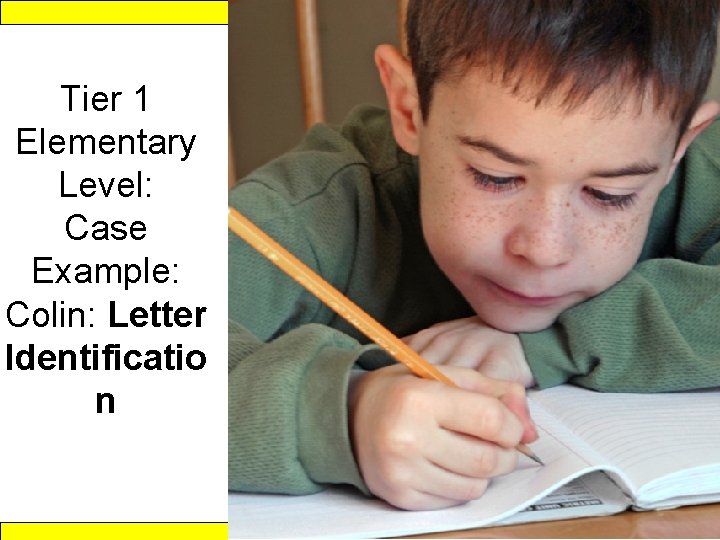
Response to Intervention Tier 1 Elementary Level: Case Example: Colin: Letter Identificatio n www. interventioncentral. org
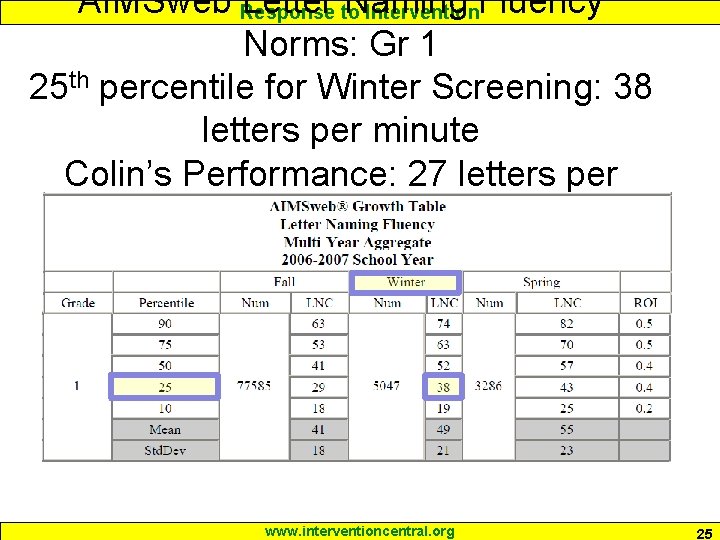
Response to Intervention AIMSweb Cut-Points: Using National Aggregate Sample • Low Risk: At or above the 25 th percentile: Core instruction alone is sufficient for the student. • Some Risk: 10 th to 24 th percentile: Student will benefit from additional intervention, which may be provided by the classroom teacher or other provider (e. g. , reading teacher). • At Risk: Below 10 th percentile : Student requires intensive intervention, which may be provided by the classroom teacher or other provider (e. g. , reading teacher). www. interventioncentral. org 23
Response to Intervention Case Example: Letter Naming The Concern • In a mid-year (Winter) school-wide screening for Letter Naming Fluency, a first-grade student new to the school, Colin, was found have moderate delays when compared to peers. In his school, Colin fell below the 25 th percentile compared with peers (AIMSweb norms). According to the benchmark norms, a student at the 25 th percentile should read at least 38 letters per minute. Colin was able to read only 27 letters per minute. (NOTE: These results place Colin between the 10 th and 25 th percentile, a mild level of deficit—‘Some Risk’. ) • Screening results, therefore, suggested that Colin www. interventioncentral. org 24
AIMSweb Response Letter to. Naming Intervention. Fluency Norms: Gr 1 25 th percentile for Winter Screening: 38 letters per minute Colin’s Performance: 27 letters per minute www. interventioncentral. org 25
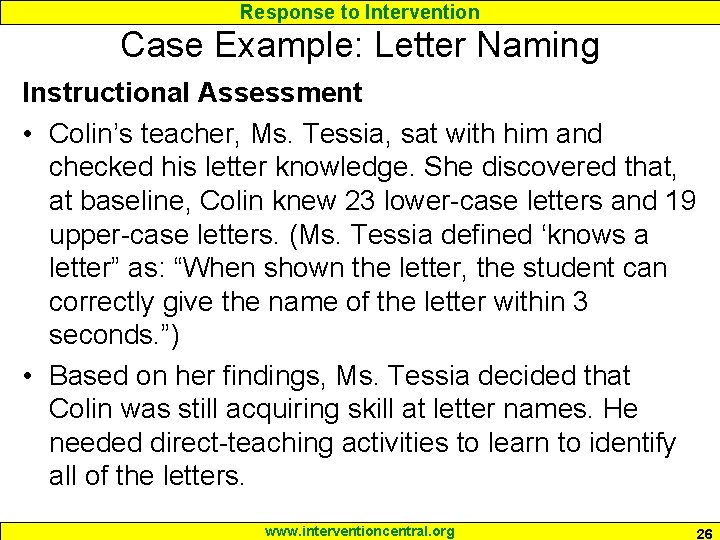
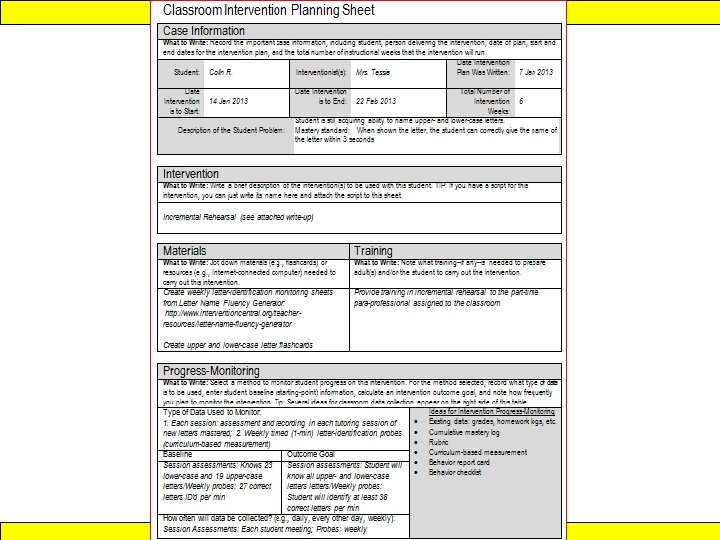
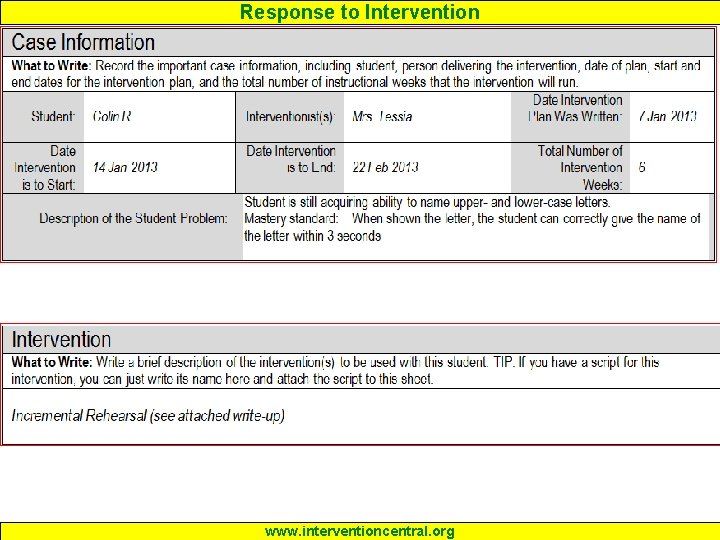
Response to Intervention Case Example: Letter Naming Instructional Assessment • Colin’s teacher, Ms. Tessia, sat with him and checked his letter knowledge. She discovered that, at baseline, Colin knew 23 lower-case letters and 19 upper-case letters. (Ms. Tessia defined ‘knows a letter” as: “When shown the letter, the student can correctly give the name of the letter within 3 seconds. ”) • Based on her findings, Ms. Tessia decided that Colin was still acquiring skill at letter names. He needed direct-teaching activities to learn to identify all of the letters. www. interventioncentral. org 26
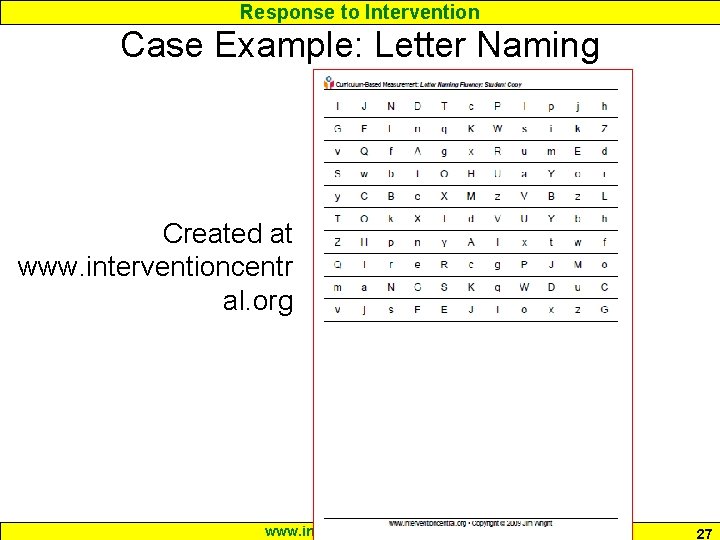
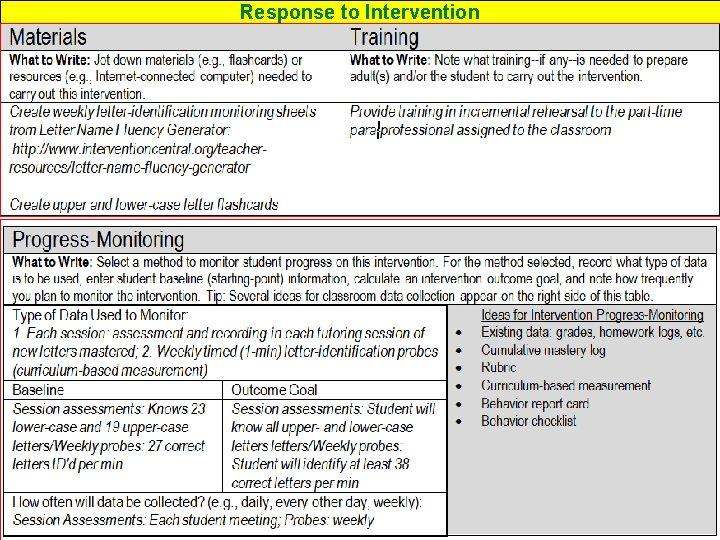
Response to Intervention Case Example: Letter Naming Created at www. interventioncentr al. org www. interventioncentral. org 27
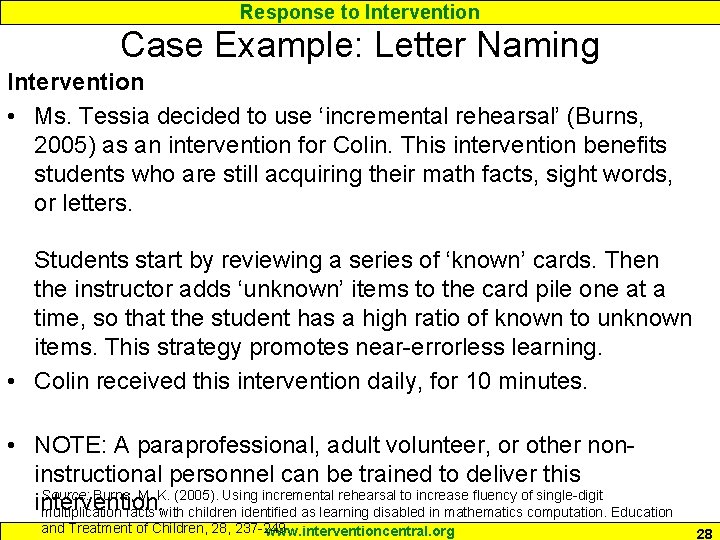
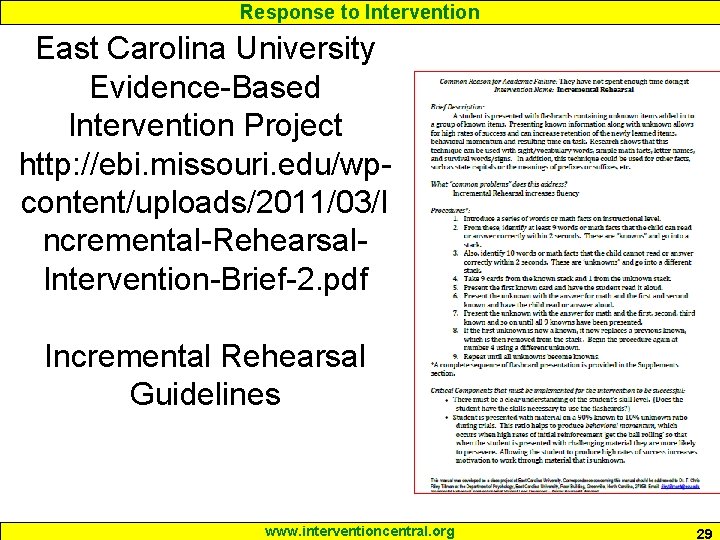
Response to Intervention Case Example: Letter Naming Intervention • Ms. Tessia decided to use ‘incremental rehearsal’ (Burns, 2005) as an intervention for Colin. This intervention benefits students who are still acquiring their math facts, sight words, or letters. Students start by reviewing a series of ‘known’ cards. Then the instructor adds ‘unknown’ items to the card pile one at a time, so that the student has a high ratio of known to unknown items. This strategy promotes near-errorless learning. • Colin received this intervention daily, for 10 minutes. • NOTE: A paraprofessional, adult volunteer, or other noninstructional personnel can be trained to deliver this Source: Burns, M. K. (2005). Using incremental rehearsal to increase fluency of single-digit intervention. multiplication facts with children identified as learning disabled in mathematics computation. Education and Treatment of Children, 28, 237 -249. www. interventioncentral. org 28
Response to Intervention East Carolina University Evidence-Based Intervention Project http: //ebi. missouri. edu/wpcontent/uploads/2011/03/I ncremental-Rehearsal. Intervention-Brief-2. pdf Incremental Rehearsal Guidelines www. interventioncentral. org 29
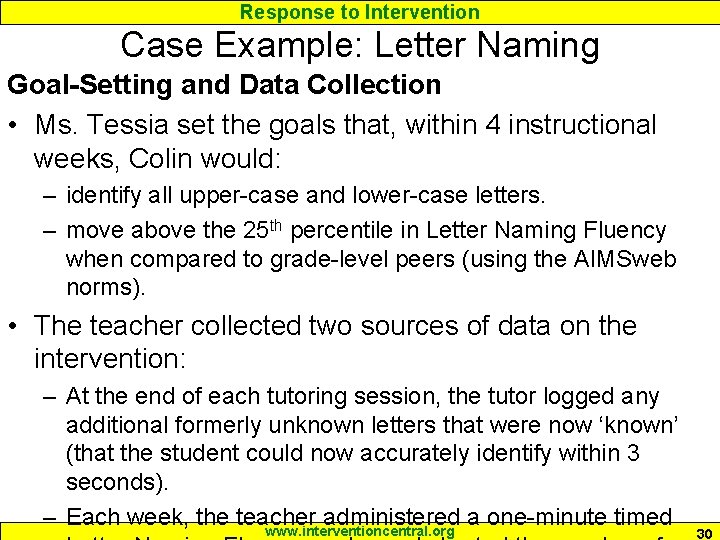
Response to Intervention Case Example: Letter Naming Goal-Setting and Data Collection • Ms. Tessia set the goals that, within 4 instructional weeks, Colin would: – identify all upper-case and lower-case letters. – move above the 25 th percentile in Letter Naming Fluency when compared to grade-level peers (using the AIMSweb norms). • The teacher collected two sources of data on the intervention: – At the end of each tutoring session, the tutor logged any additional formerly unknown letters that were now ‘known’ (that the student could now accurately identify within 3 seconds). – Each week, the teacher administered a one-minute timed www. interventioncentral. org 30
Response to Intervention www. interventioncentral. org
Response to Intervention www. interventioncentral. org
Response to Intervention www. interventioncentral. org
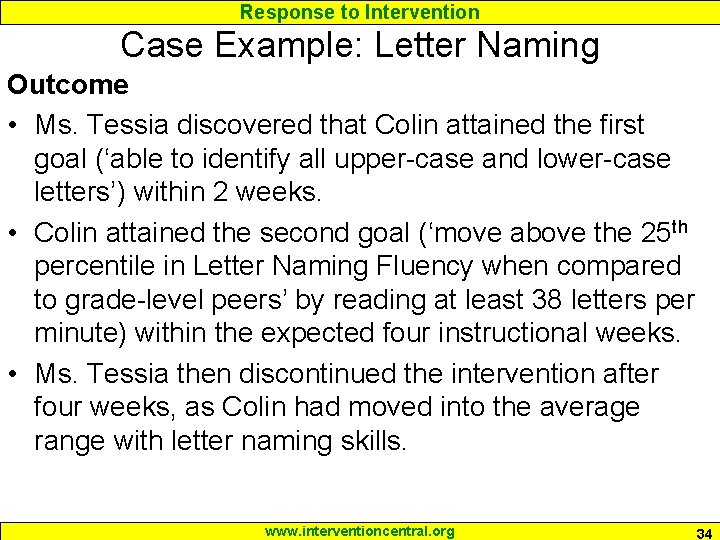
Response to Intervention Case Example: Letter Naming Outcome • Ms. Tessia discovered that Colin attained the first goal (‘able to identify all upper-case and lower-case letters’) within 2 weeks. • Colin attained the second goal (‘move above the 25 th percentile in Letter Naming Fluency when compared to grade-level peers’ by reading at least 38 letters per minute) within the expected four instructional weeks. • Ms. Tessia then discontinued the intervention after four weeks, as Colin had moved into the average range with letter naming skills. www. interventioncentral. org 34
Response to Intervention Tier 1 Secondary Level: Case Example: Patricia: Reading Comprehension www. interventioncentral. org
Response to Intervention Case Example: Reading Comprehension The Problem • A student, Patricia, struggled in her social studies class, particularly in understanding the course readings. Her teacher, Ms. Cardamone, decided that the problem was significant enough that the student required some individualized support. www. interventioncentral. org 36
Response to Intervention Case Example: Reading Comprehension The Evidence • Student Interview. Ms. Cardamone met with Patricia to ask her questions about her difficulties with social studies content and assignments. Patricia said that when she reads the course text and other assigned readings, she doesn’t have difficulty with the vocabulary but often realizes after reading half a page that she hasn’t really understood what she has read. Sometimes she has to reread a page several times and that can be frustrating. www. interventioncentral. org 37
Response to Intervention Case Example: Reading Comprehension The Evidence (Cont. ) • Review of Records. Past teacher report card comments suggest that Patricia has had difficulty with reading comprehension tasks in earlier grades. She had received help in the reading lab at her previous school, although there was no record of what specific interventions were tried in that setting. • Input from Other Teachers. Ms. Cardamone checked with other teachers who have Patricia in their classes. All expressed concern about Patricia’s reading comprehension skills. The English teacher noted that Patricia appears to have difficulty pulling the main idea from a passage, which limits her ability to extract www. interventioncentral. org 38
Response to Intervention Case Example: Reading Comprehension The Intervention • Ms. Cardamone decided, based on the evidence collected, that Patricia would benefit from training in identifying the main idea from a passage, rather than trying to retain all the information presented in the text. She selected two simple interventions: Question Generation and Text Lookback. She arranged to have Patricia meet with her during an open period to review these two strategies. During that meeting, Ms. Cardamone demonstrated how to use these strategies effectively with the social studies course www. interventioncentral. org 39
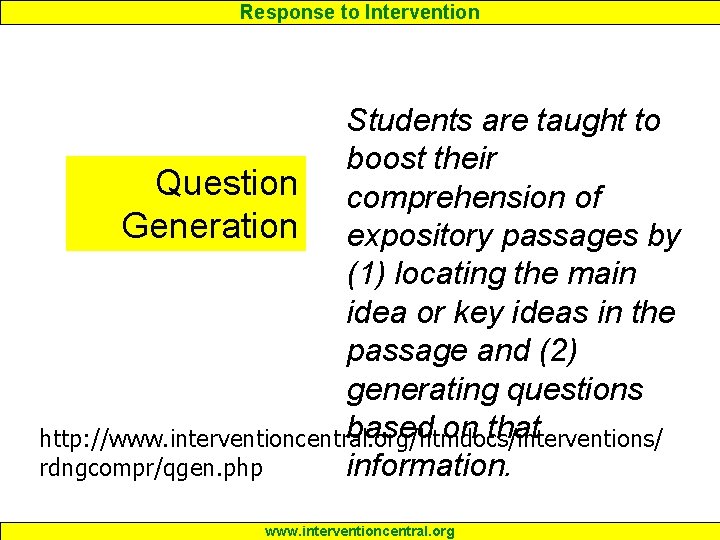
Response to Intervention Students are taught to boost their Question comprehension of Generation expository passages by (1) locating the main idea or key ideas in the passage and (2) generating questions based on that http: //www. interventioncentral. org/htmdocs/interventions/ rdngcompr/qgen. php information. www. interventioncentral. org
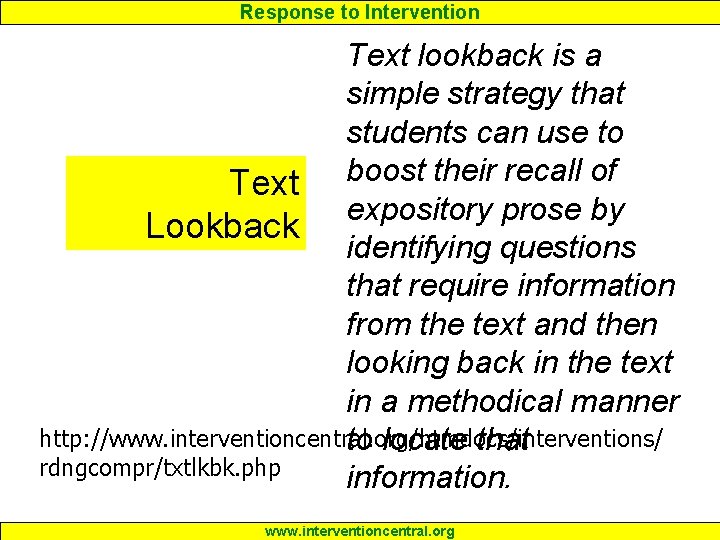
Response to Intervention Text lookback is a simple strategy that students can use to Text boost their recall of expository prose by Lookback identifying questions that require information from the text and then looking back in the text in a methodical manner http: //www. interventioncentral. org/htmdocs/interventions/ to locate that rdngcompr/txtlkbk. php information. www. interventioncentral. org
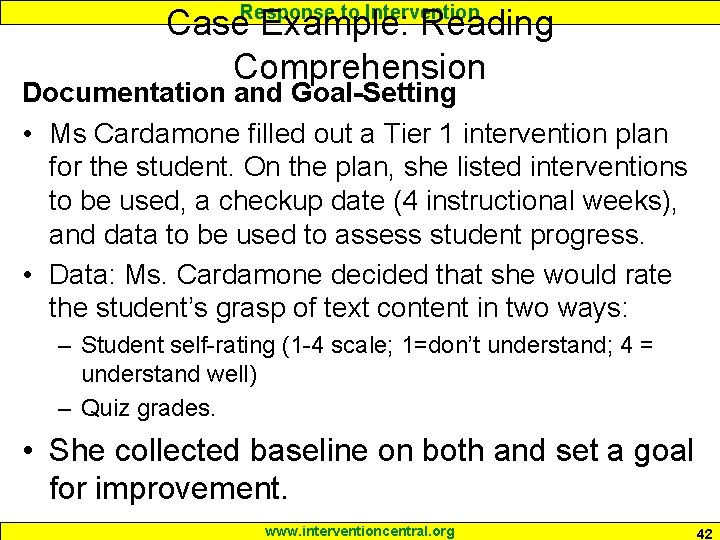
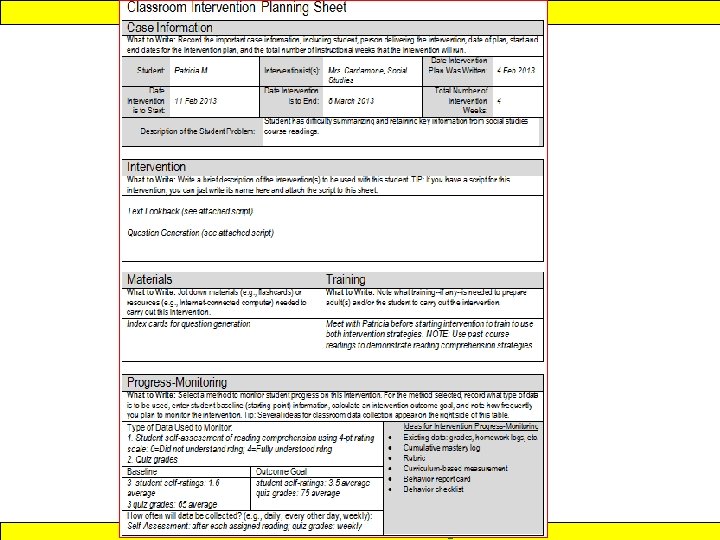
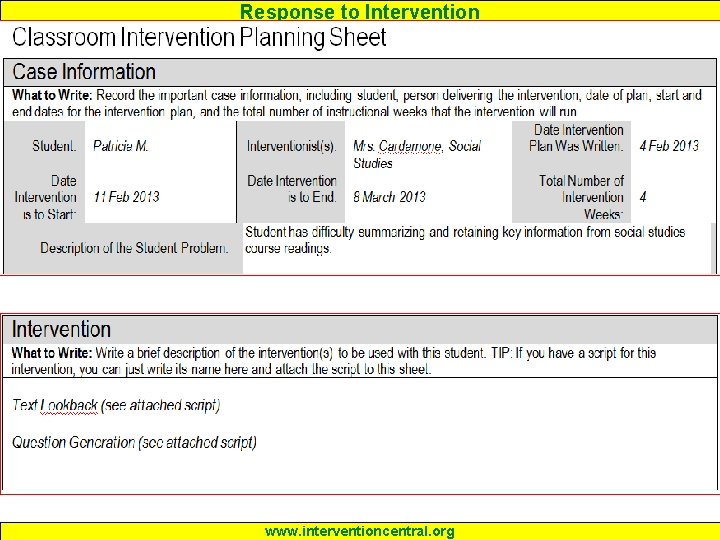
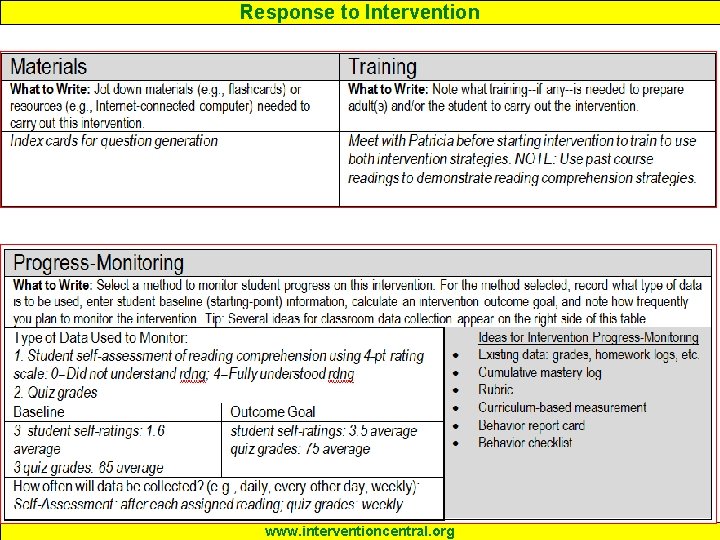
Response to Intervention Case Example: Reading Comprehension Documentation and Goal-Setting • Ms Cardamone filled out a Tier 1 intervention plan for the student. On the plan, she listed interventions to be used, a checkup date (4 instructional weeks), and data to be used to assess student progress. • Data: Ms. Cardamone decided that she would rate the student’s grasp of text content in two ways: – Student self-rating (1 -4 scale; 1=don’t understand; 4 = understand well) – Quiz grades. • She collected baseline on both and set a goal for improvement. www. interventioncentral. org 42
Response to Intervention www. interventioncentral. org
Response to Intervention www. interventioncentral. org
Response to Intervention www. interventioncentral. org
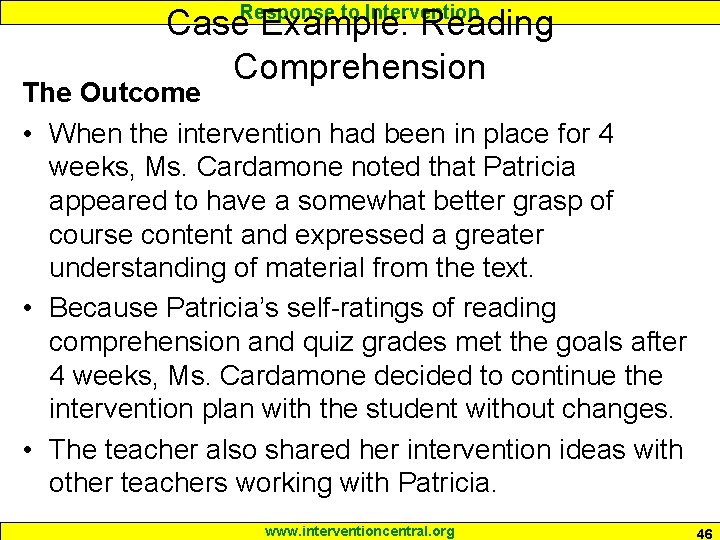
Response to Intervention Case Example: Reading Comprehension The Outcome • When the intervention had been in place for 4 weeks, Ms. Cardamone noted that Patricia appeared to have a somewhat better grasp of course content and expressed a greater understanding of material from the text. • Because Patricia’s self-ratings of reading comprehension and quiz grades met the goals after 4 weeks, Ms. Cardamone decided to continue the intervention plan with the student without changes. • The teacher also shared her intervention ideas with other teachers working with Patricia. www. interventioncentral. org 46
Response to Intervention Tier 1: Universal Instruction & Classroom Intervention Next Steps. What are the recommended ‘next steps’ for this module? www. interventioncentral. org 47
Response to Intervention Tier 1: Recommended Next Steps… 1. Develop a Checklist to Define Strong Instruction. Select or develop an observational checklist for "direct instruction" to help teachers to verify delivery of strong, consistent instruction across classrooms. 2. Define Intervention-Related Terms. Share with teachers the definitions of academic intervention, instructional adjustment/accommodation, and modification--to prevent accidental modification of instruction for generalwww. interventioncentral. org 48
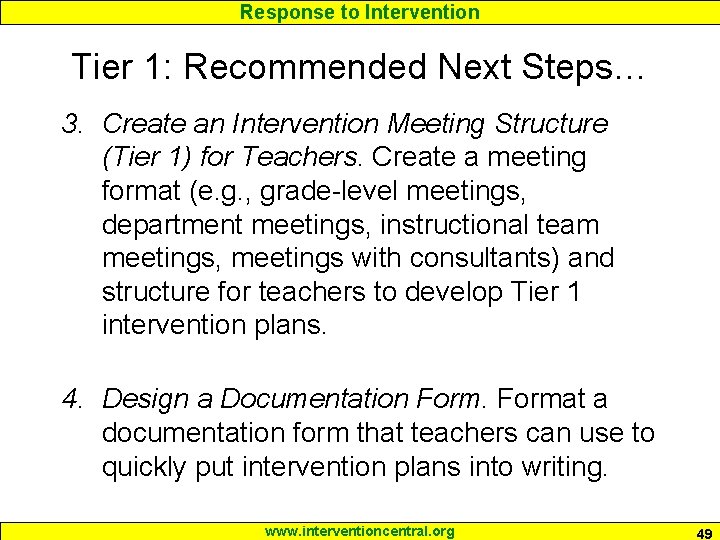
Response to Intervention Tier 1: Recommended Next Steps… 3. Create an Intervention Meeting Structure (Tier 1) for Teachers. Create a meeting format (e. g. , grade-level meetings, department meetings, instructional team meetings, meetings with consultants) and structure for teachers to develop Tier 1 intervention plans. 4. Design a Documentation Format a documentation form that teachers can use to quickly put intervention plans into writing. www. interventioncentral. org 49
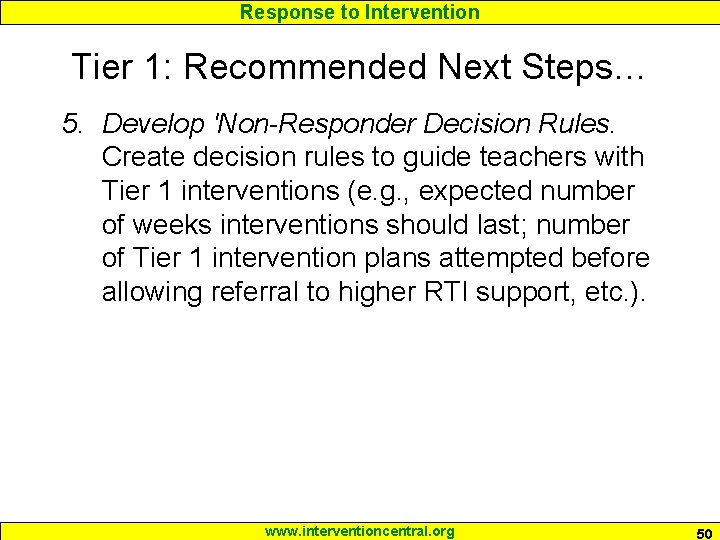
Response to Intervention Tier 1: Recommended Next Steps… 5. Develop 'Non-Responder Decision Rules. Create decision rules to guide teachers with Tier 1 interventions (e. g. , expected number of weeks interventions should last; number of Tier 1 intervention plans attempted before allowing referral to higher RTI support, etc. ). www. interventioncentral. org 50
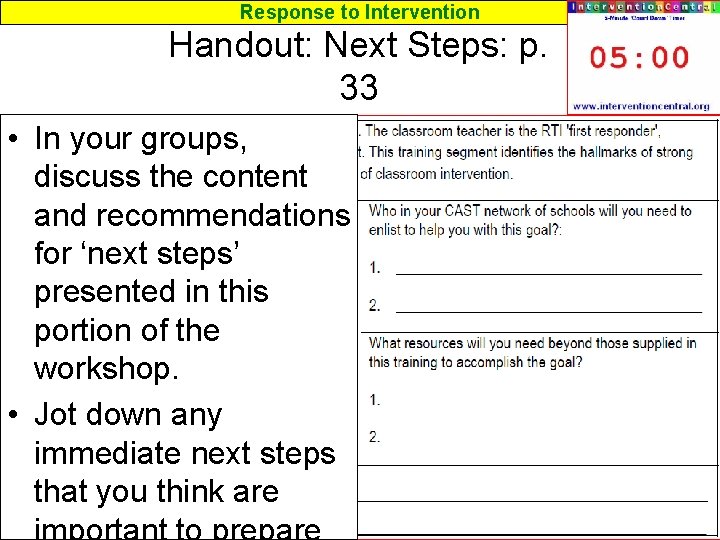
Response to Intervention Handout: Next Steps: p. 33 • In your groups, discuss the content and recommendations for ‘next steps’ presented in this portion of the workshop. • Jot down any immediate next steps that you think are www. interventioncentral. org 51