
Response to Intervention Policy Considerations and Implementation The







- Slides: 36
Response to Intervention Policy Considerations and Implementation
The IDEA Partnership acknowledges the work of the National Association of State Directors of Special Education (NASDSE) and the following authors George Batsche Judy Elliott Janet L. Graden Jeffrey Grimes Joseph F. Kovaleski David Prasse Daniel Reschley Judy Schrag W. David Tilly III who collaborated to create “Response to Intervention: Policy Considerations and Implementation” -andis deeply grateful for being allowed to adapt the original presentation in order to provide additional access to all education stakeholders. February 2007 IDEA Partnership 2
Overview § § § § Definition Basis in Federal Law Core Principles Essential Components Simplified Process Special Education Eligibility Considerations Policy Issues Professional Development Issues February 2007 IDEA Partnership 3
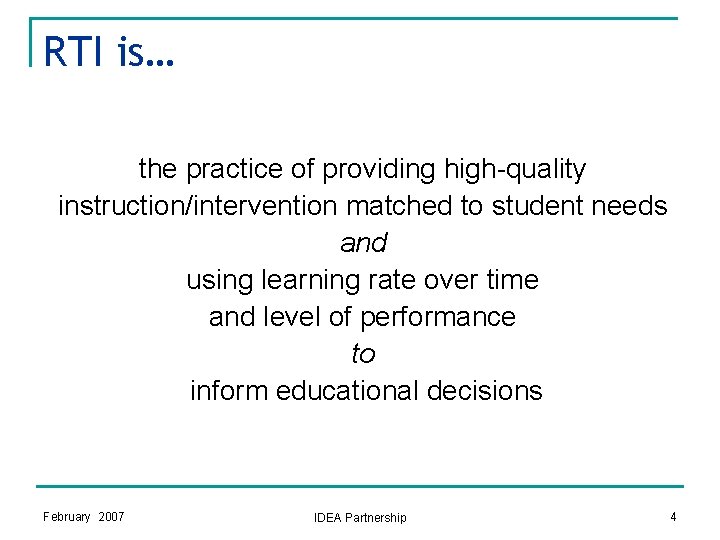
RTI is… the practice of providing high-quality instruction/intervention matched to student needs and using learning rate over time and level of performance to inform educational decisions February 2007 IDEA Partnership 4
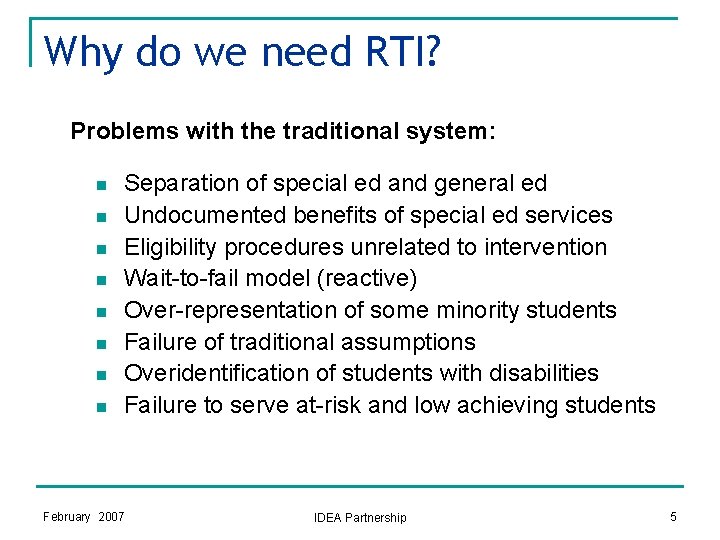
Why do we need RTI? Problems with the traditional system: n n n n Separation of special ed and general ed Undocumented benefits of special ed services Eligibility procedures unrelated to intervention Wait-to-fail model (reactive) Over-representation of some minority students Failure of traditional assumptions Overidentification of students with disabilities Failure to serve at-risk and low achieving students February 2007 IDEA Partnership 5
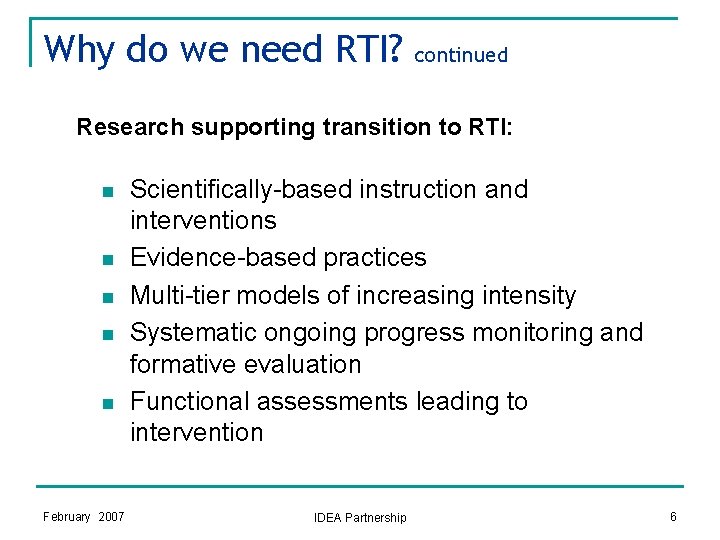
Why do we need RTI? continued Research supporting transition to RTI: n n n February 2007 Scientifically-based instruction and interventions Evidence-based practices Multi-tier models of increasing intensity Systematic ongoing progress monitoring and formative evaluation Functional assessments leading to intervention IDEA Partnership 6
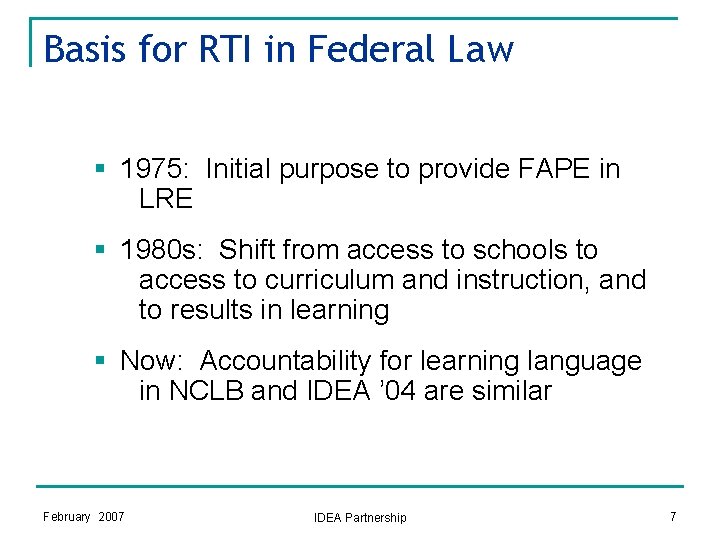
Basis for RTI in Federal Law § 1975: Initial purpose to provide FAPE in LRE § 1980 s: Shift from access to schools to access to curriculum and instruction, and to results in learning § Now: Accountability for learning language in NCLB and IDEA ’ 04 are similar February 2007 IDEA Partnership 7
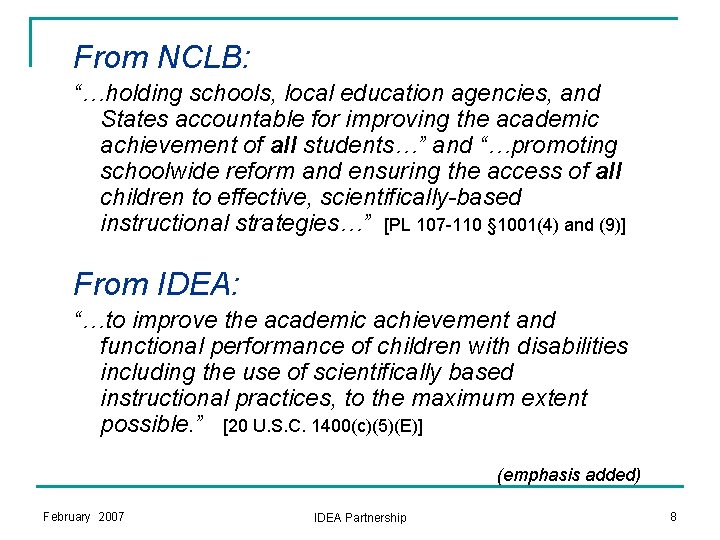
From NCLB: “…holding schools, local education agencies, and States accountable for improving the academic achievement of all students…” and “…promoting schoolwide reform and ensuring the access of all children to effective, scientifically-based instructional strategies…” [PL 107 -110 § 1001(4) and (9)] From IDEA: “…to improve the academic achievement and functional performance of children with disabilities including the use of scientifically based instructional practices, to the maximum extent possible. ” [20 U. S. C. 1400(c)(5)(E)] (emphasis added) February 2007 IDEA Partnership 8
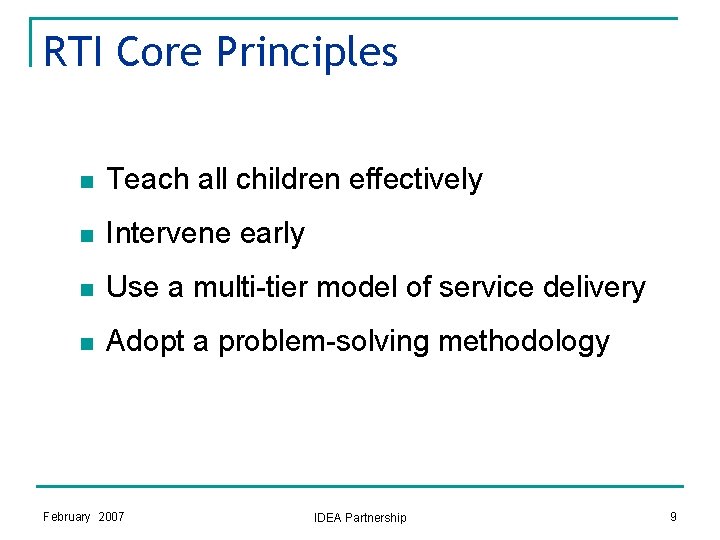
RTI Core Principles n Teach all children effectively n Intervene early n Use a multi-tier model of service delivery n Adopt a problem-solving methodology February 2007 IDEA Partnership 9
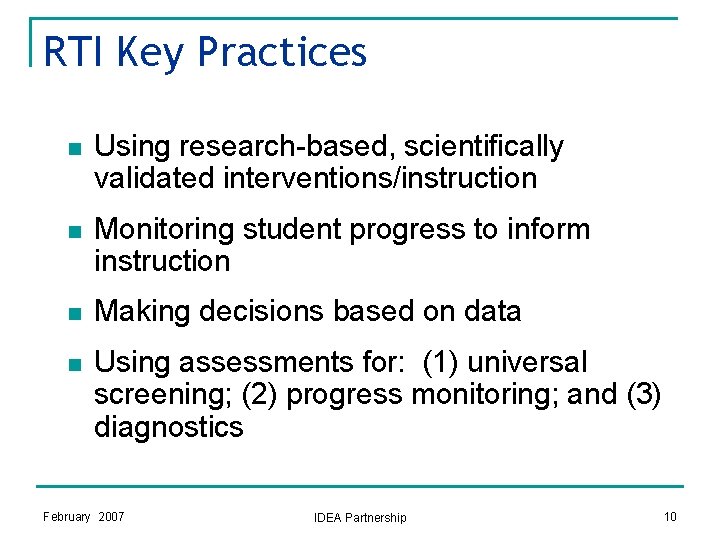
RTI Key Practices n Using research-based, scientifically validated interventions/instruction n Monitoring student progress to inform instruction n Making decisions based on data n Using assessments for: (1) universal screening; (2) progress monitoring; and (3) diagnostics February 2007 IDEA Partnership 10
Essential Components of RTI Implementation 1. Multi-tier model 2. Problem-solving method 3. Integrated data collection/ assessment system February 2007 IDEA Partnership 11
Essential Component 1: Multi-tier Model February 2007 IDEA Partnership 12
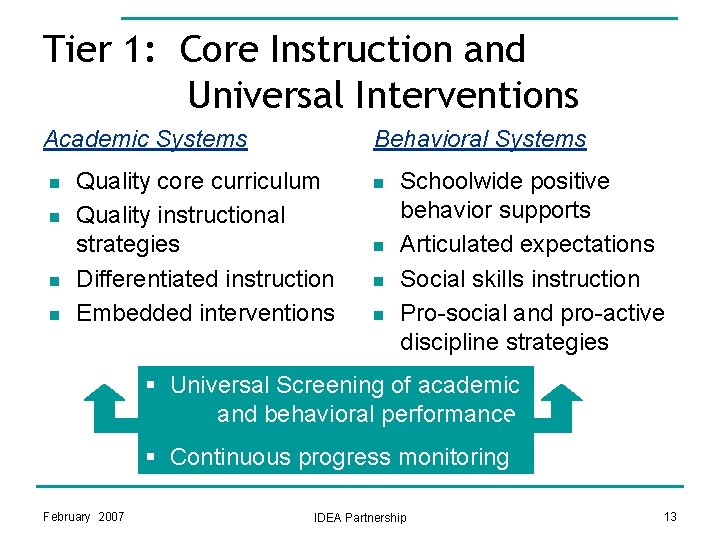
Tier 1: Core Instruction and Universal Interventions Academic Systems n n Behavioral Systems Quality core curriculum Quality instructional strategies Differentiated instruction Embedded interventions n n Schoolwide positive behavior supports Articulated expectations Social skills instruction Pro-social and pro-active discipline strategies § Universal Screening of academic and behavioral performance § Continuous progress monitoring February 2007 IDEA Partnership 13
Tier 2: Targeted Interventions Academic Systems n n n Behavioral Systems Strategic supplemental academic programs Standard protocol treatment interventions Small group interventions q q General education Other settings n n Strategic supplemental behavior programs Small group training q q n Social skills Anger management Peer/adult mentoring program § Process / guidelines for fading, continuing, changing intervention § Focused continuous progress monitoring of responsiveness to intervention(s) February 2007 IDEA Partnership 14
Tier 3: Intensive Interventions Academic Systems n Behavioral Systems Small group/individualized standard protocol and/or interventions determined through problem solving n n n Small group/individualized counseling therapy Individualized behavior plan Frequent, daily mentoring § Guidelines for fading, continuing, changing intervention § Focused continuous progress monitoring of responsiveness to intervention(s) § Pattern of inadequate response(s) may indicate special education February 2007 IDEA Partnership 15
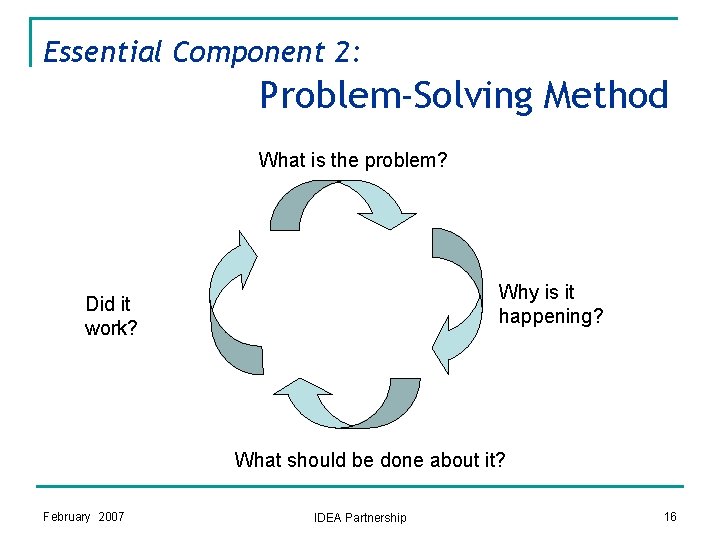
Essential Component 2: Problem-Solving Method What is the problem? Why is it happening? Did it work? What should be done about it? February 2007 IDEA Partnership 16
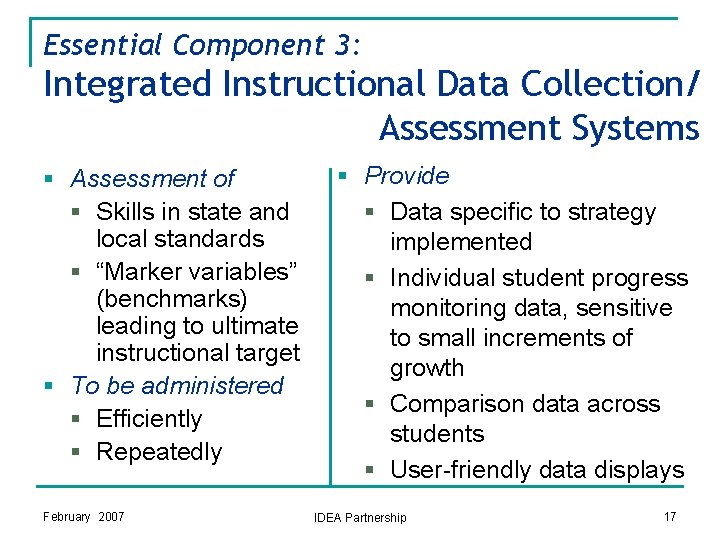
Essential Component 3: Integrated Instructional Data Collection/ Assessment Systems § Assessment of § Skills in state and local standards § “Marker variables” (benchmarks) leading to ultimate instructional target § To be administered § Efficiently § Repeatedly February 2007 § Provide § Data specific to strategy implemented § Individual student progress monitoring data, sensitive to small increments of growth § Comparison data across students § User-friendly data displays IDEA Partnership 17
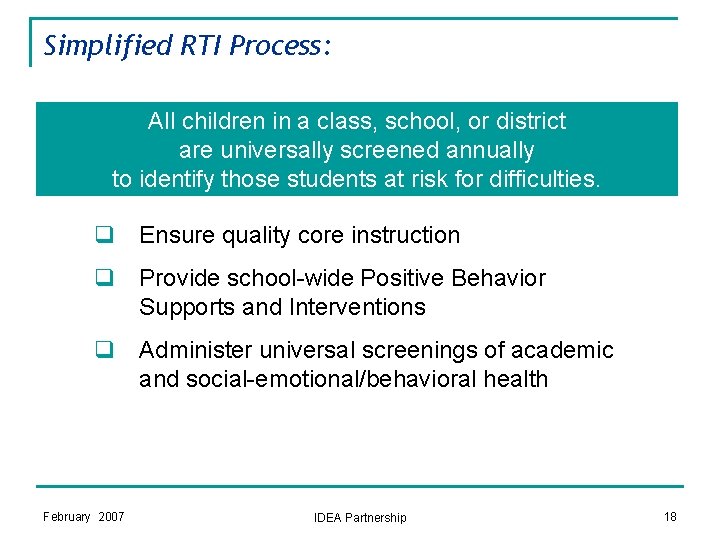
Simplified RTI Process: All children in a class, school, or district are universally screened annually to identify those students at risk for difficulties. q Ensure quality core instruction q Provide school-wide Positive Behavior Supports and Interventions q Administer universal screenings of academic and social-emotional/behavioral health February 2007 IDEA Partnership 18
Simplified RTI Process: The responsiveness of students to general education instruction is monitored to determine those requiring a targeted intervention. q Gather and review student performance data q Clarify goal(s) for the student through team decision-making process q Brainstorm interventions q Select interventions q Determine dependent variables q Implement interventions q Monitor student progress q Conduct follow-up meeting February 2007 IDEA Partnership 19
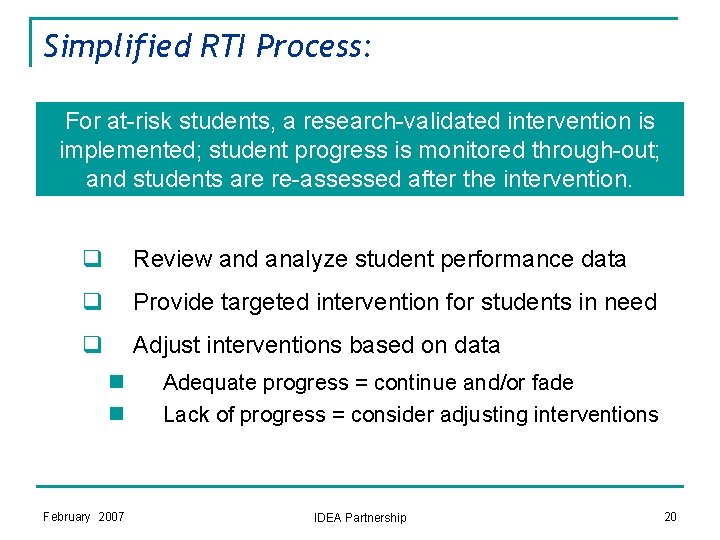
Simplified RTI Process: For at-risk students, a research-validated intervention is implemented; student progress is monitored through-out; and students are re-assessed after the intervention. q Review and analyze student performance data q Provide targeted intervention for students in need q Adjust interventions based on data n n February 2007 Adequate progress = continue and/or fade Lack of progress = consider adjusting interventions IDEA Partnership 20
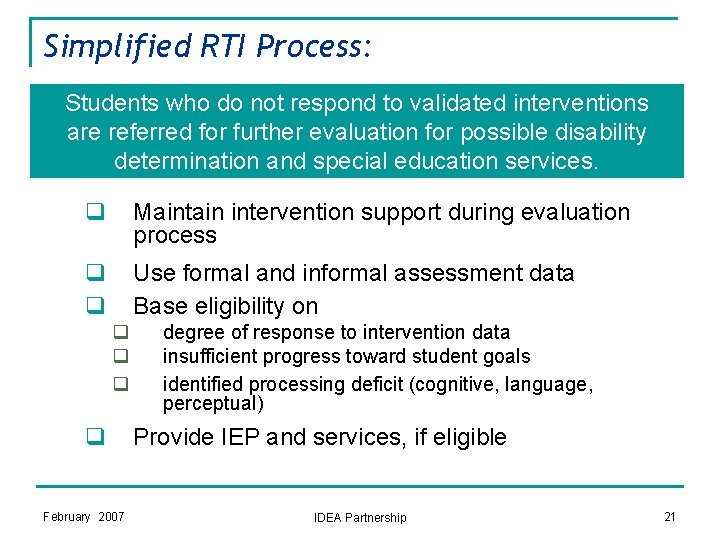
Simplified RTI Process: Students who do not respond to validated interventions are referred for further evaluation for possible disability determination and special education services. q Maintain intervention support during evaluation process q q Use formal and informal assessment data Base eligibility on q q February 2007 degree of response to intervention data insufficient progress toward student goals identified processing deficit (cognitive, language, perceptual) Provide IEP and services, if eligible IDEA Partnership 21
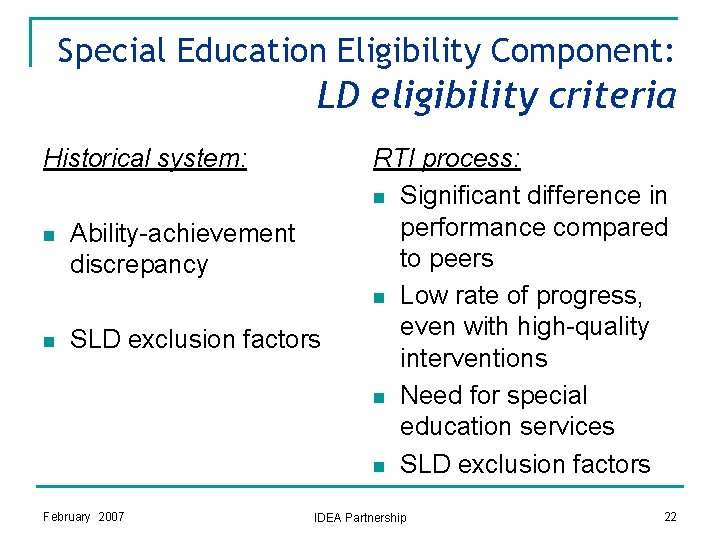
Special Education Eligibility Component: LD eligibility criteria Historical system: n Ability-achievement discrepancy n SLD exclusion factors February 2007 RTI process: n Significant difference in performance compared to peers n Low rate of progress, even with high-quality interventions n Need for special education services n SLD exclusion factors IDEA Partnership 22
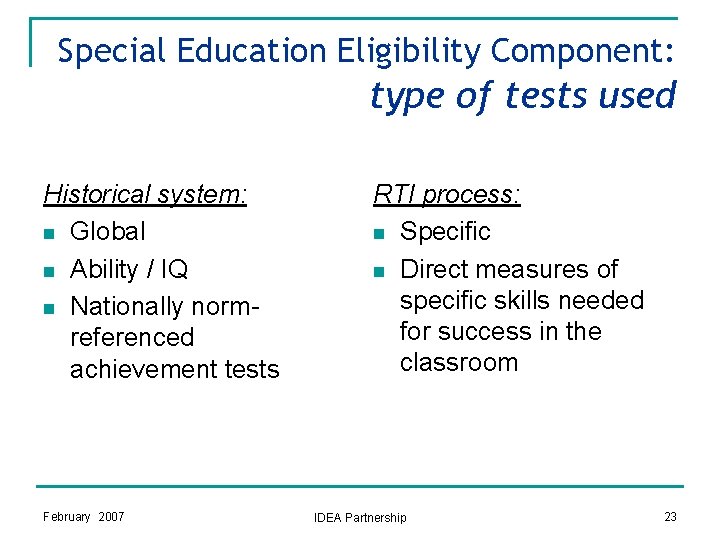
Special Education Eligibility Component: type of tests used Historical system: n Global n Ability / IQ n Nationally normreferenced achievement tests February 2007 RTI process: n Specific n Direct measures of specific skills needed for success in the classroom IDEA Partnership 23
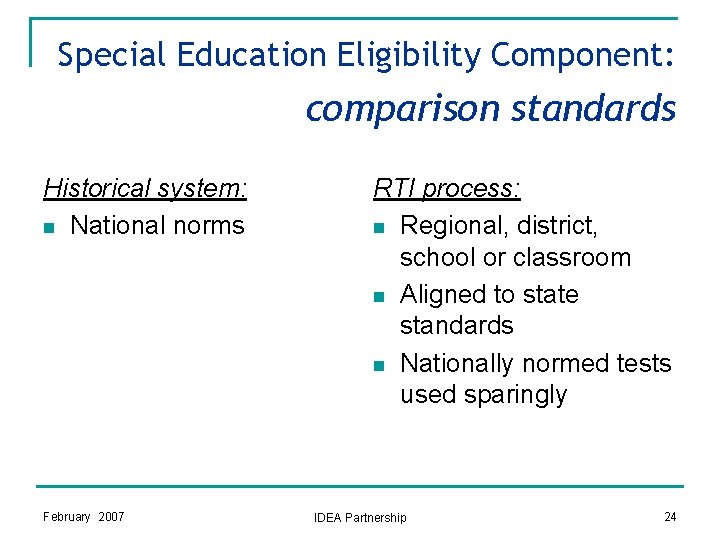
Special Education Eligibility Component: comparison standards Historical system: n National norms February 2007 RTI process: n Regional, district, school or classroom n Aligned to state standards n Nationally normed tests used sparingly IDEA Partnership 24
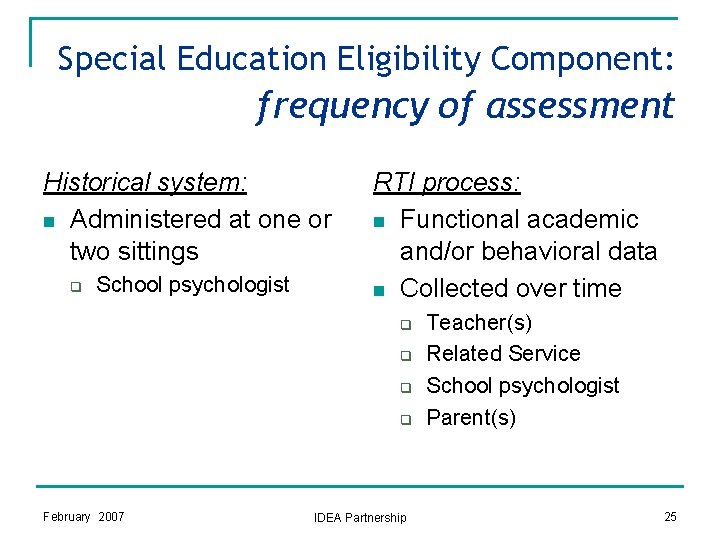
Special Education Eligibility Component: frequency of assessment Historical system: n Administered at one or two sittings q School psychologist RTI process: n Functional academic and/or behavioral data n Collected over time q q February 2007 IDEA Partnership Teacher(s) Related Service School psychologist Parent(s) 25
Special Education Eligibility Component: nature of assessment targets/ what is being measured Historical system: n Indirect or general relationships with classroom academic or behavioral problems n Most often intrinsic to the person February 2007 RTI process: n Specific skills measured n Related to student academic and/or behavioral skills and performance IDEA Partnership 26
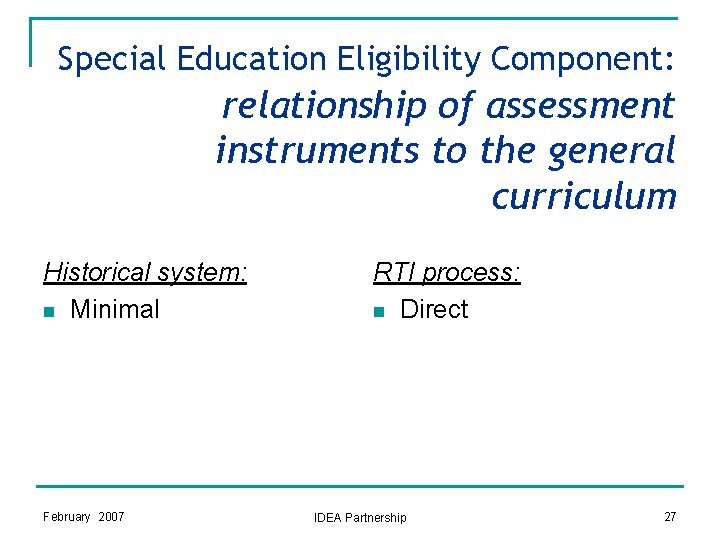
Special Education Eligibility Component: relationship of assessment instruments to the general curriculum Historical system: n Minimal February 2007 RTI process: n Direct IDEA Partnership 27
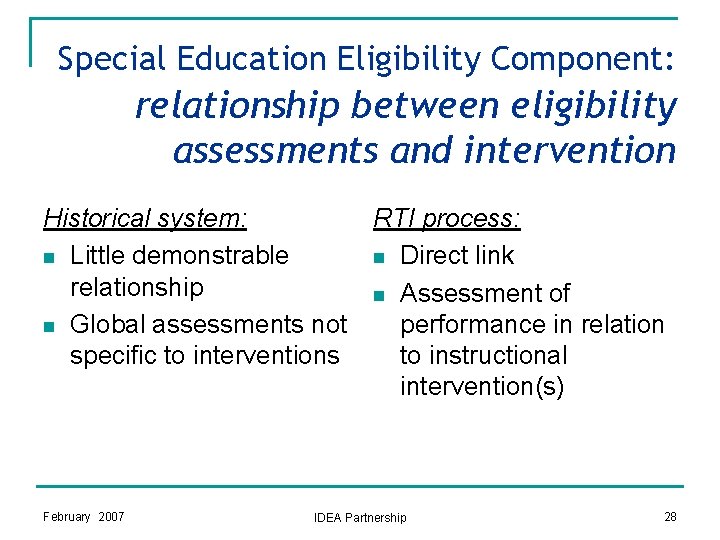
Special Education Eligibility Component: relationship between eligibility assessments and intervention Historical system: RTI process: n Little demonstrable n Direct link relationship n Assessment of n Global assessments not performance in relation specific to interventions to instructional intervention(s) February 2007 IDEA Partnership 28
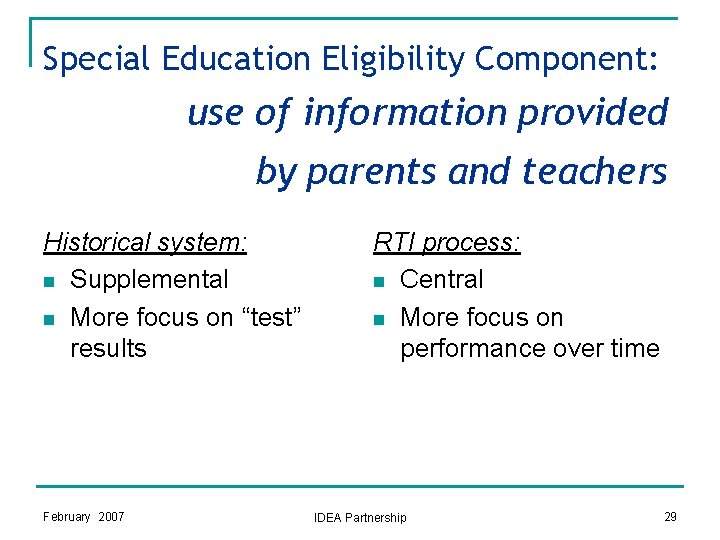
Special Education Eligibility Component: use of information provided by parents and teachers Historical system: n Supplemental n More focus on “test” results February 2007 RTI process: n Central n More focus on performance over time IDEA Partnership 29
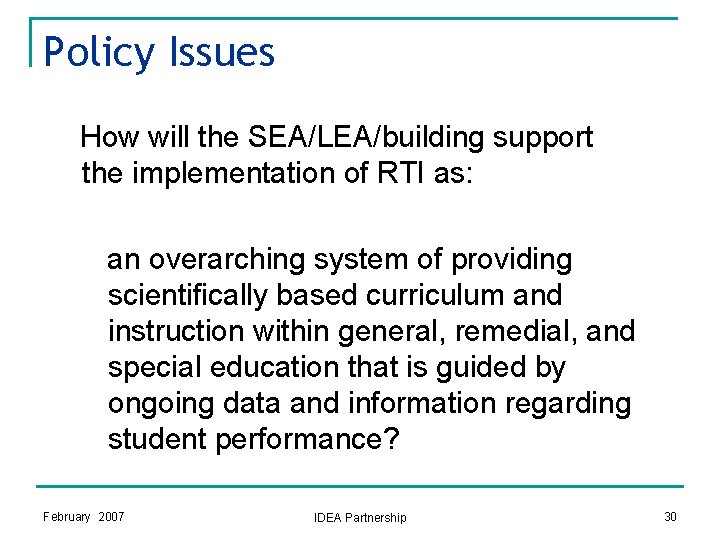
Policy Issues How will the SEA/LEA/building support the implementation of RTI as: an overarching system of providing scientifically based curriculum and instruction within general, remedial, and special education that is guided by ongoing data and information regarding student performance? February 2007 IDEA Partnership 30
Policy Issues (continued) How will the SEA/LEA/building support the implementation of RTI as: q q February 2007 a way of gathering data for use within the special education eligibility process? ongoing data-based decision making within special education as a part of using RTI practices? IDEA Partnership 31
Policy Issues What is the current state-/local-level infrastructure to support successful implementation of RTI? Including… q Rules, guidelines, best practices q Parent and professional development Providing… q Intervention structures and resources within general education q Measurement procedures for gathering ongoing student performance q Strategies for research q Evaluation of impact February 2007 IDEA Partnership 32
Professional Development Needed q Pre-service at college/university level q District-level leadership q Building-level administration q Direct services (e. g. , teachers) q Support services q Parents/Families February 2007 IDEA Partnership 33
A leader is a person you would follow to a place you would not go yourself. Joel Barker, Future Edge, 1992 February 2007 IDEA Partnership 34
For More Information: IDEA Partnership’s RTI Initiative Website: www. ideapartnership. org n n n February 2007 A Partnership Collection on RTI Many Journals, Many Voices Results for Kids: Resources IDEA Partnership 35
! Reflections! Questions? ? Discussion. ! February 2007 . . IDEA Partnership ? ? ! 36