
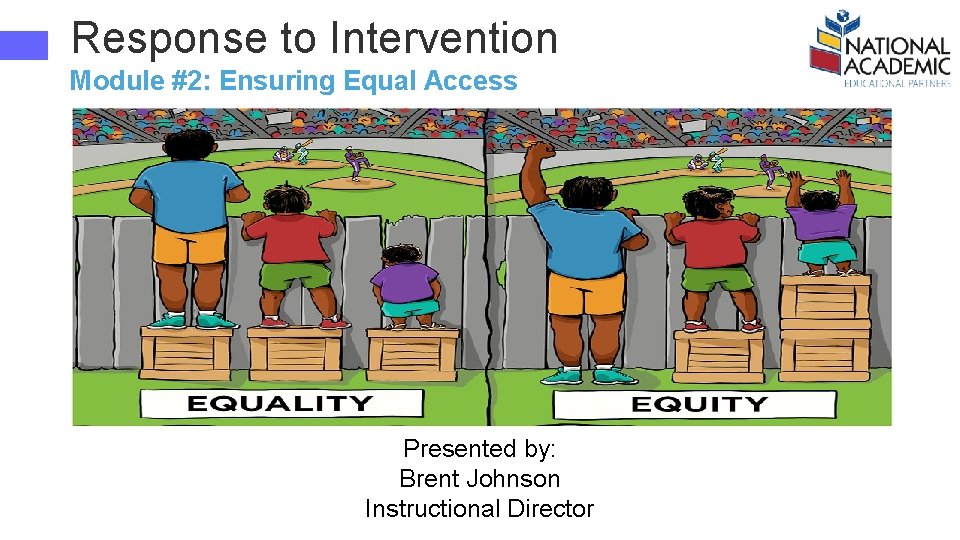
Response to Intervention Module 2 Ensuring Equal Access


- Slides: 28
Response to Intervention Module #2: Ensuring Equal Access Presented by: Brent Johnson Instructional Director
Agenda 1 Review the RTI Pyramid, key terms and concepts associated with RTI and the Gradual Release of Responsibility Model Identify various types of data collection methods and data analysis tools Analyze student progress for the 4 purpose of making data-based decisions for students’ instruction and placement Create coaching plan for next two coaching sessions
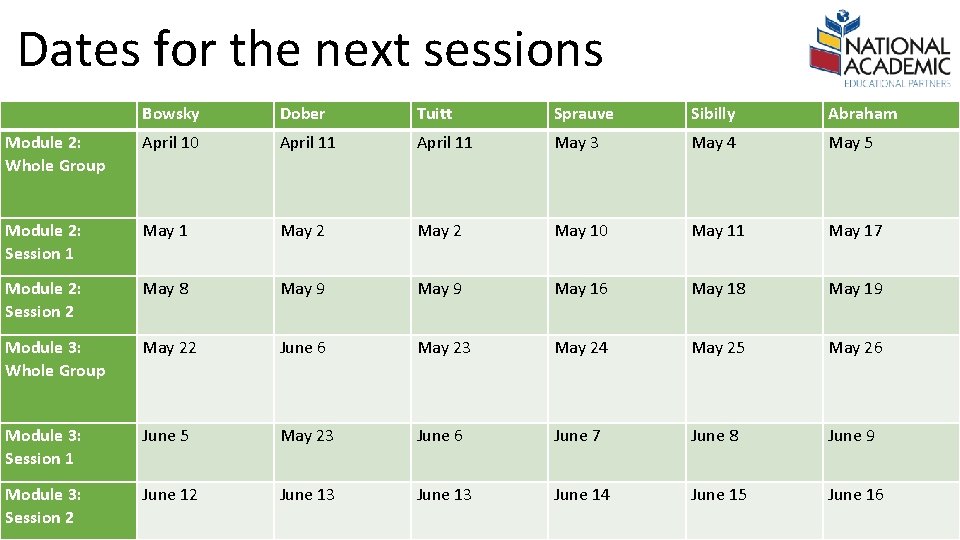
Dates for the next sessions Bowsky Dober Tuitt Sprauve Sibilly Abraham Module 2: Whole Group April 10 April 11 May 3 May 4 May 5 Module 2: Session 1 May 2 May 10 May 11 May 17 Module 2: Session 2 May 8 May 9 May 16 May 18 May 19 Module 3: Whole Group May 22 June 6 May 23 May 24 May 25 May 26 Module 3: Session 1 June 5 May 23 June 6 June 7 June 8 June 9 Module 3: Session 2 June 13 June 14 June 15 June 16
Objectives Participants will be able to. . 1 Understand the importance of progress monitoring. 2 Understand various types of data collection and data analysis processes. 3 Understand how to make data-based decisions to move students through the RTI process. 1 4
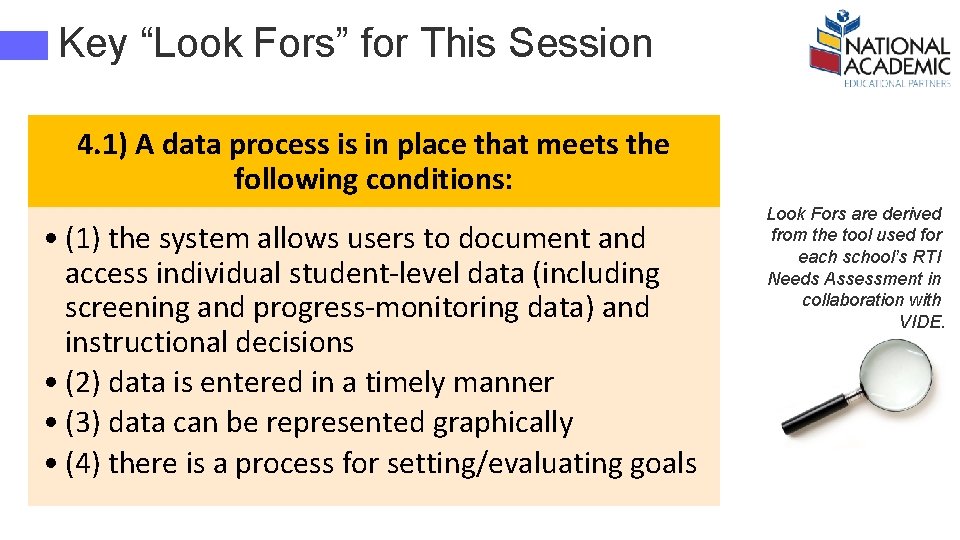
Key “Look Fors” for This Session 4. 1) A data process is in place that meets the following conditions: • (1) the system allows users to document and access individual student-level data (including screening and progress-monitoring data) and instructional decisions • (2) data is entered in a timely manner • (3) data can be represented graphically • (4) there is a process for setting/evaluating goals Look Fors are derived from the tool used for each school’s RTI Needs Assessment in collaboration with VIDE.
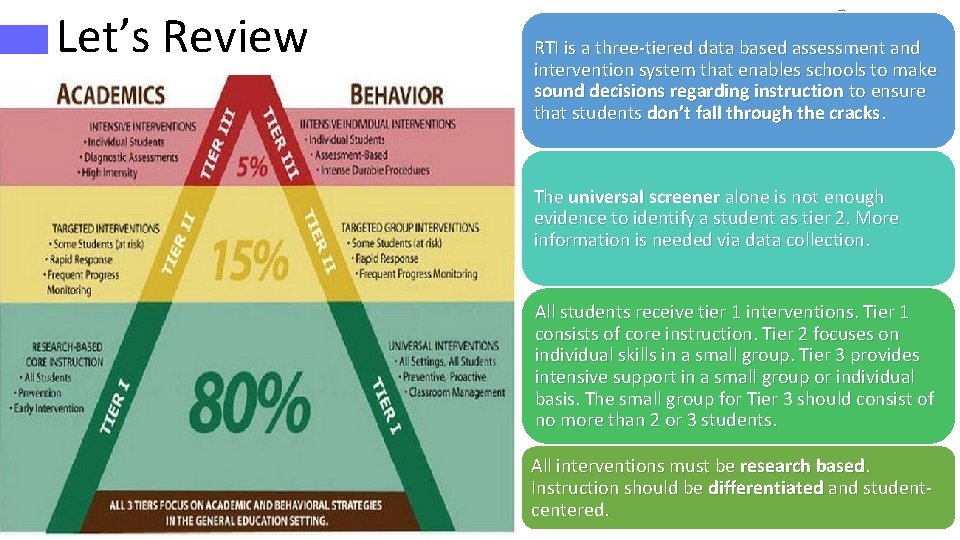
Let’s Review RTI is a three-tiered data based assessment and intervention system that enables schools to make sound decisions regarding instruction to ensure that students don’t fall through the cracks. The universal screener alone is not enough evidence to identify a student as tier 2. More information is needed via data collection. All students receive tier 1 interventions. Tier 1 consists of core instruction. Tier 2 focuses on individual skills in a small group. Tier 3 provides intensive support in a small group or individual basis. The small group for Tier 3 should consist of no more than 2 or 3 students. All interventions must be research based. Instruction should be differentiated and studentcentered.
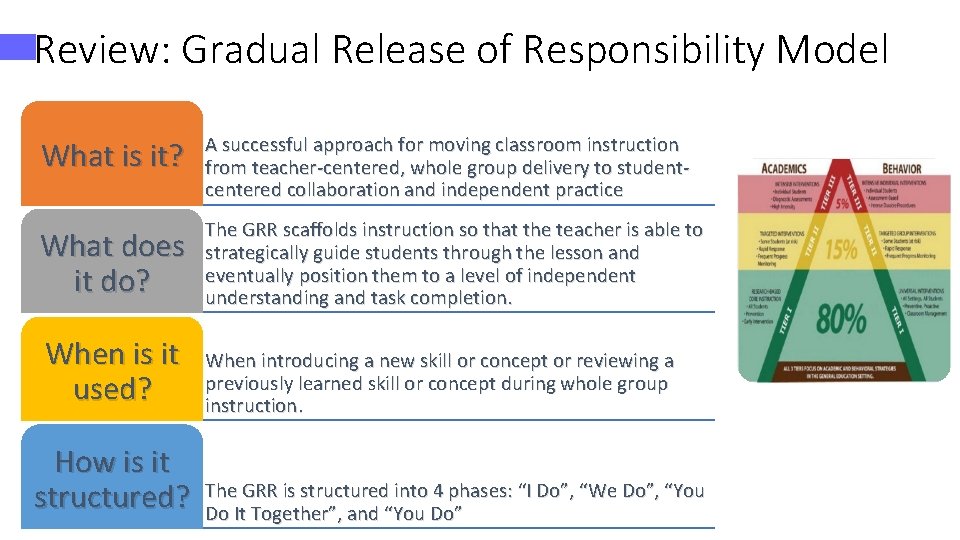
Review: Gradual Release of Responsibility Model What is it? A successful approach for moving classroom instruction from teacher-centered, whole group delivery to studentcentered collaboration and independent practice What does it do? The GRR scaffolds instruction so that the teacher is able to strategically guide students through the lesson and eventually position them to a level of independent understanding and task completion. When is it used? When introducing a new skill or concept or reviewing a previously learned skill or concept during whole group instruction. How is it structured? The GRR is structured into 4 phases: “I Do”, “We Do”, “You Do It Together”, and “You Do”
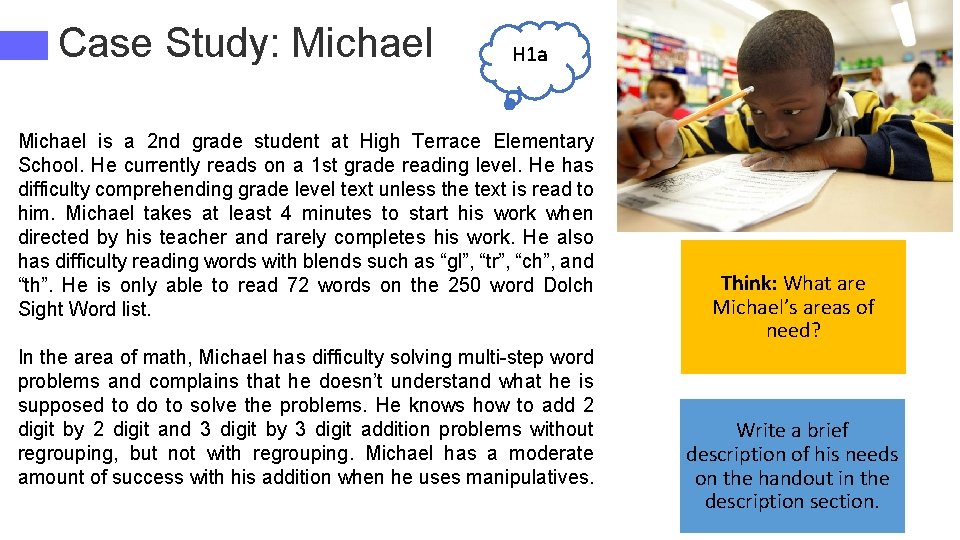
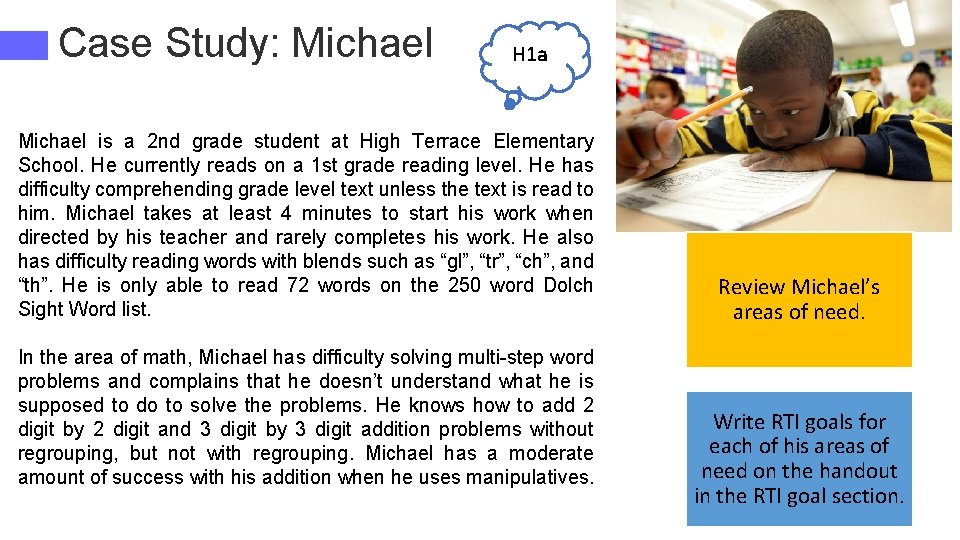
Case Study: Michael H 1 a Michael is a 2 nd grade student at High Terrace Elementary School. He currently reads on a 1 st grade reading level. He has difficulty comprehending grade level text unless the text is read to him. Michael takes at least 4 minutes to start his work when directed by his teacher and rarely completes his work. He also has difficulty reading words with blends such as “gl”, “tr”, “ch”, and “th”. He is only able to read 72 words on the 250 word Dolch Sight Word list. In the area of math, Michael has difficulty solving multi-step word problems and complains that he doesn’t understand what he is supposed to do to solve the problems. He knows how to add 2 digit by 2 digit and 3 digit by 3 digit addition problems without regrouping, but not with regrouping. Michael has a moderate amount of success with his addition when he uses manipulatives. Think: What are Michael’s areas of need? Write a brief description of his needs on the handout in the description section. 8
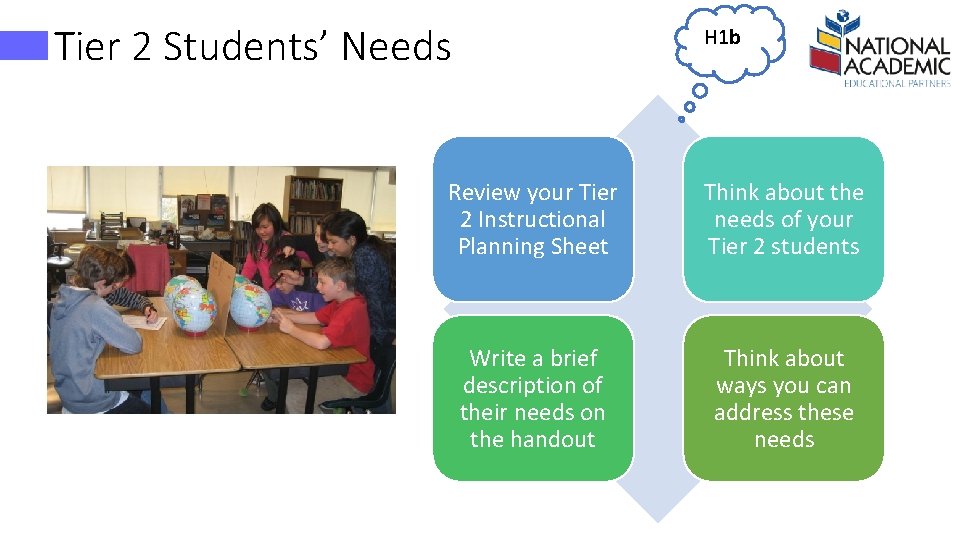
Tier 2 Students’ Needs H 1 b Review your Tier 2 Instructional Planning Sheet Think about the needs of your Tier 2 students Write a brief description of their needs on the handout Think about ways you can address these needs
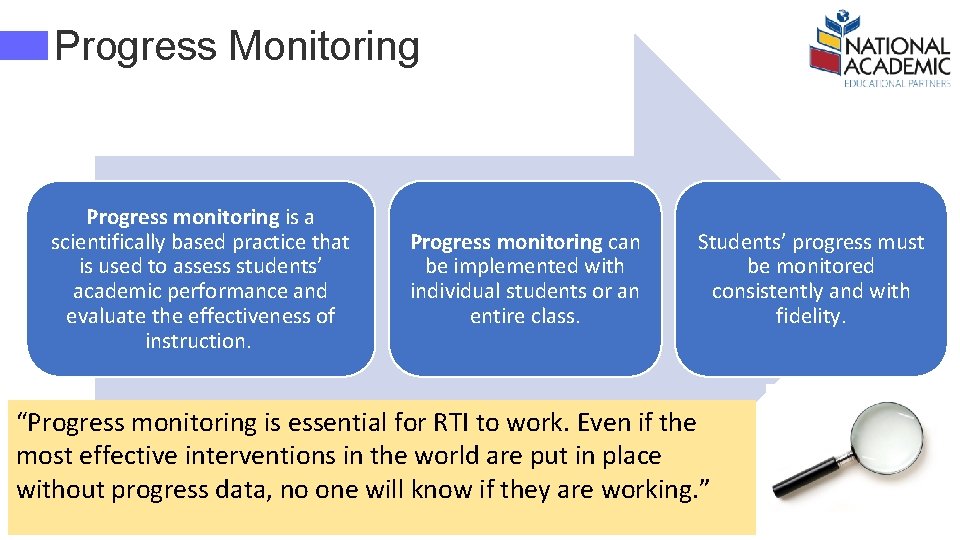
Progress Monitoring Progress monitoring is a scientifically based practice that is used to assess students’ academic performance and evaluate the effectiveness of instruction. Progress monitoring can be implemented with individual students or an entire class. Students’ progress must be monitored consistently and with fidelity. “Progress monitoring is essential for RTI to work. Even if the most effective interventions in the world are put in place without progress data, no one will know if they are working. ”
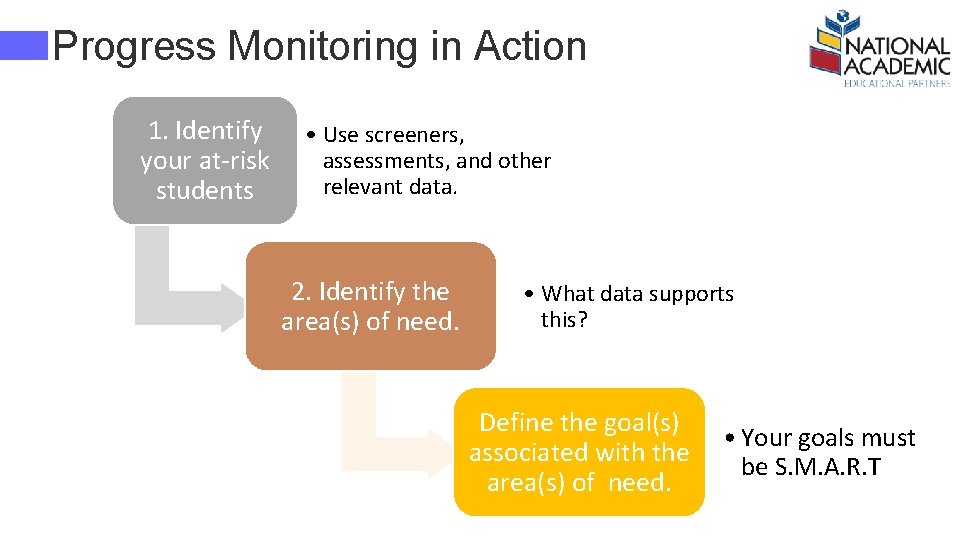
Progress Monitoring in Action 1. Identify your at-risk students • Use screeners, assessments, and other relevant data. 2. Identify the area(s) of need. • What data supports this? Define the goal(s) • Your goals must associated with the be S. M. A. R. T area(s) of need.
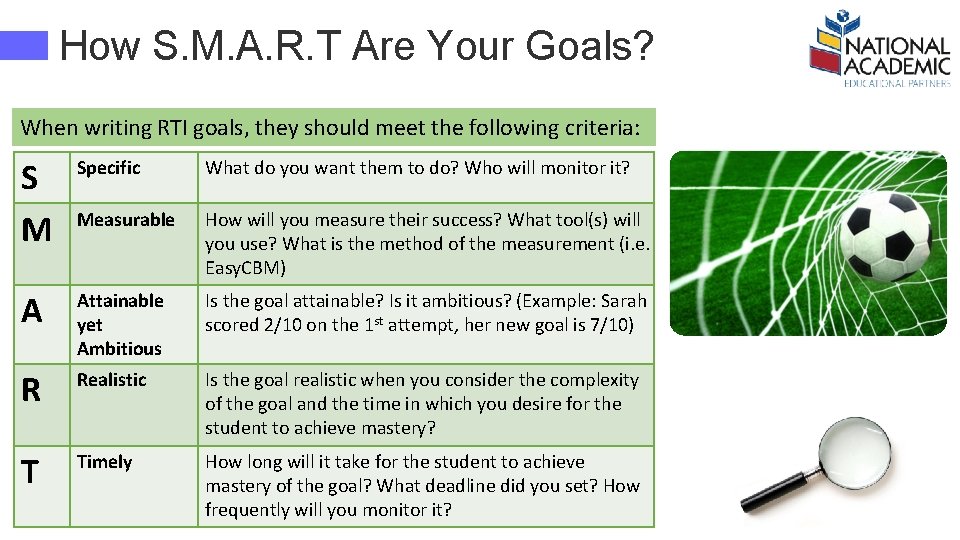
How S. M. A. R. T Are Your Goals? When writing RTI goals, they should meet the following criteria: S M Specific What do you want them to do? Who will monitor it? Measurable How will you measure their success? What tool(s) will you use? What is the method of the measurement (i. e. Easy. CBM) A Attainable yet Ambitious Is the goal attainable? Is it ambitious? (Example: Sarah scored 2/10 on the 1 st attempt, her new goal is 7/10) R Realistic Is the goal realistic when you consider the complexity of the goal and the time in which you desire for the student to achieve mastery? T Timely How long will it take for the student to achieve mastery of the goal? What deadline did you set? How frequently will you monitor it?
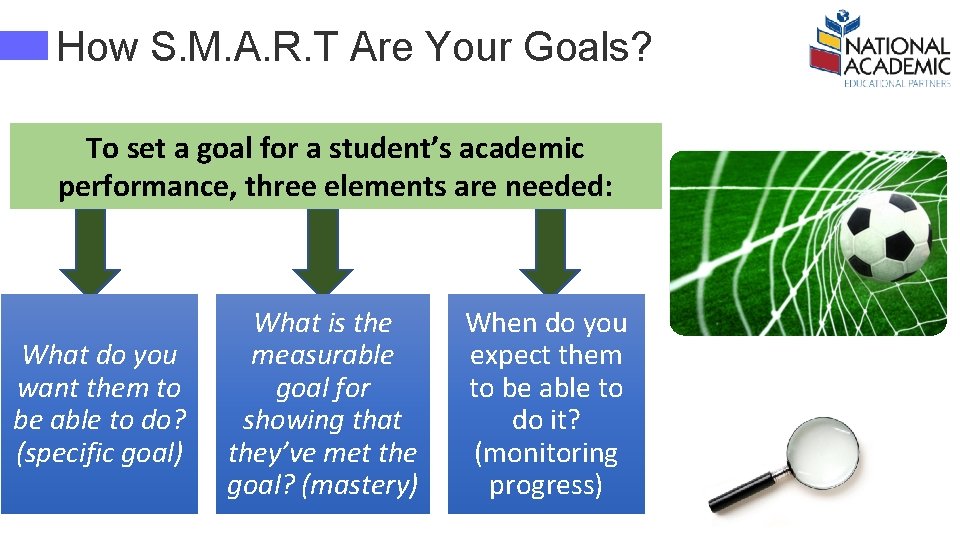
How S. M. A. R. T Are Your Goals? To set a goal for a student’s academic performance, three elements are needed: What do you want them to be able to do? (specific goal) What is the measurable goal for showing that they’ve met the goal? (mastery) When do you expect them to be able to do it? (monitoring progress)
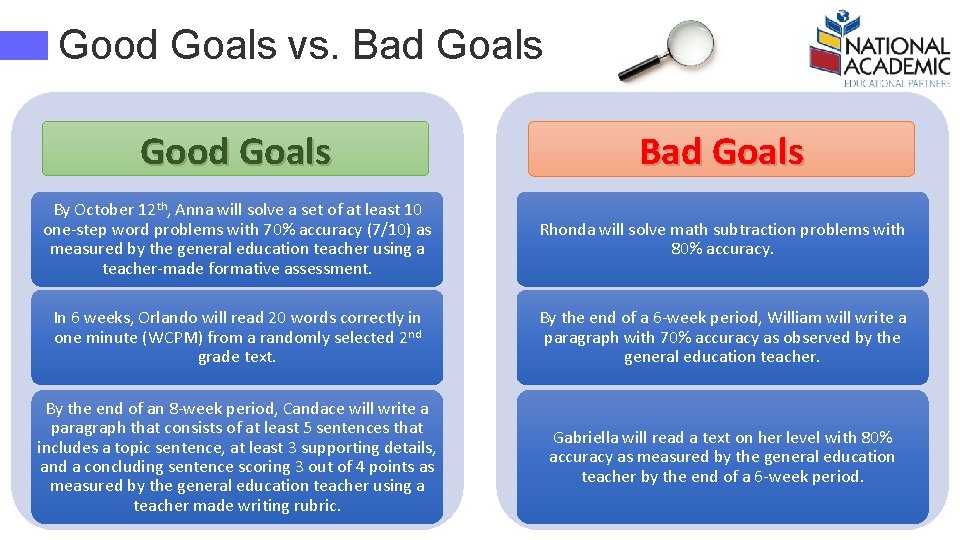
Good Goals vs. Bad Goals Good Goals Bad Goals By October 12 th, Anna will solve a set of at least 10 one-step word problems with 70% accuracy (7/10) as measured by the general education teacher using a teacher-made formative assessment. Rhonda will solve math subtraction problems with 80% accuracy. In 6 weeks, Orlando will read 20 words correctly in one minute (WCPM) from a randomly selected 2 nd grade text. By the end of a 6 -week period, William will write a paragraph with 70% accuracy as observed by the general education teacher. By the end of an 8 -week period, Candace will write a paragraph that consists of at least 5 sentences that includes a topic sentence, at least 3 supporting details, and a concluding sentence scoring 3 out of 4 points as measured by the general education teacher using a teacher made writing rubric. Gabriella will read a text on her level with 80% accuracy as measured by the general education teacher by the end of a 6 -week period.
Case Study: Michael H 1 a Michael is a 2 nd grade student at High Terrace Elementary School. He currently reads on a 1 st grade reading level. He has difficulty comprehending grade level text unless the text is read to him. Michael takes at least 4 minutes to start his work when directed by his teacher and rarely completes his work. He also has difficulty reading words with blends such as “gl”, “tr”, “ch”, and “th”. He is only able to read 72 words on the 250 word Dolch Sight Word list. In the area of math, Michael has difficulty solving multi-step word problems and complains that he doesn’t understand what he is supposed to do to solve the problems. He knows how to add 2 digit by 2 digit and 3 digit by 3 digit addition problems without regrouping, but not with regrouping. Michael has a moderate amount of success with his addition when he uses manipulatives. Review Michael’s areas of need. Write RTI goals for each of his areas of need on the handout in the RTI goal section. 15
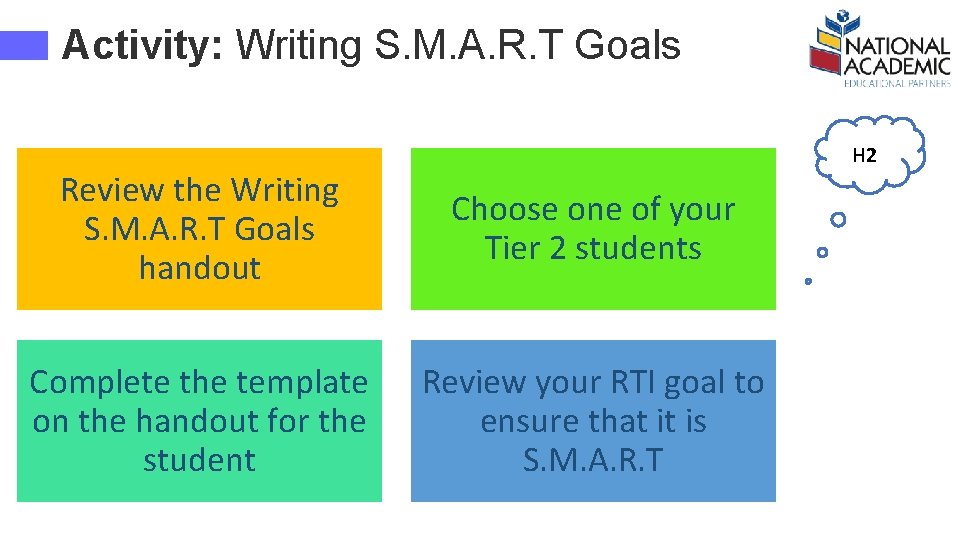
Activity: Writing S. M. A. R. T Goals H 2 Review the Writing S. M. A. R. T Goals handout Choose one of your Tier 2 students Complete the template on the handout for the student Review your RTI goal to ensure that it is S. M. A. R. T
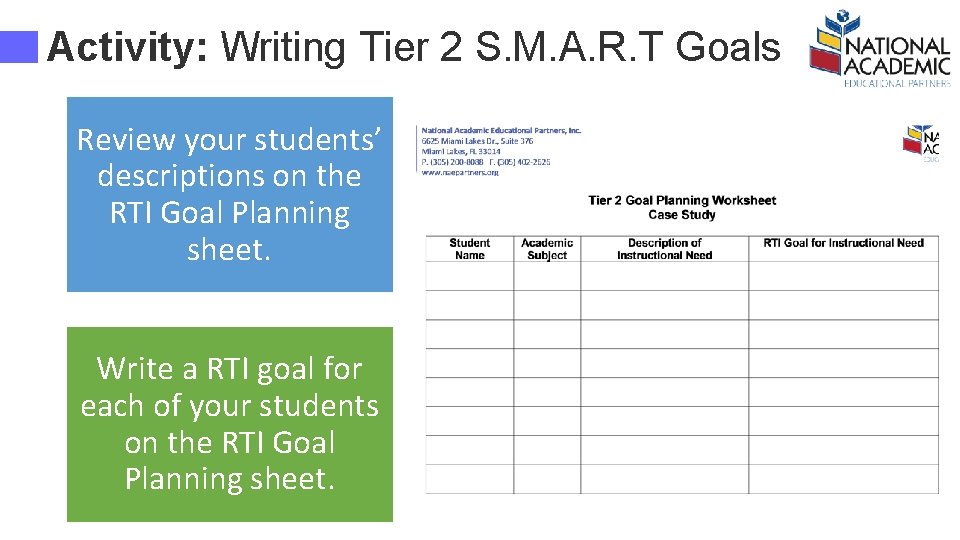
Activity: Writing Tier 2 S. M. A. R. T Goals Review your students’ descriptions on the RTI Goal Planning sheet. Write a RTI goal for each of your students on the RTI Goal Planning sheet.
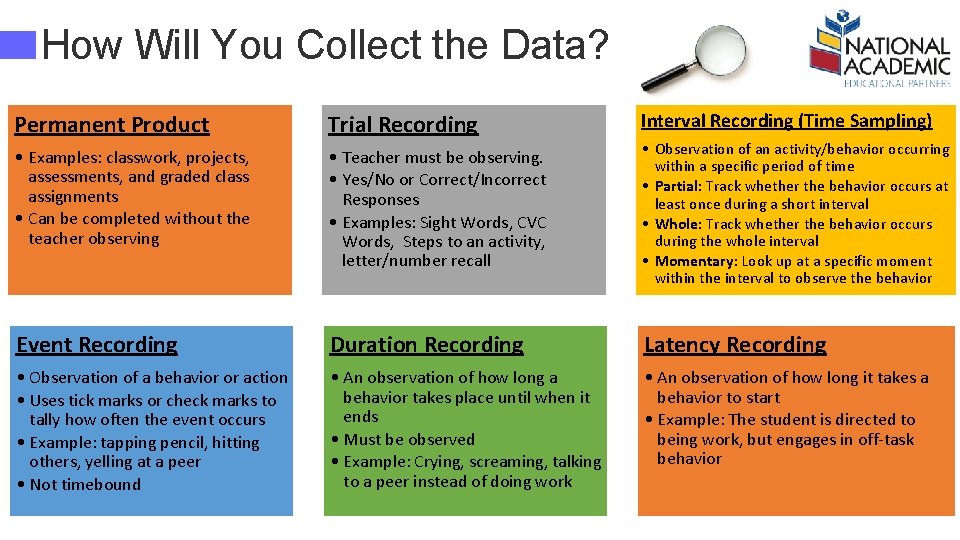
How Will You Collect the Data? Interval Recording (Time Sampling) Permanent Product Trial Recording • Examples: classwork, projects, assessments, and graded class assignments • Can be completed without the teacher observing • Teacher must be observing. • Yes/No or Correct/Incorrect Responses • Examples: Sight Words, CVC Words, Steps to an activity, letter/number recall • Observation of an activity/behavior occurring within a specific period of time • Partial: Track whether the behavior occurs at least once during a short interval • Whole: Track whether the behavior occurs during the whole interval • Momentary: Look up at a specific moment within the interval to observe the behavior Event Recording Duration Recording Latency Recording • Observation of a behavior or action • Uses tick marks or check marks to tally how often the event occurs • Example: tapping pencil, hitting others, yelling at a peer • Not timebound • An observation of how long a behavior takes place until when it ends • Must be observed • Example: Crying, screaming, talking to a peer instead of doing work • An observation of how long it takes a behavior to start • Example: The student is directed to being work, but engages in off-task behavior
Activity: Data Recording Methods Use your laptop, cell phone, or other device to log into Kahoot. it Use the following code to log into Kahoot. Use your device to select the appropriate data recording method for each scenario.
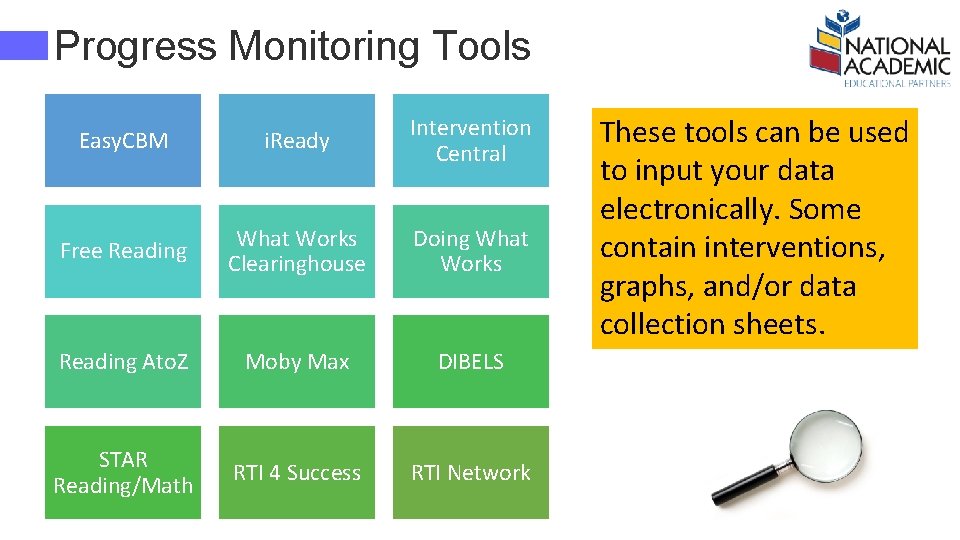
Progress Monitoring Tools Easy. CBM i. Ready Intervention Central Free Reading What Works Clearinghouse Doing What Works Reading Ato. Z Moby Max DIBELS STAR Reading/Math RTI 4 Success RTI Network These tools can be used to input your data electronically. Some contain interventions, graphs, and/or data collection sheets.
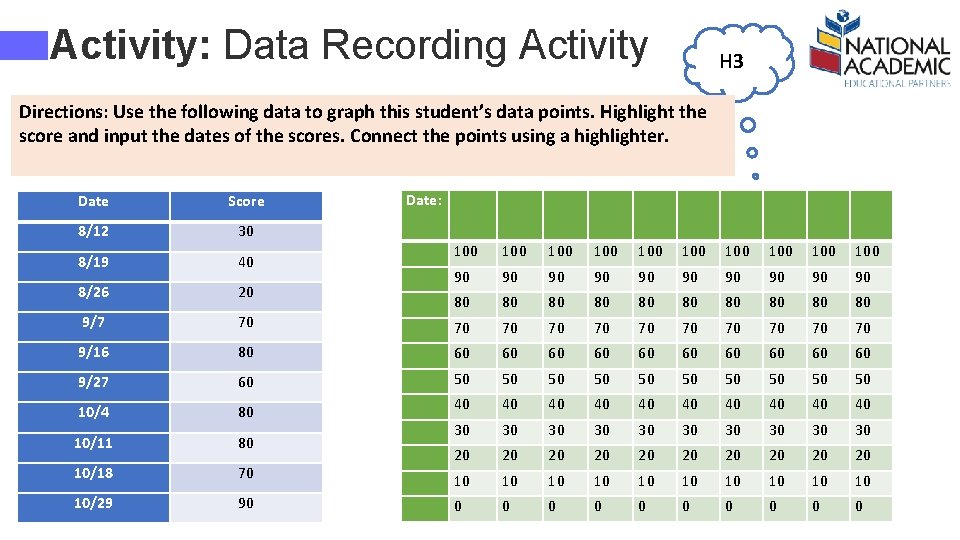
Activity: Data Recording Activity H 3 Directions: Use the following data to graph this student’s data points. Highlight the score and input the dates of the scores. Connect the points using a highlighter. Date: 100 100 100 90 90 90 80 80 80 70 70 70 9/16 80 60 60 60 9/27 60 50 50 50 10/4 80 40 40 40 10/11 80 30 30 30 10/18 70 20 20 20 10 10 10/29 90 0 0 Date Score 8/12 30 8/19 40 8/26 20 9/7
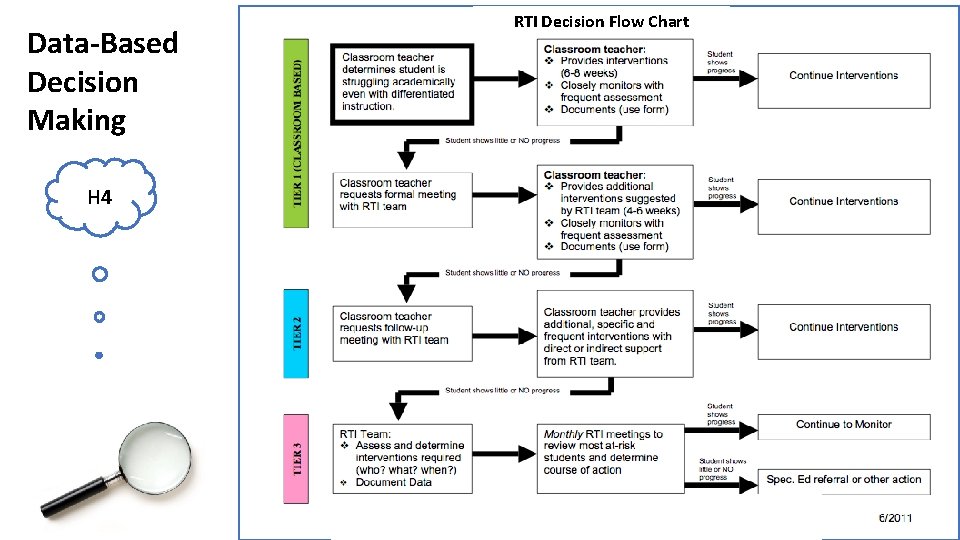
Data-Based Decision Making H 4 RTI Decision Flow Chart
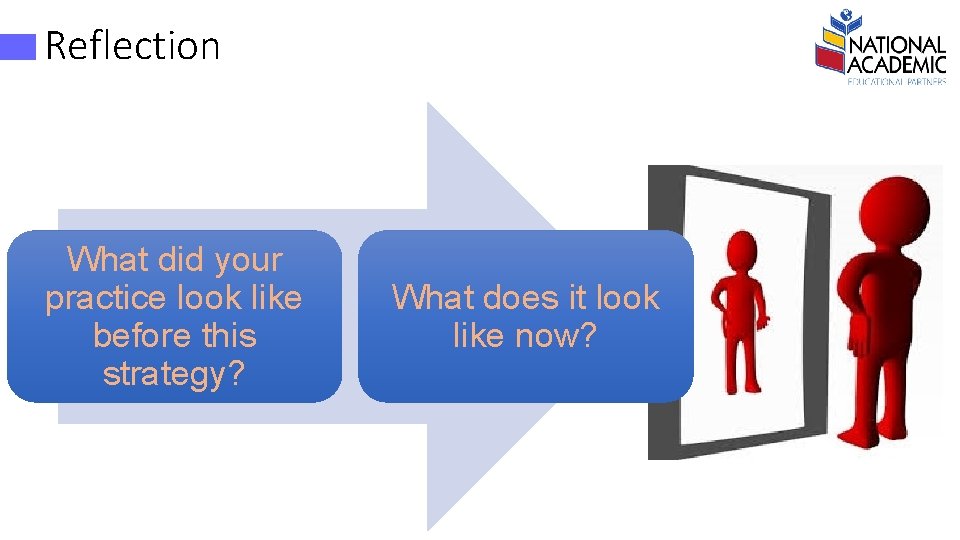
Reflection What did your practice look like before this strategy? What does it look like now?
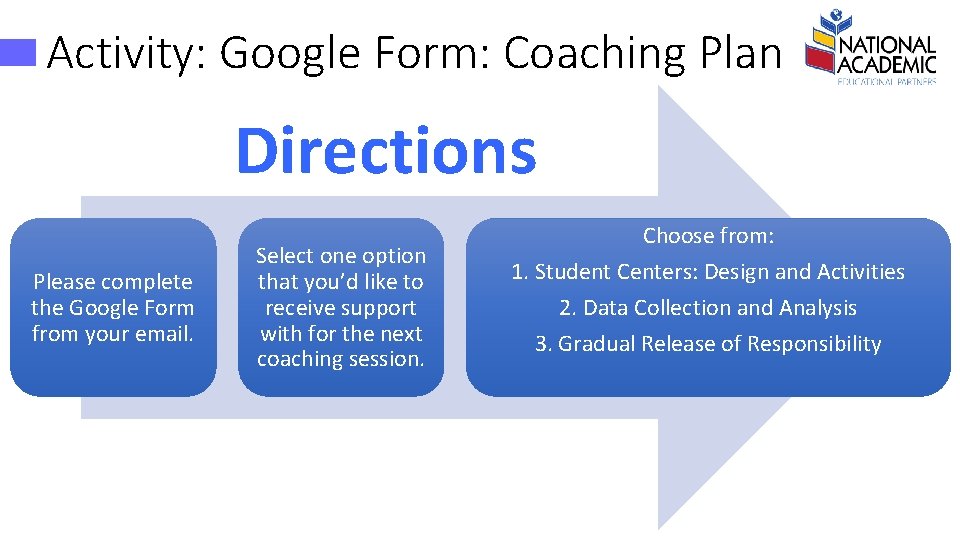
Activity: Google Form: Coaching Plan Directions Please complete the Google Form from your email. Select one option that you’d like to receive support with for the next coaching session. Choose from: 1. Student Centers: Design and Activities 2. Data Collection and Analysis 3. Gradual Release of Responsibility
Next Steps Begin reviewing types of interventions on Intervention Central Begin planning tier 2 intervention(s) for at least one student. Collect and analyze the data as you support the student with his or her needs Implement at least one intervention with your tier 2 students What barriers do you anticipate? Let’s collaborate to overcome them.
Feedback H 5 Please complete the feedback forms before you leave.
Brent Johnson Instructional Director, NAEP (678) 770 -0561 bjohnson@naepartners. org