
Response to Intervention Elizabeth Doyle What is RTI
Response to Intervention Elizabeth Doyle
What is RTI? RTI is a combination of high quality, culturally and linguistically responsive instruction; assessment; and evidence-based intervention. RTI will contribute to more meaningful identification of learning and behavioral problems, improve instructional quality, provide ALL students with the best opportunities to succeed in school, and assist with the identification of learning and other disabilities.
Why use RTI? RTI is a process that schools can use to help children who are struggling academically or behaviorally. One of its underlying premises is the possibility that a child’s struggles may be due to inadequacies in instruction or in the curriculum either in use at the moment or in the child’s past.

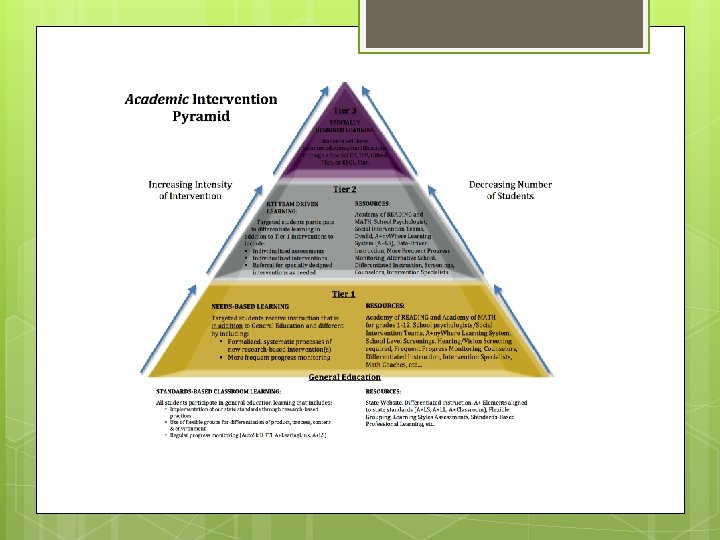
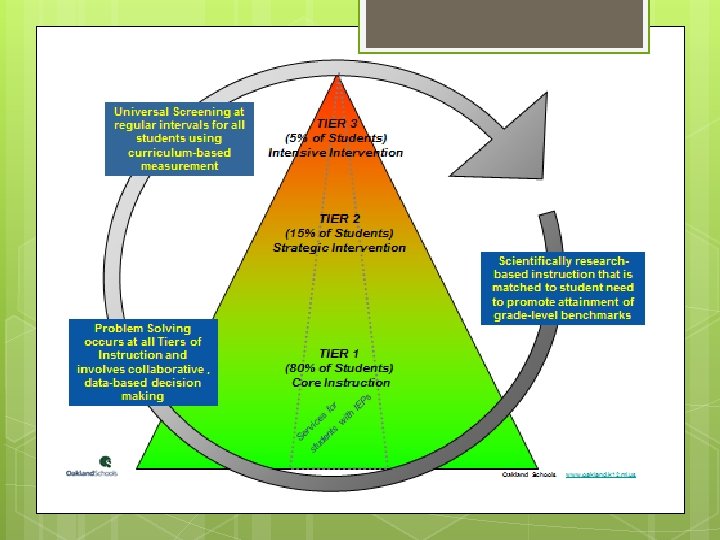
The Multi-Level Prevention System Level One: High-quality core instruction with an entire group or classroom of students. Level Two: Evidence-based instruction of moderate intensity with a smaller group of students.

Level Three: ndividualized interventions of increased intensity for students who show minimal response to secondary /moderate prevention.
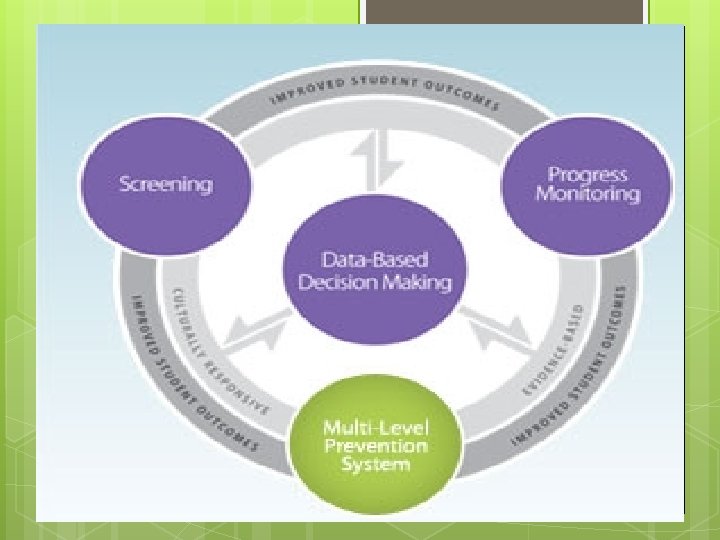
RTI Each intervention should take into consideration the child’s cultural and linguistic responsiveness AND should remain positive to recognize the child’s strengths.
What screening is done? Universal screening tests are brief and conducted with all students at a grade level. They are followed by additional testing or short-term progress monitoring to corroborate students’ risk status. Attention should focus on implementation and selection of evidence based tools, with consideration for cultural and linguistic responsiveness and recognition of student strengths.
Progress Monitoring Progress monitoring is used to assess students’ academic performance To examine a student rate of improvement or responsiveness to instruction To evaluate the effectiveness of instruction Progress monitoring can be implemented with individual students or an entire class
Data-Based Decision Making Data analysis and decision making occur at all levels of RTI implementation and all levels of instruction. Teams use screening and progress monitoring data to make decisions about instruction, movement within the multi-level prevention system, and disability identification (in accordance with state law).


How do you implement RTI? Explore and Adapt: It is important to understand what is being implemented and why it is being implemented to support the implementation efforts. Effective leadership sets the context for successful implementation by creating momentum for the implementation of an innovation and supporting the advancement of data driven solutions. For RTI to achieve success in the performance of individual students and in school improvement, it requires the full support of leadership.

Some Key Components: Convening a team who are empowered to make decisions Identifying site needs and desired outcomes Gathering information about the essential components of RTI Assessing the match between RTI and the site’s needs and desired outcomes Educating key stakeholders (may include state- district- and school- level staff, families, and community members) about the essential components of RTI and how RTI can address the needs of the site Achieving a consensus among stakeholders to adopt RTI Identifying implications of implementing RTI for existing systems and policies Establishing a clear vision, mission and measurable goals of RTI implementation Developing a culturally and linguistically responsive framework for RTI
Planning for RTI The purpose of planning develop clear plans, processes, and procedures that lead to successful implementation and to construct the infrastructure and structural supports necessary to support RTI implementation. Use planning time as needed. Some sites fail to plan or move too quickly through the planning process. Poor planning can lead to frustrated administrators and teachers, wasted resources, and ineffective implementation.
Some Supports: Defining leadership roles Developing plans for implementation, professional development and evaluation Reallocating resources to support RTI implementation (e. g. funds, staff, and time) Creating policies, procedures, and guidance that support RTI Providing ongoing professional development Performing an “audit” of existing assessment and curricular materials to determine if they are evidence-based and culturally and linguistically responsive. Screening and progress monitoring assessments should be brief, reliable, and valid Conducting ongoing evaluation of progress in preparing for RTI implementation If necessary, creating and/or purchasing reliable and valid screening and progress monitoring tools that are culturally and linguistically responsive If necessary, creating and/or purchasing evidence based curriculums for core instruction and interventions that match the needs of the population and are culturally and linguistically responsive Engaging and building support among stakeholders throughout planning Designing a program evaluation method Revising the vision, framework, and goals, as necessary
Tiered Instruction Students identified through the universal screening as “at risk” or “struggling” They then move through the general education curriculum with adapted and individualized interventions that increase in intensity (the tiers)for specific students who do not show sufficient learning or skill development. RTI models vary with respect to the number of tiers involved in the process. There is no “official” recommendation as to the most effective number of tiers. Three tiers of instructional intervention is a common practice.
Evidence Based Interventions cornerstone of instruction within an RTI process. Within an RTI process, instructional strategies and interventions are based on what research has shown to be effective with students. Using evidence-based practices ensures better results for students. (I. e. “its worked before, maybe it’ll work again? ”)

RTI and Families: Certainly, parents need to be informed when their child is not making expected academic or behavioral progress. The sticky issue is that RTI is typically used before a child is evaluated under IDEA, before the public agency is even proposing to evaluate the child, so many of IDEA’s provisions for parent notification have not yet come into play. Informing parents along the way is important, valuable, and good policy. In practice, parents are generally informed when the child is unsuccessful in Tier 1 and moves on to Tier 2. Interventions here are typically more intensive, with the instructional intervention delivered to small groups of children, not the entire class. It is at this point that parents may meet with school staff to discuss their child’s lack of progress and hear what the school has in mind. This would include: What type of performance data will be collected, and how much; What general education services are planned; and What strategies the school will use to increase the child’s rate of learning.
RTI and Families: Parents would also be informed that they have the right to request that their child be evaluated under IDEA—a full and individual evaluation. If they do request such an evaluation, the school must promptly ask for parents’ written consent and conduct the evaluation in keeping with IDEA’s timeframe requirements (60 days from receiving parental permission, or within the timeframe designated by the state).

Here’s a video: http: //www. youtube. com/watch? v=nk. K 1 b. T 8 ls 0 M&feature=em-share_video_user (Video on RTI)
References: Atlasinitiative- You. Tube. url National Center on Response to Intervention www. rti 4 sucess. org Response to Interventions (RTI)-National Dissemination Center for Children with Disabilities. url www. nichcy. org
- Slides: 25