
Response to Intervention Building Student Motivation and Academic
Response to Intervention Building Student Motivation and Academic Skills: Research Supported Interventions Jim Wright www. interventioncentral. org NASP 2007 Annual Convention New York City www. interventioncentral. org
Response to Intervention Discussion: Read the quote below and discuss in pairs: How sloppy can we be in doing RTI in schools and still be effective? www. interventioncentral. org 2
Response to Intervention Workshop Goals… In this training, we will review ideas to: q Understanding of foundation learning concepts, (e. g. , Instructional Hierarchy) q Knowledge of effective interventions in reading fluency/comprehension, math computation/problem-solving, writing, and study skills q Ability to increase student motivation by correcting faulty attributions about academic competencies and altering the instructional environment www. interventioncentral. org 3
Response to Intervention RTI: Essential Elements for Intervention Planning www. interventioncentral. org
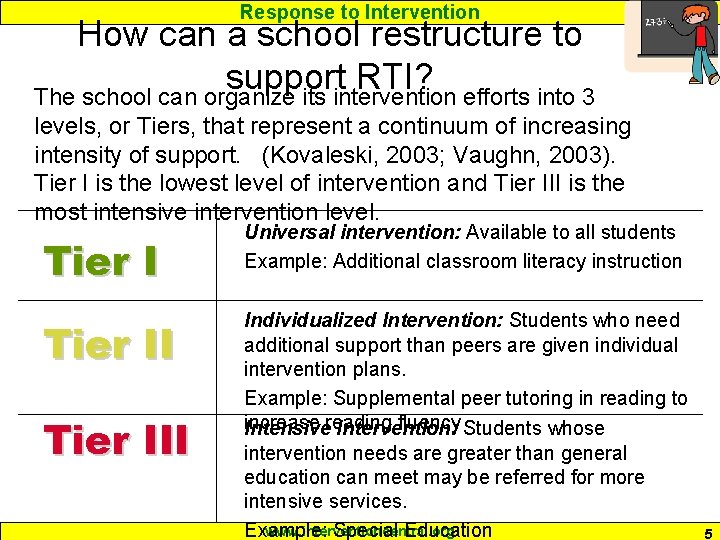
Response to Intervention How can a school restructure to support RTI? The school can organize its intervention efforts into 3 levels, or Tiers, that represent a continuum of increasing intensity of support. (Kovaleski, 2003; Vaughn, 2003). Tier I is the lowest level of intervention and Tier III is the most intensive intervention level. Tier III Universal intervention: Available to all students Example: Additional classroom literacy instruction Individualized Intervention: Students who need additional support than peers are given individual intervention plans. Example: Supplemental peer tutoring in reading to increase fluency Students whose Intensivereading Intervention: intervention needs are greater than general education can meet may be referred for more intensive services. www. interventioncentral. org Example: Special Education 5
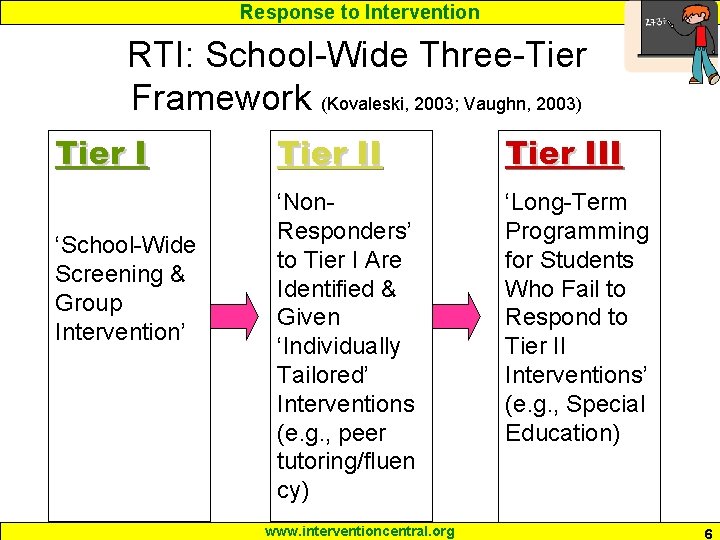
Response to Intervention RTI: School-Wide Three-Tier Framework (Kovaleski, 2003; Vaughn, 2003) Tier I ‘School-Wide Screening & Group Intervention’ Tier III ‘Non. Responders’ to Tier I Are Identified & Given ‘Individually Tailored’ Interventions (e. g. , peer tutoring/fluen cy) ‘Long-Term Programming for Students Who Fail to Respond to Tier II Interventions’ (e. g. , Special Education) www. interventioncentral. org 6
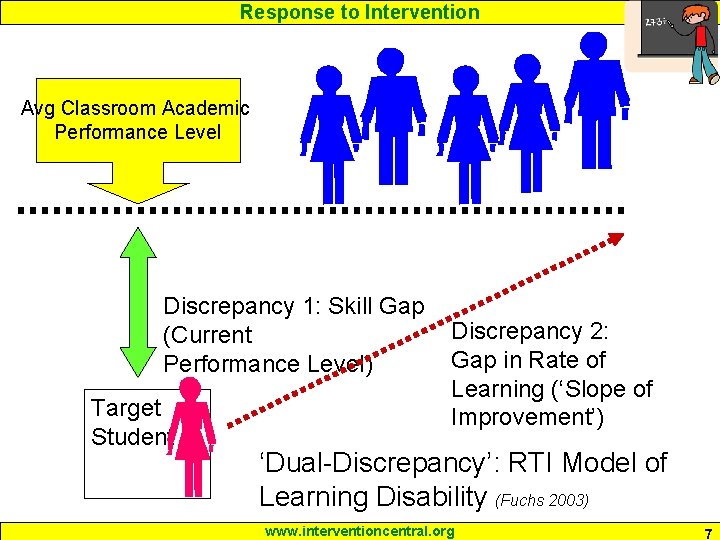
Response to Intervention Avg Classroom Academic Performance Level Discrepancy 1: Skill Gap (Current Performance Level) Target Student Discrepancy 2: Gap in Rate of Learning (‘Slope of Improvement’) ‘Dual-Discrepancy’: RTI Model of Learning Disability (Fuchs 2003) www. interventioncentral. org 7
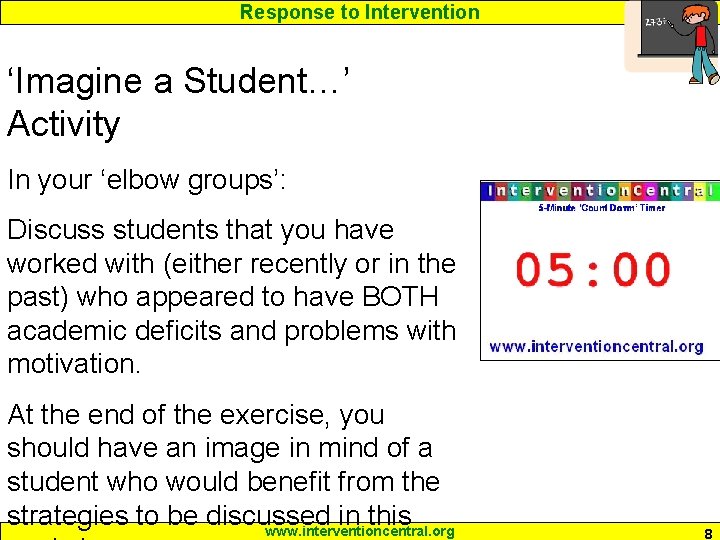
Response to Intervention ‘Imagine a Student…’ Activity In your ‘elbow groups’: Discuss students that you have worked with (either recently or in the past) who appeared to have BOTH academic deficits and problems with motivation. At the end of the exercise, you should have an image in mind of a student who would benefit from the strategies to be discussed in this www. interventioncentral. org 8
Response to Intervention ‘Big Ideas’ in Academic Interventions Jim Wright www. interventioncentral. org 9
Response to Intervention None of us is as smart as all of us. --Anonymous www. interventioncentral. org 10
Response to Intervention Any darn mule can kick a barn down, but it takes a carpenter to build one. --Lyndon Johnson www. interventioncentral. org 11
Response to Intervention ‘Curriculum Train’ www. interventioncentral. org 12
Response to Intervention Difficult-To-Teach Students • Experience greater difficulty with learning and retention of information • May also have behavioral problems • Fall along a continuum, with some students showing more severe needs than others www. interventioncentral. org 13
Response to Intervention Difficult-To-Teach Students: The Numbers • One in ten children in schools is classified as Special Education • 3 -5% of students may qualify for ADHD • In 1998, about 40% of 4 th grade youngsters fell below grade-level on a national reading test www. interventioncentral. org 14
Response to Intervention Difficult-To-Teach Students “An increasing body of evidence supports the need for students with disabilities to be directly taught the processes and concepts that nondisabled children tend to learn naturally through experiences. ” --Office of Special Education Programs 21 st Annual Report to Congress (1999) www. interventioncentral. org 15
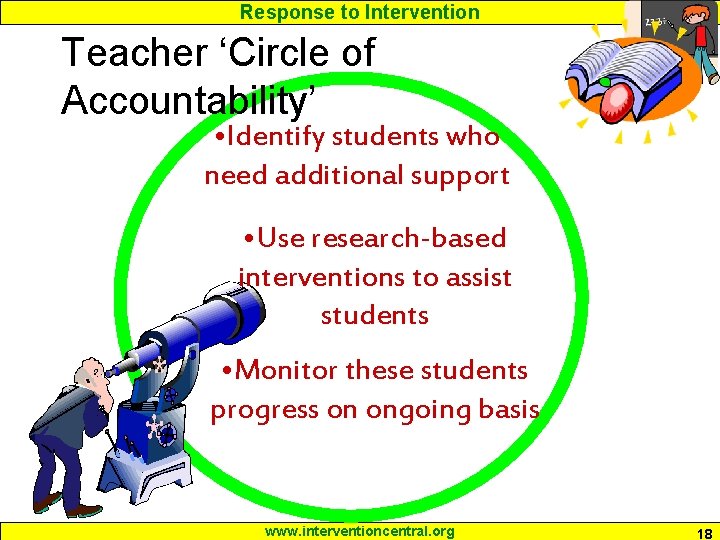
Response to Intervention Teacher ‘Circle of Accountability’ • Identify students who need additional support • Use research-based interventions to assist students • Monitor these students progress on ongoing basis www. interventioncentral. org 18
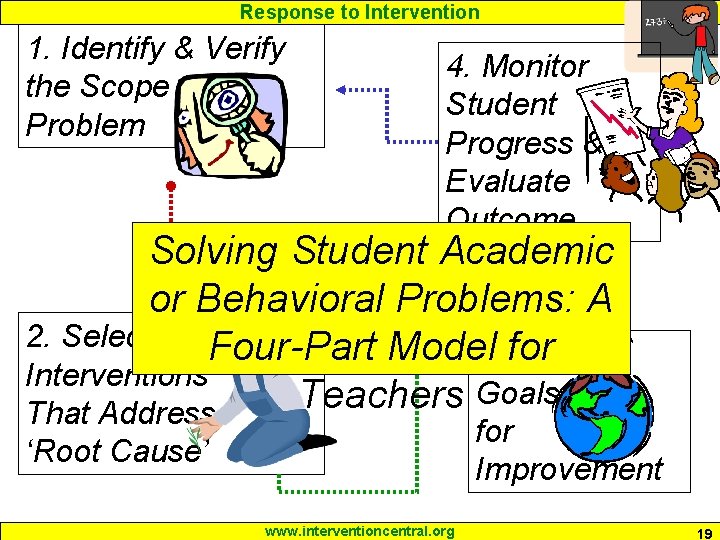
Response to Intervention 1. Identify & Verify the Scope of the Problem 4. Monitor Student Progress & Evaluate Outcome Solving Student Academic or Behavioral Problems: A 2. Select Four-Part Model 3. for Set Interventions Goals Teachers That Address for Improvement ‘Root Cause’ www. interventioncentral. org 19

Response to Intervention Building Blocks of Effective Instruction … www. interventioncentral. org 20
Response to Intervention Learning: Interaction Between Student and Setting “It would be hard to imagine a model of academic achievement that failed to recognize that learning involves interaction between students and their environment. Certainly one function of formal schooling is to organize the environment so that learning can occur effectively. ” p. 346 Source: Lentz, F. E. & Shapiro, E. S. (1986). Functional assessment of the academic environment. School Psychology Review, 15, 346 -357. www. interventioncentral. org 21
Response to Intervention ‘Big Ideas’ as an Academic Intervention… www. interventioncentral. org 22
Response to Intervention ‘Big Ideas’ As an Academic Intervention… (Carnine, 1994) “The notion of big ideas is roughly comparable to important ideas, knowledge, and concepts. Specifically, instead of teaching for coverage (i. e. , exposing students to all the objectives of a lesson), only a few big ideas would be taught, but more thoroughly. It is better to do a few robust things well than lots of things poorly…”p. 346 Example: Fractions, decimals, ratios, percents all represent the concept of proportion. www. interventioncentral. org 23
Response to Intervention Identifying the ‘Driver(s)’ or Cause(s) of Student Academic Concerns www. interventioncentral. org
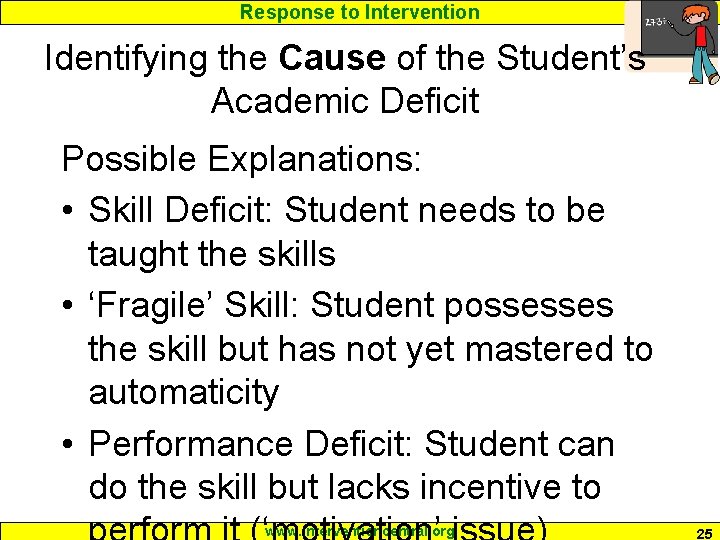
Response to Intervention Identifying the Cause of the Student’s Academic Deficit Possible Explanations: • Skill Deficit: Student needs to be taught the skills • ‘Fragile’ Skill: Student possesses the skill but has not yet mastered to automaticity • Performance Deficit: Student can do the skill but lacks incentive to www. interventioncentral. org 25
Response to Intervention Instructional Hierarchy (Haring, et al, 1978) www. interventioncentral. org 26
Response to Intervention www. interventioncentral. org 27

Response to Intervention Instructional Hierarchy: Four Stages of Learning • • Acquisition Fluency Generalization Adaptation Source: Haring, N. G. , Lovitt, T. C. , Eaton, M. D. , & Hansen, C. L. (1978). The fourth R: Research in the classroom. Columbus, OH: Charles E. Merrill Publishing Co. www. interventioncentral. org 28
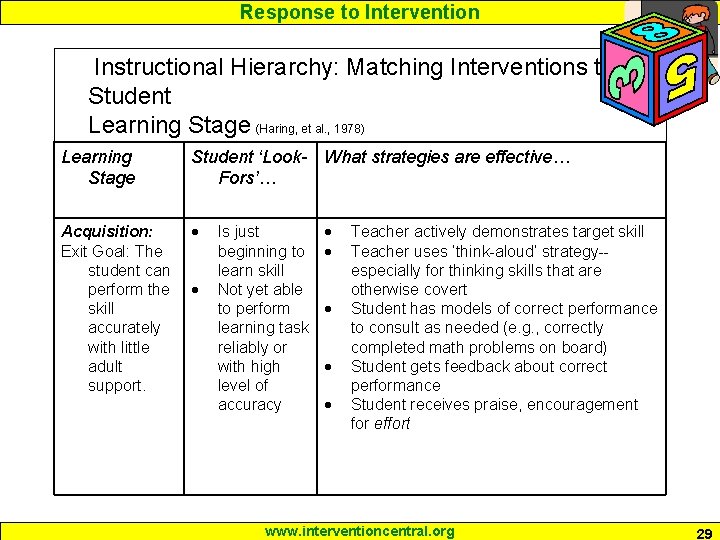
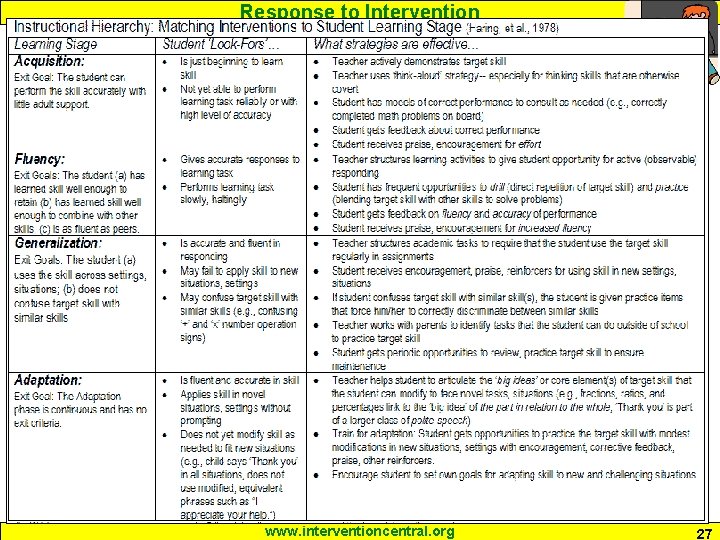
Response to Intervention Instructional Hierarchy: Matching Interventions to Student Learning Stage (Haring, et al. , 1978) Learning Stage Student ‘Look- What strategies are effective… Fors’… Acquisition: Exit Goal: The student can perform the skill accurately with little adult support. Is just beginning to learn skill Not yet able to perform learning task reliably or with high level of accuracy Teacher actively demonstrates target skill Teacher uses ‘think-aloud’ strategy-especially for thinking skills that are otherwise covert Student has models of correct performance to consult as needed (e. g. , correctly completed math problems on board) Student gets feedback about correct performance Student receives praise, encouragement for effort www. interventioncentral. org 29

Response to Intervention Instructional Hierarchy: Matching Interventions to Student Learning Stage (Haring, et al. , 1978) Learning Stage Student ‘Look- What strategies are effective… Fors’… Fluency: Exit Goals: The student (a) has learned skill well enough to retain (b) has learned skill well enough to combine with other skills, (c) is as fluent as peers. Gives accurate responses to learning task Performs learning task slowly, haltingly Teacher structures learning activities to give student opportunity for active (observable) responding Student has frequent opportunities to drill (direct repetition of target skill) and practice (blending target skill with other skills to solve problems) Student gets feedback on fluency and accuracy of performance Student receives praise, encouragement for increased fluency www. interventioncentral. org 30
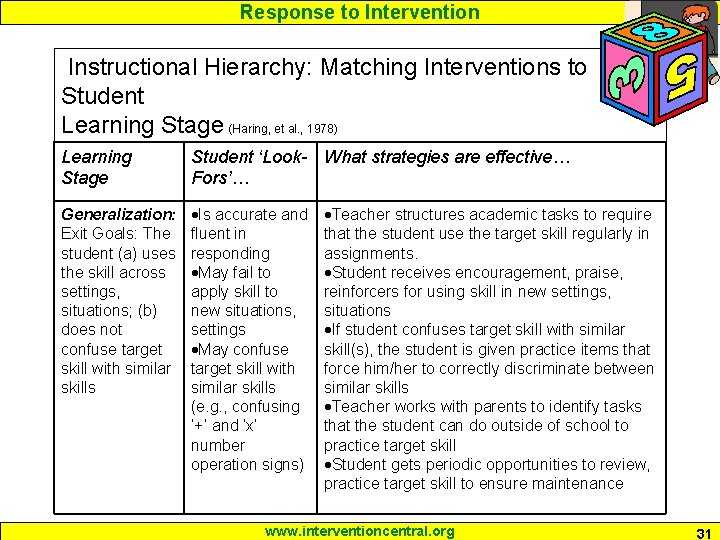
Response to Intervention Instructional Hierarchy: Matching Interventions to Student Learning Stage (Haring, et al. , 1978) Learning Stage Student ‘Look- What strategies are effective… Fors’… Generalization: Exit Goals: The student (a) uses the skill across settings, situations; (b) does not confuse target skill with similar skills Is accurate and fluent in responding May fail to apply skill to new situations, settings May confuse target skill with similar skills (e. g. , confusing ‘+’ and ‘x’ number operation signs) Teacher structures academic tasks to require that the student use the target skill regularly in assignments. Student receives encouragement, praise, reinforcers for using skill in new settings, situations If student confuses target skill with similar skill(s), the student is given practice items that force him/her to correctly discriminate between similar skills Teacher works with parents to identify tasks that the student can do outside of school to practice target skill Student gets periodic opportunities to review, practice target skill to ensure maintenance www. interventioncentral. org 31
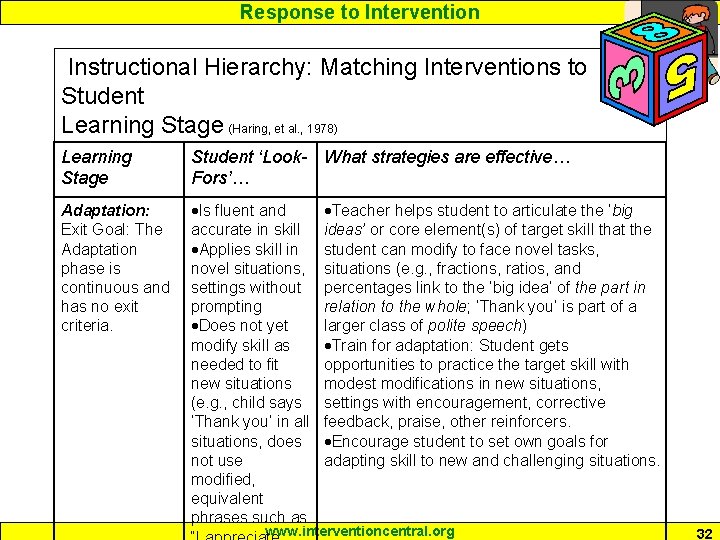
Response to Intervention Instructional Hierarchy: Matching Interventions to Student Learning Stage (Haring, et al. , 1978) Learning Stage Student ‘Look- What strategies are effective… Fors’… Adaptation: Exit Goal: The Adaptation phase is continuous and has no exit criteria. Is fluent and accurate in skill Applies skill in novel situations, settings without prompting Does not yet modify skill as needed to fit new situations (e. g. , child says ‘Thank you’ in all situations, does not use modified, equivalent phrases such as Teacher helps student to articulate the ‘big ideas’ or core element(s) of target skill that the student can modify to face novel tasks, situations (e. g. , fractions, ratios, and percentages link to the ‘big idea’ of the part in relation to the whole; ‘Thank you’ is part of a larger class of polite speech) Train for adaptation: Student gets opportunities to practice the target skill with modest modifications in new situations, settings with encouragement, corrective feedback, praise, other reinforcers. Encourage student to set own goals for adapting skill to new and challenging situations. www. interventioncentral. org 32
Response to Intervention Learn Unit (Heward, 1996) www. interventioncentral. org 33
Response to Intervention Instructional Building Blocks… ‘Learn Unit’ (Heward, 1996) 1. Academic Opportunity to Respond 2. Active Student Response 3. Performance Feedback www. interventioncentral. org 34
Response to Intervention Elements of ‘Learn Unit’… • Academic Opportunity to Respond. The student is presented with a meaningful opportunity to respond to an academic task. A question posed by the teacher, a math word problem, and a spelling item on an educational computer ‘Word Gobbler’ game could all be considered academic opportunities to respond. www. interventioncentral. org 35
Response to Intervention Elements of ‘Learn Unit’… • Active Student Response. The student answers the item, solves the problem presented, or completes the academic task. Answering the teacher’s question, computing the answer to a math word problem (and showing all work), and typing in the correct spelling of an item when playing an educational computer game are all examples of active student responding. www. interventioncentral. org 36
Response to Intervention Elements of ‘Learn Unit’… • Performance Feedback. The student receives timely feedback about whether his or her response is correct—often with praise and encouragement. A teacher exclaiming ‘Right! Good job!’ when a student gives an response in class, a student using an answer key to check her answer to a math word problem, and a computer message that says ‘Congratulations! You get 2 points for correctly spelling this word!” are all examples of performance feedback. www. interventioncentral. org 37
Response to Intervention References • Carnine, D. (1994). Diverse learners and prevailing, emerging and research-based educational approaches and their tools. School Psychology Review, 23, 341 -350. • Heward, W. L. (1996). Three low-tech strategies for increasing the frequency of active student response during group instruction. In R. Gardner III, D. M. Sainato, J. O. Cooper, T. E. Heron, W. L. Heward, J. W. Eshleman, & T. A. Grossi (Eds. ) Behavior analysis in education: Focus on measurably superior instruction (pp. 283 -320). Pacific Grove, CA: Brooks/Cole. www. interventioncentral. org 38
- Slides: 36