
Response to Intervention Academic Interventions for DifficulttoTeach Students
- Slides: 21
Response to Intervention Academic Interventions for Difficult-to-Teach Students Jim Wright www. interventioncentral. org
Response to Intervention Download Power. Points and Handouts from this workshop at: http: //www. interventioncentral. org/se_ glrs. php www. interventioncentral. org 2
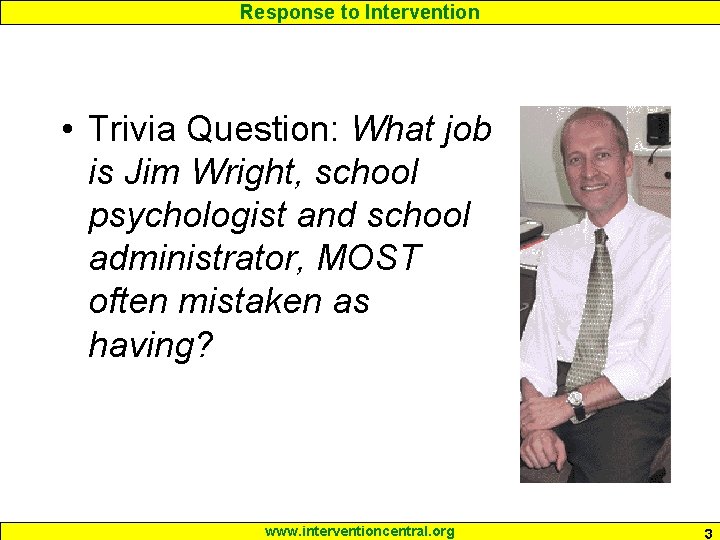
Response to Intervention • Trivia Question: What job is Jim Wright, school psychologist and school administrator, MOST often mistaken as having? www. interventioncentral. org 3
Response to Intervention “RTI: How sloppy can we be and still be effective? ” What is your reaction to this statement? www. interventioncentral. org 4
Response to Intervention What is ‘Response to Intervention’ (RTI)? 'Response to Intervention' is an emerging approach to the diagnosis of Learning Disabilities that holds considerable promise. In the RTI model: • A student with academic delays is given one or more research-validated interventions. • The student's academic progress is monitored frequently to see if those interventions are sufficient to help the student to catch up with his or her peers. • If the student fails to show significantly improved academic skills despite several well-designed and implemented interventions, this failure to www. interventioncentral. org 5
Response to Intervention ‘RTI Logic’: The Power of Working Smarter… -You're a pretty smart fella. -Not that smart. -How'd you figure it out? -I imagined someone smarter than me. Then I tried to think, "What would he do? ” From HEIST (2001) Written by David Mamet www. interventioncentral. org 6
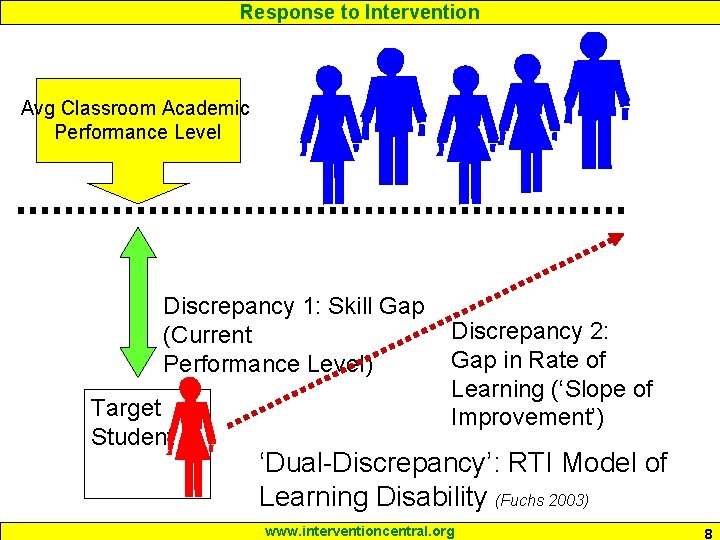
Response to Intervention What does RTI look like when applied to an individual student? A widely accepted method for determining whether a student has a Learning Disability under RTI is the ‘dual discrepancy model’ (Fuchs, 2003). – Discrepancy 1: The student is found to be performing academically at a level significantly below that of his or her typical peers (discrepancy in initial skills or performance). – Discrepancy 2: Despite the implementation of one or more well-designed, well-implemented interventions tailored specifically for the student, he or she fails to ‘close the gap’ with classmates (discrepancy in rate of learning relative to peers). www. interventioncentral. org 7
Response to Intervention Avg Classroom Academic Performance Level Discrepancy 1: Skill Gap (Current Performance Level) Target Student Discrepancy 2: Gap in Rate of Learning (‘Slope of Improvement’) ‘Dual-Discrepancy’: RTI Model of Learning Disability (Fuchs 2003) www. interventioncentral. org 8
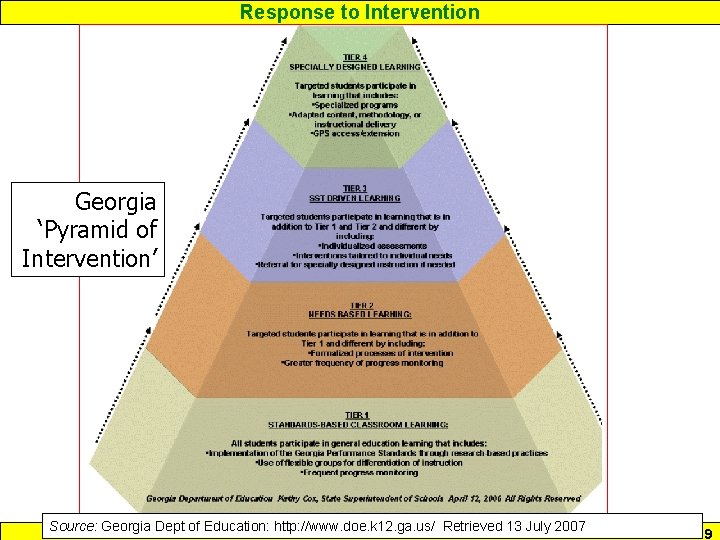
Response to Intervention Georgia ‘Pyramid of Intervention’ Source: Georgia Dept of Education: www. interventioncentral. org http: //www. doe. k 12. ga. us/ Retrieved 13 July 2007 9
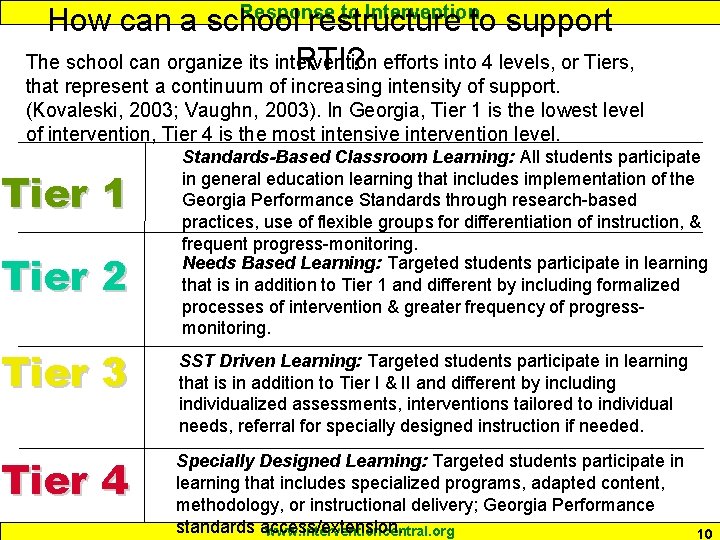
Response to Intervention How can a school restructure to support The school can organize its intervention RTI? efforts into 4 levels, or Tiers, that represent a continuum of increasing intensity of support. (Kovaleski, 2003; Vaughn, 2003). In Georgia, Tier 1 is the lowest level of intervention, Tier 4 is the most intensive intervention level. Tier 1 Tier 2 Standards-Based Classroom Learning: All students participate in general education learning that includes implementation of the Georgia Performance Standards through research-based practices, use of flexible groups for differentiation of instruction, & frequent progress-monitoring. Needs Based Learning: Targeted students participate in learning that is in addition to Tier 1 and different by including formalized processes of intervention & greater frequency of progressmonitoring. Tier 3 SST Driven Learning: Targeted students participate in learning that is in addition to Tier I & II and different by including individualized assessments, interventions tailored to individual needs, referral for specially designed instruction if needed. Tier 4 Specially Designed Learning: Targeted students participate in learning that includes specialized programs, adapted content, methodology, or instructional delivery; Georgia Performance standards access/extension. www. interventioncentral. org 10
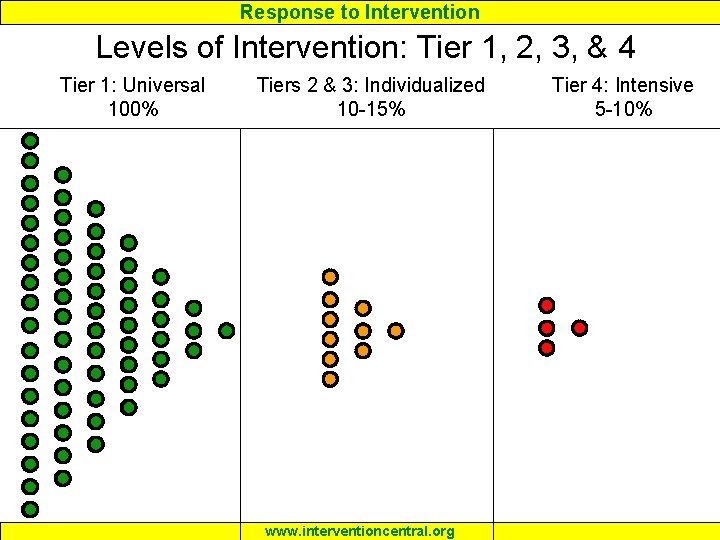
Response to Intervention Levels of Intervention: Tier 1, 2, 3, & 4 Tier 1: Universal 100% Tiers 2 & 3: Individualized 10 -15% www. interventioncentral. org Tier 4: Intensive 5 -10%
Response to Intervention ‘Big Ideas’ About Student Learning www. interventioncentral. org
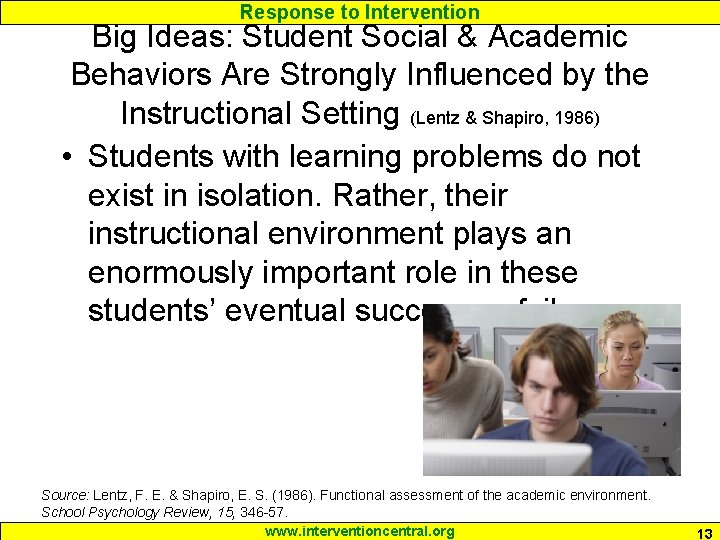
Response to Intervention Big Ideas: Student Social & Academic Behaviors Are Strongly Influenced by the Instructional Setting (Lentz & Shapiro, 1986) • Students with learning problems do not exist in isolation. Rather, their instructional environment plays an enormously important role in these students’ eventual success or failure Source: Lentz, F. E. & Shapiro, E. S. (1986). Functional assessment of the academic environment. School Psychology Review, 15, 346 -57. www. interventioncentral. org 13
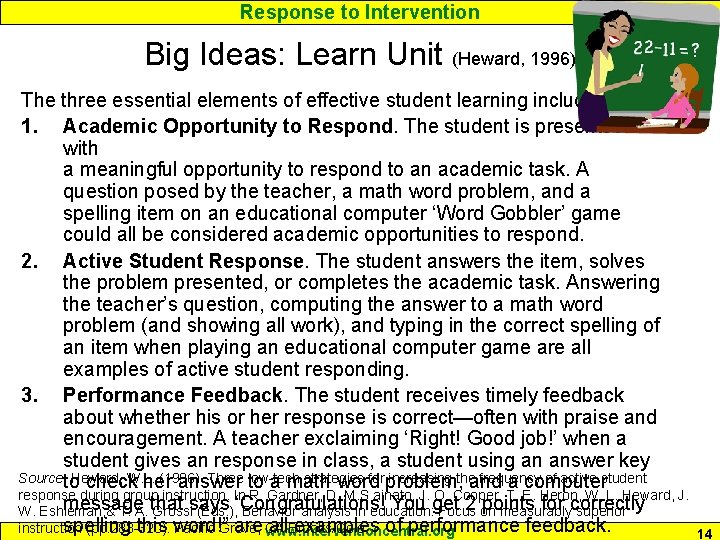
Response to Intervention Big Ideas: Learn Unit (Heward, 1996) The three essential elements of effective student learning include: 1. Academic Opportunity to Respond. The student is presented with a meaningful opportunity to respond to an academic task. A question posed by the teacher, a math word problem, and a spelling item on an educational computer ‘Word Gobbler’ game could all be considered academic opportunities to respond. 2. Active Student Response. The student answers the item, solves the problem presented, or completes the academic task. Answering the teacher’s question, computing the answer to a math word problem (and showing all work), and typing in the correct spelling of an item when playing an educational computer game are all examples of active student responding. 3. Performance Feedback. The student receives timely feedback about whether his or her response is correct—often with praise and encouragement. A teacher exclaiming ‘Right! Good job!’ when a student gives an response in class, a student using an answer key Source: to Heward, W. L. (1996). Three to low-tech strategies for problem, increasing theand frequency of active student check her answer a math word a computer response during group instruction. In R. Gardner, D. M. S ainato, J. O. Cooper, T. E. Heron, W. L. Heward, J. message You get 2 on points for correctly W. Eshleman, & T. A. that Grossisays (Eds. ), ‘Congratulations! Behavior analysis in education: Focus measurably superior spelling this word!” are all examples of performance feedback. instruction (pp. 283 -320). Pacific Grove, CA: Brooks/Cole. www. interventioncentral. org 14
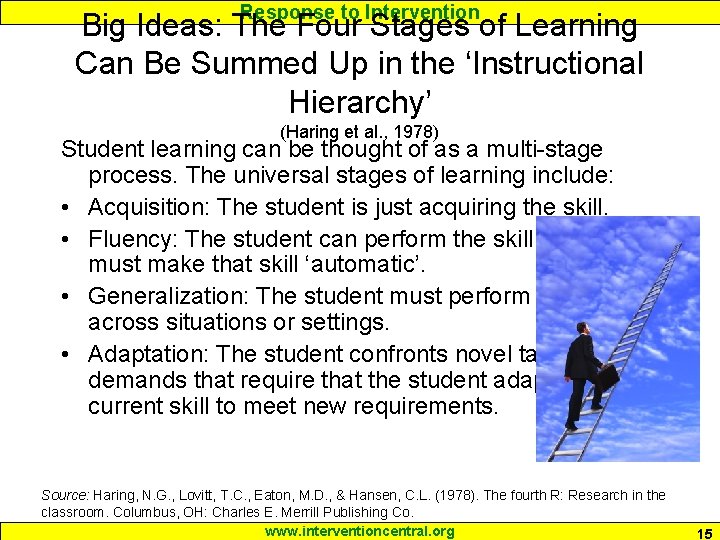
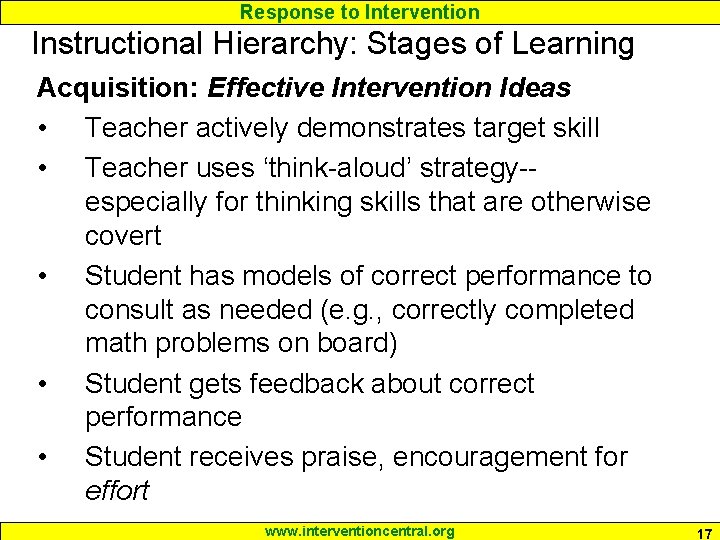
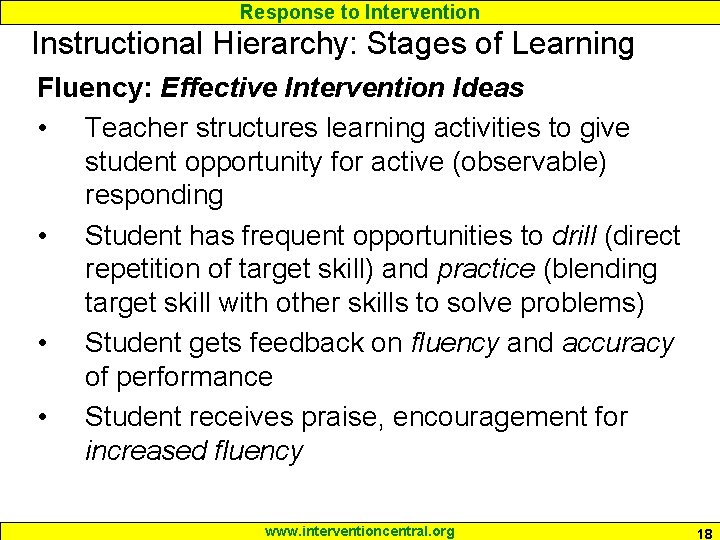
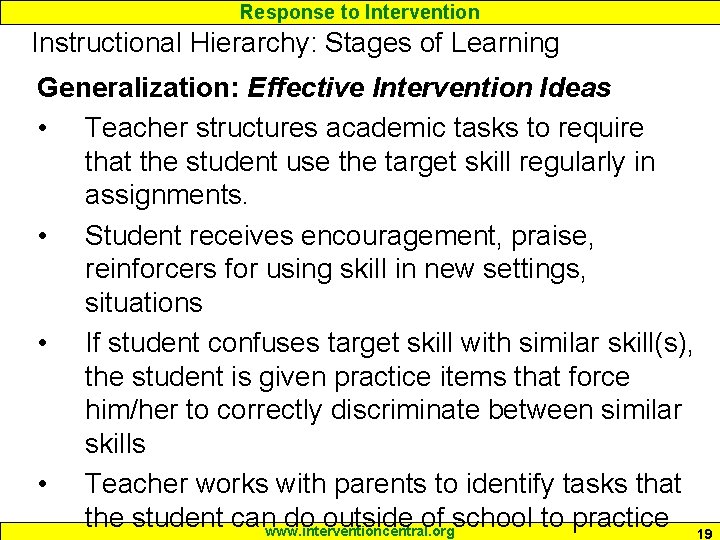
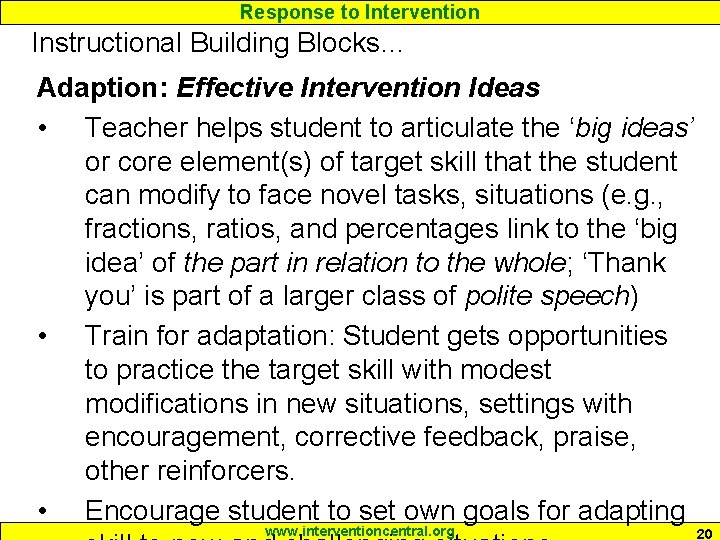
Response to Intervention Big Ideas: The Four Stages of Learning Can Be Summed Up in the ‘Instructional Hierarchy’ (Haring et al. , 1978) Student learning can be thought of as a multi-stage process. The universal stages of learning include: • Acquisition: The student is just acquiring the skill. • Fluency: The student can perform the skill but must make that skill ‘automatic’. • Generalization: The student must perform the skill across situations or settings. • Adaptation: The student confronts novel task demands that require that the student adapt a current skill to meet new requirements. Source: Haring, N. G. , Lovitt, T. C. , Eaton, M. D. , & Hansen, C. L. (1978). The fourth R: Research in the classroom. Columbus, OH: Charles E. Merrill Publishing Co. www. interventioncentral. org 15
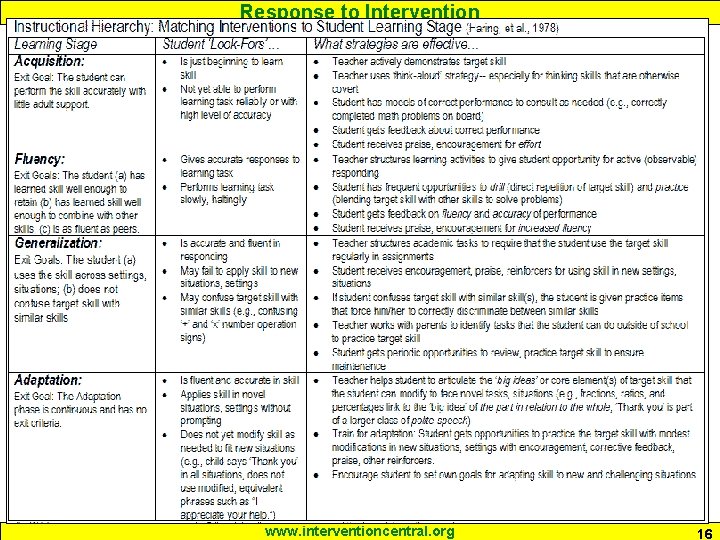
Response to Intervention www. interventioncentral. org 16
Response to Intervention Instructional Hierarchy: Stages of Learning Acquisition: Effective Intervention Ideas • Teacher actively demonstrates target skill • Teacher uses ‘think-aloud’ strategy-especially for thinking skills that are otherwise covert • Student has models of correct performance to consult as needed (e. g. , correctly completed math problems on board) • Student gets feedback about correct performance • Student receives praise, encouragement for effort www. interventioncentral. org 17
Response to Intervention Instructional Hierarchy: Stages of Learning Fluency: Effective Intervention Ideas • Teacher structures learning activities to give student opportunity for active (observable) responding • Student has frequent opportunities to drill (direct repetition of target skill) and practice (blending target skill with other skills to solve problems) • Student gets feedback on fluency and accuracy of performance • Student receives praise, encouragement for increased fluency www. interventioncentral. org 18
Response to Intervention Instructional Hierarchy: Stages of Learning Generalization: Effective Intervention Ideas • Teacher structures academic tasks to require that the student use the target skill regularly in assignments. • Student receives encouragement, praise, reinforcers for using skill in new settings, situations • If student confuses target skill with similar skill(s), the student is given practice items that force him/her to correctly discriminate between similar skills • Teacher works with parents to identify tasks that the student canwww. interventioncentral. org do outside of school to practice 19
Response to Intervention Instructional Building Blocks… Adaption: Effective Intervention Ideas • Teacher helps student to articulate the ‘big ideas’ or core element(s) of target skill that the student can modify to face novel tasks, situations (e. g. , fractions, ratios, and percentages link to the ‘big idea’ of the part in relation to the whole; ‘Thank you’ is part of a larger class of polite speech) • Train for adaptation: Student gets opportunities to practice the target skill with modest modifications in new situations, settings with encouragement, corrective feedback, praise, other reinforcers. • Encourage student to set own goals for adapting www. interventioncentral. org 20
Response to Intervention ‘Elbow Group’ Activity: What Are Your School’s Top Academic Intervention Needs? In your group: 1. Have each participant list the top 3 academic intervention concerns in heror his building or district. 2. Note any common themes of intervention needs identified by multiple members of your group. www. interventioncentral. org 21