
Response to 1999 SAB Recommendations on salmon recovery
Response to 1999 SAB Recommendations on salmon recovery science A Presentation to the NOAA Science Advisory Board John Stein, Ph. D. Deputy Director Northwest Fisheries Science Center NOAA Fisheries Service August 2005 1
Outline • • Purpose Issue Presentation of Briefing Desired Outcomes 2
Purpose In response to SAB request: – Summarize progress made relative to 1999 recommendations for strengthening salmon science in Pacific Northwest (PNW) – Receive SAB feedback – Discuss recommendations in context current state of salmon recovery efforts 3
Summary of 1999 SAB recommendations • Build and strengthen connections with agencies outside of the core NOAA-university community • Increased emphasis on the oceanic portion of the salmon lifehistory • Develop and improve models to predict salmon population changes from habitat changes, ocean survival and oceanic factors. NOAA Environmental Research Laboratories should be encouraged to partner with NMFS • Prepare revised medium and long term science plan following CRI workshops. Address key sources of uncertainties and strengthen understanding of critical process and parameters in recovery of salmon in the PNW. • Links to managers and management agencies should be built explicitly into all stages of the science initiatives and salmon recovery. 4
Issue • Should any of the previous SAB recommendations continue as a high priority? • Does the SAB have additional recommendations? 5
Build and strengthen connections Two specific examples – Endangered Species Act (ESA) Recovery Planning – Habitat/Life Cycle Models 6
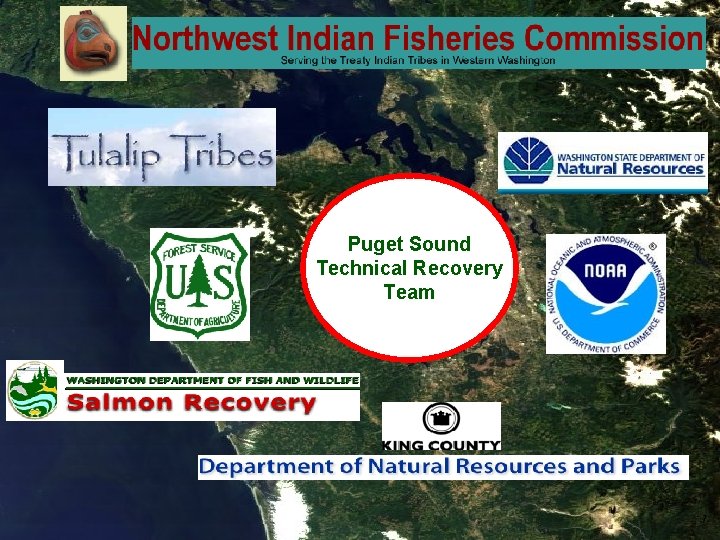
Puget Sound Technical Recovery Team 7
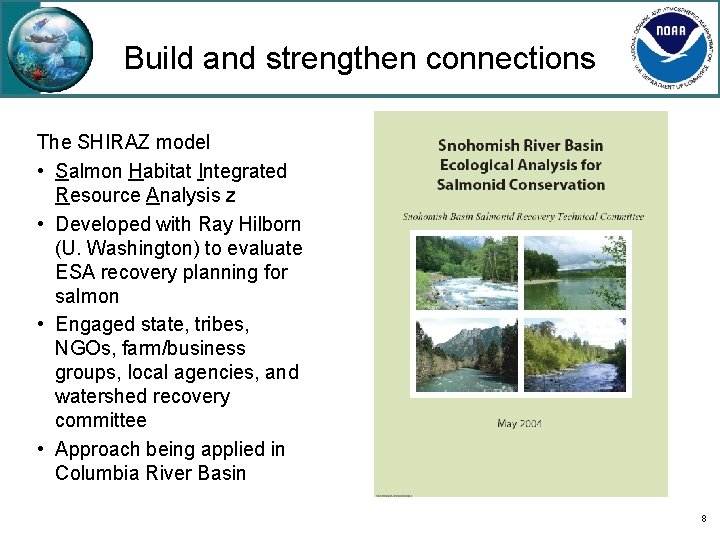
Build and strengthen connections The SHIRAZ model • Salmon Habitat Integrated Resource Analysis z • Developed with Ray Hilborn (U. Washington) to evaluate ESA recovery planning for salmon • Engaged state, tribes, NGOs, farm/business groups, local agencies, and watershed recovery committee • Approach being applied in Columbia River Basin 8
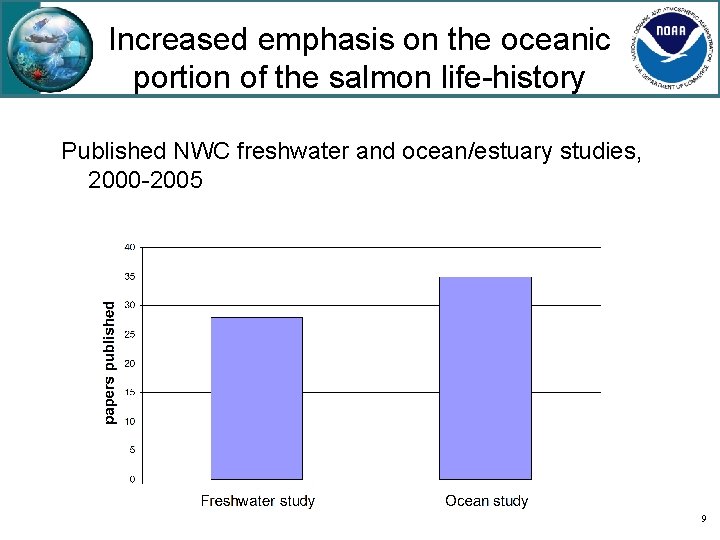
Increased emphasis on the oceanic portion of the salmon life-history Published NWC freshwater and ocean/estuary studies, 2000 -2005 9
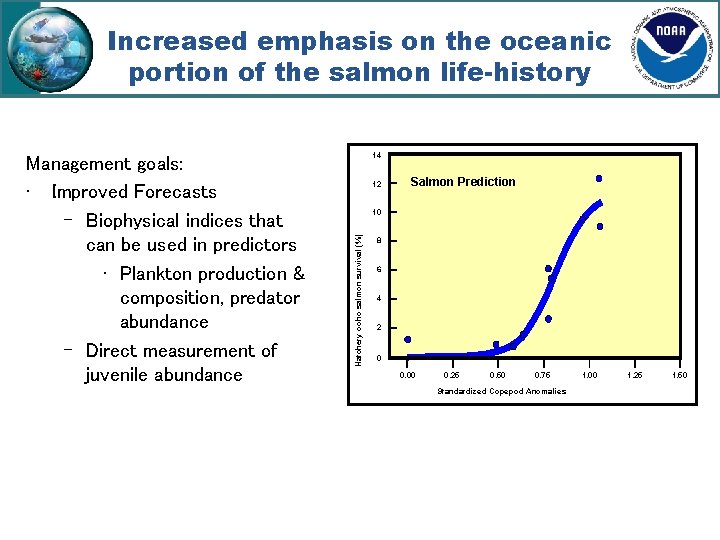
Increased emphasis on the oceanic portion of the salmon life-history 14 12 Salmon Prediction 10 Hatchery coho salmon survival (%) Management goals: • Improved Forecasts – Biophysical indices that can be used in predictors • Plankton production & composition, predator abundance – Direct measurement of juvenile abundance 8 6 4 2 0 0. 00 0. 25 0. 50 0. 75 Standardized Copepod Anomalies 1. 00 1. 25 1. 50
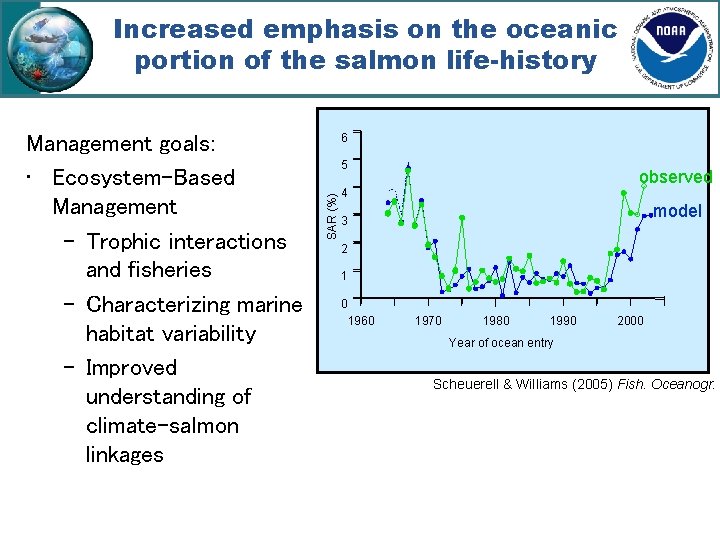
Increased emphasis on the oceanic portion of the salmon life-history 6 5 SAR (%) Management goals: • Ecosystem-Based Management – Trophic interactions and fisheries – Characterizing marine habitat variability – Improved understanding of climate-salmon linkages observed 4 model 3 2 1 0 1960 1970 1980 1990 2000 Year of ocean entry Scheuerell & Williams (2005) Fish. Oceanogr.
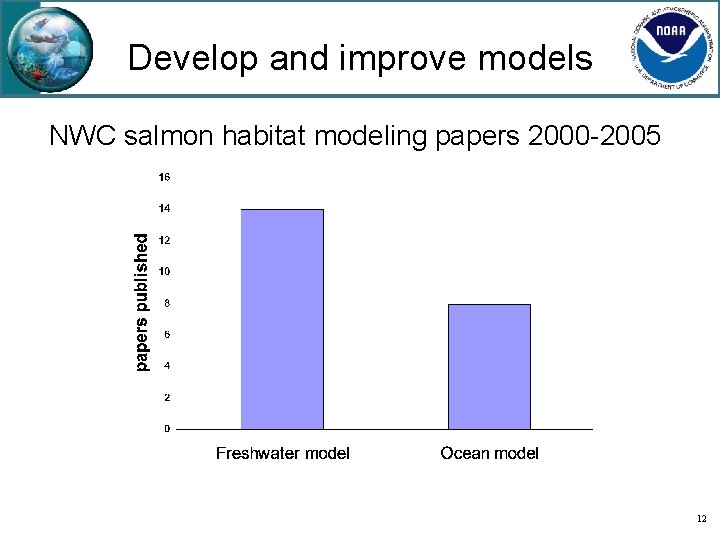
Develop and improve models NWC salmon habitat modeling papers 2000 -2005 12
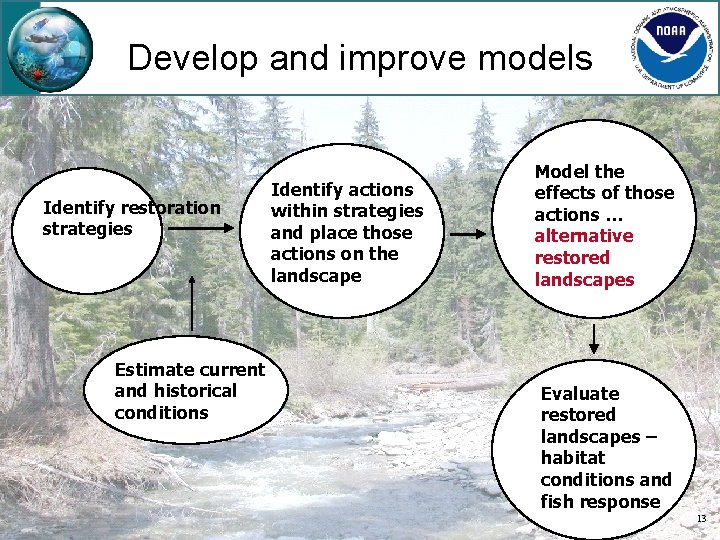
Develop and improve models Identify restoration strategies Estimate current and historical conditions Identify actions within strategies and place those actions on the landscape Model the effects of those actions … alternative restored landscapes Evaluate restored landscapes – habitat conditions and fish response 13
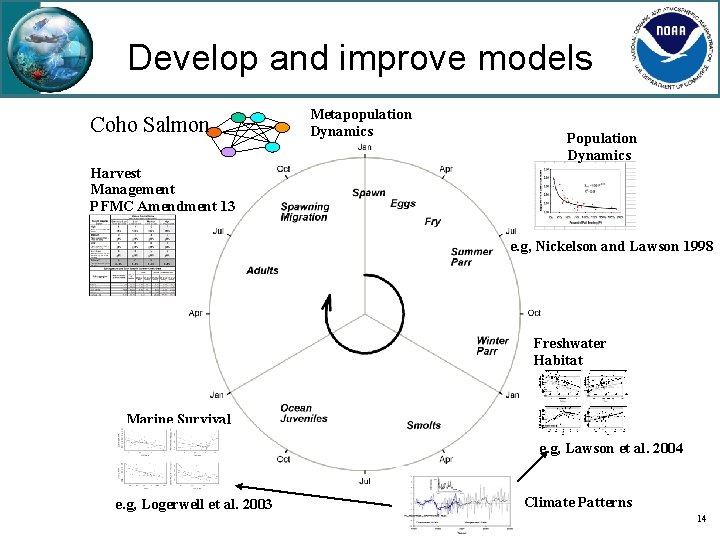
Develop and improve models Coho Salmon Metapopulation Dynamics Population Dynamics Harvest Management PFMC Amendment 13 e. g, Nickelson and Lawson 1998 Freshwater Habitat Marine Survival e. g, Lawson et al. 2004 e. g, Logerwell et al. 2003 Climate Patterns 14
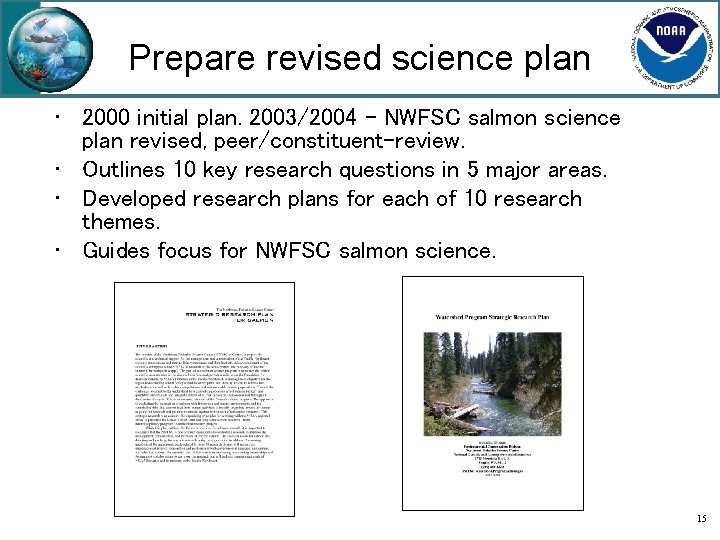
Prepare revised science plan • 2000 initial plan. 2003/2004 - NWFSC salmon science plan revised, peer/constituent-review. • Outlines 10 key research questions in 5 major areas. • Developed research plans for each of 10 research themes. • Guides focus for NWFSC salmon science. 15
Social Science Research Plan • Developed NWFSC Social Science Research Plan (peer-reviewed) • Plan covers: - Research Methods and Tools - Social Science Research Themes -In situ Conservation of Protected Species and Ecosystems -Commercial & Recreational Fisheries; - Ongoing Projects and Research Priorities 16
Links to managers and management agencies • Research conducted as a result of mandates in 2000 and 2004 Col. River Hydropower Biological Opinions – – – – Population Identification Viability goals (population and ESU level) Limiting factors analyses Monitoring and Evaluation Workshops and public releases of documents Habitat and life cycle modeling Hydro effects: direct effects and on estuary Multiple public meetings 17
Desired Outcomes • Confirmation that NOAA Fisheries achieved the intent of the 1999 recommendations • Additional recommendation from the SAB 18
Backup Slides • The following provide additional information and examples of how the NW Fisheries Science Center has responded to the 1999 recommendations by the SAB 19
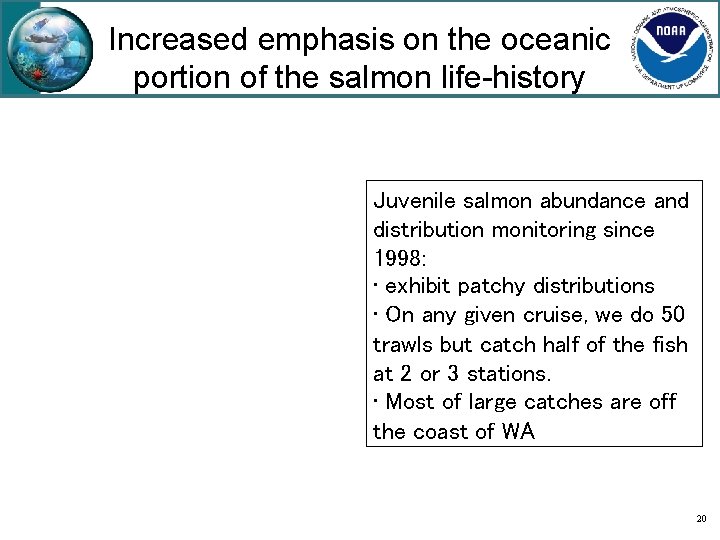
Increased emphasis on the oceanic portion of the salmon life-history Juvenile salmon abundance and distribution monitoring since 1998: • exhibit patchy distributions • On any given cruise, we do 50 trawls but catch half of the fish at 2 or 3 stations. • Most of large catches are off the coast of WA 20
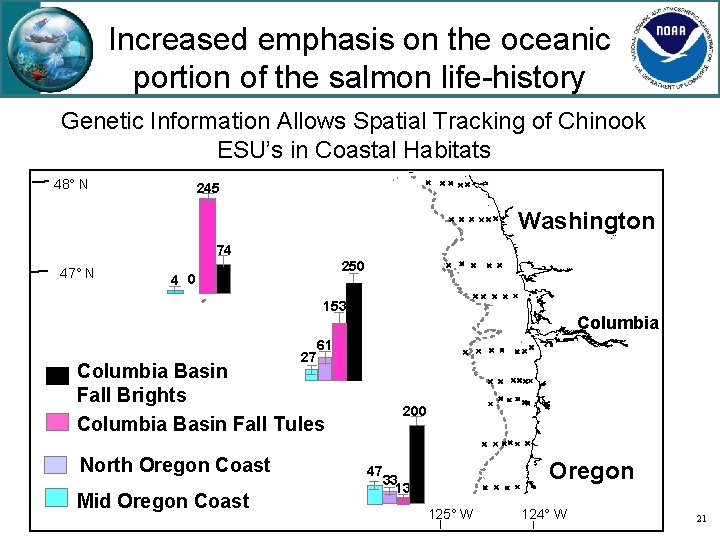
Increased emphasis on the oceanic portion of the salmon life-history Genetic Information Allows Spatial Tracking of Chinook ESU’s in Coastal Habitats 48° N 245 Washington 74 47° N 250 4 0 153 27 61 Columbia Basin Fall Brights Columbia Basin Fall Tules North Oregon Coast Mid Oregon Coast Columbia 200 Oregon 47 33 13 125° W 124° W 21
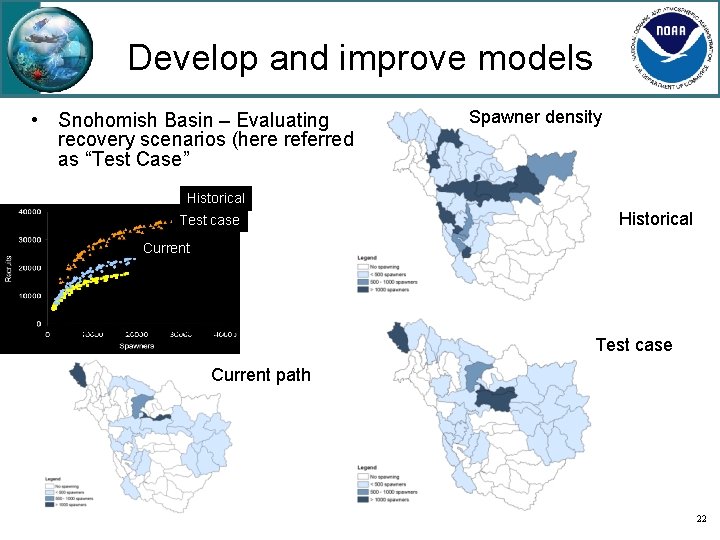
Develop and improve models • Snohomish Basin – Evaluating recovery scenarios (here referred to as “Test Case” Spawner density Historical Test case Historical Current Population productivity Test case Current path 22
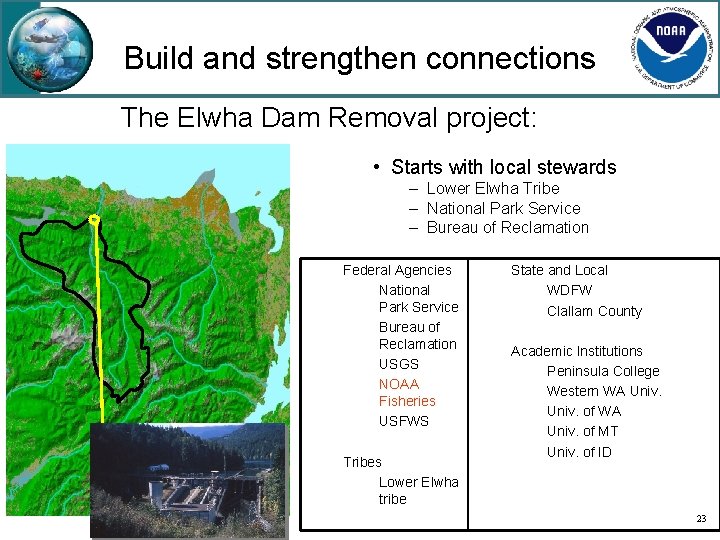
Build and strengthen connections The Elwha Dam Removal project: • Starts with local stewards – Lower Elwha Tribe – National Park Service – Bureau of Reclamation Federal Agencies National Park Service Bureau of Reclamation USGS NOAA Fisheries USFWS Tribes Lower Elwha tribe State and Local WDFW Clallam County Academic Institutions Peninsula College Western WA Univ. of MT Univ. of ID 23
Prepare revised science plan • Worked closely with Recovery Science Review Panel to implement recommendations of that panel, as feasible • Have conducted workshops to address key scientific uncertainties, e. g. – Workshops on Columbia River channel improvement project (1999) – Symposium/workshop on how to evaluate ESU status of hatchery and resident fish (2005) 24
Social Science Projects • Integration of economic data and research into endangered species policymaking – Critical habitat designation for West Coast salmon and steelhead • Economic data used to estimate impacts of ESA protection for West Coast salmon and steelhead • Cost-effectiveness framework used as part of critical habitat designation regulatory process – Recovery planning for NW salmon and steelhead (ongoing) • Developing economic database of costs of conservation actions covering 4 Hs 25
- Slides: 25