
Response Time and Staffing Analysis Model for the


- Slides: 48
Response Time and Staffing Analysis Model for the Houston Fire Department 1
Houston Fire Department �Introductions �Our Process �Overview �Specific Recommendations 2
Introductions �William Bryson �Cathy Gleason �Ken Riddle �Kevin Roche �Nancy Trench Chris Callsen, Amos Chalmers, Randy Griffin, Charles Hood, Charles Jennings, Brett Lacey, Gary Ludwig, Richard Marinucci, Larry Schwarz, Denise Smith, Eric Tade, Robert Tutterow, Andy Whitehead, Mike Wieder, Sally Young 3
Our Process – First-Hand � Fire Executive Staff � Fire Management �Prevention, Logistics, Operations and Special Operations, Training, Administration � Firefighters and Fire Officers � Medical Director � Mayor’s Office � Finance, Emergency Management, Dispatch, Fleet, Human Resources � Houston Black Firefighters Association � Houston Professional Firefighters Association International Association of Fire Fighters Local 341 � Houston Female Firefighters and Fire Officers 4
Our Process – First-Hand � Dispatch System Data Review � Computerized Deployment Modeling � SOP and Document Review � Standards and Best Practices � Benchmarking � Close Coordination with Fire Department Administration 5
Our Premise �Outside Experts �Unencumbered by the “way things are done” �A Critical Eye �Realistic and Achievable Recommendations �Recognition of Best Practices 6
Fire and EMS in Houston City of Houston � Complicated Transportation System � Significant Industrial Presence � Significant Educational and Medical Presence � Lack of a Single Central Core � Historic Peripheral Growth and Current Urbanization 7
Fire and EMS in Houston Fire Department Description �Dedicated Staff – System Efficiency �Reductions in Support Staff �Emergency Unit Staffing in Compliance with National Standard �Deferral of Capital Expenditures �Very, Very Busy Response System Budget and Governance �Fire – 21 -23 percent of General Fund - $509 M �Fire Revenue - $75 M – ambulance/prevention �Sales Tax Rate Restriction – Texas �Property Tax Growth Restriction - Houston 8
Ideas Considered �EMS Model Changes �Ambulance Service Privatization �Peak-Time Ambulances, Medic Units, and Squads �Emergency Unit Staffing �Work Shift Change from 4 to 3 shifts �Cost Recovery �Ambulance Billing Efficiency 9
EMS Model Changes � HFD All-Hazards Deployment Model is a Best Practice � Help at the Customer’s Side � Preservation of Finite Resources �Call Processing at Dispatch �BLS/ALS Response �ETHAN �Po. P Engines � Suggestions on Expanded EMS and Role of Squads 10
Ambulance Service Privatization � Fully Integrated EMS Provided by the HFD � Likely Need for Subsidy if Privatized � 12 Largest Cities (population) � 12 Provide EMS � 9 Provide Ambulance Service � 2 Use 3 rd Public Service � Issues with Service Abandonment and Underserved Areas 11
Peak-Time Ambulances, Medic Units, Squads � Houston Fire Staffs Constant Staffs 58 BLS Ambulances and 34 Medic Units � Our Assumption that HFD did not Need All Units 24/7 � Performance Analysis and Modeling Show All Units Needed Plus Peak-Time Capability � Peak-Time Units - Used During Most Active Times 12
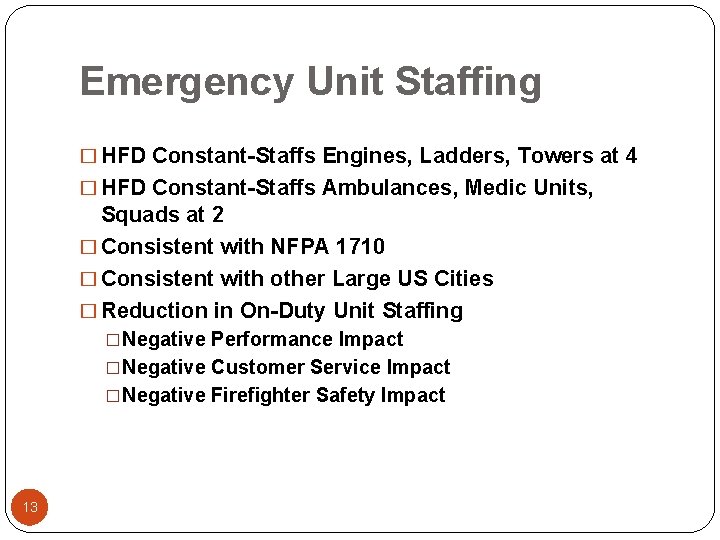
Emergency Unit Staffing � HFD Constant-Staffs Engines, Ladders, Towers at 4 � HFD Constant-Staffs Ambulances, Medic Units, Squads at 2 � Consistent with NFPA 1710 � Consistent with other Large US Cities � Reduction in On-Duty Unit Staffing �Negative Performance Impact �Negative Customer Service Impact �Negative Firefighter Safety Impact 13
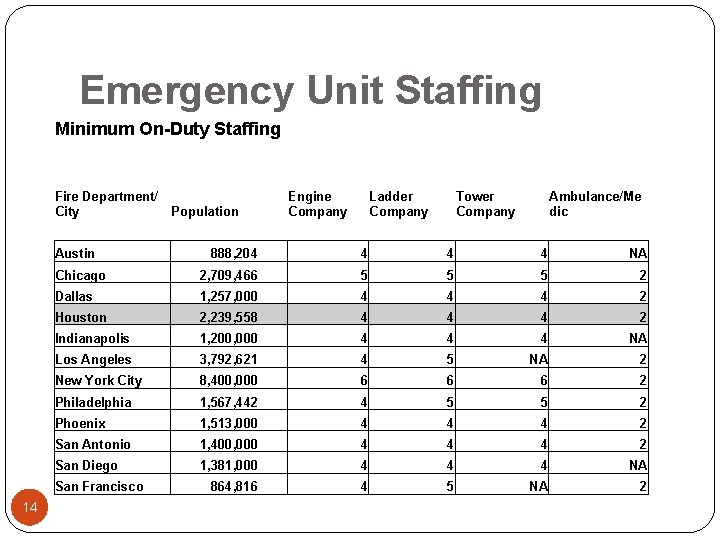
Emergency Unit Staffing Minimum On-Duty Staffing Fire Department/ City Austin Ladder Company Tower Company Ambulance/Me dic 888, 204 4 NA Chicago 2, 709, 466 5 5 5 2 Dallas 1, 257, 000 4 4 4 2 Houston 2, 239, 558 4 4 4 2 Indianapolis 1, 200, 000 4 4 4 NA Los Angeles 3, 792, 621 4 5 NA 2 New York City 8, 400, 000 6 6 6 2 Philadelphia 1, 567, 442 4 5 5 2 Phoenix 1, 513, 000 4 4 4 2 San Antonio 1, 400, 000 4 4 4 2 San Diego 1, 381, 000 4 4 4 NA 864, 816 4 5 NA 2 San Francisco 14 Population Engine Company
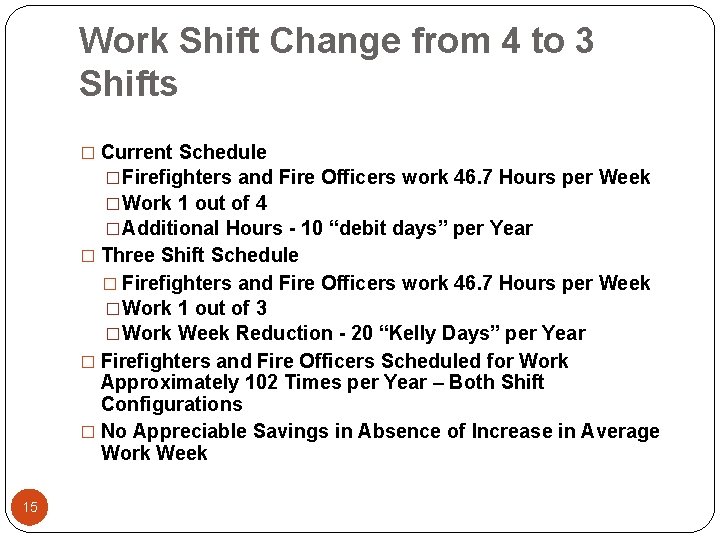
Work Shift Change from 4 to 3 Shifts � Current Schedule �Firefighters and Fire Officers work 46. 7 Hours per Week �Work 1 out of 4 �Additional Hours - 10 “debit days” per Year � Three Shift Schedule � Firefighters and Fire Officers work 46. 7 Hours per Week �Work 1 out of 3 �Work Week Reduction - 20 “Kelly Days” per Year � Firefighters and Fire Officers Scheduled for Work Approximately 102 Times per Year – Both Shift Configurations � No Appreciable Savings in Absence of Increase in Average Work Week 15
Cost Recovery � Current – Ambulance Fees, Fire Prevention Fees, Hazmat Program � Few Opportunities for Cost Recovery by Fire Departments � Changes in the Health Care System 16
Ambulance Billing Efficiency � Cooperative Effort Between Finance and Fire � Billing Quality Control � Partial Day Coverage �Should be Expanded 17
Areas of Analysis � Logistics � Professional Development � Deployment – Emergency Operations � Emergency Medical Services � Dispatch and Technology � Staffing of Emergency Operations � Life Safety Bureau � Arson Bureau � Safety and Health Programs 18
Logistics 19
Logistics Recommendations � Fleet Replacement Fund � Return Fleet Maintenance Responsibilities to the control of the Fire Department. � Training for Fleet Mechanics - Emergency Vehicle Certification (EVT) program. � Self-Contained Breathing Apparatus (SCBA) Replacement 20
Logistics Recommendations � Dedicated General Services Division (GSD) Facility Maintenance Crew � Install Diesel Exhaust Systems in Fire Stations � Dedicated Procurement Personnel in Fire � Explore Purchasing Partnerships – Hospital System - EMS Supplies 21
Professional Development 22
Professional Development Recommendations � Involve Uniformed HFD members in the Recruiting Process - Diversity � Utilize the Candidate Physical Abilities Test (CPAT) � Analyze the Causes of Cadet “Washouts” – Mitigation � Standardized Driver Training Program � Fire Officers Continuing Education � Career Development Plan � Refresh Facility Master Plan for the VJTF 23
Deployment – Emergency Operations 24
Deployment – Emergency Operations NFPA 1710 Standard for the Organization and Deployment of Fire Suppression Operations, Emergency Medical Operations, and Special Operations to the Public by Career Fire Departments � 240 seconds travel – first engine on-scene � 480 seconds travel – initial full alarm � 610 seconds travel – highrise initial alarm � 240 seconds travel – EMS � 480 seconds travel – Advanced Life Support � 90 th Percentile 25
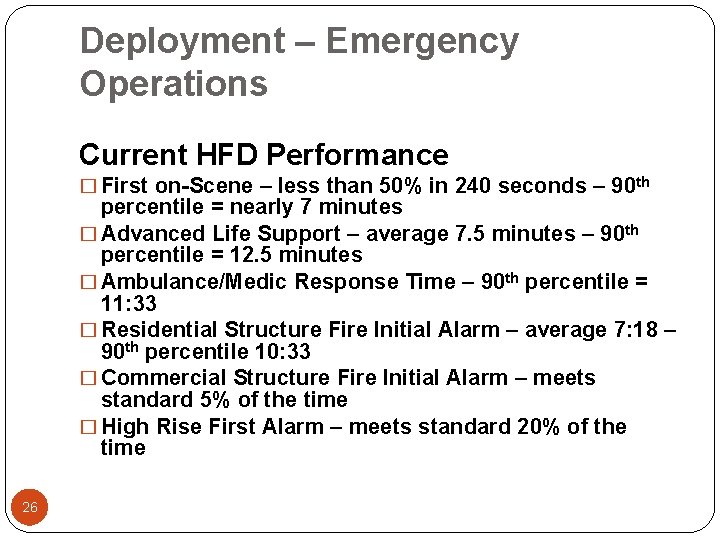
Deployment – Emergency Operations Current HFD Performance � First on-Scene – less than 50% in 240 seconds – 90 th percentile = nearly 7 minutes � Advanced Life Support – average 7. 5 minutes – 90 th percentile = 12. 5 minutes � Ambulance/Medic Response Time – 90 th percentile = 11: 33 � Residential Structure Fire Initial Alarm – average 7: 18 – 90 th percentile 10: 33 � Commercial Structure Fire Initial Alarm – meets standard 5% of the time � High Rise First Alarm – meets standard 20% of the time 26
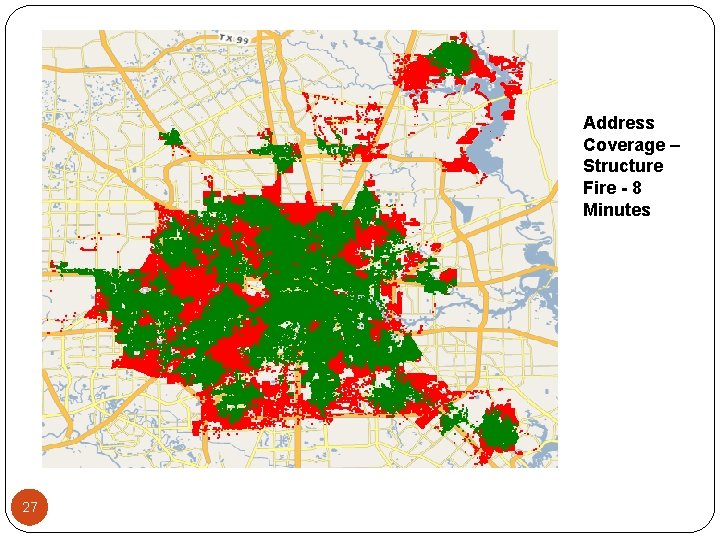
Address Coverage – Structure Fire - 8 Minutes 27
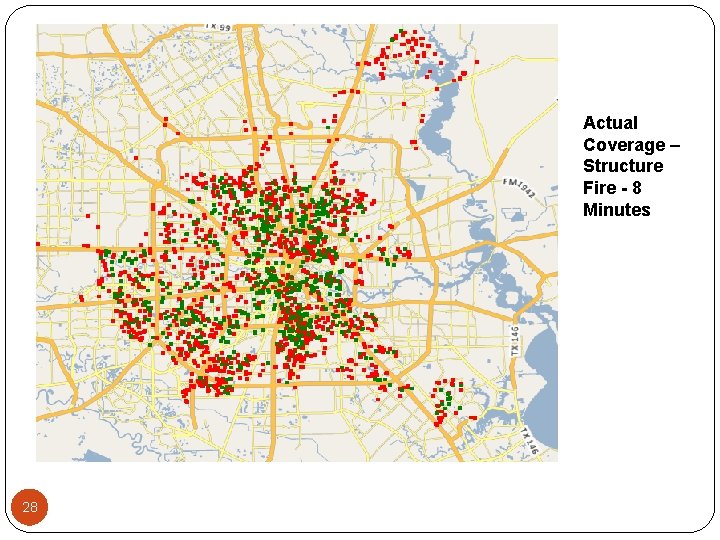
Actual Coverage – Structure Fire - 8 Minutes 28
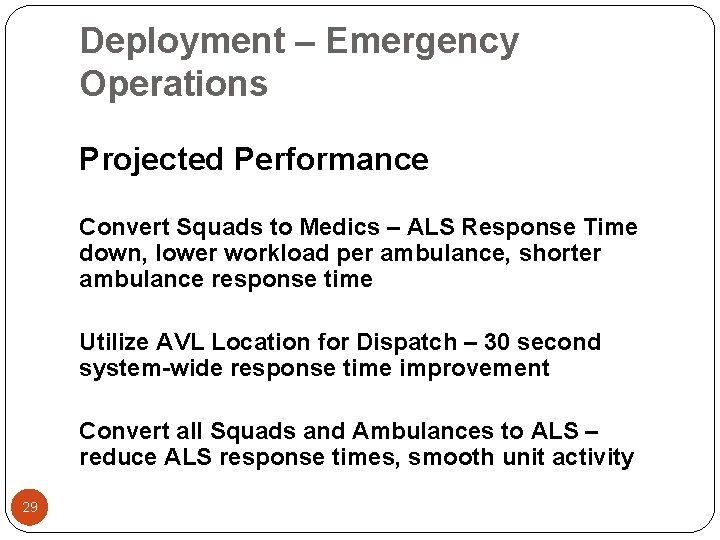
Deployment – Emergency Operations Projected Performance Convert Squads to Medics – ALS Response Time down, lower workload per ambulance, shorter ambulance response time Utilize AVL Location for Dispatch – 30 second system-wide response time improvement Convert all Squads and Ambulances to ALS – reduce ALS response times, smooth unit activity 29
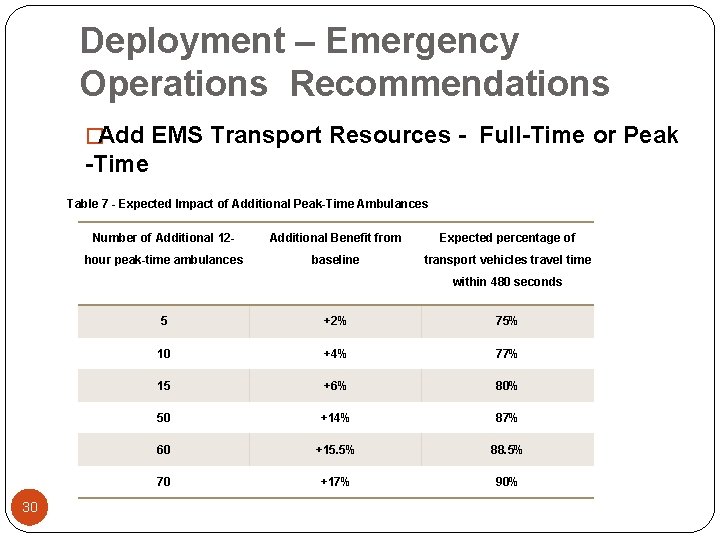
Deployment – Emergency Operations Recommendations �Add EMS Transport Resources - Full-Time or Peak -Time Table 7 - Expected Impact of Additional Peak-Time Ambulances Number of Additional 12 - Additional Benefit from Expected percentage of hour peak-time ambulances baseline transport vehicles travel time within 480 seconds 30 5 +2% 75% 10 +4% 77% 15 +6% 80% 50 +14% 87% 60 +15. 5% 88. 5% 70 +17% 90%
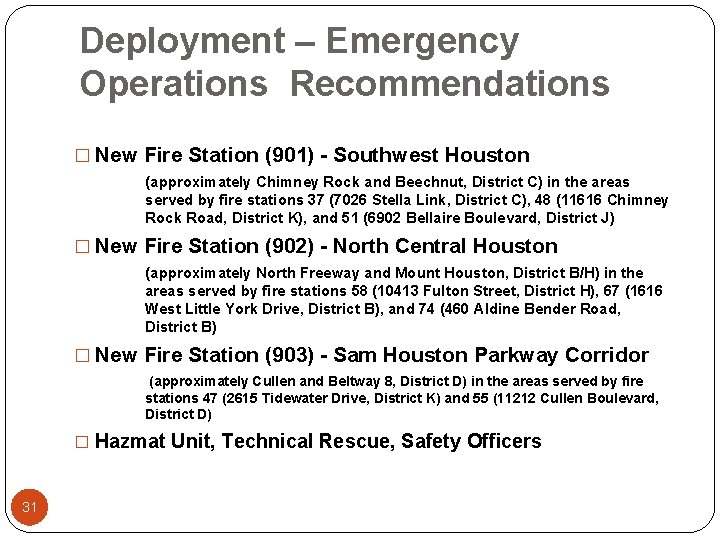
Deployment – Emergency Operations Recommendations � New Fire Station (901) - Southwest Houston (approximately Chimney Rock and Beechnut, District C) in the areas served by fire stations 37 (7026 Stella Link, District C), 48 (11616 Chimney Rock Road, District K), and 51 (6902 Bellaire Boulevard, District J) � New Fire Station (902) - North Central Houston (approximately North Freeway and Mount Houston, District B/H) in the areas served by fire stations 58 (10413 Fulton Street, District H), 67 (1616 West Little York Drive, District B), and 74 (460 Aldine Bender Road, District B) � New Fire Station (903) - Sam Houston Parkway Corridor (approximately Cullen and Beltway 8, District D) in the areas served by fire stations 47 (2615 Tidewater Drive, District K) and 55 (11212 Cullen Boulevard, District D) � Hazmat Unit, Technical Rescue, Safety Officers 31
Emergency Medical Services 32
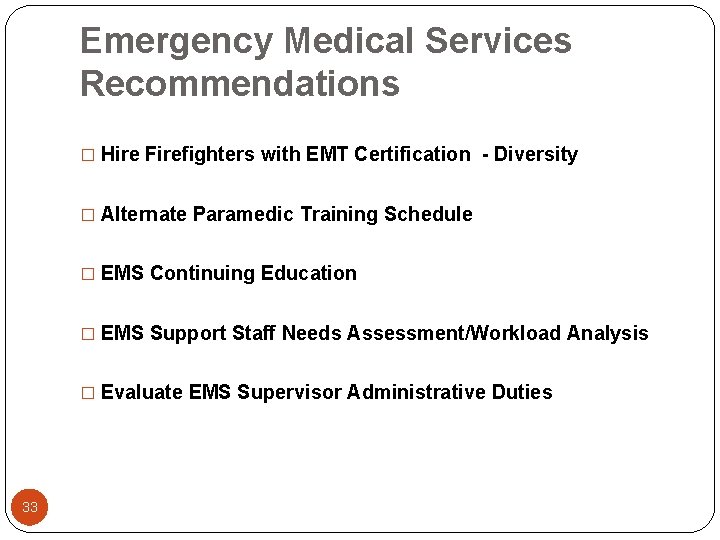
Emergency Medical Services Recommendations � Hire Firefighters with EMT Certification - Diversity � Alternate Paramedic Training Schedule � EMS Continuing Education � EMS Support Staff Needs Assessment/Workload Analysis � Evaluate EMS Supervisor Administrative Duties 33
Emergency Medical Services Recommendations � Continue to Evaluate the Efficacy of the Medical Priority Dispatch System � Consider Changes to the Medical Credentialing Process and the Utilization of Paramedics within the HFD � Continue the ETHAN Program - Explore Alternative Funding � Continue Care Houston - Seek Funding and Opportunities - Methods to Manage Demand 34
Dispatch and Technology 35
Dispatch and Technology Recommendations � Utilize Automatic Vehicle Location (AVL) Technology � Streamline Call Taking Process � Prompt Responders - Acknowledgement 36
Staffing of Emergency Operations 37
Staffing of Emergency Operations Recommendations � Staff Emergency Operations at 3, 634 FTE (plus/minus 3%) �Staffing in Emergency Operations (plus Life Safety, Staff, Logistics, etc. ) �Constant Staffing �Most Efficient Balance Between FTE and Overtime �Staffing Factor = 4. 3 38
Life Safety Bureau 39
Life Safety Bureau Recommendations � Basic Resources – vehicles, computers � Inspection Management System � Business and Organizational Best Practices -strategic plan, standard operating procedures, internal communications plan 40
Life Safety Bureau Recommendations � Access to Fire Experience Data � Community Risk Reduction Strategy – Target Risk Based on Data � Increase Bureau Involvement – Construction Review Process - FPE’s 41
Arson Bureau 42
Arson Bureau Recommendations � Mission Statement � Fleet Management Plan � Additional Certifications for Fire Investigators 43
Firefighter Safety and Health Programs 44
Firefighter Safety and Health Program Recommendations � Annual Medical Evaluations � Comprehensive Wellness/Fitness Program � Tobacco-Free Work Environment � Cancer Awareness/Prevention Program 45
Savings and Efficiencies � Emergency Call Taking and Dispatch � Overtime Management � Increased Efficiency in Life Safety Bureau �Deployment of Technology �Involvement in Construction Process �Focus on Risk � Hazmat Fee Changes � Response Time Reductions � Recruitment � Purchasing 46
Summary � Highly Active Emergency Response System � Efficient Use of Resources � Challenging Service Area � Dedicated Staff � Fiscal Constraints � Need for Investment � Prioritization of Needs 47
Thank you – to HFD and City of Houston Staffs Questions? 48