
Responding to the needs of ALL learners Differentiation
- Slides: 10
Responding to the needs of ALL learners.
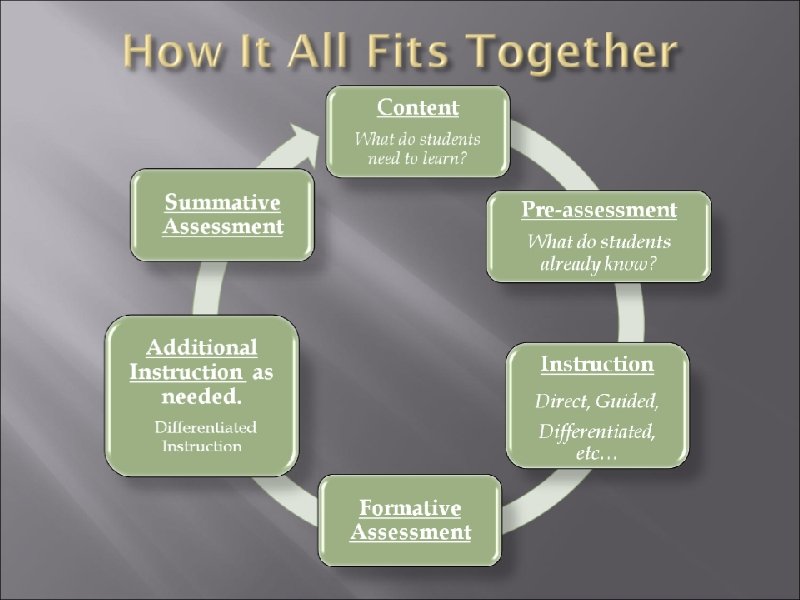
Differentiation means tailoring instruction to meet individual needs. Whether teachers differentiate content, process, products, or the learning environment, the use of ongoing assessment and flexible grouping makes this a successful approach to instruction.
At its most basic level, differentiation consists of the efforts of teachers to respond to variance among learners in the classroom. Whenever a teacher reaches out to an individual or small group to vary his or her teaching in order to create the best learning experience possible, that teacher is differentiating instruction.
• Content – what the student needs to learn or • • • how the student will get access to the information Process – activities in which the student engages in order to make sense of or master the content Products – culminating projects that ask the student to rehearse, apply, and extend what he or she has learned in a unit Learning environment – the way the classroom works and feels
Examples of differentiating content at the elementary level include the following: • Using reading materials at varying readability levels • Putting text materials on tape • Using spelling or vocabulary lists at readiness levels of students
Examples of differentiating process or activities at the elementary level include the following: • Offering manipulatives or other hands-on supports for students who need them • Presenting ideas through both auditory and visual means • Using reading buddies • Allowing students to work alone or in small groups on their
Examples of differentiating products at the elementary level include the following: • Giving students options of how to express required learning (e. g. , create a puppet show, write a letter, or develop a mural with labels) • Using rubrics that match and extend students' varied skills levels • Encouraging students to create their own product assignments as long as the assignments contain
Examples of differentiating learning environment at the elementary level include: • Making sure there are places in the room to work quietly and without distraction • Setting out clear guidelines for independent work that matches individual needs • Developing routines that allow students to get help when teachers are busy with other students and cannot help them
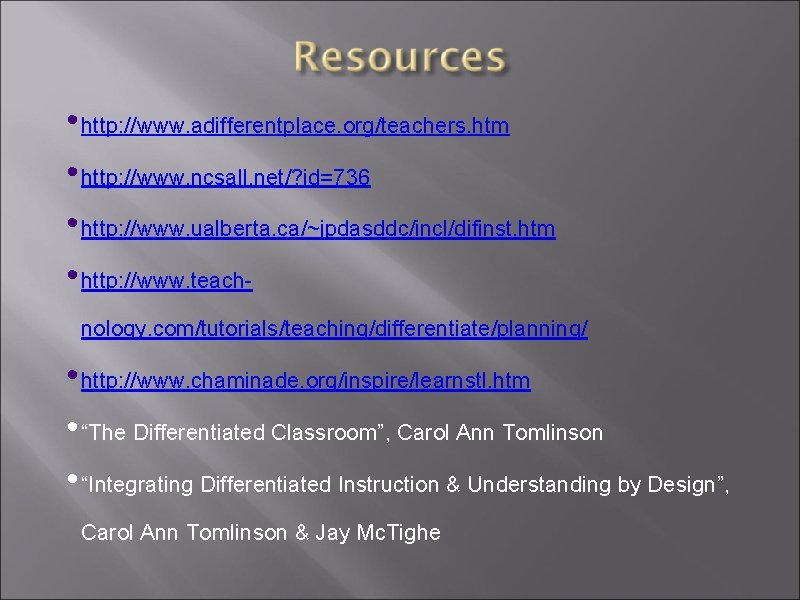
• http: //www. adifferentplace. org/teachers. htm • http: //www. ncsall. net/? id=736 • http: //www. ualberta. ca/~jpdasddc/incl/difinst. htm • http: //www. teachnology. com/tutorials/teaching/differentiate/planning/ • http: //www. chaminade. org/inspire/learnstl. htm • “The Differentiated Classroom”, Carol Ann Tomlinson • “Integrating Differentiated Instruction & Understanding by Design”, Carol Ann Tomlinson & Jay Mc. Tighe