
Responding to Resolution C 056 Resources for Blessing
Responding to Resolution C 056 Resources for Blessing Same-Gender Relationships
SCLM Report 1. Introduction 2. Faith, Hope, and Love: Theological Resources for Blessing Same. Gender Relationships 3. The Church‘s Canon Law and Laws of the States 4. Hearing, Seeing, and Declaring New Things: Preparing Same-Gender Couples for a Liturgy of Blessing 5. The Witnessing and Blessing of a Lifelong Covenant: Liturgical Resources for Blessing Same-Gender Relationships 6. Discussion Guide to “I Will Bless You, and You Will Be a Blessing”: Resources for Blessing Same-Gender Relationships 7. Appendices: A Review of General Convention Legislation Glossary
Resolution 2009 -C 056 • Resolved, the House of Deputies concurring, That the 76 th General Convention acknowledge the changing circumstances in the United States and in other nations, as legislation authorizing or forbidding marriage, civil unions or domestic partnerships for gay and lesbian persons is passed in various civil jurisdictions that call forth a renewed pastoral response from this Church, and for an open process for the consideration of theological and liturgical resources for the blessing of same gender relationships; and be it further • Resolved, That the Standing Commission on Liturgy and Music, in consultation with the House of Bishops, collect and develop theological and liturgical resources, and report to the 77 th General Convention; and be it further •
• Resolved, That the Standing Commission on Liturgy and Music, in consultation with the House of Bishops, devise an open process for the conduct of its work inviting participation from provinces, dioceses, congregations, and individuals who are engaged in such theological work, and inviting theological reflection from throughout the Anglican Communion; and be it further • Resolved, That bishops, particularly those in dioceses within civil jurisdictions where same-gender marriage, civil unions, or domestic partnerships are legal, may provide generous pastoral response to meet the needs of members of this Church; and be it further • Resolved, That this Convention honor theological diversity of this Church in regard to matters of human sexuality; and be it further • Resolved, That the members of this Church be encouraged to engage in this effort.
Resolution 2009 - C 056 Action Items the resolution calls for? v Collect and develop theological & liturgical resources v Consult HOB v Devise open process v Invite participation
How did the SCLM Respond? An Open Process • Early 2010 – Created 4 Task Groups Liturgical, Theological, Pastoral & Teaching, and Civil/Canon Law. Secured funding for the work. • July 2010 - The SCLM and Task Groups met and 4 more times over the next 14 months. • September 2010 - Consultation with the House of Bishops. • October 2010 - Province I Hearing.
• October 2010 -January 2011 - Churchwide Webbased Survey Regarding Pastoral Counseling and Teaching Materials. 1, 131 responses, 111 dioceses, all 9 Provinces. • March 2011 - Churchwide Consultation. 195 Deputies (lay & ordained) from 98 dioceses • July 2011 - Review of Draft Resources. 133 reviewers, lay and ordained, from all 9 provinces. • September 2011 – House of Bishops review final drafts. • Informal networks of Bishops and Task Group members in and across various dioceses.
Inviting Reflection from throughout the Anglican Communion • Anglican Church of Canada shared insights and liturgies • Bishops invited to share Liturgical and Theological principles with Anglican Bishops • International Anglican Liturgical Consultation (IALC). Discussion with 55 people from 19 Provinces of the Anglican Communion.
Remembering How We Got Here General Convention’s work over 35 years: • 1976: homosexual persons are children of God • 2000: Clarity about same-gender couples: such relationships will be characterized by fidelity, monogamy, mutual affection and respect, careful, honest communication, and holy love • 2003: Liturgies celebrating/blessing relationship: the bounds of our common life. within • Honor theological diversity of The Episcopal Church Discussions and Resolutions also in 1985, 1991, 1994, 1997
How we’ll spend our time with you We’ll touch on each section, as time allows, deeper with underlined sections 1. 2. 3. 4. 5. 6. 7. 8. Overview – How we got here (Introduction) 2012 GC resolutions from the SCLM Expectations of couples and a “case study” Observe and reflect upon the liturgy Look at theological material Canonical and civil implications Preparing same-gender couples Educational material for congregations
SCLM Resolutions for 2012 GC RESOLUTION #A 049: • Commend Blessing material for study & use • Authorize Liturgy for trial use under Bishop’s direction • Bishop: generous pastoral response and may adapt Liturgy & Declaration of Intention • Develop open process of review (Episcopal and Anglican) and report back in 2015

SCLM Resolutions for 2012 GC RESOLUTION #A 050: • Task Force - explore biblical, theological, historical, liturgical, and canonical dimensions of marriage • Consider issues of social & cultural change that include, but are not limited to, same-gender couples • Develop tools for theological reflection and norms for local theological discussion • Report back 2015 • Request $30, 000 for implementation
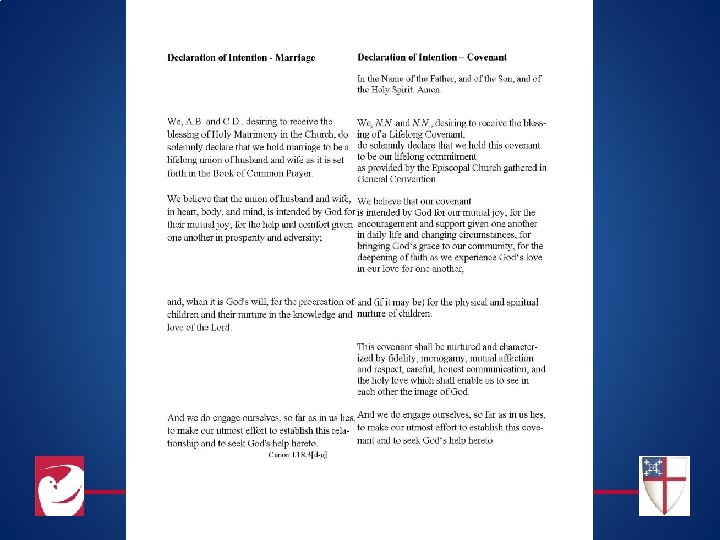
What kind of relationships are we blessing? Most Frequently asked Questions • Clarity of GC’s request • Same expectations for same-gender couples as different-gender couples • Look through the lens of the Declaration of Intent as required in a marriage and adapted for lifelong covenant
Brief “case study” Anne and Brenda – – – New York. Couple for 11 years. 5 year old son. Previous church – reject & condemn Post-2001: Formation Course St. Luke’s Normal prenuptial requirements Church liturgy • Set in Eucharist • Vows by couple and community • Elaborate liturgy to reflect their parish – Insights: renewed, blessed, supported, called to give back, healing, safe and salvation journey. Same-Sex Unions: Stories and Rites, Marshall, Paul, Church Publishing, 2004. Pages 15 -31.
“case study” – People not Concept Two of the SCLM’s most important “discoveries: ” 1. About real couples … trying to love one another, be in relationship, find support / blessing from God and community. 2. We are backing into this ministry. Blessings were already happening. General Convention asked SCLM to learn what’s been done and bring a report to be considered.
Qualities of Anglican Liturgy • It resonates with Scripture and proclaims the gospel. • It is rooted in Anglican theological tradition. • It has high literary value; it is beautiful according to accepted and respected standards. • It uses the recurring structures, linguistic patterns, and metaphors of the 1979 BCP.
Qualities of Anglican Liturgy • It is formal, not casual, conversational, or colloquial. • It is dense enough to bear the weight of the sacred purpose for which it is intended. • It is metaphoric without being obtuse. • It is performative. , that is, it effects what it says.
Let’s Experience the Liturgy Presider People Blessed be God: Father, Son, and Holy Spirit. And blessed be God’s kingdom, now and for ever. Amen. Presider People Beloved, let us love one another, For love is of God. Whoever does not love does not know God, For God is love. Since God so loves us, Let us love one another.
Presider People Will all of you here gathered uphold and honor this couple and respect the covenant they make? We will. Will you pray for them in times of trouble and celebrate with them in times of joy? We will.
Reflection What did you observe? How did it affect you? Did it match the Declaration? How might it advance the Gospel?
Faith, Hope and Love Theological Resources for Blessing Same-Gender Relationships Episcopal Church “doing theology” over 35 years: Ø same–gender couples talked about/asked about God’s place in their relationships. Ø Articles and Books written Ø SCLM charge: Theological Resources ØResearched and Reviewed ØConsidered what we’ve learned ØReport, including 73 footnotes
Faith, Hope and Love Theological Resources for Blessing Same-Gender Relationships Four Sections: 1. Mission: What does the Church believe these blessings will contribute to God‘s own work of redeeming and reconciling love in the world? 2. Blessings: What does the Church believe is happening when it pronounces God‘s blessing? 3. Covenant: What does the Church believe are the distinguishing marks of a holy covenant? 4. Unity: What is the relationship between Christian unity and our differing approaches to biblical interpretation regarding same-gender relationships?
Theological Resources for Blessing Same-Gender Relationships MISSION Missional understanding of blessing: I will bless you, and make your name great, so that you will be a blessing (Genesis 12: 2 b) Christians - Missional understanding of covenantal blessing: grace they received in Christ not for themselves alone but so that they could bear witness to that grace - in Jerusalem, in all Judea and Samaria, and to the ends of the earth (Acts 1: 8) Jesus - life of faith has mission: no one after lighting a lamp puts it under the bushel basket, but on the lampstand, and it gives light to all in the house (Matthew 5: 15)
Theological Resources for Blessing Same-Gender Relationships MISSION Worship - Church‘s rites from the Daily Office to the Holy Eucharist: we give thanks for God‘s blessings, and we pray for the grace we need to manifest that blessing in the world, to ―do the work [God has] given us to do (BCP pg. 366) Eschatological Vision: we collaborate with God as both proclaimers of and instruments for the new creation God is bringing about Challenge: expanding mission in response to God‘s extravagant grace and blessing (Acts 10)
Theological Resources for Blessing Same-Gender Relationships Theology of Blessing – The Church’s Joy Blessing always originates in God Blessing threefold aspects Blessing changes a couple Blessing changes the Church Blessing emphasis on God’s abundance
Theological Resources for Blessing Same-Gender Relationships Covenantal Relationship - The Church’s Life Creation, Baptism and Eucharist Characteristics: fidelity, monogamy, mutual affection and respect, careful, honest communication, and the holy love which enables those in such relationships to see in each other the image of God (GC 2000 D 039) Framework and Pattern: v. Goodness v. Marked as Christ’s own v. Take - Bless – Break – Give*
Theological Resources for Blessing Same-Gender Relationships Covenantal Relationship - The Church’s Life Loving Our Neighbors as Ourselves Called into Covenant The Vocation of Households Faithful Intimacy Mutual Blessing and Fruitfulness

Theological Resources for Blessing Same-Gender Relationships Christian Unity and Biblical Interpretation The Church’s Challenge BCP: Pray for Christian unity Challenges to God‘s gift of unity - Not New q. I Corinthians 3: 1 -9 q. Romans 12: 3 -8 q. Galatians 2: 2 -21 q. Acts 10: 9 -47 C 056: Acknowledges differences of opinion concerning the interpretation of Scripture and same-gender relationships
Theological Resources for Blessing Same-Gender Relationships Christian Unity and Biblical Interpretation The Church’s Challenge First words from this section: v All of us have more to learn from Scripture and from each other. v In faithfulness to Christ, we acknowledge and respect those differences among us in our fervent hope that disagreements over this biblical material need not divide the Church. v Writers in our shared Anglican history have often turned to “a theologically informed and spiritually sustained patience”
Theological Resources for Blessing Same-Gender Relationships Christian Unity and Biblical Interpretation The Church’s Challenge Agreement: the saving love and grace of God in Christ Disagreements: Marked church life throughout history: OLDER: Usury, canon of Scripture, liturgical vestments, place of music, role of ordained ministers OLD: Economic reform, divorce and remarriage, contraception MORE RECENT: slavery, role of women & samegender relationships
Theological Resources for Blessing Same-Gender Relationships Christian Unity and Biblical Interpretation The Church’s Challenge The Great Example of Re-Interpretation: Acts 15 • Process of prayerful deliberation adopted by those early believers • The apostles sought a way to honor the centrality of Scripture while also attending carefully to the ongoing movement of the Spirit in their midst. The importance of this historical moment lies in modeling the process those early believers adopted.
The Church‘s Canon Law and Laws of the States A. Civil Law considerations: blessing a same-gender couple’s covenantal relationship – OK (1 st Amendment) B. Canonical considerations: More complex
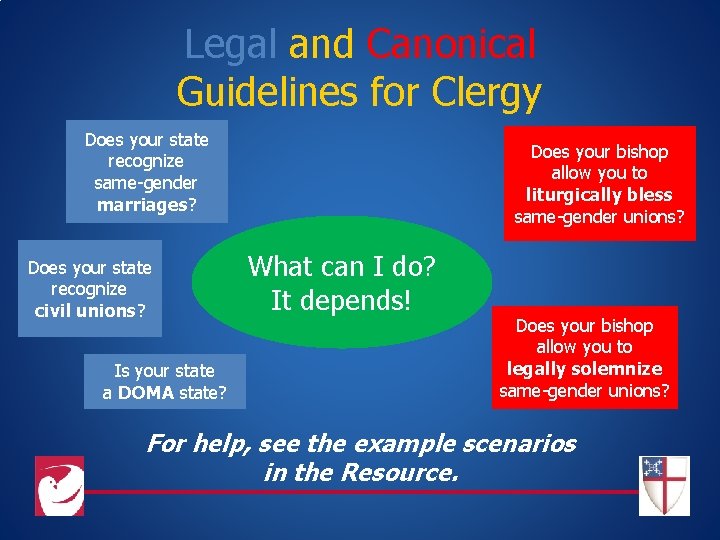
Legal and Canonical Guidelines for Clergy Does your state recognize same-gender marriages? Does your state recognize civil unions? Is your state a DOMA state? Does your bishop allow you to liturgically bless same-gender unions? What can I do? It depends! Does your bishop allow you to legally solemnize same-gender unions? For help, see the example scenarios in the Resource.
Legal and Canonical Guidelines for Clergy What can I do? It depends! But… One thing is clear: If General Convention agrees and your Bishop authorizes the use of the trial Liturgy for Same-Gender Blessings, then … You may officiate at the liturgy in your diocese.
Hearing, Seeing, and Declaring New Things Preparing Same-Gender Couples for a Liturgy of Blessing Overview: Pastoral Care for Same. Gender Couples 1. Materials for Pastoral Preparation 2. Particular Issues Affecting Same- Gender Couples 3. Presenters 4. Outline of Pre-Blessing Preparation for Same-Gender Couples
Preparing Same-Gender Couples for a Liturgy of Blessing Thanks to the Province One Task Force’s work 2006 -2008 Overview Contextual Competence Couple in 70 s vs. 20 s Just met vs. 10 years Different vs. Same
Preparing Same-Gender Couples for a Liturgy of Blessing 1. Materials for Pastoral Preparation – Survey Data: what people used – 2 Suggestions w/Pros and Cons
Preparing Same-Gender Couples for a Liturgy of Blessing 2. Particular Issues Affecting Same-Gender Couples • • Clergy Comfort/Referring out Sexual Orientation & Gender Identity Long Term Relationships Societal/Ecclesial Hurt In/Out Families Origin/Relational History Legal/Children
Preparing Same-Gender Couples for a Liturgy of Blessing 3. Presenters • Optional • Only use if for all couples • Support, link to congregation • Greater Liturgical role • Handouts
Preparing Same-Gender Couples for a Liturgy of Blessing 4. Outline of Pre-Blessing Preparation for Same-Gender Couples • • Model for 5 Session Preparation Handouts: – – – Theological Principles Declaration of Intent Presenters Model Congregational Guidelines
Discussion Guide to “I Will Bless You, and You Will Be a Blessing”: Resources for Blessing Same-Gender Relationships 5 Study Areas for Congregations: v. Broad areas v. Adjustable to context v. About “opening/having the conversation” v. Mutual Respect/Covenant
Discussion Guide to “I Will Bless You, and You Will Be a Blessing”: Resources for Blessing Same-Gender Relationships Study Area One: History Study Area Two: Theology and the Bible Study Area Three: Liturgy Study Area Four: Civil and Canon Law Study Area Five: Mission
One Congregation’s Experience St. Paul’s, Fayetteville, Arkansas www. stpaulsfay. org/id 541. html
Info and Updates: www. liturgyandmusic. wordpress. com www. generalconvention. org/ccab/files/2 www. episcopalarchives. org/SCLM/ Questions? Keri Aubert kaubert@cdsp. edu Thank you!
- Slides: 46