
Responding to Problem Behaviors Socially Mediated vs Emotionally
Responding to Problem Behaviors: Socially Mediated vs. Emotionally Driven Diana Browning Wright, M. S. , L. E. P.
The ACEs Study Implications • Adverse Childhood Experiences (ACE) Study – Calculate yourself (but keep it private) – Calculate 2 different students with behavior issues for whom you know their background very well HERE WE GO! Diana Browning Wright, M. S. , L. E. P.
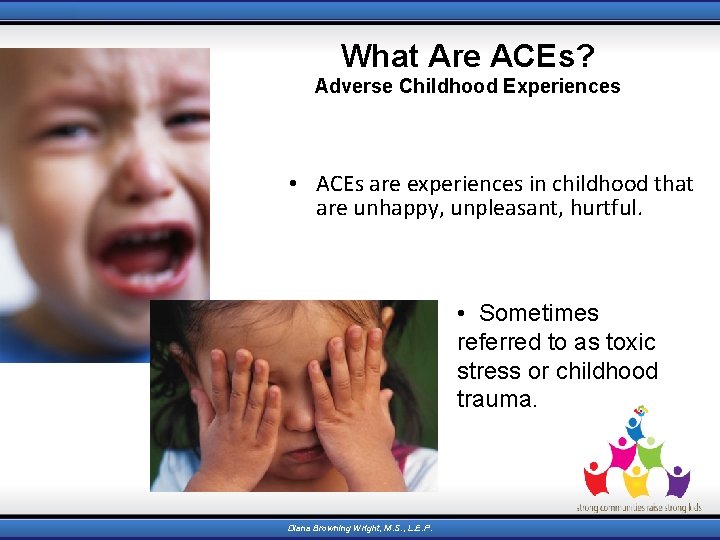
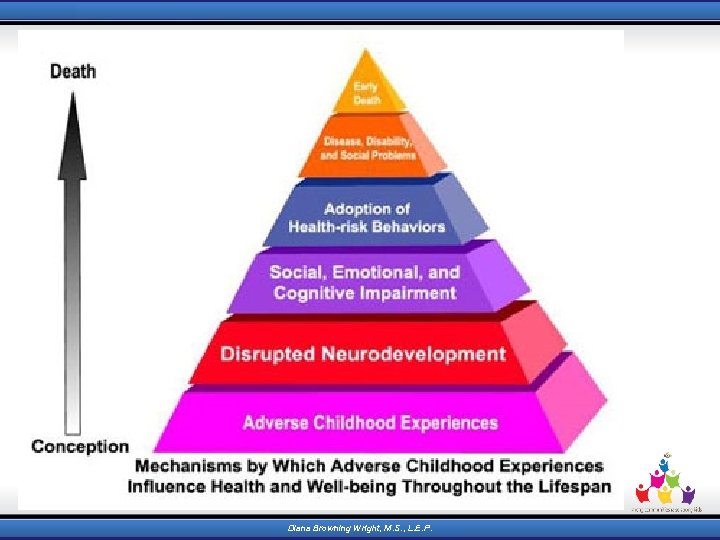
What Are ACEs? Adverse Childhood Experiences • ACEs are experiences in childhood that are unhappy, unpleasant, hurtful. • Sometimes referred to as toxic stress or childhood trauma. Diana Browning Wright, M. S. , L. E. P.
Adverse Childhood Experiences Survey Let’s Review the Implications

• An ACE Score of 4 or more results in having multiple risk factors for these diseases or the disease themselves • An ACE score of 6 or more results in a 20 year decrease in life expectancy Diana Browning Wright, M. S. , L. E. P.
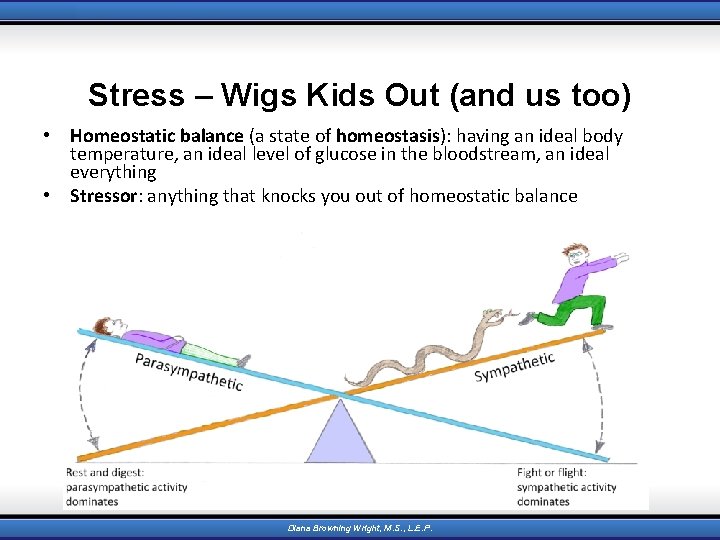
Stress – Wigs Kids Out (and us too) • Homeostatic balance (a state of homeostasis): having an ideal body temperature, an ideal level of glucose in the bloodstream, an ideal everything • Stressor: anything that knocks you out of homeostatic balance Diana Browning Wright, M. S. , L. E. P.
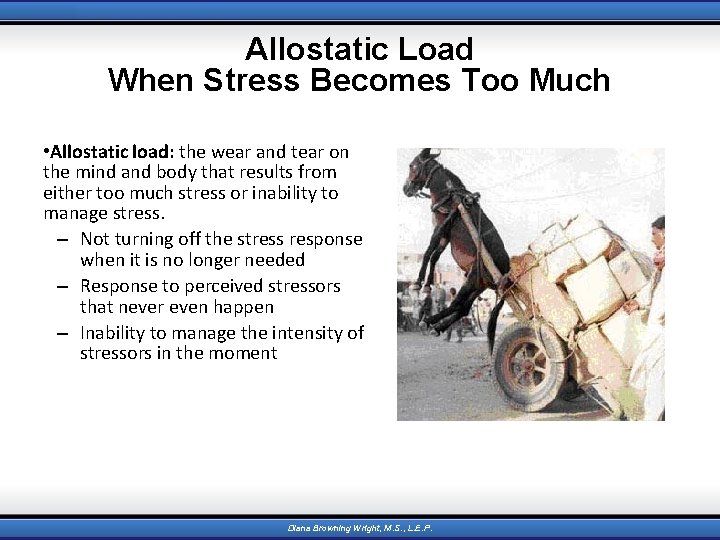
Allostatic Load When Stress Becomes Too Much • Allostatic load: the wear and tear on the mind and body that results from either too much stress or inability to manage stress. – Not turning off the stress response when it is no longer needed – Response to perceived stressors that never even happen – Inability to manage the intensity of stressors in the moment Diana Browning Wright, M. S. , L. E. P.
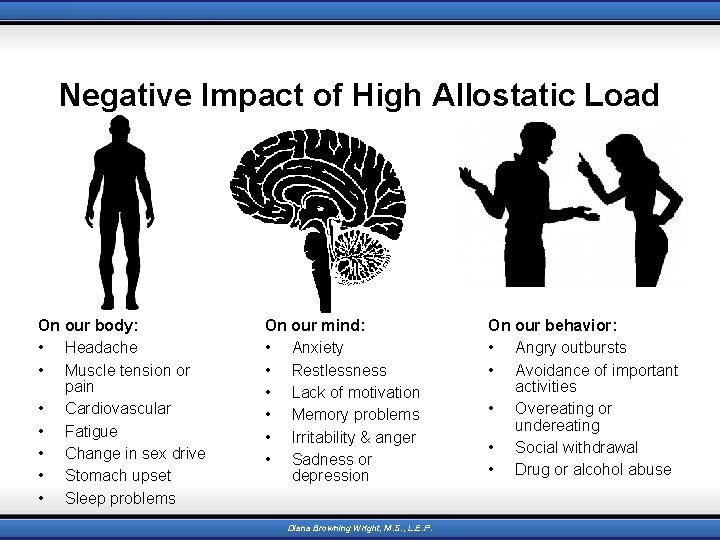
Negative Impact of High Allostatic Load On our body: • Headache • Muscle tension or pain • Cardiovascular • Fatigue • Change in sex drive • Stomach upset • Sleep problems On our mind: • Anxiety • Restlessness • Lack of motivation • Memory problems • Irritability & anger • Sadness or depression Diana Browning Wright, M. S. , L. E. P. On our behavior: • Angry outbursts • Avoidance of important activities • Overeating or undereating • Social withdrawal • Drug or alcohol abuse
Adverse Childhood Experiences (ACES) Study Of 17, 000 respondents, two-thirds had at leat one adverse childhood event • Physical, emotional or sexual abuse • Emotional or physical neglect • Growing up with family members with mental illness, alcoholism or drug problems • Family violence • Incarcerated family member • One or no parents • Parental divorce Diana Browning Wright, M. S. , L. E. P.
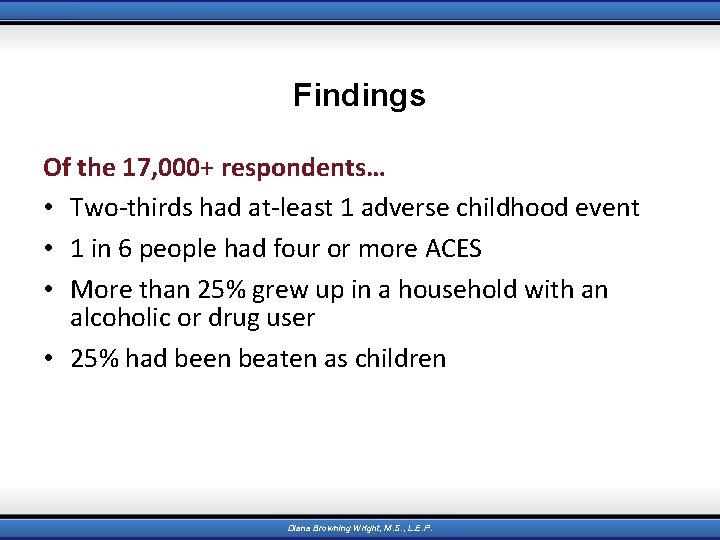
Findings Of the 17, 000+ respondents… • Two-thirds had at-least 1 adverse childhood event • 1 in 6 people had four or more ACES • More than 25% grew up in a household with an alcoholic or drug user • 25% had been beaten as children Diana Browning Wright, M. S. , L. E. P.
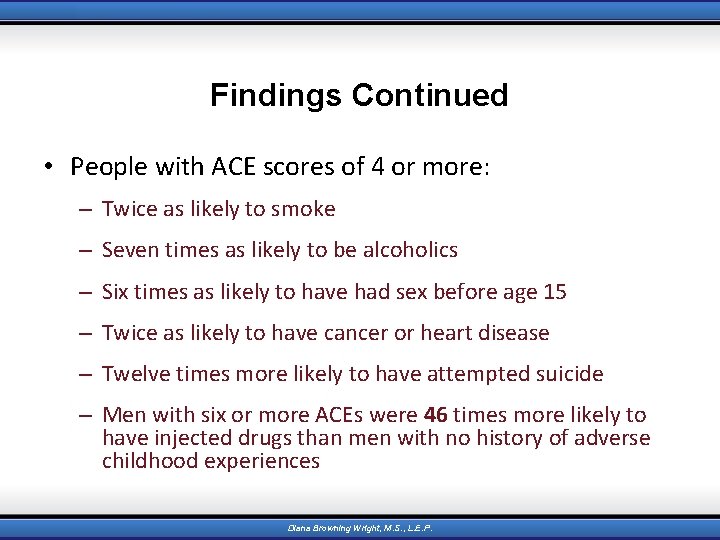
Findings Continued • People with ACE scores of 4 or more: – Twice as likely to smoke – Seven times as likely to be alcoholics – Six times as likely to have had sex before age 15 – Twice as likely to have cancer or heart disease – Twelve times more likely to have attempted suicide – Men with six or more ACEs were 46 times more likely to have injected drugs than men with no history of adverse childhood experiences Diana Browning Wright, M. S. , L. E. P.
Diana Browning Wright, M. S. , L. E. P.
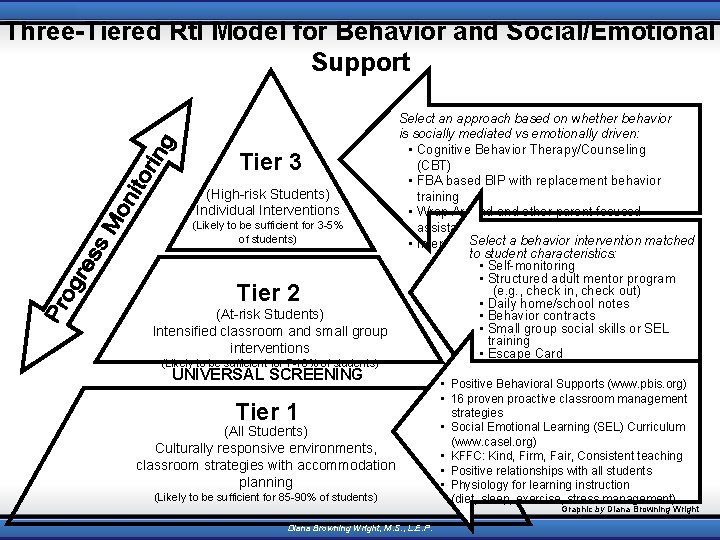
Three-Tiered Rt. I Model for Behavior and Social/Emotional Support Select an approach based on whether behavior is socially mediated vs emotionally driven: • Cognitive Behavior Therapy/Counseling (CBT) • FBA based BIP with replacement behavior (High-risk Students) training Individual Interventions • Wrap Around and other parent focused (Likely to be sufficient for 3 -5% assistance of students) Select a behavior intervention matched • Inter-agency services to student characteristics: • Self-monitoring • Structured adult mentor program (e. g. , check in, check out) • Daily home/school notes (At-risk Students) • Behavior contracts • Small group social skills or SEL Intensified classroom and small group training interventions • Escape Card (Likely to be sufficient for 7 -10% of students) • Positive Peer Reporting UNIVERSAL SCREENING • Positive Behavioral Supports (www. pbis. org) • 16 proven proactive classroom management Tier 3 Tier 2 Tier 1 (All Students) Culturally responsive environments, classroom strategies with accommodation planning (Likely to be sufficient for 85 -90% of students) strategies • Social Emotional Learning (SEL) Curriculum (www. casel. org) • KFFC: Kind, Firm, Fair, Consistent teaching • Positive relationships with all students • Physiology for learning instruction (diet, sleep, exercise, stress management) Graphic by Diana Browning Wright, M. S. , L. E. P.
Why not stop light? Card Pulling vs. Rainbow Club See handout “Classwide systems” On www. pent. ca. gov for Rainbow Club
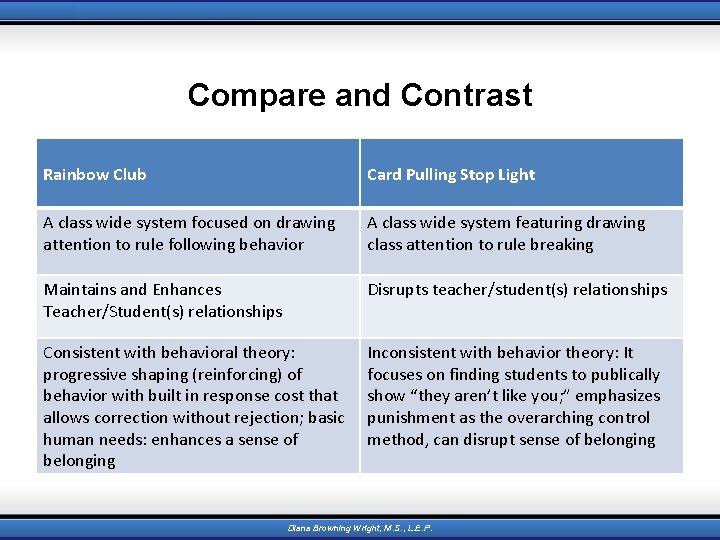
Compare and Contrast Rainbow Club Card Pulling Stop Light A class wide system focused on drawing attention to rule following behavior A class wide system featuring drawing class attention to rule breaking Maintains and Enhances Teacher/Student(s) relationships Disrupts teacher/student(s) relationships Consistent with behavioral theory: progressive shaping (reinforcing) of behavior with built in response cost that allows correction without rejection; basic human needs: enhances a sense of belonging Inconsistent with behavior theory: It focuses on finding students to publically show “they aren’t like you; ” emphasizes punishment as the overarching control method, can disrupt sense of belonging Diana Browning Wright, M. S. , L. E. P.
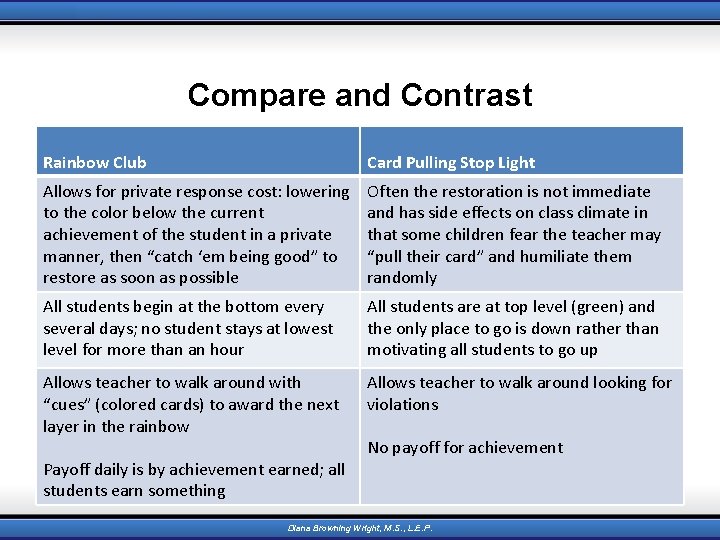
Compare and Contrast Rainbow Club Card Pulling Stop Light Allows for private response cost: lowering to the color below the current achievement of the student in a private manner, then “catch ‘em being good” to restore as soon as possible Often the restoration is not immediate and has side effects on class climate in that some children fear the teacher may “pull their card” and humiliate them randomly All students begin at the bottom every several days; no student stays at lowest level for more than an hour All students are at top level (green) and the only place to go is down rather than motivating all students to go up Allows teacher to walk around with “cues” (colored cards) to award the next layer in the rainbow Allows teacher to walk around looking for violations Payoff daily is by achievement earned; all students earn something No payoff for achievement Diana Browning Wright, M. S. , L. E. P.
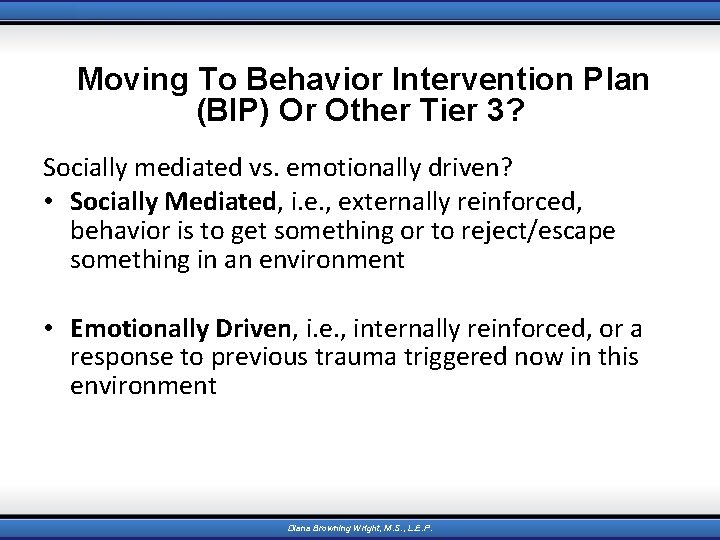
Moving To Behavior Intervention Plan (BIP) Or Other Tier 3? Socially mediated vs. emotionally driven? • Socially Mediated, i. e. , externally reinforced, behavior is to get something or to reject/escape something in an environment • Emotionally Driven, i. e. , internally reinforced, or a response to previous trauma triggered now in this environment Diana Browning Wright, M. S. , L. E. P.
BIP Examples Of Behaviors Examples of socially mediated behaviors that may not have not responded to default behavior interventions and therefore require a BIP include: • Hitting others in protest/escape their behaviors, or hitting to get their attention • Making sexually explicit remarks to get laughs from others • Refusing to do work to escape the task requirement, or the class! • Etc. , etc. Diana Browning Wright, M. S. , L. E. P.
Socially Mediated Behaviors In BIPs Require: • Replacement behavior training – Socially mediated behaviors require instruction on skillful use of a functionally equivalent replacement behavior (FERB) when default interventions failed • Reinforcement of overall positive behaviors as well as FERBs • Specification of how staff should respond if and when problem behavior occurs again • Progress Monitoring and Two-Way Communication Diana Browning Wright, M. S. , L. E. P.
Cognitive Behavior Therapy (CBT) And Other Evidence Based Therapy/ Counseling • Anxiety triggered by fear of failure or separation anxiety or selective mutism that is not seeking a response from the environment and does not respond to environmental changes and default behavior interventions. These require a specific protocol to address the emotions, e. g. , a cognitive behavioral treatment plan. • Depressed withdrawn behaviors not seeking a response from the environment that have not responded to lesser interventions that have attempted to “behaviorally activate” require a cognitive behavioral treatment plan. Diana Browning Wright, M. S. , L. E. P.
Emotionally Driven Examples • School Phobia and other phobias that require a specific evidence based protocol to systematically desensitize the student to stress provoking stimuli. (CBT approaches) • Habits, such as tic disorders, that require an evidence based Habit Reversal Protocol (CBT approaches) • Repetitive genital rubbing (pleasure seeking) that has not responded to environmental changes to enhance engagement and is not associated with child abuse (non FERB based Direct Treatment protocol) Diana Browning Wright, M. S. , L. E. P.
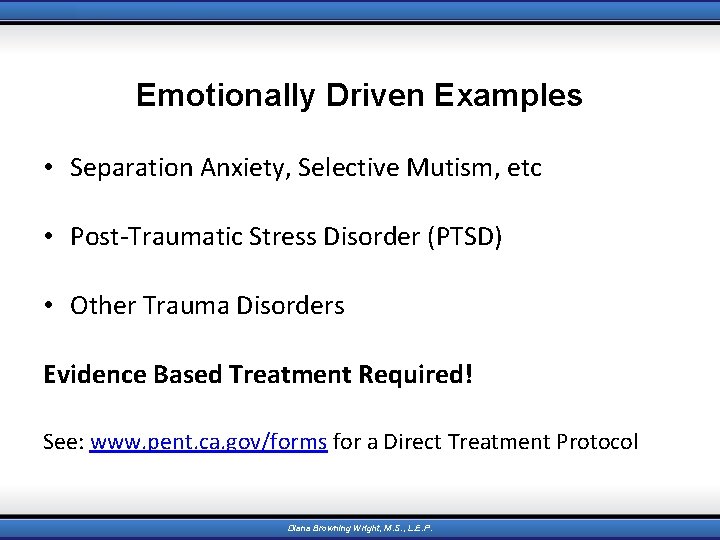
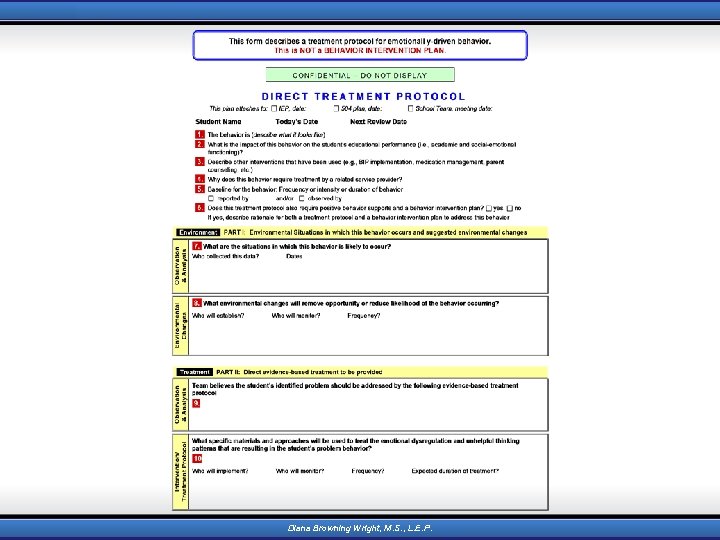
Emotionally Driven Examples • Separation Anxiety, Selective Mutism, etc • Post-Traumatic Stress Disorder (PTSD) • Other Trauma Disorders Evidence Based Treatment Required! See: www. pent. ca. gov/forms for a Direct Treatment Protocol Diana Browning Wright, M. S. , L. E. P.
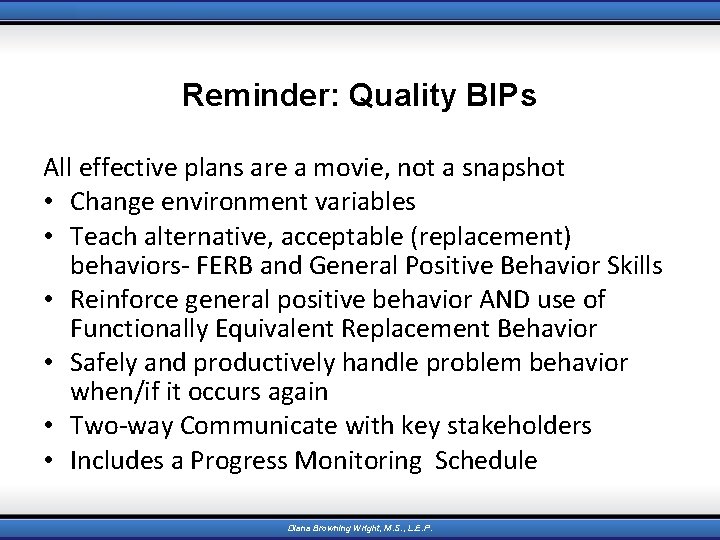
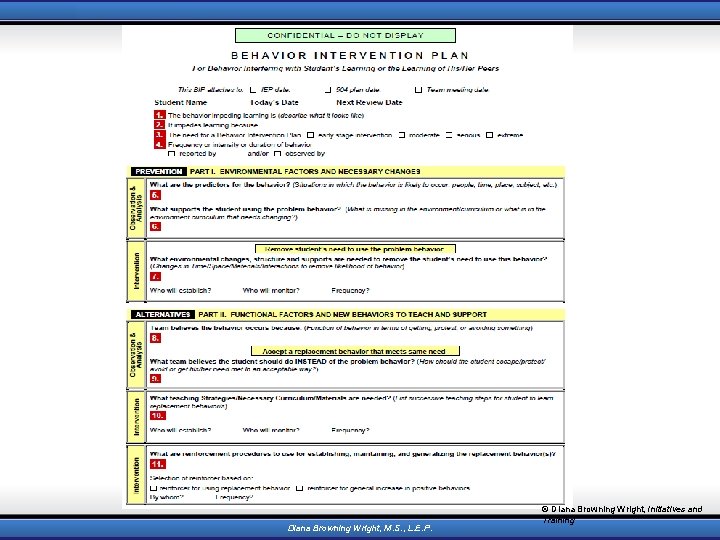
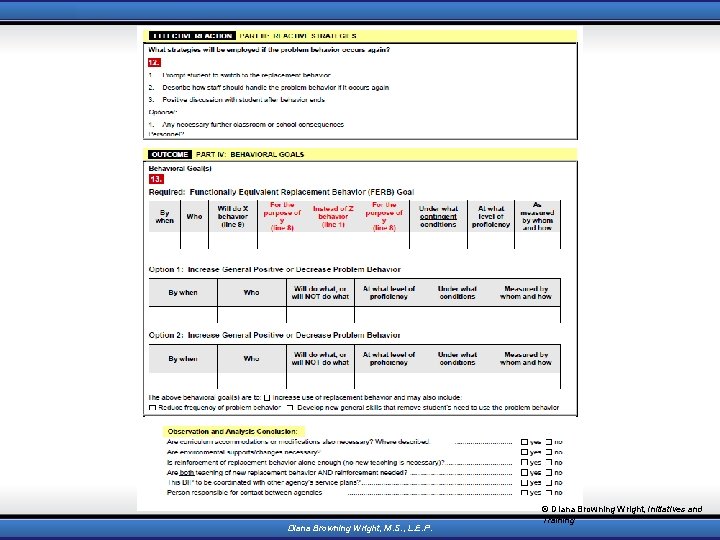
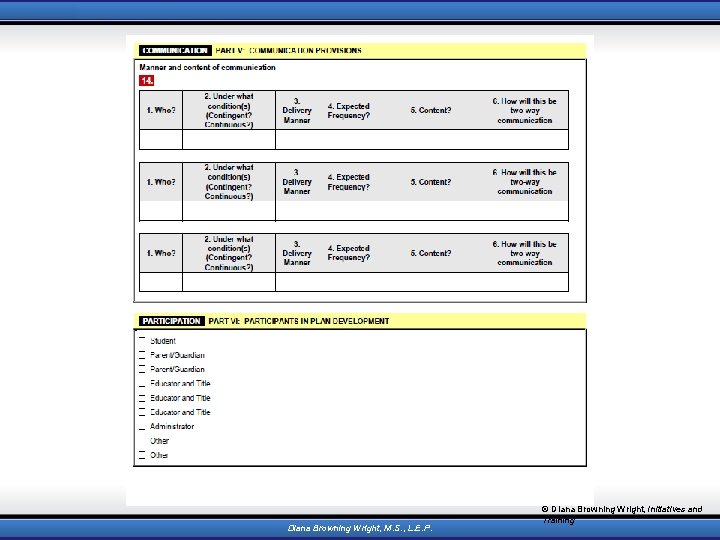
Reminder: Quality BIPs All effective plans are a movie, not a snapshot • Change environment variables • Teach alternative, acceptable (replacement) behaviors- FERB and General Positive Behavior Skills • Reinforce general positive behavior AND use of Functionally Equivalent Replacement Behavior • Safely and productively handle problem behavior when/if it occurs again • Two-way Communicate with key stakeholders • Includes a Progress Monitoring Schedule Diana Browning Wright, M. S. , L. E. P.
Diana Browning Wright, M. S. , L. E. P. © Diana Browning Wright, Initiatives and Training
Diana Browning Wright, M. S. , L. E. P. © Diana Browning Wright, Initiatives and Training
Diana Browning Wright, M. S. , L. E. P. © Diana Browning Wright, Initiatives and Training
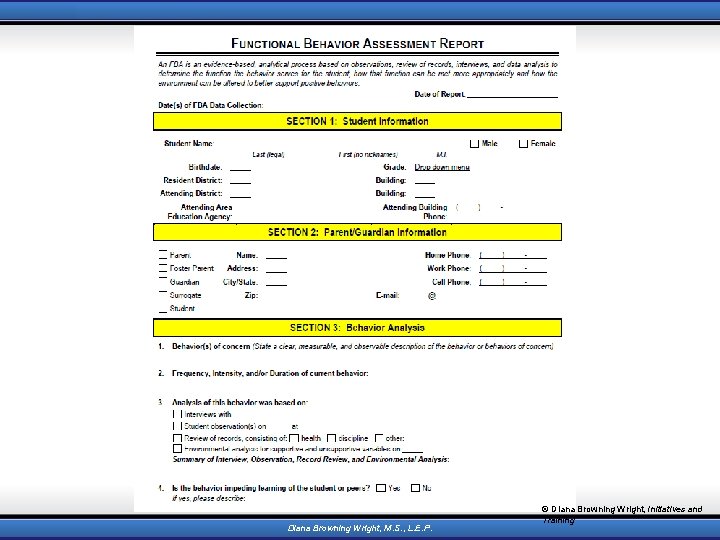
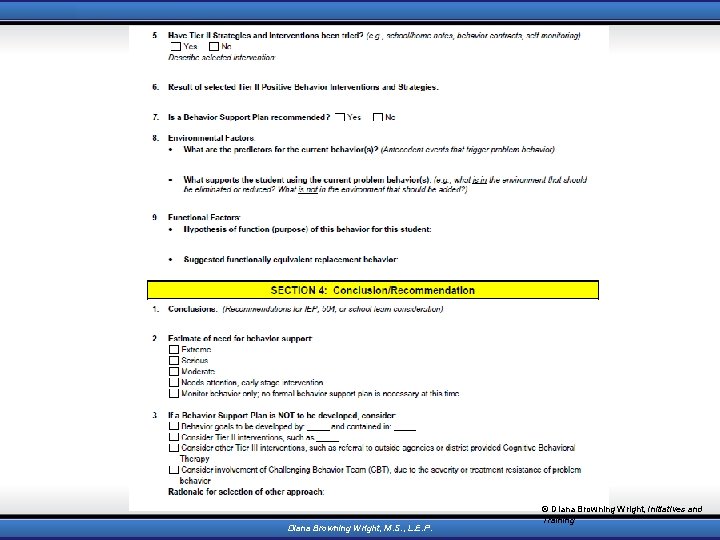
Evaluating Your Functional Behavior Assessment (FBA) Report • Were all elements that document process and conclusions included? • Did you specify that a BIP is appropriate for the problem? See: Checklist for Complete FBA Reports and a model FBA report at www. pent. ca. gov/forms Diana Browning Wright, M. S. , L. E. P.
FBA Report Diana Browning Wright, M. S. , L. E. P. © Diana Browning Wright, Initiatives and Training
Diana Browning Wright, M. S. , L. E. P. © Diana Browning Wright, Initiatives and Training
Diana Browning Wright, M. S. , L. E. P. © Diana Browning Wright, Initiatives and Training
BIP Desk Reference And BIP-QE II • Use to train staff on the key concepts of applied behavioral analysis and behavior intervention plans Download the 345 page manual for free: www. pent. ca. gov Diana Browning Wright, M. S. , L. E. P.
Multiple Purposes For BIP-QE II • Use to keep proper focus balance between positive behavioral interventions and potential future disciplinary considerations • Use when a BIP has not been successful • Use to improve your ability to legally defend the team’s Behavior Plan Diana Browning Wright, M. S. , L. E. P.
What The BIP-QE II Does NOT Measure • Whether the new behaviors, interventions, environmental changes, and reinforcers fit the student • Whether the behavior was socially mediated or internally driven • Whether this plan is developmentally appropriate for this student See: http: //www. pent. ca. gov/beh/dev. html Diana Browning Wright, M. S. , L. E. P.
BIP-QE II Does NOT Measure Fidelity • Whether the plan was or will be implemented consistently and skillfully • This takes observation, data analysis and review systems Diana Browning Wright, M. S. , L. E. P.
Peer Reviewed Journal Publications www. pent. ca. gov/hom/research. html • Cook, C. R. , Mayer, G. R. , Browning-Wright, D. , Kraemer, B. , Gale, B. & Wallace, M. D. (2012). Exploring the link between evidence-based quality of behavior intervention plans, treatment integrity and student outcomes under natural educational conditions. The Journal of Special Education, 46, 3 -16. • Kraemer, B. R. , Cook, C. R. , Browning-Wright, D. , Mayer, G. R. , & Wallace, M. D. (2008). Effects of training on the use of the Behavior Support Plan Quality Evaluation Guide with autism educators: A preliminary investigation examining positive behavior support plans. Journal of Positive Behavior Interventions, 179 -189. Diana Browning Wright, M. S. , L. E. P.
Peer Reviewed Journal Publications www. pent. ca. gov/hom/research. html • Cook, C. R. , Crews, D. , Browning-Wright, D. , Mayer, R. , Gale, B. , & Kraemer, B. (2007). Establishing and evaluating the substantive adequacy of positive behavior support plans. Journal of Behavioral Education, 16, 191 -206. • Browning-Wright, D. , Mayer, G. R. , Cook, C. R. , Crews, D. , Kraemer, B. R. , & Gale, B. (2007) A preliminary study on the effects of training using behavior support plan quality evaluation guide (BSP-QE) to improve positive behavioral support plans. Education and Treatment of Children, 30, 89106. Diana Browning Wright, M. S. , L. E. P.
Implications Of Research For Practitioners • Research on the BIP has demonstrated that the better the evaluated plan, the more likely the plan will be implemented with fidelity – “Failure to properly or consistently implement the behavioral interventions identified in an appropriately developed BIP can amount to a denial of FAPE. ” (Norlin, John W. (2012) FBAs and BIPS: Meeting IDEA Compliance Obligation. Palm Beach Gardens, Florida: LRP publication, p. 28. ] Diana Browning Wright, M. S. , L. E. P.
Implications Of Research For Practitioners • The BIP-QE II is a valid and reliable instrument for evaluating behavior plans • Use the BIP-QE II as a training tool when teaching staff how to develop a complete and adequate BIP. Research has shown that this tool increased staff performance • Periodically evaluate your plans to maintain skill mastery Diana Browning Wright, M. S. , L. E. P.
What IS The Positive Behavior Intervention Process for Socially Mediated Behaviors? • A data-driven team approach with built-in accountability for a supplementary aid & support – Follows a carefully look at the context of the problem behavior – Hypothesizes why the behavior is occurring – Develops a plan to teach the student a replacement behavior and new skills – Changes environments to match student needs – Involves people who really care about the student – Develops a written plan capturing the team’s decisions and methods Diana Browning Wright, M. S. , L. E. P.
What IS The Positive Behavior Intervention Process for Emotionally Driven Behaviors? • A data-driven team approach with built-in accountability for related services to benefit from Special Education – Follows a carefully look at the context of the problem behavior and the history of trauma and triggers – Hypothesizes why the behavior is occurring – Develops a plan to teach the student coping behaviors and new skills – Involves people who really care about the student – Develops a plan capturing the team’s decisions and methods Diana Browning Wright, M. S. , L. E. P.
Diana Browning Wright, M. S. , L. E. P.
Diana Browning Wright, M. S. , L. E. P.
Diana Browning Wright, M. S. , L. E. P.
Streamlined 10 Steps After the decision is made to conduct the assessment and permission is received 1. Meet with teacher(s) and outline the follow-up steps to plan development Typically 30 minutes 2. Review Records and Interview Stakeholders (e. g. , teachers, parents, administrators, paraeducators, therapists peers, etc. ) Typically 1 -2 hours 3. Classroom observation (see section 3 in BIP Manual on line) for environmental assessment and functional observation Typically 30 minutes to one hour Diana Browning Wright, M. S. , L. E. P.
Streamlined 10 Steps 4. Set up data collection for baseline and explain to classroom staff (use FAOB, see section 3 on line) Typically 30 minutes 5. Collect and Analyze data Typically one hour 6. Meet with implementer(s) and discuss the 3 pathways on the pathway chart, using “consultant script for pathways”(see section 3) Typically 45 minutes to one hour 7. Write FBA or Social/Emotional/Mental Health report or other summary of data collected Typically 30 to 45 minutes Diana Browning Wright, M. S. , L. E. P.
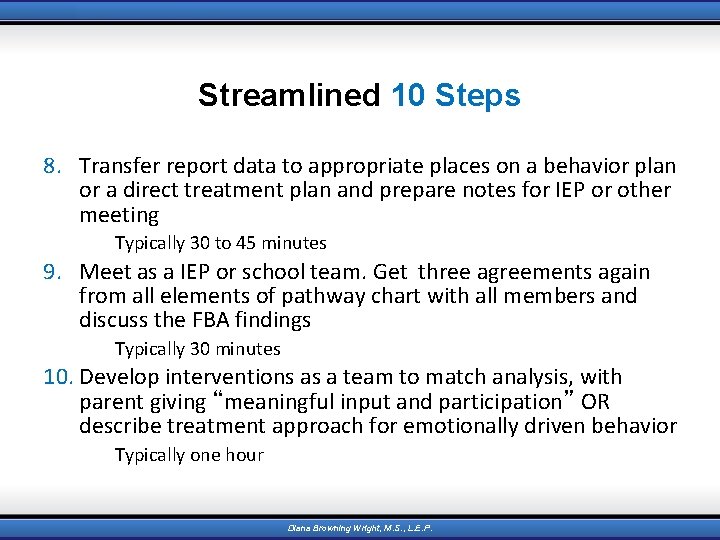
Streamlined 10 Steps 8. Transfer report data to appropriate places on a behavior plan or a direct treatment plan and prepare notes for IEP or other meeting Typically 30 to 45 minutes 9. Meet as a IEP or school team. Get three agreements again from all elements of pathway chart with all members and discuss the FBA findings Typically 30 minutes 10. Develop interventions as a team to match analysis, with parent giving “meaningful input and participation” OR describe treatment approach for emotionally driven behavior Typically one hour Diana Browning Wright, M. S. , L. E. P.
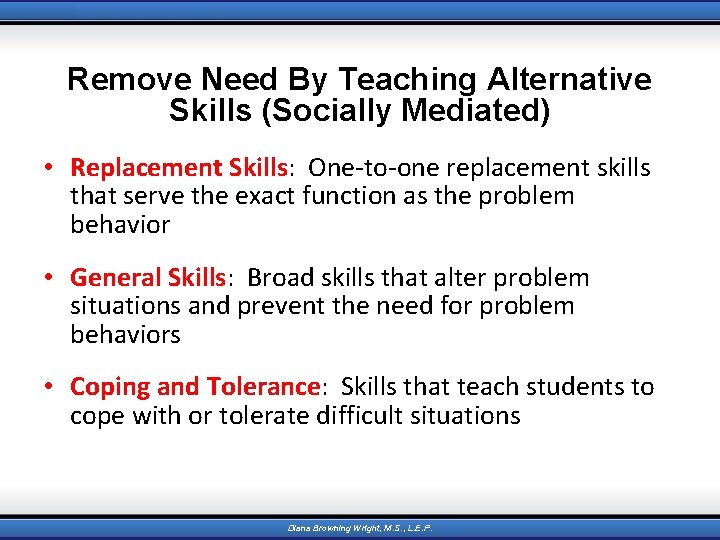
Remove Need By Teaching Alternative Skills (Socially Mediated) • Replacement Skills: One-to-one replacement skills that serve the exact function as the problem behavior • General Skills: Broad skills that alter problem situations and prevent the need for problem behaviors • Coping and Tolerance: Skills that teach students to cope with or tolerate difficult situations Diana Browning Wright, M. S. , L. E. P.
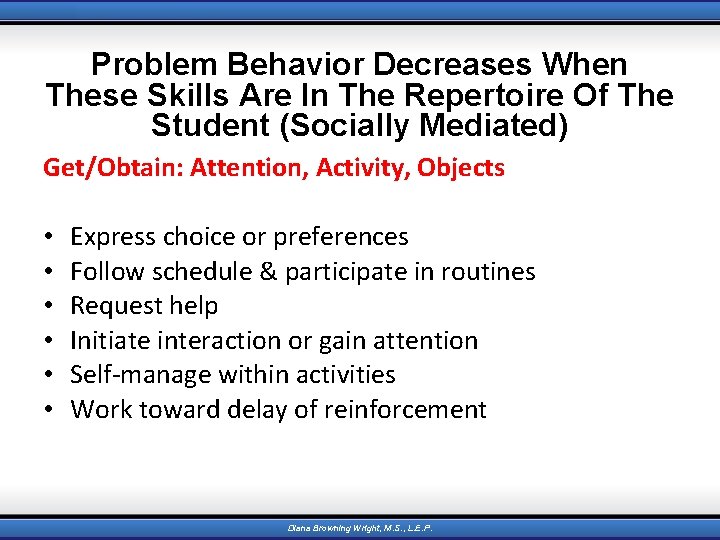
Problem Behavior Decreases When These Skills Are In The Repertoire Of The Student (Socially Mediated) Get/Obtain: Attention, Activity, Objects • • • Express choice or preferences Follow schedule & participate in routines Request help Initiate interaction or gain attention Self-manage within activities Work toward delay of reinforcement Diana Browning Wright, M. S. , L. E. P.
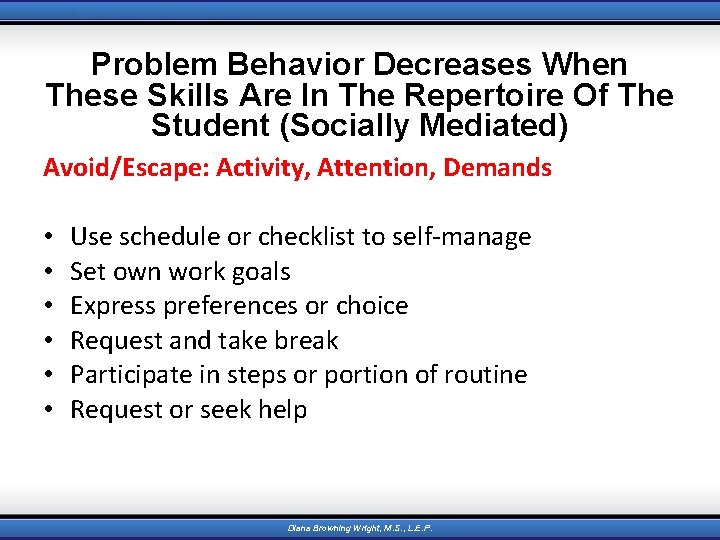
Problem Behavior Decreases When These Skills Are In The Repertoire Of The Student (Socially Mediated) Avoid/Escape: Activity, Attention, Demands • • • Use schedule or checklist to self-manage Set own work goals Express preferences or choice Request and take break Participate in steps or portion of routine Request or seek help Diana Browning Wright, M. S. , L. E. P.
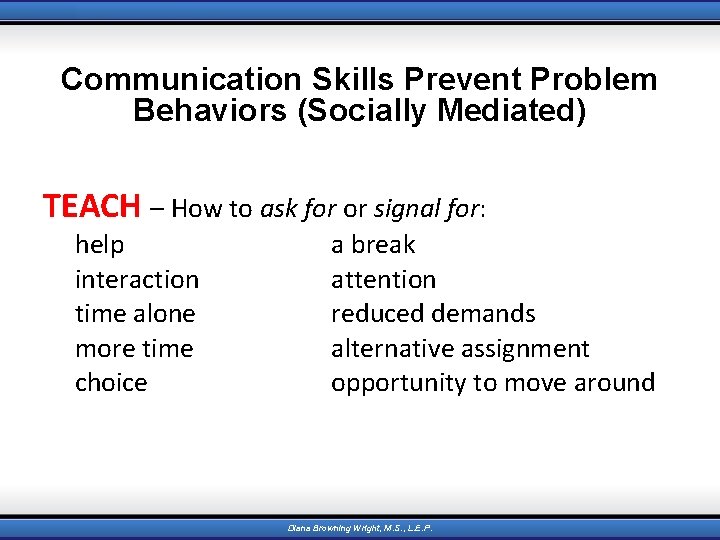
Communication Skills Prevent Problem Behaviors (Socially Mediated) TEACH – How to ask for or signal for: help interaction time alone more time choice a break attention reduced demands alternative assignment opportunity to move around Diana Browning Wright, M. S. , L. E. P.
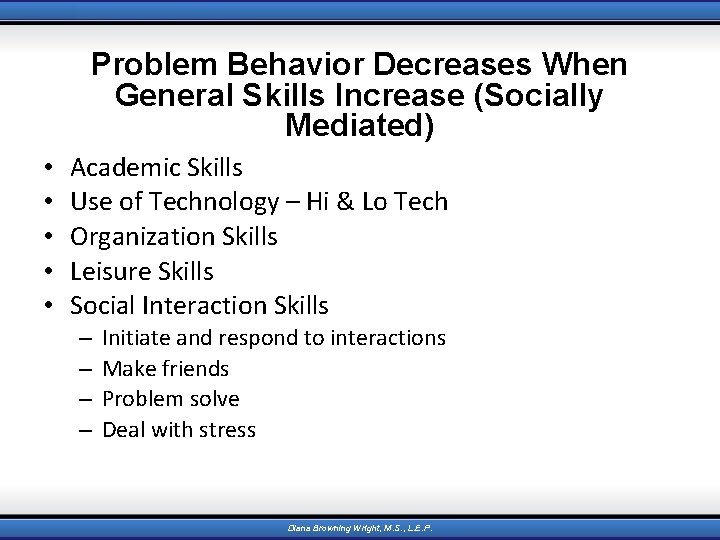
Problem Behavior Decreases When General Skills Increase (Socially Mediated) • • • Academic Skills Use of Technology – Hi & Lo Tech Organization Skills Leisure Skills Social Interaction Skills – – Initiate and respond to interactions Make friends Problem solve Deal with stress Diana Browning Wright, M. S. , L. E. P.
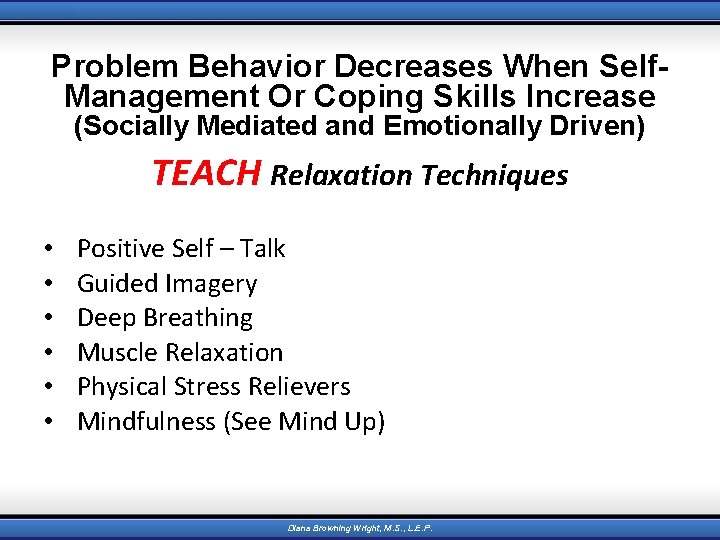
Problem Behavior Decreases When Self. Management Or Coping Skills Increase (Socially Mediated and Emotionally Driven) TEACH Relaxation Techniques • • • Positive Self – Talk Guided Imagery Deep Breathing Muscle Relaxation Physical Stress Relievers Mindfulness (See Mind Up) Diana Browning Wright, M. S. , L. E. P.
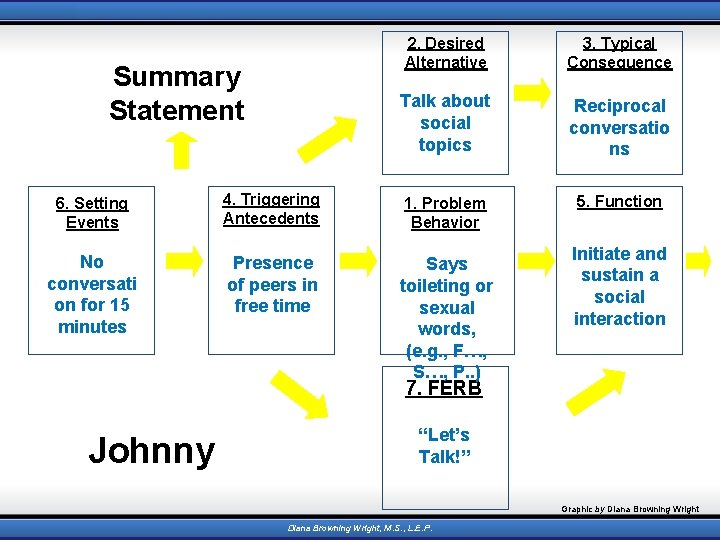
Summary Statement 2. Desired Alternative 3. Typical Consequence Talk about social topics Reciprocal conversatio ns 5. Function 6. Setting Events 4. Triggering Antecedents 1. Problem Behavior No conversati on for 15 minutes Presence of peers in free time Says toileting or sexual words, (e. g. , F…, S…, P. . ) Initiate and sustain a social interaction 7. FERB Johnny “Let’s Talk!” Graphic by Diana Browning Wright, M. S. , L. E. P.
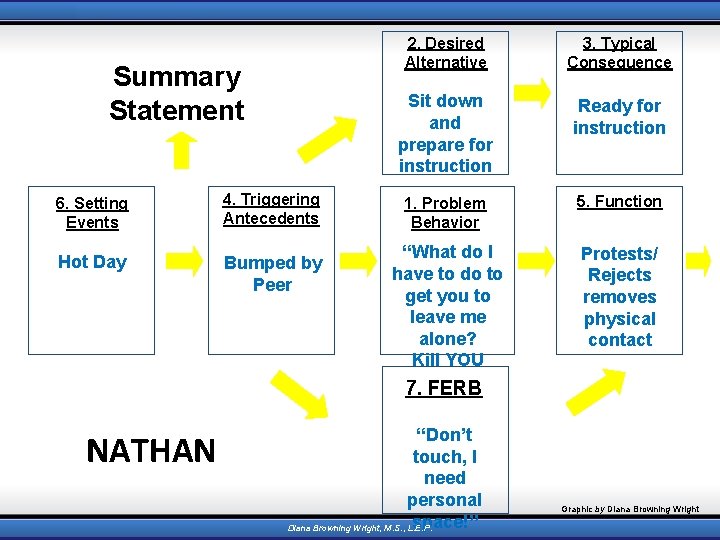
Summary Statement 6. Setting Events 4. Triggering Antecedents Hot Day Bumped by Peer 2. Desired Alternative 3. Typical Consequence Sit down and prepare for instruction Ready for instruction 1. Problem Behavior 5. Function “What do I have to do to get you to leave me alone? Kill YOU Protests/ Rejects removes physical contact 7. FERB NATHAN “Don’t touch, I need personal space!” Diana Browning Wright, M. S. , L. E. P. Graphic by Diana Browning Wright
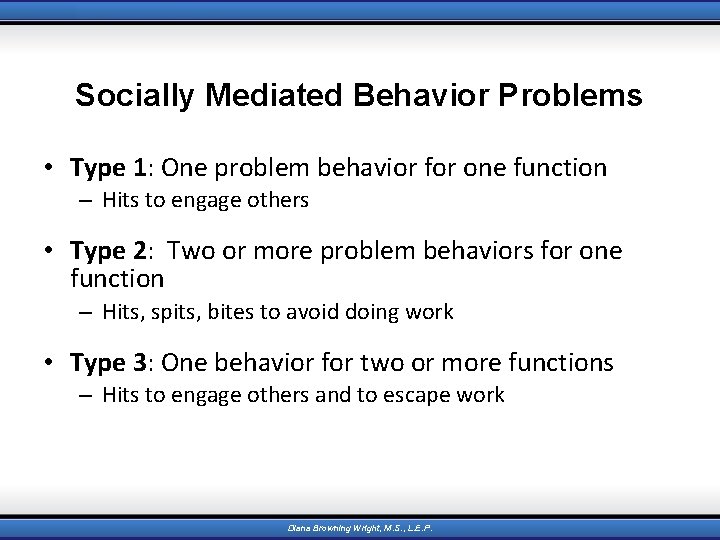
Socially Mediated Behavior Problems • Type 1: One problem behavior for one function – Hits to engage others • Type 2: Two or more problem behaviors for one function – Hits, spits, bites to avoid doing work • Type 3: One behavior for two or more functions – Hits to engage others and to escape work Diana Browning Wright, M. S. , L. E. P.
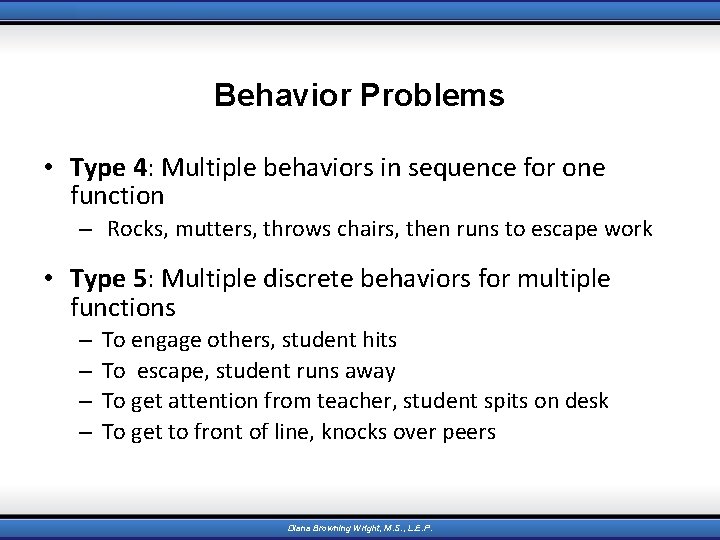
Behavior Problems • Type 4: Multiple behaviors in sequence for one function – Rocks, mutters, throws chairs, then runs to escape work • Type 5: Multiple discrete behaviors for multiple functions – – To engage others, student hits To escape, student runs away To get attention from teacher, student spits on desk To get to front of line, knocks over peers Diana Browning Wright, M. S. , L. E. P.
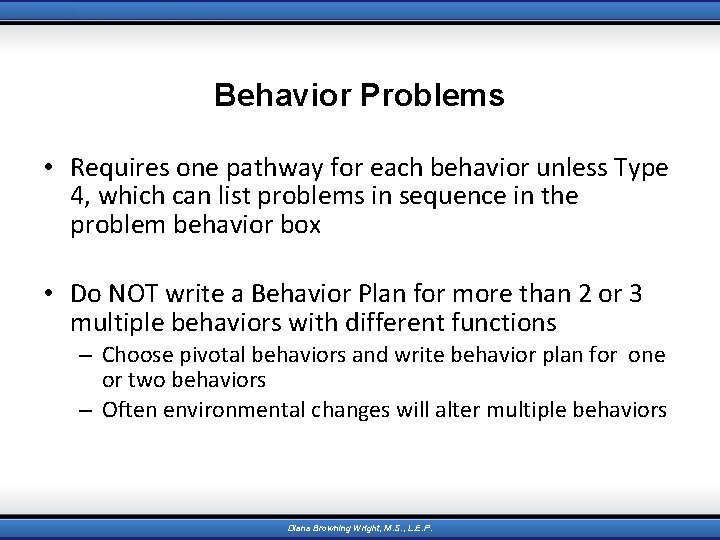
Behavior Problems • Requires one pathway for each behavior unless Type 4, which can list problems in sequence in the problem behavior box • Do NOT write a Behavior Plan for more than 2 or 3 multiple behaviors with different functions – Choose pivotal behaviors and write behavior plan for one or two behaviors – Often environmental changes will alter multiple behaviors Diana Browning Wright, M. S. , L. E. P.
Research On Training And Scoring Behavior Plans • A method of learning behavior analysis and improving quality of plans • A method of evaluation of the extent to which your plan is in alignment with the field of behavior analysis • A method of improving likely fidelity once the plan is approved • A method of improving outcomes for students Diana Browning Wright, M. S. , L. E. P.
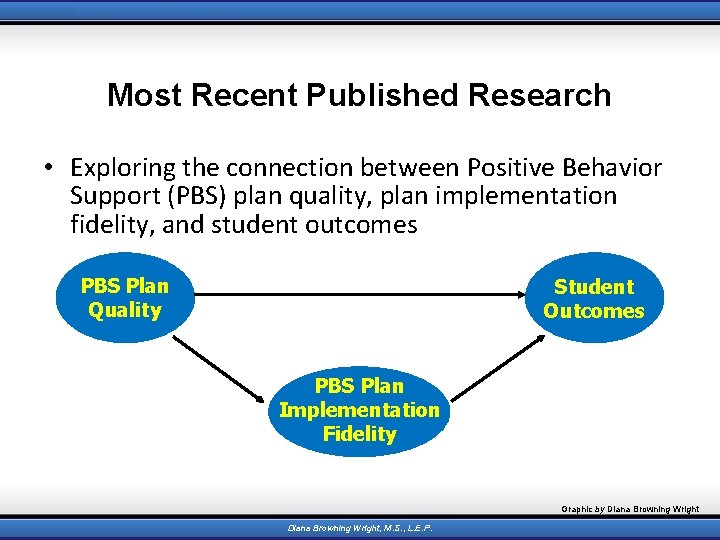
Most Recent Published Research • Exploring the connection between Positive Behavior Support (PBS) plan quality, plan implementation fidelity, and student outcomes PBS Plan Quality Student Outcomes PBS Plan Implementation Fidelity Graphic by Diana Browning Wright, M. S. , L. E. P.
Relationship Between Plan Quality And Plan Fidelity • Results: the better the plan, the more likely the plan is to be implemented with integrity (i. e. , implemented as written [r =. 56]) • Analysis results: We examined the sequence to determine whether fidelity significantly predicts student outcomes – Step 1: Developed a high quality plan – Step 2: Implemented the plan with high fidelity (as written) – Step 3: Improved student outcomes Diana Browning Wright, M. S. , L. E. P.
Follow-up Analysis Needed Research Needs: Staff characteristics that relate to behavior plan quality, implementation fidelity, and student outcomes – Preliminary results suggest that “number of ABA courses” is positively correlated with PBS plan quality (the more courses, the better the plan) and – “Years in education” is negatively correlated with BIP quality (i. e. , the more years in education the poorer the BIP plan) Diana Browning Wright, M. S. , L. E. P.
Where To Get Free Self-Training On-line • www. pent. ca. gov “Behavior Intervention Plan Desk Reference” – A Comprehensive Manual that includes how to score behavior plans (section 15) write effective behavior goals (section 8) that are measureable, how to develop effective communication between all stakeholders, how to link pathways to the plan (section 3), how to consult using the pathway tool (section 3) and many other embedded “how to” guides Diana Browning Wright, M. S. , L. E. P.
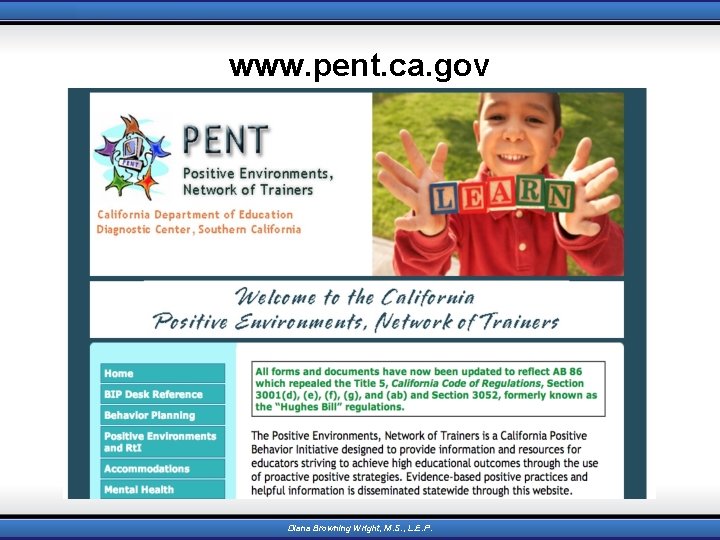
www. pent. ca. gov Diana Browning Wright, M. S. , L. E. P.
Emotionally Driven Behaviors? Related Service to Benefit from Special Education vs. Supplementary Aids and Services to Maintain the LRE Diana Browning Wright, M. S. , L. E. P.
Earlier Onset Of Internalizing Disorders • First episode of anxiety, depression is occurring earlier and earlier in American culture • Warnings on increasing internalizing disorders in children are increasing • Cultural shift from “the American Dream” to “Bleak Outlook” see: Optimistic Child by Martin Seligman Diana Browning Wright, M. S. , L. E. P.
School-Based Problems And Disorders • Internalizing problems: – Anxiety, Fears, Phobias – Depression – Trauma Responses • Children and youth vary from normal to disordered functioning in each of these areas Diana Browning Wright, M. S. , L. E. P.
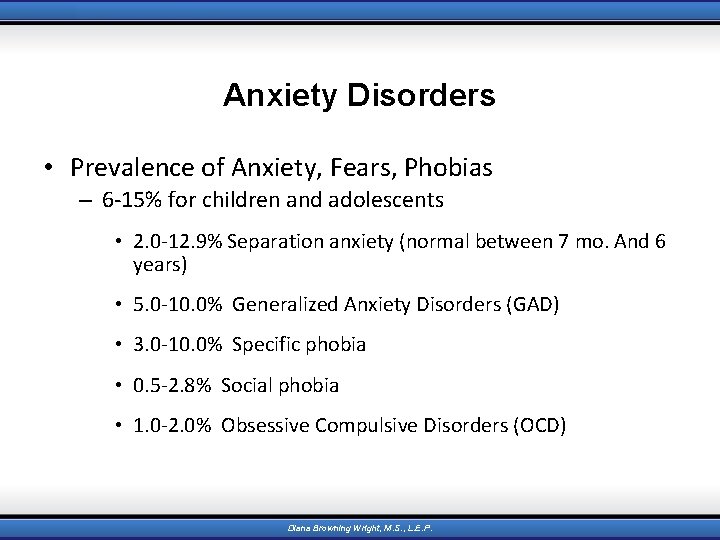
Anxiety Disorders • Prevalence of Anxiety, Fears, Phobias – 6 -15% for children and adolescents • 2. 0 -12. 9% Separation anxiety (normal between 7 mo. And 6 years) • 5. 0 -10. 0% Generalized Anxiety Disorders (GAD) • 3. 0 -10. 0% Specific phobia • 0. 5 -2. 8% Social phobia • 1. 0 -2. 0% Obsessive Compulsive Disorders (OCD) Diana Browning Wright, M. S. , L. E. P.
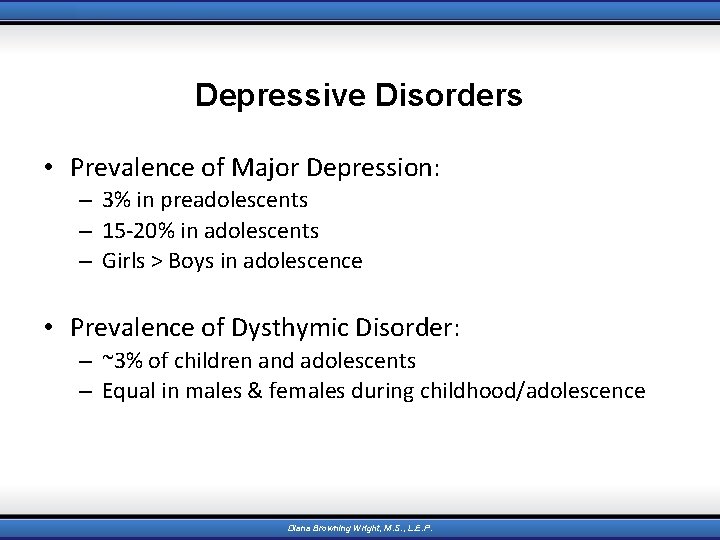
Depressive Disorders • Prevalence of Major Depression: – 3% in preadolescents – 15 -20% in adolescents – Girls > Boys in adolescence • Prevalence of Dysthymic Disorder: – ~3% of children and adolescents – Equal in males & females during childhood/adolescence Diana Browning Wright, M. S. , L. E. P.
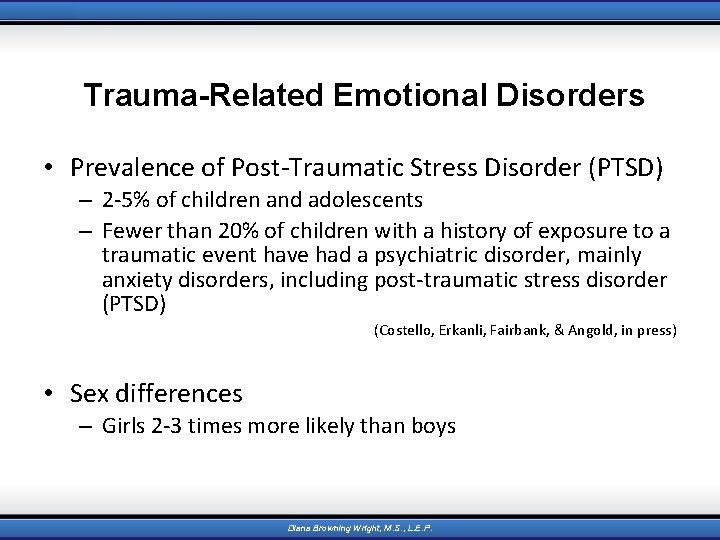
Trauma-Related Emotional Disorders • Prevalence of Post-Traumatic Stress Disorder (PTSD) – 2 -5% of children and adolescents – Fewer than 20% of children with a history of exposure to a traumatic event have had a psychiatric disorder, mainly anxiety disorders, including post-traumatic stress disorder (PTSD) (Costello, Erkanli, Fairbank, & Angold, in press) • Sex differences – Girls 2 -3 times more likely than boys Diana Browning Wright, M. S. , L. E. P.
What Is Trauma? • Sudden or unexpected events • Shocking nature of events • Actual or threatened death/threat to life/bodily integrity • Subjective feelings of intense terror, horror, or helplessness Diana Browning Wright, M. S. , L. E. P.
Which Experiences Are Traumatic? • Child physical or sexual abuse • Witnessing or victimization of domestic, community, or school violence • Severe accidents • Potentially life-threatening illnesses • Natural/human-made disasters • Sudden death of family member/peer • Exposure to war, terrorism, or refugee conditions Diana Browning Wright, M. S. , L. E. P.
Maltreatment Data • U. S. Department of Health & Human Services, Administration on Children Youth & Families. Child Maltreatment – Data on severe inflicted child abuse, trauma, which in 2011 resulted nationally in the death of 1570 per 100, 000 children • 76. 7 million children 0 -17 in USA projected for 2013, data not yet available http: //www. acf. hhs. gov/sites/default/files/cb/cm 11. pdf#page=28 Diana Browning Wright, M. S. , L. E. P.
What Teachers And Staff Observe In Emotional/Internalizing Patterns Of Behavior • A shrinking of the student’s repertoire of approach behaviors and skills to nothing (poor use of social skills) • Students develop a repertoire of avoidance behaviors in attempt to alleviate anxiety out of their life. • Students that fear separation from their caregivers attempt to cling to their caregivers to avoid being separated. Diana Browning Wright, M. S. , L. E. P.
What Teachers See And Hear As Student Reacts To Provocative Stimuli • Physical sensations: (e. g. , rapid heart rate, short of breath, cold sweaty hands, blushed face, butterflies) • Thoughts/Beliefs: faulty interpretation and meaning making of situation • Escape/Avoidance Behaviors: attempt to remove contact with provocative stimulus • Oppositional Behaviors: when forced to have contact with provocative stimulus • Feelings: sad, angry, upset, depressed, worried Diana Browning Wright, M. S. , L. E. P.
What Teachers See And Students Report • Somatic complaints: headaches, stomachaches, muscle tension • Physiological arousal: racing heart, sweating palms, teeth chattering, dizziness, flushed face, trembling hands Diana Browning Wright, M. S. , L. E. P.
Early Intervention By Teachers Through Physiology For Learning • Use Strategies and Procedures to Monitor and Support Physiology for Learning – Diet: teach and support families in healthy eating/healthy minds – Sleep hygiene: log activities 30 minutes before bedtime activities, time in bed , times up in the night, time out of bed, fatigue level at waking and daily mood Diana Browning Wright, M. S. , L. E. P.
Early Intervention By Teachers Through Physiology For Learning • Use Strategies and Procedures to Monitor and Support Physiology for Learning – Exercise: endorphins – move it or lose it – Stress management e. g. , relaxation techniques, “belly breathing, ” mindfulness practices, etc. – Stress Management: Evidence based mindfulness-see www. learning 2 breathe. org (HS) and www. mindup. org (pre k-8) Diana Browning Wright, M. S. , L. E. P.
Early Intervention By Teachers Prevention Through Mindfulness Training • Existing in the present moment – Preventing the thoughts about the past and future from invading and capturing your mind • What’s happening now? – Going through the senses • • • What am I seeing? What am I smelling? What am I feeling? What am I hearing? What am I tasting? See: http: //mindfulnessforchildren. org/research/ Diana Browning Wright, M. S. , L. E. P.

• Mind Up: Resources for Schools http: //thehawnfoundation. org/mindup-curriculum/ • Mindfulness In Education: www. mindfuleducation. org • Mindful Schools: http: //www. mindfulschools. org • Positive Psychology: www. greatergood. berkeley. edu www. ggia. berkeley. edu www. authentichappiness. org Diana Browning Wright, M. S. , L. E. P.
Positive Psychology: Evidence-Based Resources • https: //sites. google. com/site/psychospiritualtools/Home/psych ological-practices/three-good-things (Listen to Martin Seligman explain the 3 good things technique) • Ben’s Top 11 positive psychology websites at: http: //www. authentichappiness. sas. upenn. edu/newsletter. aspx ? id=76 • http: //www. authentichappiness. sas. upenn. edu/books. aspx (Look for THE OPTIMISTIC CHILD) • http: //www. authentichappiness. sas. upenn. edu/testcenter. aspx (Look for adult and children tools) Diana Browning Wright, M. S. , L. E. P.
Depression Specific Strategies • Tracking of Mood/Activity Level • Behavioral Activation Planning – Identify baseline level of pleasant events – Identify “high impact” activities – Promote participation in pleasant activities • Join a club (to increase social experiences) • Set a goal to learn to do something better (to increase success experiences) • Invite others to join your activities – Reward completion of goal doing something that is: • • Very enjoyable Under self-control Powerful – equal to effort made to accomplish goal Immediately available Diana Browning Wright, M. S. , L. E. P.
Social Emotional Learning (SEL) • These Social Emotional skills include the ability to: – Recognize and manage emotions – Care about and respect others – Develop positive relationships – Make good decisions – Behave responsibly and ethically © 2006. Collaborative for Academic, Social, and Emotional Learning (CASEL). Diana Browning Wright, M. S. , L. E. P.
Two Components To SEL • SEL involves: 1. Teaching students a set of skills to help support their social and emotional well-being and, 2. Creating a safe, caring learning environment conducive to learning where students are encouraged and reinforced for applying those skills. Diana Browning Wright, M. S. , L. E. P.
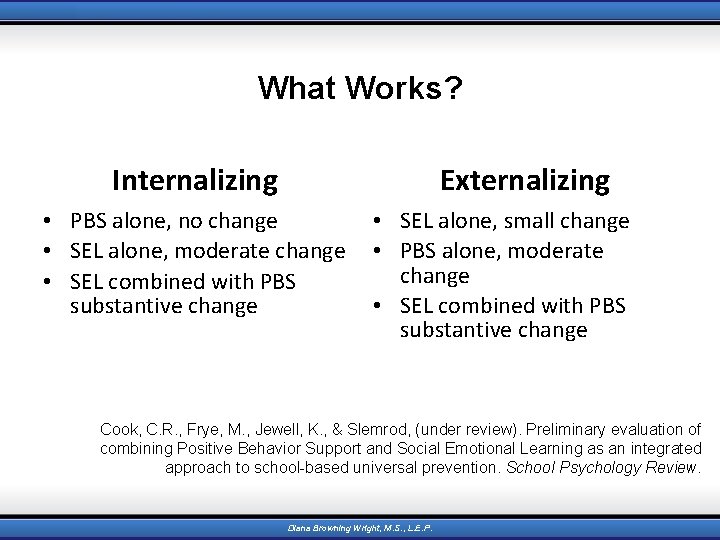
What Works? Internalizing Externalizing • PBS alone, no change • SEL alone, moderate change • SEL combined with PBS substantive change • SEL alone, small change • PBS alone, moderate change • SEL combined with PBS substantive change Cook, C. R. , Frye, M. , Jewell, K. , & Slemrod, (under review). Preliminary evaluation of combining Positive Behavior Support and Social Emotional Learning as an integrated approach to school-based universal prevention. School Psychology Review. Diana Browning Wright, M. S. , L. E. P.
Signs Of Need For Second Tier Of Supports And Recommendations • In Behavioral RTI/MTSS schools: High scores on the internalizing half of Universal Screening Measures for behavior • In non-RTI/MTSS schools: high intensity, duration and/or frequency of presenting problems described above, after prevention measures have been used both in class and school-wide Diana Browning Wright, M. S. , L. E. P.
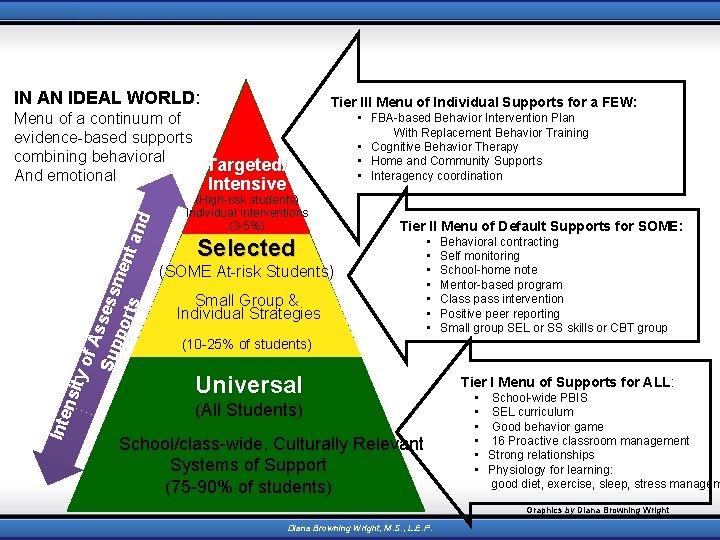
IN AN IDEAL WORLD: Menu of a continuum of evidence-based supports combining behavioral Targeted/ And emotional Tier III Menu of Individual Supports for a FEW: Inte nsi ty o f As Sup sess por men ts t an d Intensive (High-risk students) Individual Interventions (3 -5%) • FBA-based Behavior Intervention Plan With Replacement Behavior Training • Cognitive Behavior Therapy • Home and Community Supports • Interagency coordination Tier II Menu of Default Supports for SOME: Selected (SOME At-risk Students) Small Group & Individual Strategies • • Behavioral contracting Self monitoring School-home note Mentor-based program Class pass intervention Positive peer reporting Small group SEL or SS skills or CBT group (10 -25% of students) Universal (All Students) School/class-wide, Culturally Relevant Systems of Support (75 -90% of students) Tier I Menu of Supports for ALL: • School-wide PBIS • SEL curriculum • Good behavior game • 16 Proactive classroom management • Strong relationships • Physiology for learning: good diet, exercise, sleep, stress managem Graphics by Diana Browning Wright, M. S. , L. E. P.
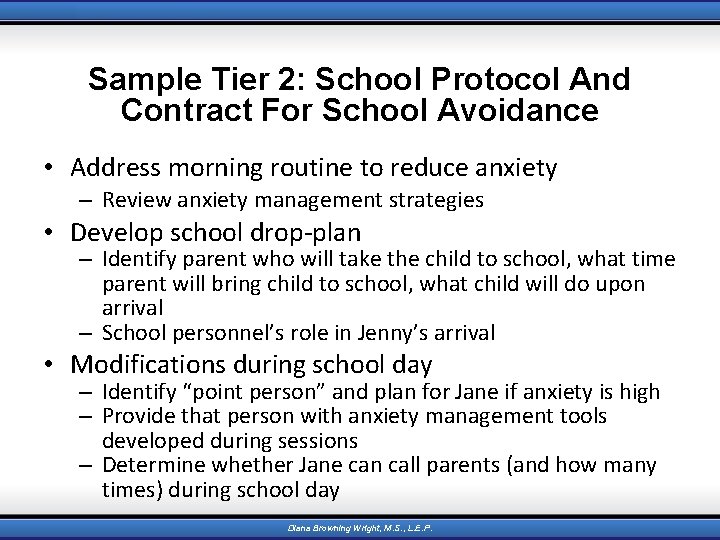
Sample Tier 2: School Protocol And Contract For School Avoidance • Address morning routine to reduce anxiety – Review anxiety management strategies • Develop school drop-plan – Identify parent who will take the child to school, what time parent will bring child to school, what child will do upon arrival – School personnel’s role in Jenny’s arrival • Modifications during school day – Identify “point person” and plan for Jane if anxiety is high – Provide that person with anxiety management tools developed during sessions – Determine whether Jane can call parents (and how many times) during school day Diana Browning Wright, M. S. , L. E. P.
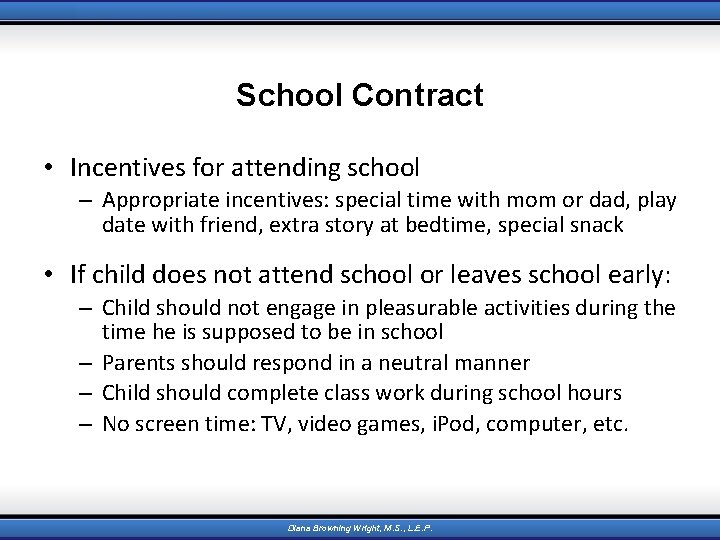
School Contract • Incentives for attending school – Appropriate incentives: special time with mom or dad, play date with friend, extra story at bedtime, special snack • If child does not attend school or leaves school early: – Child should not engage in pleasurable activities during the time he is supposed to be in school – Parents should respond in a neutral manner – Child should complete class work during school hours – No screen time: TV, video games, i. Pod, computer, etc. Diana Browning Wright, M. S. , L. E. P.
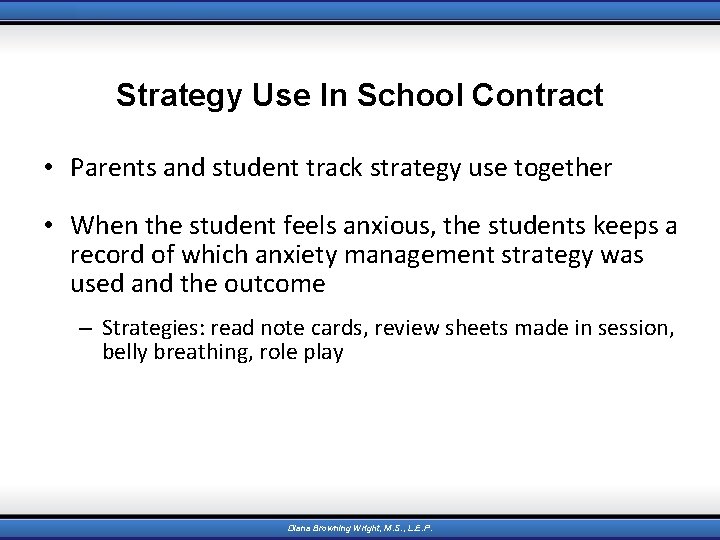
Strategy Use In School Contract • Parents and student track strategy use together • When the student feels anxious, the students keeps a record of which anxiety management strategy was used and the outcome – Strategies: read note cards, review sheets made in session, belly breathing, role play Diana Browning Wright, M. S. , L. E. P.
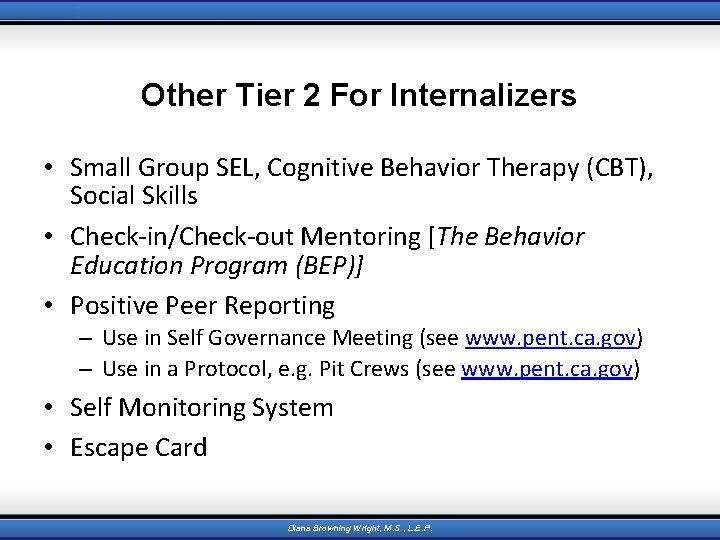
Other Tier 2 For Internalizers • Small Group SEL, Cognitive Behavior Therapy (CBT), Social Skills • Check-in/Check-out Mentoring [The Behavior Education Program (BEP)] • Positive Peer Reporting – Use in Self Governance Meeting (see www. pent. ca. gov) – Use in a Protocol, e. g. Pit Crews (see www. pent. ca. gov) • Self Monitoring System • Escape Card Diana Browning Wright, M. S. , L. E. P.
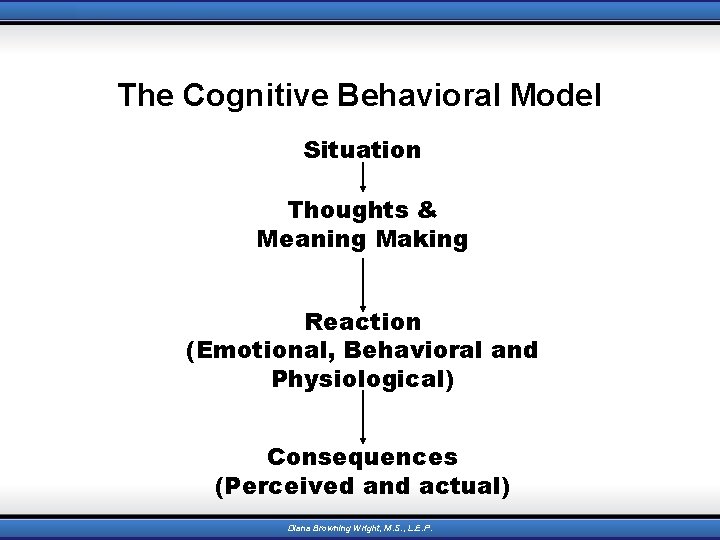
The Cognitive Behavioral Model Situation Thoughts & Meaning Making Reaction (Emotional, Behavioral and Physiological) Consequences (Perceived and actual) Diana Browning Wright, M. S. , L. E. P.
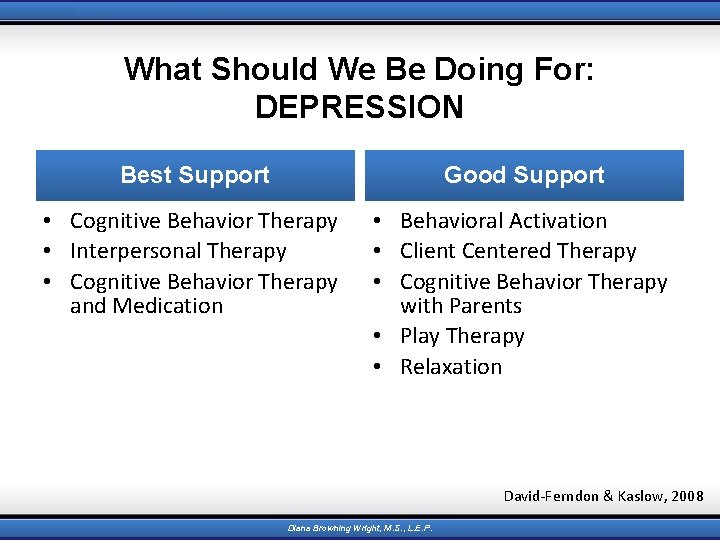
What Should We Be Doing For: DEPRESSION Best Support Good Support • Cognitive Behavior Therapy • Interpersonal Therapy • Cognitive Behavior Therapy and Medication • Behavioral Activation • Client Centered Therapy • Cognitive Behavior Therapy with Parents • Play Therapy • Relaxation David-Ferndon & Kaslow, 2008 Diana Browning Wright, M. S. , L. E. P.
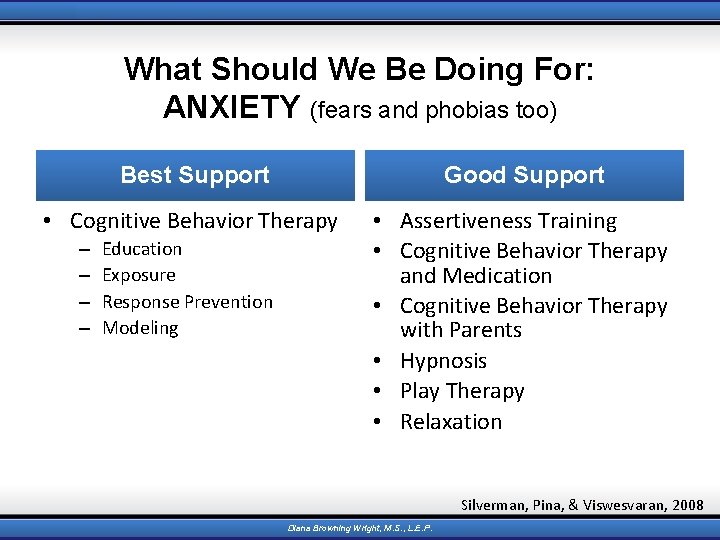
What Should We Be Doing For: ANXIETY (fears and phobias too) Best Support Good Support • Cognitive Behavior Therapy • Assertiveness Training • Cognitive Behavior Therapy and Medication • Cognitive Behavior Therapy with Parents • Hypnosis • Play Therapy • Relaxation – – Education Exposure Response Prevention Modeling Silverman, Pina, & Viswesvaran, 2008 Diana Browning Wright, M. S. , L. E. P.
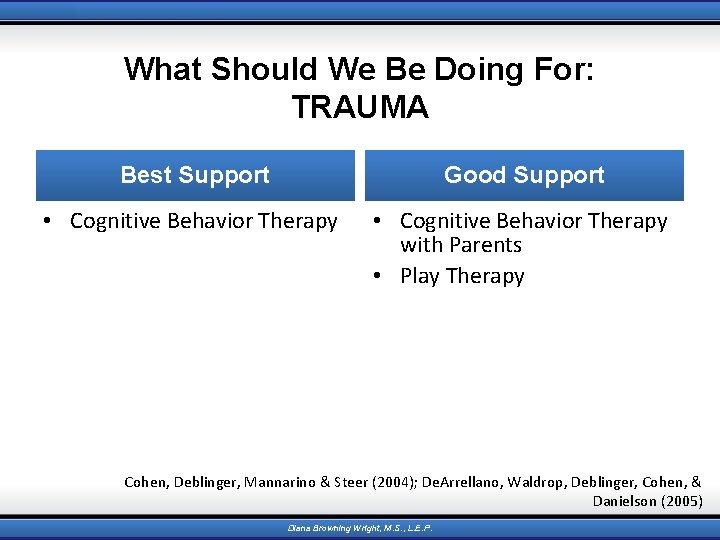
What Should We Be Doing For: TRAUMA Best Support Good Support • Cognitive Behavior Therapy with Parents • Play Therapy Cohen, Deblinger, Mannarino & Steer (2004); De. Arrellano, Waldrop, Deblinger, Cohen, & Danielson (2005) Diana Browning Wright, M. S. , L. E. P.
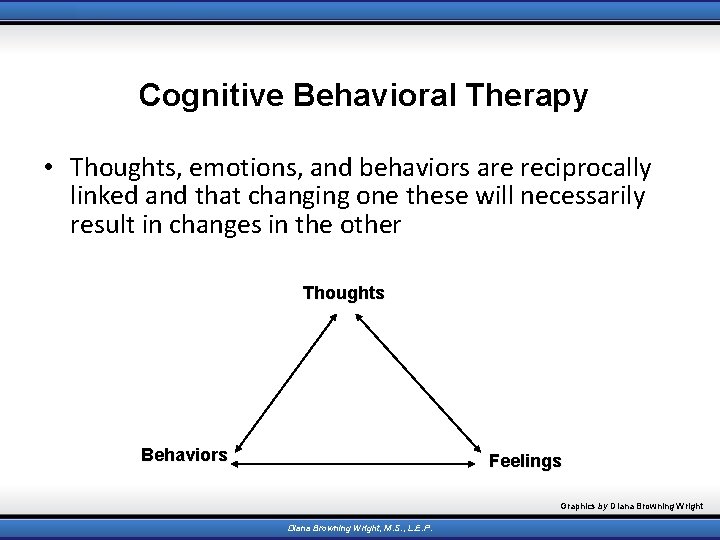
Cognitive Behavioral Therapy • Thoughts, emotions, and behaviors are reciprocally linked and that changing one these will necessarily result in changes in the other Thoughts Behaviors Feelings Graphics by Diana Browning Wright, M. S. , L. E. P.
Cognitive Behavioral Therapy CBT is a combination of cognitive techniques (how we think) and behavioral techniques (how we act) Premise: The way an individual feels and behaves in influenced by the way s/he processes and perceives her/his experiences Premise: Dysfunctional behavior is the result of dysfunctional thinking Diana Browning Wright, M. S. , L. E. P.
Dialectical Behavior Therapy (DBT) Individual And Group • Linehan, M. M. (1993). Cognitive-behavioral treatment of borderline personality disorder. The Guilford Press: New York. Lihenan, M. M. (1993). Skills training manual for treating borderline personality disorder. The Guilford Press: New York. http: //dbtcentermi. org/Overview_of_DBT_. php • Borderline personality disorder, OCD, emotion regulation disorders, eating disorders, cutting, etc Diana Browning Wright, M. S. , L. E. P.
Who Is Qualified To Deliver CBT School Services? • Scope of practice is defined for the profession as a whole – It is within the scope of practice for the following professions to deliver CBT: • School psychologist • Social worker • Clinical psychologist • Counseling psychologist • School counselor • Marriage and family therapist Diana Browning Wright, M. S. , L. E. P.
Who Is Qualified To Deliver CBT School Services? • Scope of competence, is individually defined and determined for each practitioner – This is determined based on the individual’s previous training, experience, and supervision Diana Browning Wright, M. S. , L. E. P.
How Does Someone With A Scope Of Practice Move In To Scope Of Competence? • • Continuing education Take additional coursework Read relevant literature Watch relevant videos Read relevant information online Get consultation Get supervised experience Diana Browning Wright, M. S. , L. E. P.
Key Concept: CBT Is About Helping The Student Draw The Connection Between Thoughts, Feelings, And Behaviors • E. G. , Thoughts, Feelings, & Behaviors Associated with Anxiety – Thought: this is scary – Feeling: anxiety – Behavior: Escape – Teach the student to attend to body signals, thought signals, action signals Diana Browning Wright, M. S. , L. E. P.
Coping Cat Tier 2 Group/Tier 3 Individual • Kendall (1994) – 16 session CBT (Coping Cat) superior at posttreatment to waiting list control – Gains maintained at 1 yr (n=47, age 9 -13) • Kendall et al (1997) – 16 session CBT (Coping Cat) superior to waiting list posttreatment – Maintained at 12 mos (n=94, age 9 -13) Diana Browning Wright, M. S. , L. E. P.
Coping Cat • Kendall, P. C. , & Hedtke, K. A. (2006). Cognitive-behavioral therapy for anxious children: therapist manual, (3 rd edition). Ardmore, PA : Workbook Publishing. • Kendall, P. C. , Choudhury, M. A. , Hudson, J. , & Webb, A. (2002). The C. A. T. project manual. Ardmore, PA : Workbook Publishing. – For children 14 -17 • Kendall, P. C. , & Hedtke, K. A. (2006). The Coping cat workbook, (2 nd edition). Ardmore, PA : Workbook Publishing. – For children 7 -13 http: //www. workbookpublishing. com/ Diana Browning Wright, M. S. , L. E. P.
Coping With Depression Tier 2 Class Design • Clarke (1990) – 16 session group (4 -8 participants with active depression or depressed mood) • Two 2 -hour sessions per week for 8 weeks – Psychoeducational & cognitive behavioral intervention – Targeting youth 14 -18 years old – Adapted from Adult Coping with Depression Course (Lewinsohn et al. , 1984) Diana Browning Wright, M. S. , L. E. P.
Coping With Depression (CWD-A) • Lewinsohn et al. (1990) – 16 session CBT (CWD-A) superior at post treatment to waiting list control – Gains maintained at 24 mos (n=59, age 14 -18) • Clarke et al. (1999) – 16 session CBT (CWD-A) superior to waiting list post treatment – Maintained at 12 & 24 mos (n=123, age 14 -18) Diana Browning Wright, M. S. , L. E. P.
Coping With Depression (CWD-A) • Rohde et al. (2004) – 16 session CBT (CWD-A) superior at post treatment to control non-therapeutic intervention for symptom reduction & improved social functioning – (n=93, age 13 -17, comorbid MDD & CD) – No change in symptoms of CD – Significant differences not maintained at 6 & 12 mos follow-up Diana Browning Wright, M. S. , L. E. P.
CWD-A • Clarke, G. , Lewinsohn, P. , & Hops, H. (1990). Leader’s manual for adolescent groups: Adolescents coping with depression course. Portland, OR: Kaiser Permanente. • Clarke, G. , Lewinsohn, P. , & Hops, H. (1990). Student workbook: Adolescents coping with depression course. Portland, OR: Kaiser Permanente. • Center for Health Research http: //www. kpchr. org/public/acwd. html Diana Browning Wright, M. S. , L. E. P.
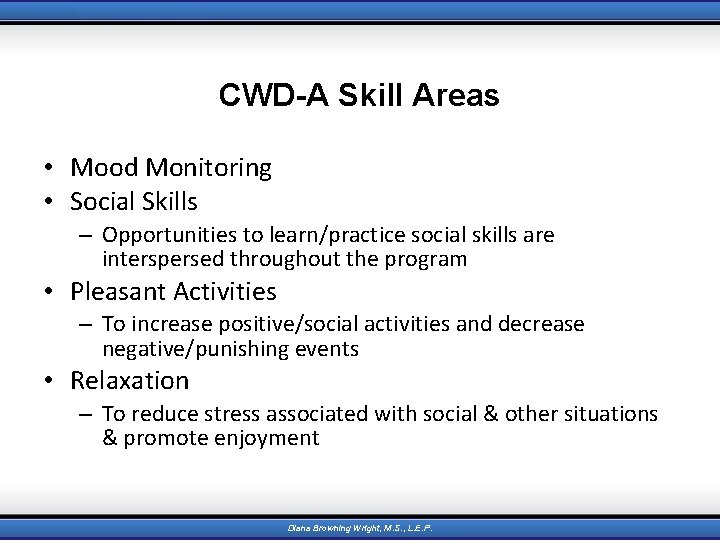
CWD-A Skill Areas • Mood Monitoring • Social Skills – Opportunities to learn/practice social skills are interspersed throughout the program • Pleasant Activities – To increase positive/social activities and decrease negative/punishing events • Relaxation – To reduce stress associated with social & other situations & promote enjoyment Diana Browning Wright, M. S. , L. E. P.
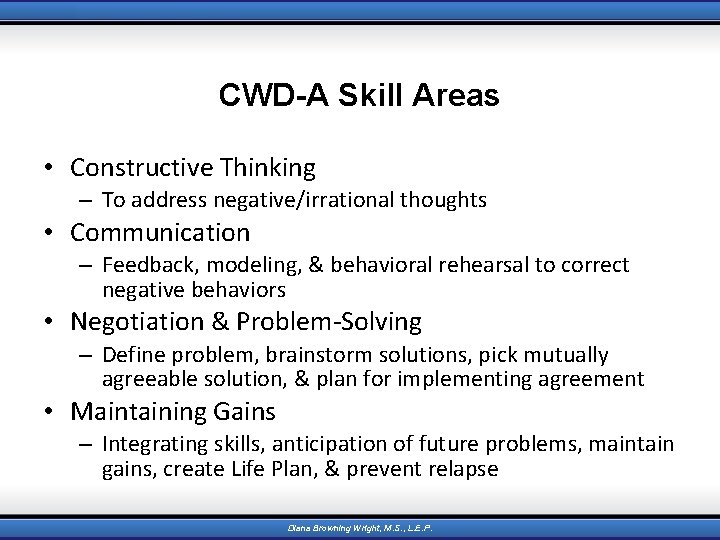
CWD-A Skill Areas • Constructive Thinking – To address negative/irrational thoughts • Communication – Feedback, modeling, & behavioral rehearsal to correct negative behaviors • Negotiation & Problem-Solving – Define problem, brainstorm solutions, pick mutually agreeable solution, & plan for implementing agreement • Maintaining Gains – Integrating skills, anticipation of future problems, maintain gains, create Life Plan, & prevent relapse Diana Browning Wright, M. S. , L. E. P.
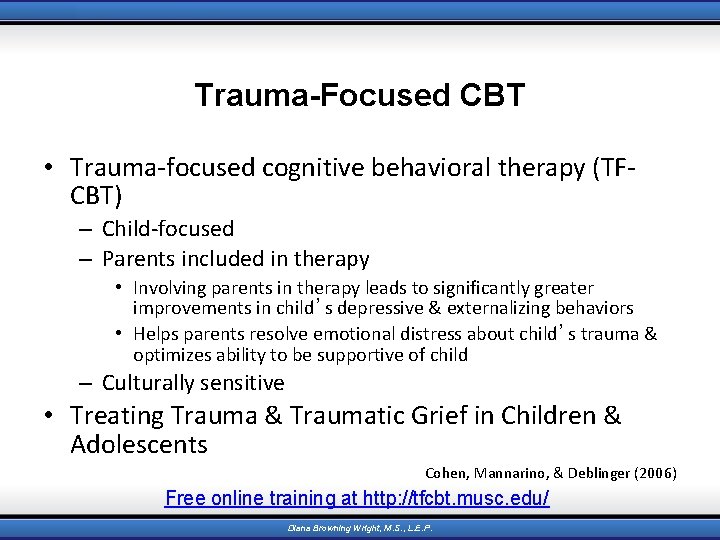
Trauma-Focused CBT • Trauma-focused cognitive behavioral therapy (TFCBT) – Child-focused – Parents included in therapy • Involving parents in therapy leads to significantly greater improvements in child’s depressive & externalizing behaviors • Helps parents resolve emotional distress about child’s trauma & optimizes ability to be supportive of child – Culturally sensitive • Treating Trauma & Traumatic Grief in Children & Adolescents Cohen, Mannarino, & Deblinger (2006) Free online training at http: //tfcbt. musc. edu/ Diana Browning Wright, M. S. , L. E. P.
Trauma-Focused CBT • Cohen, Deblinger, Mannarino, & Steer (2004) – 12 session TFCBT for children with symptoms of PTSD who experienced sexual abuse superior at posttreatment to child-centered therapy treatment – Greater reductions in symptoms of PTSD & depression in children & symptoms of depression in parents (n=229, age 8 -14) Diana Browning Wright, M. S. , L. E. P.
Trauma-Focused CBT • Cohen, Mannarino, & Staron (2006) – 12 session TFCBT for children with symptoms of PTSD who experienced traumatic grief – Compared to pretreatment, children reported significant improvements in symptoms of traumatic grief, PTSD, depression & anxiety at posttreatment; Parents reported significant reductions in symptoms of PTSD, internalizing, & behavior problems & their own PTSD (n=39, age 6 -17) Diana Browning Wright, M. S. , L. E. P.
Cognitive Behavior Intervention (CBI) For Trauma In Schools Tier 2 or 3 • Free programming and resources at : http: //cbitsprogram. org • School-based, group, and individual intervention • Reduce symptoms of post-traumatic stress disorder (PTSD), depression, and behavioral problems, and to improve functioning, grades and attendance, peer and parent support, and coping skills Diana Browning Wright, M. S. , L. E. P.
Cognitive Behavior Intervention For Trauma In Schools Tier 2 or 3 • CBITS uses cognitive-behavioral techniques (e. g. , psychoeducation, relaxation, social problem solving, cognitive restructuring, and exposure). Diana Browning Wright, M. S. , L. E. P.
Cognitive Behavior Intervention For Trauma In Schools • Reduce symptoms of post-traumatic stress disorder (PTSD), depression, and behavioral problems, and to improve functioning, grades and attendance, peer and parent support, and coping skills for students from 5 th to 12 th grade who have witnessed or experienced traumatic life events such as community and school violence, accidents and injuries, physical abuse and domestic violence, and natural and manmade disasters Diana Browning Wright, M. S. , L. E. P.
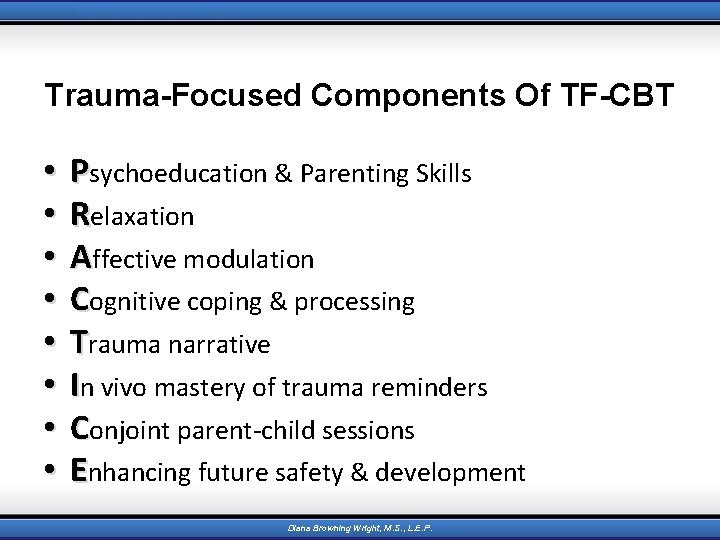
Trauma-Focused Components Of TF-CBT • • Psychoeducation & Parenting Skills Relaxation Affective modulation Cognitive coping & processing Trauma narrative In vivo mastery of trauma reminders Conjoint parent-child sessions Enhancing future safety & development Diana Browning Wright, M. S. , L. E. P.
Grief-Focused Components Of TF-CBT • Grief psychoeducation • Grieving the loss & resolving ambivalent feelings • Preserving positive memories • Redefining the relationship & committing to present relationships Diana Browning Wright, M. S. , L. E. P.
Related Service Needed? • Behaviors that produce automatic reinforcement, i. e. , are not socially mediated, require a treatment plan that may be a related service if there is an IEP Examples: Non responsiveness to behavior supports may suggest the behavior requires another approach, history of trauma, general anxiety, social anxiety, depression, selective mutism, habit reversal needs (OCD, Tourettes, etc. ) and so forth Differentiating socially mediated from behaviors producing automatic reinforcement: http: //www. pent. ca. gov/mh/differentiatingbehavior. pdf Diana Browning Wright, M. S. , L. E. P.
What About Services For Internalized Behavior? • Tutorial on differentiating socially mediated from behaviors producing automatic reinforcement http: //www. pent. ca. gov/mh/differentiatingbehavior. pdf • Forms for a Protocol for Addressing Problem Behavior Resulting from Internal States http: //www. pent. ca. gov/mh/protocolinternalstates. pdf • Need to coordinate a combination of approaches? Behavior support, academic accommodations and mental health/counseling services? http: //www. pent. ca. gov/mh/coordinationofplans. MH. pdf Diana Browning Wright, M. S. , L. E. P.
Disproportionality Prevention • Donovan, M. S. , & Cross, C. T. (2002). Minority students in special and gifted education. Washington, DC: National Academy Press. “There is substantial evidence with regard to both behavior and achievement that early identification and intervention is more effective than later identification and intervention. ” Executive Summary, p. 5 (Reschly) Diana Browning Wright, M. S. , L. E. P.
What do we DO when explosions happen? • PROMPT system (next ppt show) for socially mediated behaviors • Personalized deescalation system (next ppt show) for emotionally driven behaviors NOTE: Restrictive settings are appropriate for nonresponders to Tier 1 and Tier 2 delivered with fidelity in order to deliver specialized instruction (see handouts) Diana Browning Wright, M. S. , L. E. P.
THANK YOU! Please visit PENT website for further assistance. Diana Browning Wright, M. S. , L. E. P. www. pent. ca. gov www. dianabrowningwright. com (626) 487 -9455 Thank you for ALL that you do for students with poorly understood behaviors! Diana Browning Wright, M. S. , L. E. P.
- Slides: 122