
RESPONDING TO EMERGENCIES Triage BASIC PRINCIPLES Stay calm
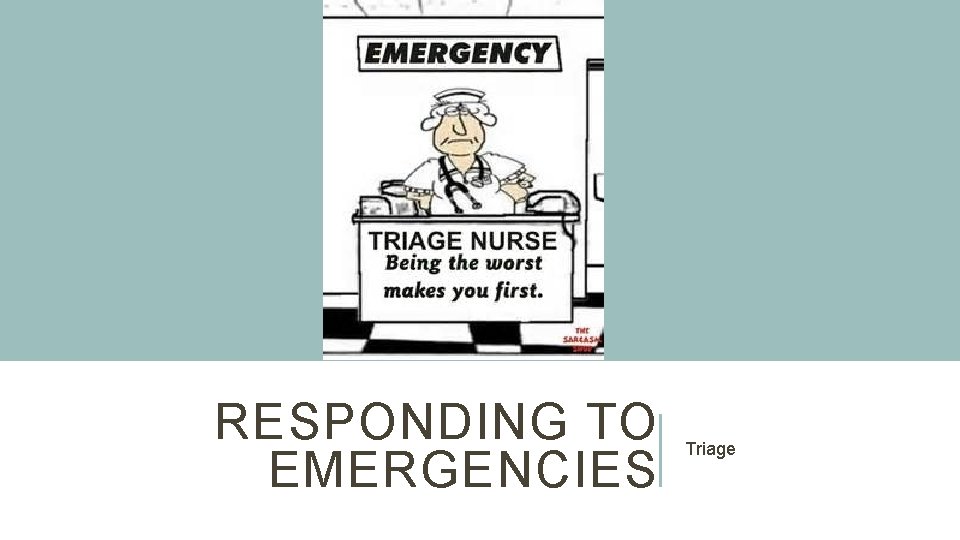
RESPONDING TO EMERGENCIES Triage
BASIC PRINCIPLES ØStay calm ØAssess the environment ØCall for help ØObtain consent to treat the victim ØTry to determine what happened ØPractice standard precautions
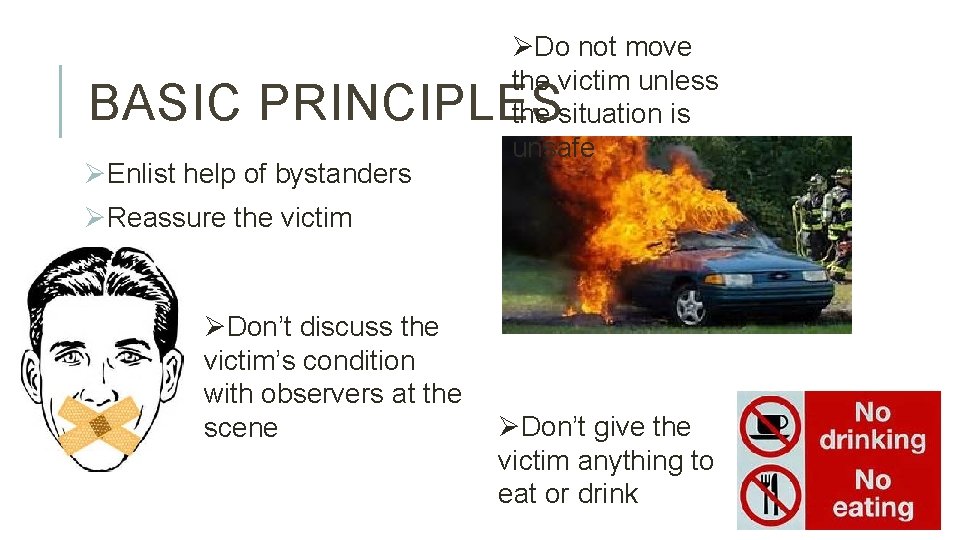
ØDo not move the victim unless the situation is unsafe BASIC PRINCIPLES ØEnlist help of bystanders ØReassure the victim ØDon’t discuss the victim’s condition with observers at the scene ØDon’t give the victim anything to eat or drink
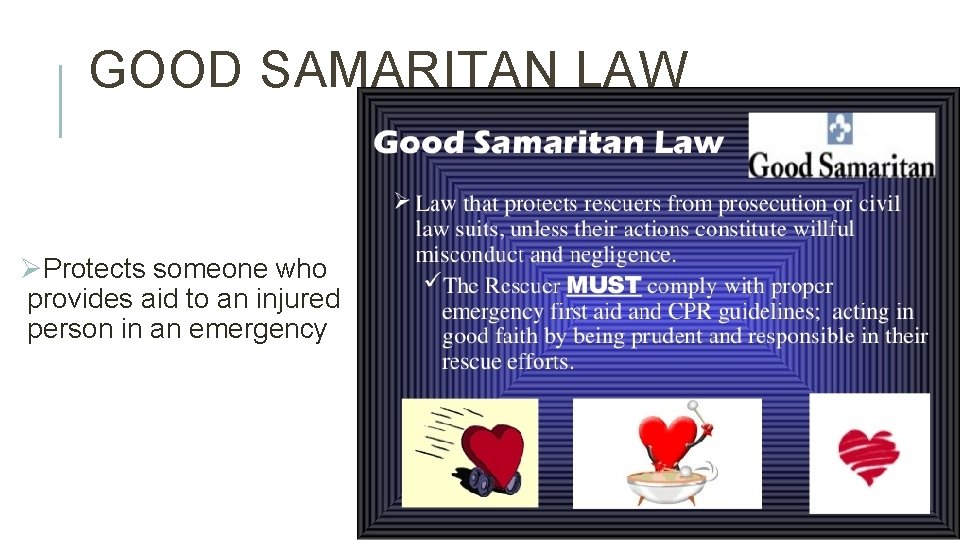
GOOD SAMARITAN LAW ØProtects someone who provides aid to an injured person in an emergency

TRIAGE ØProcess of deciding which victims should be treated first based on how sick or seriously injured they are
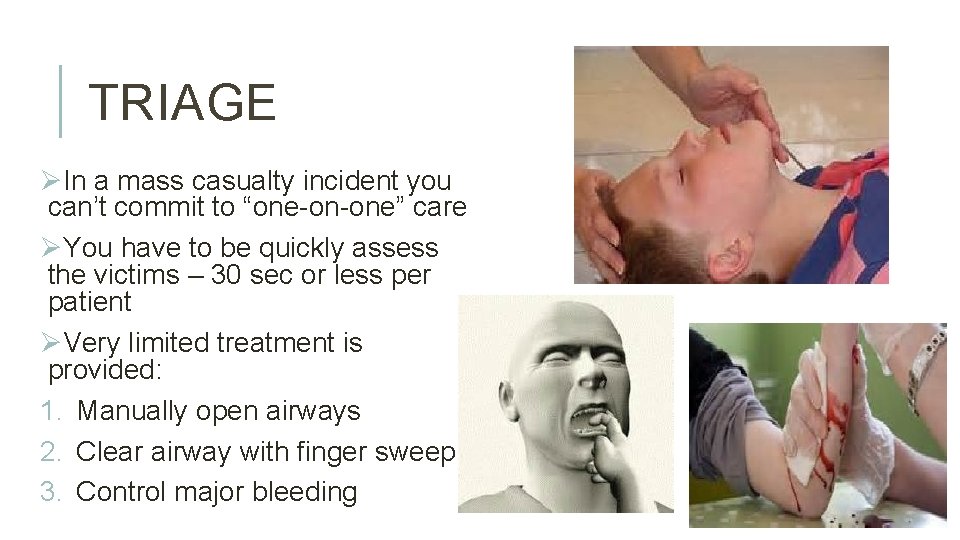
TRIAGE ØIn a mass casualty incident you can’t commit to “one-on-one” care ØYou have to be quickly assess the victims – 30 sec or less per patient ØVery limited treatment is provided: 1. Manually open airways 2. Clear airway with finger sweep 3. Control major bleeding
PRIMARY AND SECONDARY TRIAGE ØSecondary triage - ongoing process that takes place after the patient has been moved to a treatment/holding area awaiting transport. ØPrimary triage - 1 st contact-Assign triage category
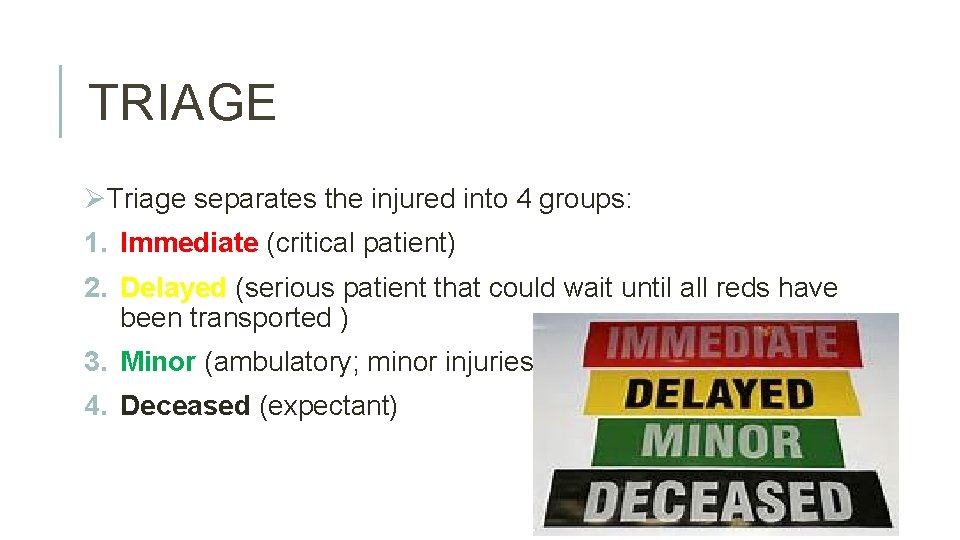
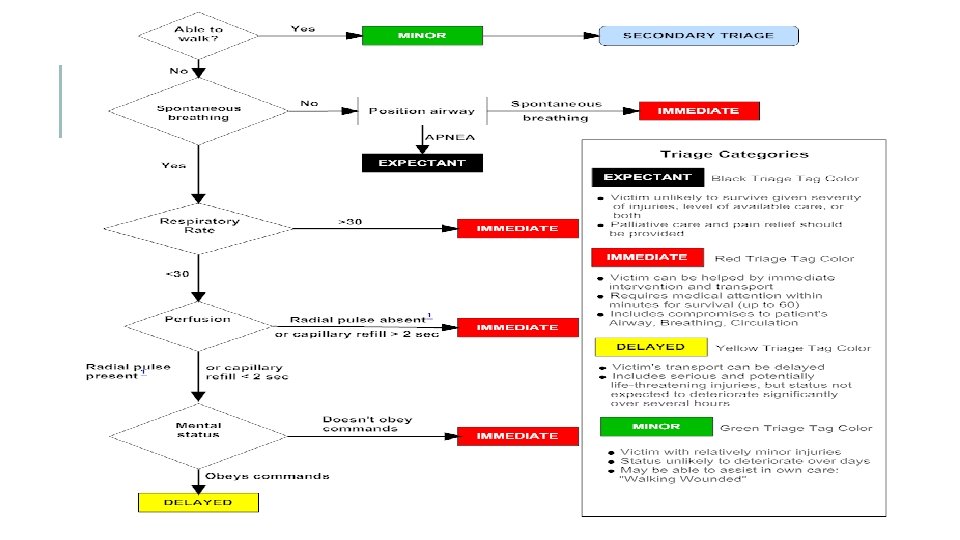
TRIAGE ØTriage separates the injured into 4 groups: 1. Immediate (critical patient) 2. Delayed (serious patient that could wait until all reds have been transported ) 3. Minor (ambulatory; minor injuries) 4. Deceased (expectant)
4 THINGS TO THINK ABOUT… 1. Ability to follow directions and walk 2. Respiratory effort 3. Pulses/perfusion 4. Mental status
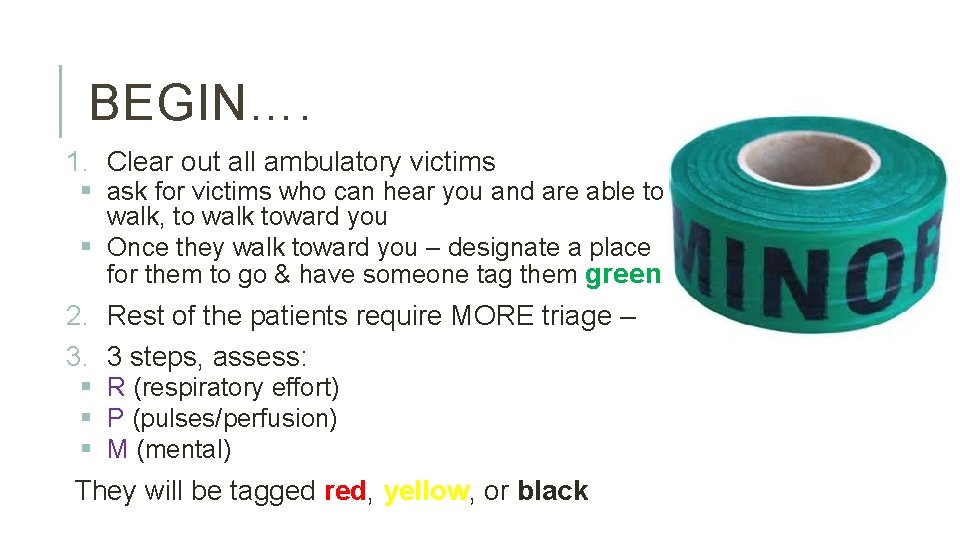
BEGIN…. 1. Clear out all ambulatory victims § ask for victims who can hear you and are able to walk, to walk toward you § Once they walk toward you – designate a place for them to go & have someone tag them green 2. Rest of the patients require MORE triage – 3. 3 steps, assess: § R (respiratory effort) § P (pulses/perfusion) § M (mental) They will be tagged red, yellow, or black
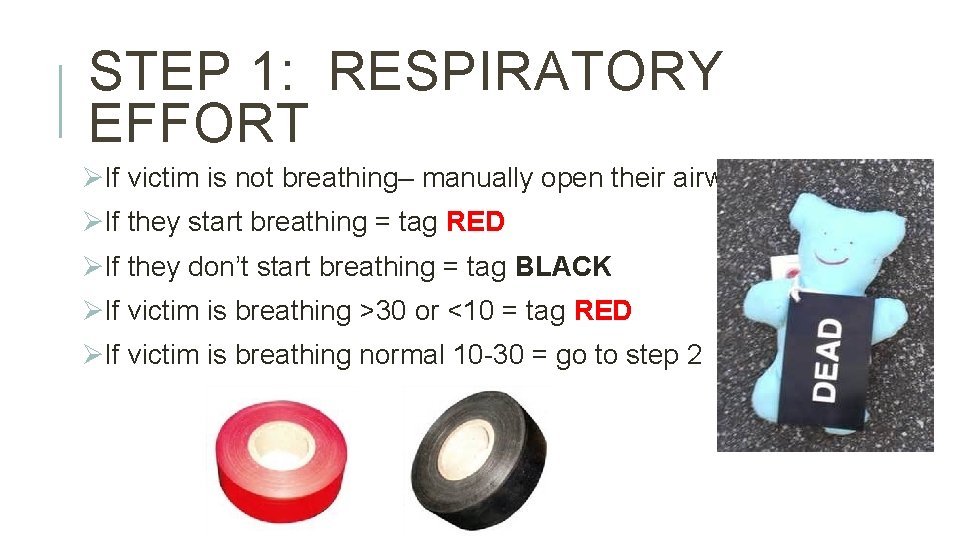
STEP 1: RESPIRATORY EFFORT ØIf victim is not breathing– manually open their airway ØIf they start breathing = tag RED ØIf they don’t start breathing = tag BLACK ØIf victim is breathing >30 or <10 = tag RED ØIf victim is breathing normal 10 -30 = go to step 2
STEP 2: PULSES/PERFUSION ØCheck for radial pulse or capillary refill ØIf radial pulse absent or cap refill >2 seconds = tag RED ØIf radial pulse present or cap refill < 2 seconds = go to step 3
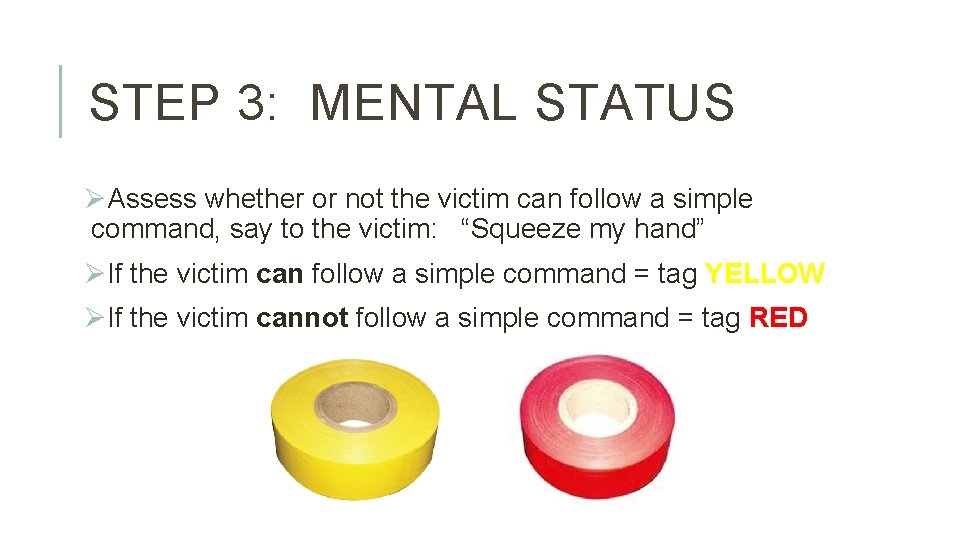
STEP 3: MENTAL STATUS ØAssess whether or not the victim can follow a simple command, say to the victim: “Squeeze my hand” ØIf the victim can follow a simple command = tag YELLOW ØIf the victim cannot follow a simple command = tag RED
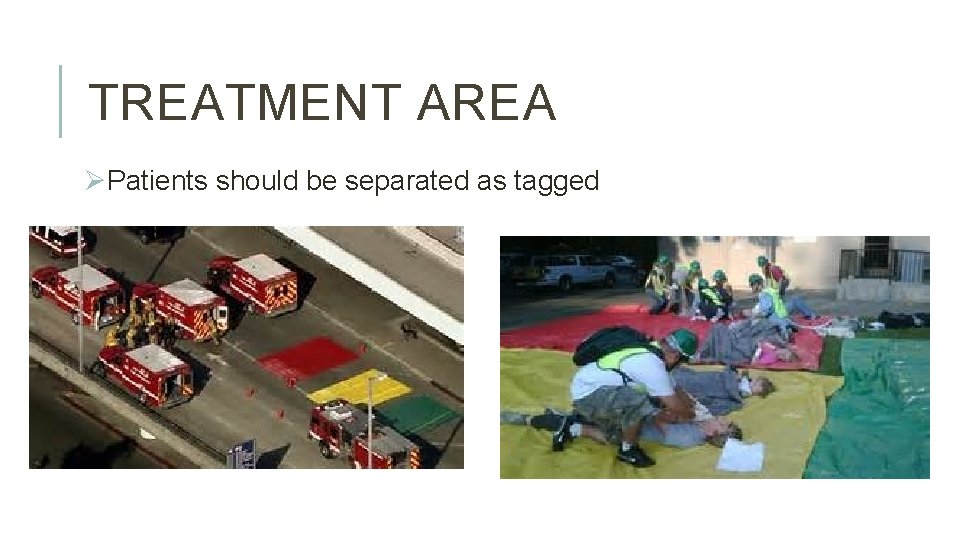
TREATMENT AREA ØPatients should be separated as tagged
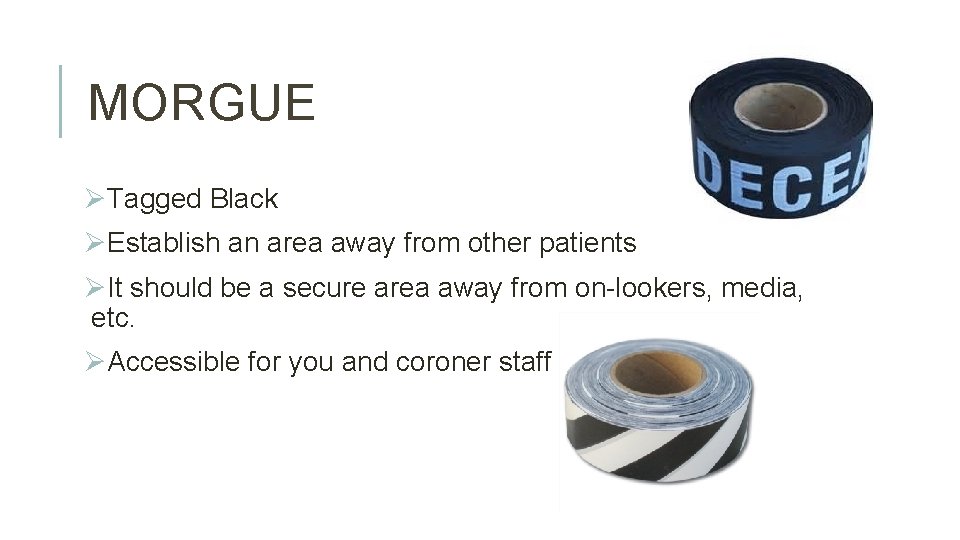
MORGUE ØTagged Black ØEstablish an area away from other patients ØIt should be a secure area away from on-lookers, media, etc. ØAccessible for you and coroner staff
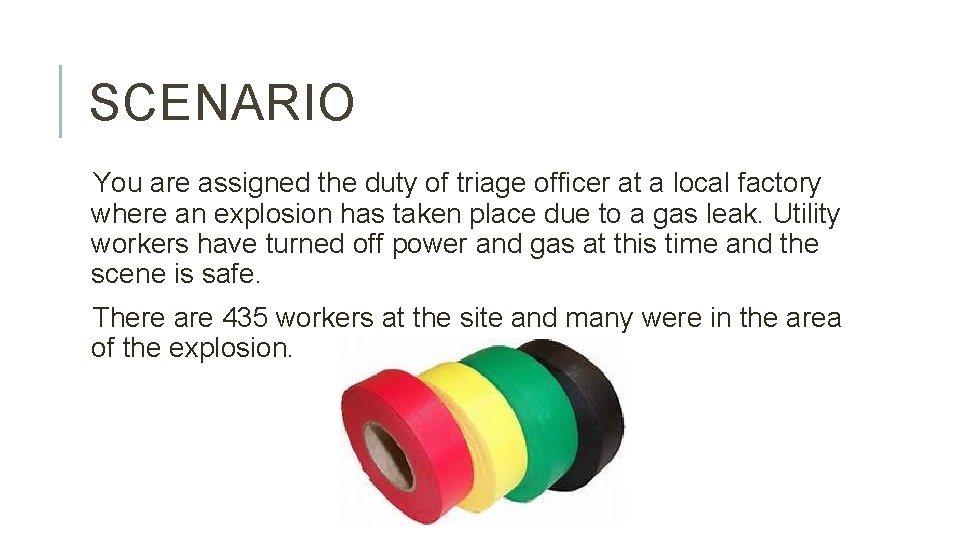
SCENARIO You are assigned the duty of triage officer at a local factory where an explosion has taken place due to a gas leak. Utility workers have turned off power and gas at this time and the scene is safe. There are 435 workers at the site and many were in the area of the explosion.
SCENARIO The following patients (#1 thru #5) are involved in the worksite explosion. Looking around, you visualize 40 – 50 workers involved. You begin the triage process. . .
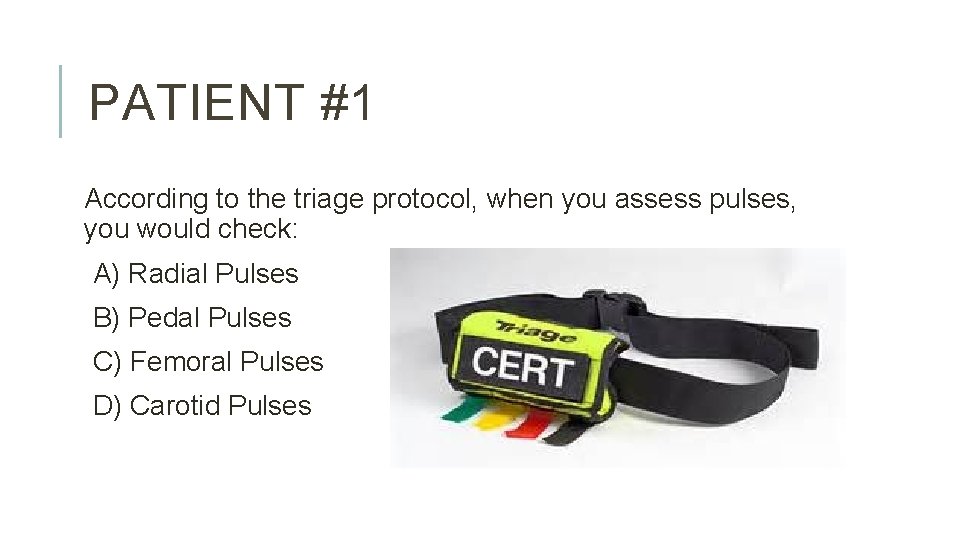
PATIENT #1 According to the triage protocol, when you assess pulses, you would check: A) Radial Pulses B) Pedal Pulses C) Femoral Pulses D) Carotid Pulses
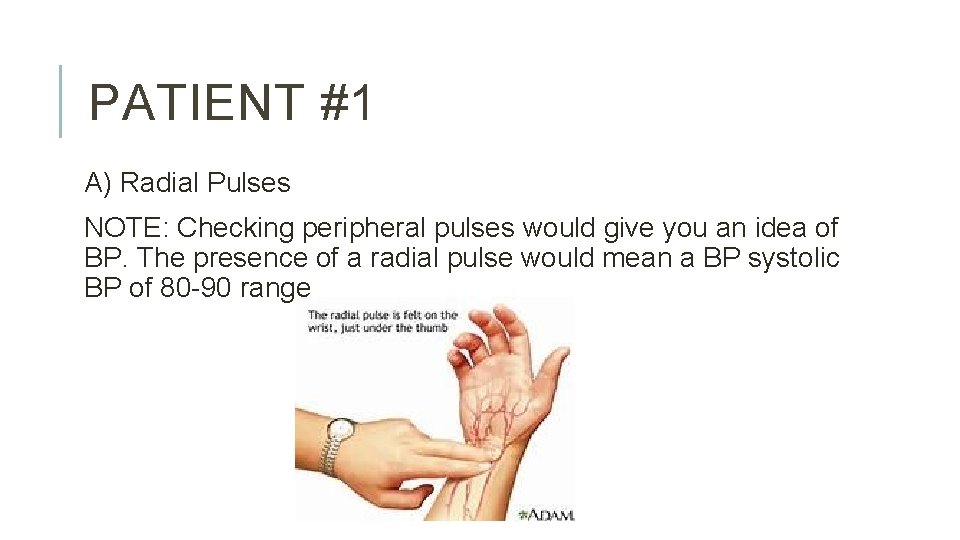
PATIENT #1 A) Radial Pulses NOTE: Checking peripheral pulses would give you an idea of BP. The presence of a radial pulse would mean a BP systolic BP of 80 -90 range
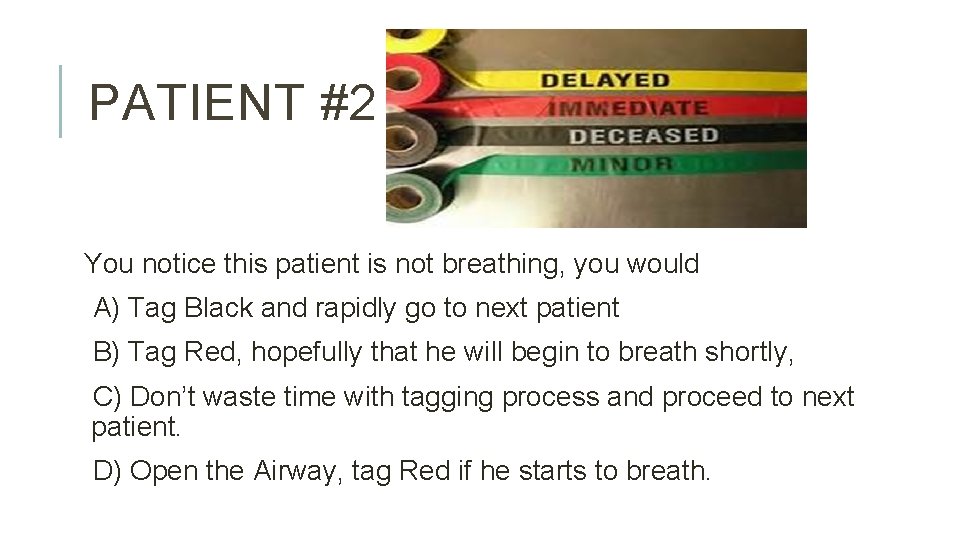
PATIENT #2 You notice this patient is not breathing, you would A) Tag Black and rapidly go to next patient B) Tag Red, hopefully that he will begin to breath shortly, C) Don’t waste time with tagging process and proceed to next patient. D) Open the Airway, tag Red if he starts to breath.
PATIENT #2 D) Open the Airway, tag Red if he starts to breath. Note: If victim does not start to breath, tag black and & move to next victim
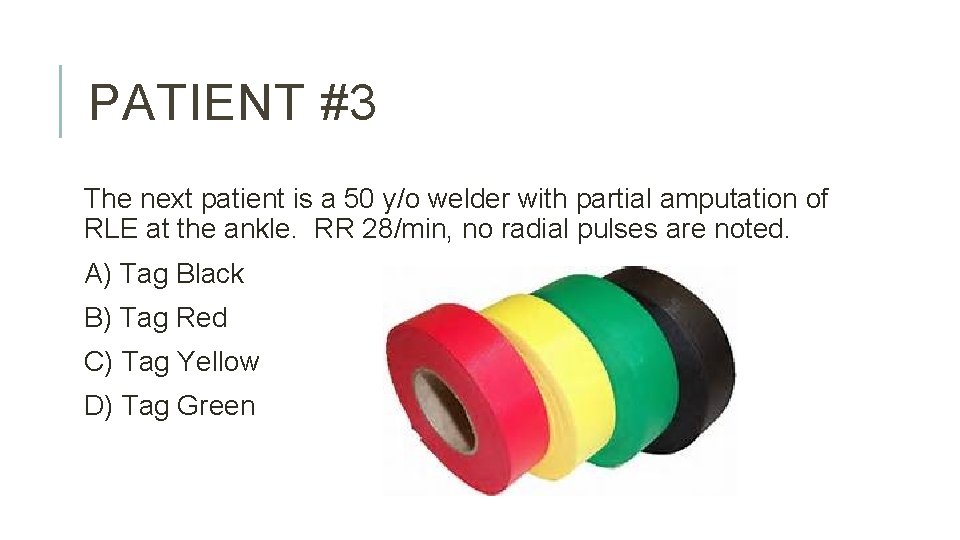
PATIENT #3 The next patient is a 50 y/o welder with partial amputation of RLE at the ankle. RR 28/min, no radial pulses are noted. A) Tag Black B) Tag Red C) Tag Yellow D) Tag Green
PATIENT #3 B) Tag Red NOTE: Victim is not ambulatory, breathing is good, but absent radial pulse confirms RED
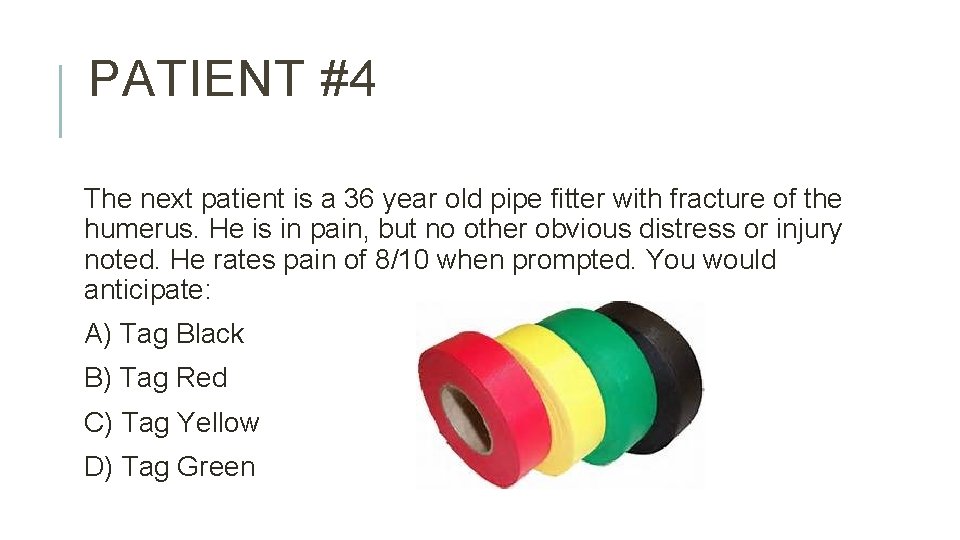
PATIENT #4 The next patient is a 36 year old pipe fitter with fracture of the humerus. He is in pain, but no other obvious distress or injury noted. He rates pain of 8/10 when prompted. You would anticipate: A) Tag Black B) Tag Red C) Tag Yellow D) Tag Green
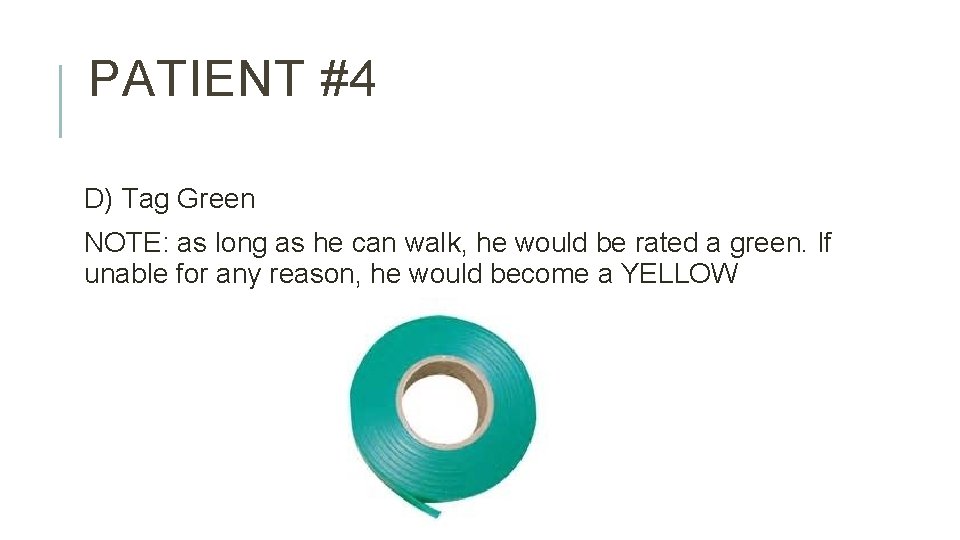
PATIENT #4 D) Tag Green NOTE: as long as he can walk, he would be rated a green. If unable for any reason, he would become a YELLOW
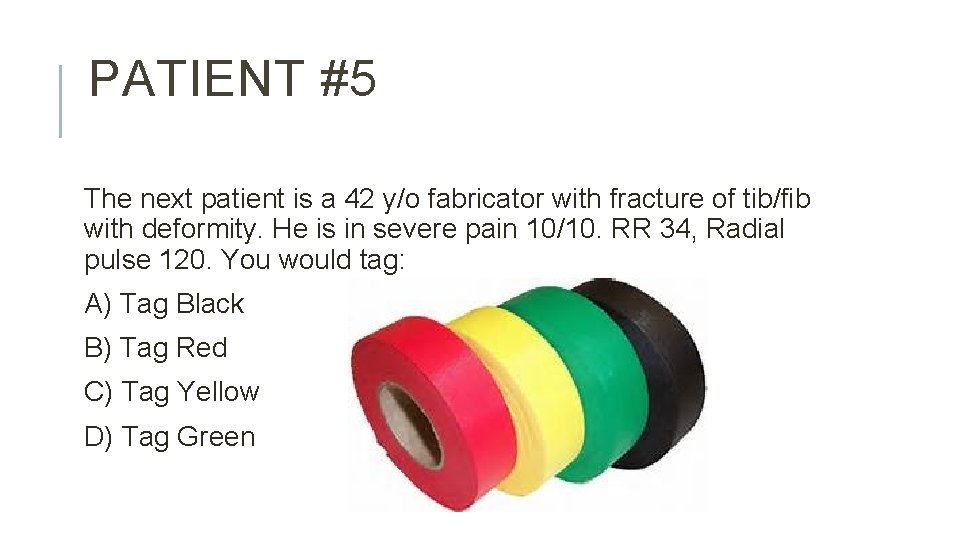
PATIENT #5 The next patient is a 42 y/o fabricator with fracture of tib/fib with deformity. He is in severe pain 10/10. RR 34, Radial pulse 120. You would tag: A) Tag Black B) Tag Red C) Tag Yellow D) Tag Green
PATIENT #5 B) Tag Red Rationale: victim unable to walk, RR>30
- Slides: 28