
Responding to a review The Response Letter Response

- Slides: 3
Responding to a review: The Response Letter • Response Letter: A letter explaining how you responded to comments from the editor and reviewer. – Brief introduction/overview. Make it brief, unless there is something special about your situation (there probably is not). Sample text: We thank the editor and reviewers for their insightful comments that have greatly improved our paper. Below, we list each comment from the editor and reviewer, followed by our response to each comment. – Most of the letter is a list of comments/responses. • Pick your battles. – Your responses should primarily be brief explanations of how you improved or clarified the MS. – Avoid lengthy explanations of why you are right and the reviewer is wrong. You can do this a few times. But if you do it over and over, you are probably asking for trouble. – The editor wants to know, in as few words as possible, how you responded to the reviewer’s comment. The editor is typically not interested in wading through lengthy technical arguments about why the reviewer is wrong. – If the reviewer is confused, that is most likely your fault. Tell the editor how you fixed the problem. If you are an editor, it is very frustrating to read a lengthy rebuttal with no indication of how the MS was changed!
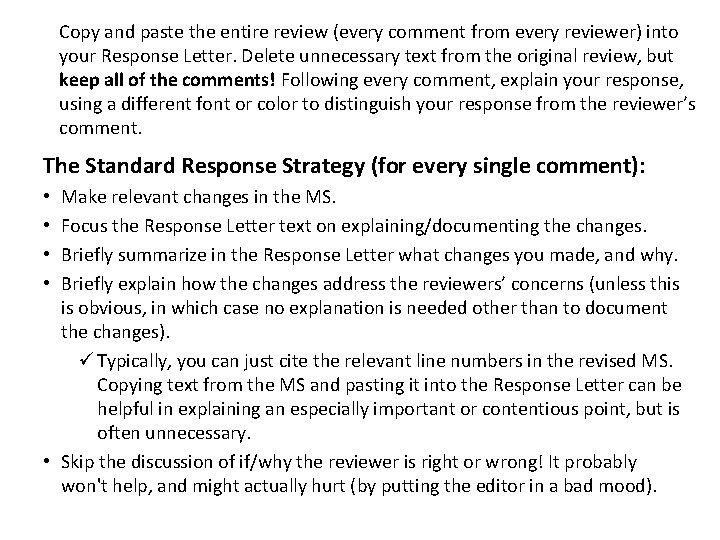
Copy and paste the entire review (every comment from every reviewer) into your Response Letter. Delete unnecessary text from the original review, but keep all of the comments! Following every comment, explain your response, using a different font or color to distinguish your response from the reviewer’s comment. The Standard Response Strategy (for every single comment): Make relevant changes in the MS. Focus the Response Letter text on explaining/documenting the changes. Briefly summarize in the Response Letter what changes you made, and why. Briefly explain how the changes address the reviewers’ concerns (unless this is obvious, in which case no explanation is needed other than to document the changes). ü Typically, you can just cite the relevant line numbers in the revised MS. Copying text from the MS and pasting it into the Response Letter can be helpful in explaining an especially important or contentious point, but is often unnecessary. • Skip the discussion of if/why the reviewer is right or wrong! It probably won't help, and might actually hurt (by putting the editor in a bad mood). • •
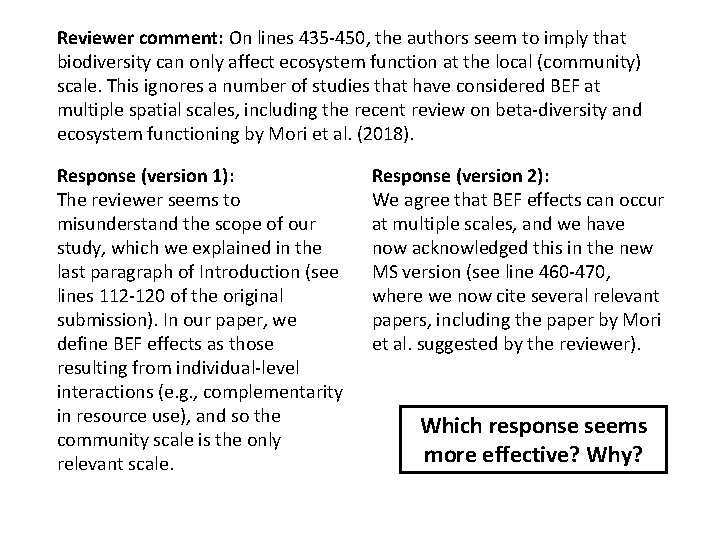
Reviewer comment: On lines 435 -450, the authors seem to imply that biodiversity can only affect ecosystem function at the local (community) scale. This ignores a number of studies that have considered BEF at multiple spatial scales, including the recent review on beta-diversity and ecosystem functioning by Mori et al. (2018). Response (version 1): The reviewer seems to misunderstand the scope of our study, which we explained in the last paragraph of Introduction (see lines 112 -120 of the original submission). In our paper, we define BEF effects as those resulting from individual-level interactions (e. g. , complementarity in resource use), and so the community scale is the only relevant scale. Response (version 2): We agree that BEF effects can occur at multiple scales, and we have now acknowledged this in the new MS version (see line 460 -470, where we now cite several relevant papers, including the paper by Mori et al. suggested by the reviewer). Which response seems more effective? Why?