
Respiratory Systems What is a respiratory system How

![Oxygen Equilibrium Curves Log[Y/(1 -Y)] vs. Log(PO 2)](https://slidetodoc.com/presentation_image_h/bdc4b399a8764f016c2322c5b29cd5f7/image-117.jpg "Oxygen Equilibrium Curves Log[Y/(1 -Y)] vs. Log(PO 2)")

- Slides: 188
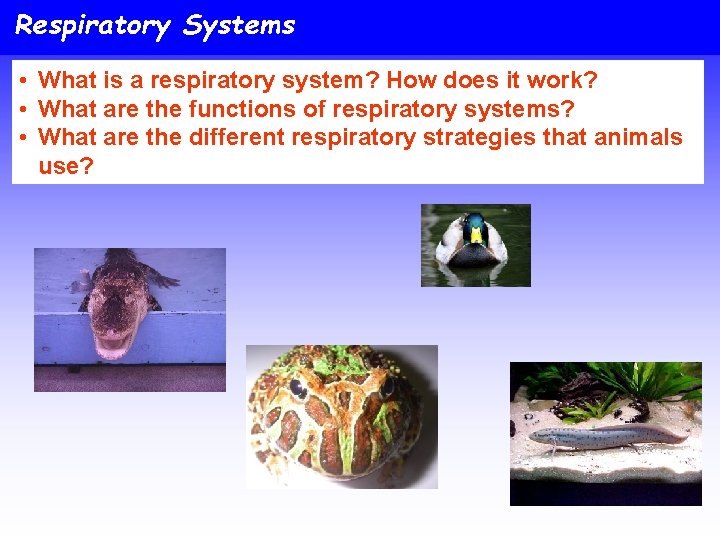
Respiratory Systems • What is a respiratory system? How does it work? • What are the functions of respiratory systems? • What are the different respiratory strategies that animals use?
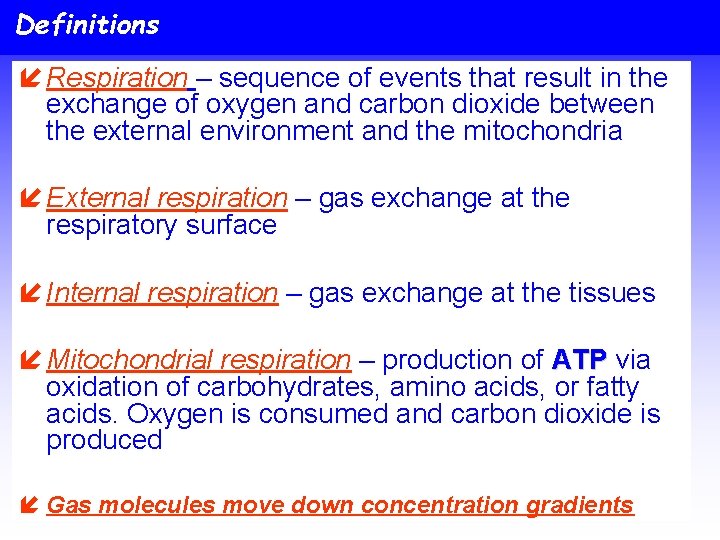
Definitions í Respiration – sequence of events that result in the exchange of oxygen and carbon dioxide between the external environment and the mitochondria í External respiration – gas exchange at the respiratory surface í Internal respiration – gas exchange at the tissues í Mitochondrial respiration – production of ATP via oxidation of carbohydrates, amino acids, or fatty acids. Oxygen is consumed and carbon dioxide is produced í Gas molecules move down concentration gradients
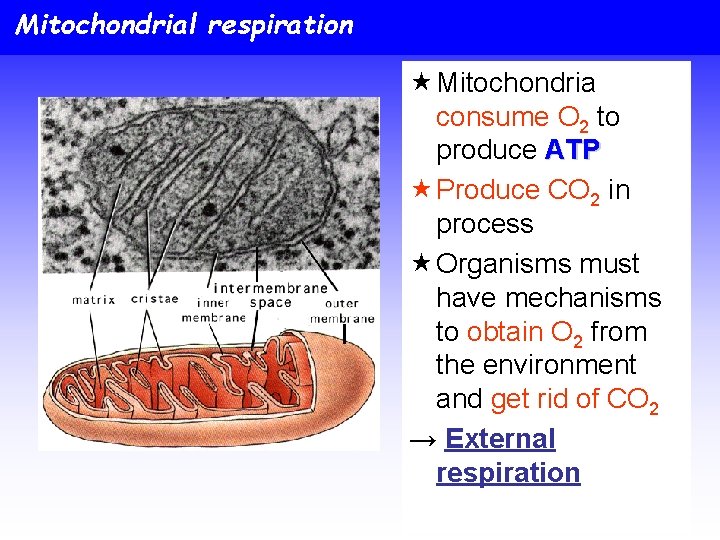
Mitochondrial respiration « Mitochondria consume O 2 to produce ATP « Produce CO 2 in process « Organisms must have mechanisms to obtain O 2 from the environment and get rid of CO 2 → External respiration
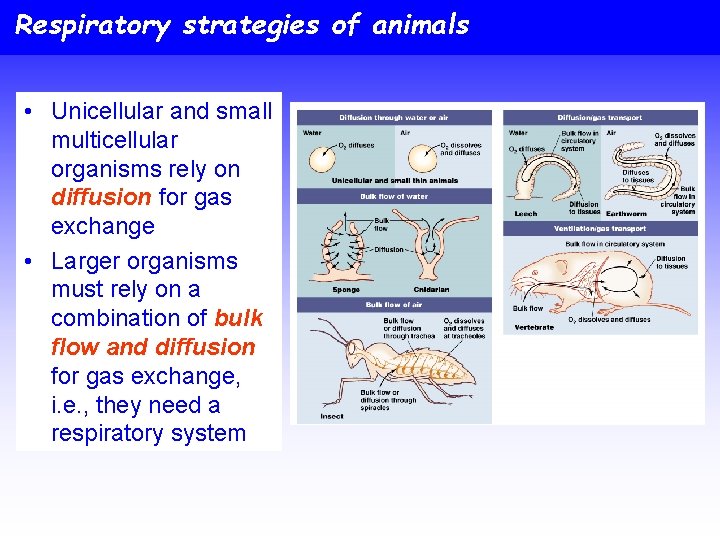
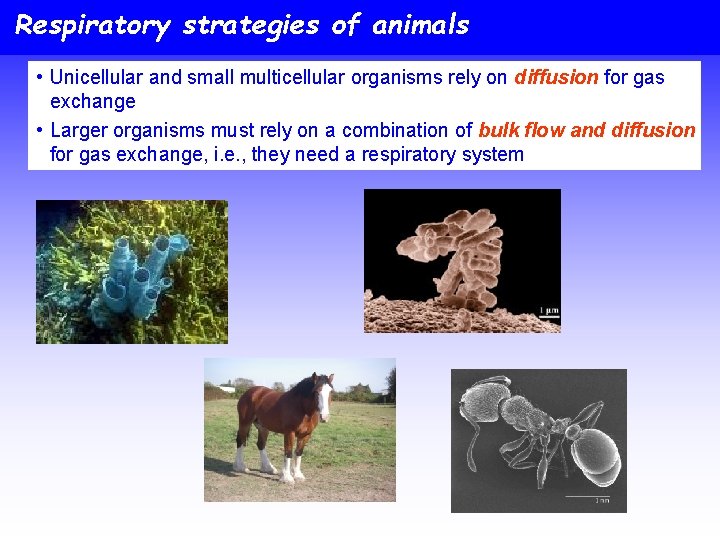
Respiratory strategies of animals • Unicellular and small multicellular organisms rely on diffusion for gas exchange • Larger organisms must rely on a combination of bulk flow and diffusion for gas exchange, i. e. , they need a respiratory system
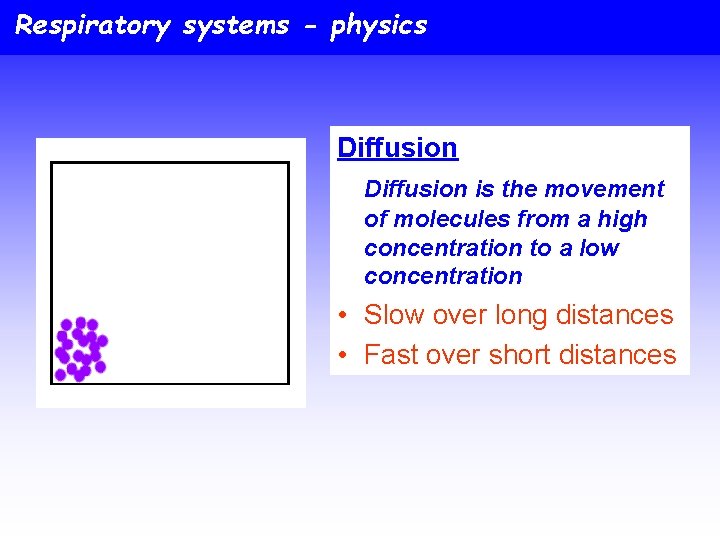
Respiratory systems - physics Diffusion is the movement of molecules from a high concentration to a low concentration • Slow over long distances • Fast over short distances
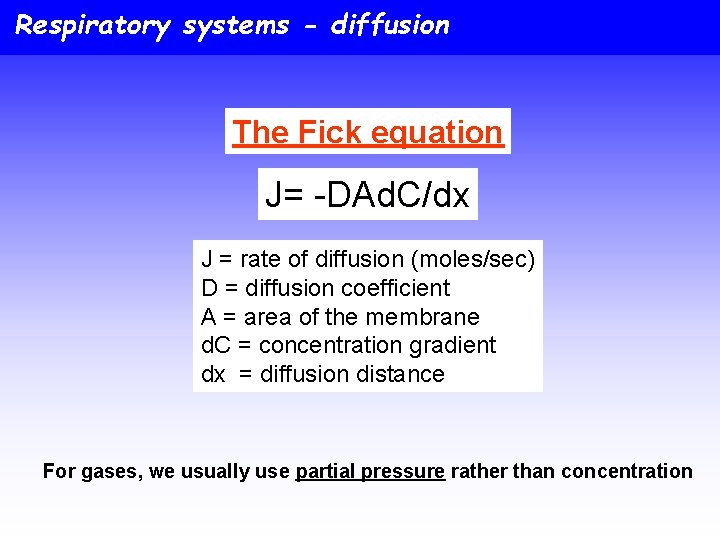
Respiratory systems - diffusion The Fick equation J= -DAd. C/dx J = rate of diffusion (moles/sec) D = diffusion coefficient A = area of the membrane d. C = concentration gradient dx = diffusion distance For gases, we usually use partial pressure rather than concentration
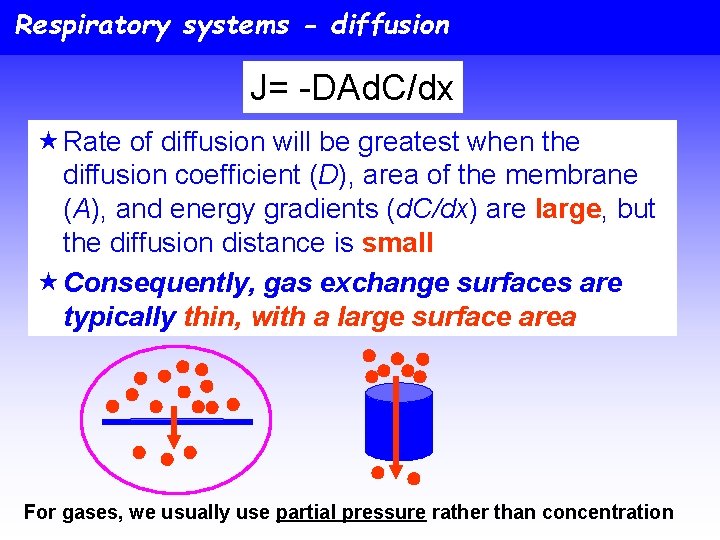
Respiratory systems - diffusion J= -DAd. C/dx « Rate of diffusion will be greatest when the diffusion coefficient (D), area of the membrane (A), and energy gradients (d. C/dx) are large, but the diffusion distance is small « Consequently, gas exchange surfaces are typically thin, with a large surface area For gases, we usually use partial pressure rather than concentration
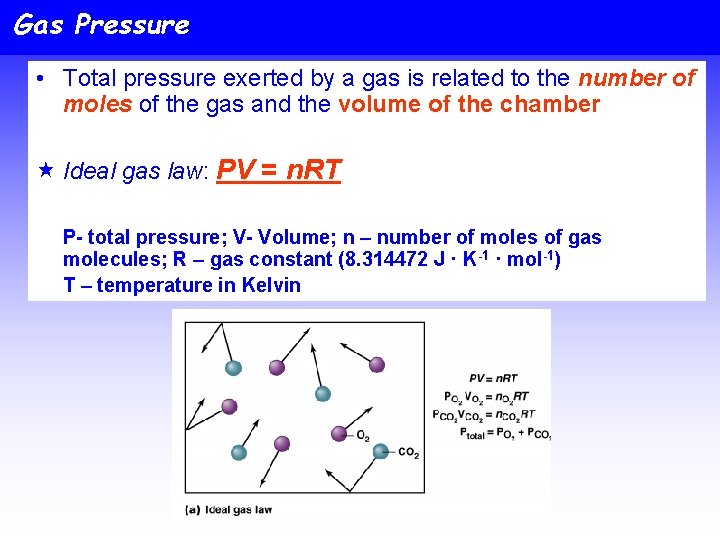
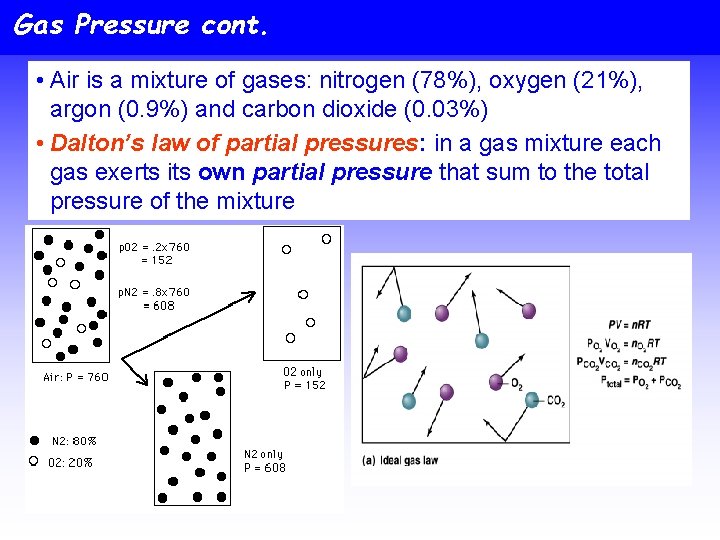
Gas Pressure • Total pressure exerted by a gas is related to the number of moles of the gas and the volume of the chamber « Ideal gas law: PV = n. RT P- total pressure; V- Volume; n – number of moles of gas molecules; R – gas constant (8. 314472 J · K-1 · mol-1) T – temperature in Kelvin
Gas Pressure cont. • Air is a mixture of gases: nitrogen (78%), oxygen (21%), argon (0. 9%) and carbon dioxide (0. 03%) • Dalton’s law of partial pressures: in a gas mixture each gas exerts its own partial pressure that sum to the total pressure of the mixture
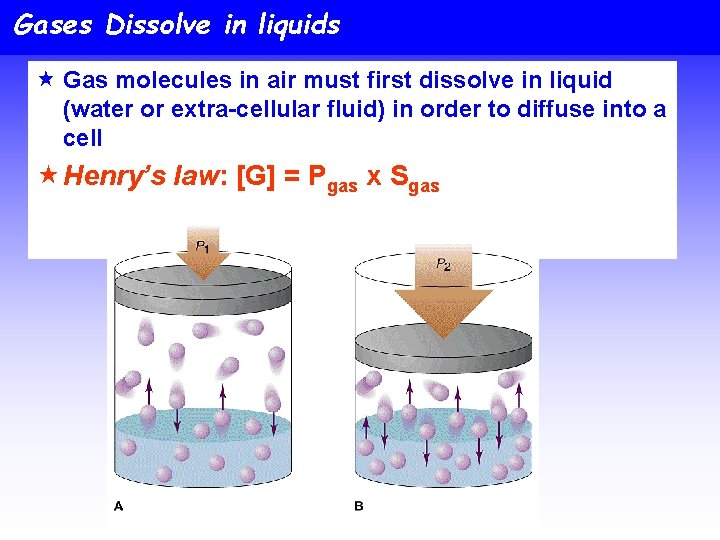
Gases Dissolve in liquids « Gas molecules in air must first dissolve in liquid (water or extra-cellular fluid) in order to diffuse into a cell « Henry’s law: [G] = Pgas x Sgas
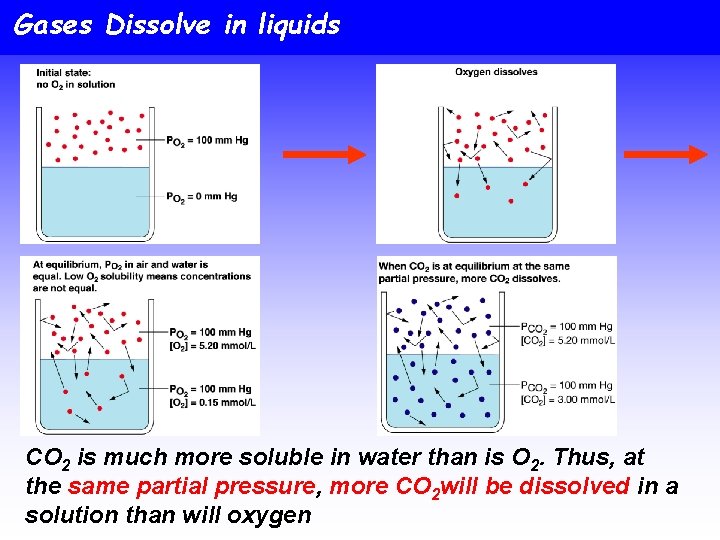
Gases Dissolve in liquids CO 2 is much more soluble in water than is O 2. Thus, at the same partial pressure, more CO 2 will be dissolved in a solution than will oxygen
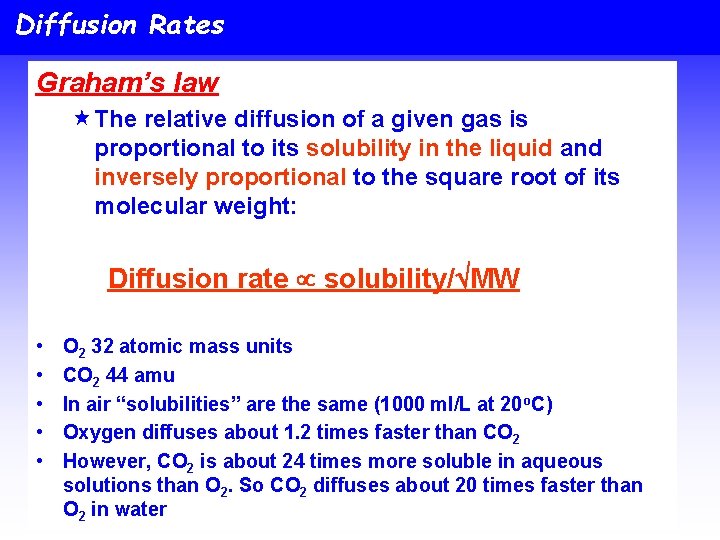
Diffusion Rates Graham’s law «The relative diffusion of a given gas is proportional to its solubility in the liquid and inversely proportional to the square root of its molecular weight: Diffusion rate solubility/ MW • • • O 2 32 atomic mass units CO 2 44 amu In air “solubilities” are the same (1000 ml/L at 20 o. C) Oxygen diffuses about 1. 2 times faster than CO 2 However, CO 2 is about 24 times more soluble in aqueous solutions than O 2. So CO 2 diffuses about 20 times faster than O 2 in water
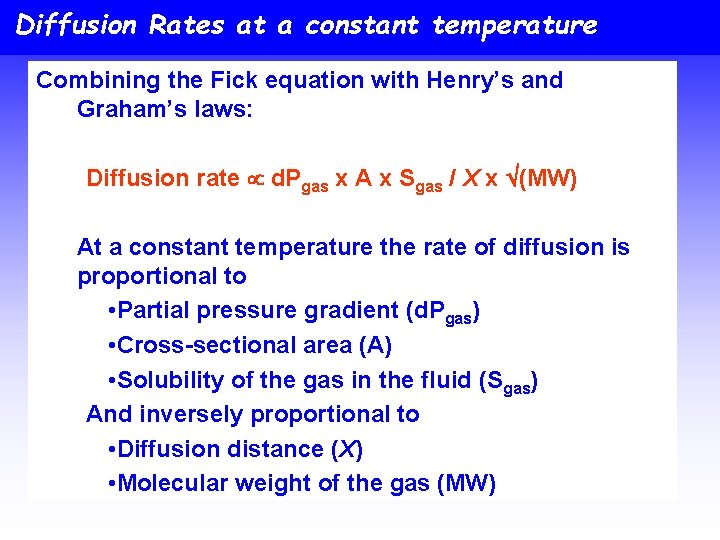
Diffusion Rates at a constant temperature Combining the Fick equation with Henry’s and Graham’s laws: Diffusion rate d. Pgas x A x Sgas / X x (MW) At a constant temperature the rate of diffusion is proportional to • Partial pressure gradient (d. Pgas) • Cross-sectional area (A) • Solubility of the gas in the fluid (Sgas) And inversely proportional to • Diffusion distance (X) • Molecular weight of the gas (MW)
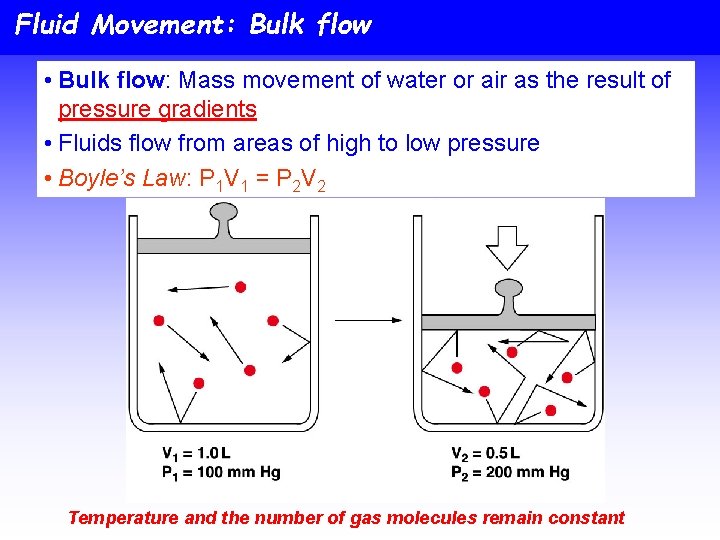
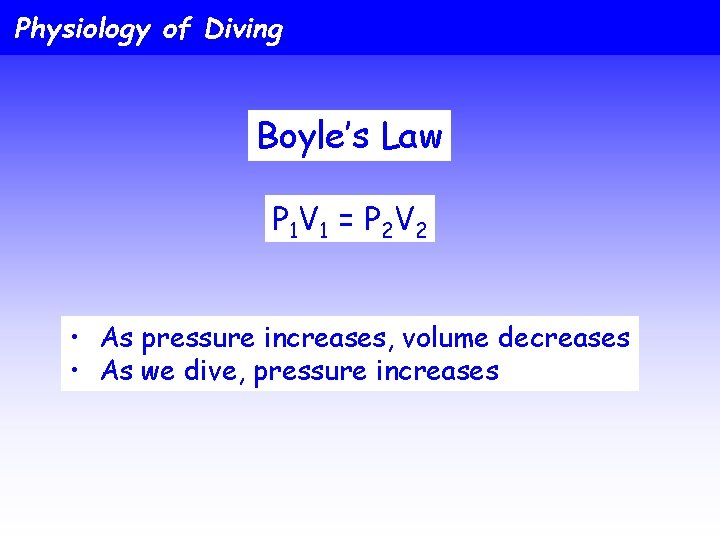
Fluid Movement: Bulk flow • Bulk flow: Mass movement of water or air as the result of pressure gradients • Fluids flow from areas of high to low pressure • Boyle’s Law: P 1 V 1 = P 2 V 2 Temperature and the number of gas molecules remain constant
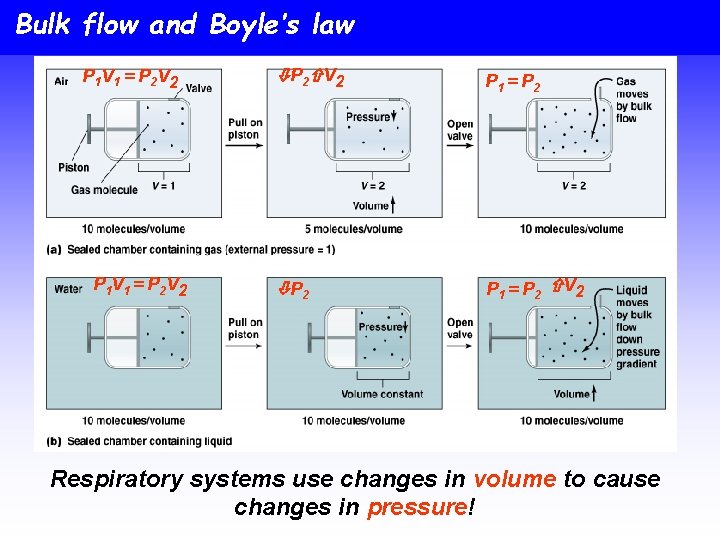
Bulk flow and Boyle’s law P 1 V 1 = P 2 V 2 P 2 V 2 P 1 = P 2 V 2 Respiratory systems use changes in volume to cause changes in pressure!
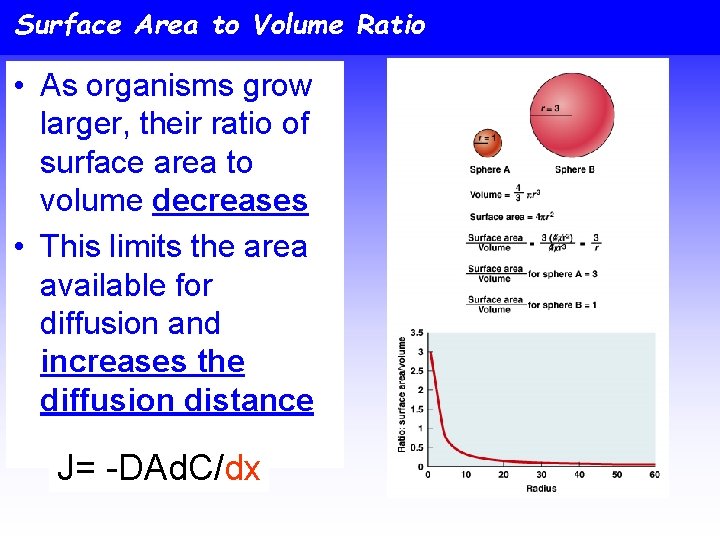
Surface Area to Volume Ratio • As organisms grow larger, their ratio of surface area to volume decreases • This limits the area available for diffusion and increases the diffusion distance J= -DAd. C/dx
Respiratory strategies of animals • Unicellular and small multicellular organisms rely on diffusion for gas exchange • Larger organisms must rely on a combination of bulk flow and diffusion for gas exchange, i. e. , they need a respiratory system
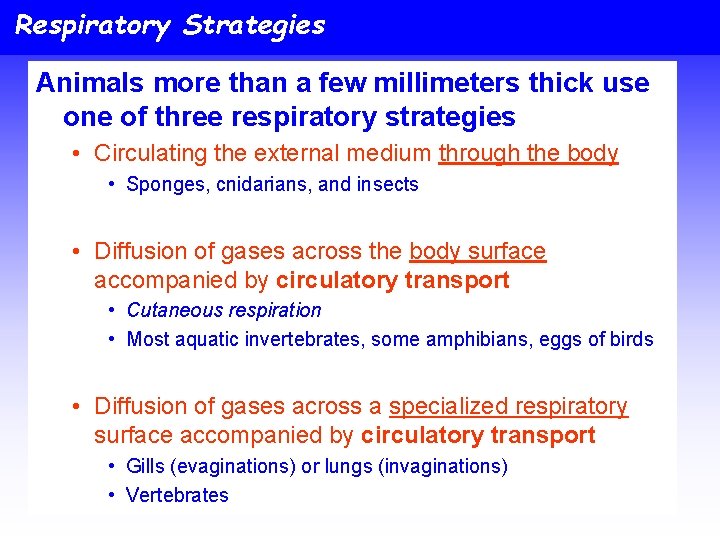
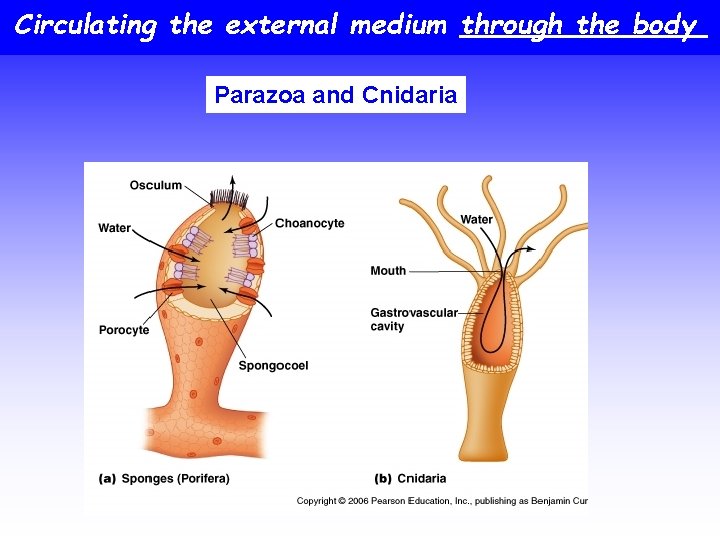
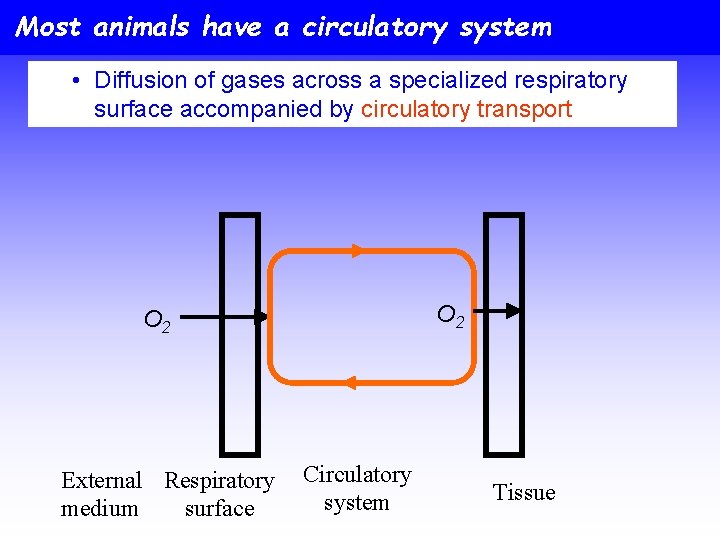
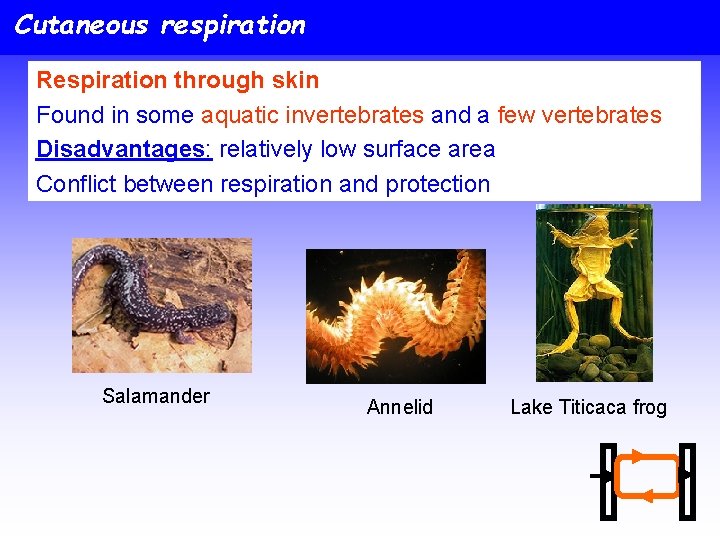
Respiratory Strategies Animals more than a few millimeters thick use one of three respiratory strategies • Circulating the external medium through the body • Sponges, cnidarians, and insects • Diffusion of gases across the body surface accompanied by circulatory transport • Cutaneous respiration • Most aquatic invertebrates, some amphibians, eggs of birds • Diffusion of gases across a specialized respiratory surface accompanied by circulatory transport • Gills (evaginations) or lungs (invaginations) • Vertebrates
Circulating the external medium through the body Parazoa and Cnidaria
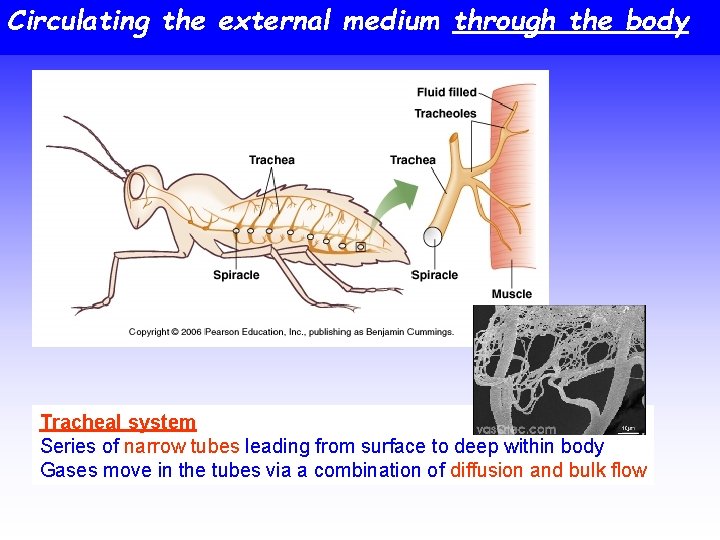
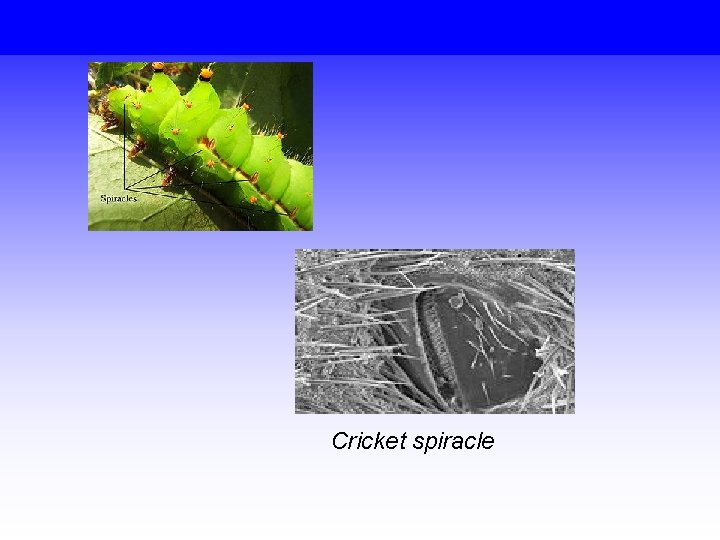
Circulating the external medium through the body Tracheal system Series of narrow tubes leading from surface to deep within body Gases move in the tubes via a combination of diffusion and bulk flow
Cricket spiracle
Most animals have a circulatory system • Diffusion of gases across a specialized respiratory surface accompanied by circulatory transport O 2 External Respiratory medium surface Circulatory system Tissue
Cutaneous respiration Respiration through skin Found in some aquatic invertebrates and a few vertebrates Disadvantages: relatively low surface area Conflict between respiration and protection Salamander Annelid Lake Titicaca frog
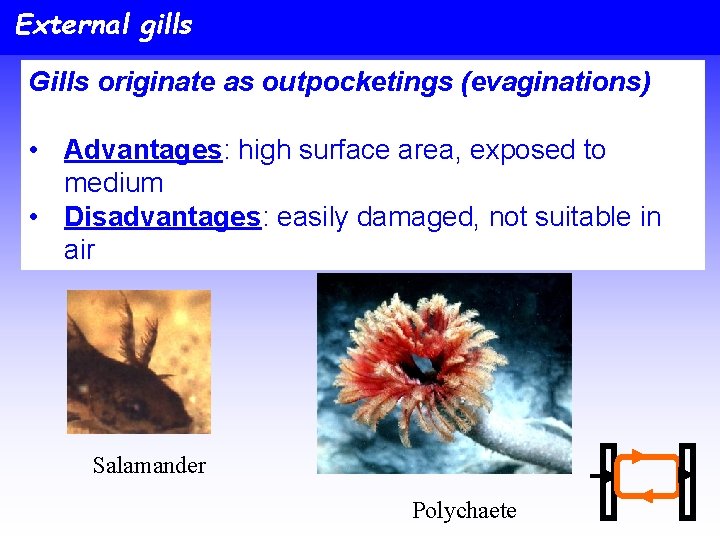
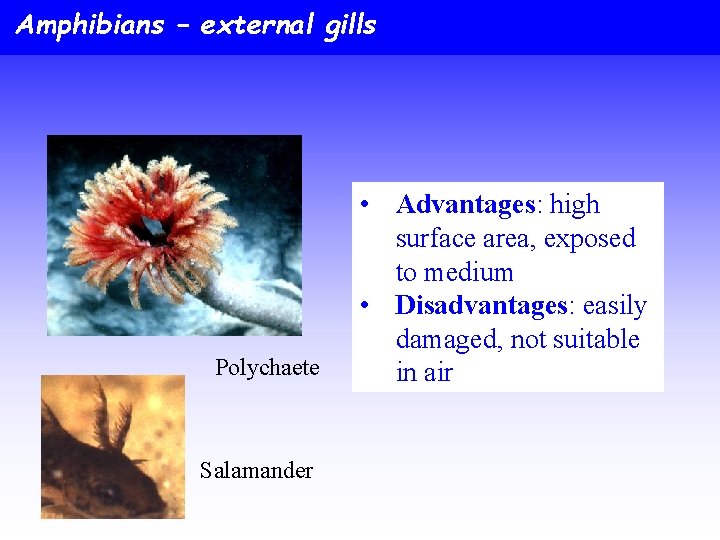
External gills Gills originate as outpocketings (evaginations) • Advantages: high surface area, exposed to medium • Disadvantages: easily damaged, not suitable in air Salamander Polychaete
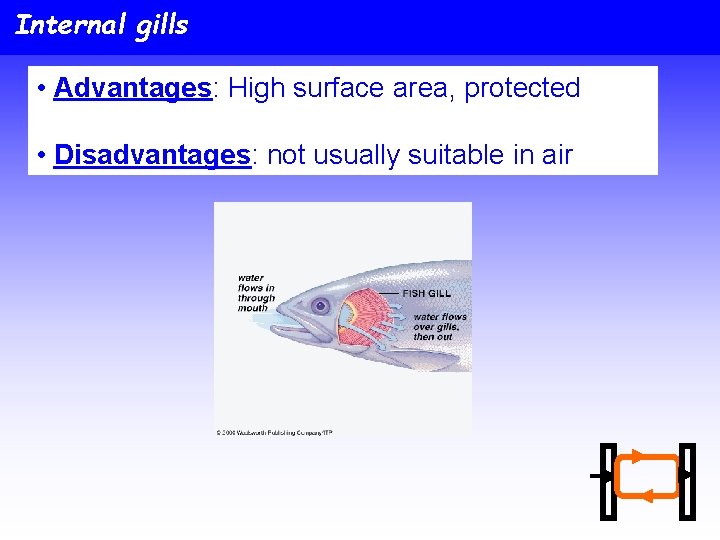
Internal gills • Advantages: High surface area, protected • Disadvantages: not usually suitable in air
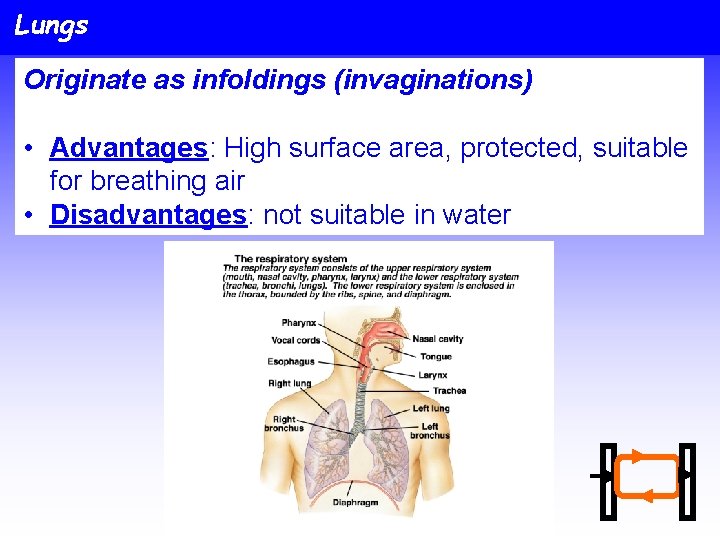
Lungs Originate as infoldings (invaginations) • Advantages: High surface area, protected, suitable for breathing air • Disadvantages: not suitable in water
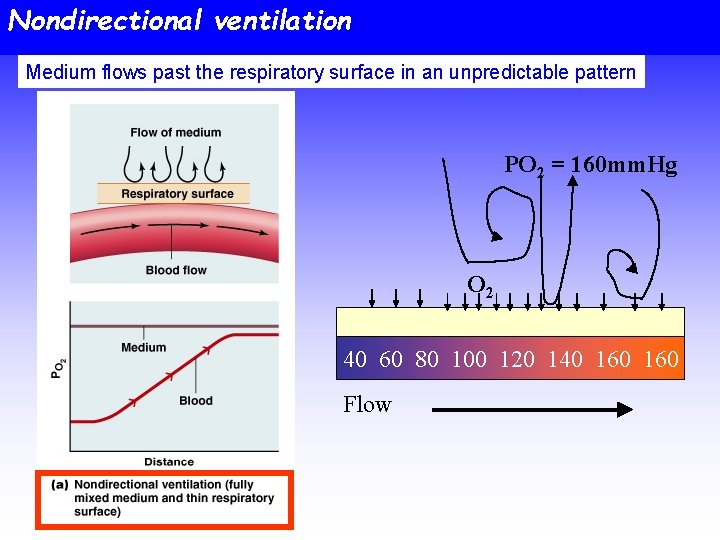
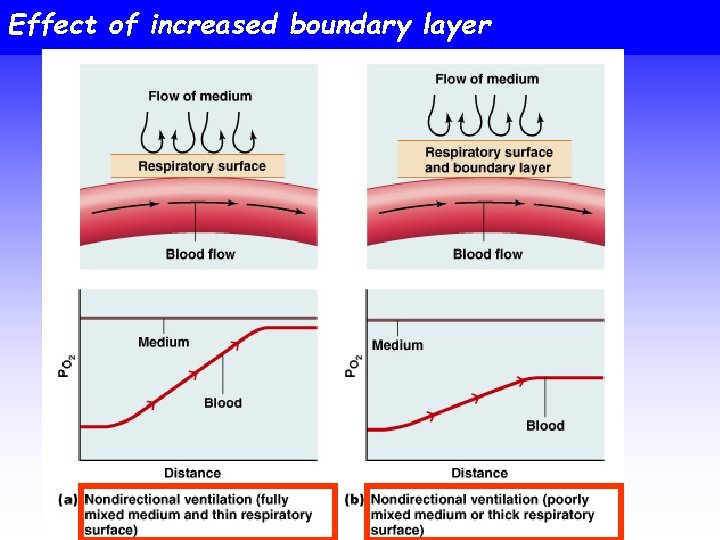
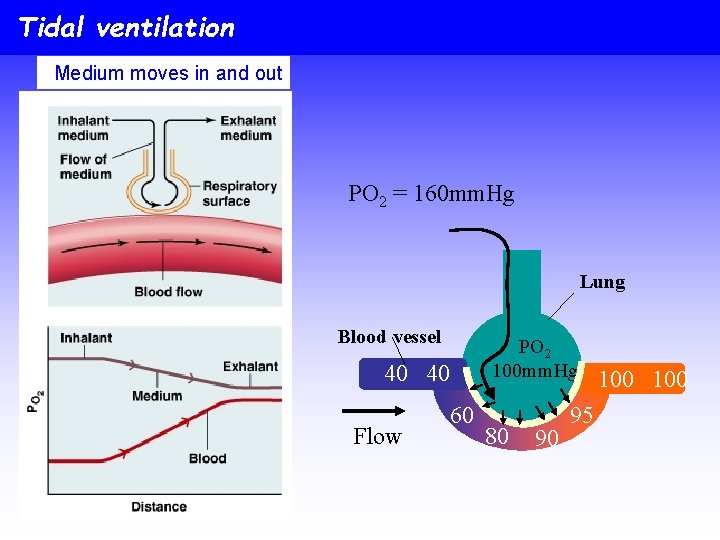
Ventilation « The active movement of the respiratory medium (air or water) across the respiratory surface « Ventilation of respiratory surfaces reduces the formation of static boundary layers i. e. improves efficiency of gas exchange Types of ventilation • Nondirectional - medium flows past the respiratory surface in an unpredictable pattern • Tidal - medium moves in and out • Unidirectional - medium enters the chamber at one point and exits at another Animals respond to changes in environmental oxygen or metabolic demands by altering the rate or pattern of ventilation
Nondirectional ventilation Medium flows past the respiratory surface in an unpredictable pattern PO 2 = 160 mm. Hg O 2 40 60 80 100 120 140 160 Flow
Effect of increased boundary layer
Tidal ventilation Medium moves in and out PO 2 = 160 mm. Hg Lung Blood vessel PO 2 100 mm. Hg 40 40 Flow 60 80 90 95 100
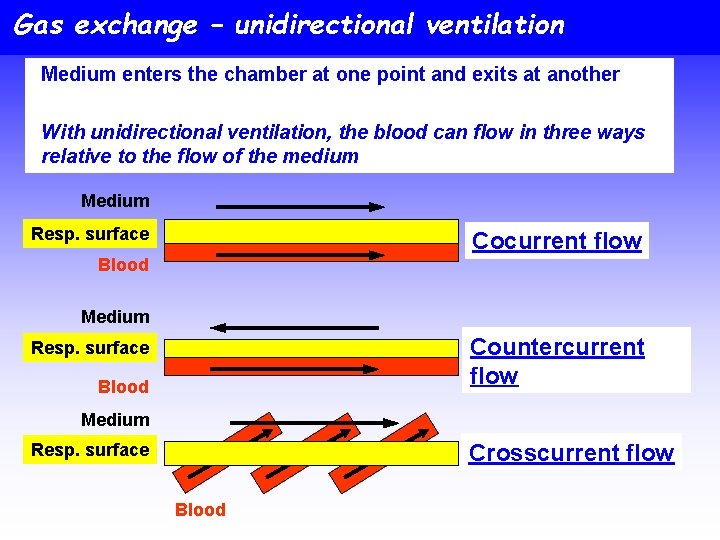
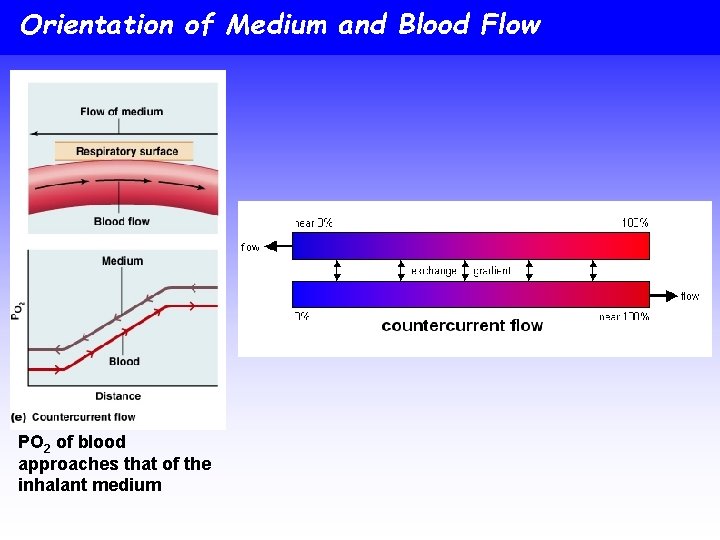
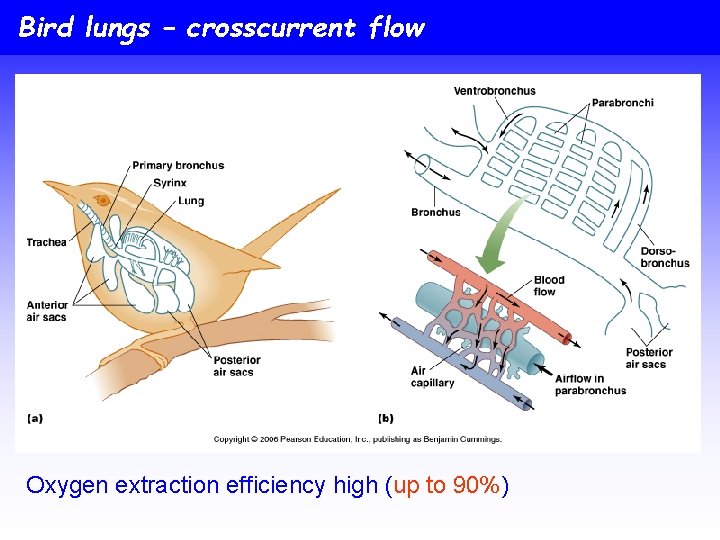
Gas exchange – unidirectional ventilation Medium enters the chamber at one point and exits at another With unidirectional ventilation, the blood can flow in three ways relative to the flow of the medium Medium Resp. surface Cocurrent flow Blood Medium Countercurrent flow Resp. surface Blood Medium Crosscurrent flow Resp. surface Blood
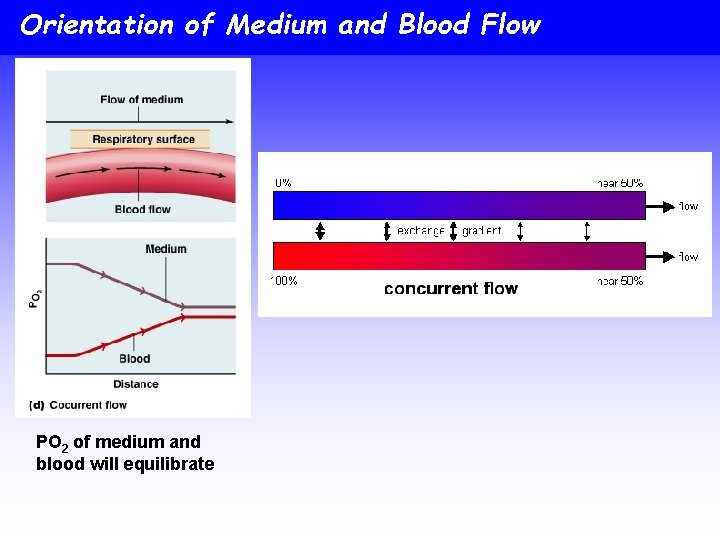
Orientation of Medium and Blood Flow PO 2 of medium and blood will equilibrate
Orientation of Medium and Blood Flow PO 2 of blood approaches that of the inhalant medium
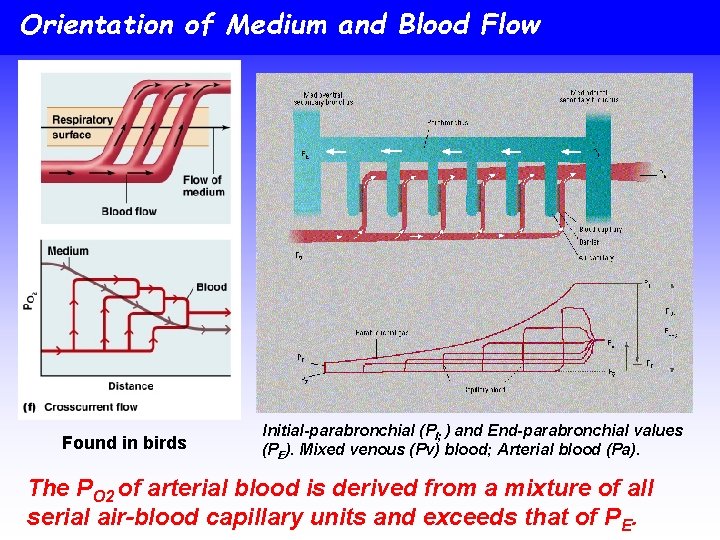
Orientation of Medium and Blood Flow Found in birds Initial-parabronchial (PI; ) and End-parabronchial values (PE). Mixed venous (Pv) blood; Arterial blood (Pa). The PO 2 of arterial blood is derived from a mixture of all serial air-blood capillary units and exceeds that of PE.
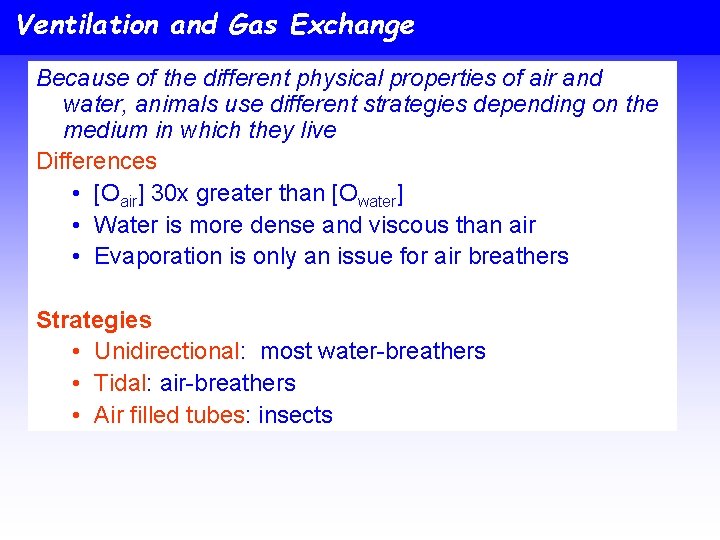
Ventilation and Gas Exchange Because of the different physical properties of air and water, animals use different strategies depending on the medium in which they live Differences • [Oair] 30 x greater than [Owater] • Water is more dense and viscous than air • Evaporation is only an issue for air breathers Strategies • Unidirectional: most water-breathers • Tidal: air-breathers • Air filled tubes: insects
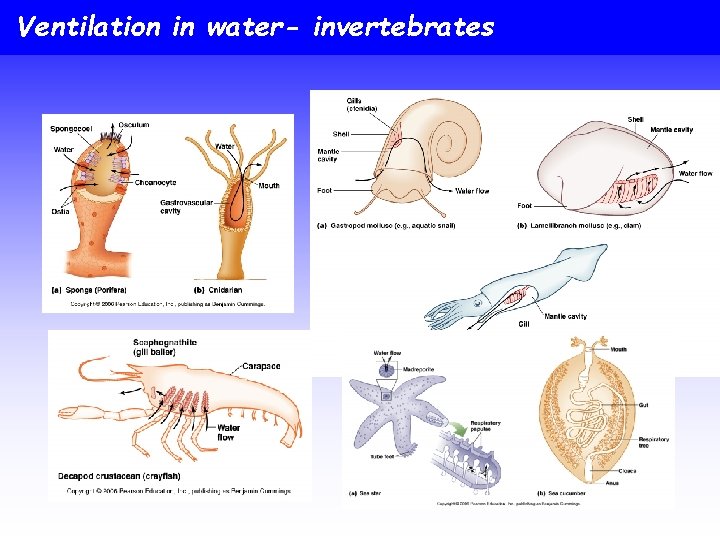
Ventilation and Gas Exchange in Water Strategies • Circulate the external medium through an internal cavity • Various strategies for ventilating internal and external gills
Ventilation in water- invertebrates
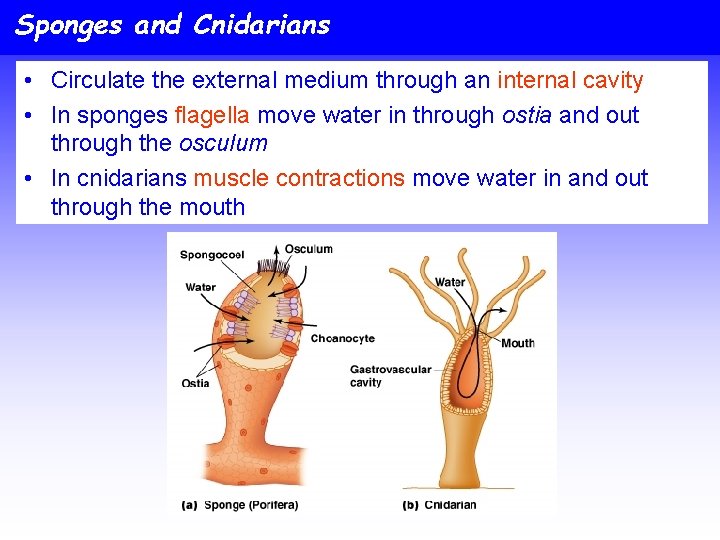
Sponges and Cnidarians • Circulate the external medium through an internal cavity • In sponges flagella move water in through ostia and out through the osculum • In cnidarians muscle contractions move water in and out through the mouth
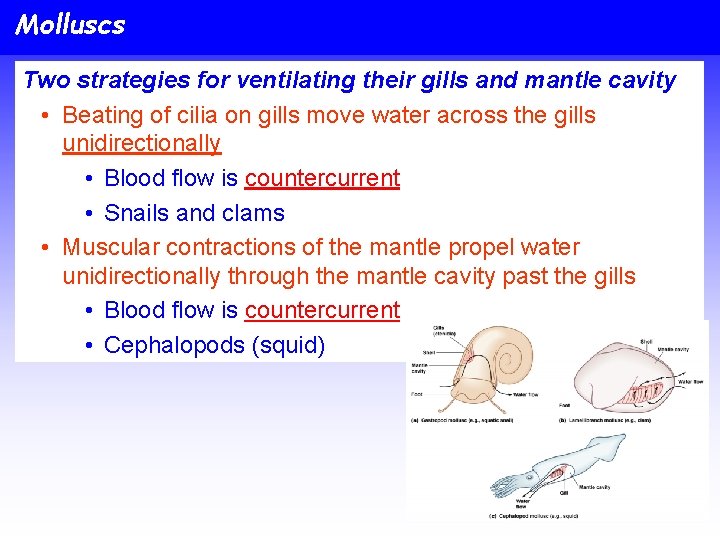
Molluscs Two strategies for ventilating their gills and mantle cavity • Beating of cilia on gills move water across the gills unidirectionally • Blood flow is countercurrent • Snails and clams • Muscular contractions of the mantle propel water unidirectionally through the mantle cavity past the gills • Blood flow is countercurrent • Cephalopods (squid)
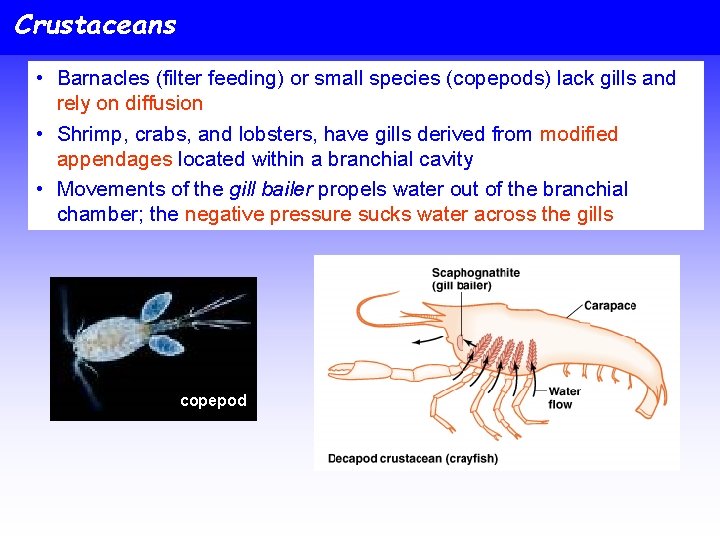
Crustaceans • Barnacles (filter feeding) or small species (copepods) lack gills and rely on diffusion • Shrimp, crabs, and lobsters, have gills derived from modified appendages located within a branchial cavity • Movements of the gill bailer propels water out of the branchial chamber; the negative pressure sucks water across the gills copepod
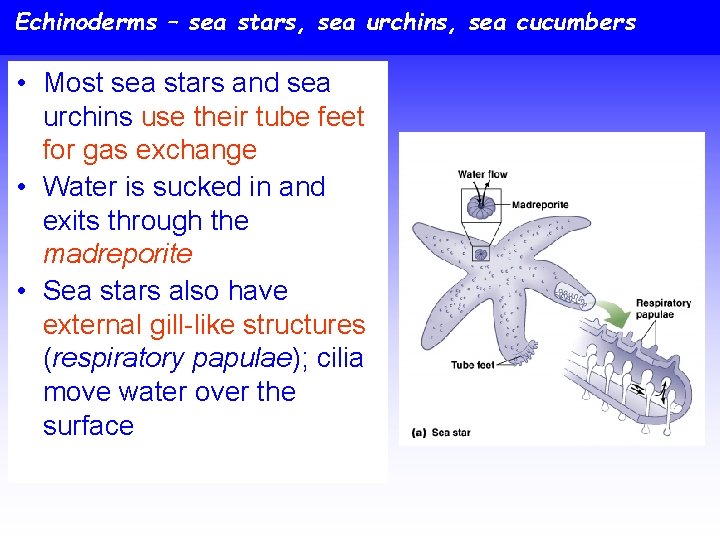
Echinoderms – sea stars, sea urchins, sea cucumbers • Most sea stars and sea urchins use their tube feet for gas exchange • Water is sucked in and exits through the madreporite • Sea stars also have external gill-like structures (respiratory papulae); cilia move water over the surface
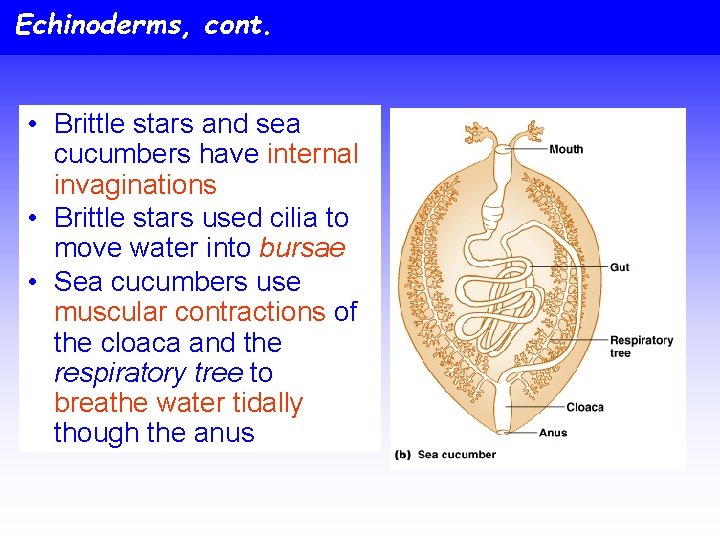
Echinoderms, cont. • Brittle stars and sea cucumbers have internal invaginations • Brittle stars used cilia to move water into bursae • Sea cucumbers use muscular contractions of the cloaca and the respiratory tree to breathe water tidally though the anus
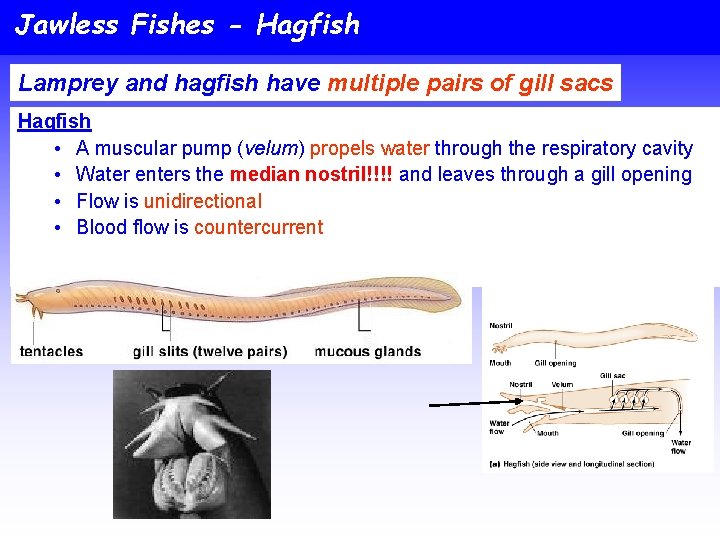
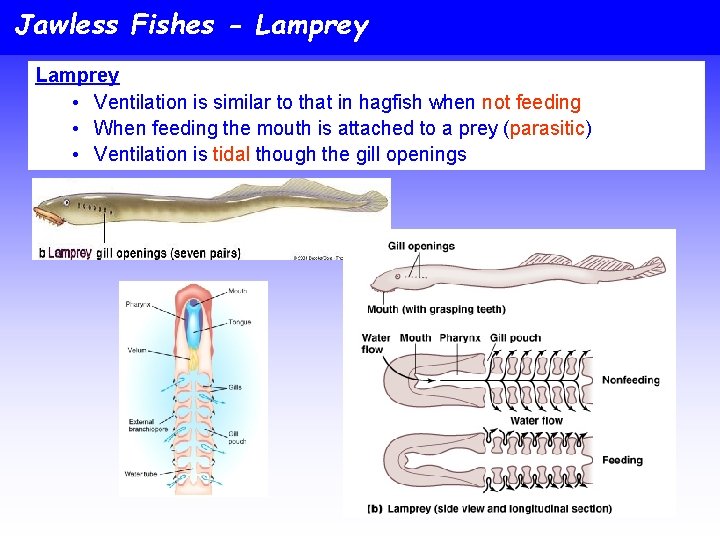
Jawless Fishes - Hagfish Lamprey and hagfish have multiple pairs of gill sacs Hagfish • A muscular pump (velum) propels water through the respiratory cavity • Water enters the median nostril!!!! and leaves through a gill opening • Flow is unidirectional • Blood flow is countercurrent
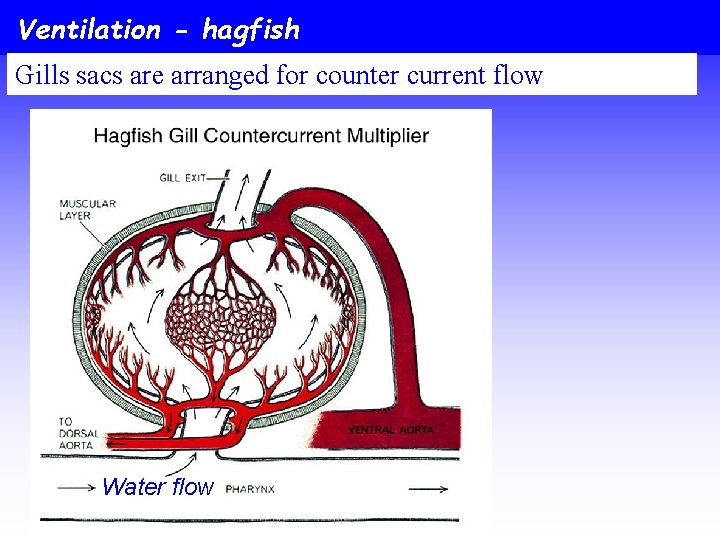
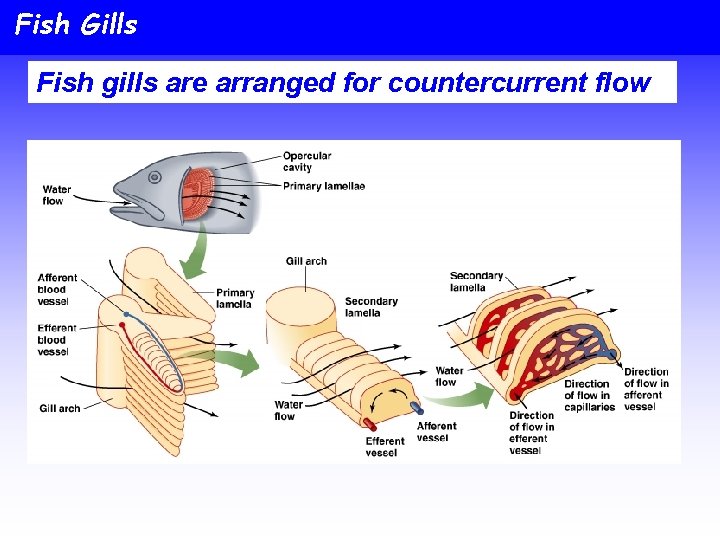
Ventilation - hagfish Gills sacs are arranged for counter current flow Water flow
Jawless Fishes - Lamprey • Ventilation is similar to that in hagfish when not feeding • When feeding the mouth is attached to a prey (parasitic) • Ventilation is tidal though the gill openings
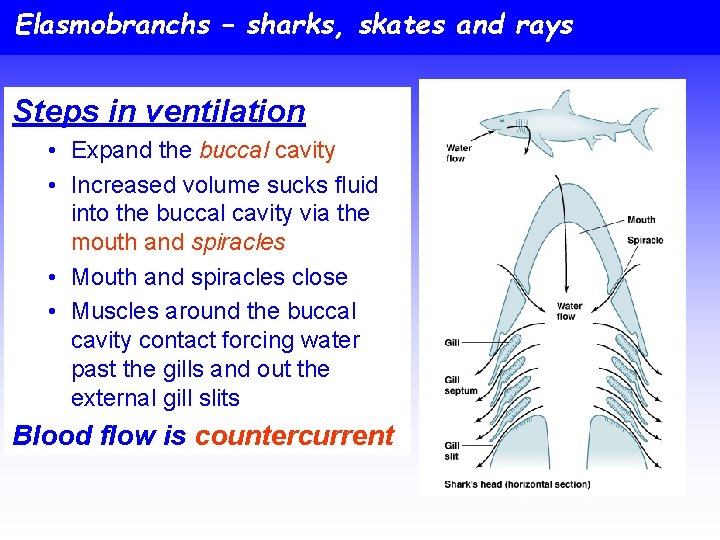
Elasmobranchs – sharks, skates and rays Steps in ventilation • Expand the buccal cavity • Increased volume sucks fluid into the buccal cavity via the mouth and spiracles • Mouth and spiracles close • Muscles around the buccal cavity contact forcing water past the gills and out the external gill slits Blood flow is countercurrent
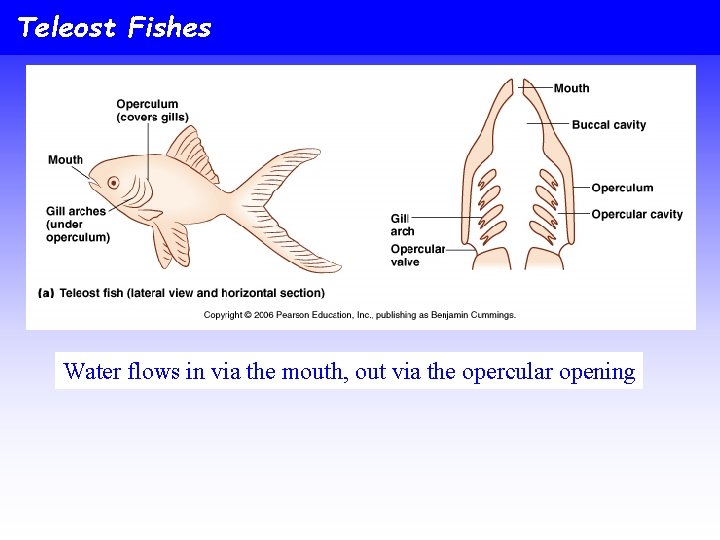
Teleost Fishes Water flows in via the mouth, out via the opercular opening
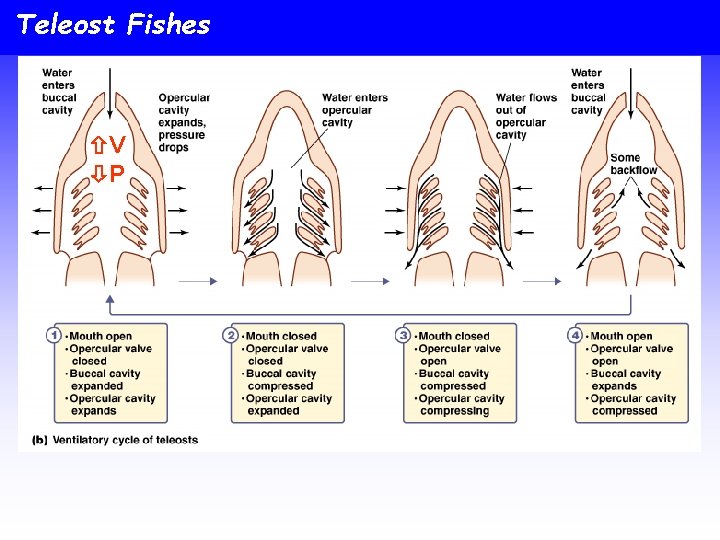
Teleost Fishes V P
Fish Gills Fish gills are arranged for countercurrent flow
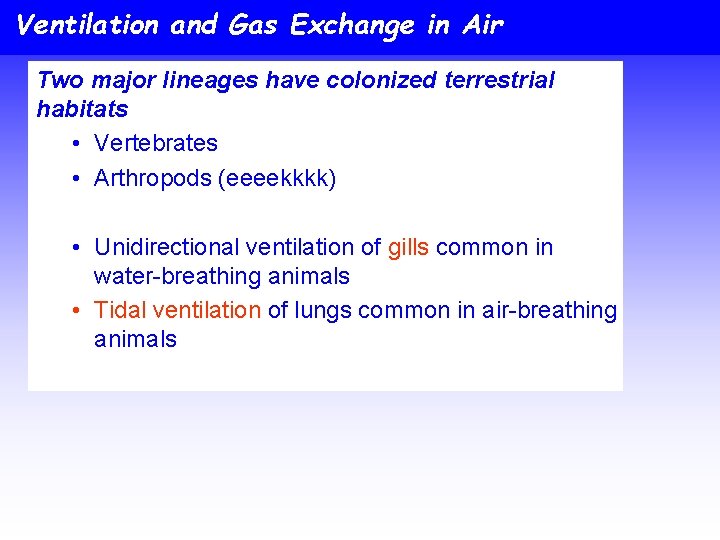
Ventilation and Gas Exchange in Air Two major lineages have colonized terrestrial habitats • Vertebrates • Arthropods (eeeekkkk) • Unidirectional ventilation of gills common in water-breathing animals • Tidal ventilation of lungs common in air-breathing animals
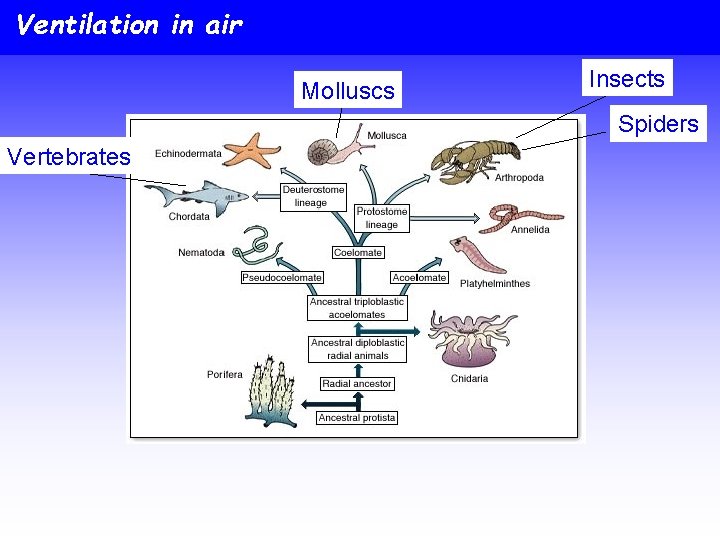
Ventilation in air Molluscs Insects Spiders Vertebrates
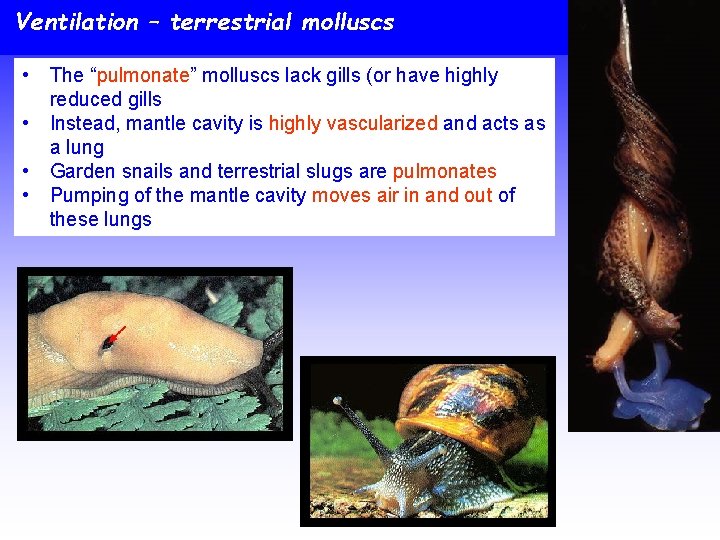
Ventilation – terrestrial molluscs • • The “pulmonate” molluscs lack gills (or have highly reduced gills Instead, mantle cavity is highly vascularized and acts as a lung Garden snails and terrestrial slugs are pulmonates Pumping of the mantle cavity moves air in and out of these lungs
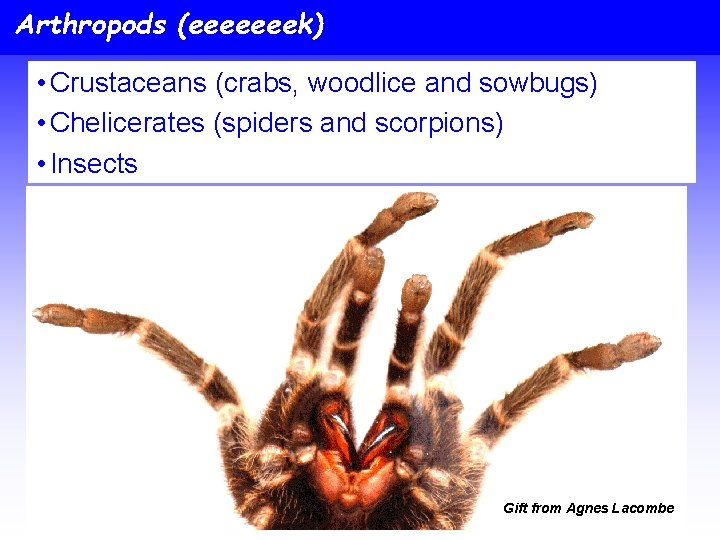
Arthropods (eeeeeeek) • Crustaceans (crabs, woodlice and sowbugs) • Chelicerates (spiders and scorpions) • Insects Gift from Agnes Lacombe
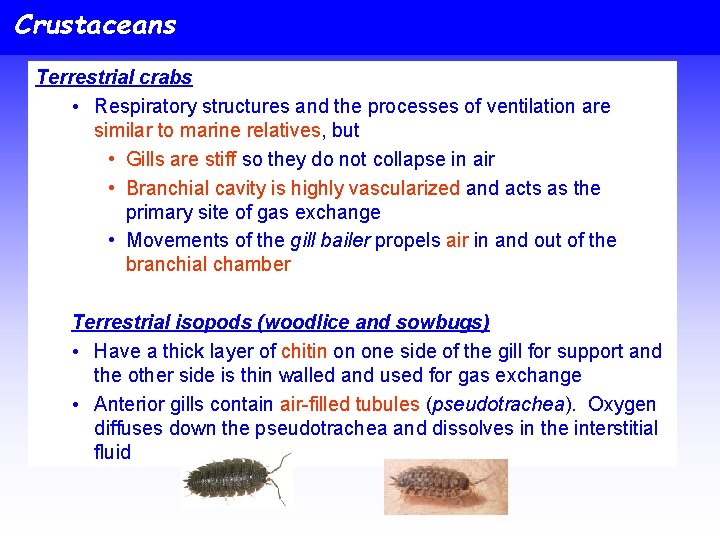
Crustaceans Terrestrial crabs • Respiratory structures and the processes of ventilation are similar to marine relatives, but • Gills are stiff so they do not collapse in air • Branchial cavity is highly vascularized and acts as the primary site of gas exchange • Movements of the gill bailer propels air in and out of the branchial chamber Terrestrial isopods (woodlice and sowbugs) • Have a thick layer of chitin on one side of the gill for support and the other side is thin walled and used for gas exchange • Anterior gills contain air-filled tubules (pseudotrachea). Oxygen diffuses down the pseudotrachea and dissolves in the interstitial fluid
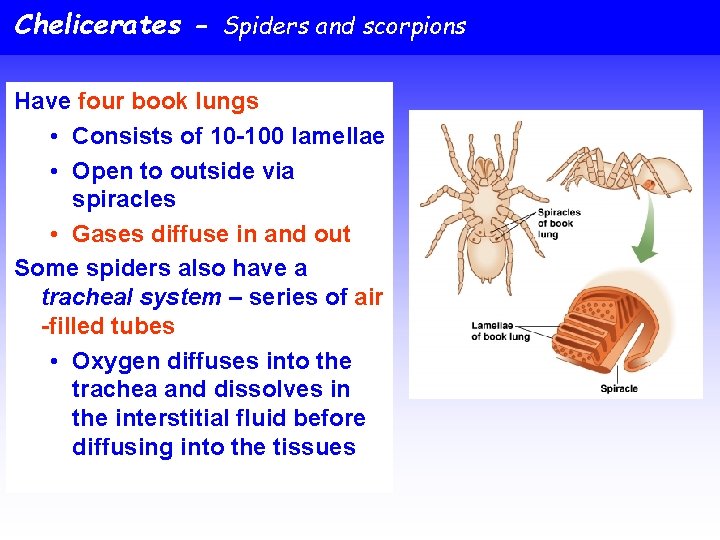
Chelicerates - Spiders and scorpions Have four book lungs • Consists of 10 -100 lamellae • Open to outside via spiracles • Gases diffuse in and out Some spiders also have a tracheal system – series of air -filled tubes • Oxygen diffuses into the trachea and dissolves in the interstitial fluid before diffusing into the tissues
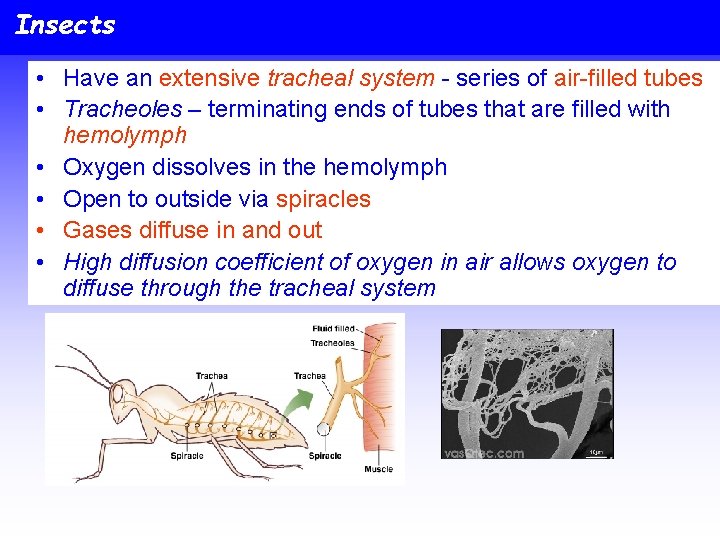
Insects • Have an extensive tracheal system - series of air-filled tubes • Tracheoles – terminating ends of tubes that are filled with hemolymph • Oxygen dissolves in the hemolymph • Open to outside via spiracles • Gases diffuse in and out • High diffusion coefficient of oxygen in air allows oxygen to diffuse through the tracheal system
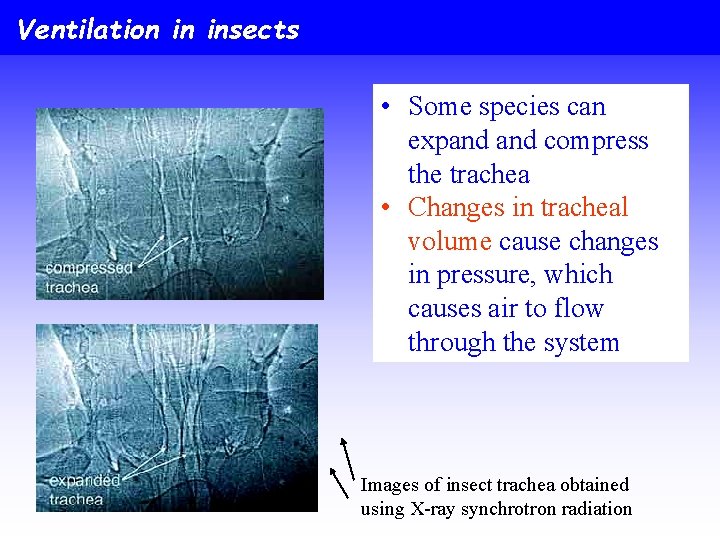
Ventilation in insects • Some species can expand compress the trachea • Changes in tracheal volume cause changes in pressure, which causes air to flow through the system Images of insect trachea obtained using X-ray synchrotron radiation
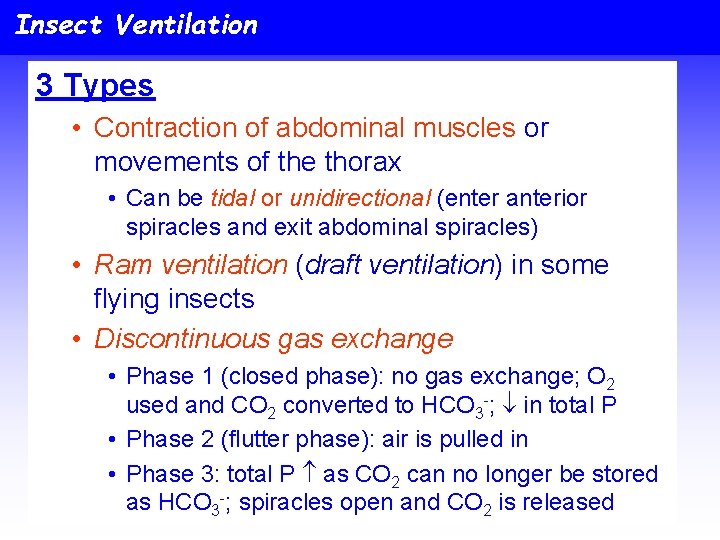
Insect Ventilation 3 Types • Contraction of abdominal muscles or movements of the thorax • Can be tidal or unidirectional (enter anterior spiracles and exit abdominal spiracles) • Ram ventilation (draft ventilation) in some flying insects • Discontinuous gas exchange • Phase 1 (closed phase): no gas exchange; O 2 used and CO 2 converted to HCO 3 -; in total P • Phase 2 (flutter phase): air is pulled in • Phase 3: total P as CO 2 can no longer be stored as HCO 3 -; spiracles open and CO 2 is released
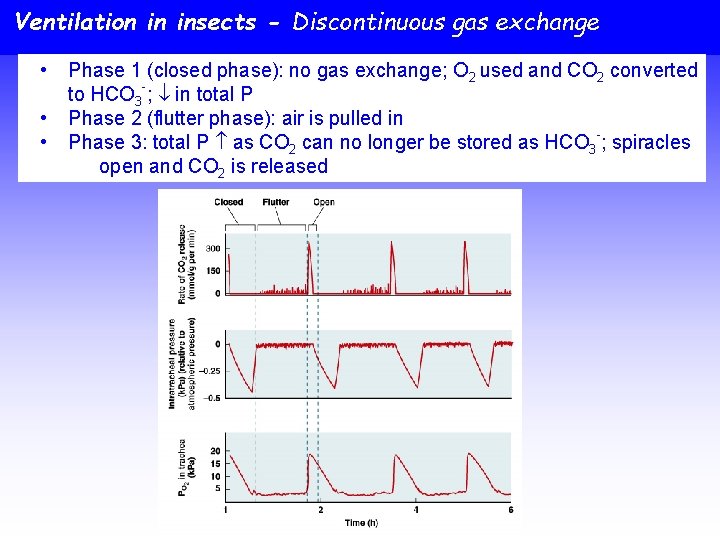
Ventilation in insects - Discontinuous gas exchange • • • Phase 1 (closed phase): no gas exchange; O 2 used and CO 2 converted to HCO 3 -; in total P Phase 2 (flutter phase): air is pulled in Phase 3: total P as CO 2 can no longer be stored as HCO 3 -; spiracles open and CO 2 is released
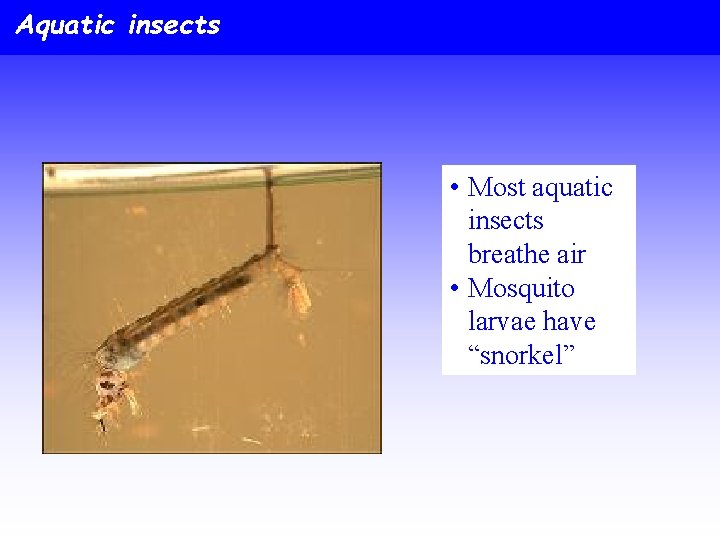
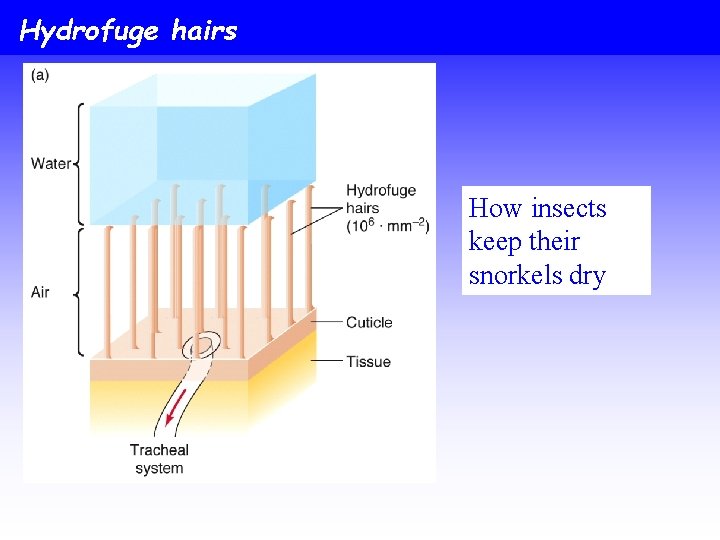
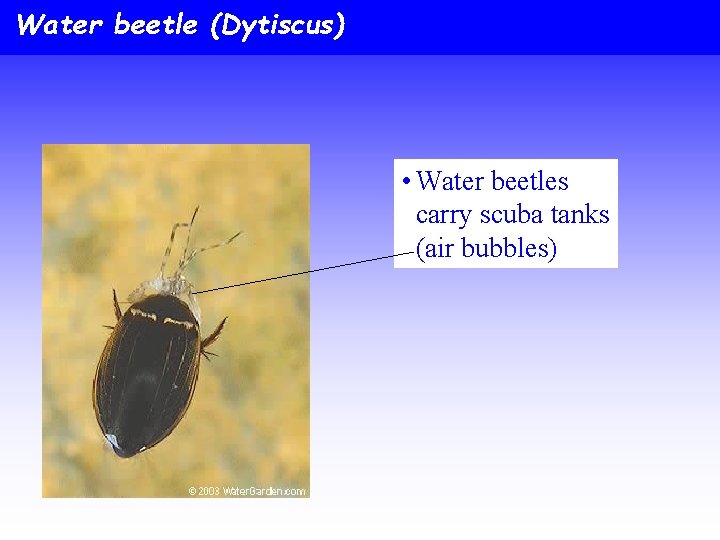
Aquatic insects • Most aquatic insects breathe air • Mosquito larvae have “snorkel”
Hydrofuge hairs How insects keep their snorkels dry
Water beetle (Dytiscus) • Water beetles carry scuba tanks (air bubbles)
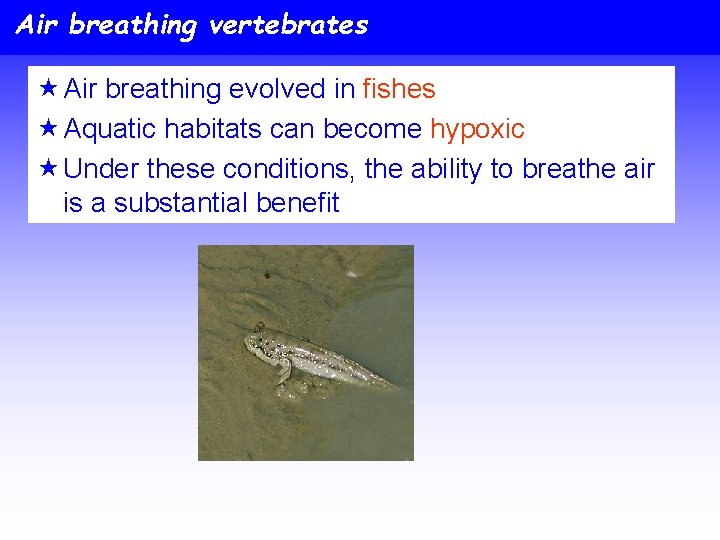
Air breathing vertebrates « Air breathing evolved in fishes « Aquatic habitats can become hypoxic « Under these conditions, the ability to breathe air is a substantial benefit
Vertebrates • • • Fish Amphibians Reptiles Birds Mammals
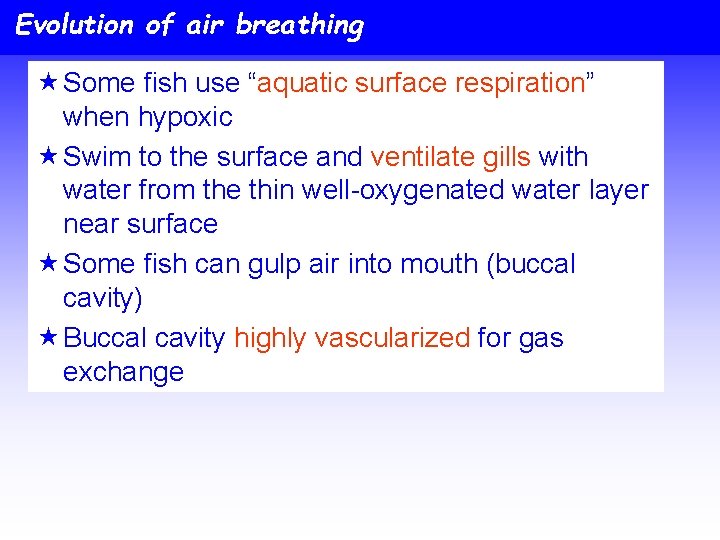
Evolution of air breathing « Some fish use “aquatic surface respiration” when hypoxic « Swim to the surface and ventilate gills with water from the thin well-oxygenated water layer near surface « Some fish can gulp air into mouth (buccal cavity) « Buccal cavity highly vascularized for gas exchange
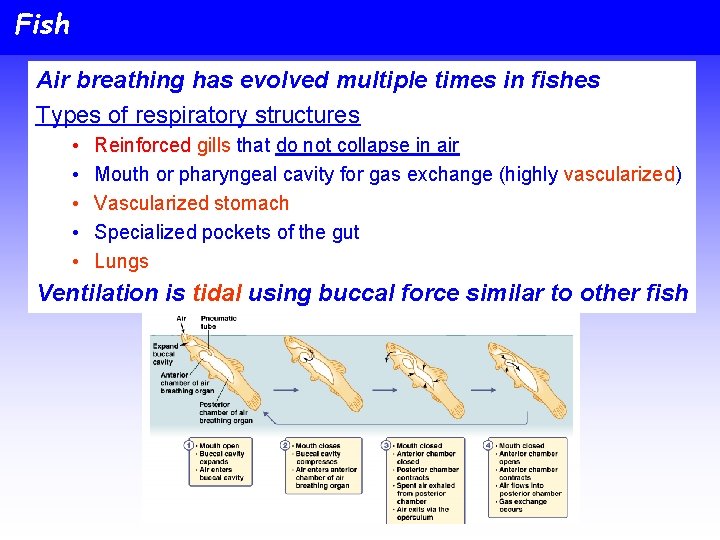
Fish Air breathing has evolved multiple times in fishes Types of respiratory structures • • • Reinforced gills that do not collapse in air Mouth or pharyngeal cavity for gas exchange (highly vascularized) Vascularized stomach Specialized pockets of the gut Lungs Ventilation is tidal using buccal force similar to other fish
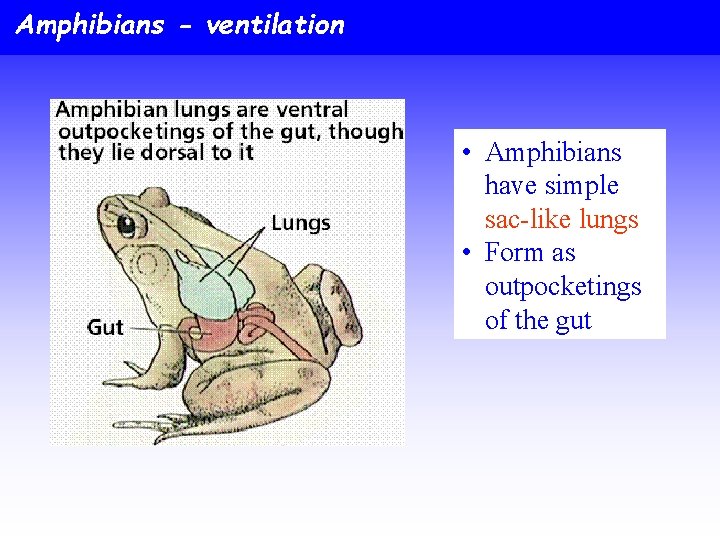
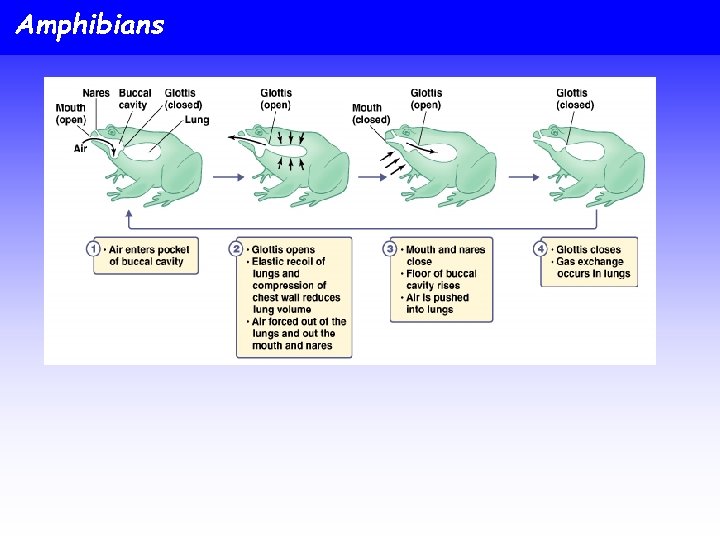
Amphibians - ventilation • Amphibians have simple sac-like lungs • Form as outpocketings of the gut
Amphibians Types of respiratory structures • Cutaneous respiration • External gills • Simple bilobed lungs; more complex in terrestrial frogs and toads Ventilation is tidal using a buccal force pump
Amphibians – external gills Polychaete Salamander • Advantages: high surface area, exposed to medium • Disadvantages: easily damaged, not suitable in air
Amphibians
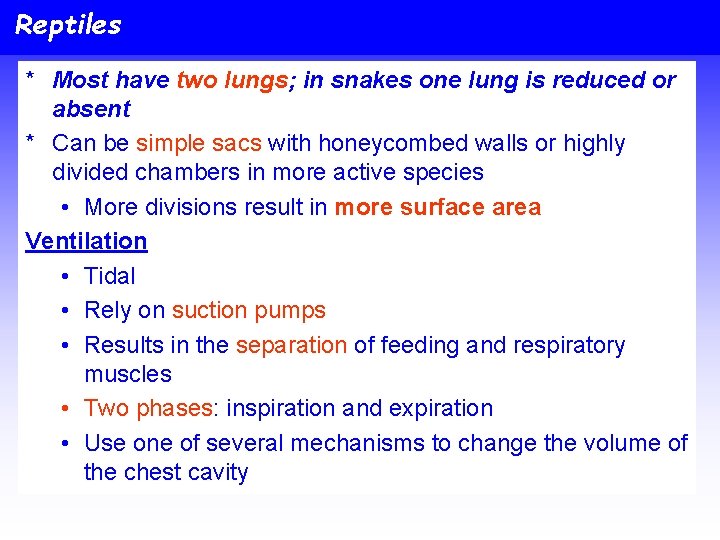
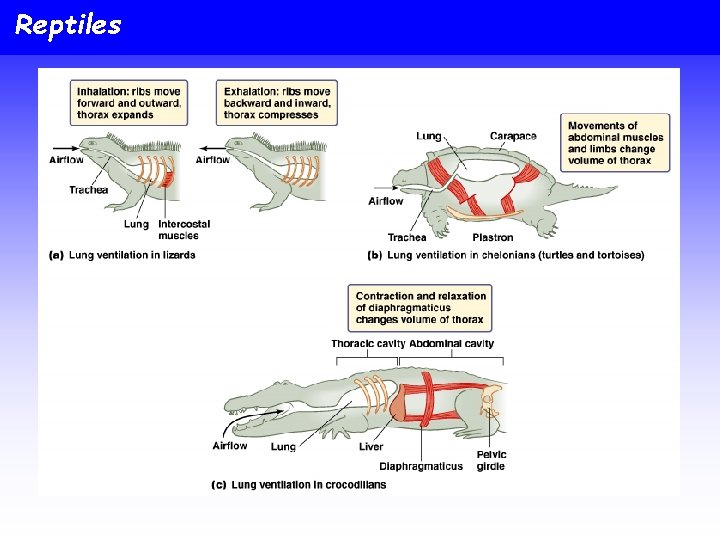
Reptiles * Most have two lungs; in snakes one lung is reduced or absent * Can be simple sacs with honeycombed walls or highly divided chambers in more active species • More divisions result in more surface area Ventilation • Tidal • Rely on suction pumps • Results in the separation of feeding and respiratory muscles • Two phases: inspiration and expiration • Use one of several mechanisms to change the volume of the chest cavity
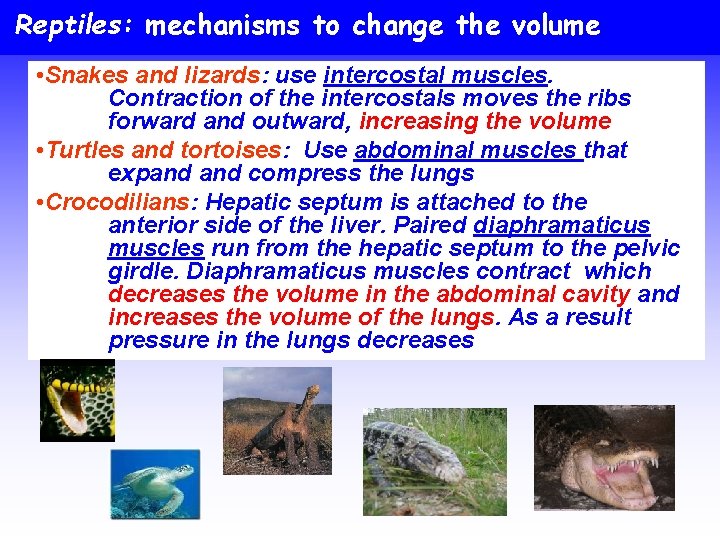
Reptiles: mechanisms to change the volume • Snakes and lizards: use intercostal muscles. Contraction of the intercostals moves the ribs forward and outward, increasing the volume • Turtles and tortoises: Use abdominal muscles that expand compress the lungs • Crocodilians: Hepatic septum is attached to the anterior side of the liver. Paired diaphramaticus muscles run from the hepatic septum to the pelvic girdle. Diaphramaticus muscles contract which decreases the volume in the abdominal cavity and increases the volume of the lungs. As a result pressure in the lungs decreases
Reptiles
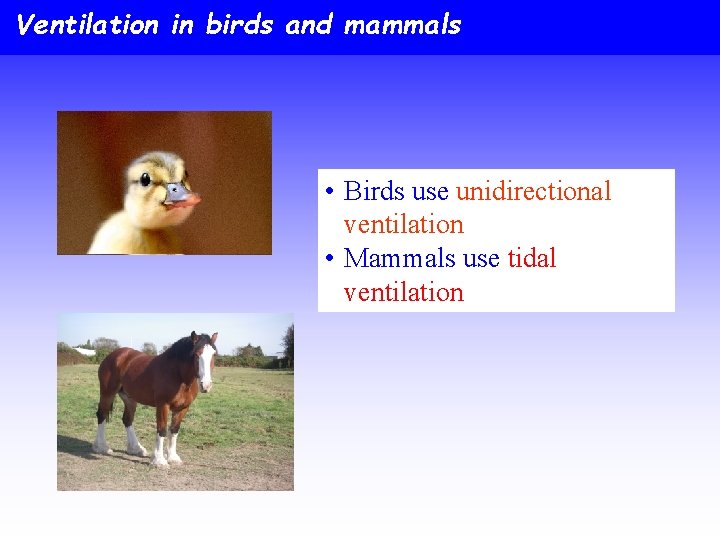
Ventilation in birds and mammals • Birds use unidirectional ventilation • Mammals use tidal ventilation
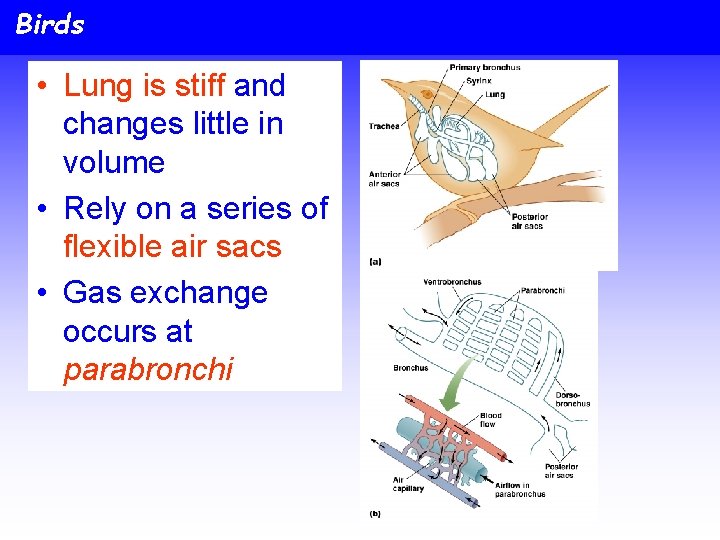
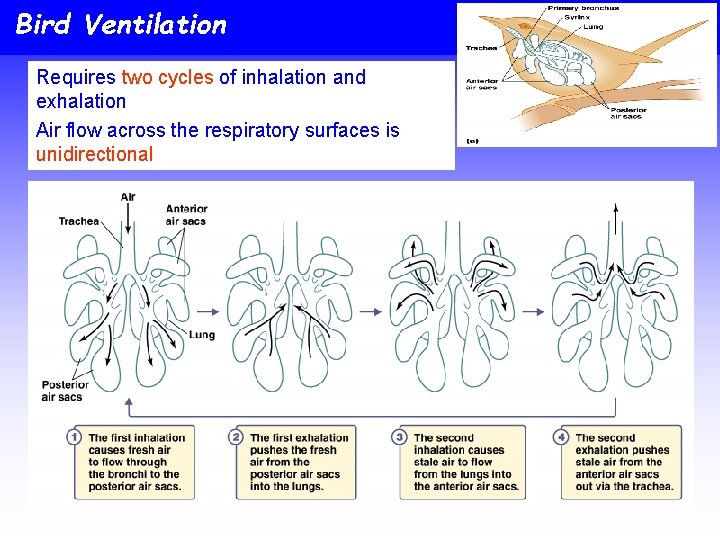
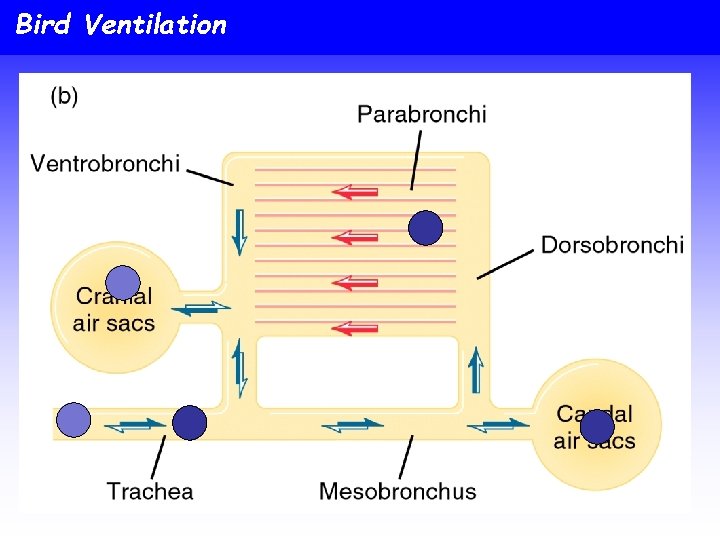
Birds • Lung is stiff and changes little in volume • Rely on a series of flexible air sacs • Gas exchange occurs at parabronchi
Bird lungs – crosscurrent flow Oxygen extraction efficiency high (up to 90%)
Bird Ventilation Requires two cycles of inhalation and exhalation Air flow across the respiratory surfaces is unidirectional
Bird Ventilation
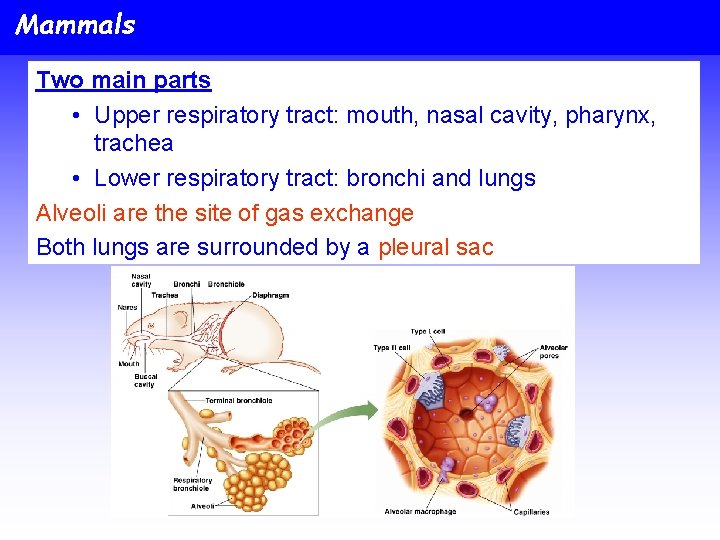
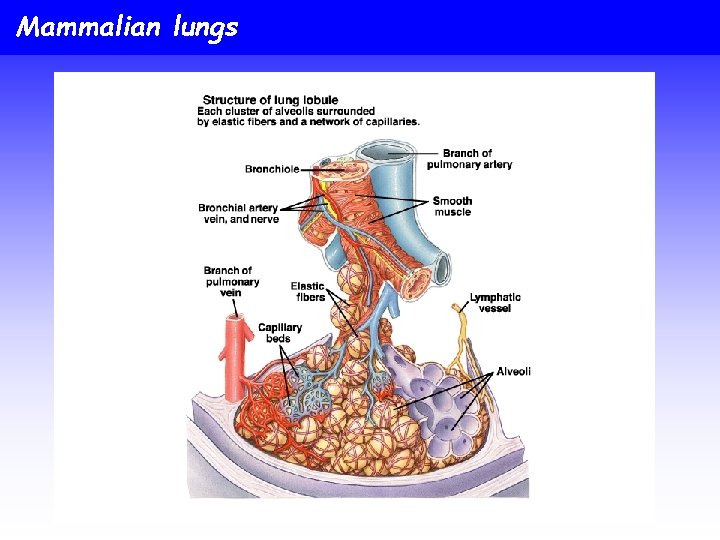
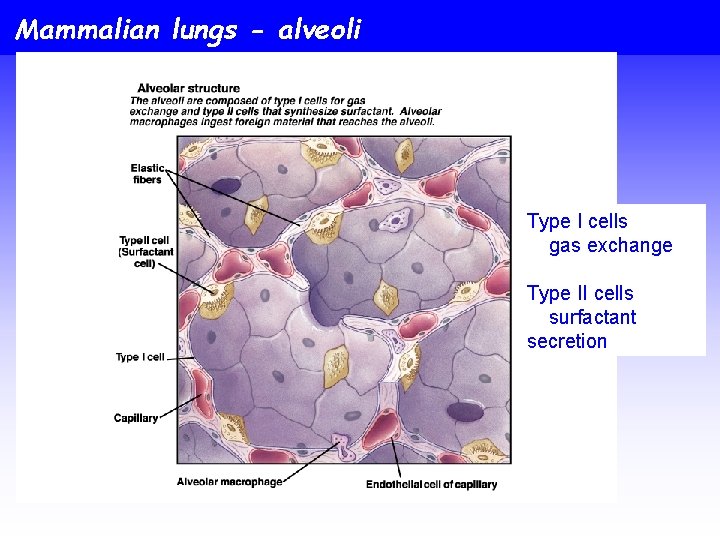
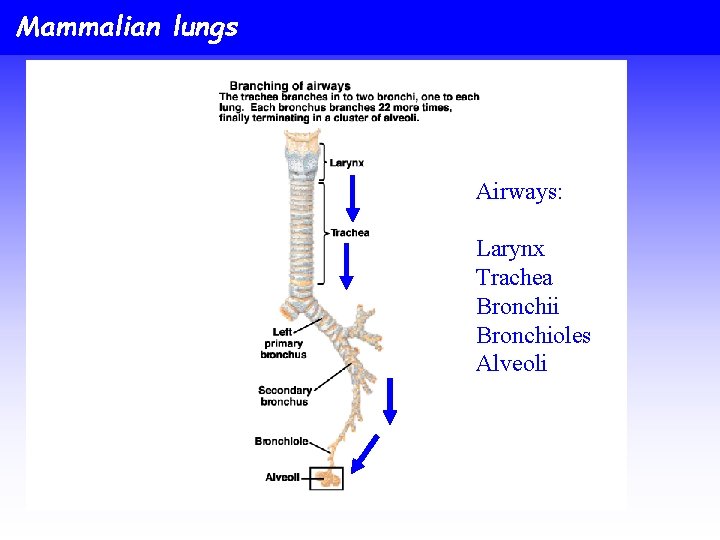
Mammals Two main parts • Upper respiratory tract: mouth, nasal cavity, pharynx, trachea • Lower respiratory tract: bronchi and lungs Alveoli are the site of gas exchange Both lungs are surrounded by a pleural sac
Mammalian lungs
Mammalian lungs - alveoli Type I cells gas exchange Type II cells surfactant secretion
Mammalian lungs Airways: Larynx Trachea Bronchii Bronchioles Alveoli
Its Friday
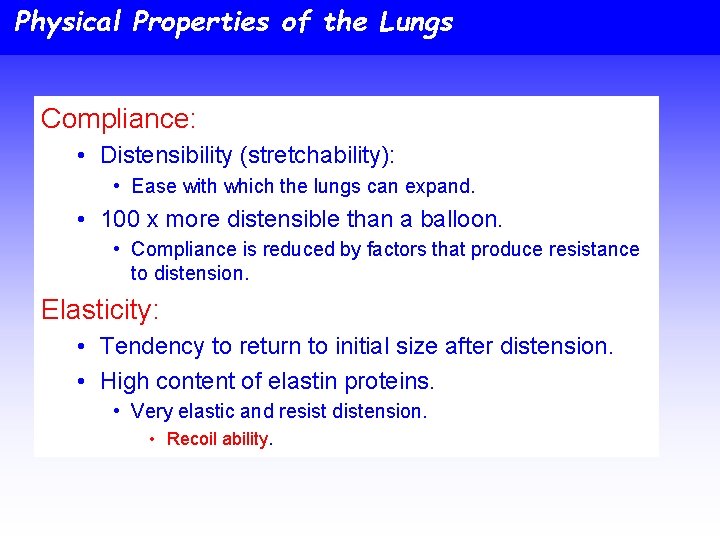
Physical Properties of the Lungs Compliance: • Distensibility (stretchability): • Ease with which the lungs can expand. • 100 x more distensible than a balloon. • Compliance is reduced by factors that produce resistance to distension. Elasticity: • Tendency to return to initial size after distension. • High content of elastin proteins. • Very elastic and resist distension. • Recoil ability.
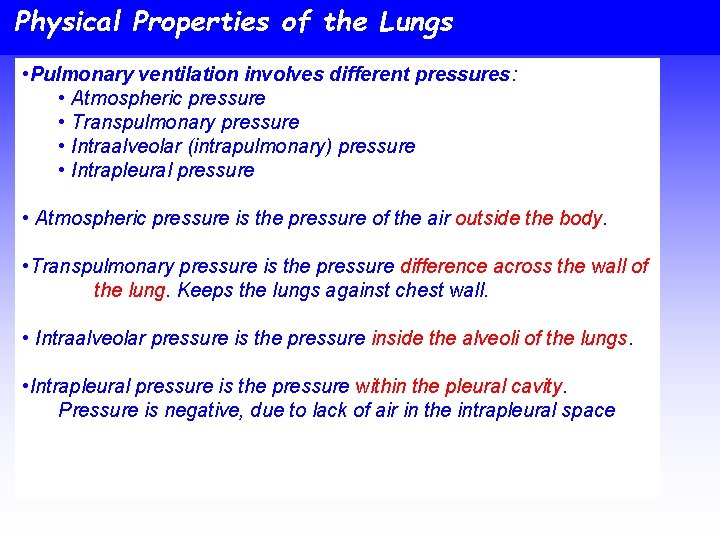
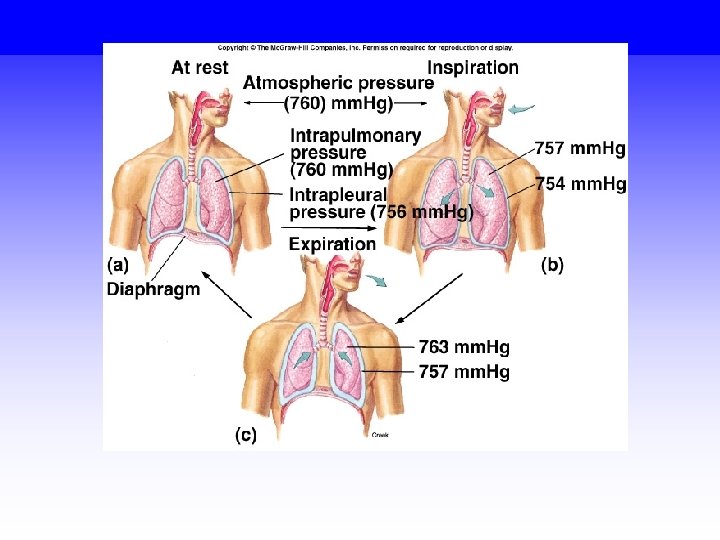
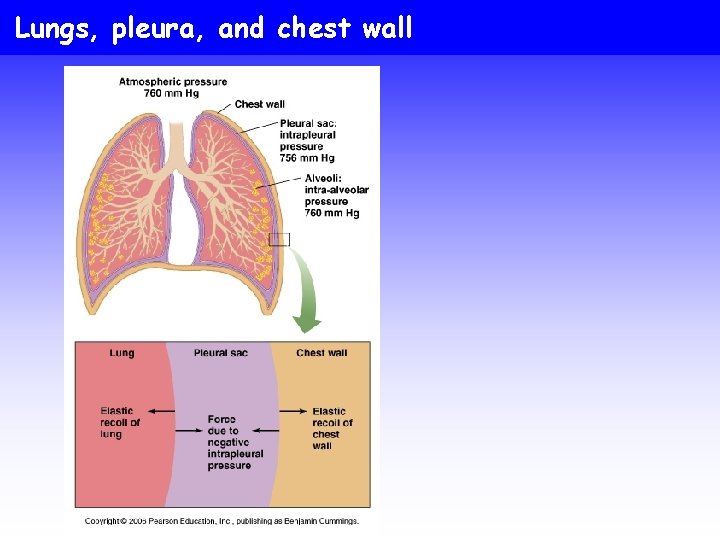
Physical Properties of the Lungs • Pulmonary ventilation involves different pressures: • Atmospheric pressure • Transpulmonary pressure • Intraalveolar (intrapulmonary) pressure • Intrapleural pressure • Atmospheric pressure is the pressure of the air outside the body. • Transpulmonary pressure is the pressure difference across the wall of the lung. Keeps the lungs against chest wall. • Intraalveolar pressure is the pressure inside the alveoli of the lungs. • Intrapleural pressure is the pressure within the pleural cavity. Pressure is negative, due to lack of air in the intrapleural space
Insert fig. 16. 15
Lungs, pleura, and chest wall
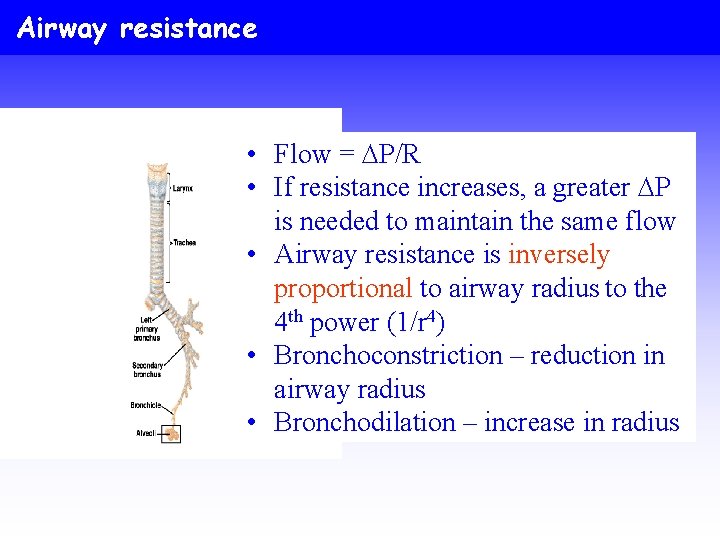
Airway resistance • Flow = DP/R • If resistance increases, a greater DP is needed to maintain the same flow • Airway resistance is inversely proportional to airway radius to the 4 th power (1/r 4) • Bronchoconstriction – reduction in airway radius • Bronchodilation – increase in radius
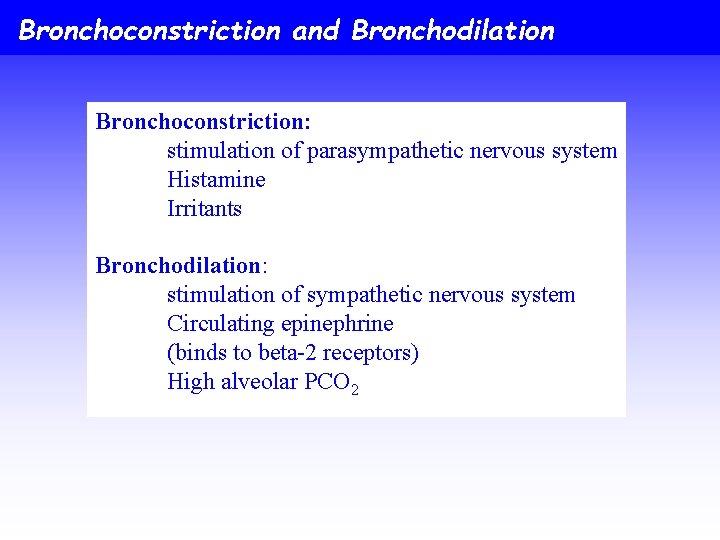
Bronchoconstriction and Bronchodilation Bronchoconstriction: stimulation of parasympathetic nervous system Histamine Irritants Bronchodilation: stimulation of sympathetic nervous system Circulating epinephrine (binds to beta-2 receptors) High alveolar PCO 2
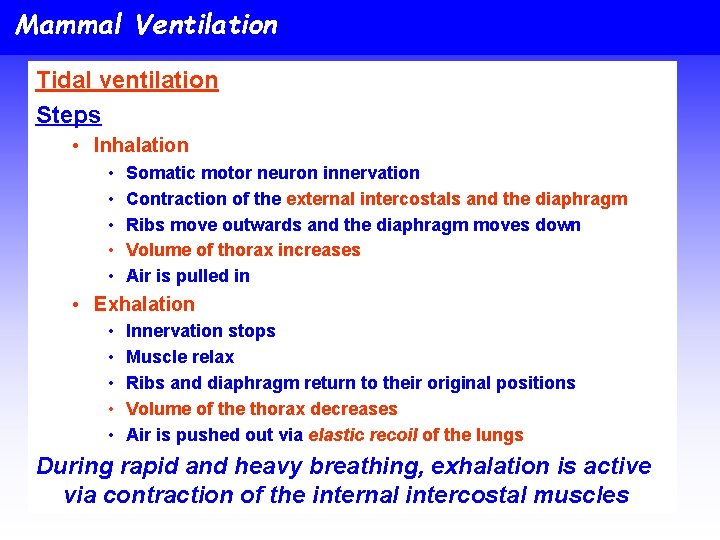
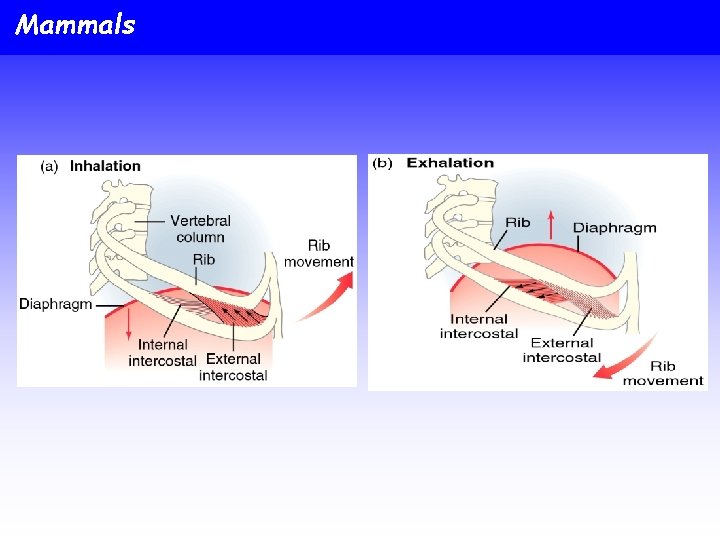
Mammal Ventilation Tidal ventilation Steps • Inhalation • • • Somatic motor neuron innervation Contraction of the external intercostals and the diaphragm Ribs move outwards and the diaphragm moves down Volume of thorax increases Air is pulled in • Exhalation • • • Innervation stops Muscle relax Ribs and diaphragm return to their original positions Volume of the thorax decreases Air is pushed out via elastic recoil of the lungs During rapid and heavy breathing, exhalation is active via contraction of the internal intercostal muscles
Mammals
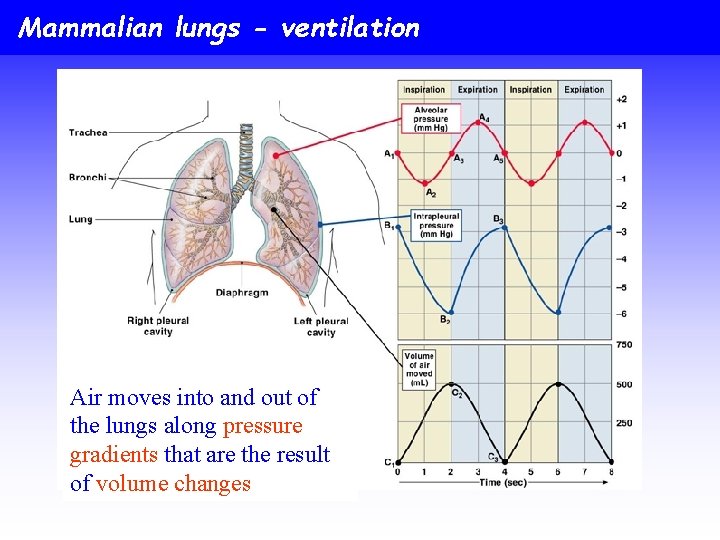
Mammalian lungs - ventilation Air moves into and out of the lungs along pressure gradients that are the result of volume changes
Surfactants • Surfactants – reduce surface tension by disrupting the cohesive forces between water molecules • Results in an increase in lung compliance and a decrease in the force needed to inflate the lungs • In humans, surfactant synthesis does not begin until late gestation
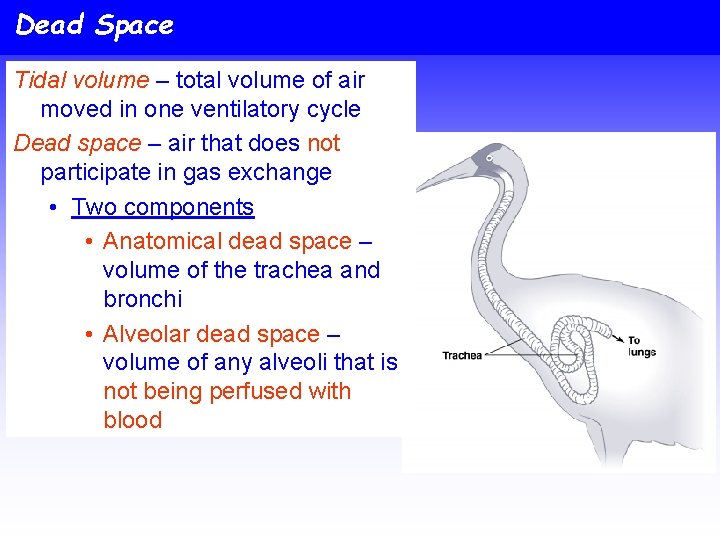
Dead Space Tidal volume – total volume of air moved in one ventilatory cycle Dead space – air that does not participate in gas exchange • Two components • Anatomical dead space – volume of the trachea and bronchi • Alveolar dead space – volume of any alveoli that is not being perfused with blood
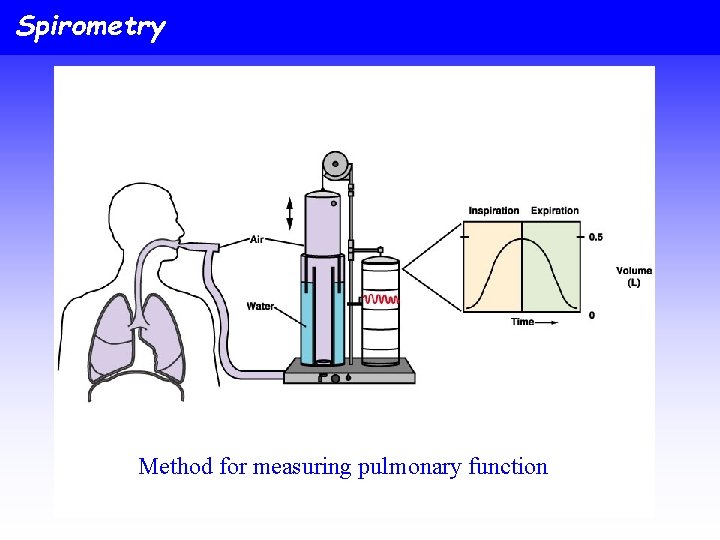
Spirometry Method for measuring pulmonary function
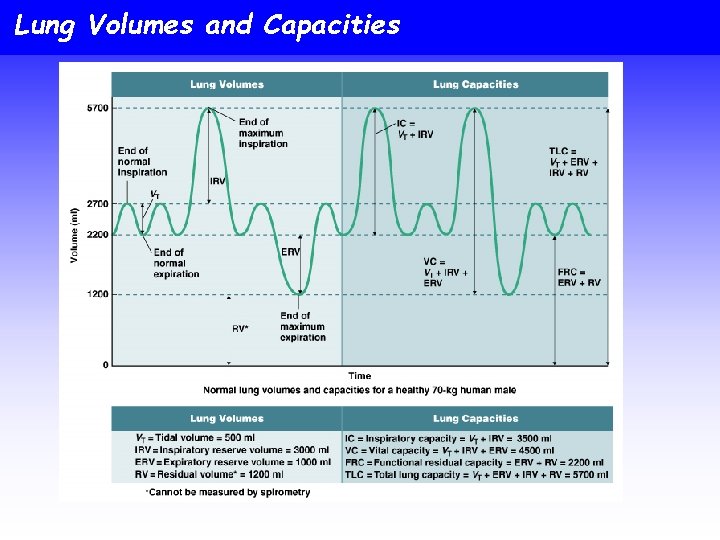
Lung Volumes and Capacities
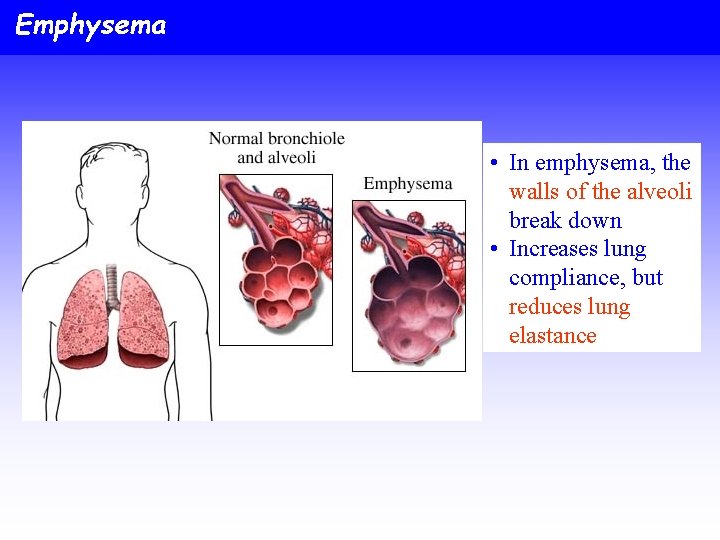
Emphysema • In emphysema, the walls of the alveoli break down • Increases lung compliance, but reduces lung elastance
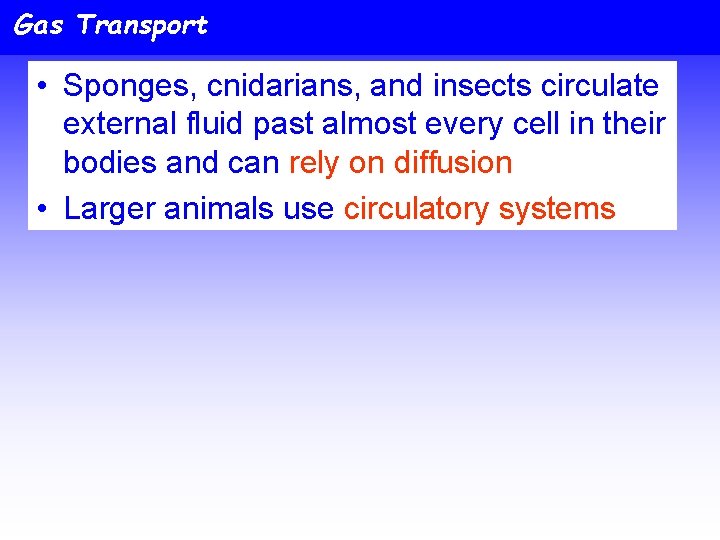
Gas Transport • Sponges, cnidarians, and insects circulate external fluid past almost every cell in their bodies and can rely on diffusion • Larger animals use circulatory systems
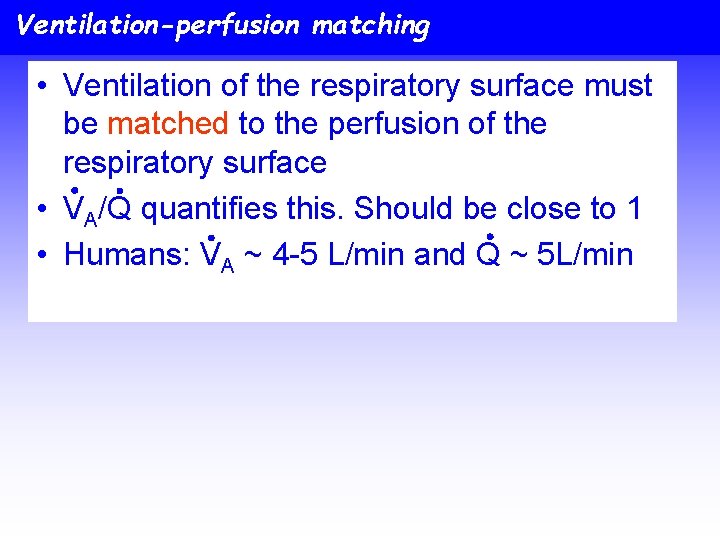
Ventilation-perfusion matching • Ventilation of the respiratory surface must be matched to the perfusion of the respiratory surface • VA/Q quantifies this. Should be close to 1 • Humans: VA ~ 4 -5 L/min and Q ~ 5 L/min
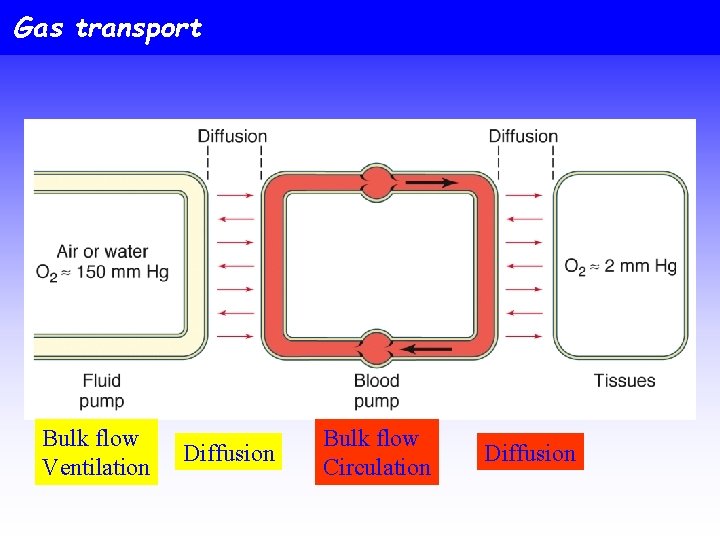
Gas transport Bulk flow Ventilation Diffusion Bulk flow Circulation Diffusion
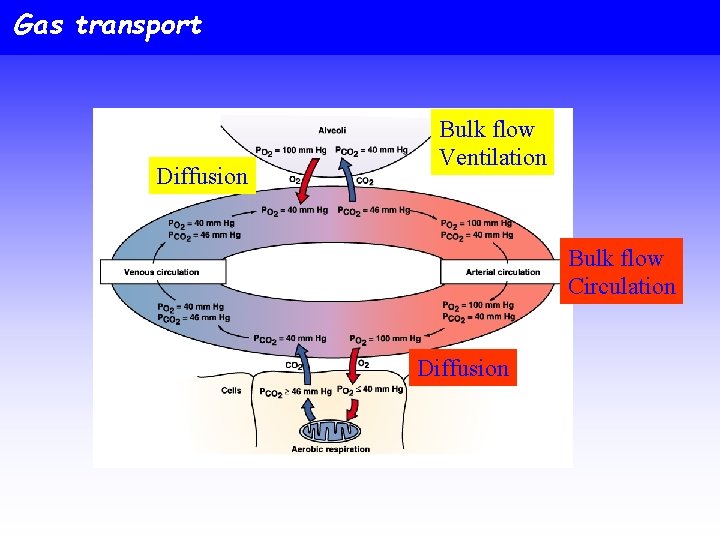
Gas transport Diffusion Bulk flow Ventilation Bulk flow Circulation Diffusion
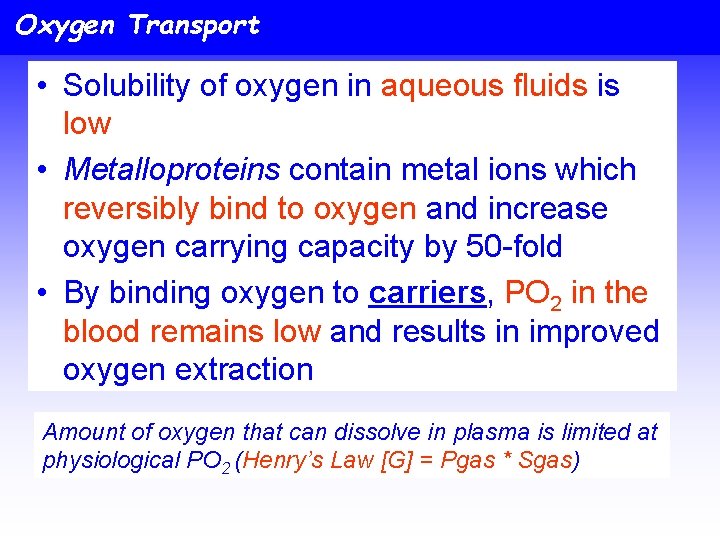
Oxygen Transport • Solubility of oxygen in aqueous fluids is low • Metalloproteins contain metal ions which reversibly bind to oxygen and increase oxygen carrying capacity by 50 -fold • By binding oxygen to carriers, PO 2 in the blood remains low and results in improved oxygen extraction Amount of oxygen that can dissolve in plasma is limited at physiological PO 2 (Henry’s Law [G] = Pgas * Sgas)
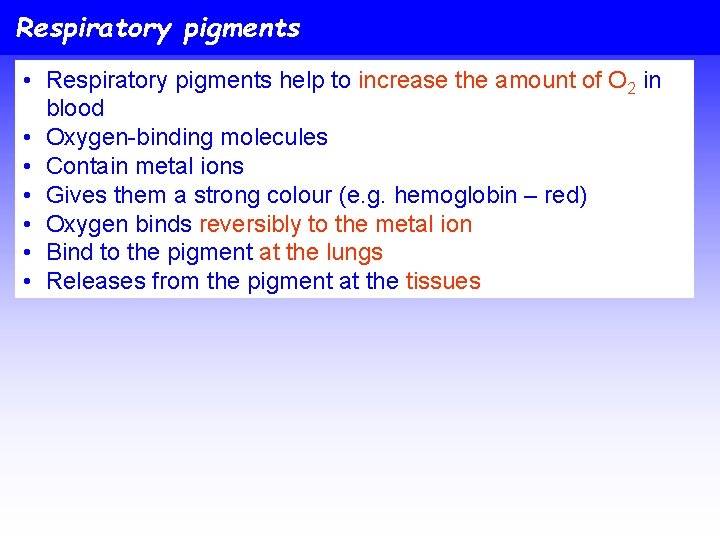
Respiratory pigments • Respiratory pigments help to increase the amount of O 2 in blood • Oxygen-binding molecules • Contain metal ions • Gives them a strong colour (e. g. hemoglobin – red) • Oxygen binds reversibly to the metal ion • Bind to the pigment at the lungs • Releases from the pigment at the tissues
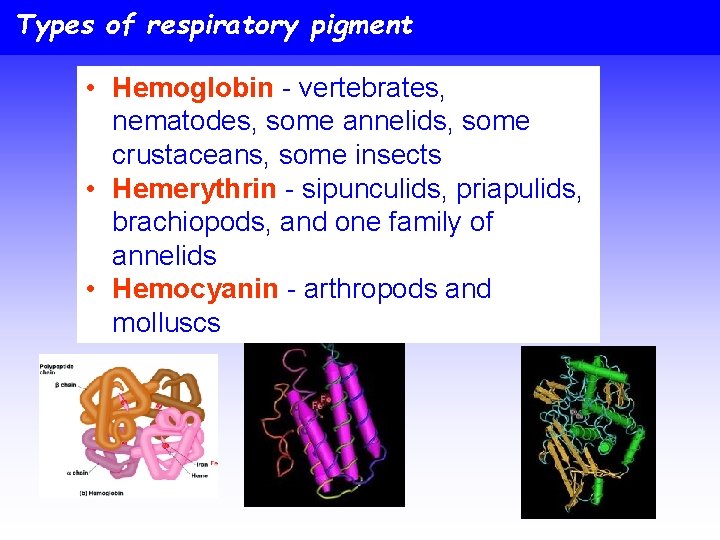
Types of respiratory pigment • Hemoglobin - vertebrates, nematodes, some annelids, some crustaceans, some insects • Hemerythrin - sipunculids, priapulids, brachiopods, and one family of annelids • Hemocyanin - arthropods and molluscs
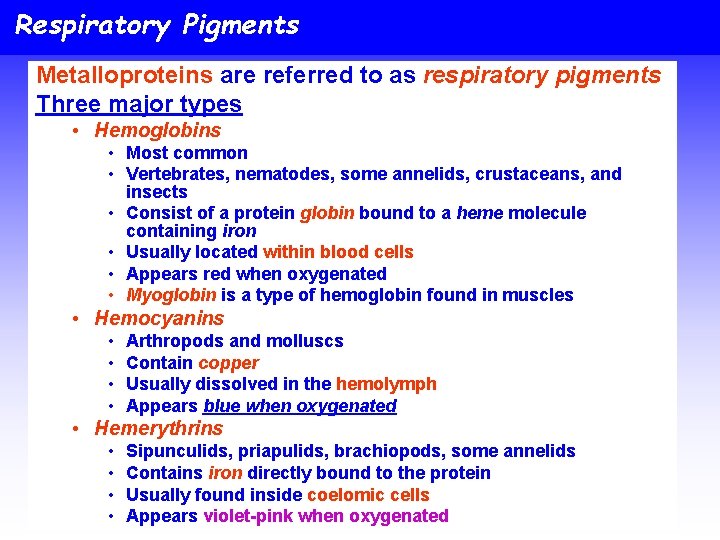
Respiratory Pigments Metalloproteins are referred to as respiratory pigments Three major types • Hemoglobins • Most common • Vertebrates, nematodes, some annelids, crustaceans, and insects • Consist of a protein globin bound to a heme molecule containing iron • Usually located within blood cells • Appears red when oxygenated • Myoglobin is a type of hemoglobin found in muscles • Hemocyanins • • Arthropods and molluscs Contain copper Usually dissolved in the hemolymph Appears blue when oxygenated • Hemerythrins • • Sipunculids, priapulids, brachiopods, some annelids Contains iron directly bound to the protein Usually found inside coelomic cells Appears violet-pink when oxygenated
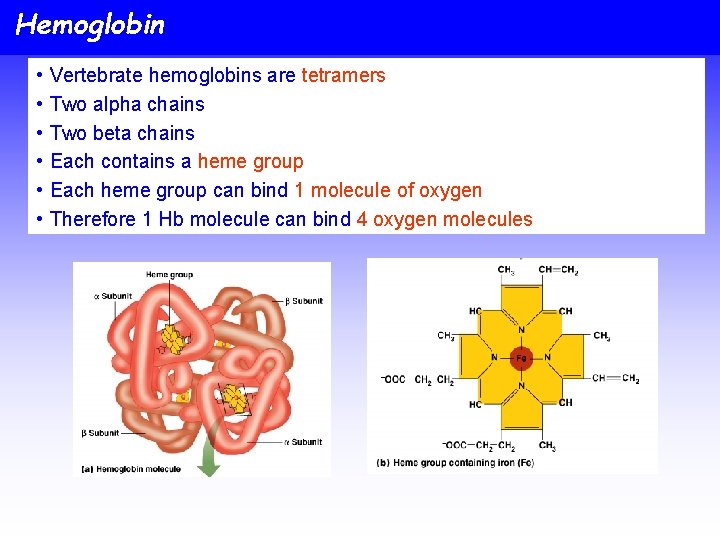
Hemoglobin • • • Vertebrate hemoglobins are tetramers Two alpha chains Two beta chains Each contains a heme group Each heme group can bind 1 molecule of oxygen Therefore 1 Hb molecule can bind 4 oxygen molecules
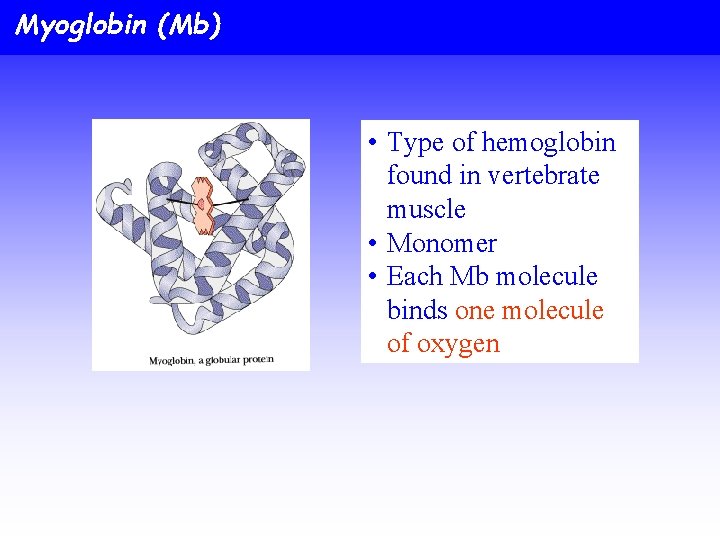
Myoglobin (Mb) • Type of hemoglobin found in vertebrate muscle • Monomer • Each Mb molecule binds one molecule of oxygen
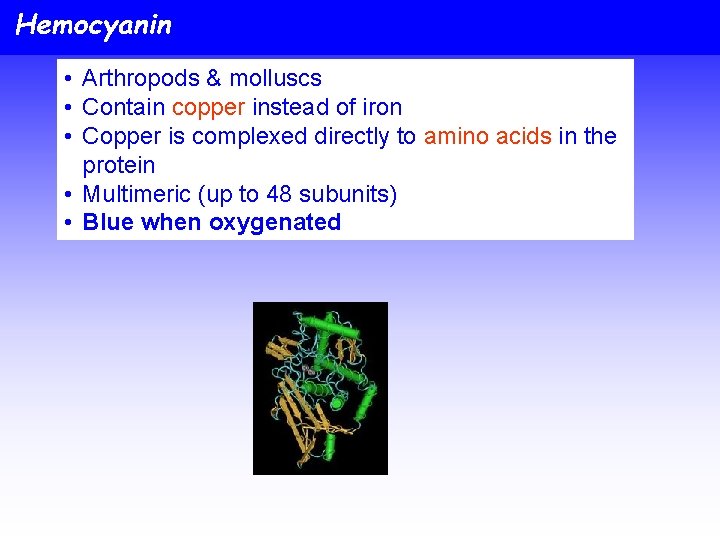
Hemocyanin • Arthropods & molluscs • Contain copper instead of iron • Copper is complexed directly to amino acids in the protein • Multimeric (up to 48 subunits) • Blue when oxygenated
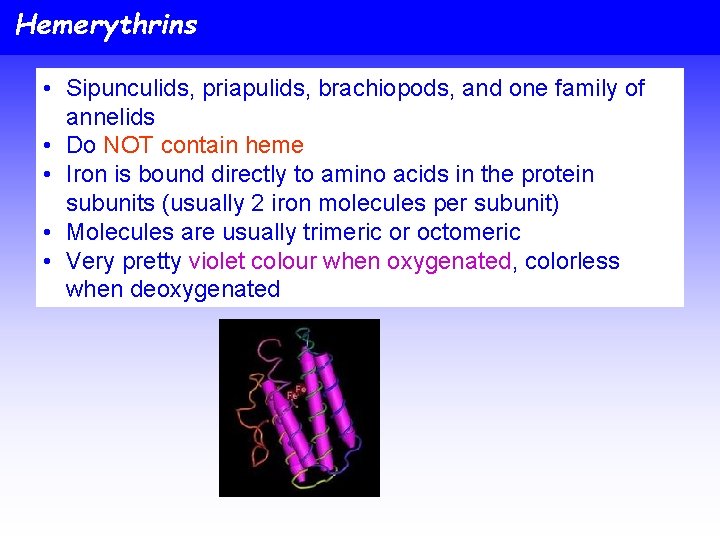
Hemerythrins • Sipunculids, priapulids, brachiopods, and one family of annelids • Do NOT contain heme • Iron is bound directly to amino acids in the protein subunits (usually 2 iron molecules per subunit) • Molecules are usually trimeric or octomeric • Very pretty violet colour when oxygenated, colorless when deoxygenated
Oxygen carrying capacity of blood • Carrying capacity = the maximum amount of oxygen that can be carried in blood • Total O 2 in blood = dissolved O 2 + O 2 bound to respiratory pigment • Increased amount of respiratory pigment = increased capacity for carrying oxygen
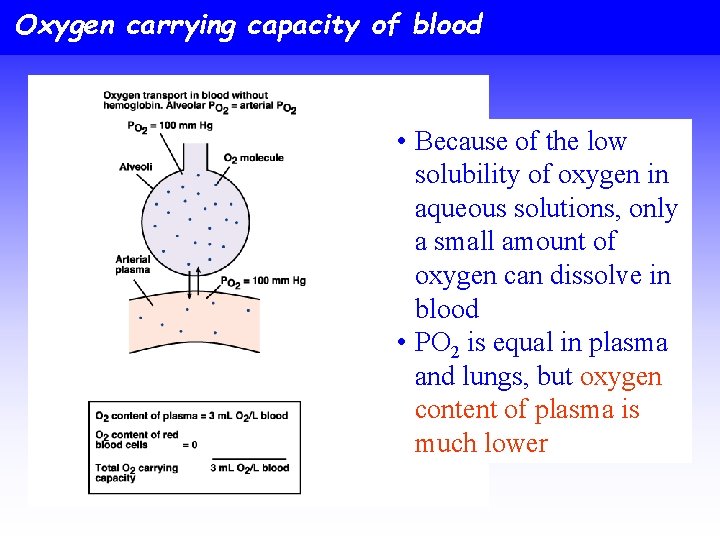
Oxygen carrying capacity of blood • Because of the low solubility of oxygen in aqueous solutions, only a small amount of oxygen can dissolve in blood • PO 2 is equal in plasma and lungs, but oxygen content of plasma is much lower
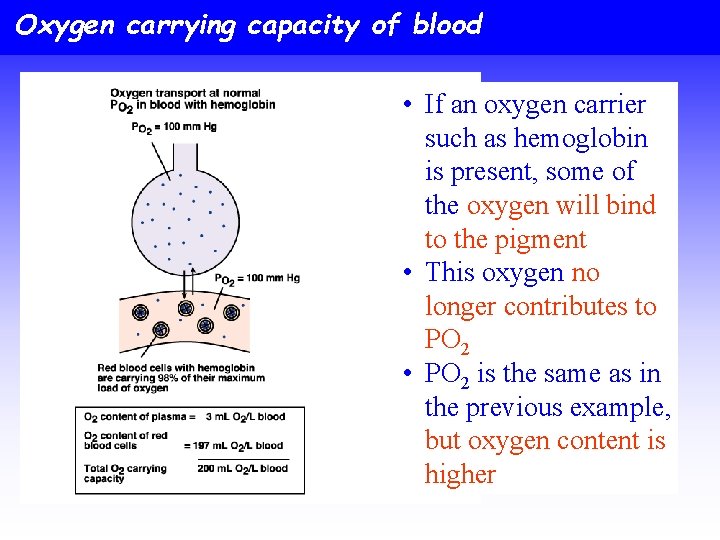
Oxygen carrying capacity of blood • If an oxygen carrier such as hemoglobin is present, some of the oxygen will bind to the pigment • This oxygen no longer contributes to PO 2 • PO 2 is the same as in the previous example, but oxygen content is higher
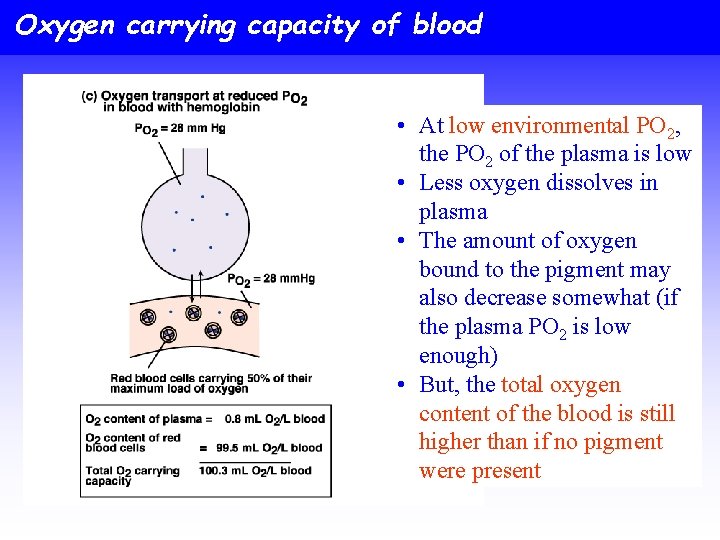
Oxygen carrying capacity of blood • At low environmental PO 2, the PO 2 of the plasma is low • Less oxygen dissolves in plasma • The amount of oxygen bound to the pigment may also decrease somewhat (if the plasma PO 2 is low enough) • But, the total oxygen content of the blood is still higher than if no pigment were present
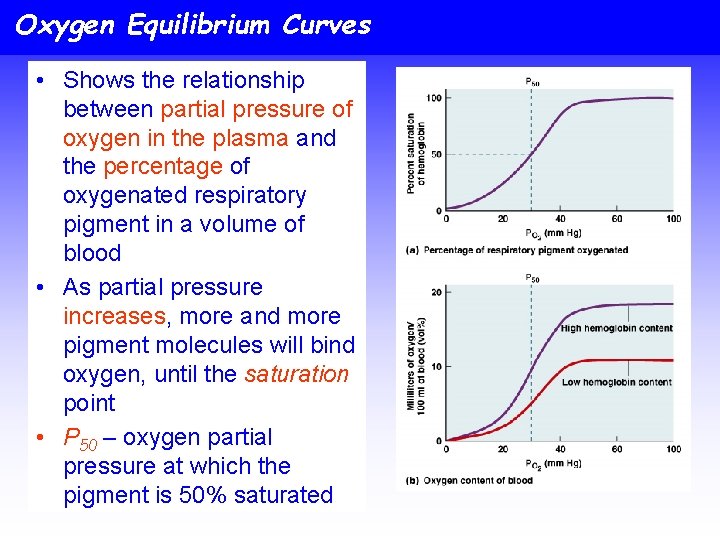
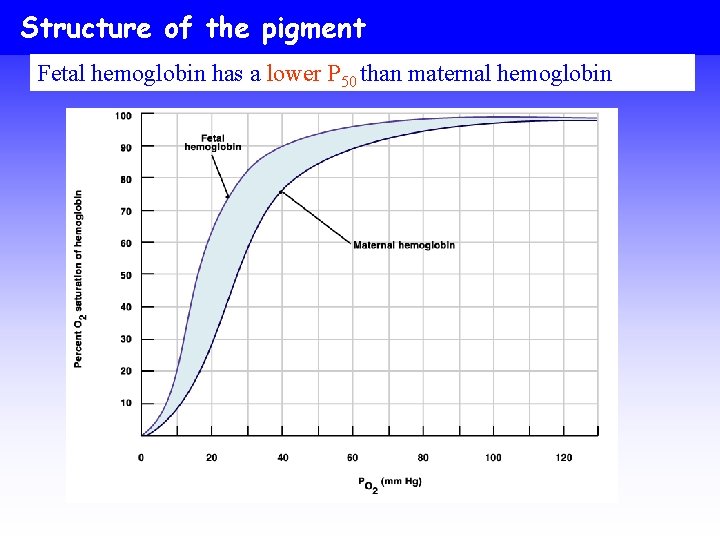
Oxygen Equilibrium Curves • Shows the relationship between partial pressure of oxygen in the plasma and the percentage of oxygenated respiratory pigment in a volume of blood • As partial pressure increases, more and more pigment molecules will bind oxygen, until the saturation point • P 50 – oxygen partial pressure at which the pigment is 50% saturated
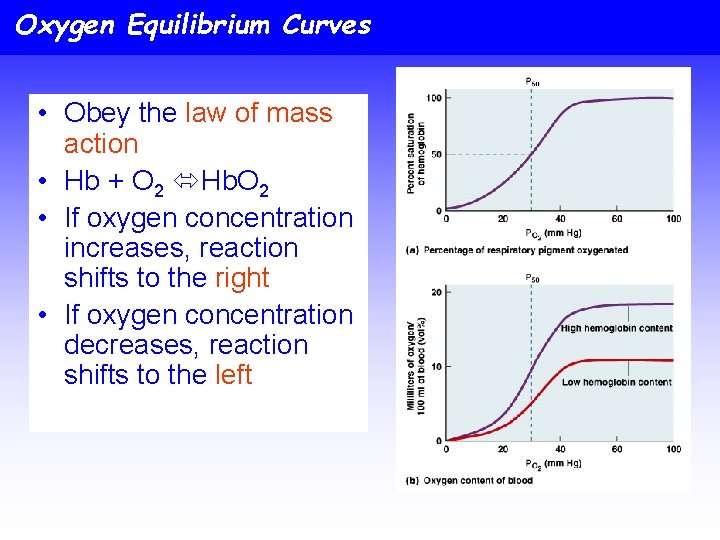
Oxygen Equilibrium Curves • Obey the law of mass action • Hb + O 2 Hb. O 2 • If oxygen concentration increases, reaction shifts to the right • If oxygen concentration decreases, reaction shifts to the left
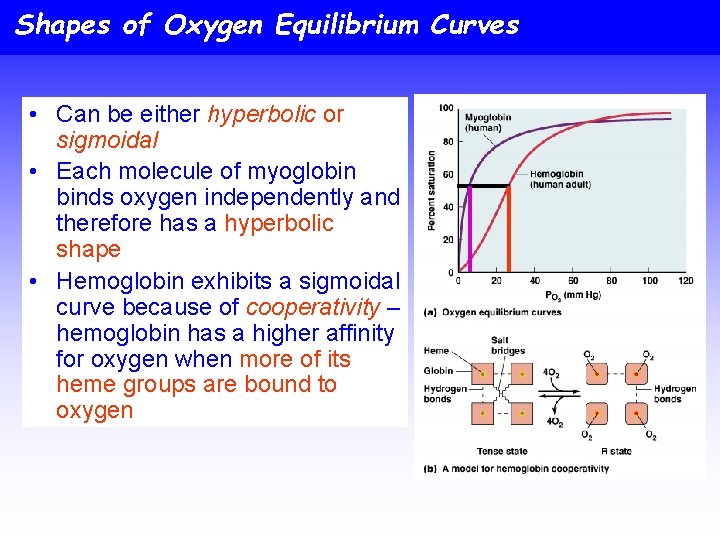
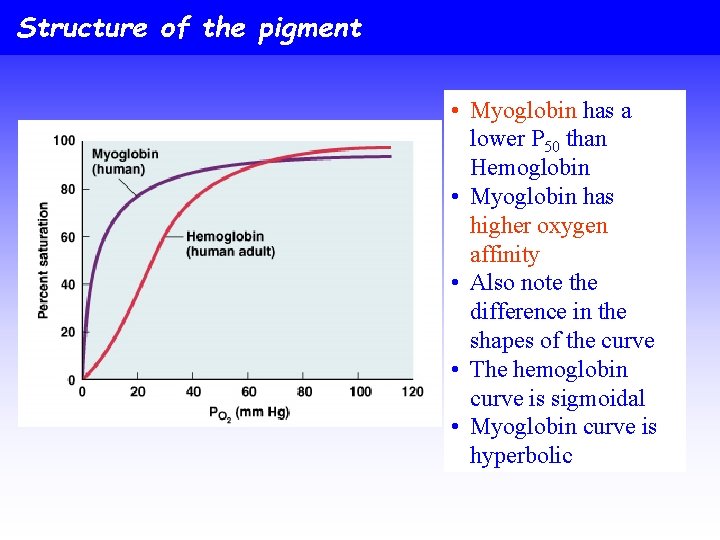
Shapes of Oxygen Equilibrium Curves • Can be either hyperbolic or sigmoidal • Each molecule of myoglobin binds oxygen independently and therefore has a hyperbolic shape • Hemoglobin exhibits a sigmoidal curve because of cooperativity – hemoglobin has a higher affinity for oxygen when more of its heme groups are bound to oxygen
Oxygen Equilibrium Curves Log[Y/(1 -Y)] vs. Log(PO 2)
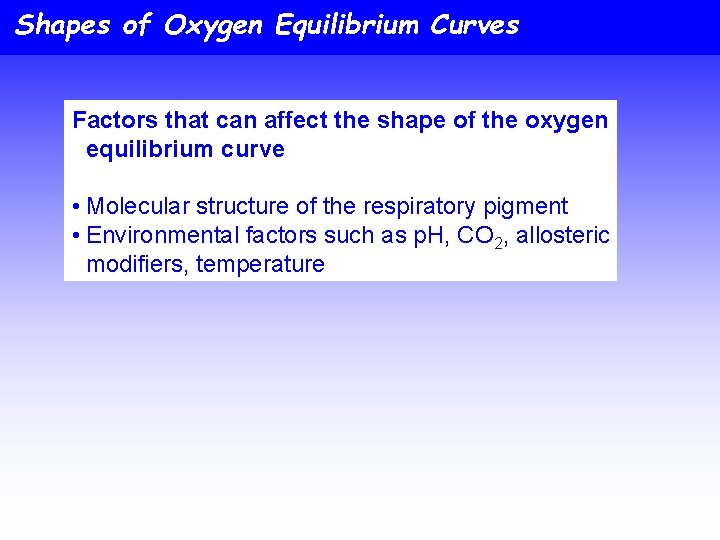
Shapes of Oxygen Equilibrium Curves Factors that can affect the shape of the oxygen equilibrium curve • Molecular structure of the respiratory pigment • Environmental factors such as p. H, CO 2, allosteric modifiers, temperature
Structure of the pigment Fetal hemoglobin has a lower P 50 than maternal hemoglobin
Structure of the pigment • Myoglobin has a lower P 50 than Hemoglobin • Myoglobin has higher oxygen affinity • Also note the difference in the shapes of the curve • The hemoglobin curve is sigmoidal • Myoglobin curve is hyperbolic
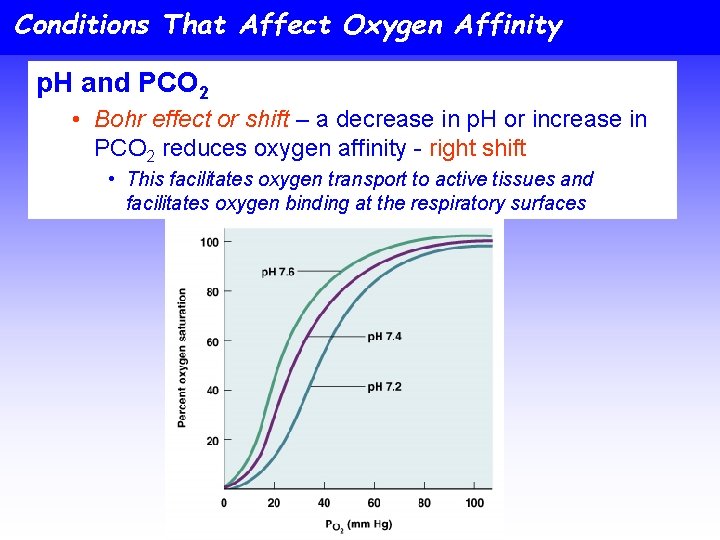
Conditions That Affect Oxygen Affinity p. H and PCO 2 • Bohr effect or shift – a decrease in p. H or increase in PCO 2 reduces oxygen affinity - right shift • This facilitates oxygen transport to active tissues and facilitates oxygen binding at the respiratory surfaces
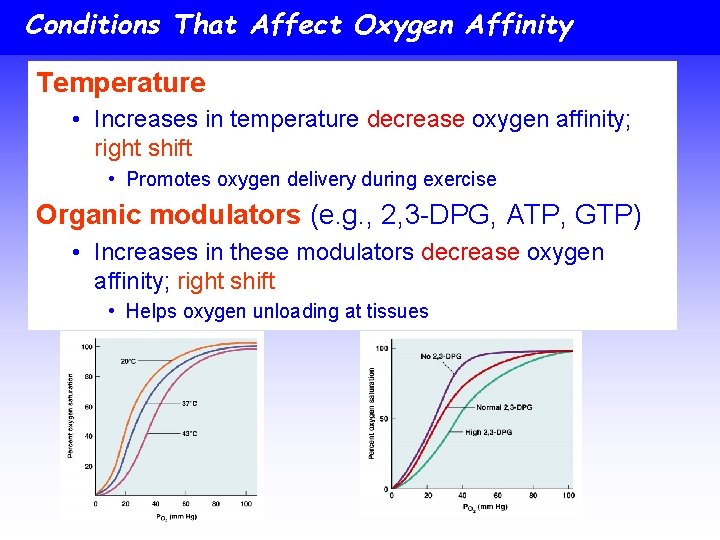
Conditions That Affect Oxygen Affinity Temperature • Increases in temperature decrease oxygen affinity; right shift • Promotes oxygen delivery during exercise Organic modulators (e. g. , 2, 3 -DPG, ATP, GTP) • Increases in these modulators decrease oxygen affinity; right shift • Helps oxygen unloading at tissues
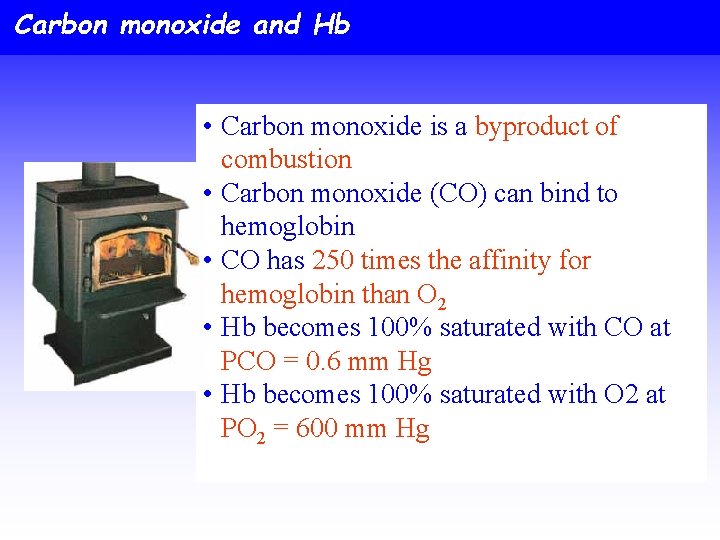
Carbon monoxide and Hb • Carbon monoxide is a byproduct of combustion • Carbon monoxide (CO) can bind to hemoglobin • CO has 250 times the affinity for hemoglobin than O 2 • Hb becomes 100% saturated with CO at PCO = 0. 6 mm Hg • Hb becomes 100% saturated with O 2 at PO 2 = 600 mm Hg
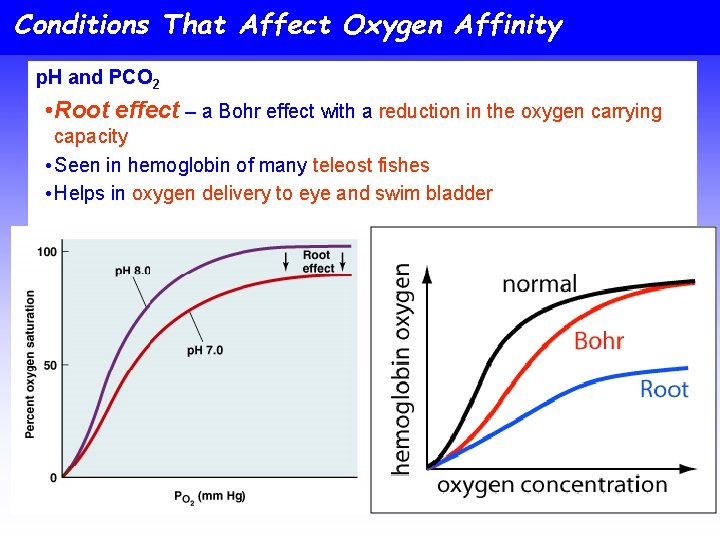
Conditions That Affect Oxygen Affinity p. H and PCO 2 • Root effect – a Bohr effect with a reduction in the oxygen carrying capacity • Seen in hemoglobin of many teleost fishes • Helps in oxygen delivery to eye and swim bladder
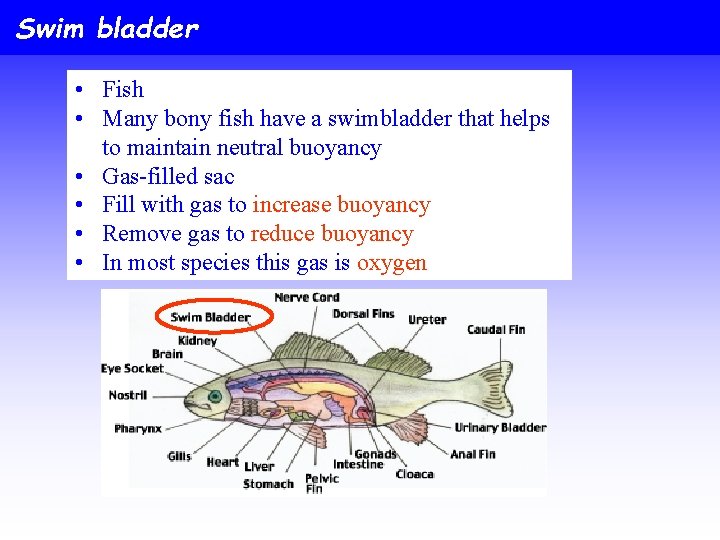
Swim bladder • Fish • Many bony fish have a swimbladder that helps to maintain neutral buoyancy • Gas-filled sac • Fill with gas to increase buoyancy • Remove gas to reduce buoyancy • In most species this gas is oxygen
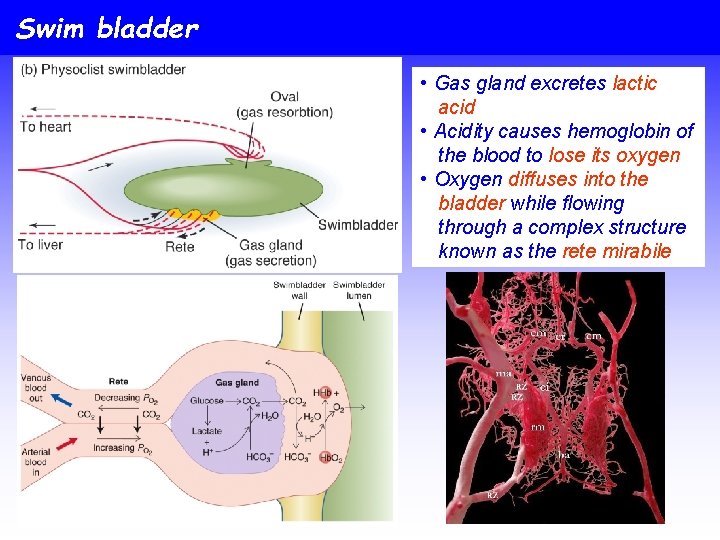
Swim bladder • Gas gland excretes lactic acid • Acidity causes hemoglobin of the blood to lose its oxygen • Oxygen diffuses into the bladder while flowing through a complex structure known as the rete mirabile
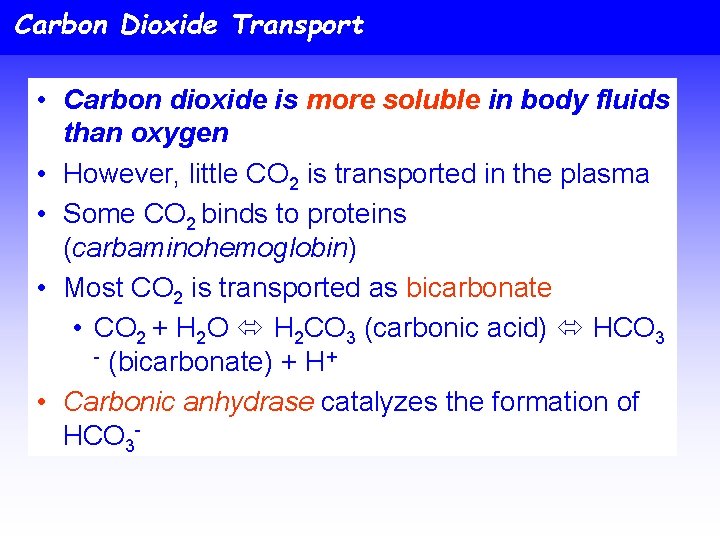
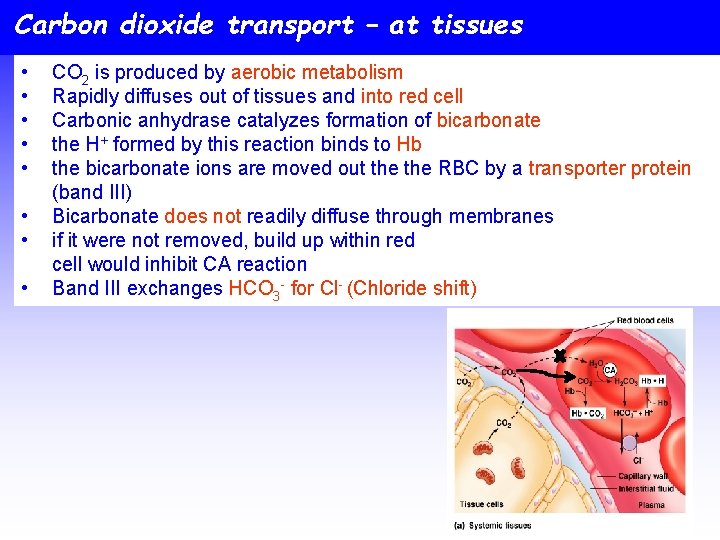
Carbon Dioxide Transport • Carbon dioxide is more soluble in body fluids than oxygen • However, little CO 2 is transported in the plasma • Some CO 2 binds to proteins (carbaminohemoglobin) • Most CO 2 is transported as bicarbonate • CO 2 + H 2 O H 2 CO 3 (carbonic acid) HCO 3 - (bicarbonate) + H+ • Carbonic anhydrase catalyzes the formation of HCO 3 -
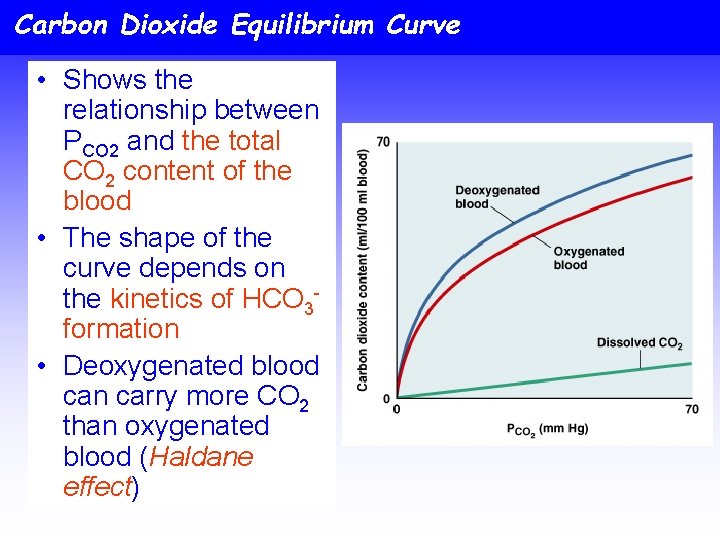
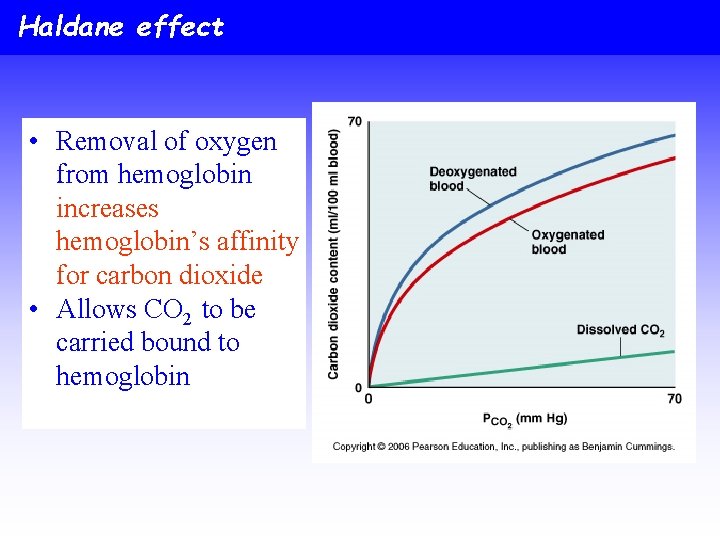
Carbon Dioxide Equilibrium Curve • Shows the relationship between PCO 2 and the total CO 2 content of the blood • The shape of the curve depends on the kinetics of HCO 3 formation • Deoxygenated blood can carry more CO 2 than oxygenated blood (Haldane effect)
Haldane effect • Removal of oxygen from hemoglobin increases hemoglobin’s affinity for carbon dioxide • Allows CO 2 to be carried bound to hemoglobin
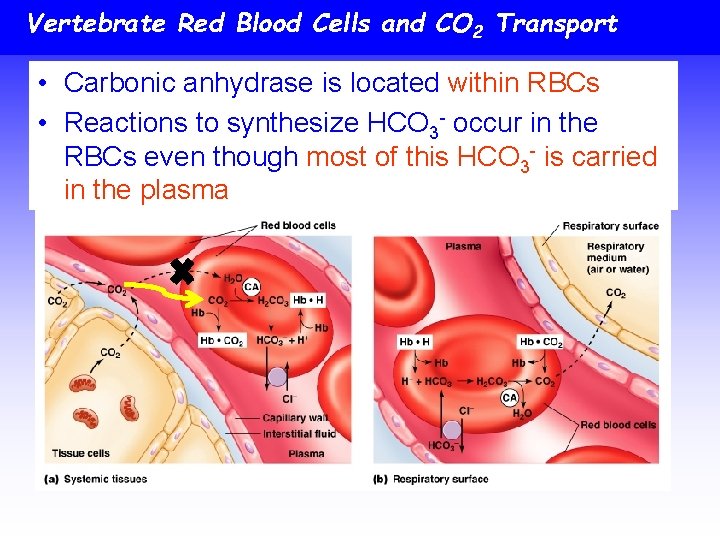
Vertebrate Red Blood Cells and CO 2 Transport • Carbonic anhydrase is located within RBCs • Reactions to synthesize HCO 3 - occur in the RBCs even though most of this HCO 3 - is carried in the plasma
Carbon dioxide transport – at tissues • • CO 2 is produced by aerobic metabolism Rapidly diffuses out of tissues and into red cell Carbonic anhydrase catalyzes formation of bicarbonate the H+ formed by this reaction binds to Hb the bicarbonate ions are moved out the RBC by a transporter protein (band III) Bicarbonate does not readily diffuse through membranes if it were not removed, build up within red cell would inhibit CA reaction Band III exchanges HCO 3 - for Cl- (Chloride shift)
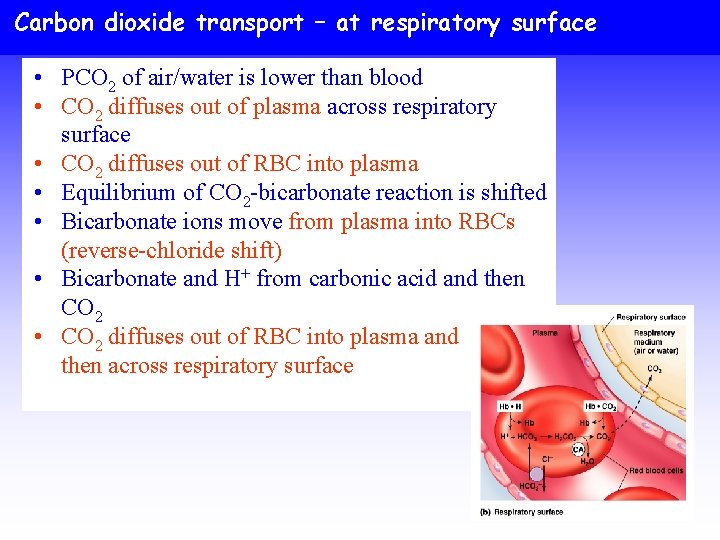
Carbon dioxide transport – at respiratory surface • PCO 2 of air/water is lower than blood • CO 2 diffuses out of plasma across respiratory surface • CO 2 diffuses out of RBC into plasma • Equilibrium of CO 2 -bicarbonate reaction is shifted • Bicarbonate ions move from plasma into RBCs (reverse-chloride shift) • Bicarbonate and H+ from carbonic acid and then CO 2 • CO 2 diffuses out of RBC into plasma and then across respiratory surface
Regulation of Respiratory Systems • Respiratory systems are closely regulated • Respond to changes in external and internal environment • Must be able to supply sufficient oxygen to meet metabolic demands • Must be able to remove carbon dioxide to prevent p. H disturbance Vertebrate respiratory and circulatory systems work together to regulate gas delivery by • Regulating ventilation • Altering oxygen carrying capacity and affinity • Altering perfusion
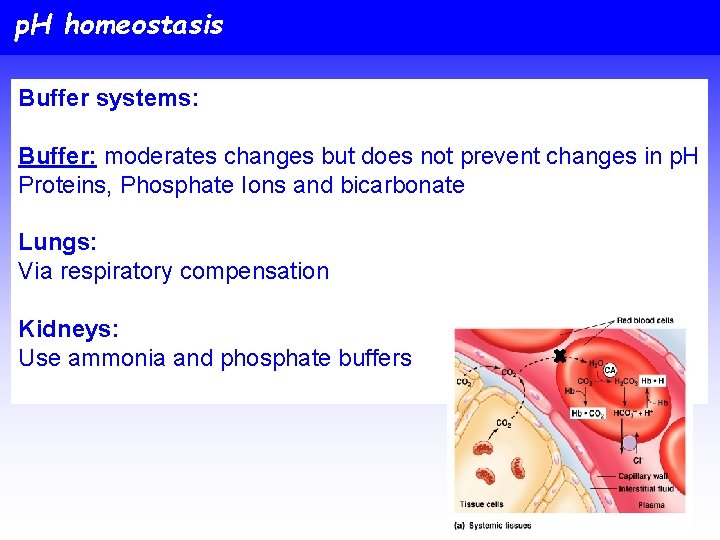
p. H homeostasis Buffer systems: Buffer: moderates changes but does not prevent changes in p. H Proteins, Phosphate Ions and bicarbonate Lungs: Via respiratory compensation Kidneys: Use ammonia and phosphate buffers
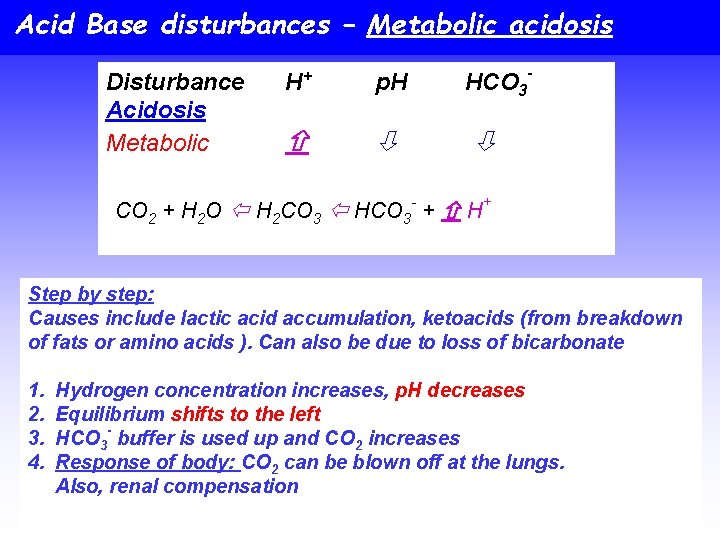
Acid Base disturbances – Metabolic acidosis Disturbance Acidosis Metabolic H+ p. H HCO 3 - CO 2 + H 2 O H 2 CO 3 HCO 3 - + H+ Step by step: Causes include lactic acid accumulation, ketoacids (from breakdown of fats or amino acids ). Can also be due to loss of bicarbonate 1. 2. 3. 4. Hydrogen concentration increases, p. H decreases Equilibrium shifts to the left HCO 3 - buffer is used up and CO 2 increases Response of body: CO 2 can be blown off at the lungs. Also, renal compensation
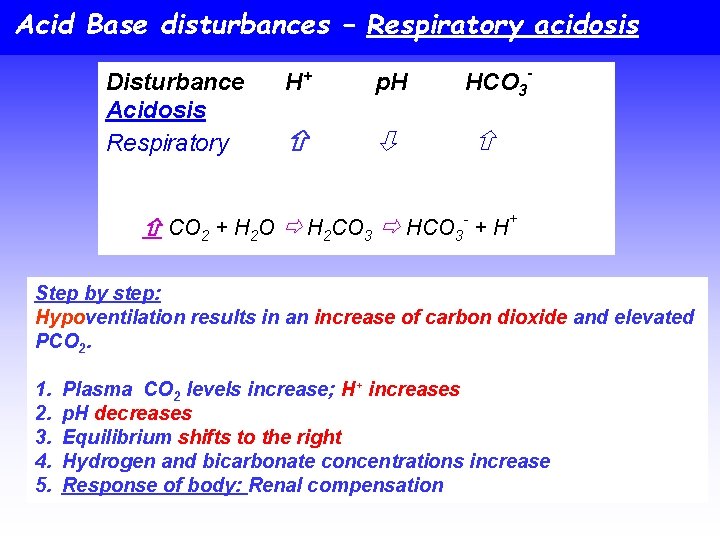
Acid Base disturbances – Respiratory acidosis Disturbance Acidosis Respiratory H+ p. H HCO 3 - CO 2 + H 2 O H 2 CO 3 HCO 3 - + H+ Step by step: Hypoventilation results in an increase of carbon dioxide and elevated PCO 2. 1. 2. 3. 4. 5. Plasma CO 2 levels increase; H+ increases p. H decreases Equilibrium shifts to the right Hydrogen and bicarbonate concentrations increase Response of body: Renal compensation
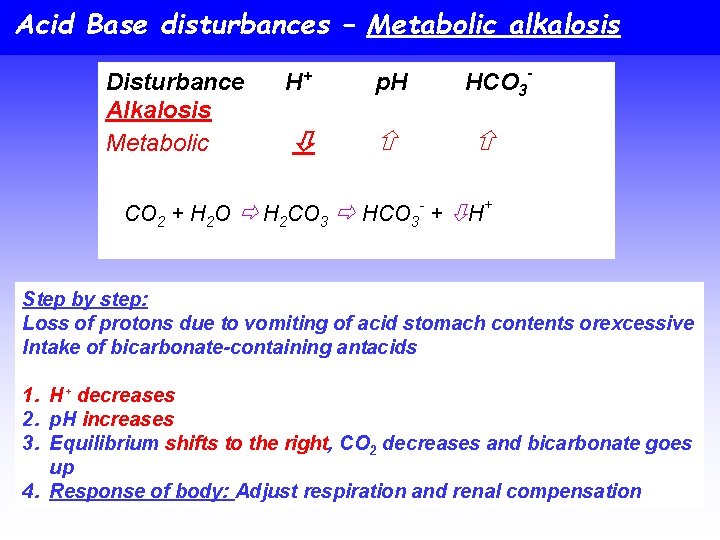
Acid Base disturbances – Metabolic alkalosis Disturbance Alkalosis Metabolic H+ p. H HCO 3 - CO 2 + H 2 O H 2 CO 3 HCO 3 - + H+ Step by step: Loss of protons due to vomiting of acid stomach contents orexcessive Intake of bicarbonate-containing antacids 1. H+ decreases 2. p. H increases 3. Equilibrium shifts to the right, CO 2 decreases and bicarbonate goes up 4. Response of body: Adjust respiration and renal compensation
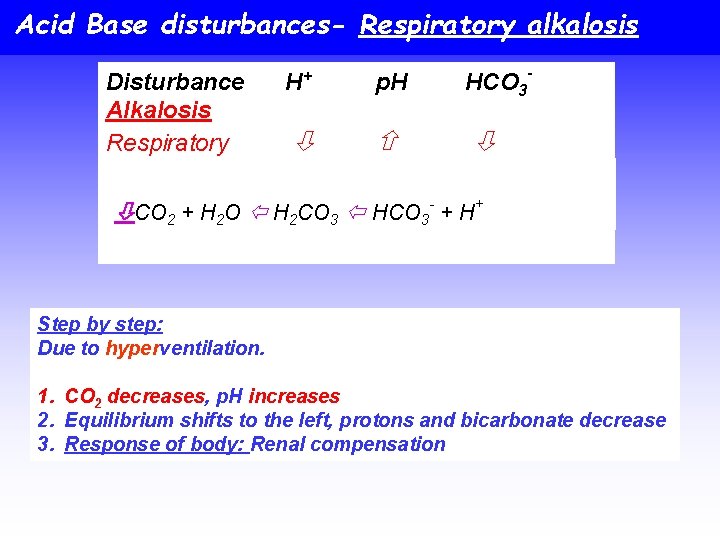
Acid Base disturbances- Respiratory alkalosis Disturbance Alkalosis Respiratory H+ p. H HCO 3 - CO 2 + H 2 O H 2 CO 3 HCO 3 - + H+ Step by step: Due to hyperventilation. 1. CO 2 decreases, p. H increases 2. Equilibrium shifts to the left, protons and bicarbonate decrease 3. Response of body: Renal compensation
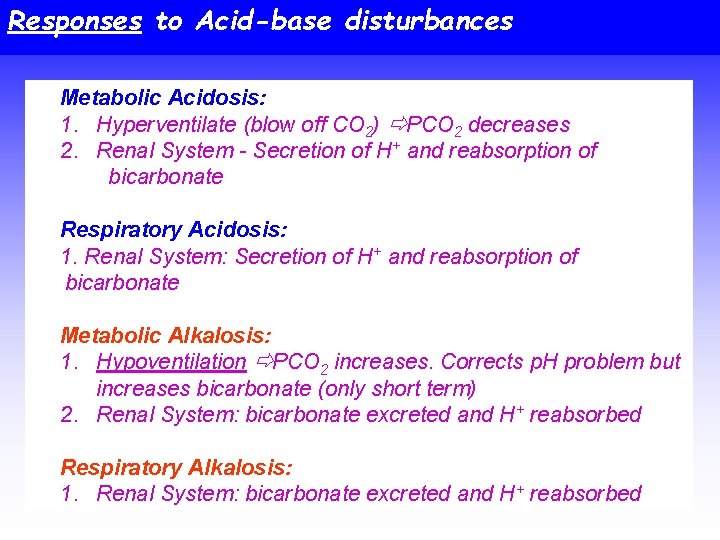
Responses to Acid-base disturbances Metabolic Acidosis: 1. Hyperventilate (blow off CO 2) PCO 2 decreases 2. Renal System - Secretion of H+ and reabsorption of bicarbonate Respiratory Acidosis: 1. Renal System: Secretion of H+ and reabsorption of bicarbonate Metabolic Alkalosis: 1. Hypoventilation PCO 2 increases. Corrects p. H problem but increases bicarbonate (only short term) 2. Renal System: bicarbonate excreted and H+ reabsorbed Respiratory Alkalosis: 1. Renal System: bicarbonate excreted and H+ reabsorbed
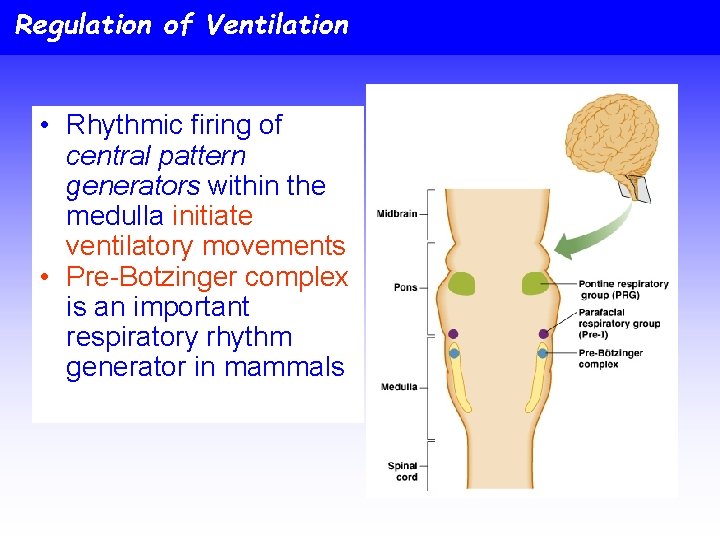
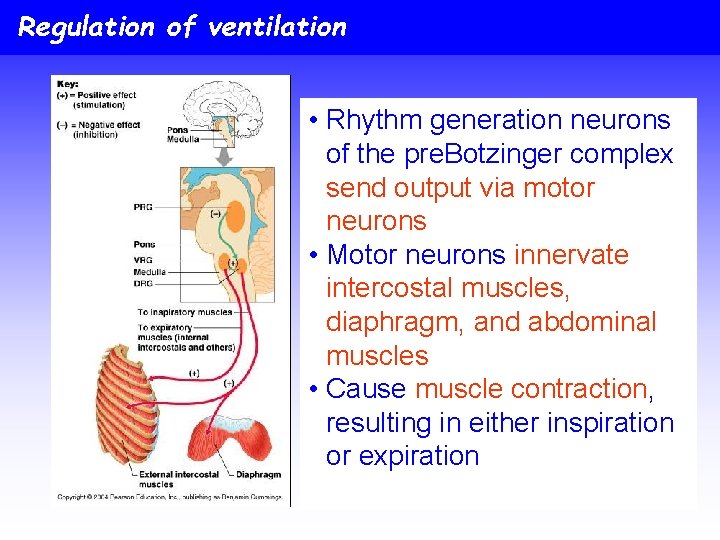
Regulation of Ventilation • Rhythmic firing of central pattern generators within the medulla initiate ventilatory movements • Pre-Botzinger complex is an important respiratory rhythm generator in mammals
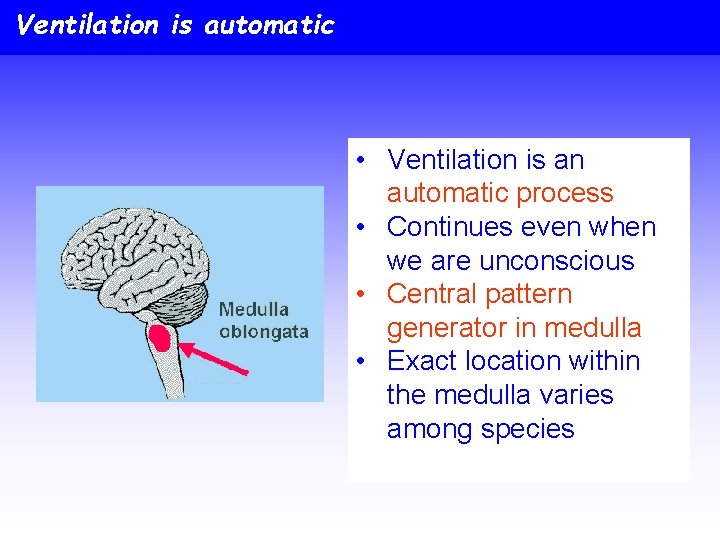
Ventilation is automatic • Ventilation is an automatic process • Continues even when we are unconscious • Central pattern generator in medulla • Exact location within the medulla varies among species
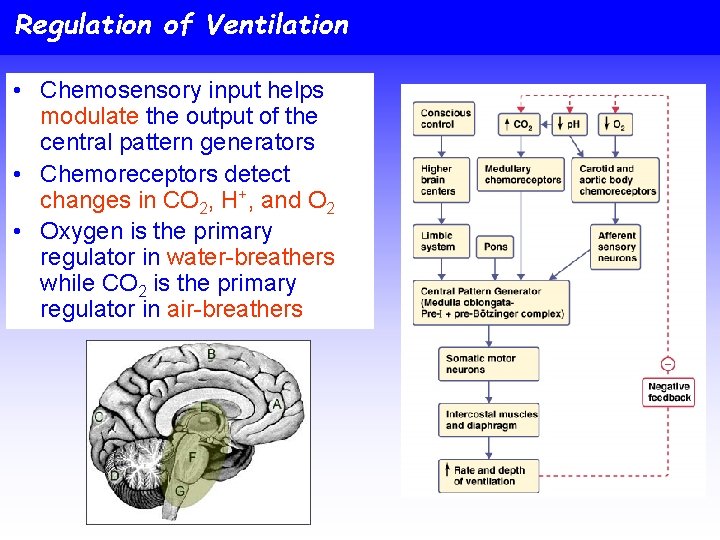
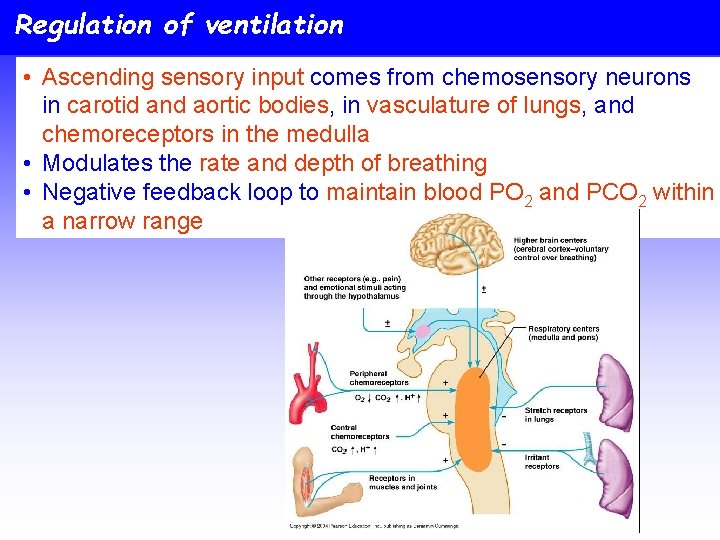
Regulation of Ventilation • Chemosensory input helps modulate the output of the central pattern generators • Chemoreceptors detect changes in CO 2, H+, and O 2 • Oxygen is the primary regulator in water-breathers while CO 2 is the primary regulator in air-breathers
Regulation of ventilation • Rhythm generation neurons of the pre. Botzinger complex send output via motor neurons • Motor neurons innervate intercostal muscles, diaphragm, and abdominal muscles • Cause muscle contraction, resulting in either inspiration or expiration
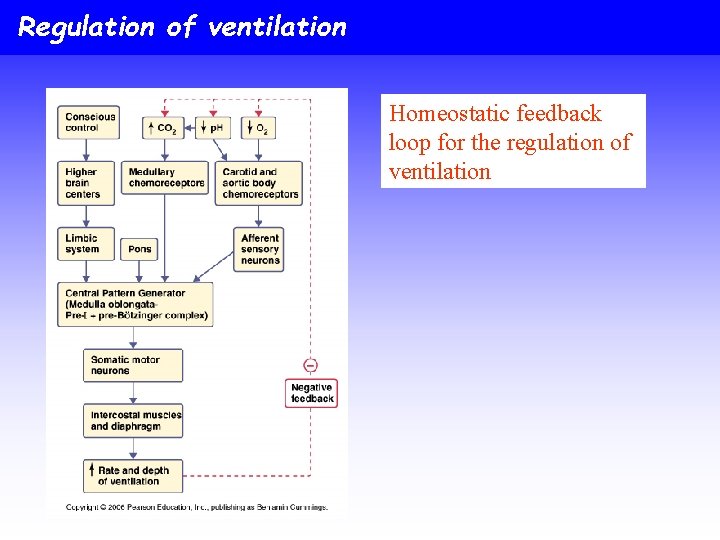
Regulation of ventilation • Ascending sensory input comes from chemosensory neurons in carotid and aortic bodies, in vasculature of lungs, and chemoreceptors in the medulla • Modulates the rate and depth of breathing • Negative feedback loop to maintain blood PO 2 and PCO 2 within a narrow range
Regulation of ventilation Homeostatic feedback loop for the regulation of ventilation
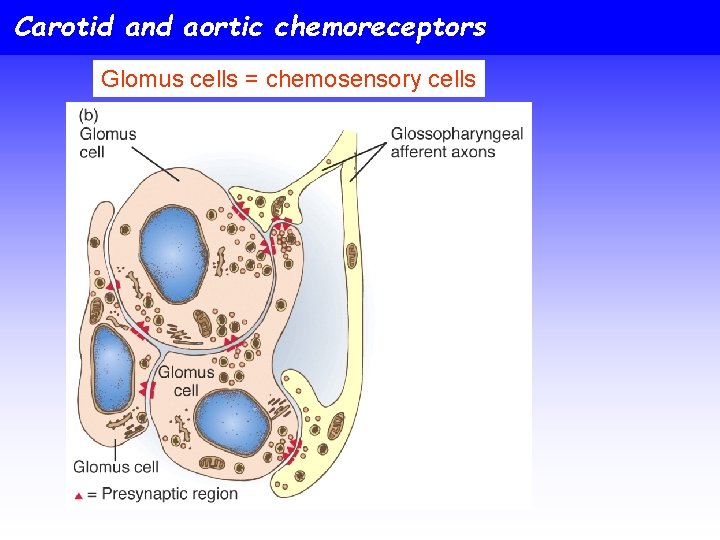
Carotid and aortic chemoreceptors Glomus cells = chemosensory cells
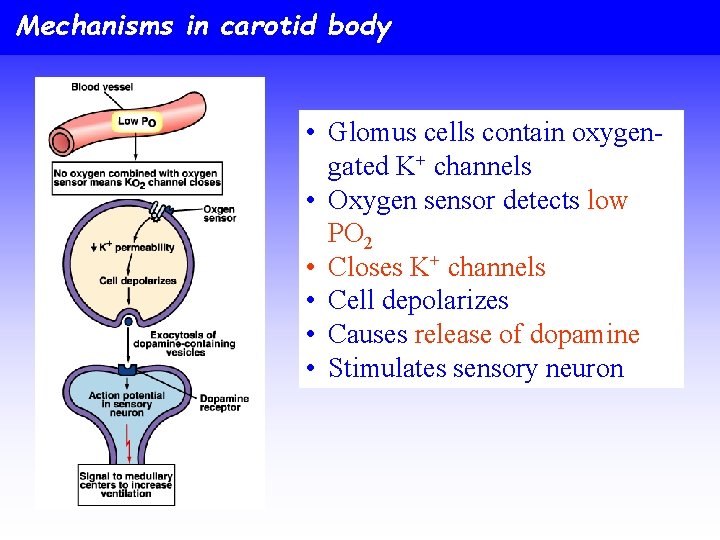
Mechanisms in carotid body • Glomus cells contain oxygengated K+ channels • Oxygen sensor detects low PO 2 • Closes K+ channels • Cell depolarizes • Causes release of dopamine • Stimulates sensory neuron
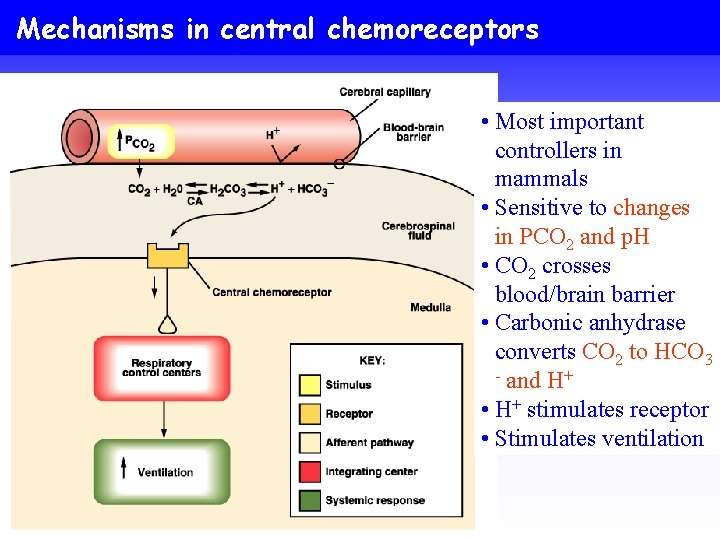
Mechanisms in central chemoreceptors • Most important controllers in mammals • Sensitive to changes in PCO 2 and p. H • CO 2 crosses blood/brain barrier • Carbonic anhydrase converts CO 2 to HCO 3 - and H+ • H+ stimulates receptor • Stimulates ventilation
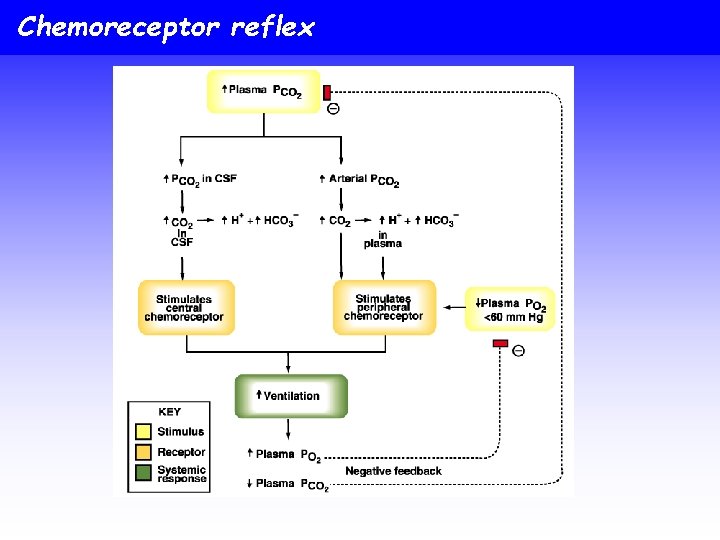
Chemoreceptor reflex
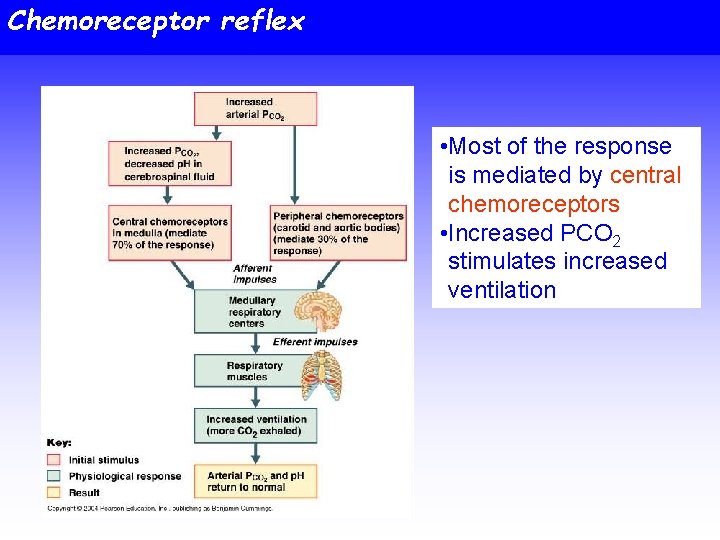
Chemoreceptor reflex • Most of the response is mediated by central chemoreceptors • Increased PCO 2 stimulates increased ventilation
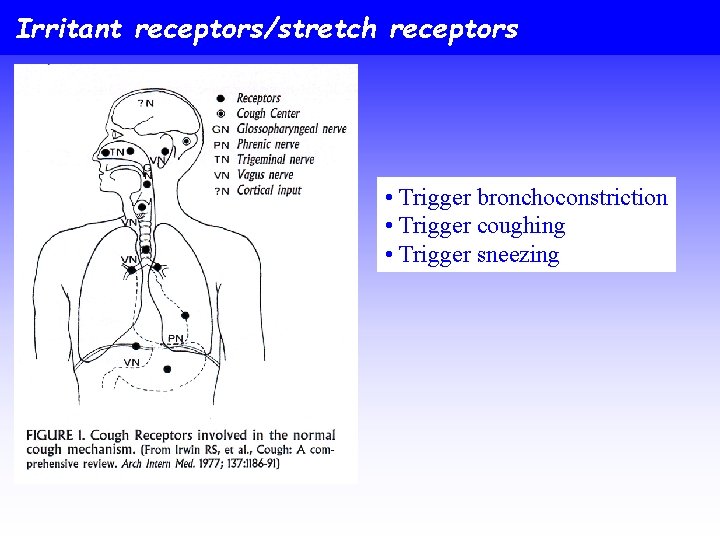
Irritant receptors/stretch receptors • Trigger bronchoconstriction • Trigger coughing • Trigger sneezing
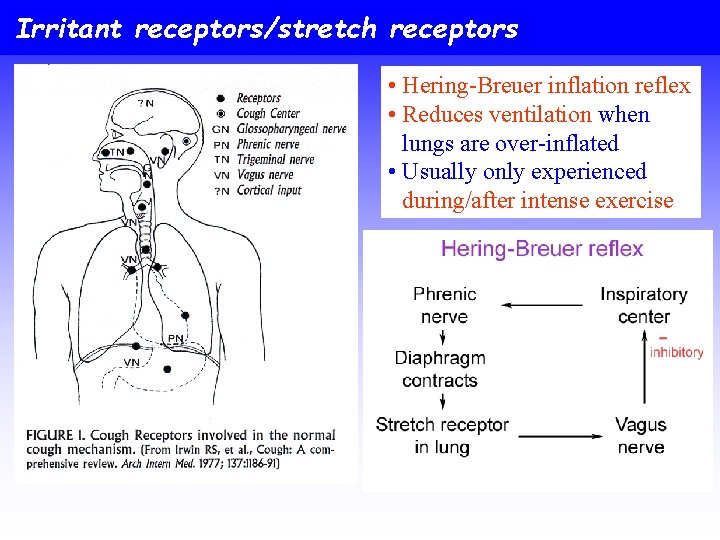
Irritant receptors/stretch receptors • Hering-Breuer inflation reflex • Reduces ventilation when lungs are over-inflated • Usually only experienced during/after intense exercise
Regulation of ventilation in water breathers • Water-breathers such as fish are typically more sensitive to PO 2 than PCO 2 • Decreases in PO 2 increase ventilation • Most species are sensitive to blood PO 2 • A few species are thought to be sensitive to environmental PO 2
Environmental Hypoxia • Hypoxia – lower than normal levels of oxygen • Can be caused by environmental hypoxia, inadequate ventilation, reduced blood hemoglobin content • Hyper-, hypocapnia – higher or lower than normal levels of CO 2
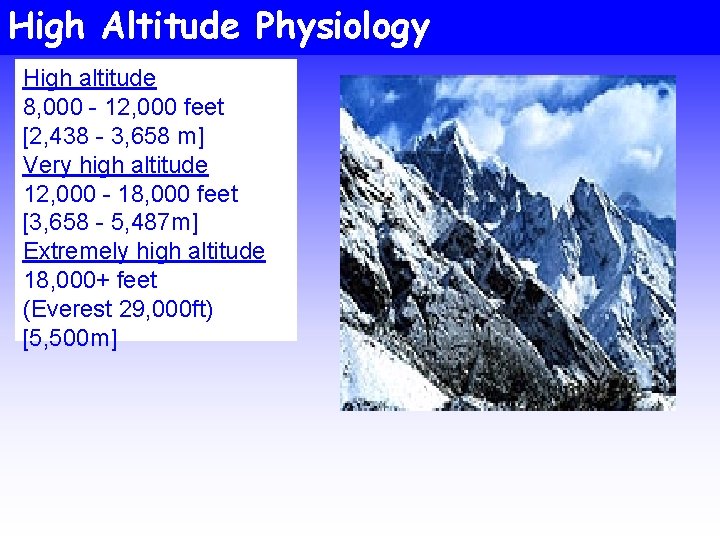
High Altitude Physiology High altitude 8, 000 - 12, 000 feet [2, 438 - 3, 658 m] Very high altitude 12, 000 - 18, 000 feet [3, 658 - 5, 487 m] Extremely high altitude 18, 000+ feet (Everest 29, 000 ft) [5, 500 m]
Oxygen at Altitude • Pressure declines as altitude increases • Oxygen delivery to body dependent on partial pressure of oxygen • Concentration of oxygen doesn’t change but you get less oxygen per breath • At 12, 000 ft you get ~40% less oxygen per breath
Physiological Response to Altitude Moderate Altitude – initial symptoms • • • Headache Nausea Fatigue Loss of appetite Difficulty sleeping Frequent Urination
Physiological Response to Altitude High Altitude – initial symptoms • • • Confusion Reduced mental acuity Loss of coordination Cerebral edema Pulmonary edema death
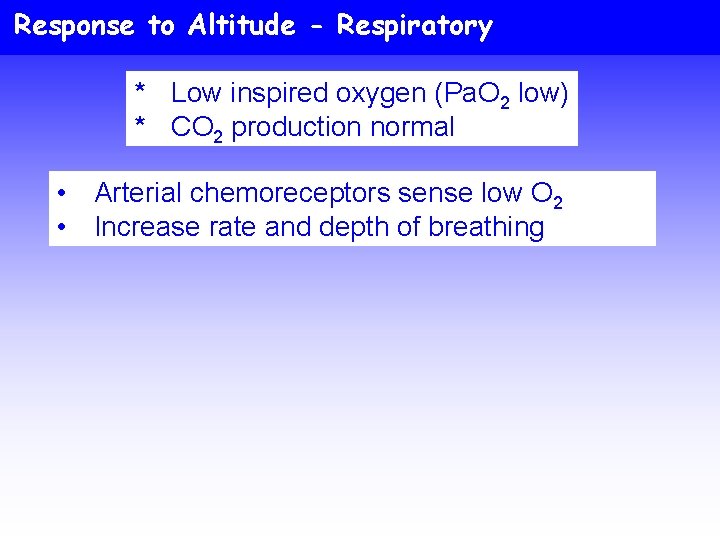
Response to Altitude - Respiratory * Low inspired oxygen (Pa. O 2 low) * CO 2 production normal • Arterial chemoreceptors sense low O 2 • Increase rate and depth of breathing
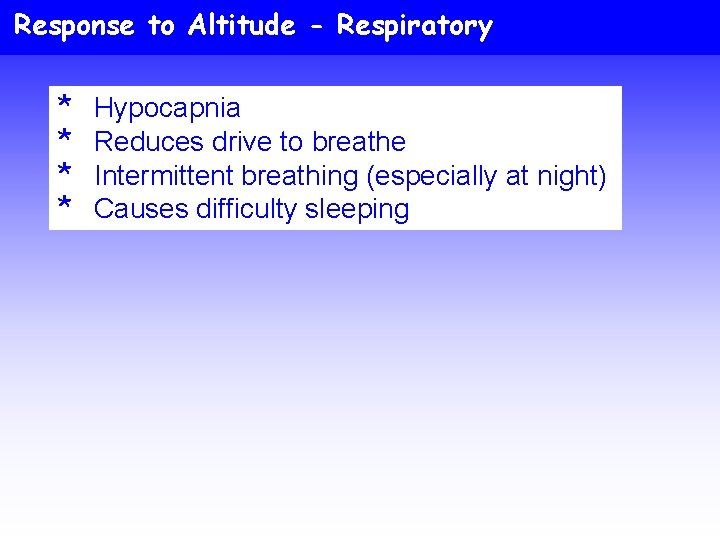
Response to Altitude - Respiratory * * Hypocapnia Reduces drive to breathe Intermittent breathing (especially at night) Causes difficulty sleeping
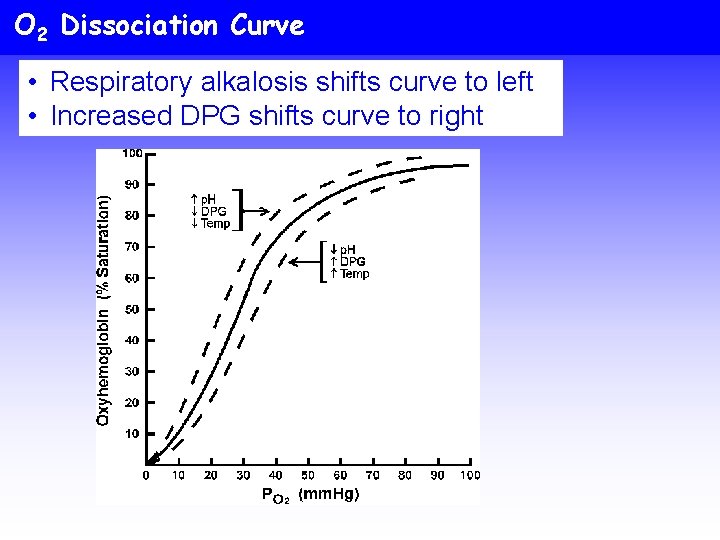
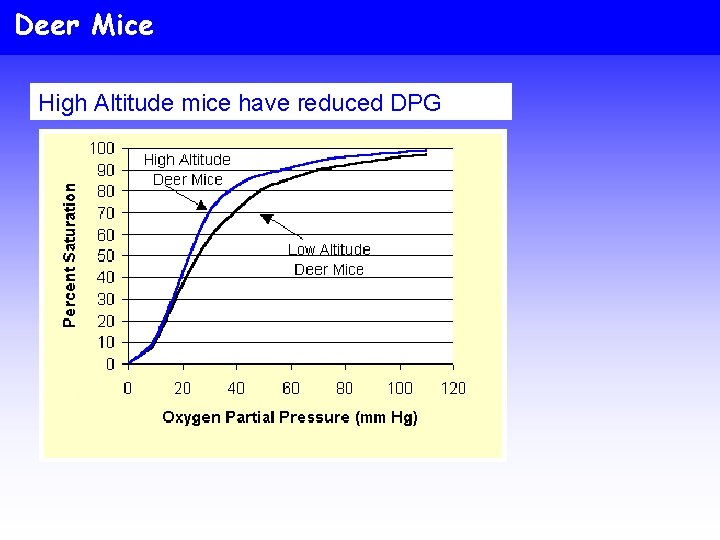
O 2 Dissociation Curve • Respiratory alkalosis shifts curve to left • Increased DPG shifts curve to right
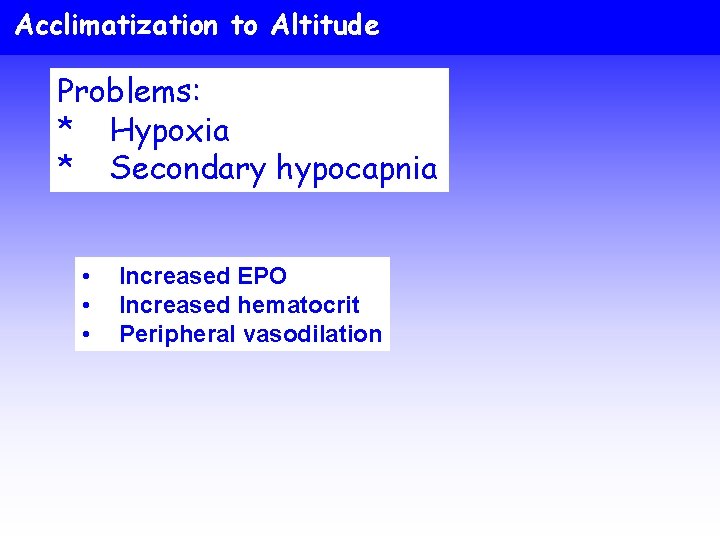
Acclimatization to Altitude Problems: * Hypoxia * Secondary hypocapnia • • • Increased EPO Increased hematocrit Peripheral vasodilation
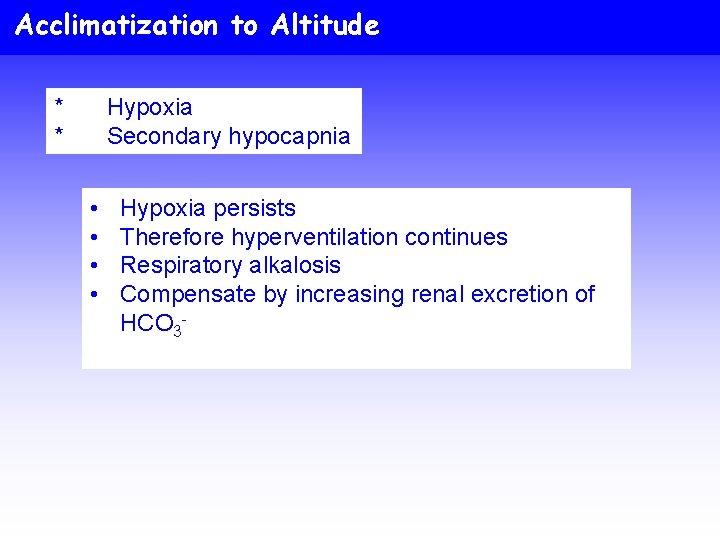
Acclimatization to Altitude * * Hypoxia Secondary hypocapnia • • Hypoxia persists Therefore hyperventilation continues Respiratory alkalosis Compensate by increasing renal excretion of HCO 3 -
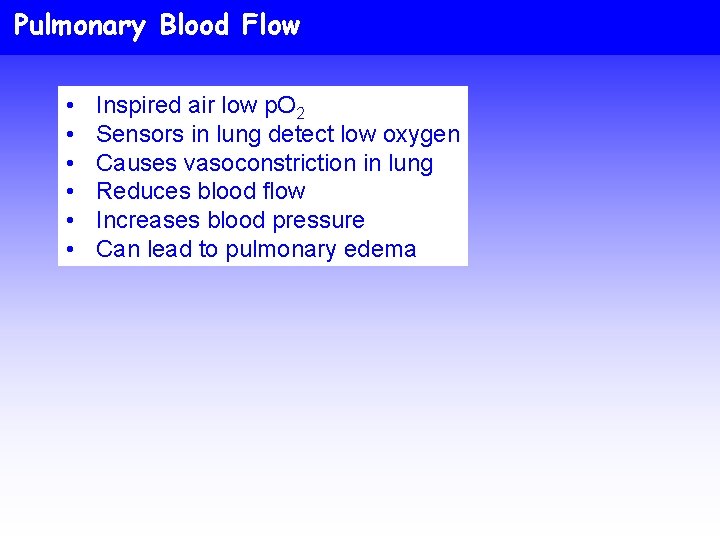
Pulmonary Blood Flow • • • Inspired air low p. O 2 Sensors in lung detect low oxygen Causes vasoconstriction in lung Reduces blood flow Increases blood pressure Can lead to pulmonary edema
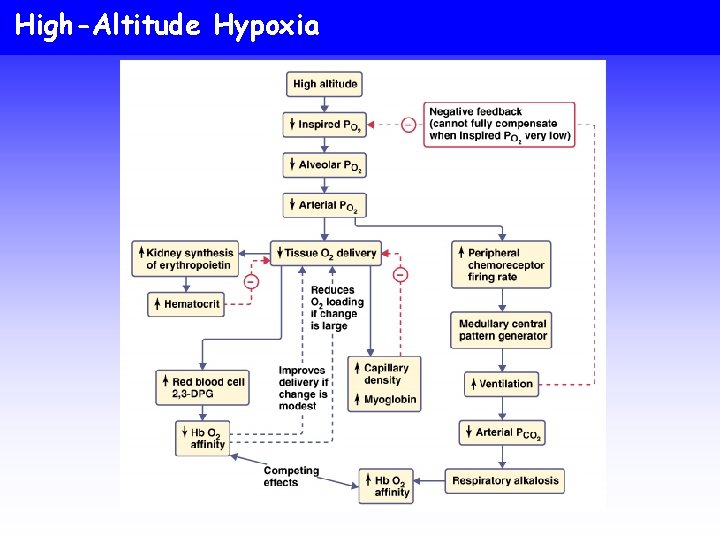
High-Altitude Hypoxia
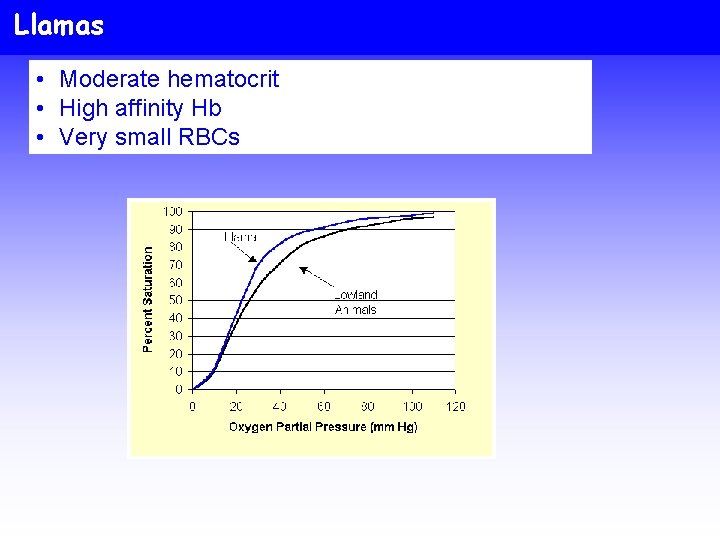
Llamas • Moderate hematocrit • High affinity Hb • Very small RBCs
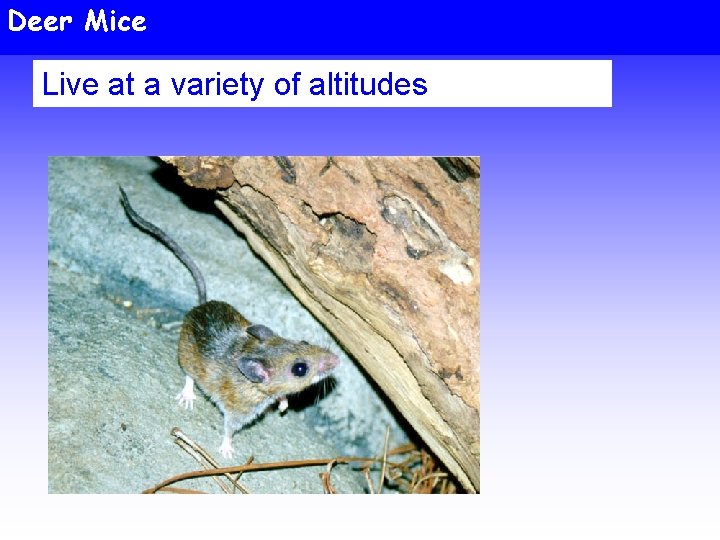
Deer Mice Live at a variety of altitudes
Deer Mice High Altitude mice have reduced DPG
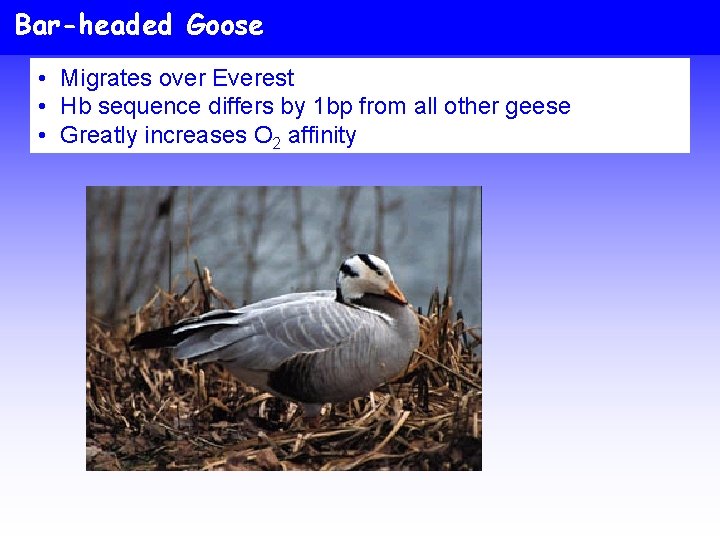
Bar-headed Goose • Migrates over Everest • Hb sequence differs by 1 bp from all other geese • Greatly increases O 2 affinity
Physiology of Diving
Physiology of Diving Boyle’s Law P 1 V 1 = P 2 V 2 • As pressure increases, volume decreases • As we dive, pressure increases
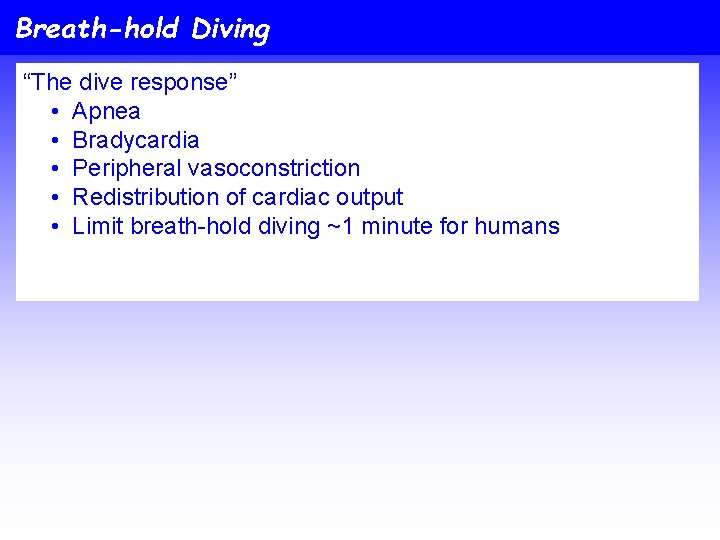
Breath-hold Diving “The dive response” • Apnea • Bradycardia • Peripheral vasoconstriction • Redistribution of cardiac output • Limit breath-hold diving ~1 minute for humans
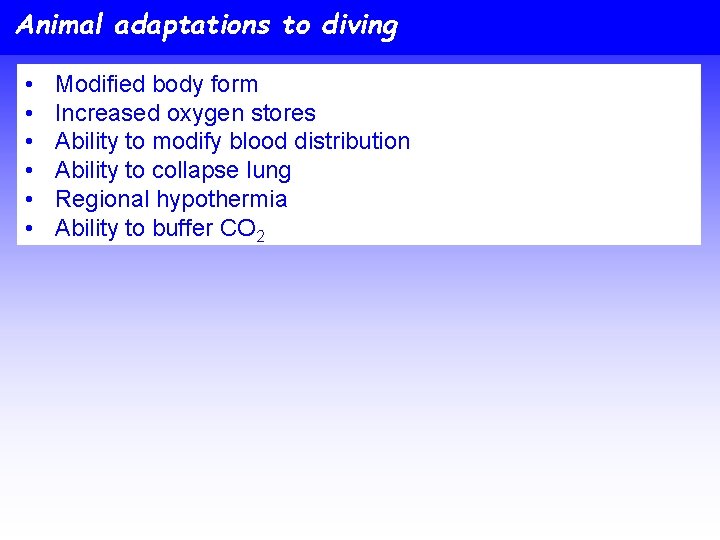
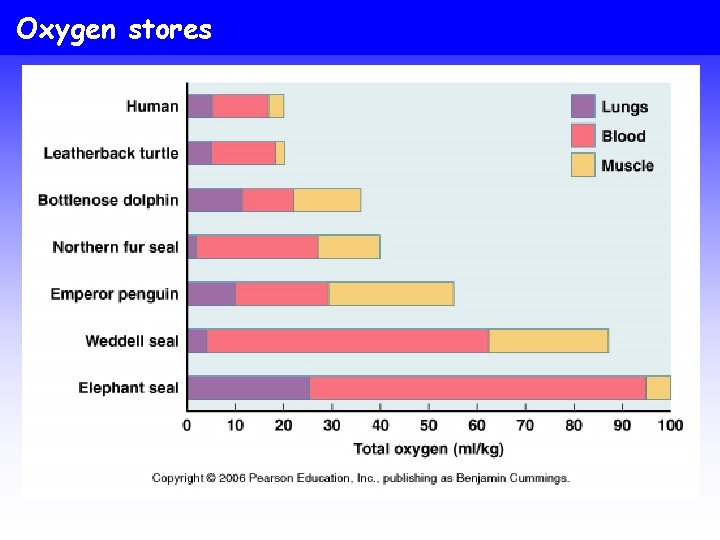
Animal adaptations to diving • • • Modified body form Increased oxygen stores Ability to modify blood distribution Ability to collapse lung Regional hypothermia Ability to buffer CO 2
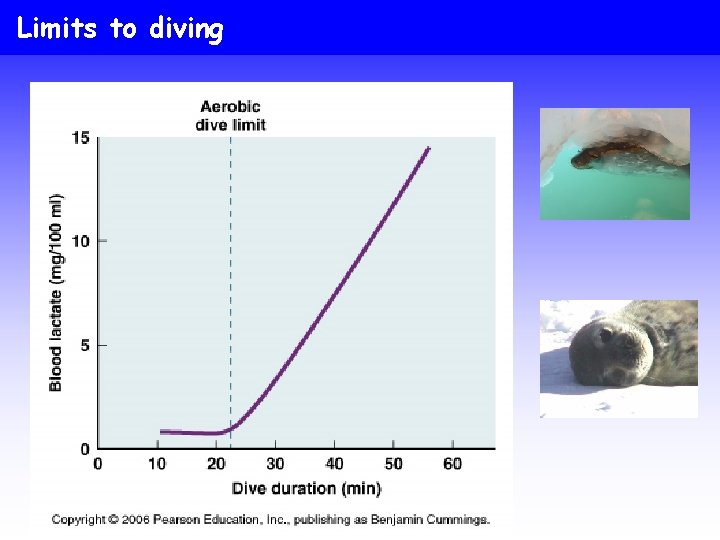
Limits to diving
Oxygen stores
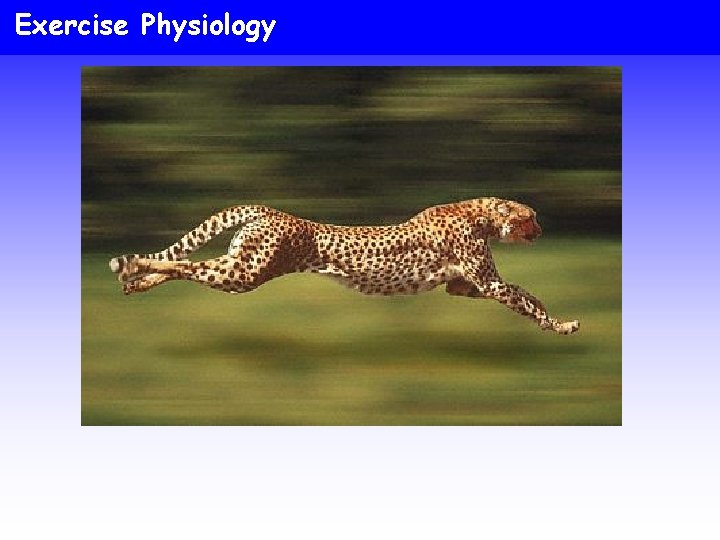
Exercise Physiology
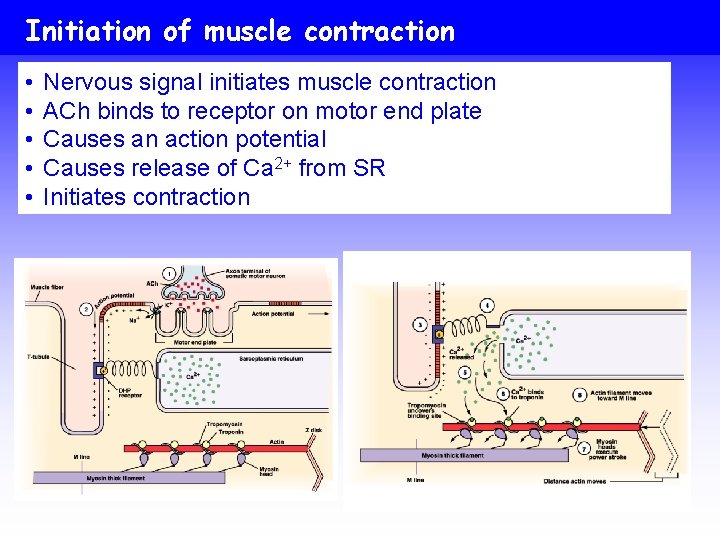
Initiation of muscle contraction • • • Nervous signal initiates muscle contraction ACh binds to receptor on motor end plate Causes an action potential Causes release of Ca 2+ from SR Initiates contraction
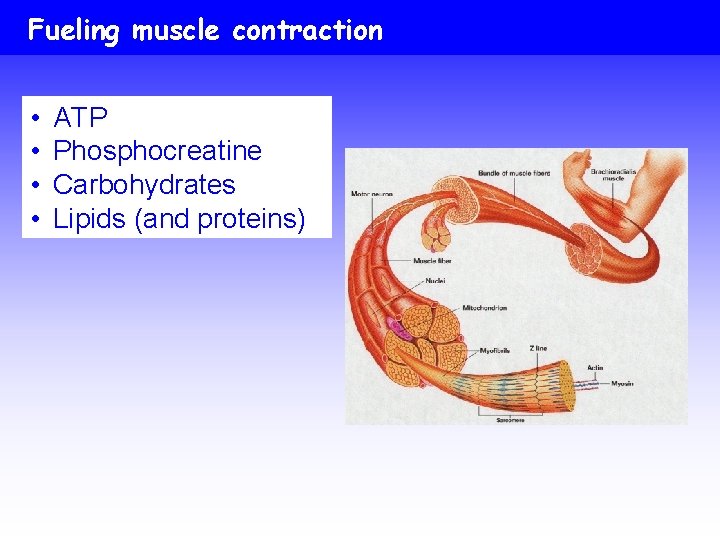
Fueling muscle contraction • • ATP Phosphocreatine Carbohydrates Lipids (and proteins)
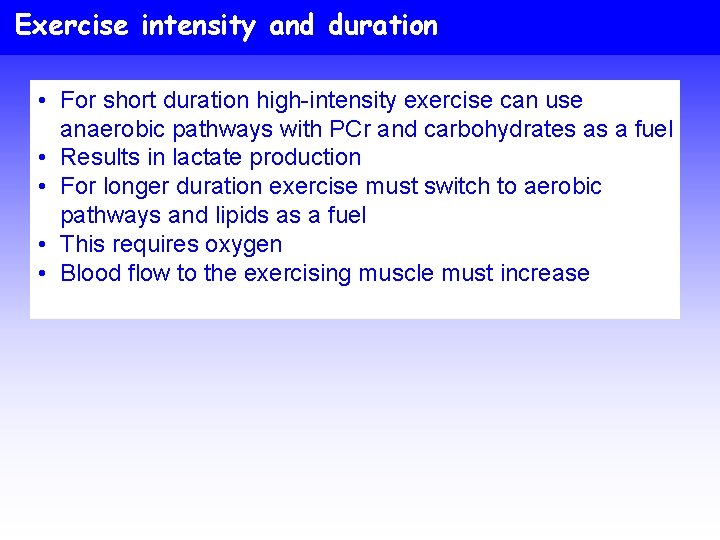
Exercise intensity and duration • For short duration high-intensity exercise can use anaerobic pathways with PCr and carbohydrates as a fuel • Results in lactate production • For longer duration exercise must switch to aerobic pathways and lipids as a fuel • This requires oxygen • Blood flow to the exercising muscle must increase
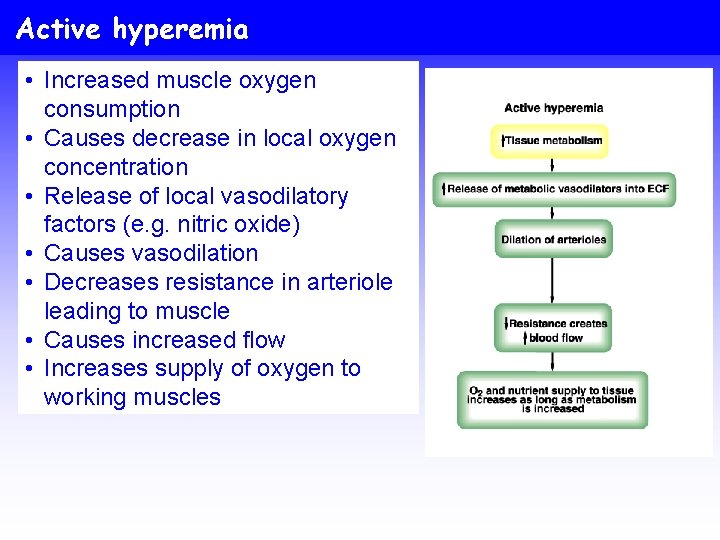
Active hyperemia • Increased muscle oxygen consumption • Causes decrease in local oxygen concentration • Release of local vasodilatory factors (e. g. nitric oxide) • Causes vasodilation • Decreases resistance in arteriole leading to muscle • Causes increased flow • Increases supply of oxygen to working muscles
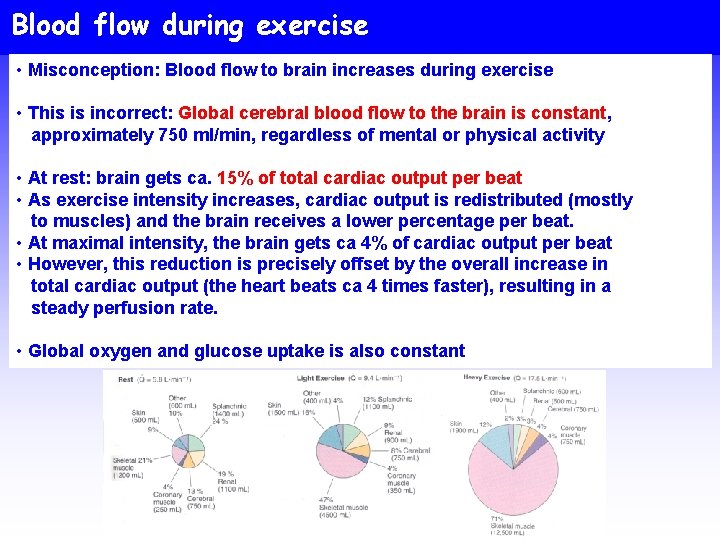
Blood flow during exercise • Misconception: Blood flow to brain increases during exercise • This is incorrect: Global cerebral blood flow to the brain is constant, approximately 750 ml/min, regardless of mental or physical activity • At rest: brain gets ca. 15% of total cardiac output per beat • As exercise intensity increases, cardiac output is redistributed (mostly to muscles) and the brain receives a lower percentage per beat. • At maximal intensity, the brain gets ca 4% of cardiac output per beat • However, this reduction is precisely offset by the overall increase in total cardiac output (the heart beats ca 4 times faster), resulting in a steady perfusion rate. • Global oxygen and glucose uptake is also constant
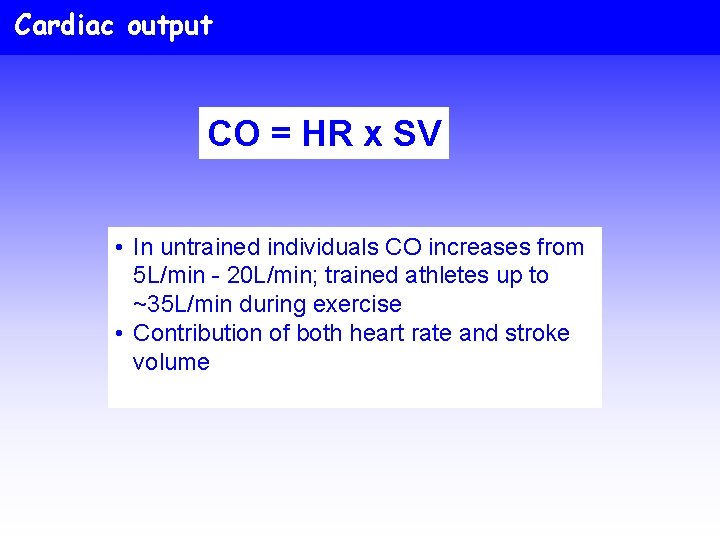
Cardiac output CO = HR x SV • In untrained individuals CO increases from 5 L/min - 20 L/min; trained athletes up to ~35 L/min during exercise • Contribution of both heart rate and stroke volume
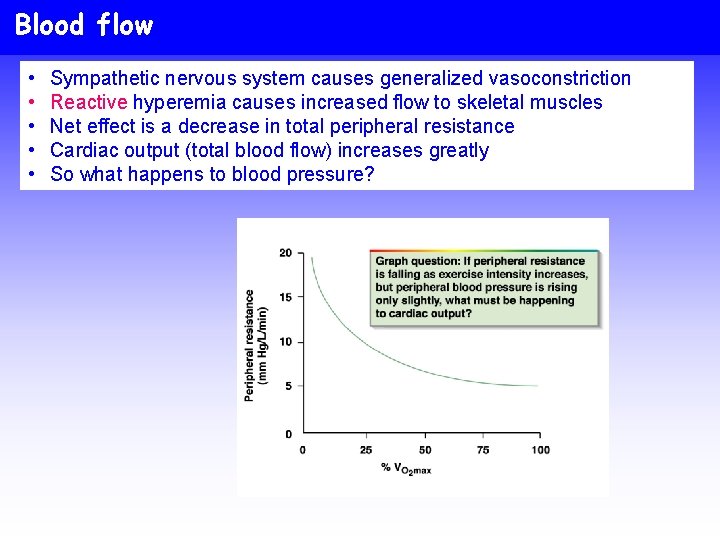
Blood flow • • • Sympathetic nervous system causes generalized vasoconstriction Reactive hyperemia causes increased flow to skeletal muscles Net effect is a decrease in total peripheral resistance Cardiac output (total blood flow) increases greatly So what happens to blood pressure?
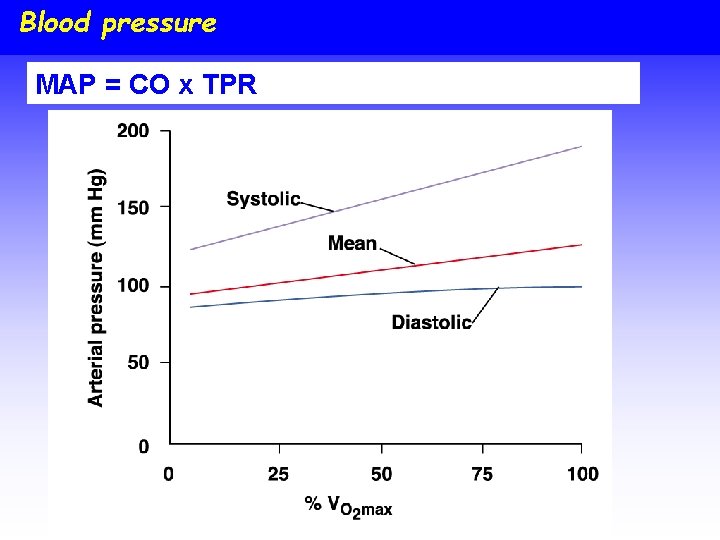
Blood pressure MAP = CO x TPR
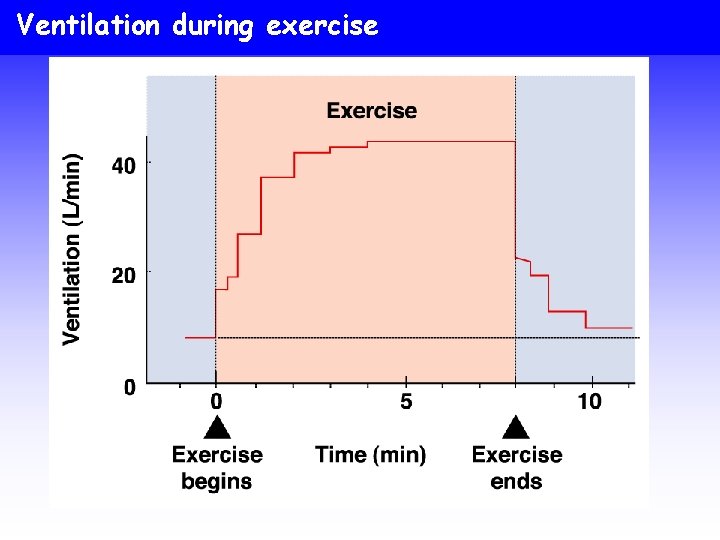
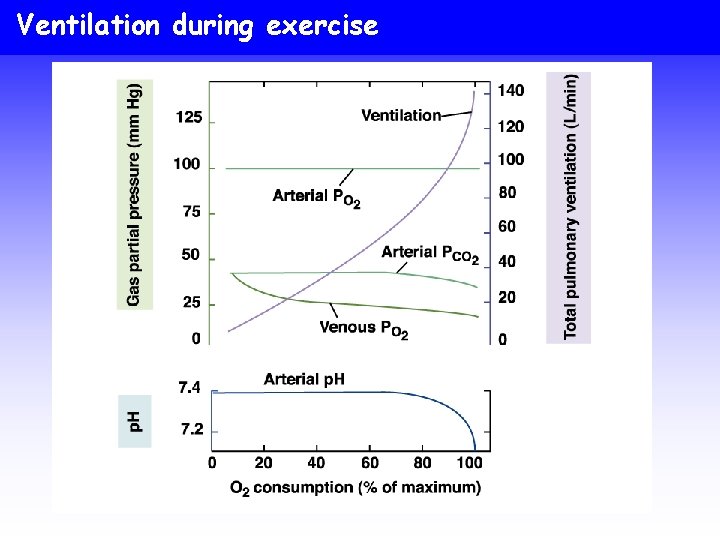
Ventilation during exercise
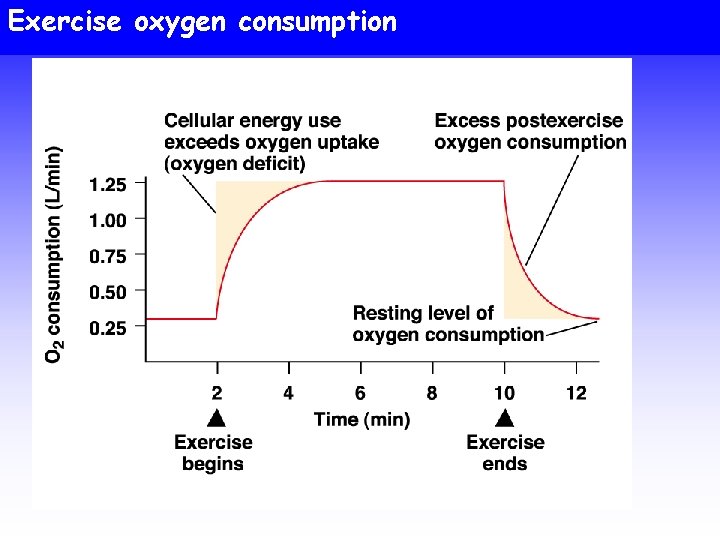
Exercise oxygen consumption
Ventilation during exercise
Have a great weekend!