
Respiratory Systems Chapter 35 BIOL 1000 Dr Mohamad
Respiratory Systems Chapter 35 BIOL 1000 Dr. Mohamad H. Termos

Gas Exchange Surfaces • Respiration: Events associated with gas exchange between the body’s cells and the environment • Why is respiration needed? • Can occur in organisms at: skin/body surface, gills, tracheae, lungs • Gas exchange takes place by diffusion • For external respiration to be effective, gas-exchange regions must be: moist, thin, large in relation to body size 2
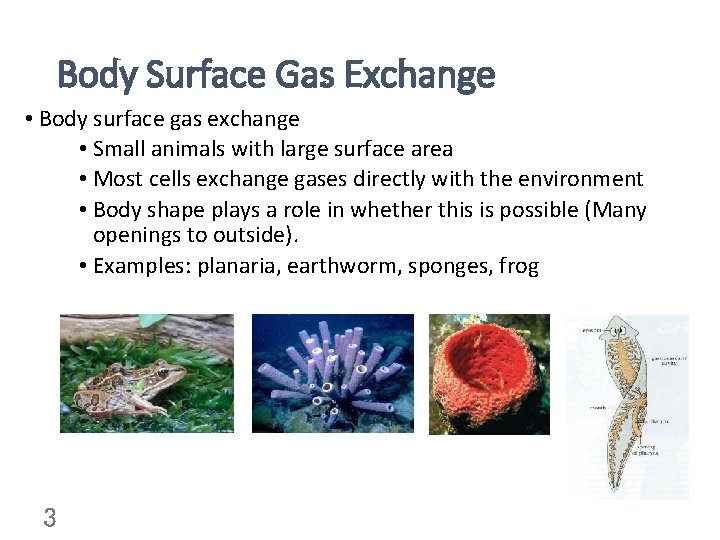
Body Surface Gas Exchange • Body surface gas exchange • Small animals with large surface area • Most cells exchange gases directly with the environment • Body shape plays a role in whether this is possible (Many openings to outside). • Examples: planaria, earthworm, sponges, frog 3

Gas Exchange Surfaces • Larger aquatic animals often have gills • Finely divided vascularized outgrowths of the body surface or pharynx 4

Gas Exchange Surfaces • Tracheae • Insects and other terrestrial arthropods • Oxygen enters at spiracles • Tracheae branch into small tubules • End in tracheoles that are in direct contact with body cells 5

Human Respiration • In terrestrial vertebrates, respiration includes: Ventilation, External respiration, and Internal respiration • Terrestrial vertebrates have lungs Functions of human respiration: 1. Oxygen and carbon dioxide exchange 2. Speech and other vocalizations 3. Smell 4. Controls p. H of body fluids (by eliminating carbon dioxide) 5. Pressure gradients between thoracic and abdominal cavities 6
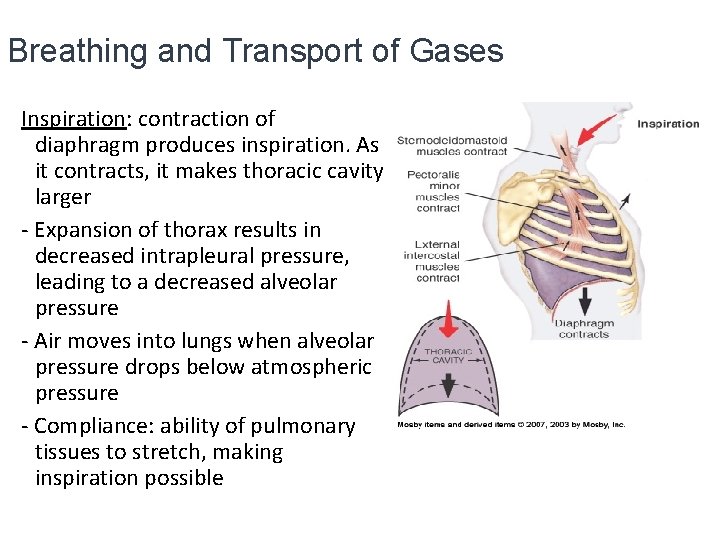
Breathing and Transport of Gases Inspiration: contraction of diaphragm produces inspiration. As it contracts, it makes thoracic cavity larger - Expansion of thorax results in decreased intrapleural pressure, leading to a decreased alveolar pressure - Air moves into lungs when alveolar pressure drops below atmospheric pressure - Compliance: ability of pulmonary tissues to stretch, making inspiration possible

Mechanism of pulmonary ventilation Expiration: a passive process that begins when inspiratory muscles are relaxed, decreasing size of thorax - Decreasing thoracic volume increases intrapleural pressure and thus increases alveolar pressure above atmospheric pressure - Air moves out of lungs when alveolar pressure exceeds atmospheric pressure - Elastic recoil: tendency of pulmonary tissues to return to a smaller size after having been stretched passively during expiration
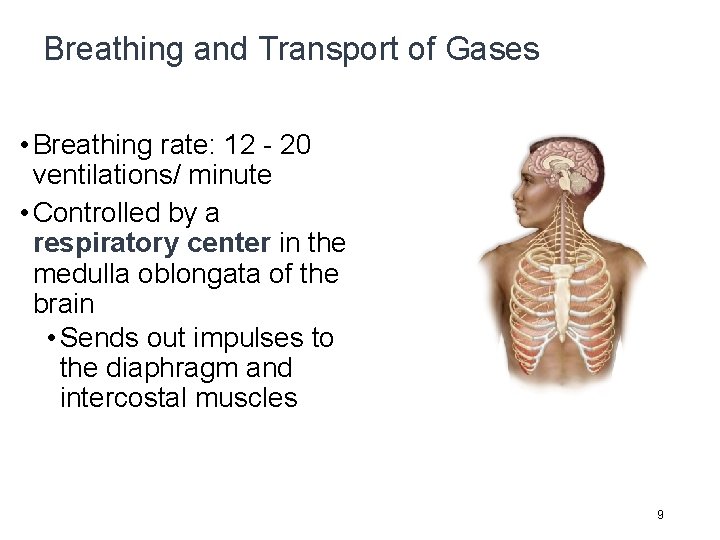
Breathing and Transport of Gases • Breathing rate: 12 - 20 ventilations/ minute • Controlled by a respiratory center in the medulla oblongata of the brain • Sends out impulses to the diaphragm and intercostal muscles 9

Path of Air in Humans • Nasal cavities/mouth: intake of air. Lined with mucous membranes. Filter, warm and moisten air. • Pharynx: crossing of nasal and digestive pathways. It connects to larynx and esophagus • As air moves through upper respiratory system: It is filtered to free it of debris (Warmed and Humidified). When air reaches lungs It is at body temperature saturated with water 10
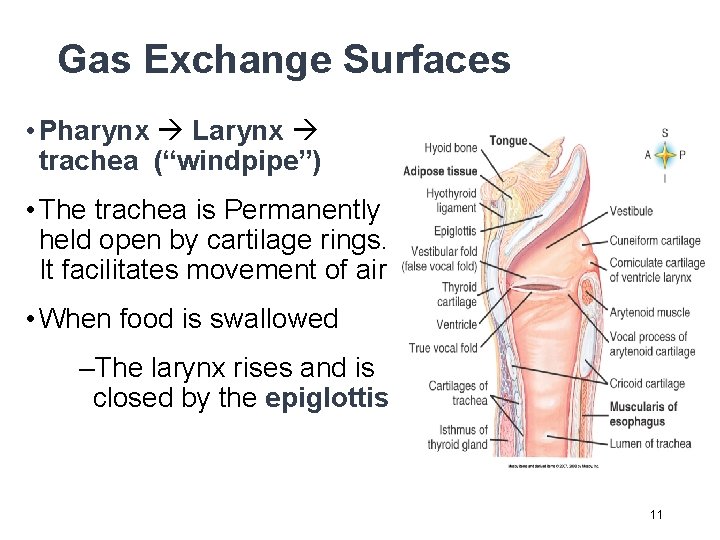
Gas Exchange Surfaces • Pharynx Larynx trachea (“windpipe”) • The trachea is Permanently held open by cartilage rings. It facilitates movement of air • When food is swallowed –The larynx rises and is closed by the epiglottis 11

Gas Exchange Surfaces –Trachea divides two primary bronchi • Bronchi enter the right and left lungs –Bronchi branch bronchioles • Each bronchiole terminates in an elongated space enclosed by alveoli 12

Gas Exchange and Transport • Gases diffuse from areas of higher to lower partial pressure • Ventilation causes the alveoli to have a higher partial pressure of oxygen and a lower partial pressure of carbon dioxide than the blood in the pulmonary capillaries • This accounts for the exchange of gases in the lungs • The opposite occurs in the tissues of the body 13
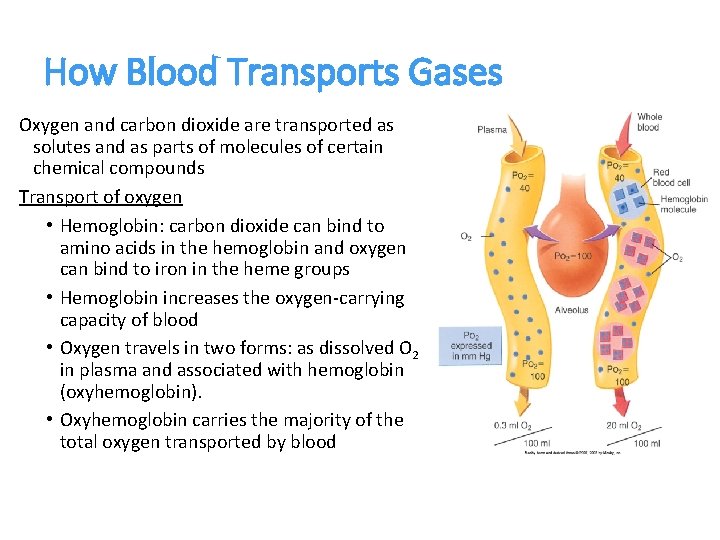
How Blood Transports Gases Oxygen and carbon dioxide are transported as solutes and as parts of molecules of certain chemical compounds Transport of oxygen • Hemoglobin: carbon dioxide can bind to amino acids in the hemoglobin and oxygen can bind to iron in the heme groups • Hemoglobin increases the oxygen-carrying capacity of blood • Oxygen travels in two forms: as dissolved O 2 in plasma and associated with hemoglobin (oxyhemoglobin). • Oxyhemoglobin carries the majority of the total oxygen transported by blood
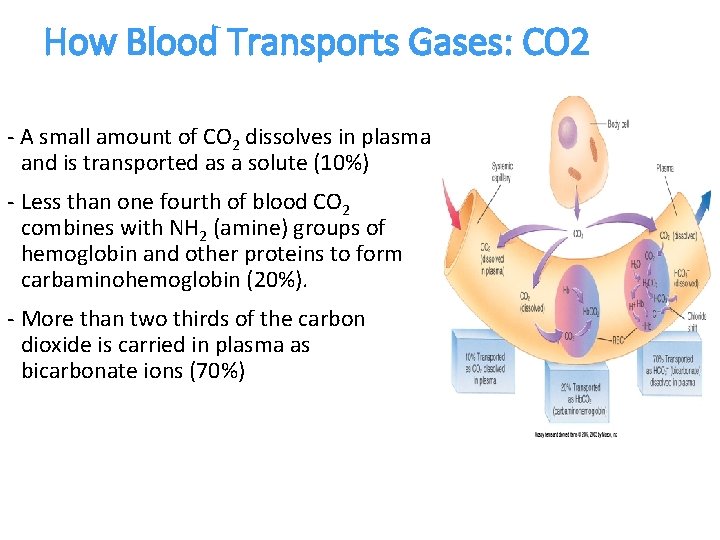
How Blood Transports Gases: CO 2 - A small amount of CO 2 dissolves in plasma and is transported as a solute (10%) - Less than one fourth of blood CO 2 combines with NH 2 (amine) groups of hemoglobin and other proteins to form carbaminohemoglobin (20%). - More than two thirds of the carbon dioxide is carried in plasma as bicarbonate ions (70%)
Disorders of the Upper Respiratory Tract –Cold (Rhinovirus) • Mild viral infections • Characterized by sneezing, runny nose, mild fever • Antibiotics ? –Strep Throat • Acute pharyngitis caused by a bacterium • Severe sore throat, high fever, swollen tonsils • Curable with antibiotics 16
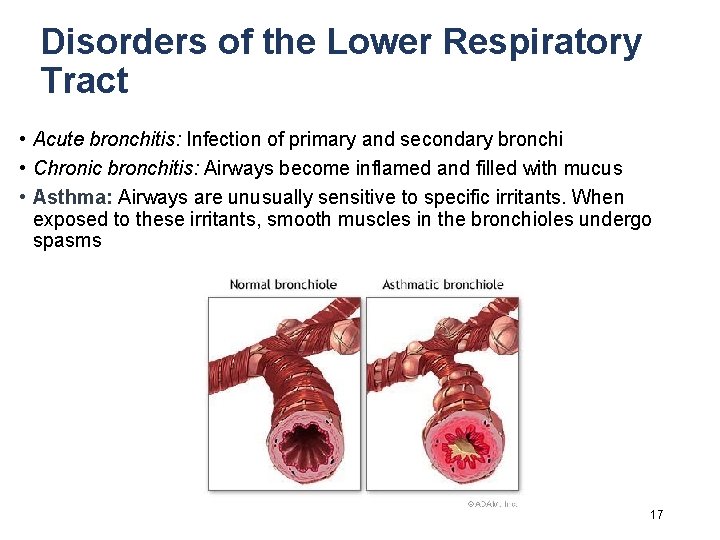
Disorders of the Lower Respiratory Tract • Acute bronchitis: Infection of primary and secondary bronchi • Chronic bronchitis: Airways become inflamed and filled with mucus • Asthma: Airways are unusually sensitive to specific irritants. When exposed to these irritants, smooth muscles in the bronchioles undergo spasms 17
Disorders Affecting the Lungs –Pneumonia: Viral, bacterial, or fungal infection of the lungs in which bronchi and alveoli fill with fluid. –Pulmonary tuberculosis: Caused by bacteria. Results in lung damage and reduced function. –Pulmonary fibrosis: Fibrous connective tissue builds up in the lungs 18
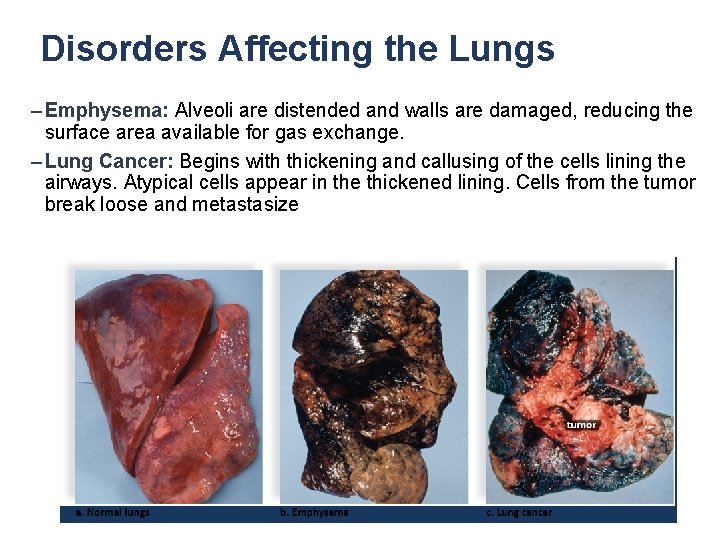
Disorders Affecting the Lungs – Emphysema: Alveoli are distended and walls are damaged, reducing the surface area available for gas exchange. – Lung Cancer: Begins with thickening and callusing of the cells lining the airways. Atypical cells appear in the thickened lining. Cells from the tumor break loose and metastasize 19
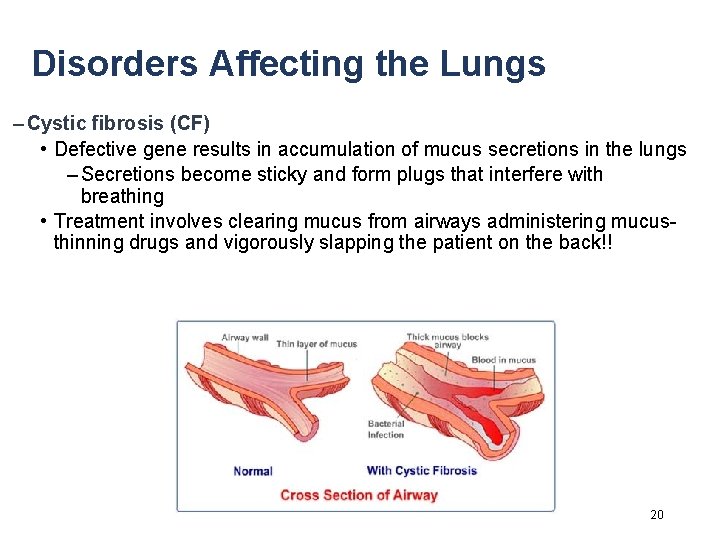
Disorders Affecting the Lungs – Cystic fibrosis (CF) • Defective gene results in accumulation of mucus secretions in the lungs – Secretions become sticky and form plugs that interfere with breathing • Treatment involves clearing mucus from airways administering mucusthinning drugs and vigorously slapping the patient on the back!! 20
- Slides: 20