
Respiratory system Prepare to be inspired Inspiration and
Respiratory system

Prepare to be inspired!
Inspiration and Expiration • Breathing in is referred to as inspiration • Breathing out is referred to as expiration • We breathe in and out about 12 -16 times/minute on average Below 12 breaths/minute or above 25 breaths/minute is abnormal • Take a minute (time yourselves) and determine how many breathes you take/minute while at rest.
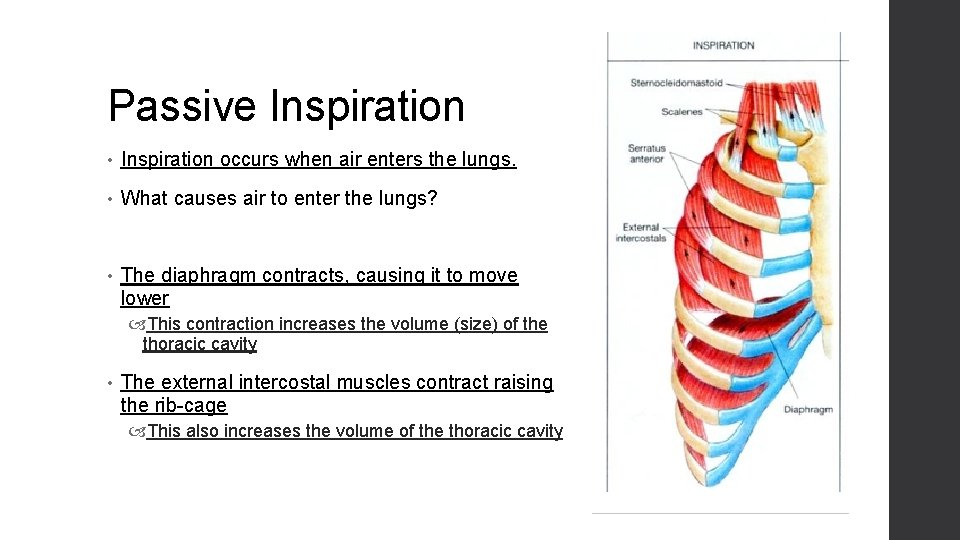
Passive Inspiration • Inspiration occurs when air enters the lungs. • What causes air to enter the lungs? • The diaphragm contracts, causing it to move lower This contraction increases the volume (size) of the thoracic cavity • The external intercostal muscles contract raising the rib-cage This also increases the volume of the thoracic cavity
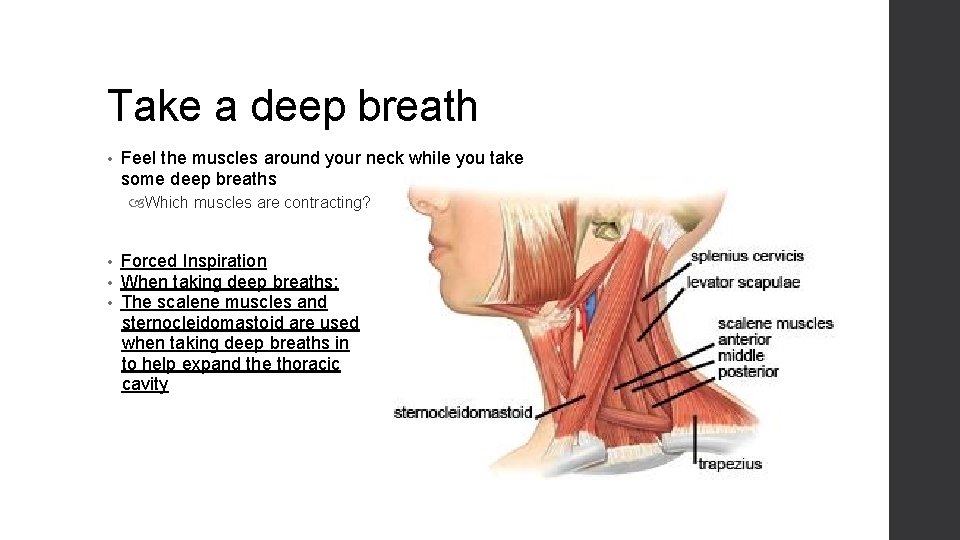
Take a deep breath • Feel the muscles around your neck while you take some deep breaths Which muscles are contracting? • • • Forced Inspiration When taking deep breaths: The scalene muscles and sternocleidomastoid are used when taking deep breaths in to help expand the thoracic cavity
Expanding the thoracic cavity • So what actually causes air to come in to our lungs? • Air enters our lungs due to differences in air pressure. • At rest the pressure outside our body is the same as inside our lungs • When we expand our lungs this lowers the pressure in the lungs • Air travels from high pressure to low pressure This causes air to enter our lungs
Breathing out: expiration • Passive expiration is due to relaxation of the external intercostal muscles as well as the diaphragm. • Forceful expiration involves the internal intercostal muscles and abdominal muscles Internal intercostal muscles pull down on the rib cage Abdominal muscles compress the abdomen resulting in the diaphragm being pushed upward • These together compress the lungs increasing the pressure within the lungs.
Oxygen and carbon dioxide exchange • Occurs in the alveoli, alveolar sacs, and respiratory bronchioles Alveoli have a very large surface area – approximately 750 square feet. This is considered the respiratory zone • Most of the air in our airways is actually nitrogen • Dead-space also accounts for a large amount of air not used in gas exchange
Oxygen and Carbon Dioxide • There are several factors which contribute to oxygen exchange in tissues (beyond what we already discussed) • Acidity in the blood results in oxygen being less tightly bound to hemoglobin Lactic acid build-up due to exercise results in acidity in the blood • Increased temperature results in oxygen being less tightly bound to hemoglobin Exercise increases temperature resulting in more oxygen being left in tissues • High concentration of CO 2 liberates oxygen from hemoglobin, tissues have higher CO 2 concentrations.
Cilia • The lungs are good at clearing out debris • This is done by cilia which constantly push small particles up into the throat from the lungs Cilia act as a broom sweeping out the lungs • https: //www. youtube. com/watch? v=LEE 63 XCFuo. I
• https: //www. youtube. com/watch? v=Z-_v. Gii. VJYA 1: 30 • https: //www. youtube. com/watch? v=GD-HPx_ZG 8 I 10: 00 how we breath • https: //www. youtube. com/watch? v=x 5 x 19 lw. Pnbo start at 5: 00, 10: 00 long
- Slides: 11