
Respiratory System Nonrespiratory functions of the system 1
- Slides: 38
Respiratory System
Non-respiratory functions of the system: 1 -water loss and heat elimination, also keeps alveoli wet 2 -inhances venous return 3 -acid-base balance 4 -enables speech 5 -defends against foreign inhaled matters. 6 -removes, modifies, & activate or inactivate materials “prostglandins” 7 -smelling 8 -shape of the chest 9 -protects heart & vessels 10 -aireate the blood between respiratory phases
Respiratory Physiology • Structure : Air conducting channels Respiratory spaces lungs float in the thoracic cavity + pleura
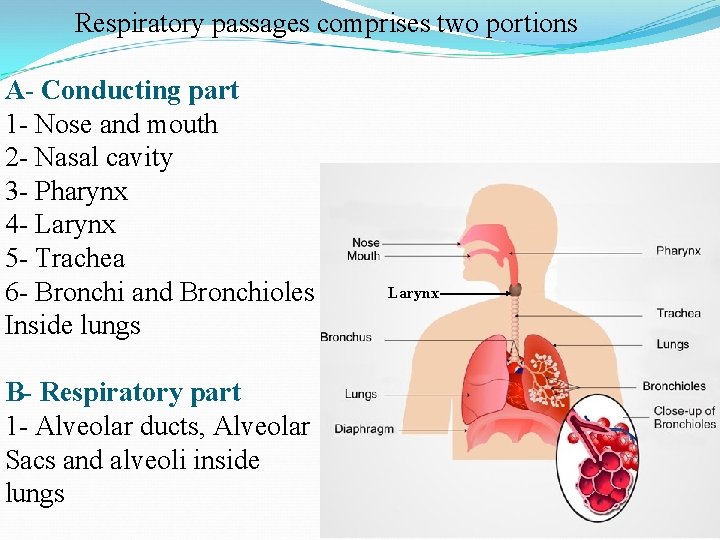
Respiratory passages comprises two portions A- Conducting part 1 - Nose and mouth 2 - Nasal cavity 3 - Pharynx 4 - Larynx 5 - Trachea 6 - Bronchi and Bronchioles Inside lungs B- Respiratory part 1 - Alveolar ducts, Alveolar Sacs and alveoli inside lungs Larynx
Respiratory Physiology Steps: 1 - pulmonary ventilation: air flow between the atmosphere and the lungs. 2 - diffusion of gasses between the alveoli and the blood. 3 - transport. 4 - regulation.
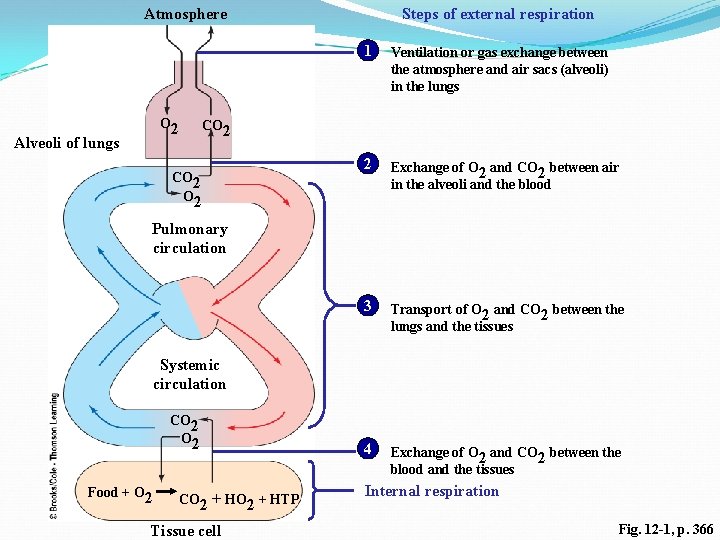
Atmosphere O 2 Alveoli of lungs Steps of external respiration 1 Ventilation or gas exchange between the atmosphere and air sacs (alveoli) in the lungs 2 Exchange of O 2 and CO 2 between air in the alveoli and the blood 3 Transport of O 2 and CO 2 between the lungs and the tissues 4 Exchange of O 2 and CO 2 between the blood and the tissues CO 2 O 2 Pulmonary circulation Systemic circulation CO 2 Food + O 2 CO 2 + HTP Tissue cell Internal respiration Fig. 12 -1, p. 366
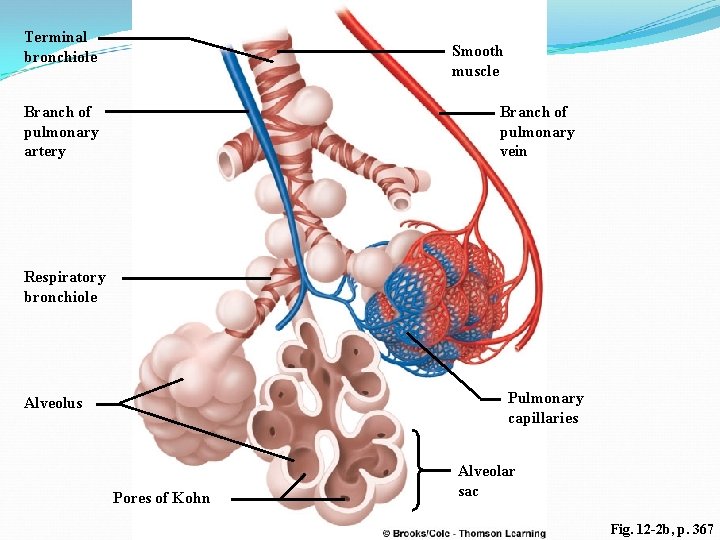
Terminal bronchiole Smooth muscle Branch of pulmonary artery Branch of pulmonary vein Respiratory bronchiole Pulmonary capillaries Alveolus Pores of Kohn Alveolar sac Fig. 12 -2 b, p. 367
Mechanics of ventilation 1. By down word and upward movement of the diaphragm lengthen or shorten(Normal) 2. By elevation and depression of the ribs (anteropost ) ribs and sternum moves away from the spine (20% more)
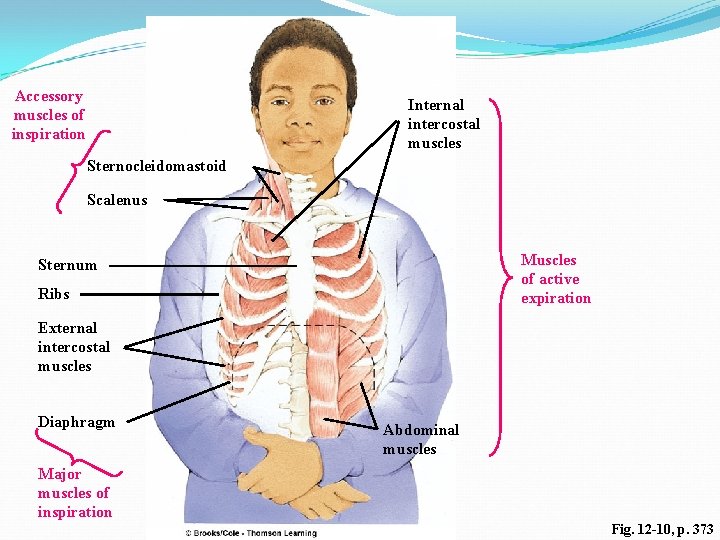
Mechanics of ventilation • Muscles : 1 - Inspiratory : Diaphragm External intercostals Sternocloidomastoid Sternum - Scalini (2 ribs) Anterior serrati
Mechanics of ventilation 2 - Expiratory muscles : internal intercostals Abdominal recti
Accessory muscles of inspiration Internal intercostal muscles Sternocleidomastoid Scalenus Muscles of active expiration Sternum Ribs External intercostal muscles Diaphragm Abdominal muscles Major muscles of inspiration Fig. 12 -10, p. 373
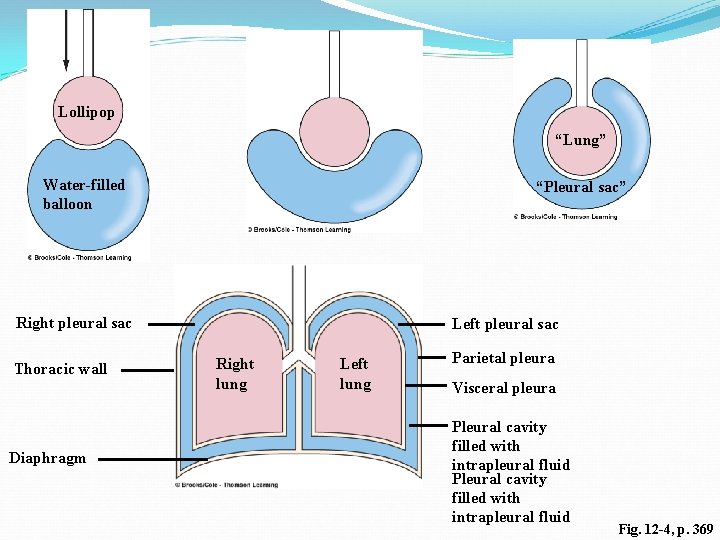
Air movement Movement of air is determined by pressures. The lung is an elastic structure that resembles a balloon floating in the thoracic cavity. Both lungs are surrounded by plural fluid which has negative pressure between the parietal a visceral layers
Lollipop “Lung” Water-filled balloon “Pleural sac” Right pleural sac Thoracic wall Diaphragm Left pleural sac Right lung Left lung Parietal pleura Visceral pleura Pleural cavity filled with intrapleural fluid Fig. 12 -4, p. 369
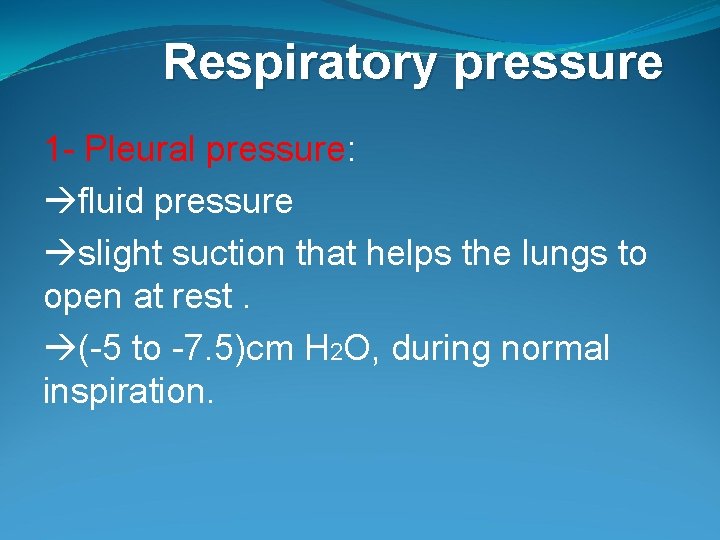
Respiratory pressure 1 - Pleural pressure: fluid pressure slight suction that helps the lungs to open at rest. (-5 to -7. 5)cm H 2 O, during normal inspiration.
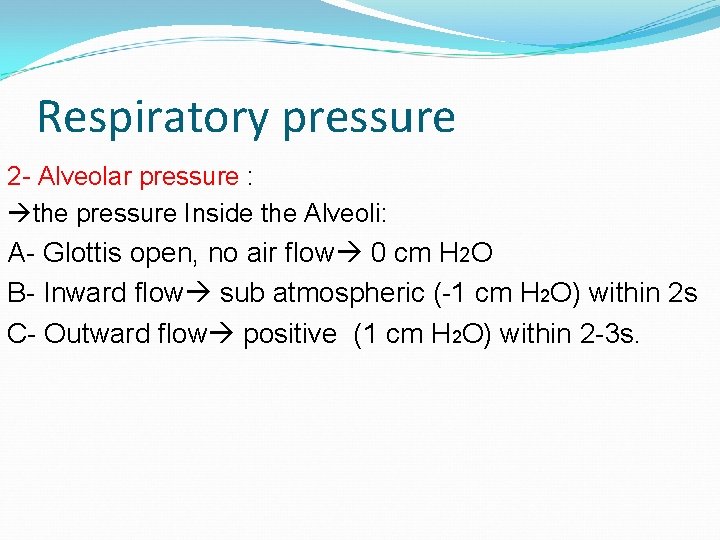
Respiratory pressure 2 - Alveolar pressure : the pressure Inside the Alveoli: A- Glottis open, no air flow 0 cm H 2 O B- Inward flow sub atmospheric (-1 cm H 2 O) within 2 s C- Outward flow positive (1 cm H 2 O) within 2 -3 s.
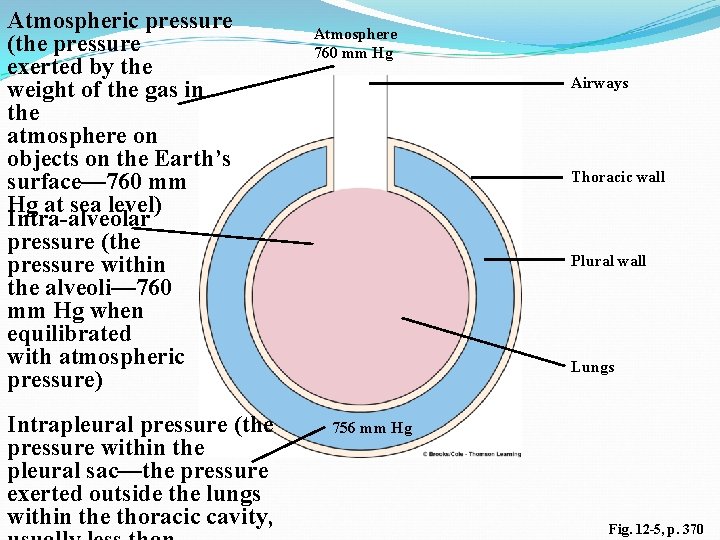
Atmospheric pressure (the pressure exerted by the weight of the gas in the atmosphere on objects on the Earth’s surface— 760 mm Hg at sea level) Intra-alveolar pressure (the pressure within the alveoli— 760 mm Hg when equilibrated with atmospheric pressure) Intrapleural pressure (the pressure within the pleural sac—the pressure exerted outside the lungs within the thoracic cavity, Atmosphere 760 mm Hg Airways Thoracic wall Plural wall Lungs 756 mm Hg Fig. 12 -5, p. 370
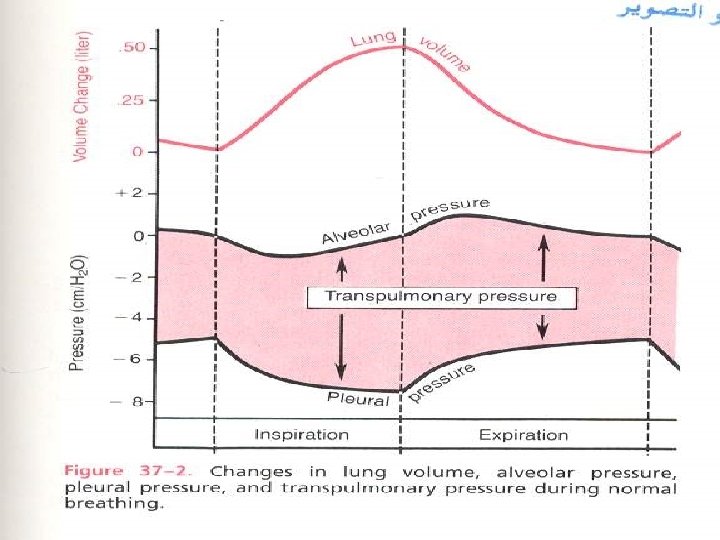
Respiratory pressure 3 - Transpulmonary pressure : Pressure difference between the alveolar pr. and pleural pr. [pr. differ. b/w alveoli and outer surfaces of the lungs] it measures elastic forces that tend to collapse the lungs each point of expansion [recoil pressure].
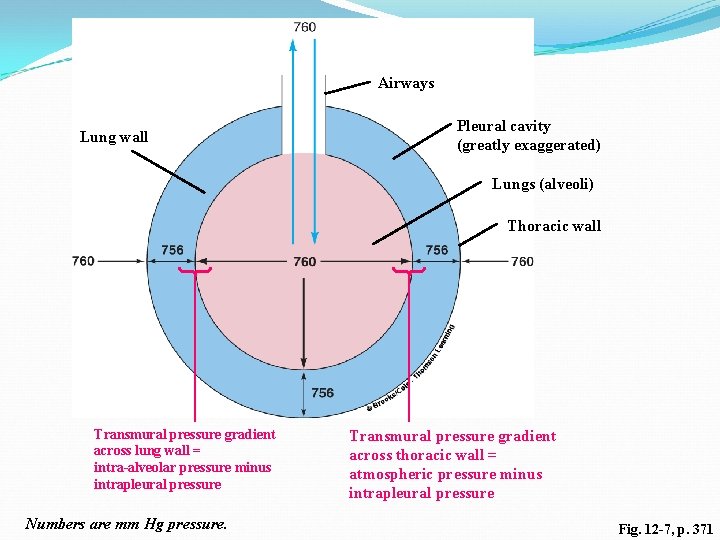
Airways Lung wall Pleural cavity (greatly exaggerated) Lungs (alveoli) Thoracic wall Transmural pressure gradient across lung wall = intra-alveolar pressure minus intrapleural pressure Numbers are mm Hg pressure. Transmural pressure gradient across thoracic wall = atmospheric pressure minus intrapleural pressure Fig. 12 -7, p. 371
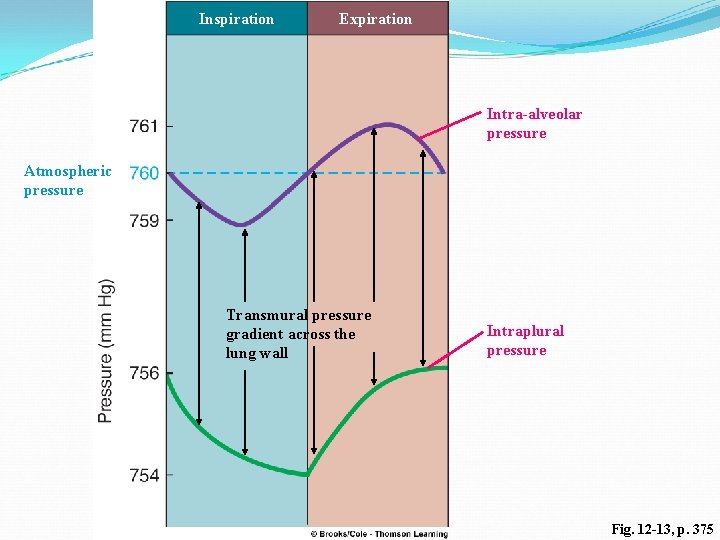
Inspiration Expiration Intra-alveolar pressure Atmospheric pressure Transmural pressure gradient across the lung wall Intraplural pressure Fig. 12 -13, p. 375
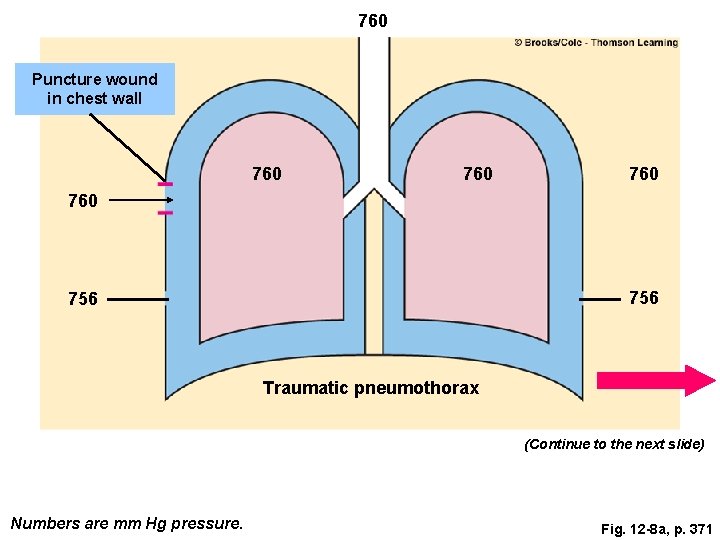
760 Puncture wound in chest wall 760 760 756 Traumatic pneumothorax (Continue to the next slide) Numbers are mm Hg pressure. Fig. 12 -8 a, p. 371
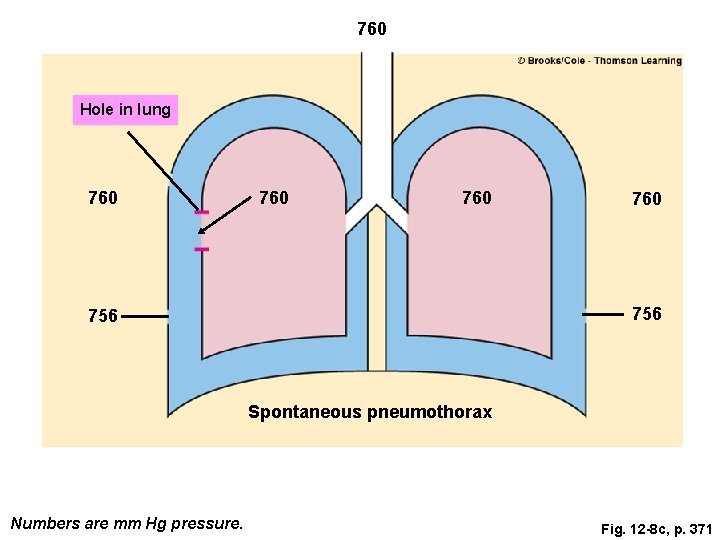
760 Hole in lung 760 760 756 Spontaneous pneumothorax Numbers are mm Hg pressure. Fig. 12 -8 c, p. 371
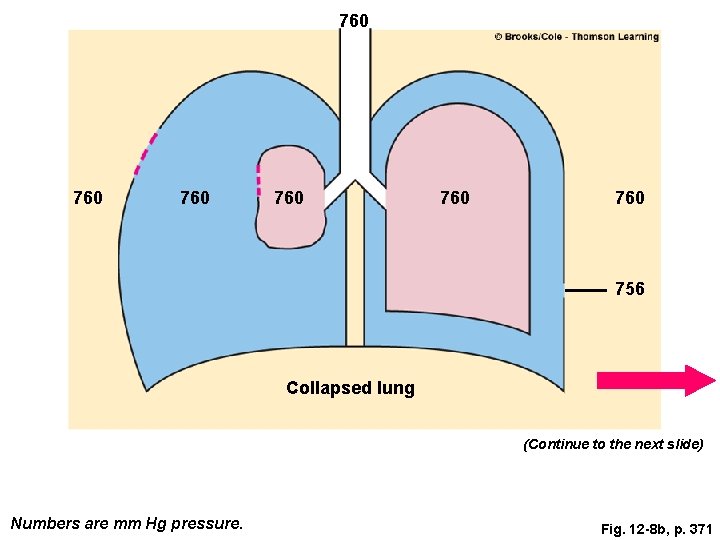
760 760 760 756 Collapsed lung (Continue to the next slide) Numbers are mm Hg pressure. Fig. 12 -8 b, p. 371
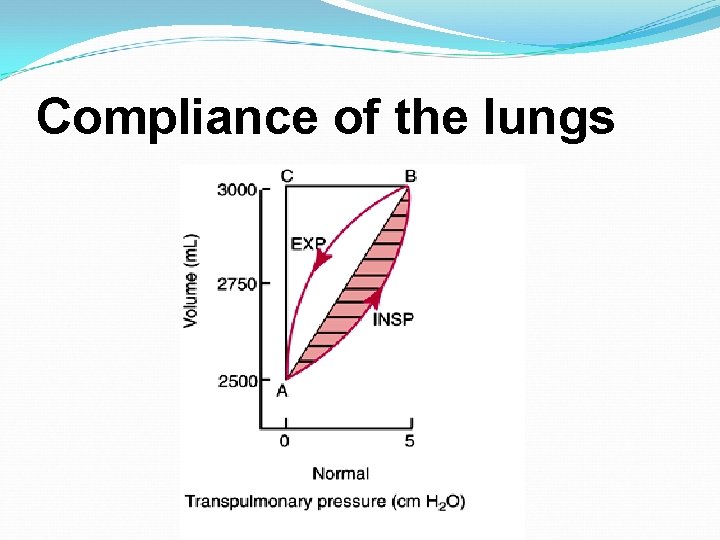
Compliance of the lungs Expandability of the lungs stretch ability of the lungs. The extent to which the lungs will expand for each unit increase in transpulmonary pr. total compliance of both lungs is around 200 ml/cm H 2 O transpulmonary pressure.
Compliance of the lungs
Compliance of the lungs A. the curves in the figure above depend on the elastic forces of the lungs : 1) elastic forces of the lung tissue (elastin and collagen fibres) (1/3 of the total force) 2) Surface tension of the fluid (2/3 of the total force) Surface tension is huge when surfactant is absent : H 2 O molecules on the surface of the water have an extra strong attraction for one another attempting to contract and collapse the alveoli.
Compliance of the lungs B. Surfactant : surface-active agent in water secreted by type II alveolar epithelial cells (10% of surface area of alveoli). Phospholipids, dipalmitoylphosphotidylcholine (DPPC) proteins (apoprotein), and ions (calcium) that help in spreading phospholipids
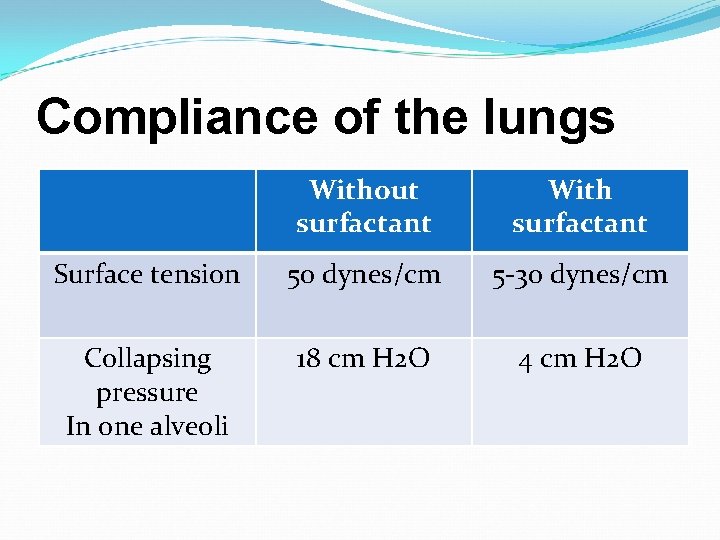
Compliance of the lungs Without surfactant With surfactant Surface tension 50 dynes/cm 5 -30 dynes/cm Collapsing pressure In one alveoli 18 cm H 2 O 4 cm H 2 O
Compliance of the lungs • Pressure generated by S. T = 2 x S. T. Radius • Effect of size of the alveoli on collapsing pr. : The Radius is inversely proportional to coll. pr. So smaller alveoli have greater pr. than the larger ones. premature babies have small alveolar radius and less surfactant tendency for lung collapse is 6 -8 times greater than in adults Respiratory distress syndrome of the newborn
Compliance of the lungs -Instability of the alveoli (rupture), -Safety factors: 1. Interdependence phenomenon (Sharing septal walls) 2. 50 000 functional units w/ fibrous septa 3. Surfactant effect : a) reduces S. T from 8 to 3 cm H 2 O b) [surfactant] in smaller alveoli > than in large
Compliance of the lungs -Compliance of thorax and lungs : 110 ml/cm H 2 O pr. - At high volume or compressed to low volumes, the compliance can be as little as one-fifth that of lungs alone.
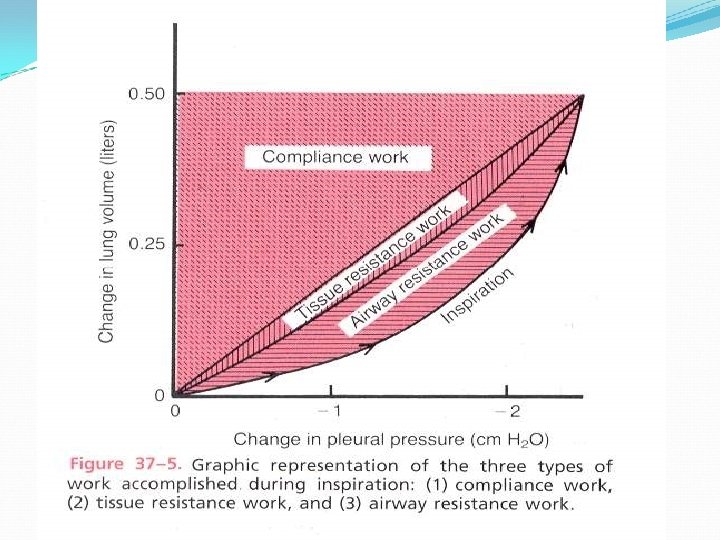
Work of breathing -Work of breathing: 1. work required to expand the lungs against the lung and chest elastic forces (compliance work) 2. work required to overcome the viscosity of the lung and chest wall (tissue resistance work) 3. work required to overcome airway resistance (airway resistance work)
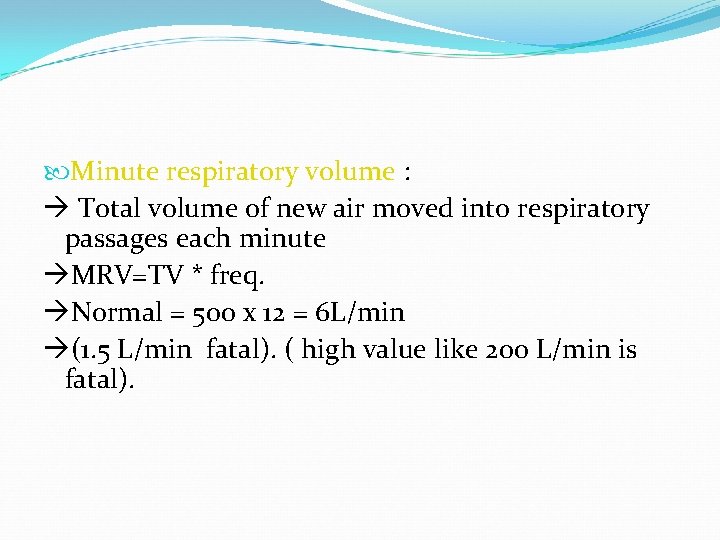
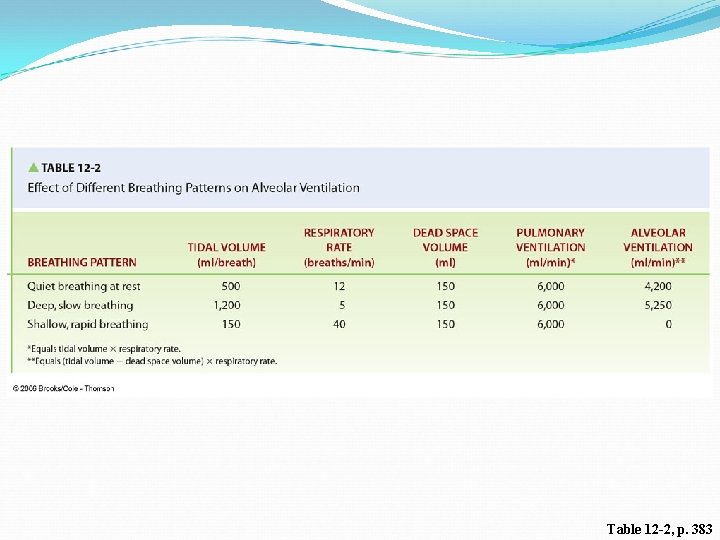
Minute respiratory volume : Total volume of new air moved into respiratory passages each minute MRV=TV * freq. Normal = 500 x 12 = 6 L/min (1. 5 L/min fatal). ( high value like 200 L/min is fatal).
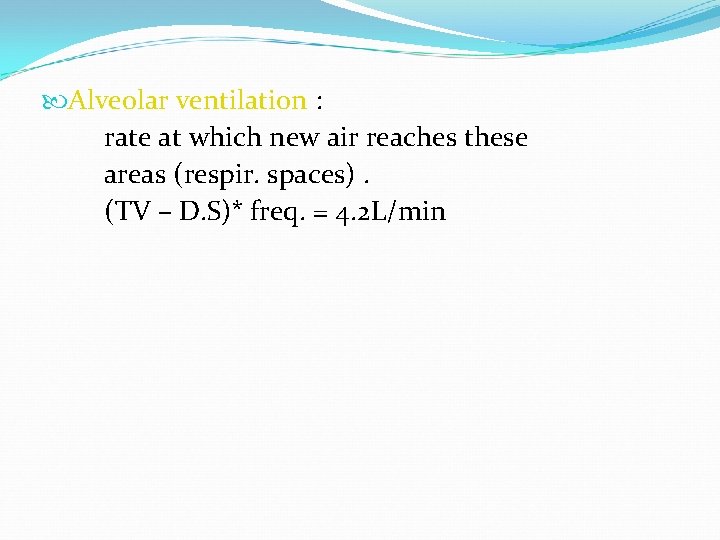
Alveolar ventilation : rate at which new air reaches these areas (respir. spaces). (TV – D. S)* freq. = 4. 2 L/min
Table 12 -2, p. 383
• • • Respiratory passageway: 1 -Main resistance to the airflow present in Large bronchioles and bronchi 2 -Sympathetic system dilate bronchioles 3 -Parasympatheic system constrict bronchioles • 4 -Irritation of membrane passageways cause constriction as(smoking, dust, Infection)
• 5 - Histamine and slow reactive substance of anaphylaxis secrete locally by the lungs • By mast cells during allergic reaction as in • Asthma. These cause bronchiolar constriction • 6 -Atropine relax respiratory passageway.