
Respiratory System Module 2020 2021 Corynebacterium diphtheriae Dr
Respiratory System Module 2020 -2021 Corynebacterium diphtheriae Dr. Mohammad Odibate Department of Microbiology and Pathology Faculty of Medicine, Mu’tah University 1
INTRODUCTION • Corynebacteria (from the Greek koryne, club) • They are small pleomorphic Nonencapsulated & nonspore-forming bacteria. • Gram-positive rods. • Typically form clusters of parallel rays (palisades) that are referred to as Chinese characters. 2
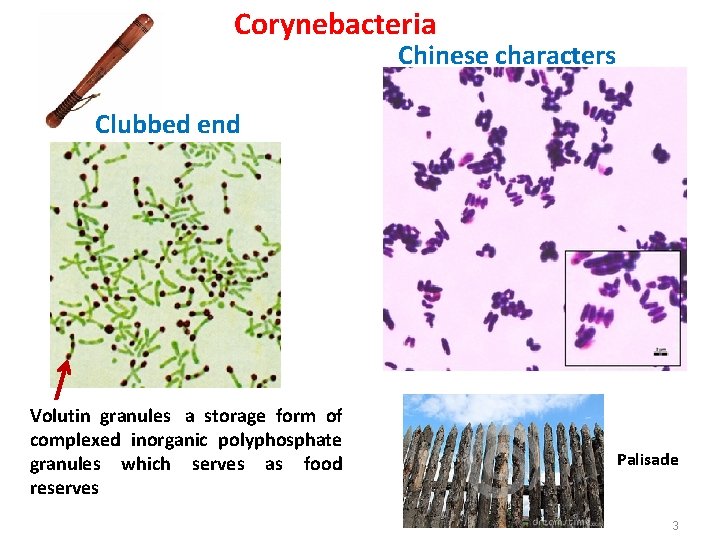
Corynebacteria Chinese characters Clubbed end Volutin granules a storage form of complexed inorganic polyphosphate granules which serves as food reserves Palisade 3
EPIDEMIOLOGY 1. Worldwide, there is declining trend of diphtheria cases due to vaccination coverage. 2. Source of infection: Carriers (95%), cases (5%). 3. Carriers: Nasal carreiers are more dangerous due to frequent shedding than thraot carriers. Incedence of carreier rate varies from 0. 1 to 5%. 4. Transmission: – – Via respiratory droplets Rarely by contact with infected skin lasions. • Reservoir: There are no significant reservoirs other than humans. 5. Commonly infected: Children aged 1 -5 yrs. 4
PATHOGENESIS Diphtheria toxin (DT) 1. Is an A-B toxin expressed from a bacteriophage in the presence of low iron concentrations. 2. It can induce protective antibodies (antitoxin). 3. LD 50 of ∼ 100 ng/kg of body weight. The DT mechanism of action 1. DT binds to receptors on the surface of eukaryotic cells 2. The A-subunite results in inhibition of polypeptide chain elongation by the eukaryotic elongation factor 2 (e. EF 2) through its ADP-ribosylation. 3. e. EF-2 is an essential factor for protein synthesis. It promotes the GTP-dependent translocation of the nascent protein chain 5 from the A-site to the P-site of the ribosome.
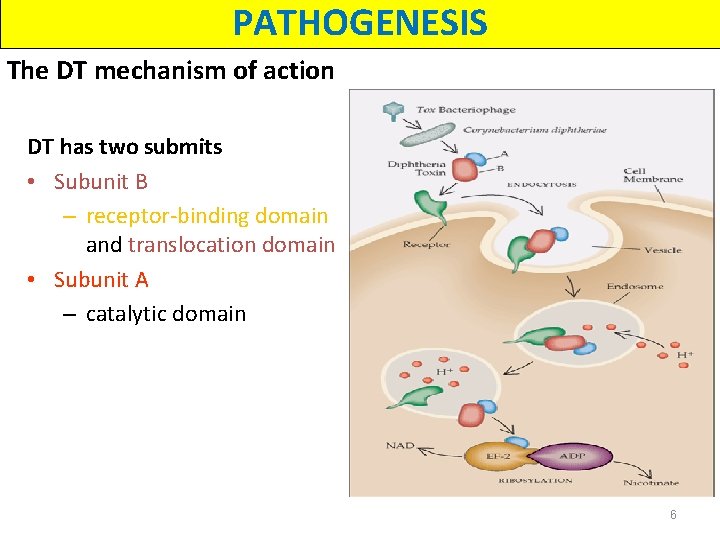
PATHOGENESIS The DT mechanism of action DT has two submits • Subunit B – receptor-binding domain and translocation domain • Subunit A – catalytic domain 6
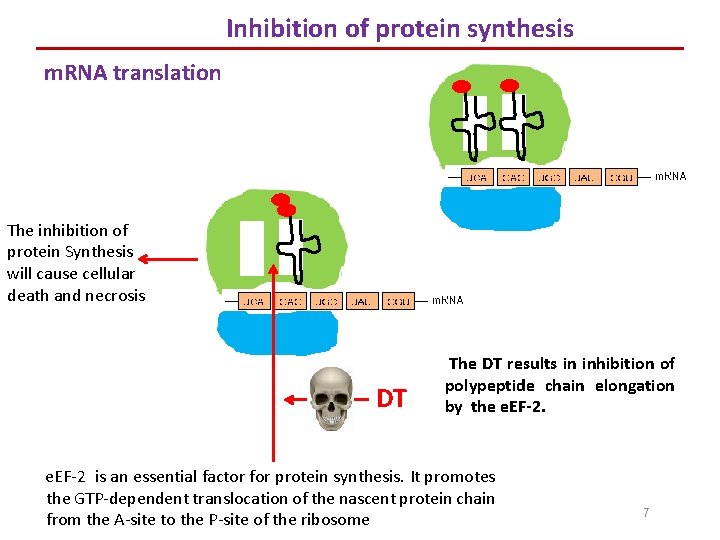
Inhibition of protein synthesis m. RNA translation The inhibition of protein Synthesis will cause cellular death and necrosis DT The DT results in inhibition of polypeptide chain elongation by the e. EF-2 is an essential factor for protein synthesis. It promotes the GTP-dependent translocation of the nascent protein chain from the A-site to the P-site of the ribosome 7
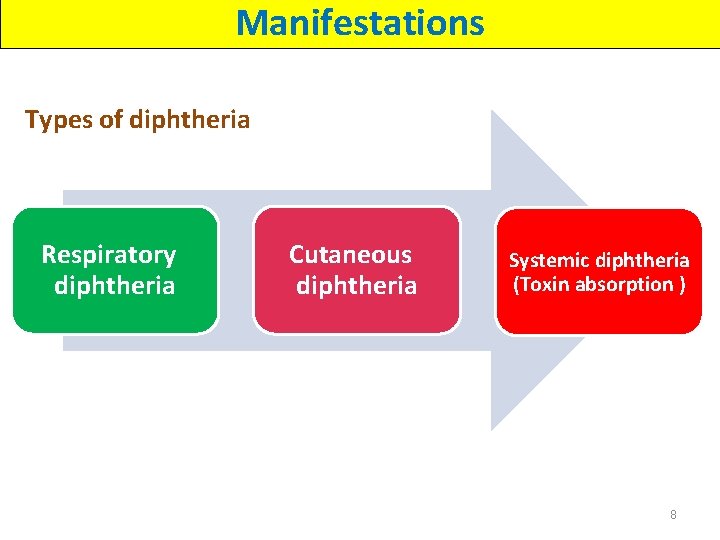
Manifestations Types of diphtheria Respiratory diphtheria Cutaneous diphtheria Systemic diphtheria (Toxin absorption ) 8
Manifestations Respiratory diptheria 1. The most common form of diptheria 2. Incubation period of 3 to 4 days 3. Stages A. Faucial diphtheria (fauces, the cavity at the back of the mouth leading into the pharynx). - Toxin elicits an inflammatory response, necrosis of the epithelium and exudate formation. - This lead to the formation of mucosal ulcers, lined by a tough leathery greyish white pseudomembrane coat; composed of an inner band of fibrin surrrounded by neutrophil, RBCs, and bacteria. - It is named as it is adhernt to the mucosal base and bleeds on removal, in contrast to the true membrane which can be easily separated. 9
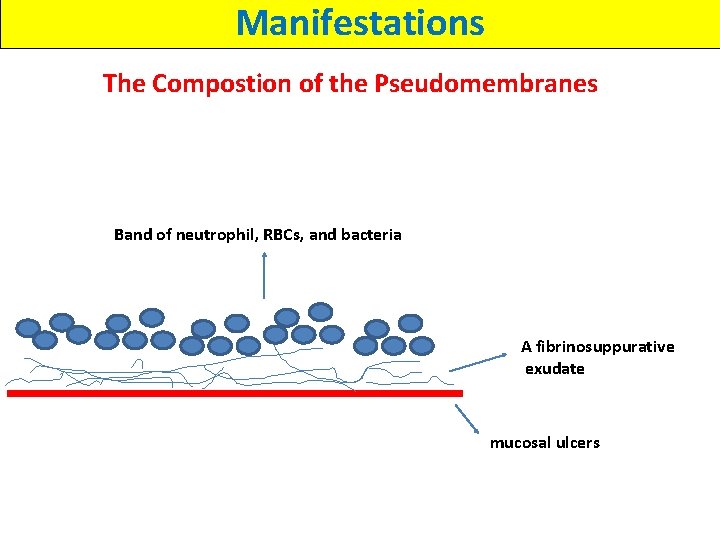
Manifestations The Compostion of the Pseudomembranes Band of neutrophil, RBCs, and bacteria A fibrinosuppurative exudate mucosal ulcers
Manifestations Respiratory diptheria -The clinical diagnosis are based on the initial manifestations including: ü Headache ü Weakness ü Sore throat ü Voice change ü Dysphagia ü Low-grade fever üDiagnosis requires the isolation of C. diphtheriae or the histopathologic isolation of compatible gram -positive organisms 11
Manifestations Respiratory diptheria B. Extension of the membrane: in sever cases, it may extend into the larynx and the bronchial airways, which may lead to fatal airway obstruction leading to asphyxia. This mandates immedites tracheostomy. C. Bull-neck apperance: A few patients develop massive swelling of the tonsils and present with “bull-neck” diphtheria, which results from lymphadenopathy, massive edema of the submandibular and paratracheal region which is characterized by foul breath, thick speech, and stridor breathing. - The infection gradually resolves, and the membrane is coughed up after 5 to 10 days. 12
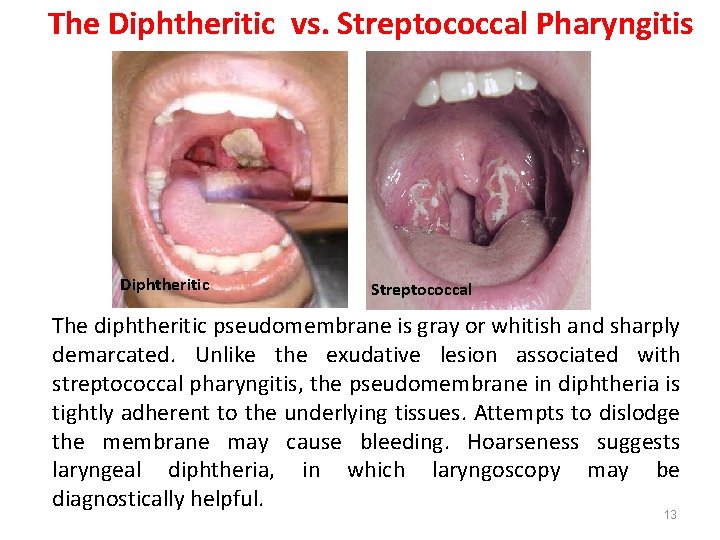
The Diphtheritic vs. Streptococcal Pharyngitis Diphtheritic Streptococcal The diphtheritic pseudomembrane is gray or whitish and sharply demarcated. Unlike the exudative lesion associated with streptococcal pharyngitis, the pseudomembrane in diphtheria is tightly adherent to the underlying tissues. Attempts to dislodge the membrane may cause bleeding. Hoarseness suggests laryngeal diphtheria, in which laryngoscopy may be diagnostically helpful. 13
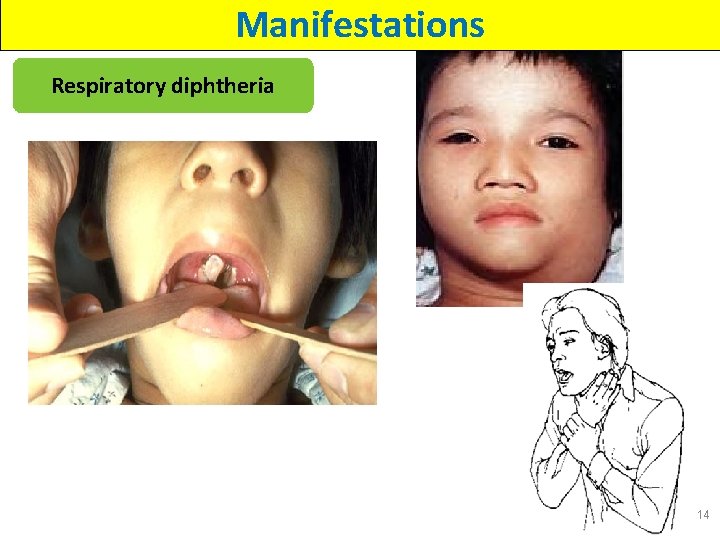
Manifestations Respiratory diphtheria 14
Manifestations Systemic diphtheria (Toxin absorption ) 1. Diphtheritic myocarditis: ü Appears during the 2 -3 week in severe cases of respiratory diphtheria. üIt is manifested by cardiac enlargement, weakness, arrhythmia, and congestive heart failure with dyspnea. 2. Nervous system involvement ü Appears later in the course of disease üToixn mediated noninflammatory demyelinating disorder ü Most often involving paralysis of the soft palate, oculomotor (eye) muscles, or selective muscle groups. ü The paralysis is reversible and is generally not serious unless the diaphragm is involved ü The disease resolves with the formation of antitoxin 15
Manifestations Infection at Other Sites: 1. 2. 3. 4. Ear (otitis externa) The eye: purulent and ulcerative conjunctivitis The genital tract : purulent and ulcerative vulvovaginitis Sporadic cases of pyogenic arthritis 16
DIFFERENTIAL DIAGNOSIS Diagnosis should be considered in patients who have - Severe pharyngitis, particularly with difficulty swallowing, respiratory compromise, or signs of systemic disease including myocarditis or generalized weakness. In the differential diagnosis, the leading causes of pharyngitis that should be considered are - Respiratory viruses (rhinoviruses, nfluenza viruses, parainfluenza viruses, coronaviruses, and adenoviruses; ∼ 25% of cases), - Group A streptococci (15– 30%), - Group C streptococci (∼ 5%), - Atypical bacteria such as Mycoplasma pneumoniae and Chlamydia pneumoniae (15– 20% in some series), - Other viruses such as herpes simplex virus (∼ 4%) and Epstein-Barr virus 17 - Others
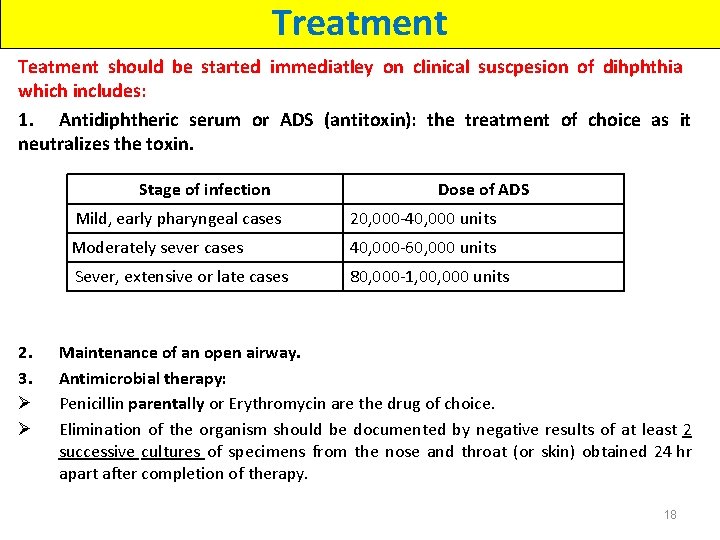
Treatment Teatment should be started immediatley on clinical suscpesion of dihphthia which includes: 1. Antidiphtheric serum or ADS (antitoxin): the treatment of choice as it neutralizes the toxin. Stage of infection 2. 3. Ø Ø Dose of ADS Mild, early pharyngeal cases 20, 000 -40, 000 units Moderately sever cases 40, 000 -60, 000 units Sever, extensive or late cases 80, 000 -1, 000 units Maintenance of an open airway. Antimicrobial therapy: Penicillin parentally or Erythromycin are the drug of choice. Elimination of the organism should be documented by negative results of at least 2 successive cultures of specimens from the nose and throat (or skin) obtained 24 hr apart after completion of therapy. 18
Vaccination Types of vaccine: 1. Single vaccine: Diphtheria toxoid 2. Combined vaccine: various vaccine available are DPT: Contains DT (diphtheria toxoid), P (pertussis whole cell), and TT (tetanus toxoid). It is the vaccine of choice for infants (why). q Pertussis in this vaccine which is used a s a whole cell acts as an adjuvant whih increases the immunogenecity of DT and TT. q Da. PT: Contains DT, TT, and acellular pertussis (a. P). q DT: Contains DT and TT q d. T: Contains TT and adult dose diphtheria toxoid (d) Note: adult dose diphtheria toxoid is given to adults more than 12 years old q Protective titer: Following vaccination, an antitoxin titer of ≥ 0. 1 unit/ml is said to protective 19
Management Patients in whom diphtheria is suspected • Should be hospitalized in respiratory isolation rooms, with close monitoring of cardiac and respiratory function. • A cardiac workup is recommended to assess the possibility of myocarditis. • In patients with extensive pseudomembranes, possibility a tracheostomy or intubation will be required. • In some settings, pseudomembranes can be removed surgically. 20
Infection Prevention and Control 1. Place patients with suspected or confirmed diphtheria in isolation room (area). 2. Apply standard precautions, including hand hygiene at all times. 3. In addition, also apply droplet and contact precautions. 4. The disease is usually not contagious 48 hours after treatment. 5. After discharge, restrict contact with others until completion of antibiotic therapy. 21
Communicability • Transmission may occur as long as virulent bacilli are present in discharges and lesions. • The time is variable, but without antibiotics, organisms usually persist 2 weeks or less and seldom more than 4 weeks. • Chronic carriers may shed organisms for 6 months or more. • People with diphtheria are usually no longer able to infect others 48 hours after they begin taking antibiotics. 22
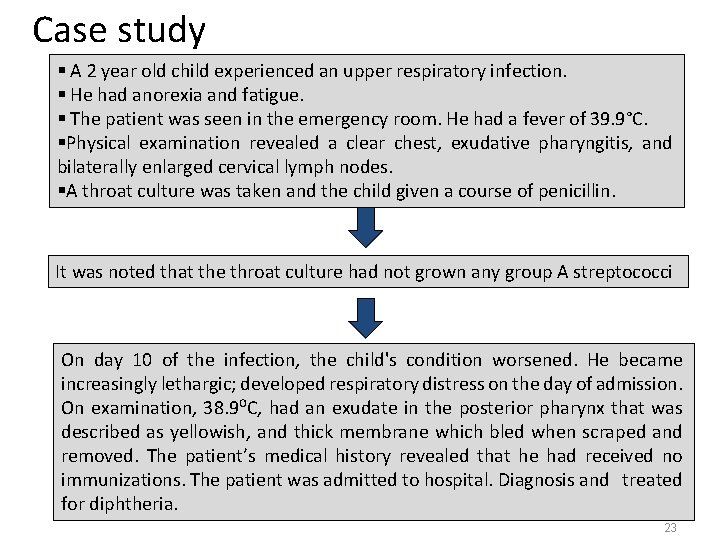
Case study § A 2 year old child experienced an upper respiratory infection. § He had anorexia and fatigue. § The patient was seen in the emergency room. He had a fever of 39. 9°C. §Physical examination revealed a clear chest, exudative pharyngitis, and bilaterally enlarged cervical lymph nodes. §A throat culture was taken and the child given a course of penicillin. It was noted that the throat culture had not grown any group A streptococci On day 10 of the infection, the child's condition worsened. He became increasingly lethargic; developed respiratory distress on the day of admission. On examination, 38. 9⁰C, had an exudate in the posterior pharynx that was described as yellowish, and thick membrane which bled when scraped and removed. The patient’s medical history revealed that he had received no immunizations. The patient was admitted to hospital. Diagnosis and treated for diphtheria. 23
- Slides: 23