
Respiratory System Dr Anderson GCIT Basic Concepts Surface
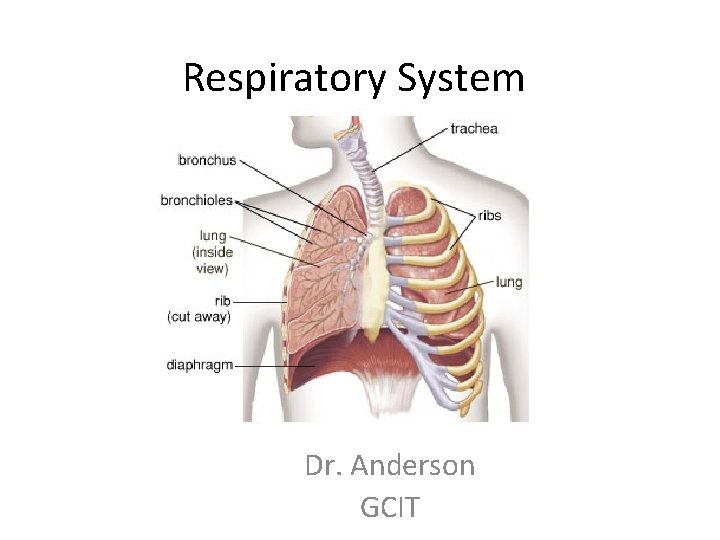
Respiratory System Dr. Anderson GCIT
Basic Concepts • Surface area is important for diffusion (again) • Physics of fluids • Special ways to insure against pathogen invasion of large mucus membranes (lungs and sinuses)
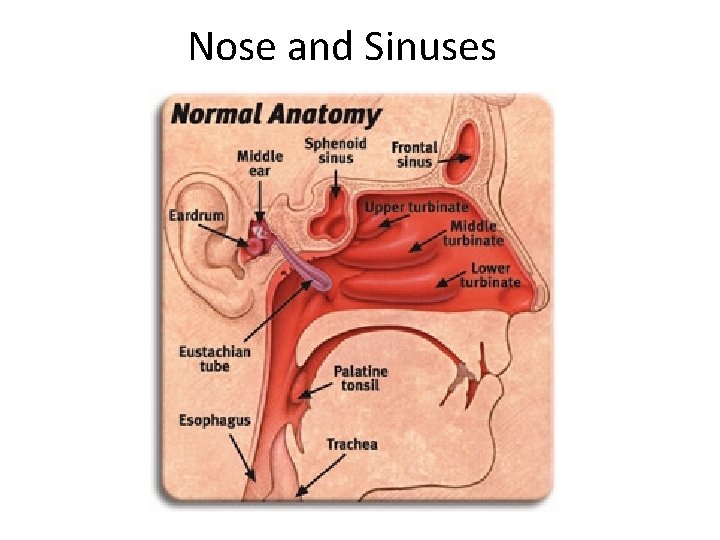
Nose and Sinuses
Nose Functions • • • Opening for air exchange Moistens and warms air Houses sensory (smell) neurons Filters air going to lungs Serves as resonating chamber for speech
Mucus Membranes • Line the interior surfaces of the nasal cavity – Mucus and defensive compounds (enzymes) are secreted to destroy trapped pathogens (E. g. defensins) – Ciliated epithelia move mucus and trapped contaminants to the back of the throat where they are swallowed and digested in the stomach
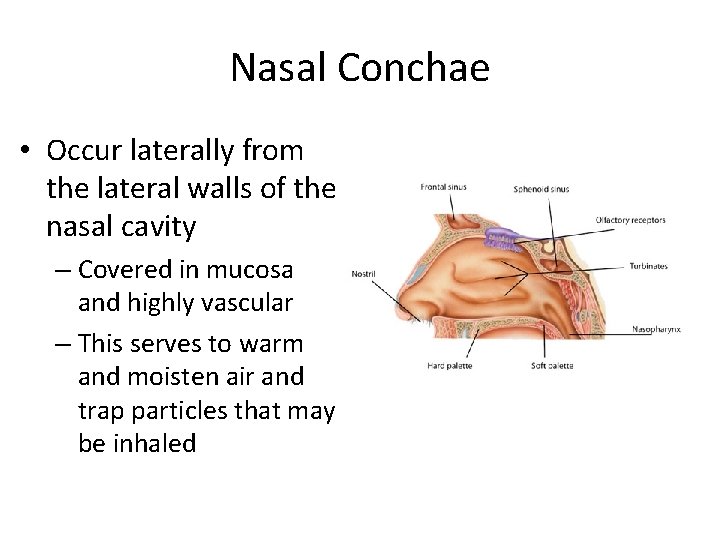
Nasal Conchae • Occur laterally from the lateral walls of the nasal cavity – Covered in mucosa and highly vascular – This serves to warm and moisten air and trap particles that may be inhaled
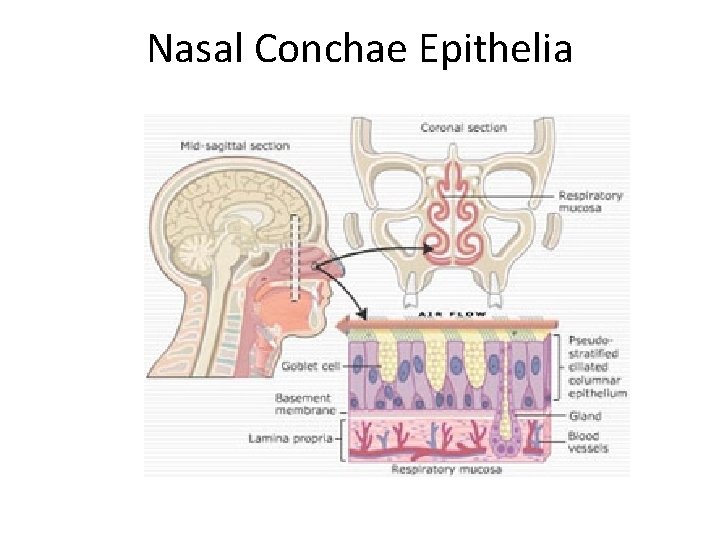
Nasal Conchae Epithelia
The Pharynx • Connects nasal cavity and mouth • Nasopharynx – (Superior to level of the soft palate) - only serves to transport air • Oropharynx – (Posterior to oral cavity) – both swallowed food and air pass through • Laryngopharynx – (merging of esophagus and trachea) serves to separate food and air
Larynx - Function • Provides a “switching” mechanism between inspiration and swallowing • Also houses vocal cords for speech
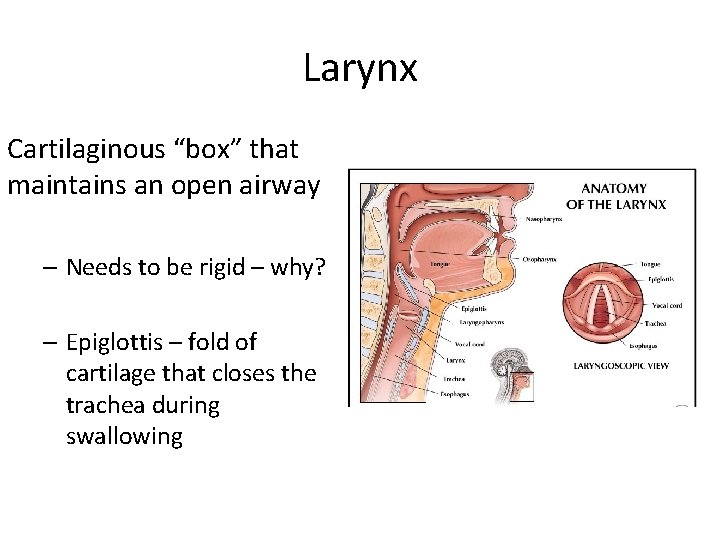
Larynx Cartilaginous “box” that maintains an open airway – Needs to be rigid – why? – Epiglottis – fold of cartilage that closes the trachea during swallowing
Voice Production • Vocal cords are stretched on either side of the larynx, and vibrate as air passed over them from the lungs • Air moves between these vocal cords through a space called the glottis • Laryngeal muscles that surround the cartilage change the pitch of the voice by flexing and relaxing https: //www. youtube. com/watch? v=y 2 oke. YVcl. Qo
Trachea (Windpipe) • Passageway for air into the lungs, from the pharynx • Rings of cartilage prevent collapse under the negative pressure of inhalation (rigid, but flexible) • Trachealis muscle allow the trachea to flex during inhalation, exhalation, sneezing and swallowing • Lined with mucosa and cilia which propels particles towards the throat to be swallowed
Bronchi • Point at which the trachea bifurcates (right bronchus is wider, shorter and more vertical) • No cartilaginous rings, but irregular plates hold bronchi open • Very little mucus produced, therefore pathogens and contaminants removes by WBCs (macrophages)
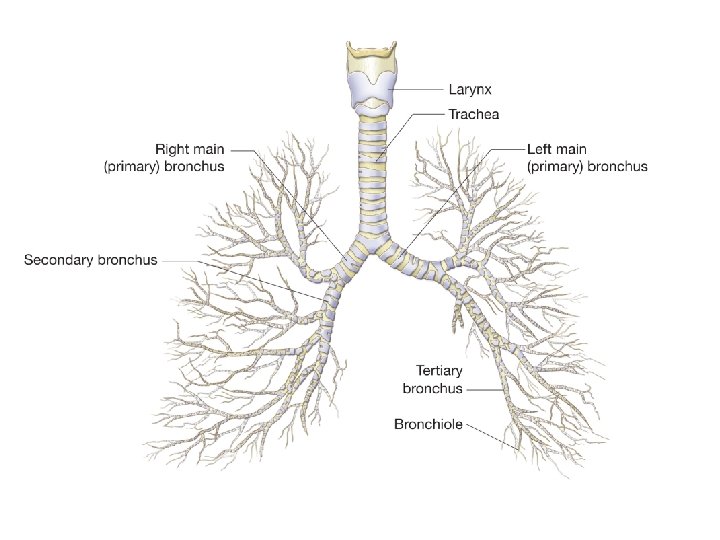
Bronchi • Bifurcates from trachea into lungs - Further subdivides into secondary, (tertiary, etc. bronchi) within the lungs - Bronchioles are 0. 1 mm in diameter - Terminal bronchioles are 0. 05 mm in diameter and lead to the alveoli
Anatomy - Lungs • Left lung – divided into 2 lobes (superior and inferior) – Also has space made to accommodate the heart (cardiac notch) • Right Lung – 3 lobes (superior, middle and inferior) • Both lungs have sections called bronchopulmonary segments that are separated by connective tissue
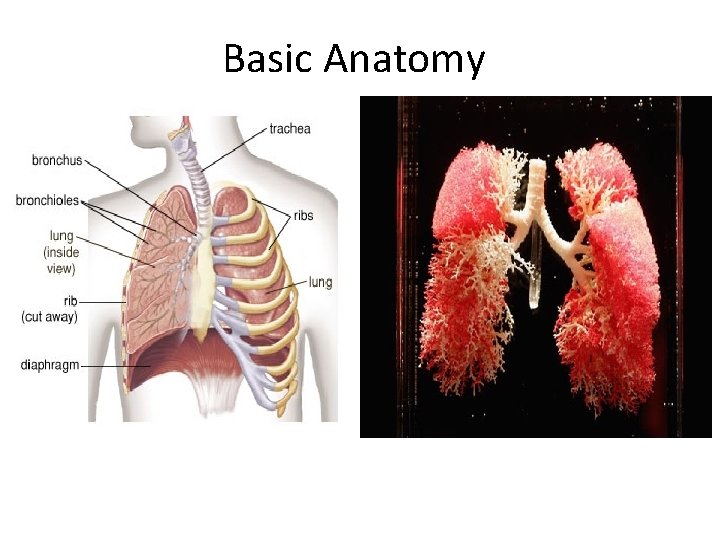
Basic Anatomy
Alveoli (the respiratory zone) • Respiratory bronchioles lead to alveolar ducts which lead to alveolar sacs that make up the alveoli – Roughly 300 million alveoli present for gas exchange
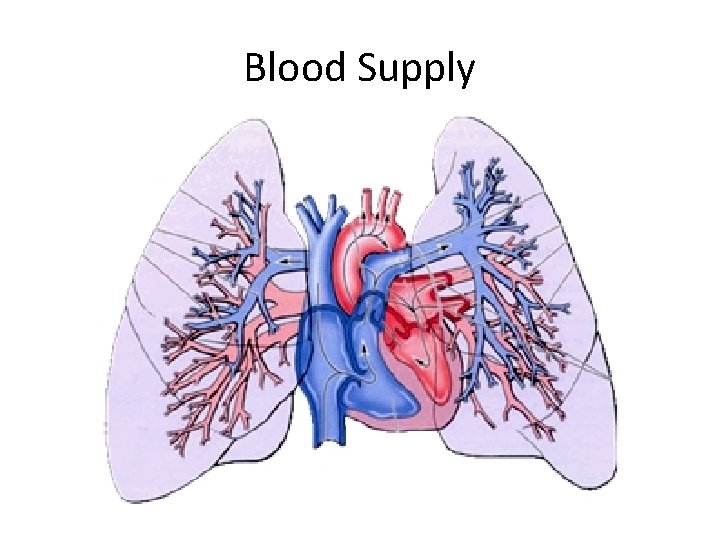
Blood Supply
Alveoli - Structure • Composed of extremely thin single layer of squamous epithelial cells, which allows rapid diffusion of O 2 in and CO 2 out of the blood • Also allows the evaporation of water out of the blood
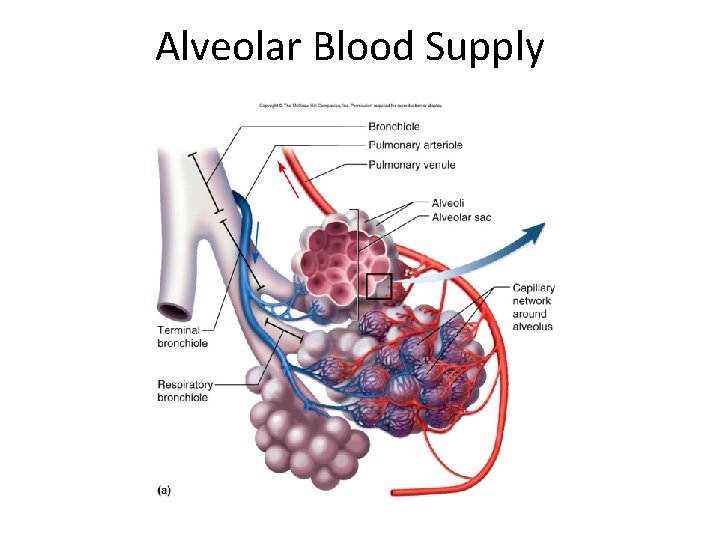
Alveolar Blood Supply
Physics of Breathing • Partial Pressure • Diffusion • Changes in space vs. pressure
Atmospheric Pressure • At sea level, air rushes towards areas of relatively lower pressure and away from areas of relatively higher pressure • This difference in pressure changes in the chest cavity via muscle flexing and resultant forces in the thoracic cavity
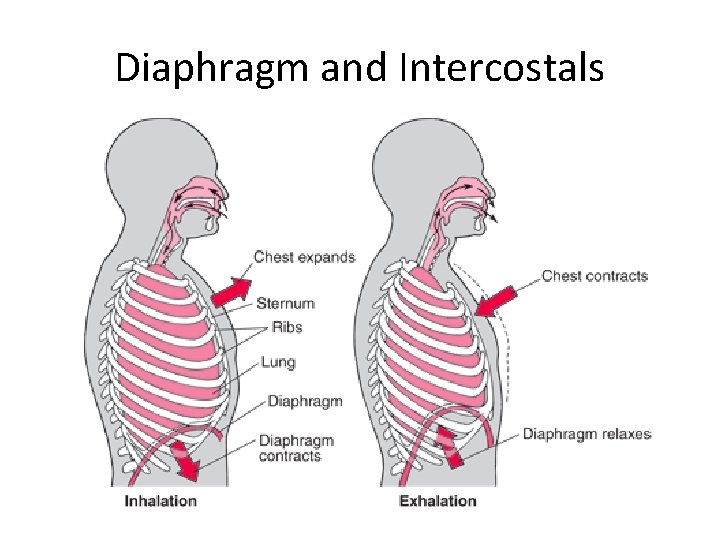
Diaphragm and Intercostals
Diaphragm • Sheet of muscle that separates the thoracic and abdominal cavities • Flexing the diaphragm causes it to drop (inferiorly), increasing the empty volume of the thoracic cavity • The resulting negative pressure causes air to rush into the lungs and fill the negative space (inspiration) • As the diaphragm relaxes, it rises and increases the pressure in the thoracic cavity, causing exhalation
Intercostal Muscles • Contraction of intercostal muscles lifts the rib cage up (superiorly) • This flexion serves to “open up” the rib cage and decreases the pressure inside the chest, causing air to rush in
Physics of Airflow • Flow = Change in pressure/resistance • Look familiar? • Air is a fluid, just as blood is, and is therefore subject to the same physical rules
Shouldn’t lungs collapse? • Elastic nature of lungs causes them to contract inwards • Surface tension in alveoli (water tension) tries to collapse alveoli • Wouldn’t this be bad? • How is this avoided?
Pressure Balances • The outside of the lung (visceral pleura) is attached via pleural fluid to the parietal pleura (inside surface of the pleural cavity) keeping them from collapsing • This keeps the lungs clinging tightly to the thoracic wall (parietal pleura), preventing their collapse
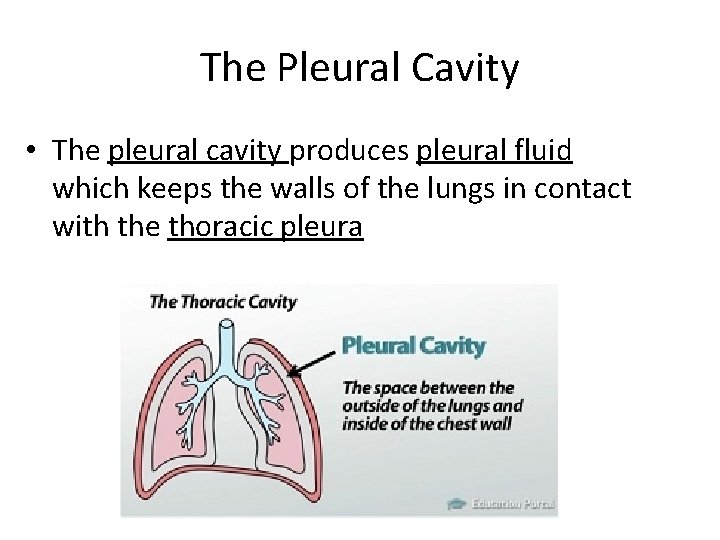
The Pleural Cavity • The pleural cavity produces pleural fluid which keeps the walls of the lungs in contact with the thoracic pleura
Alveolar Surfactant • Surfactant decreases the tension between water molecules (breaks the cohesiveness between molecules) • Reduces the force trying to pull individual alveolar walls together
Respiratory Volume and Pulmonary Function • Volumes – Tidal Volume: Amount of air moved in and out under normal resting conditions – Inspiratory Reserve Volume: amount of air that can be inspired forcibly beyond the tidal volume – Expiratory Reserve Volume: volume that can be forcibly expired beyond the tidal volume – Residual Volume: air left in lungs, even after forced expiration
Gas Physics • Dalton’s Law of Partial Pressures – gases exert a pressure in proportion to its concentration in a mixture • Air – 78% N 2, – 21% O 2, – 1% Other gases (CO 2, rare gases, etc. ) • Pressure of gas is proportional to its concentration in a mixture
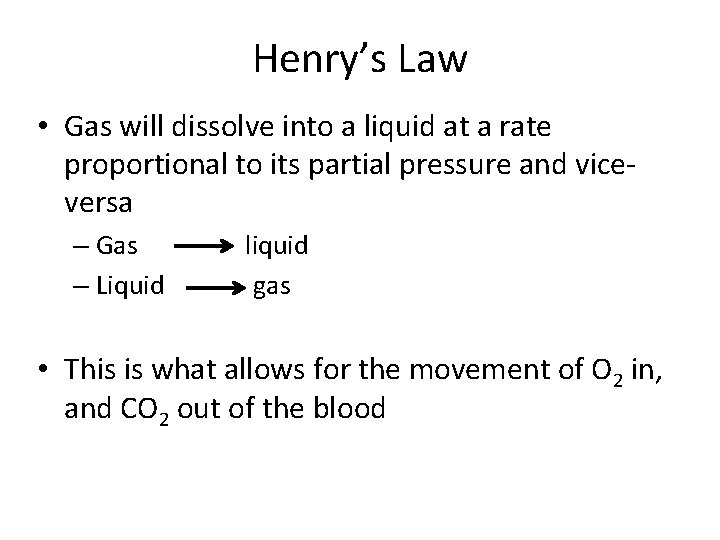
Henry’s Law • Gas will dissolve into a liquid at a rate proportional to its partial pressure and viceversa – Gas – Liquid liquid gas • This is what allows for the movement of O 2 in, and CO 2 out of the blood
Factors Effecting Gas Exchange Rate • Pressure Gradients (vary with altitude, etc. ) • Ventilation-Perfusion coupling – must be an efficient match between the volume of air reaching the alveoli and the blood flow in pulmonary capillaries – This is accomplished via vasoconstriction/dilation • Thickness and Surface area of Respiratory Membrane – Thickening of this membrane can lead to respiration issues
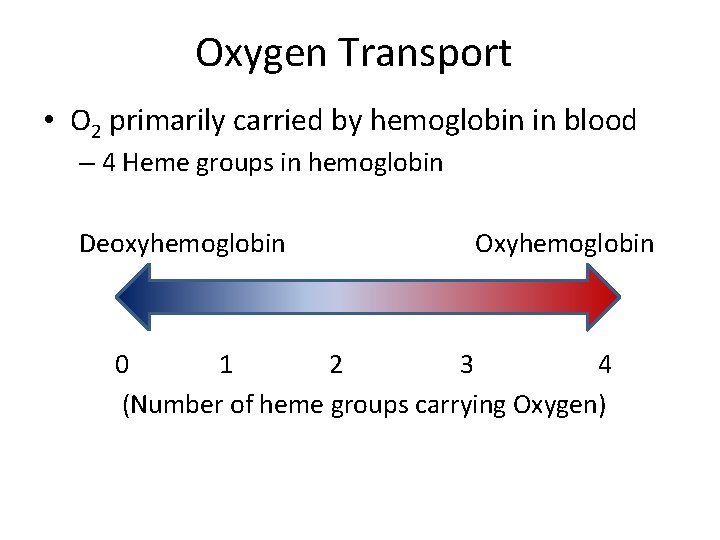
Oxygen Transport • O 2 primarily carried by hemoglobin in blood – 4 Heme groups in hemoglobin Deoxyhemoglobin Oxyhemoglobin 0 1 2 3 4 (Number of heme groups carrying Oxygen)
Factors Affecting Hemoglobin Saturation • Partial Pressure of O 2 • Blood p. H • Temperature
Bohr Effect • Increasing acidity (from increasing levels of CO 2) weaken the bond between hemoglobin and O 2. – What does this mean? Is this a good or bad thing?
CO 2 Transport • CO 2 is transported in – Plasma (7 -10%) – *Bound to hemoglobin (carbaminohemoglobin) – binds to amino acids, not the heme molecule – *as bicarbonate in plasma (via carbonic anhydrase) and RBC’s (enzyme-mediated in BRC cytoplasm) • CO 2 loading enhances O 2 release (Bohr Effect)
Control of Respiration • Neural Control – Medulla Oblongata • Ventral Respiratory Group (VRG) – Phrenic and intercostal nerves cause diaphragm and intercostal contraction • Dorsal Respiratory Group (DRG) – Modulate rhythms generates by VRG due to peripheral stimulation (stretch and chemoreceptors) • Pontine Respiratory Group (PRG) – Also modulates breathing rhythm by directing impulses to the VRG • Communication between all of these centers regulates breathing rhythm
Factors Influencing Breathing Rate • Chemoreceptors – monitor blood p. H and O 2 levels – Central (found in brain stem), monitors blood p. H – Peripheral (found in aortic arch and carotid arteries), monitors CO 2, blood p. H CO 2 in blood (Hypercapnia) = increased respiration rate • CO 2 in blood (Hypocapnia) = decreased respiration rate • blood p. H =
Higher Brain Respiratory Inputs • Hypothalamus – Processes sensory input (rapid chilling and/or heating, pain, etc. ) or limbic input affect breathing rate • Cortical Controls – Respiration rate can be consciously controlled, but will be overridden by brain stem when CO 2 gets too high
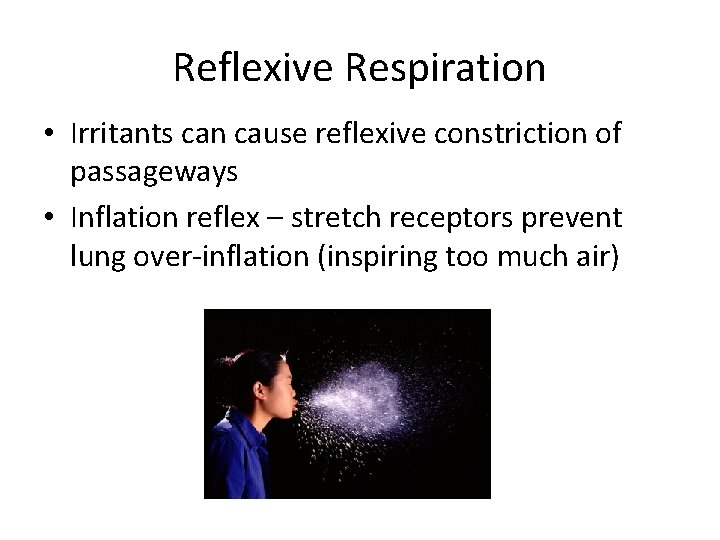
Reflexive Respiration • Irritants can cause reflexive constriction of passageways • Inflation reflex – stretch receptors prevent lung over-inflation (inspiring too much air)
Respiratory Adjustments • Exercise - CO 2 in blood (Hypercapnia) from muscle contractions – However, these are not the stimuli! • Psychological, cortical, and proprioreceptor input are the cause (we think) • Altitude – Decrease O 2 pressure results in lower O 2 absorption rates • Altitude Sickness – headache, nausea, fainting, death?
- Slides: 44