
Respiratory System Anatomy Breathing air movement in nasal
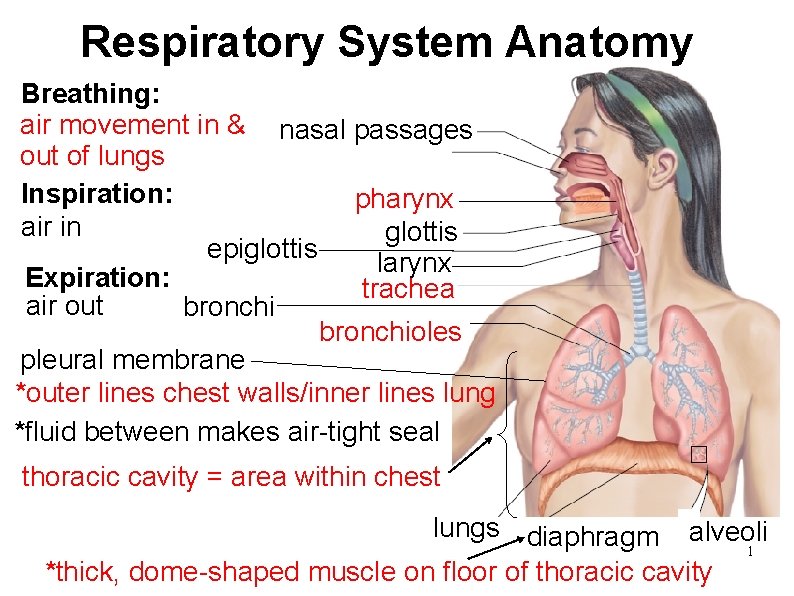
Respiratory System Anatomy Breathing: air movement in & nasal passages out of lungs Inspiration: pharynx air in glottis epiglottis larynx Expiration: trachea air out bronchioles pleural membrane *outer lines chest walls/inner lines lung *fluid between makes air-tight seal thoracic cavity = area within chest lungs diaphragm alveoli 1 *thick, dome-shaped muscle on floor of thoracic cavity

Breathing – Path of Air 1. air enters nasal passages - hairs/cilia (projections from cells in tissue) trap dust/debris – air warmed/moistened 2. air passes through pharynx (common passage for food/air) 3. glottis = opening to larynx (triangular box where air passes over vocal cords to produce sound) opens *swallowing: epiglottis covers glottis 4. air enters trachea (vessel for air passage) *trachea held open by cartilaginous rings, lined with ciliated mucous membranes *mucus traps dust/particulates, cilia sweep mucus up/ out of respiratory tract 2

Breathing – Path of Air 5. trachea divides into bronchi (passages supplying air for each lung) then into bronchioles (smaller passages that extend into lungs 6. bronchiole walls get thinner/ vessels get smaller as they branch out *bronchioles end in alveoli (sacs surrounded by capillary beds - site of gas exchange) *alveoli secrete a lipoprotein so that they do not collapse alveoli *alveoli have ↑ surface area for optimal gas capillaries exchange 3
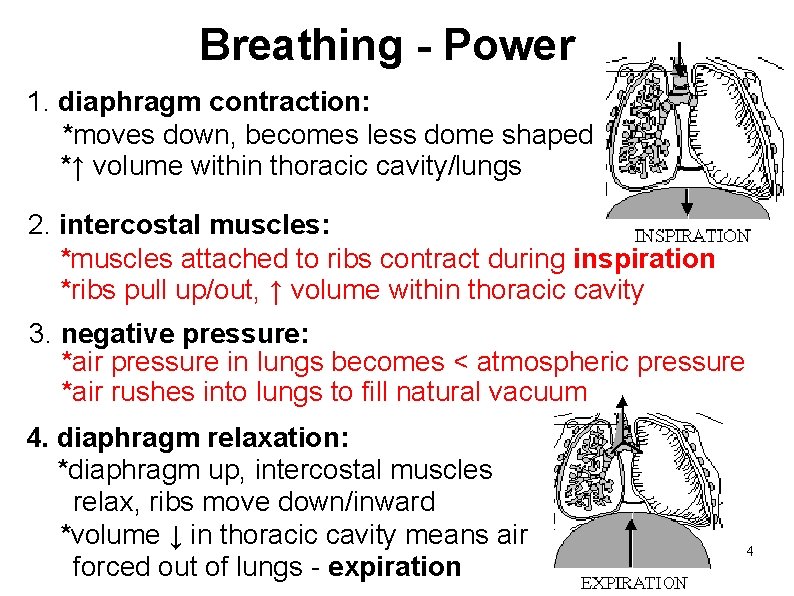
Breathing - Power 1. diaphragm contraction: *moves down, becomes less dome shaped *↑ volume within thoracic cavity/lungs 2. intercostal muscles: *muscles attached to ribs contract during inspiration *ribs pull up/out, ↑ volume within thoracic cavity 3. negative pressure: *air pressure in lungs becomes < atmospheric pressure *air rushes into lungs to fill natural vacuum 4. diaphragm relaxation: *diaphragm up, intercostal muscles relax, ribs move down/inward *volume ↓ in thoracic cavity means air forced out of lungs - expiration 4

Breathing - Control *breathing rate subject to partial conscious control *CO 2 & H+ ions in blood control breathing rate 1. 2. as cells continue to produce CO 2 - ↑ [CO 2] until it reaches threshold level *chemoreceptors in arteries detect ↑ CO 2/H+ levels *chemoreceptors in carotid artery/aorta (carotid /aortic bodies) respond primarily to [H+], also to CO 2/O 2 level in blood 3. chemoreceptors send signal to breathing center in medulla oblongata of brain *center not affected by ↓ oxygen levels 5

Breathing - Control 4. medulla oblongata sends nerve impulse to diaphragm & intercostal muscles 5. diaphragm contracts/lowers, rib cage moves up 6. air flows into alveoli, alveolar walls expand/stretch 7. stretch receptors in alveoli walls detect stretching 8. Nerves in alveoli send signal to brain to inhibit medulla oblongata from sending message to diaphragm or intercostal muscles – contraction stops 9. diaphragm relaxes/moves upward, resuming original shape - rib cage relaxes/moves downward/inward, forcing air out of lungs 6
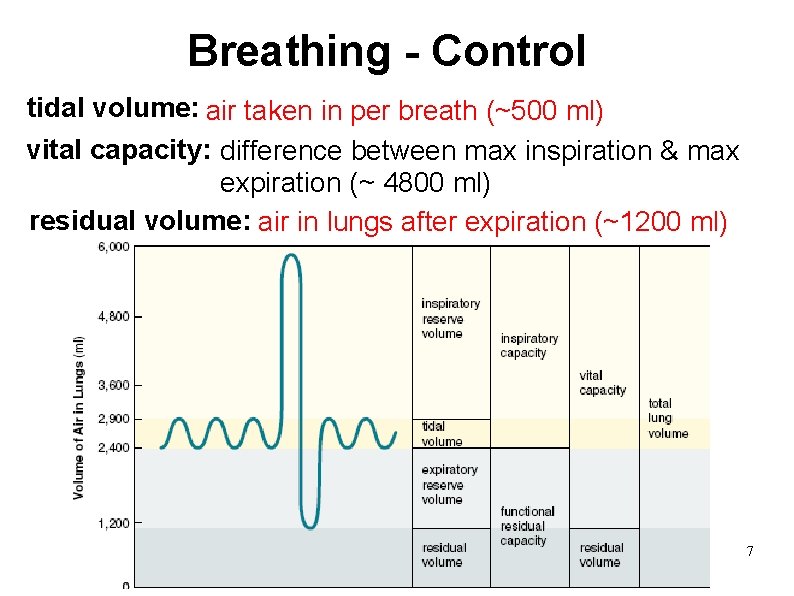
Breathing - Control tidal volume: air taken in per breath (~500 ml) vital capacity: difference between max inspiration & max expiration (~ 4800 ml) residual volume: air in lungs after expiration (~1200 ml) 7
- Slides: 7