
Respiratory Review What happens during exhalation 1 External



- Slides: 31
Respiratory Review
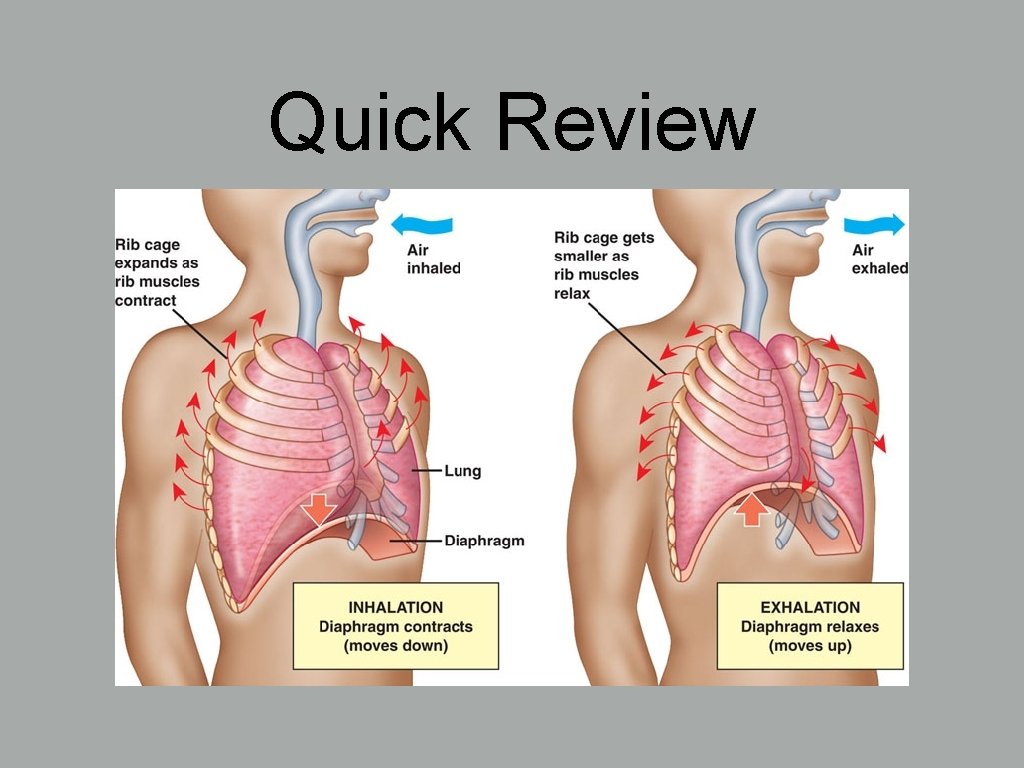
What happens during exhalation? 1. External rib muscles AND diaphragm relax 2. The volume of thoracic cavity decreases 3. The density of gas in the cavity increases – air pressure in the cavity increases 4. Air moves from areas of high to low pressure (inside the lungs to outside the lungs) 5. Air rushes out of the lungs
What happens during inhalation? 1. External rib muscles AND diaphragm contract. 2. Rib cage expands upward and outward 3. The volume of the thoracic cavity increases 4. The density of gas in the cavity decreases 5. Air pressure in the cavity decreases 6. Air moves from area high to low pressure (outside lungs to inside lungs) 7. Air rushes into lungs
Quick Review
If you INCREASE the concentration of Carbon Dioxide, what happens to the breathing rate? • If you increase the concentration of Carbon Dioxide in the air we inhale, then the breathing rate (number of breaths taken over time) will DECREASE
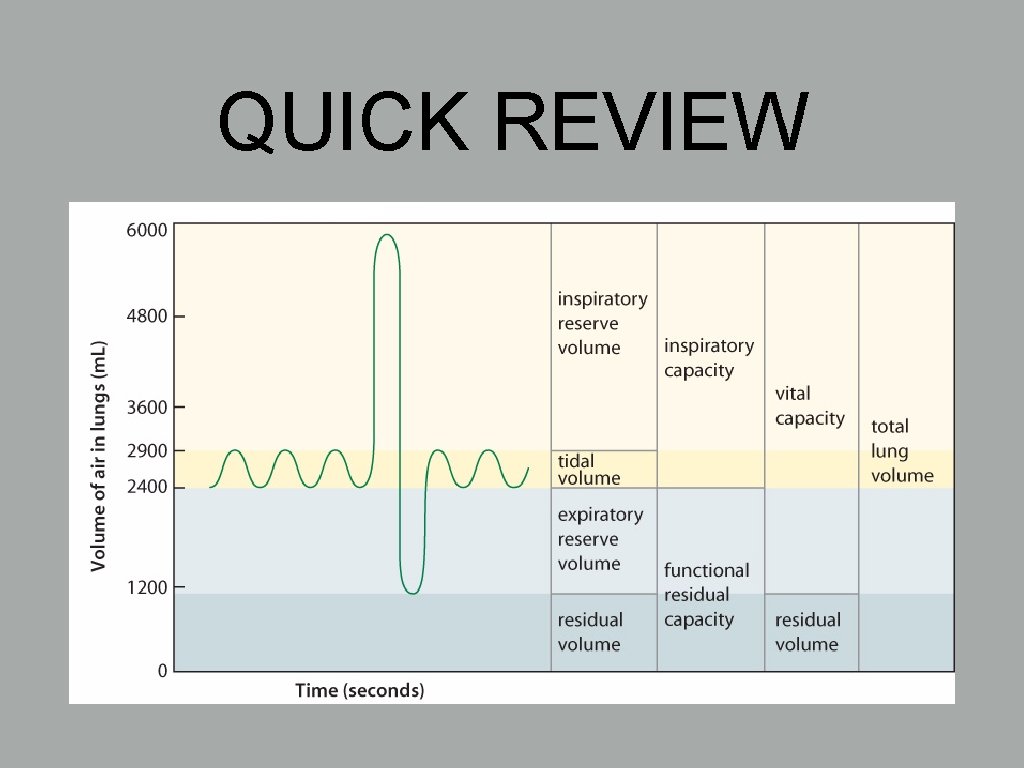
What does tidal volume measure? The volume of air inhaled and exhaled in a NORMAL breathing movement when body is at rest
What does vital capacity measure? Total lung capacity; total volume of gas that can be moved into or out of the lungs. Vital capacity = tidal volume + inspiratory reserve + expiratory reserve volume
If you put a cover (doesn’t allow air in at all) on a jar, what happens to the air pressure in the jar? • Air pressure INCREASES in the jar
If you remove that covering off of the jar, what happens to the air pressure in the jar? • The air pressure DECREASES
How is carbon dioxide carried in the blood? • It is carried in the blood as bicarbonate ions (HCO 3 -)
True or False: Oxygen is carried into the body, whereas Carbon Dioxide is carried out of the body • True
What is the site of gas exchange in the lungs? • The alveoli (where blood is oxygenated)
The walls in alveoli are ____ thick? • Alveoli walls are ONE-CELL thick
Where does oxygen go after gas exchange? • Travels into the blood stream and circulated throughout the body. Combines with hemoglobin on red blood cells
Where does carbon dioxide go after gas exchange? • Travels out of the blood and out of the body (exhaled)
How does oxygen get transported while dissolved (in water)? • Through DIFFUSION
What is the purpose of mucous in the lungs? • Helps by moistening (especially in the nasal passages) • Helps protect against foreign particles (ex. allergens) from getting to the lungs — these particles stick to the mucous
What does a buffer do? • Prevents the p. H of a solution from changing (resists change)
What does surfactant do? It is a lubricating film in the alveoli that prevents alveoli from collapsing
What happens to the p. H if you increase the concentration of Carbon Dioxide? The p. H DECREASES as the concentration of Carbon Dioxide increases.
Define Inspiration – breathing in; inhaling. Moves air from the external environment to lungs inside body
Define Expiration – breathing out; exhaling. Moves air from lungs back to external environment
Which lung has more opportunity for gas exchange? And why? • Right lung. 3 lobes, versus the left one that has 2. More areas for gas exchange to occur.
Which disorders, that we talked about, affect the UPPER respiratory tract? Tonsillitis AND Laryngitis
Which disorders, that we talked about, affect the LOWER respiratory tract? Bronchitis, Pneumonia, Pleurisy, Asthma, AND Emphysema
Why is carbon monoxide inhalation so toxic to the body? • Because it combines with hemoglobin, instead of oxygen. Prevents oxygen from combining with hemoglobin.
True or False: Alveoli have a very large, tightly knit, surface area. True. Like a cluster of grapes.
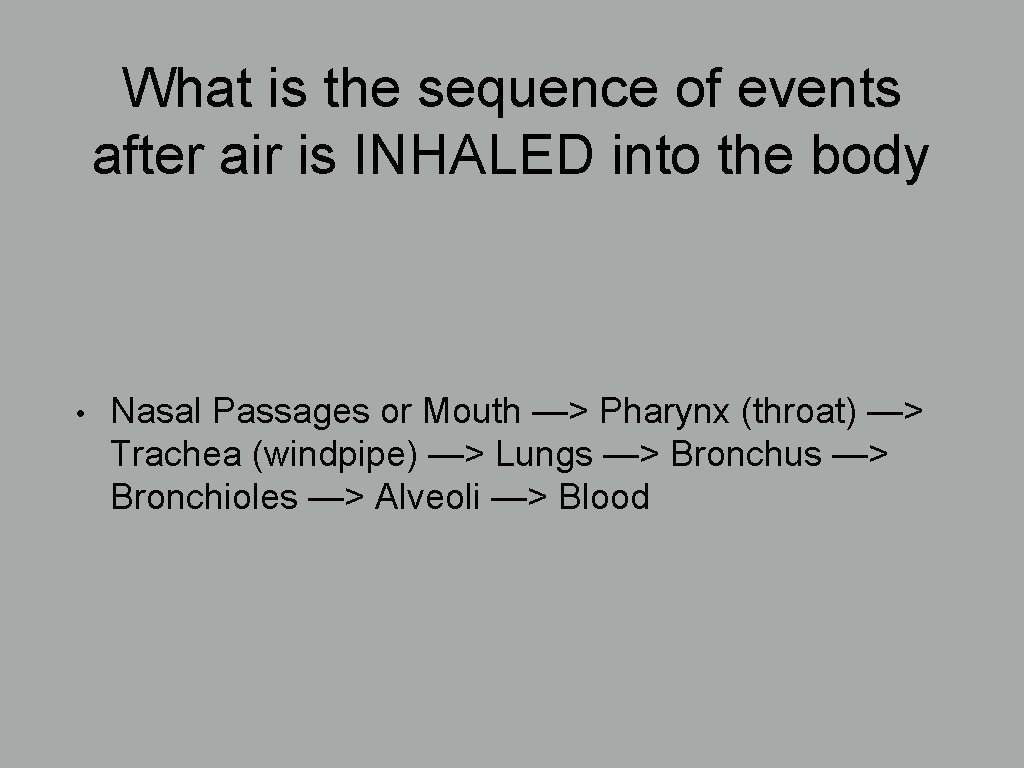
What is the sequence of events after air is INHALED into the body • Nasal Passages or Mouth —> Pharynx (throat) —> Trachea (windpipe) —> Lungs —> Bronchus —> Bronchioles —> Alveoli —> Blood
What does the epiglottis do? • Prevents from food entering the trachea
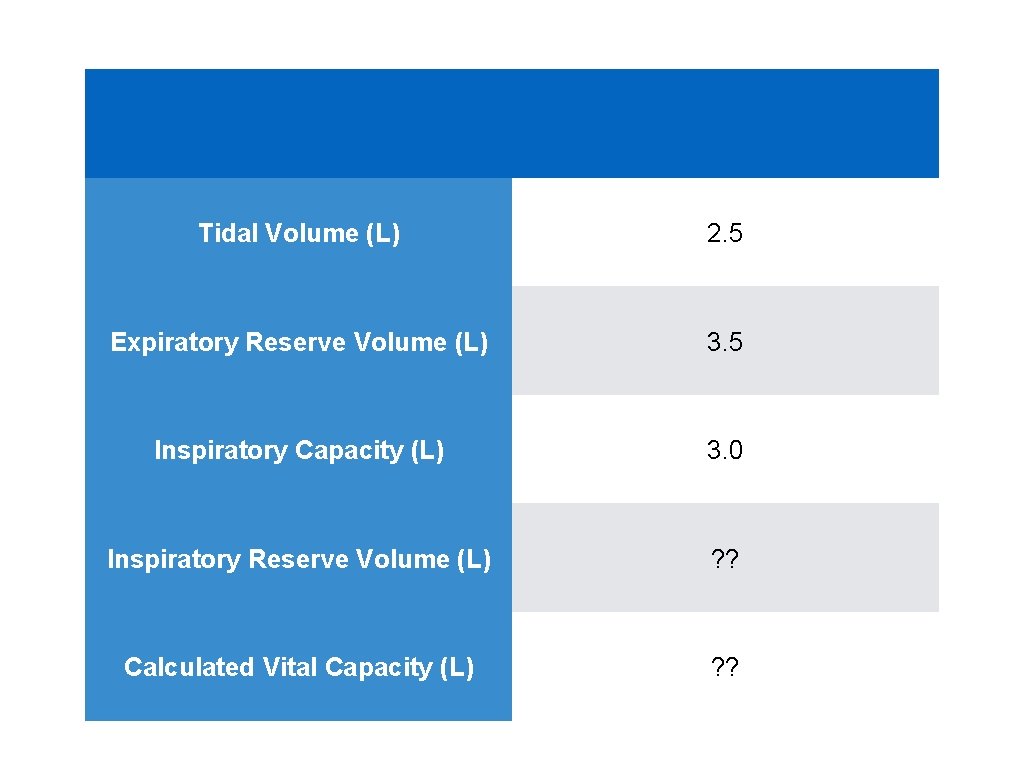
Tidal Volume (L) 2. 5 Expiratory Reserve Volume (L) 3. 5 Inspiratory Capacity (L) 3. 0 Inspiratory Reserve Volume (L) ? ? Calculated Vital Capacity (L) ? ?
QUICK REVIEW