
Respiratory Regulation During Exercise Pulmonary Ventilation H Respiratory
- Slides: 20
Respiratory Regulation During Exercise
Pulmonary Ventilation H Respiratory System Anatomy (fig. 9. 1) H Pulmonary Ventilation – commonly referred to as breathing – process of moving air in and out of the lungs – nasal breathing: warms, humidifies, and filters the air we breathe – pleural sacs suspend the lungs from the thorax and contain fluid to prevent friction against the thoracic cage.
Pulmonary Ventilation H Inspiration – is an active process of the diaphragm and the external intercostal muscles. – air rushes in into the lungs to reduce a pressure difference. – forced inspiration is further assisted by the scalene, sternocleidomastoid, and pectoralis muscles. H Expiration – is a passive relaxation of the inspiratory muscles and the lung recoils. – increased thoracic pressure forces air out of the lungs – forced expiration is an active process of the internal intercostal muscles (latissimus dorsi, quadratus lumborum & abdominals).
Pulmonary Diffusion H Is the gas exchange in the lungs and serves two functions: – it replenishes the blood’s oxygen supply in pulmonary capillaries – it removes carbon dioxide from the pulmonary capillaries H The respiratory membrane (fig. 9. 4) – gas eschange occurs between the air in the alveoli, through the respiratory membrane, to the red blood cells in the blood of the pulmonary capillaries.
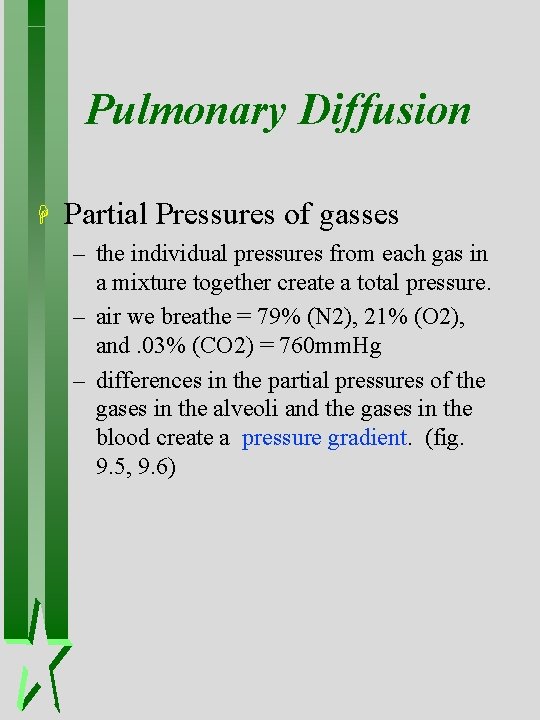
Pulmonary Diffusion H Partial Pressures of gasses – the individual pressures from each gas in a mixture together create a total pressure. – air we breathe = 79% (N 2), 21% (O 2), and. 03% (CO 2) = 760 mm. Hg – differences in the partial pressures of the gases in the alveoli and the gases in the blood create a pressure gradient. (fig. 9. 5, 9. 6)
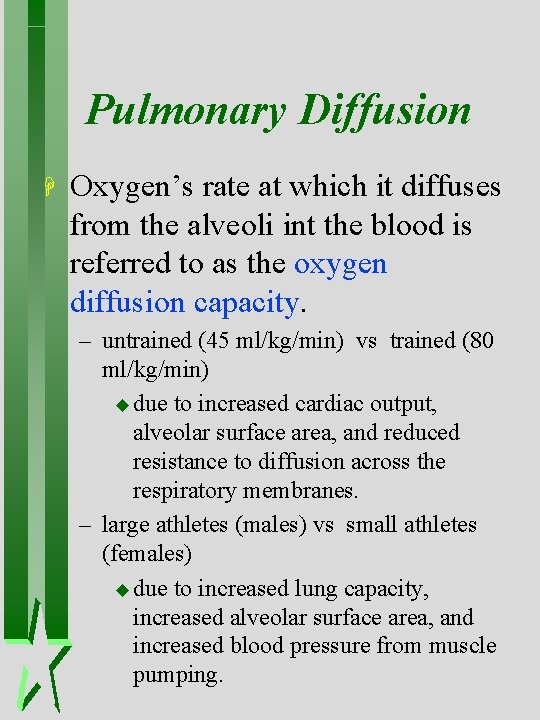
Pulmonary Diffusion H Oxygen’s rate at which it diffuses from the alveoli int the blood is referred to as the oxygen diffusion capacity. – untrained (45 ml/kg/min) vs trained (80 ml/kg/min) u due to increased cardiac output, alveolar surface area, and reduced resistance to diffusion across the respiratory membranes. – large athletes (males) vs small athletes (females) u due to increased lung capacity, increased alveolar surface area, and increased blood pressure from muscle pumping.
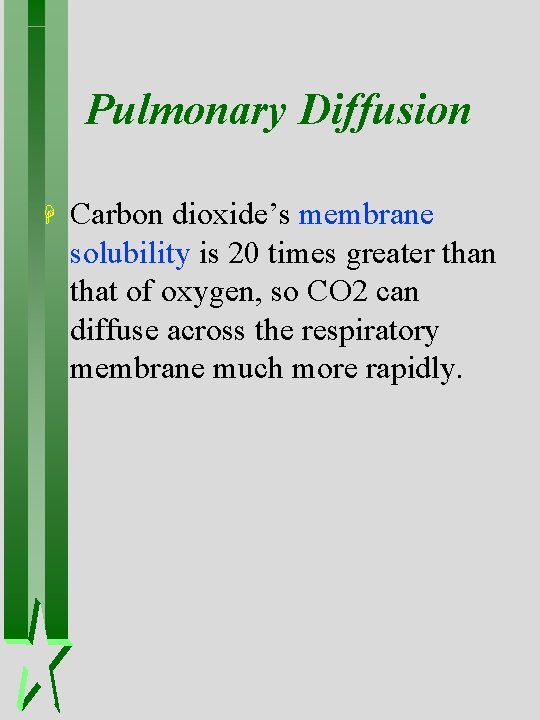
Pulmonary Diffusion H Carbon dioxide’s membrane solubility is 20 times greater than that of oxygen, so CO 2 can diffuse across the respiratory membrane much more rapidly.
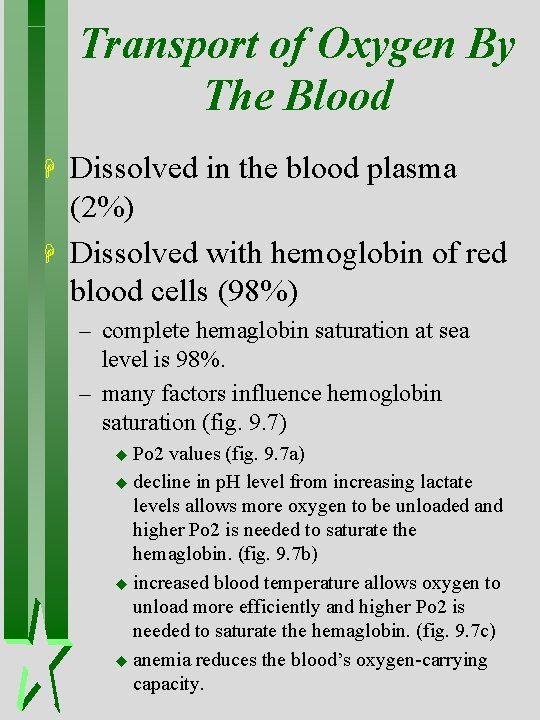
Transport of Oxygen By The Blood H H Dissolved in the blood plasma (2%) Dissolved with hemoglobin of red blood cells (98%) – complete hemaglobin saturation at sea level is 98%. – many factors influence hemoglobin saturation (fig. 9. 7) Po 2 values (fig. 9. 7 a) u decline in p. H level from increasing lactate levels allows more oxygen to be unloaded and higher Po 2 is needed to saturate the hemaglobin. (fig. 9. 7 b) u increased blood temperature allows oxygen to unload more efficiently and higher Po 2 is needed to saturate the hemaglobin. (fig. 9. 7 c) u anemia reduces the blood’s oxygen-carrying capacity. u
Athletes H Athletes with larger aerobic capacities often also have greater oxygen diffusion capacities due to increased cardiac output, blood pressure, alveolar surface area, and reduced resistance to diffusion across respiratory membranes.
Transport of Carbon Dioxide in the Blood H CO 2 released from the tissues is rarely (7%) dissolved in plasma. H CO 2 combines with H 2 O, then loses a H+ ion to form a bicarbonate ion (HCO 3) and transports 70% of carbon dioxide back to the lungs. – the lost H+ binds to hemoglobin which enhances oxygen unloading – sodium bicarbonate as an ergogenic aid serves the same purpose as a buffer and neutralizer of H+ preventing blood acidification. H CO 2 can also bind with the amino acids of the hemoglobin to form carbaminohemoglobin and is transported to the lungs.
Gas Exchange at the Muscles H The arterial-venous oxygen difference (fig. 9. 8, 9. 9) – as the rate of oxygen use increases, the a-v. O 2 difference increases. H Factors influencing oxygen delivery and uptake – under normal conditions hemoglobin is 98% saturated with O 2. – increased blood flow increases oxygen delivery and uptake u because of increased muscle use of O 2 and CO 2 productions u because of increased muscle temperature (metabolism)
Gas Exchange at The Muscles H Carbon dioxide exits the cells by simple diffusion in response to the partial pressure gradient between the tissue and the capillary blood.
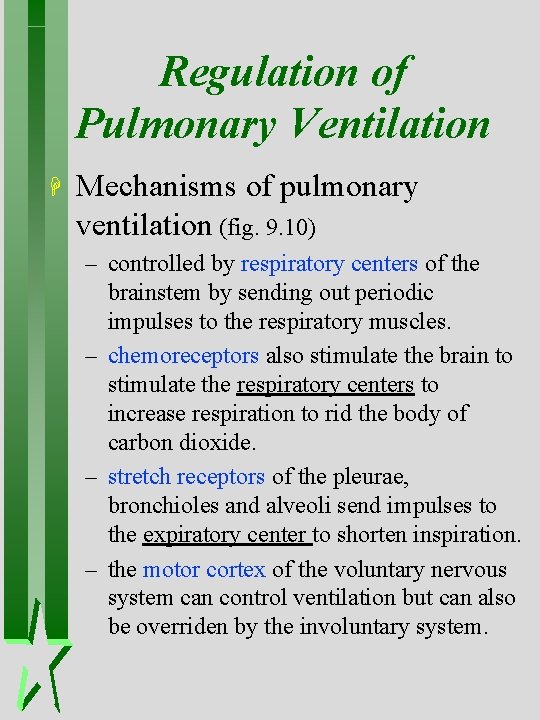
Regulation of Pulmonary Ventilation H Mechanisms of pulmonary ventilation (fig. 9. 10) – controlled by respiratory centers of the brainstem by sending out periodic impulses to the respiratory muscles. – chemoreceptors also stimulate the brain to stimulate the respiratory centers to increase respiration to rid the body of carbon dioxide. – stretch receptors of the pleurae, bronchioles and alveoli send impulses to the expiratory center to shorten inspiration. – the motor cortex of the voluntary nervous system can control ventilation but can also be overriden by the involuntary system.
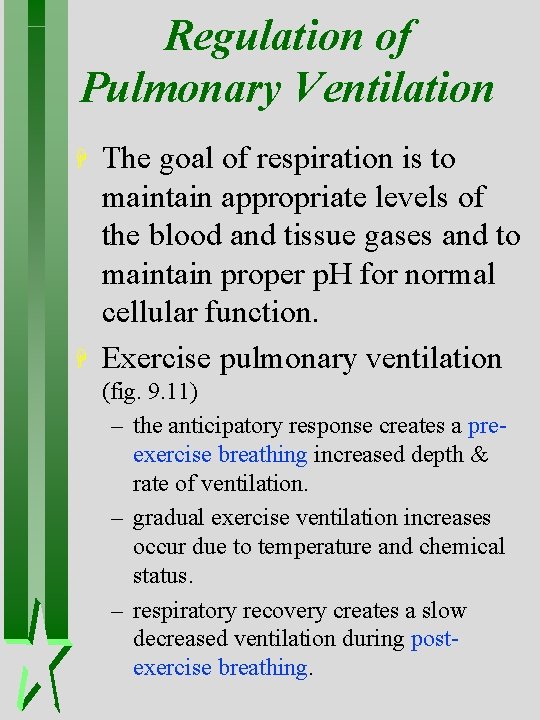
Regulation of Pulmonary Ventilation H H The goal of respiration is to maintain appropriate levels of the blood and tissue gases and to maintain proper p. H for normal cellular function. Exercise pulmonary ventilation (fig. 9. 11) – the anticipatory response creates a preexercise breathing increased depth & rate of ventilation. – gradual exercise ventilation increases occur due to temperature and chemical status. – respiratory recovery creates a slow decreased ventilation during postexercise breathing.
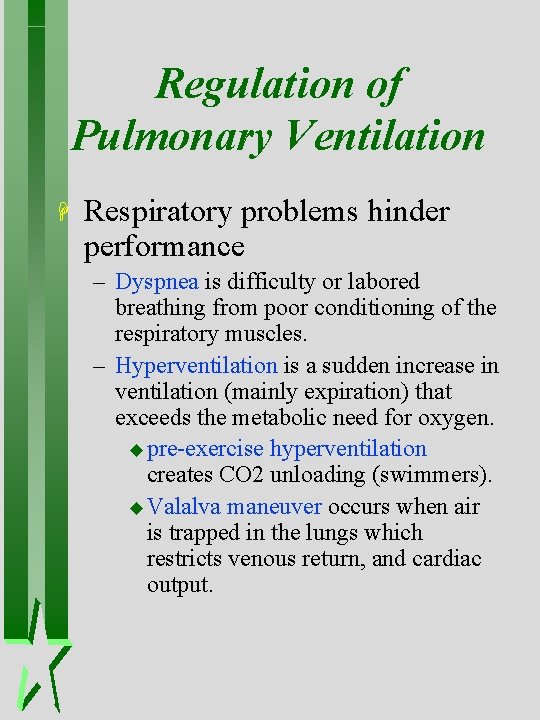
Regulation of Pulmonary Ventilation H Respiratory problems hinder performance – Dyspnea is difficulty or labored breathing from poor conditioning of the respiratory muscles. – Hyperventilation is a sudden increase in ventilation (mainly expiration) that exceeds the metabolic need for oxygen. u pre-exercise hyperventilation creates CO 2 unloading (swimmers). u Valalva maneuver occurs when air is trapped in the lungs which restricts venous return, and cardiac output.
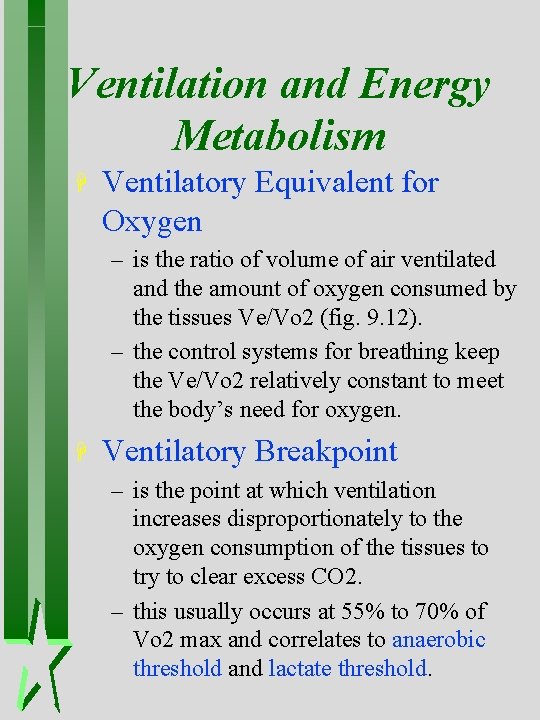
Ventilation and Energy Metabolism H Ventilatory Equivalent for Oxygen – is the ratio of volume of air ventilated and the amount of oxygen consumed by the tissues Ve/Vo 2 (fig. 9. 12). – the control systems for breathing keep the Ve/Vo 2 relatively constant to meet the body’s need for oxygen. H Ventilatory Breakpoint – is the point at which ventilation increases disproportionately to the oxygen consumption of the tissues to try to clear excess CO 2. – this usually occurs at 55% to 70% of Vo 2 max and correlates to anaerobic threshold and lactate threshold.
Ventilation and Energy Metabolism H Ventilatory Equivalent for Carbon Dioxide – is the ratio of air ventelated to the amount of CO 2 produced. – anaerobic threshold is measured by an increase in Ve/Vo 2 without an increase in Ve/Vco 2 (fig. 9. 13).
Respiratory Limitations to Performance H Energy produced by oxidation and used by the respiratory muscles increases from 2% to 15% during heavy exercise. H Pulmonary Ventilation might be a limiting factor in highly trained subjects during maximal exhaustive exercise due to a high Vo 2 max. H Airway Resistance and Gas Diffusion in the lungs do not limit exercise in a normal healthy individual. H Restrictive or Obstructive Air Ways can limit athletic performance by decreasing the Po 2 or increasing the Pco 2. – asthma – bronchitis – emphasema
Respiratory Regulation of Acid-Base Balance H Chemical Buffers – bicarbonate, phosphates, and proteins u baking soda as an ergogenic aid to buffer – increased ventilation to decrease H+ – accumulated H+ is removed by the kidneys and urinary system – H+ is difussed throughout the body fluids and reach equilibrium after only 5 to 10 minutes of recovery u this is facilitated by active recovery (fig. 9. 15).
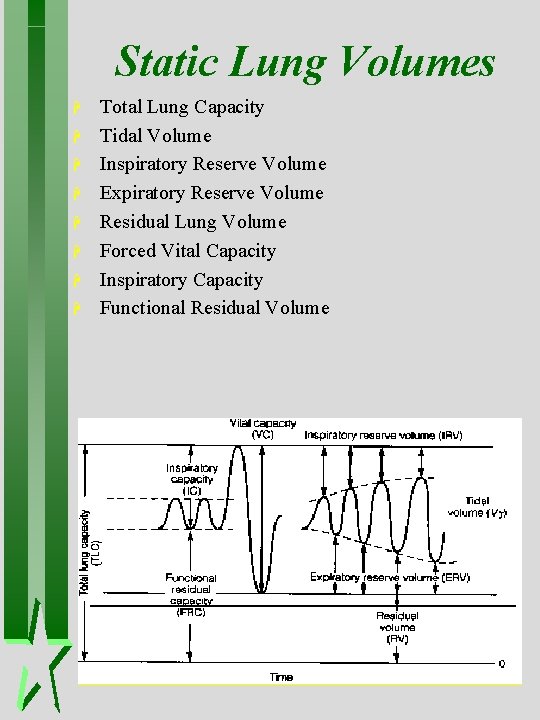
Static Lung Volumes H H H H Total Lung Capacity Tidal Volume Inspiratory Reserve Volume Expiratory Reserve Volume Residual Lung Volume Forced Vital Capacity Inspiratory Capacity Functional Residual Volume