
RESPIRATORY PROTECTION I AIRPURIFYING RESPIRATOR APR Airpurifying respirators
- Slides: 13
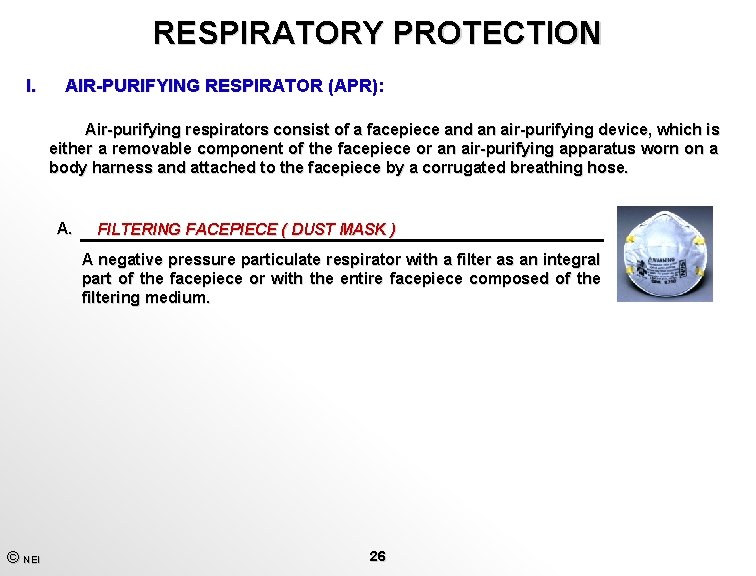
RESPIRATORY PROTECTION I. AIR-PURIFYING RESPIRATOR (APR): Air-purifying respirators consist of a facepiece and an air-purifying device, which is either a removable component of the facepiece or an air-purifying apparatus worn on a body harness and attached to the facepiece by a corrugated breathing hose. A. FILTERING FACEPIECE ( DUST MASK ) A negative pressure particulate respirator with a filter as an integral part of the facepiece or with the entire facepiece composed of the filtering medium. © NEI 26
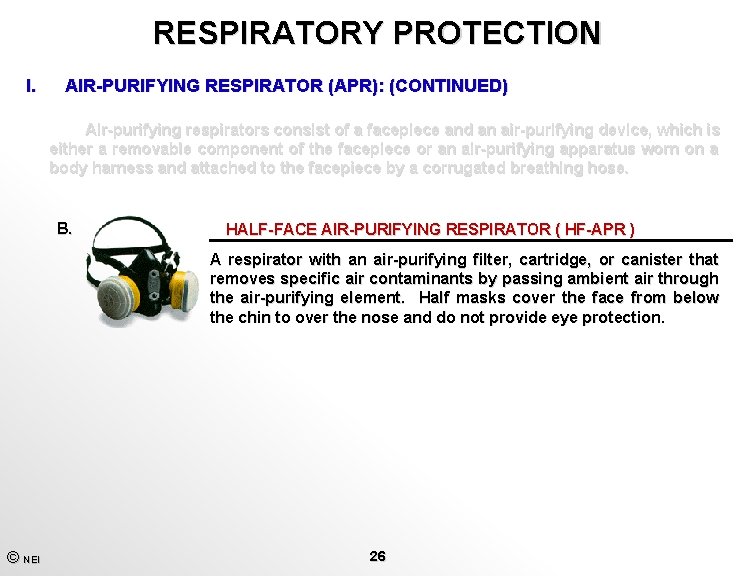
RESPIRATORY PROTECTION I. AIR-PURIFYING RESPIRATOR (APR): (CONTINUED) Air-purifying respirators consist of a facepiece and an air-purifying device, which is either a removable component of the facepiece or an air-purifying apparatus worn on a body harness and attached to the facepiece by a corrugated breathing hose. B. HALF-FACE AIR-PURIFYING RESPIRATOR ( HF-APR ) A respirator with an air-purifying filter, cartridge, or canister that removes specific air contaminants by passing ambient air through the air-purifying element. Half masks cover the face from below the chin to over the nose and do not provide eye protection. © NEI 26
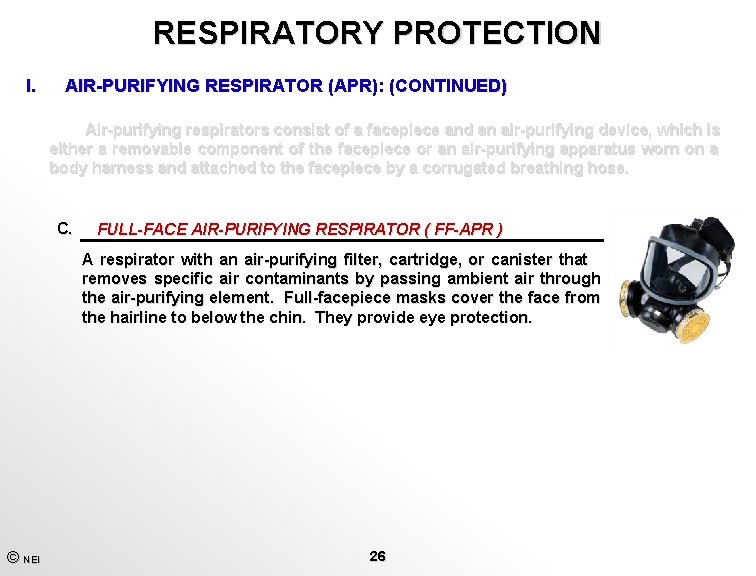
RESPIRATORY PROTECTION I. AIR-PURIFYING RESPIRATOR (APR): (CONTINUED) Air-purifying respirators consist of a facepiece and an air-purifying device, which is either a removable component of the facepiece or an air-purifying apparatus worn on a body harness and attached to the facepiece by a corrugated breathing hose. C. FULL-FACE AIR-PURIFYING RESPIRATOR ( FF-APR ) A respirator with an air-purifying filter, cartridge, or canister that removes specific air contaminants by passing ambient air through the air-purifying element. Full-facepiece masks cover the face from the hairline to below the chin. They provide eye protection. © NEI 26
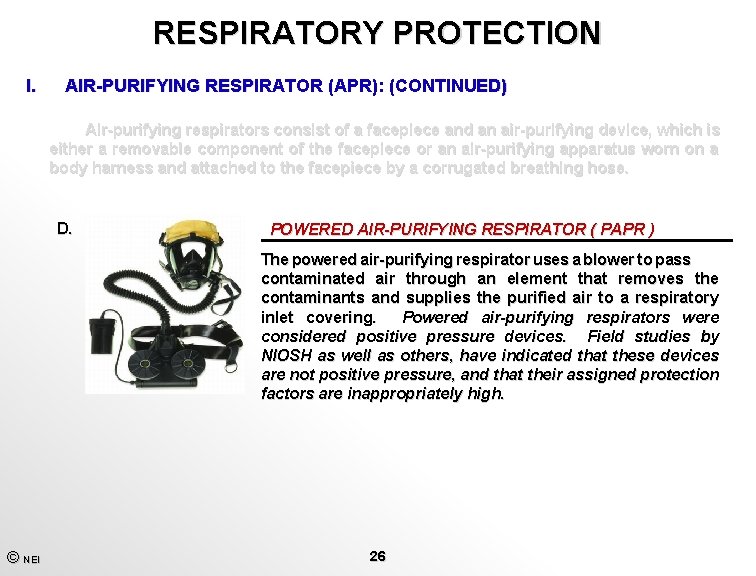
RESPIRATORY PROTECTION I. AIR-PURIFYING RESPIRATOR (APR): (CONTINUED) Air-purifying respirators consist of a facepiece and an air-purifying device, which is either a removable component of the facepiece or an air-purifying apparatus worn on a body harness and attached to the facepiece by a corrugated breathing hose. D. POWERED AIR-PURIFYING RESPIRATOR ( PAPR ) The powered air-purifying respirator uses a blower to pass contaminated air through an element that removes the contaminants and supplies the purified air to a respiratory inlet covering. Powered air-purifying respirators were considered positive pressure devices. Field studies by NIOSH as well as others, have indicated that these devices are not positive pressure, and that their assigned protection factors are inappropriately high. © NEI 26
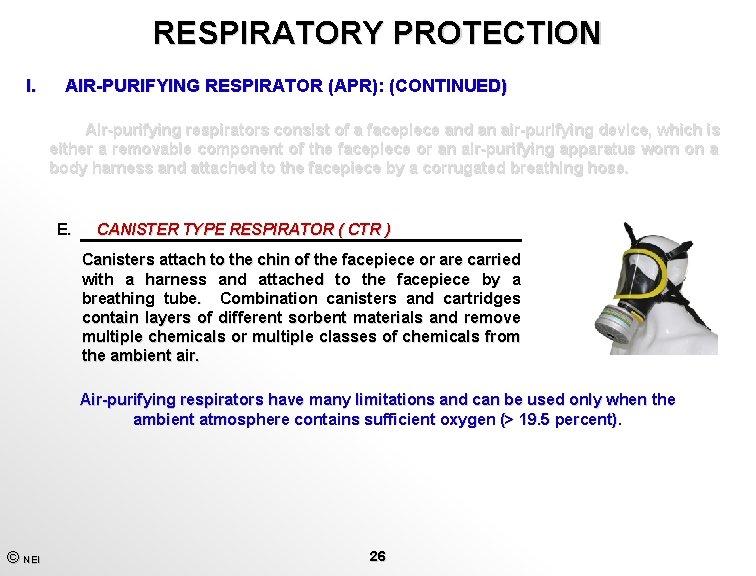
RESPIRATORY PROTECTION I. AIR-PURIFYING RESPIRATOR (APR): (CONTINUED) Air-purifying respirators consist of a facepiece and an air-purifying device, which is either a removable component of the facepiece or an air-purifying apparatus worn on a body harness and attached to the facepiece by a corrugated breathing hose. E. CANISTER TYPE RESPIRATOR ( CTR ) Canisters attach to the chin of the facepiece or are carried with a harness and attached to the facepiece by a breathing tube. Combination canisters and cartridges contain layers of different sorbent materials and remove multiple chemicals or multiple classes of chemicals from the ambient air. Air-purifying respirators have many limitations and can be used only when the ambient atmosphere contains sufficient oxygen (> 19. 5 percent). © NEI 26
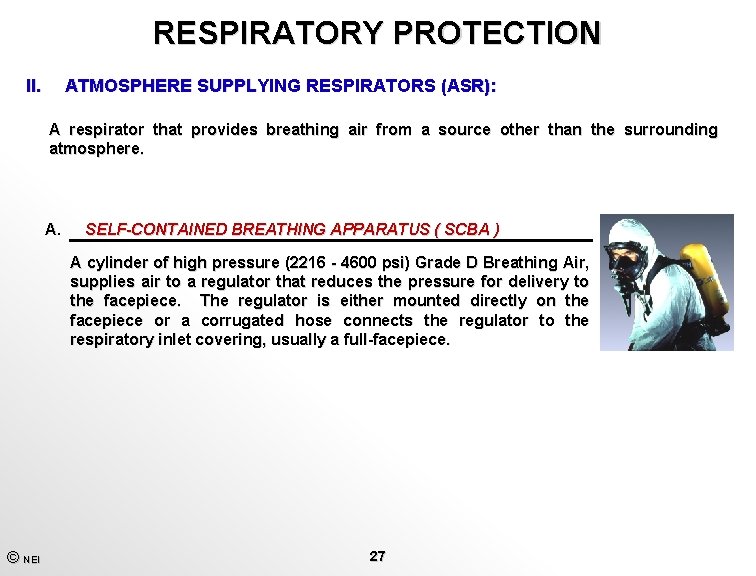
RESPIRATORY PROTECTION II. ATMOSPHERE SUPPLYING RESPIRATORS (ASR): A respirator that provides breathing air from a source other than the surrounding atmosphere. A. SELF-CONTAINED BREATHING APPARATUS ( SCBA ) A cylinder of high pressure (2216 - 4600 psi) Grade D Breathing Air, supplies air to a regulator that reduces the pressure for delivery to the facepiece. The regulator is either mounted directly on the facepiece or a corrugated hose connects the regulator to the respiratory inlet covering, usually a full-facepiece. © NEI 27
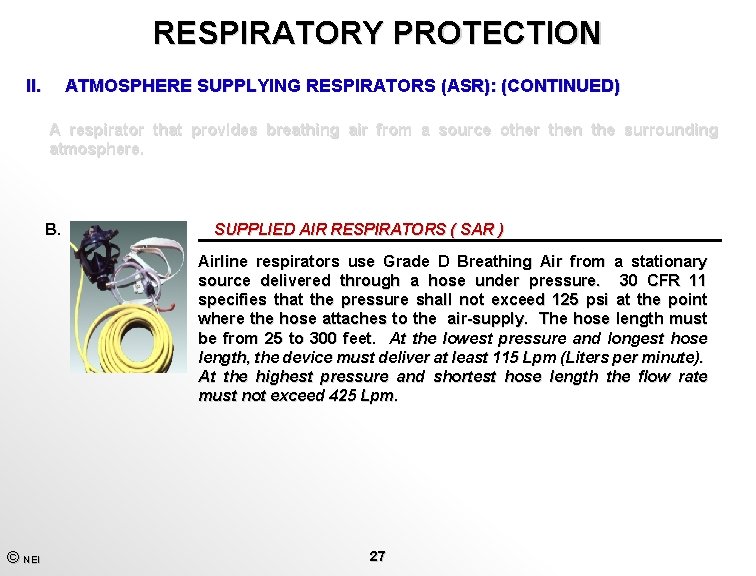
RESPIRATORY PROTECTION II. ATMOSPHERE SUPPLYING RESPIRATORS (ASR): (CONTINUED) A respirator that provides breathing air from a source other then the surrounding atmosphere. B. SUPPLIED AIR RESPIRATORS ( SAR ) Airline respirators use Grade D Breathing Air from a stationary source delivered through a hose under pressure. 30 CFR 11 specifies that the pressure shall not exceed 125 psi at the point where the hose attaches to the air-supply. The hose length must be from 25 to 300 feet. At the lowest pressure and longest hose length, the device must deliver at least 115 Lpm (Liters per minute). At the highest pressure and shortest hose length the flow rate must not exceed 425 Lpm. © NEI 27
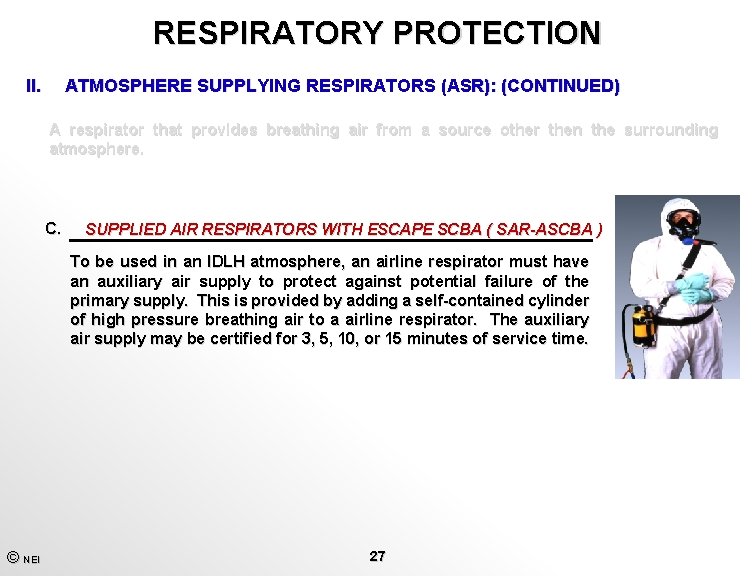
RESPIRATORY PROTECTION II. ATMOSPHERE SUPPLYING RESPIRATORS (ASR): (CONTINUED) A respirator that provides breathing air from a source other then the surrounding atmosphere. C. SUPPLIED AIR RESPIRATORS WITH ESCAPE SCBA ( SAR-ASCBA ) To be used in an IDLH atmosphere, an airline respirator must have an auxiliary air supply to protect against potential failure of the primary supply. This is provided by adding a self-contained cylinder of high pressure breathing air to a airline respirator. The auxiliary air supply may be certified for 3, 5, 10, or 15 minutes of service time. © NEI 27
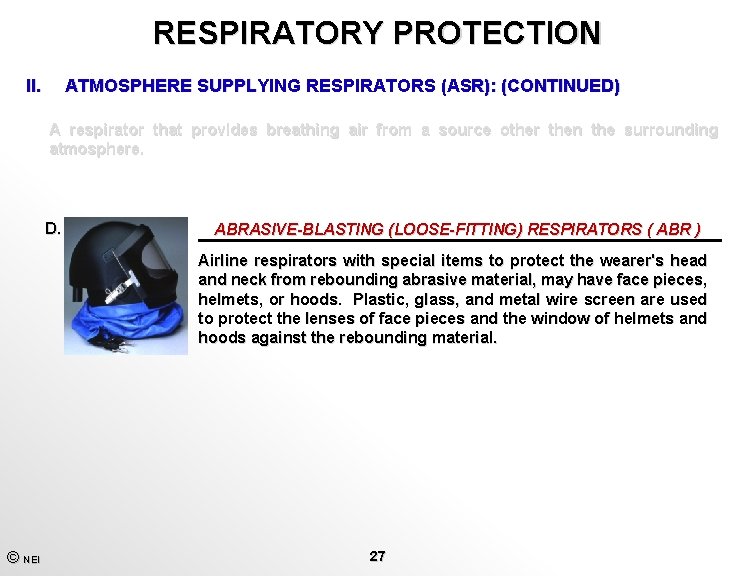
RESPIRATORY PROTECTION II. ATMOSPHERE SUPPLYING RESPIRATORS (ASR): (CONTINUED) A respirator that provides breathing air from a source other then the surrounding atmosphere. D. ABRASIVE-BLASTING (LOOSE-FITTING) RESPIRATORS ( ABR ) Airline respirators with special items to protect the wearer's head and neck from rebounding abrasive material, may have face pieces, helmets, or hoods. Plastic, glass, and metal wire screen are used to protect the lenses of face pieces and the window of helmets and hoods against the rebounding material. © NEI 27
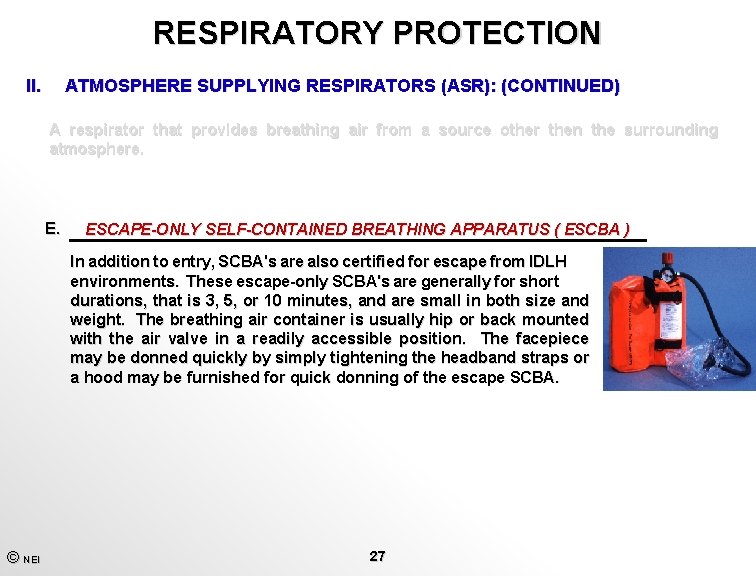
RESPIRATORY PROTECTION II. ATMOSPHERE SUPPLYING RESPIRATORS (ASR): (CONTINUED) A respirator that provides breathing air from a source other then the surrounding atmosphere. ESCAPE-ONLY SELF-CONTAINED BREATHING APPARATUS ( ESCBA ) In addition to entry, SCBA's are also certified for escape from IDLH environments. These escape-only SCBA's are generally for short durations, that is 3, 5, or 10 minutes, and are small in both size and weight. The breathing air container is usually hip or back mounted with the air valve in a readily accessible position. The facepiece may be donned quickly by simply tightening the headband straps or a hood may be furnished for quick donning of the escape SCBA. © NEI 27
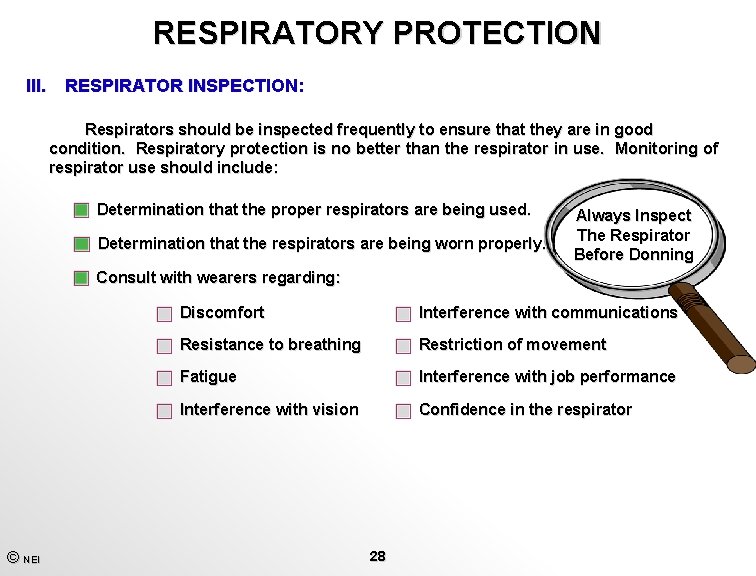
RESPIRATORY PROTECTION III. RESPIRATOR INSPECTION: Respirators should be inspected frequently to ensure that they are in good condition. Respiratory protection is no better than the respirator in use. Monitoring of respirator use should include: Determination that the proper respirators are being used. Determination that the respirators are being worn properly. Always Inspect The Respirator Before Donning Consult with wearers regarding: © NEI Discomfort Interference with communications Resistance to breathing Restriction of movement Fatigue Interference with job performance Interference with vision Confidence in the respirator 28
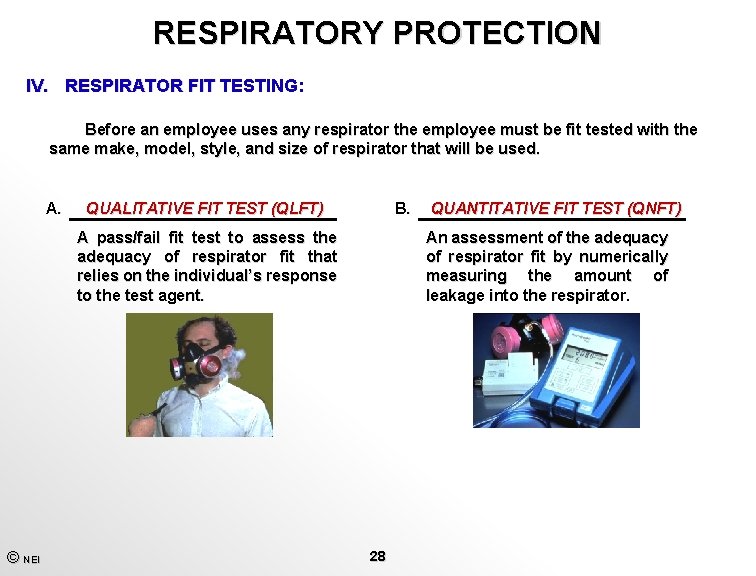
RESPIRATORY PROTECTION IV. RESPIRATOR FIT TESTING: Before an employee uses any respirator the employee must be fit tested with the same make, model, style, and size of respirator that will be used. A. B. QUALITATIVE FIT TEST (QLFT) A pass/fail fit test to assess the adequacy of respirator fit that relies on the individual’s response to the test agent. © NEI QUANTITATIVE FIT TEST (QNFT) An assessment of the adequacy of respirator fit by numerically measuring the amount of leakage into the respirator. 28
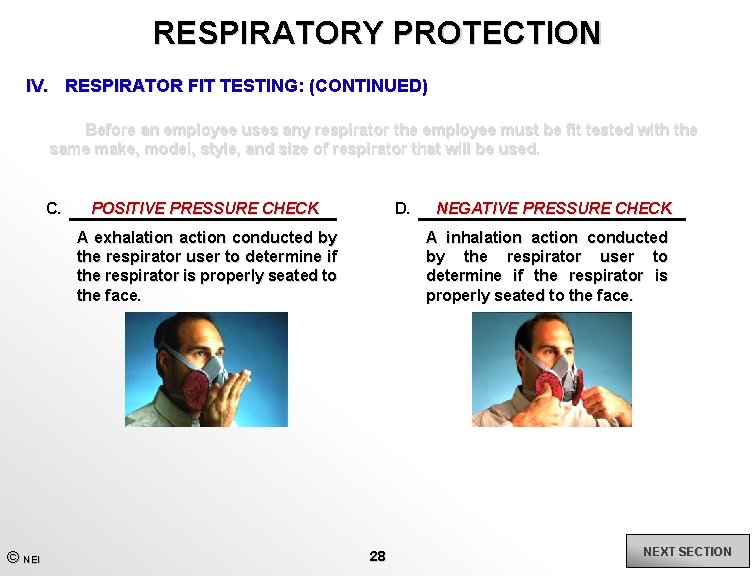
RESPIRATORY PROTECTION IV. RESPIRATOR FIT TESTING: (CONTINUED) Before an employee uses any respirator the employee must be fit tested with the same make, model, style, and size of respirator that will be used. C. D. POSITIVE PRESSURE CHECK A exhalation action conducted by the respirator user to determine if the respirator is properly seated to the face. © NEI NEGATIVE PRESSURE CHECK A inhalation action conducted by the respirator user to determine if the respirator is properly seated to the face. 28 NEXT SECTION