
Respiratory organs Organa respiratoria Respiration gas exchange between
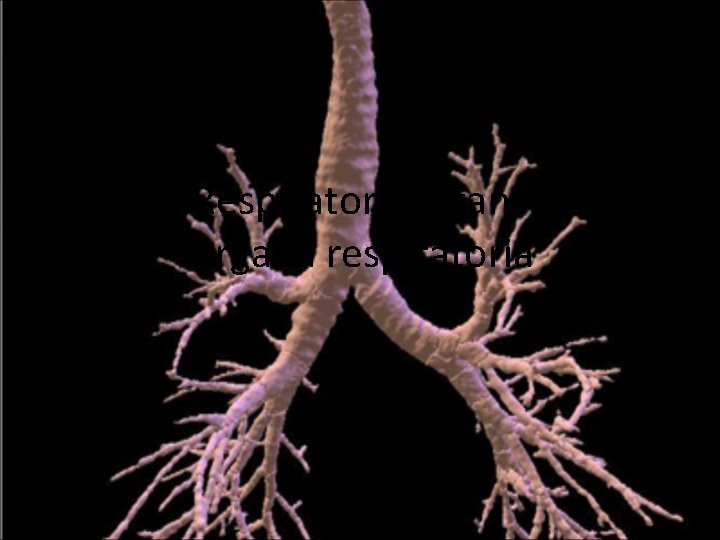
Respiratory organs Organa respiratoria
Respiration: gas exchange between the outer environment and the Parts: organism • outer: between the air and the blood • inner: between the blood and the tissues • biological oxidation: chemical process within the cells Types: 1. ) diffuse (integumental): throughout the whole body surface (skin) • Amphibians: 25 -50% • Mammals (human): 1, 5% 2. ) localized : via the respiratory organ (it requires large surface and dense vascularization)
Functions (in addition to gas exchange): • Warming and moistening the incoming air • Regulation of the air flow • Olfaction (chemical sensory function) • Removing foreign airborne particles • Cooling the entire organism
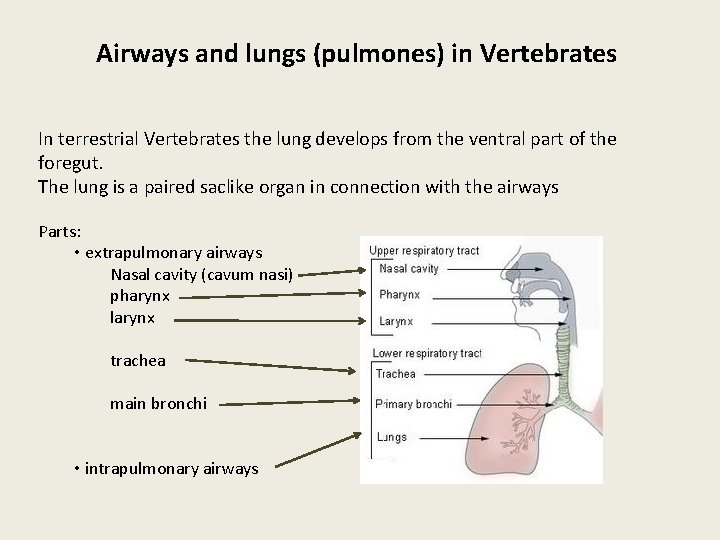
Airways and lungs (pulmones) in Vertebrates In terrestrial Vertebrates the lung develops from the ventral part of the foregut. The lung is a paired saclike organ in connection with the airways Parts: • extrapulmonary airways Nasal cavity (cavum nasi) pharynx larynx trachea main bronchi • intrapulmonary airways

Nasal cavity: cavum nasi 3 histological parts: regio cutanea regio respiratorica (the skeleton of them: hyaline cartilage) regio olfactoria (the skeleton of it: bone – os nasale) Regio cutanea: vestibulum nasi. The stratified squamous keratinized epithelium of the skin turns inside the nasal cavity. Many sebaceous glands, sweat glands and hair follicles (vibrissae) Regio respiratorica: Covered by tunica mucosa Lamina epithelialis: pseudostratified columnar epithelium + goblet cells Lamina propria: loose connective tissue, (serous and mucous glands) lymphocytes, plasma cells wide venous sinusoids („bleeding nose”) Regio olfactoria: on ethmoturbinates and nasal septum, yellow pigmented tunica mucosa Lamina epithelialis: pseudostratified columnar epithelium + goblet cells and primary sensory cells, supportive cells, basal cells Lamina propria: loose connective tissue continuous with the periosteum Bowman’s glands (branching tubuloalveolar glands producing „binding” protein)

Regio respiratorica Regio olfactoria
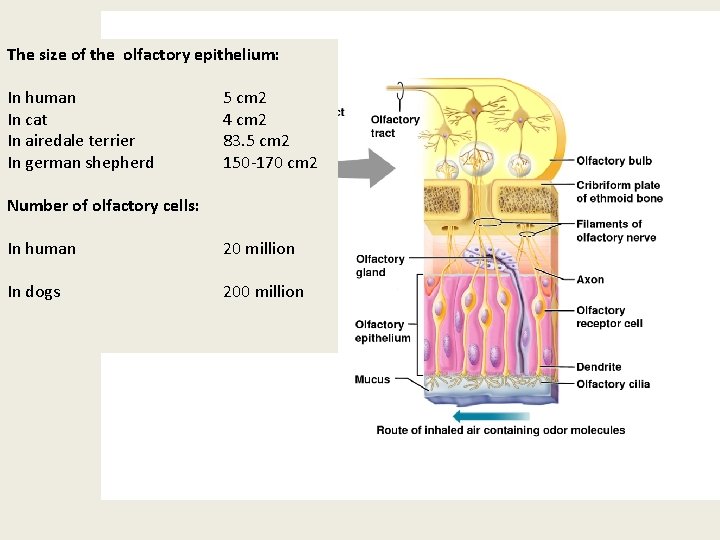
The size of the olfactory epithelium: In human In cat In airedale terrier In german shepherd 5 cm 2 4 cm 2 83. 5 cm 2 150 -170 cm 2 Number of olfactory cells: In human 20 million In dogs 200 million

Vomeronasal organ: At the base of the nasal septum. An epithelial tube surrounded by the vomeronasal hyaline cartilage. Caudally closed, rostrally it communicates wit the oral cavity. Lateral aspect: respiratory epithelium Medial aspect: olfactory epithelium Function: sexual behaviour related to specific odours.
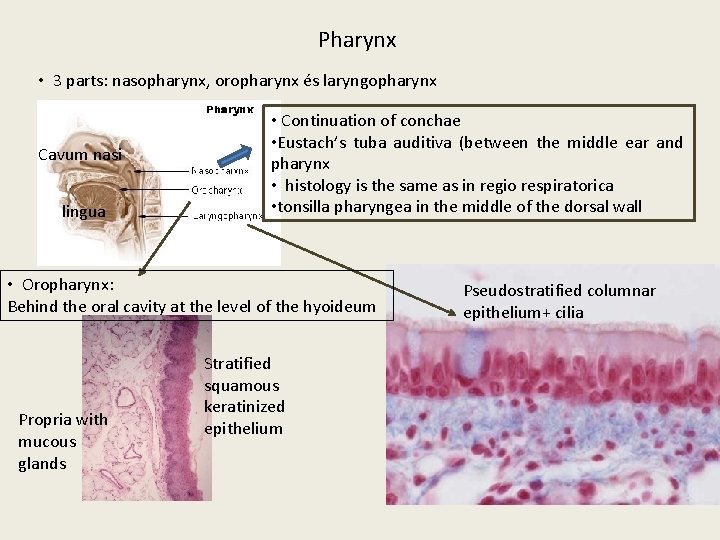
Pharynx • 3 parts: nasopharynx, oropharynx és laryngopharynx Cavum nasi lingua • Continuation of conchae • Eustach’s tuba auditiva (between the middle ear and pharynx • histology is the same as in regio respiratorica • tonsilla pharyngea in the middle of the dorsal wall • Oropharynx: Behind the oral cavity at the level of the hyoideum Propria with mucous glands Stratified squamous keratinized epithelium Pseudostratified columnar epithelium+ cilia
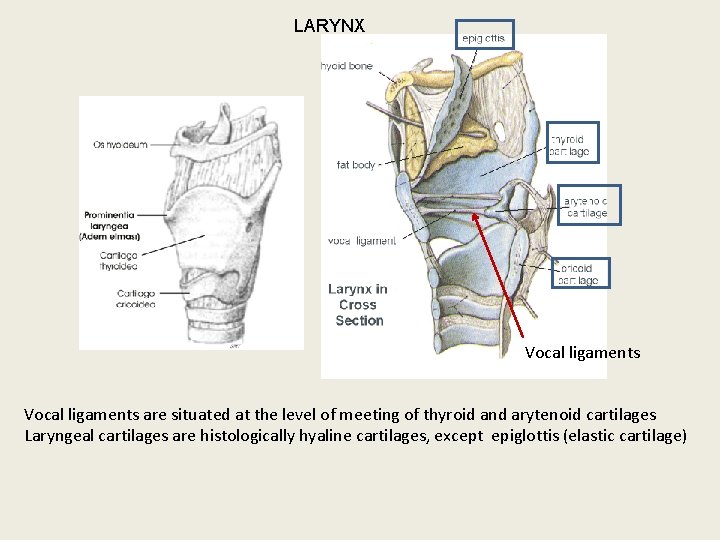
LARYNX Vocal ligaments are situated at the level of meeting of thyroid and arytenoid cartilages Laryngeal cartilages are histologically hyaline cartilages, except epiglottis (elastic cartilage)
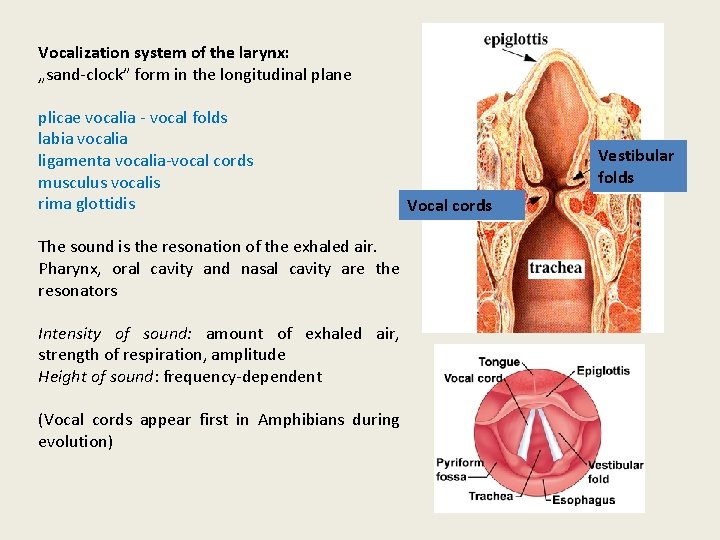
Vocalization system of the larynx: „sand-clock” form in the longitudinal plane plicae vocalia - vocal folds labia vocalia ligamenta vocalia-vocal cords musculus vocalis rima glottidis The sound is the resonation of the exhaled air. Pharynx, oral cavity and nasal cavity are the resonators Intensity of sound: amount of exhaled air, strength of respiration, amplitude Height of sound: frequency-dependent (Vocal cords appear first in Amphibians during evolution) Vestibular folds Vocal cords
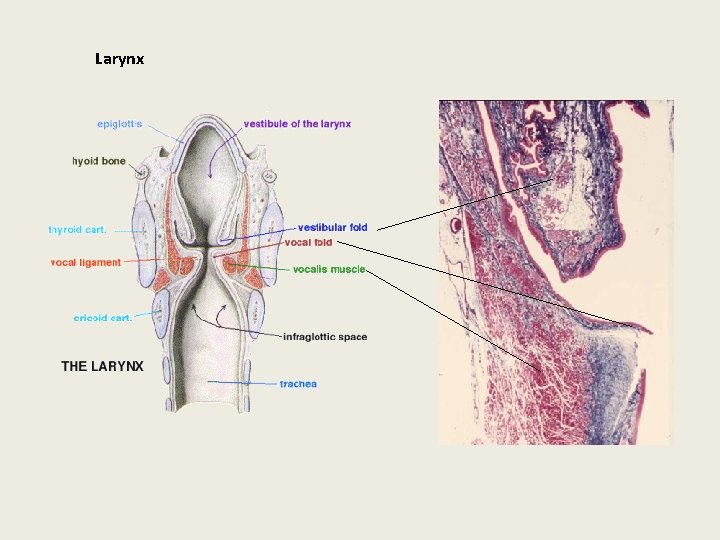
Larynx
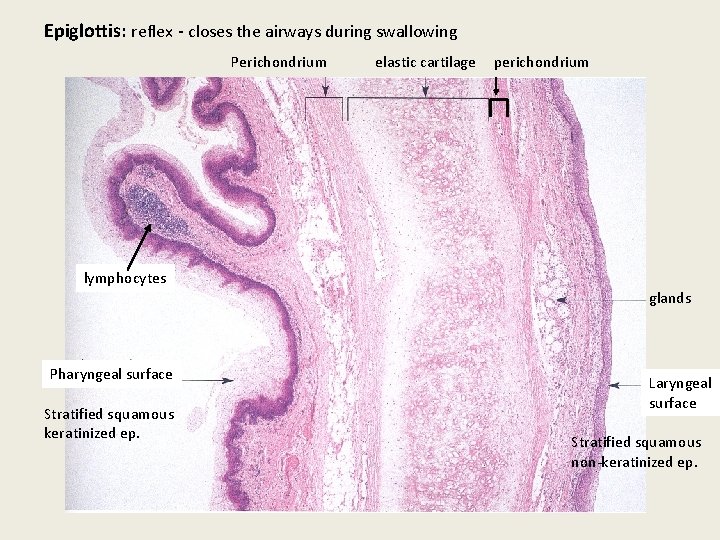
Epiglottis: reflex - closes the airways during swallowing Perichondrium elastic cartilage perichondrium lymphocytes glands Pharyngeal surface Stratified squamous keratinized ep. Laryngeal surface Stratified squamous non-keratinized ep.
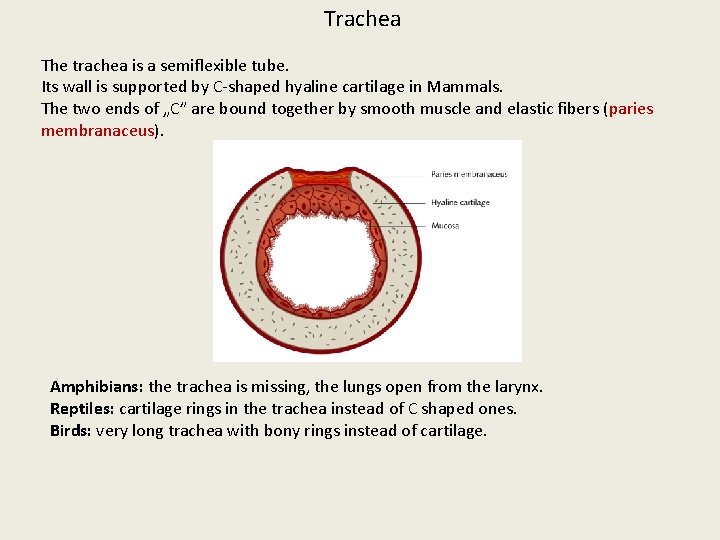
Trachea The trachea is a semiflexible tube. Its wall is supported by C-shaped hyaline cartilage in Mammals. The two ends of „C” are bound together by smooth muscle and elastic fibers (paries membranaceus). Amphibians: the trachea is missing, the lungs open from the larynx. Reptiles: cartilage rings in the trachea instead of C shaped ones. Birds: very long trachea with bony rings instead of cartilage.
Mammalian Trachea Histology of the trachea: 1. ) Tunica mucosa: lamina epithelialis: ciliated pseudostratied columnar epithelium lamina propria: cell-rich connective tissue, collagen and elastic fibres 2. ) Tunica submucosa: loose connective tissue, seromucous glands (continuous with perichondrium) 3. ) C – shaped hyaline cartilage + smooth muscle facing towards the esophagus dorsally (paries membranaceus) 4. ) Tunica adventitia: loose CT (Carnivores: smooth muscle is attached to the outer surface of the open ends of „C” Other domestic animals: smooth muscle is attached to the inner aspect) Principal bronchi: trachea bifurcation, histology is same as that of trachea
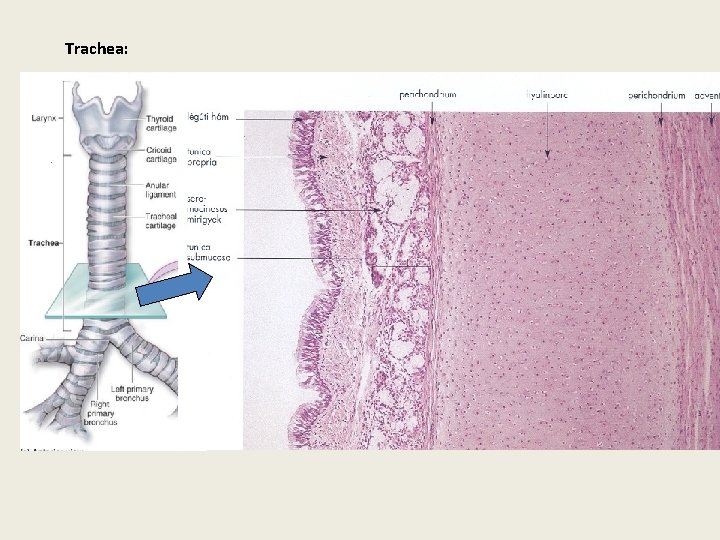
Trachea:
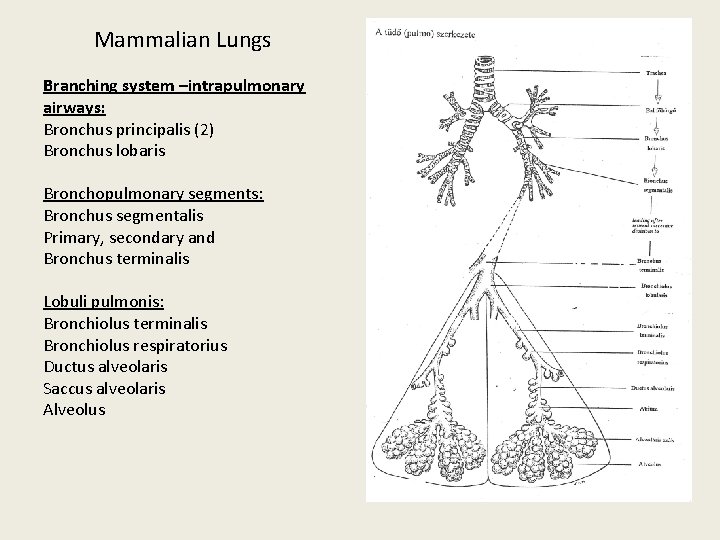
Mammalian Lungs Branching system –intrapulmonary airways: Bronchus principalis (2) Bronchus lobaris Bronchopulmonary segments: Bronchus segmentalis Primary, secondary and Bronchus terminalis Lobuli pulmonis: Bronchiolus terminalis Bronchiolus respiratorius Ductus alveolaris Saccus alveolaris Alveolus
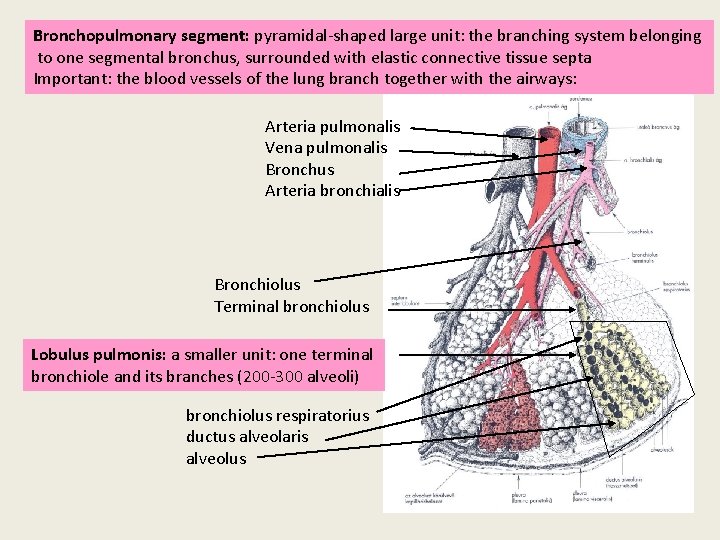
Bronchopulmonary segment: pyramidal-shaped large unit: the branching system belonging to one segmental bronchus, surrounded with elastic connective tissue septa Important: the blood vessels of the lung branch together with the airways: Arteria pulmonalis Vena pulmonalis Bronchus Arteria bronchialis Bronchiolus Terminal bronchiolus Lobulus pulmonis: a smaller unit: one terminal bronchiole and its branches (200 -300 alveoli) bronchiolus respiratorius ductus alveolaris alveolus
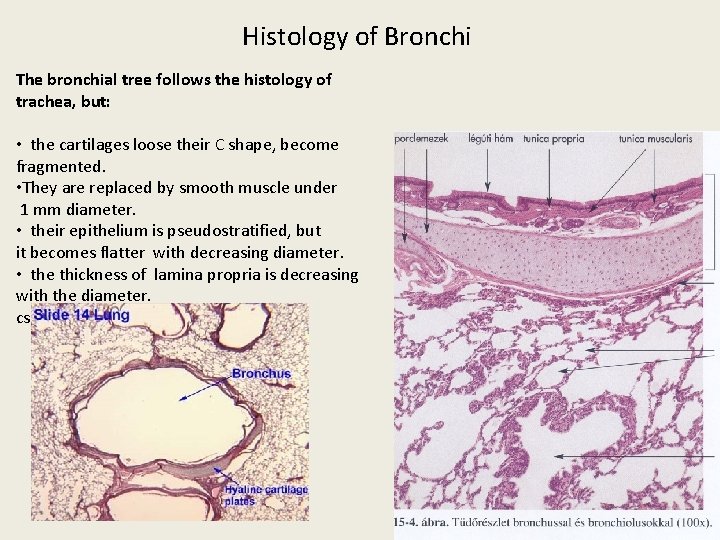
Histology of Bronchi The bronchial tree follows the histology of trachea, but: • the cartilages loose their C shape, become fragmented. • They are replaced by smooth muscle under 1 mm diameter. • their epithelium is pseudostratified, but it becomes flatter with decreasing diameter. • the thickness of lamina propria is decreasing with the diameter. csökken a légutak átmérőjével
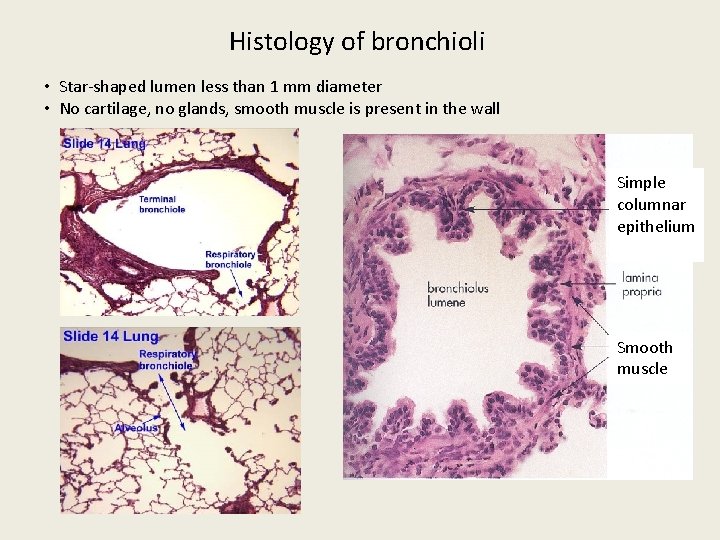
Histology of bronchioli • Star-shaped lumen less than 1 mm diameter • No cartilage, no glands, smooth muscle is present in the wall Simple columnar epithelium Smooth muscle
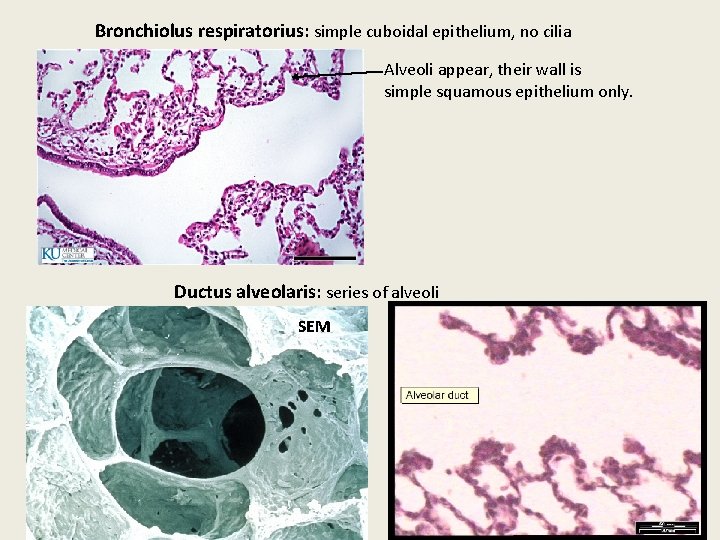
Bronchiolus respiratorius: simple cuboidal epithelium, no cilia Alveoli appear, their wall is simple squamous epithelium only. Ductus alveolaris: series of alveoli SEM
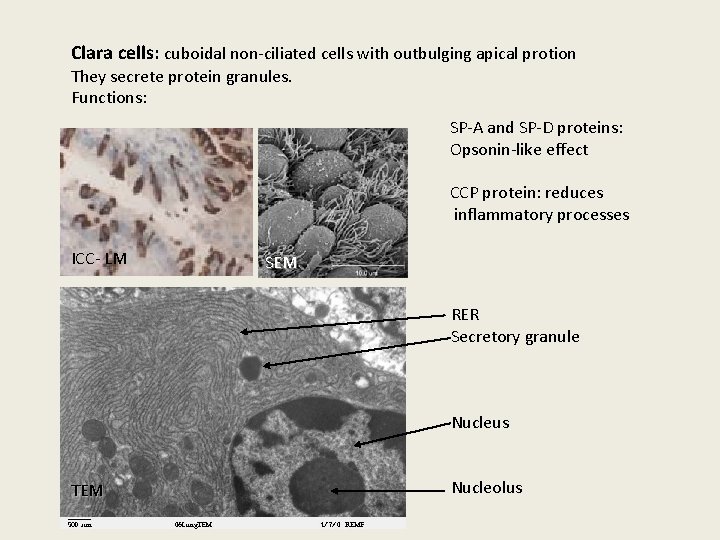
Clara cells: cuboidal non-ciliated cells with outbulging apical protion They secrete protein granules. Functions: SP-A and SP-D proteins: Opsonin-like effect CCP protein: reduces inflammatory processes ICC- LM SEM RER Secretory granule Nucleus TEM Nucleolus
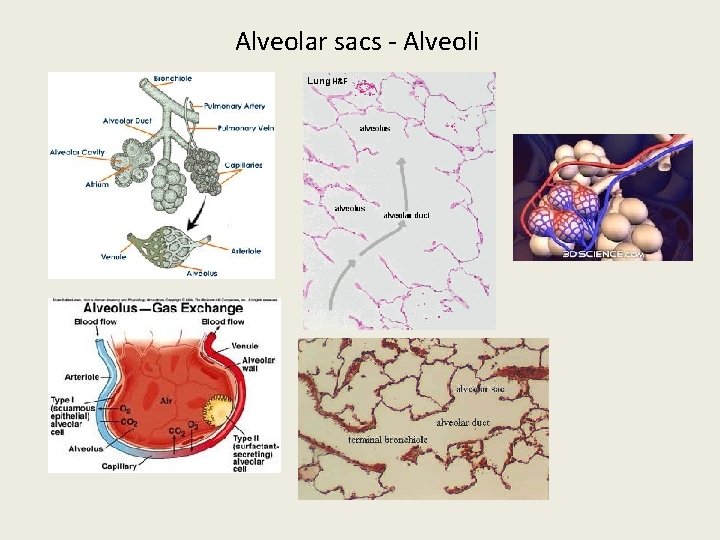
Alveolar sacs - Alveoli
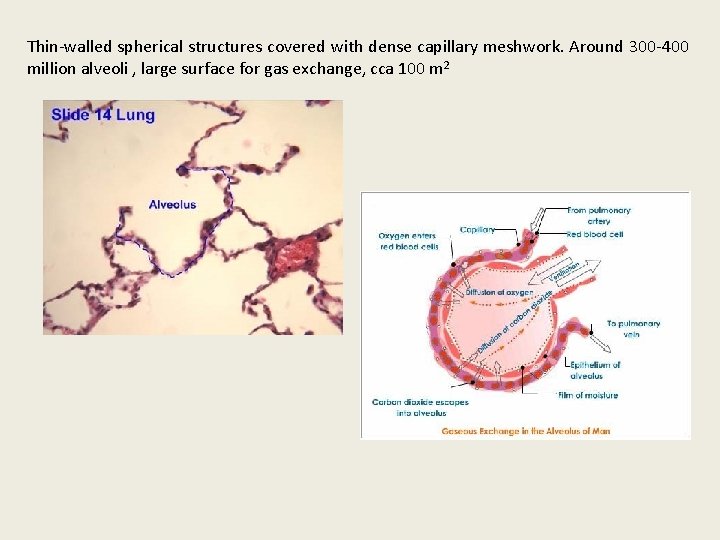
Thin-walled spherical structures covered with dense capillary meshwork. Around 300 -400 million alveoli , large surface for gas exchange, cca 100 m 2
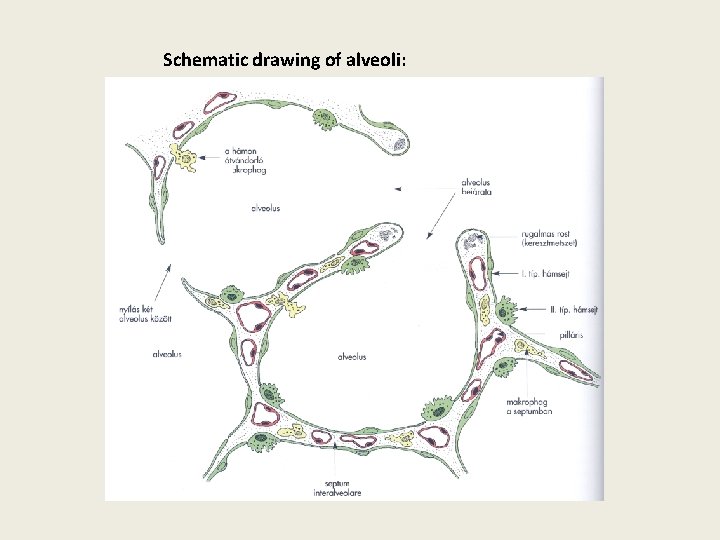
Schematic drawing of alveoli:
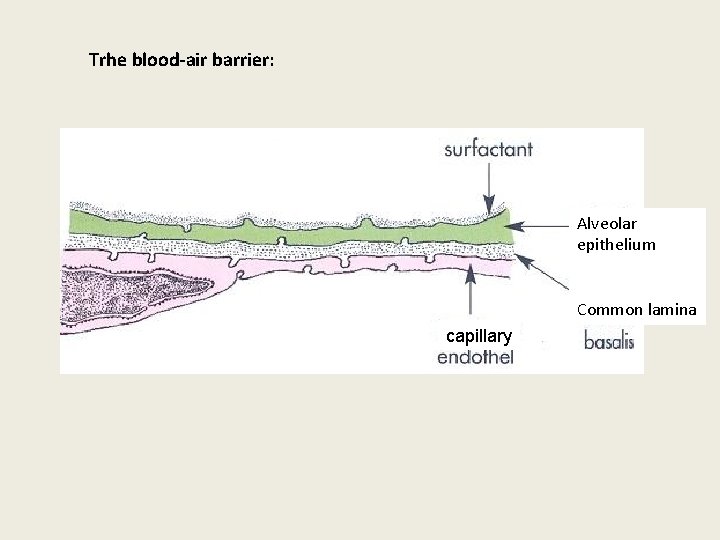
Trhe blood-air barrier: Alveolar epithelium Common lamina capillary
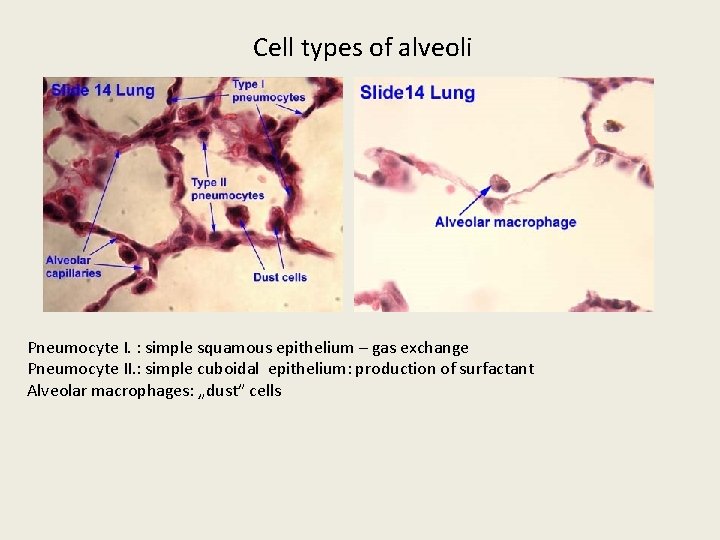
Cell types of alveoli Pneumocyte I. : simple squamous epithelium – gas exchange Pneumocyte II. : simple cuboidal epithelium: production of surfactant Alveolar macrophages: „dust” cells
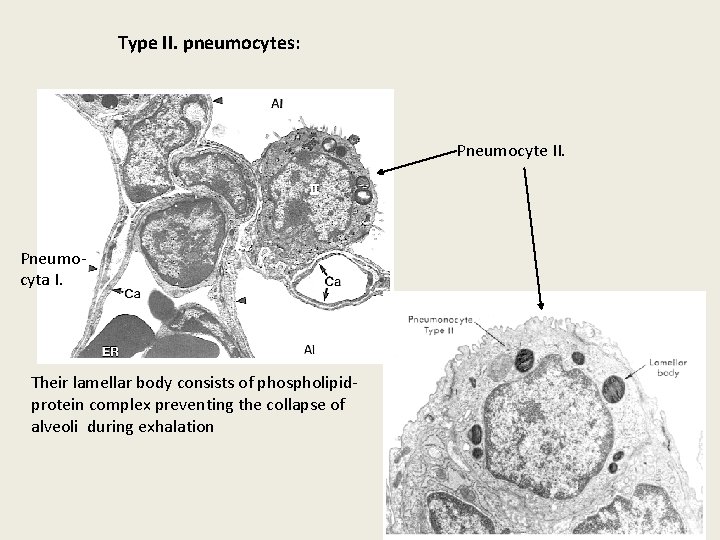
Type II. pneumocytes: Pneumocyte II. Pneumocyta I. Their lamellar body consists of phospholipidprotein complex preventing the collapse of alveoli during exhalation
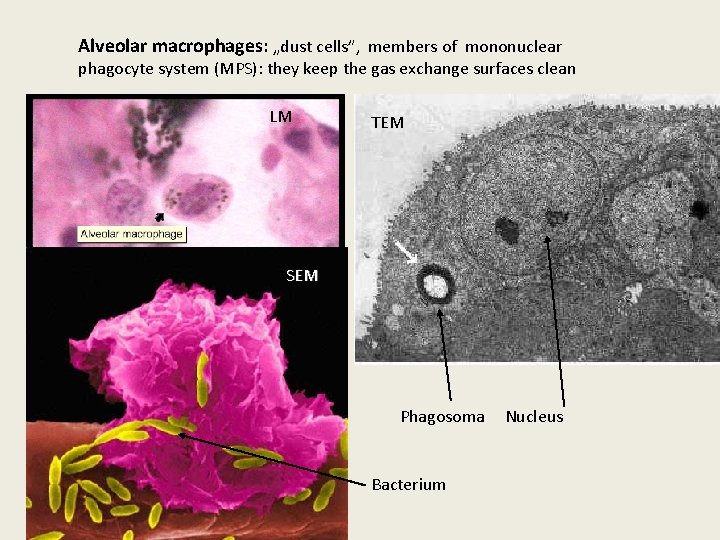
Alveolar macrophages: „dust cells”, members of mononuclear phagocyte system (MPS): they keep the gas exchange surfaces clean LM TEM SEM Phagosoma Bacterium Nucleus

Interstitium of the lung • Outer surface: pleura + CT capsule with elastic fibers • Intersegmental septa • Interlobular septa • Elastic fibers enmesh the lung tissue(resorcin-fuchsin)
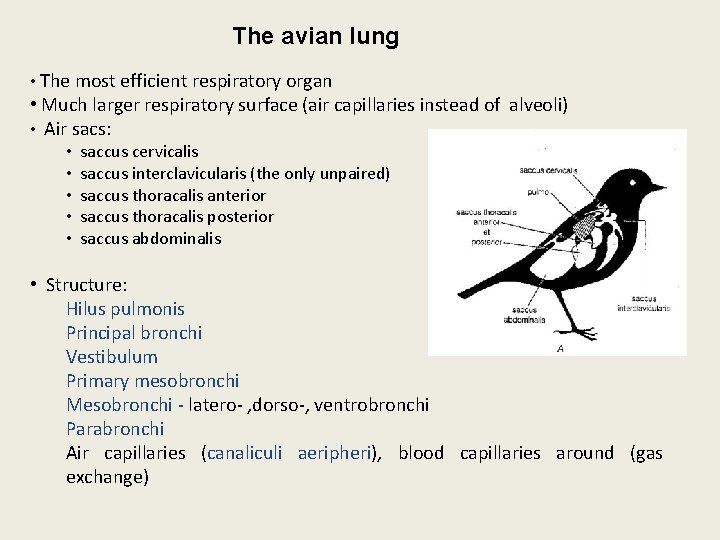
The avian lung • The most efficient respiratory organ • Much larger respiratory surface (air capillaries instead of alveoli) • Air sacs: • • • saccus cervicalis saccus interclavicularis (the only unpaired) saccus thoracalis anterior saccus thoracalis posterior saccus abdominalis • Structure: Hilus pulmonis Principal bronchi Vestibulum Primary mesobronchi Mesobronchi - latero- , dorso-, ventrobronchi Parabronchi Air capillaries (canaliculi aeripheri), blood capillaries around (gas exchange)
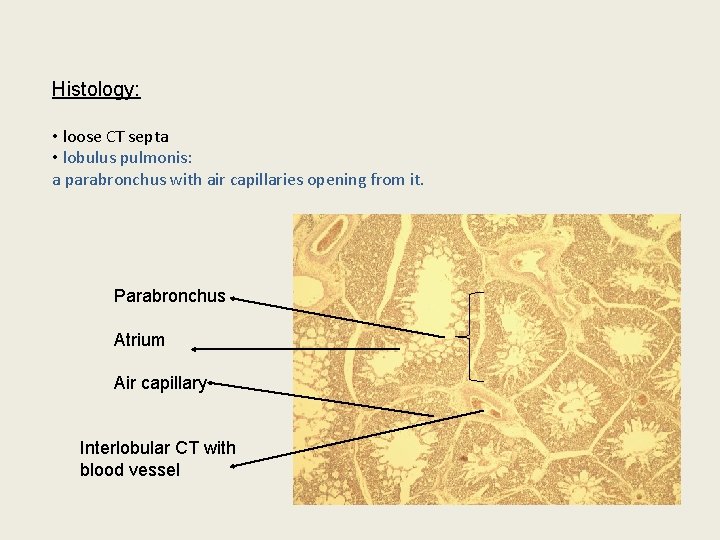
Histology: • loose CT septa • lobulus pulmonis: a parabronchus with air capillaries opening from it. Parabronchus Atrium Air capillary Interlobular CT with blood vessel

lobulus pulmonis atr ia parabronchus Air capillaries (canaliculi aeriferi) CT septum
- Slides: 33