
Respiratory Motion Management Techniques for Chest and Abdominal
Respiratory Motion Management Techniques for Chest and Abdominal Radiation Therapy Leia Szwedo In partial fulfillment of RT 412 University of Wisconsin – La Crosse, Radiation Therapy Program
Background • Issue 1: ▫ Respiratory motion caused by patient breathing during radiation therapy treatment can cause displacement of the tumor location. � 12 to 16 respiratory cycles every minute �SI direction: three to 12 millimeters �Anterior-posterior and lateral directions: five mm ▫ Causes difficulty localizing tumor �Overdosing normal tissue, under dosing tumor
Background cont. • Solution: ▫ Respiratory motion management �Techniques: �Immobilization of the diaphragm �Breathing control �Real-time tracking ▫ Consensus shows that in comparison to free breathing radiation treatments, all motion management techniques are beneficial in treating moving tumors. 2 -4 �minimal statistical differences in motion management between the techniques. 2 -4

Immobilization of the Diaphragm • Utilizes devices to compress the abdomen • Limit the air intake of the patient ▫ Thereby reducing the amount the diaphragm can move and the tumor motion associated with it 2 • More precise tumor localization 1 • Smaller margins achievable 1
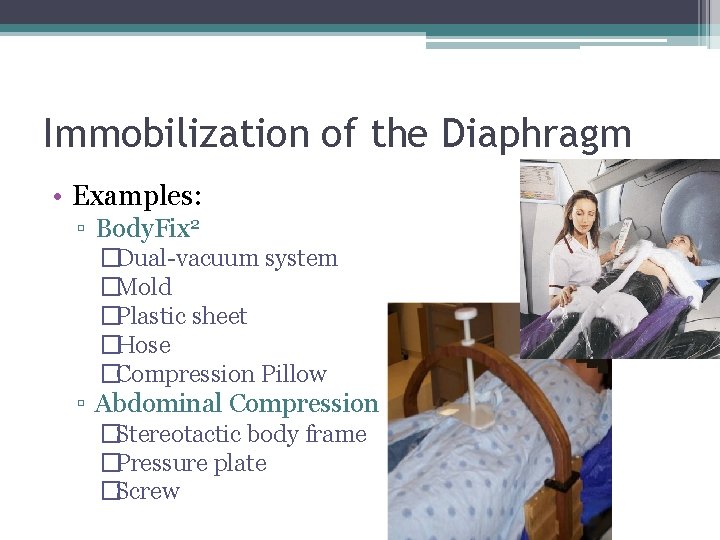
Immobilization of the Diaphragm • Examples: ▫ Body. Fix 2 �Dual-vacuum system �Mold �Plastic sheet �Hose �Compression Pillow ▫ Abdominal Compression Plate 5 �Stereotactic body frame �Pressure plate �Screw
Immobilization of the Diaphragm • Advantages 2: ▫ ▫ ▫ Simplicity Minimal technological devices Easy use Reduce respiratory motion Reusable • Disadvantages 2: ▫ Increased setup time ▫ Slight discomfort to some patients ▫ Difficult for patients who experience claustrophobia. 2
Breathing Control • Voluntary or machine-regulated breath holds. 1 • Causes a cession of breathing during the duration that the beam is on. 1 • Commonly used when treating breast, lung, and esophageal cancer. 1, 3, 4 • Techniques: ▫ Deep-inspiration breath-holds (DIBH) ▫ Active breathing control (ABC)
Breathing Control • Deep-inspiration breath-holds (DIBH)1, 3, 6 ▫ Breathing instructions given �“Take a deep breath in, and hold it. ” ▫ Beam is turned on during breath hold ▫ Patient instructed to breath when beam is turned off • Advantages: 1, 3, 6 ▫ ▫ No additional equipments Cost effective Reduces tumor motion Decrease in cardiac treated volumes (V 20 from 26. 5 to 22. 8 percent) and esophageal treated volumes (V 50 from 25. 5 to 22. 6 percent). 9 ▫ Increased doses and smaller tumor margins are possible • Disadvantages: 1, 3, 6 ▫ Difficult to determine the breath hold reproducibility ▫ Unrealistic for many elderly or frail patients, or those with pulmonary disease

Breathing Control • Active breathing control (ABC) ▫ Mouthpiece placed in the patient’s mouth � Hooked up the ABC. 7, 8 ▫ Continuously monitors lung volume ▫ When the lung volume is at the ideal level, usually 70 to 80 percent of maximum inspiration, the valve on the mouthpiece is closed off � Prevents the patient from inhaling or exhaling. 6 -8 � Ensures breath hold reproduciblity. 6 -8 ▫ The radiation beam is turned on, and once the radiation is finished being delivered, the valve is reopened, allowing the patient to resume breathing. 6 -8 • Advantages: ▫ Guarantees reproducible breath holds 3, 6, 8 ▫ Reduces tumor motion and cardiac and esophageal treated volumes 9 • Disadvantages: ▫ More invasive 6, 8 ▫ Patient needs to hold their breath for a minimum of 15 seconds 6, 8 ▫ May require verbal training by therapist 6
Real-Time Tracking • Real time tumor localizations ▫ Techniques to track tumor position 5: �External respiratory surrogates �Implanted radio-opaque fiducial markers �Surface imaging • Once the tumor is accurately located, the radiation beam will turn on and begin treating 5 • Examples: ▫ Real-time Position Management (RPM) System, Align. RT, and Cyber. Knife
Real-Time Tracking • Real-Time Position Management System ▫ Utilizes an external respiratory surrogate 5 �A plastic box with infrared reflective markers �Placed on top of the patient’s abdominal surface ▫ Infrared cameras detect the reflective markers 5, 10 ▫ During treatment, the tumor is tracked 5 �When the respiratory location matches the location predetermined, the beam will turn on. �When out of the assigned location, the beam turns off
Real Time Tracking • Align. RT 11 ▫ Surface imaging ▫ Uses two infrared cameras to triangulate the location of the patient and derive depth information ▫ In order to precisely locate the patient position, an optical pattern is projected onto the patient to identify the corresponding points ▫ An algorithm is computed to use the points to create a surface image of the patient. 11 ▫ From the surface image, therapists can then make shifts to align the image to the original planning image. ▫ Throughout the entire treatment, Align. RT tracts the motion, and only allows the continuation of treatment when the tumor location is within the assigned tolerance location.
Real-Time Tracking • Cyber. Knife 5 ▫ Machine moves along with the tumor. ▫ Implements a lightweight 6 MV linear accelerator fixed on a robotic arm. 5 ▫ A real-time motion system tracks the motion of the tumor, and the robotic arm moves in synchrony to match the movement. 5 ▫ Moves in six degrees of freedom to compensate for the true tumor motion. 5 ▫ However, the beam output, energy and size are limited. 5
Real-Time Tracking • Advantages: ▫ ▫ ▫ Accurate tracking of the tumor. 5 Intrafractional movement regulation. 1, 5 Non-invasive and excludes rigid frames. 5 Eliminates patient discomfort Requires no active patient participation. 5 Patient receives no additional radiation dose. 5 �Infrared laser use • Disadvantages ▫ Significantly increased treatment times 5 ▫ Tumor motion must be assumed to match the surface motion, unless the system uses internal markers. 5
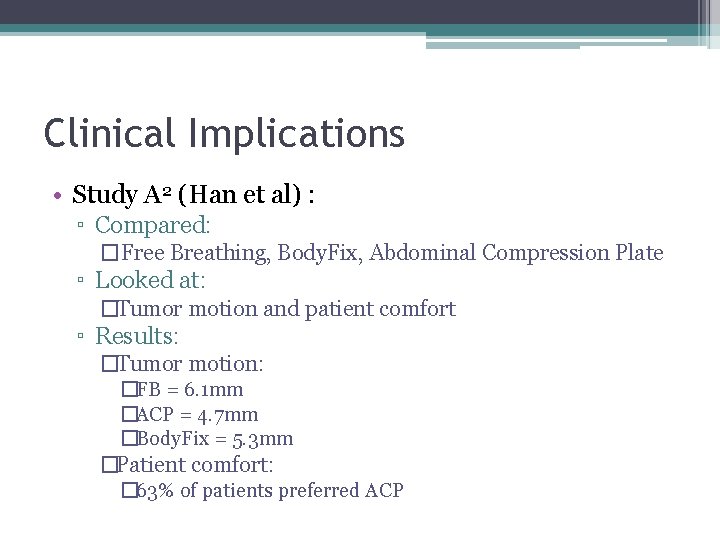
Clinical Implications • Study A 2 (Han et al) : ▫ Compared: �Free Breathing, Body. Fix, Abdominal Compression Plate ▫ Looked at: �Tumor motion and patient comfort ▫ Results: �Tumor motion: �FB = 6. 1 mm �ACP = 4. 7 mm �Body. Fix = 5. 3 mm �Patient comfort: � 63% of patients preferred ACP
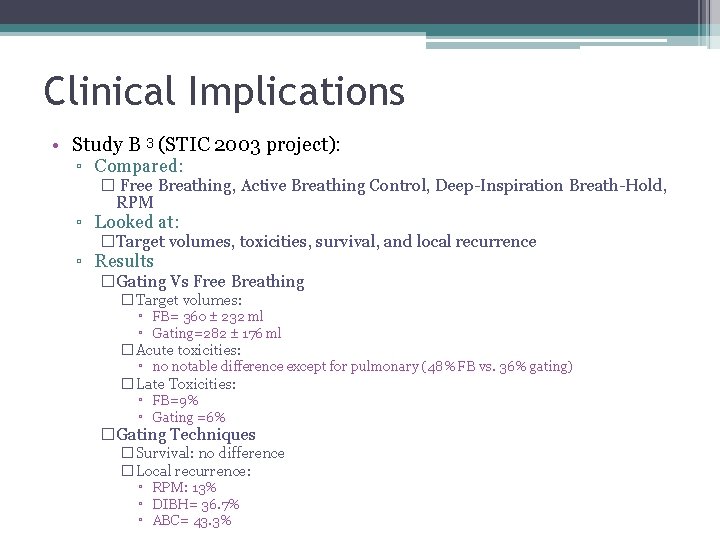
Clinical Implications • Study B 3 (STIC 2003 project): ▫ Compared: � Free Breathing, Active Breathing Control, Deep-Inspiration Breath-Hold, RPM ▫ Looked at: �Target volumes, toxicities, survival, and local recurrence ▫ Results �Gating Vs Free Breathing �Target volumes: ▫ FB= 360 232 ml ▫ Gating=282 176 ml �Acute toxicities: ▫ no notable difference except for pulmonary (48% FB vs. 36% gating) �Late Toxicities: ▫ FB=9% ▫ Gating =6% �Gating Techniques �Survival: no difference �Local recurrence: ▫ RPM: 13% ▫ DIBH= 36. 7% ▫ ABC= 43. 3%
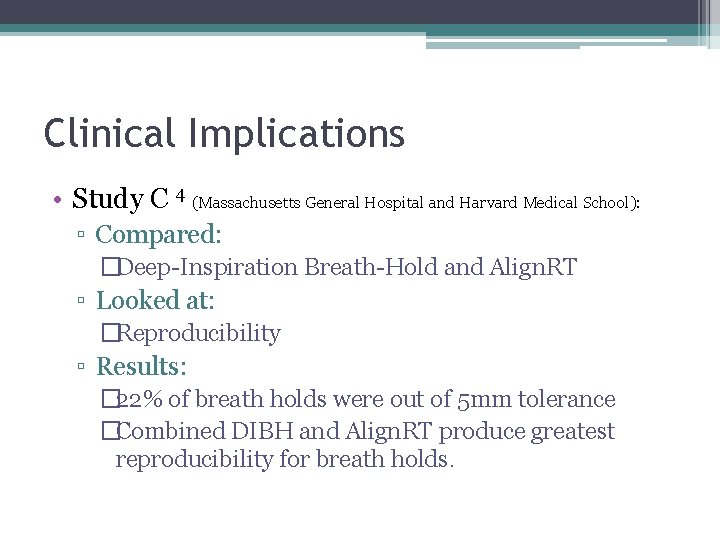
Clinical Implications • Study C 4 (Massachusetts General Hospital and Harvard Medical School): ▫ Compared: �Deep-Inspiration Breath-Hold and Align. RT ▫ Looked at: �Reproducibility ▫ Results: � 22% of breath holds were out of 5 mm tolerance �Combined DIBH and Align. RT produce greatest reproducibility for breath holds.
Conclusion • Respiratory motion management is beneficial in the reduction of intrafractional motion • Allows for a decrease in treatment volumes, resulting in a reduction of normal tissue toxicities while giving higher doses to the lesion • Still recommended to use interfractional imaging
References 1. Gilin MT. Special procedures. In: Washinton CM, Leaver D, eds. Principles and Practice of Radiation Therapy. 3 rd ed. St. Louis, MO: Mosby-Elsevier; 2010: 321 -322. 2. Han K, Cheung P, Basran PS. A comparison of two immobilization systems for stereotactic body radiation therapy of lung tumors. Radiotherapy & Oncology. 2010; 95(1): 103 -108. 1016/j. radonc. 2010. 01. 025. 3. Giraud P, Morvan E, Claude L, et al. Respiratory gating techniques for optimization of lung cancer radiotherapy. Journal of Thoracic Oncology. 2011; 6(12): 2058 -2068. doi: 10. 1097/JTO. 0 b 013 e 3182307 ec 2. 4. Gierga DP, Turcotte JC, Sharp GC, et al. A voluntary breath-hold treatment technique for the left breast with unfavorable cardiac anatomy using surface imaging. Internation Journal of Radiation Oncology Biology Physics. 2012; 84(5): 663 -668. doi: 10. 1016/j. ijrobp. 2012. 07. 2379. 5. Giraud P, Houle A. Respiratory gating for radiotherapy: Main technical aspects and clinical benefits. IRSN Pulmonary. 2013(2013). doi: 10. 1155/2013/519602. 6. Wong J. Methods to manage respiratory motion in radiation treatment. American Association of Physicists in Medicine Wed site. http: //www. aapm. org/meetings/03 SS/Presentations/Wong. pdf. Accessed January 14, 2014. 7. Saving the heart of breast cancer patients. Mercy Hospital Web site. http: //www. mercy. net/newsroom/2013 -03 -20/savings-the-heart-of-breastcancer-patients. March 20, 2013. Accessed January 25, 2014. 8. Brock J, Mc. Nair HA, Panaskis N, et al. The use of the Active Breathing Coordinator throughout radical non-small-cell lung cancer (NSCLC) radiotherapy. International Journal of Radiation Oncology, Biology, Physics. 2011; 81(2): 369 -375. doi: 10. 1016/j. ijrobp. 2010. 05. 038. 9. Sager O, Beyzadeoglu M, Dincoglan F, et al. Evaluation of active breathing conrol-moderate deep inspiration breath-hold in definite non-small cell lung cancer radiotherapy. Neoplasma. 2012; 59(3). doi: 10. 4149/neo_2012_043. 10. Real-time position management system respiration synchronized imaging and treatment. Varian Web site. http: //varian. com/us/oncology/radiation_oncology/clinic/rpm_respiratory_gating. html. Accessed January 21, 2014. 11. 3 D surface reconstruction. Vision. RT Web site. http: //www. visionrt. com/page-161. html. 2010. Accessed January 14, 2014.
- Slides: 19