
Respiratory distress syndrome RDS Hyaline membrane disease HMD

Respiratory distress syndrome (RDS) "Hyaline membrane disease (HMD)"

Definition: RDS is disease primarily occur in premature infants characterized by respiratory distress shortly after birth as a result of surfactant deficiency. Incidence: Incidence of RDS is inversely proportional to the gestational age and birth weight. Its occurs in 6080% of infants less than 28 wk of gestational age, in 15 -30% of those between 32 -36 wk, in about 5% beyond 37 wk, and rarely at term

Factors increase incidence of RDS: 1. Infants of diabetic mothers. 2. Delivery before 37 wk of gestation (prematurity). 3. Multiple pregnancies. 4. Cesarean section delivery. 5. Birth asphyxia. 6. Cold stress. 7. History of prior affected infants. 8. Preterm male or white infants.
Factors reduce incidence of RDS: 1. Chronic or pregnancy-induced hypertension. 2. Maternal opiate addiction. 3. Prolonged rupture of membranes. 4. Antenatal corticosteroids use.
Etiology and pathophysiology: Surfactant deficiency (decreased production and secretion) is the primary cause of RDS. The main function of surfactant is reduction of surface tension on the terminal alveoli at the endexpiration to prevent their collapse, so absence of surfactant will lead to collapse of alveoli causing lung atalectasis and decrease lung compliance. This will cause alveoli to perfused but not ventilated (perfusion-ventilation mismatch) causing hypoxia and respiratory distress.
Surfactant: Is lipoprotein synthesized and stored in type II alveolar cells composed of phosphatidylcholine (lecithin), phosphatidylglycerol, apoproteins (surfactant proteins (SP)-A, B, C, D) and cholesterol. The synthesis of surfactant increased with the progression of gestational age. Its present in high concentration in fetal lung by 20 wk of gestation but does not reach to the surface of the lungs until later, its appear in the amniotic fluid between 28 -32 wk and mature levels usually present after 35 wk
Clinical features: Signs of respiratory distress usually appear within minutes of birth, but may be delayed for several hours in larger preterm infants. These signs are: tachypnea, prominent (often audible) grunting, intrcostal and subcostal retractions, nasal flaring, increasing cyanosis often unresponsive to oxygen administration, respiratory sounds are normal or diminished.
If the condition is inadequately treated, blood pressure and body temperature falls, fatigue, cyanosis and pallor increase, and grunting decrease or disappear as the condition worsen. Apnea and irregular respiration occur as infant tire and are ominous signs requiring immediate intervention. Patient may also have mixed metabolicrespiratory acidosis, edema, ileus, oilgurea, and asphyxia.

Natural history (course) of RDS: Is characterized by progressive worsening of cyanosis and dyspnea, and in most cases the symptoms and signs may reach a peak within 3 days, after which improvement is gradual as indicated by spontaneous diuresis and decrease requirements of oxygen supplementation. Death is rare on the 1 st day of illness, usually occurs between days 2 and 7, its due to: 1. Alveolar air leaks (interstitial emphysema, pneumothorax) 2. Pulmonary or intraventricular hemorrhage (IVH).

Diagnosis: 1. Clinical features. t X-ray: shows characteristic but not ognomonic appearance developed at 6 nset which include fine reticular arenchyma and air onchograms which are more prominent in the lower lobe. 3. Blood gases analysis shows hypoxemia and hypercarbia. 4. Variable metabolic acidosis.

Differential diagnosis: 1. Group B streptococcal sepsis. otic congenital heart diseases (total anomalous pulmonary venous return). 3. Persistent pulmonary hypertension. 4. Spontaneous pneumothorax. 5. Pleural effusion. 6. Diaphragmatic hernia. 7. Transient tachypnea of newborn.
Prevention of RDS: 1. Prevention of prematurity by: A. Avoidance of unnecessary or poorly timed cesarean sections. B. Appropriate management of high risk pregnancy and labor.
dministration of dexamethasone or tamethasone to all pregnant women who are to deliver in one week between 24 and wk of gestation. Its significantly reduces the ence and the mortality and morbidity of DS by increasing the synthesis of surfactant affecting the neonatal growth and development. Prenatal glucocortecoid therapy also reduces idence of other complications of prematurity such as IVH, PDA, pneumothorax and necrotizing enterocolitis.

Treatment of RDS: I. Supportive care of premature infants: requent monitoring of H. R. , R. R. , arterial Co 2, &p. H, serum bicarbonate and cose, d pressure, and temperature. 2. Gentle handling and minimal disturbance of infant. 3. Maintain temperature between 36. 5 -37 C.
fluid and electrolytes: for first 24 hr give ter at a rate of g/24 hr. In second day give glucose saline at a rate of 120 -150 ml/kg/24 hr. atment of metabolic acidosis by sodium rbonate 1 -2 m. Eq/kg given I. V. over 10 -15 min. Warm humidified oxygen (>90% saturation) p arterial oxygen levels between 5575 mm. Hg.

III. Assisted mechanical ventilation indicated in: 1. Arterial p. H less than 7. 2 (acidosis) 2. Arterial blood p. Co 2 of 60 mm. Hg or more (hypercarbia). Arterial p. O 2 of 50 mm. Hg or less (hypoxia) at oxygen concentration of 100%. 4. Persistent apnea.

IV. Exogenous surfactant therapy: 1. Arterial p. H <7. 2 (acidosis). It's initiated as soon as possible in the 1 st 24 hr of life, its given via endotracheal tube every 612 hr for a total 2 -4 doses, together with 30% 4. Persistent apnea. oxygen and mechanical ventilation. It's dramatically improved survival and reduced the incidence of pulmonary air leaks but it's not reduced the incidence of chronic lung disease (CLD) Complications of surfactant therapy: 1. Transient hypoxia and hypotension. 2. Blockage of the endotracheal tube. 3. Pulmonary hemorrhage.

Complications of RDS and its intensive care: veolar air leaks (pneumothorax, interstitial emphysema, or pneumomediastinum). Endotracheal tube complications: extubation, Rt. Main bronchus, mucous plug in endotracheal tube. 3. Pulmonary hemorrhage. 4. Intraventricular hemorrhage (IVH). 5. Pneumopericardium. 6. Sepsis.
7. Intra-abdominal hemorrhage (liver, spleen, adrenal). 8. Acute pulmonary hypertension. 9. Patent ductus arteriosus (PDA).

10. Chronic lung disease (bronchopulmonary dysplasia). Is a result of lung injury in infants requiring mechanical ventilation and high oxygen supplementation. CLD is present if the neonate is oxygen dependent for 1 mo after birth (or at 36 wk after conception). The incidence of CLD is inversely related to the gestational age. Clinically, is characterized by hypoxia, hypercarbia, oxygen dependence, and, in severe cases, the development of right sided heart failure.
Treatment by: Dexamithasone 0. 3 -0. 5 mg/kg/24 hr to reduce lung inflammation. 2. Diuretics (frusemide) 1 -2 mg/kg every 6 -8 hr. 3. Inhaled steroid like beclomethasone. 4. Inhaled B 2 -adrenergic bronchodilators.

Transient Tachypnea of the Newborn (respiratory distress syndrome type II)
It characterized by the early onset of tachypnea, sometimes with retractions, or expiratory grunting and, occasionally, cyanosis that is relieved by minimal oxygen (<40%). It usually follows uneventful normal preterm or term vaginal delivery or cesarean delivery. Patients usually recover rapidly within 3 days, although they may rarely appear severely ill. On examination, the lungs are generally clear without rales or rhonchi.

Chest X-ray shows prominent pulmonary vascular markings, fluid lines in the fissures, hyperinflation, flat diaphragms, and, occasionally, pleural effusion. Distinguishing the disease from HMD may be difficult; the distinctive features of transient tachypnea are sudden recovery of the infant and the absence of reticulogranular pattern or air bronchograms in CXR. Cause: It due to slow absorption of fetal lung fluid resulting in decreased pulmonary compliance and tidal volume and increased dead space.
Neonatal apnea Is defined as respiratory pause more than 20 seconds or any respiratory pause associated with cyanosis and bradycardia. The apnea should differentiate from the periodic breathing which defined as regular ventilatory cycles interrupted by short pauses not associated with bradycardia or color changes. Periodic breathing is common in term and preterm infants.

Types of apnea: is of 3 types al apnea: refers to a complete ssation of airflow and respiratory efforts with o chest movement. Its due to CNS respiratory center depression. Obstructive apnea: There's no air flow but e is persistent chest wall movements. Its due to airway obstruction. xed apnea: It’s a combination of both al and obstructive apnea. It’s the most type, and its usually begins as a bstructive apnea followed by central apnea.
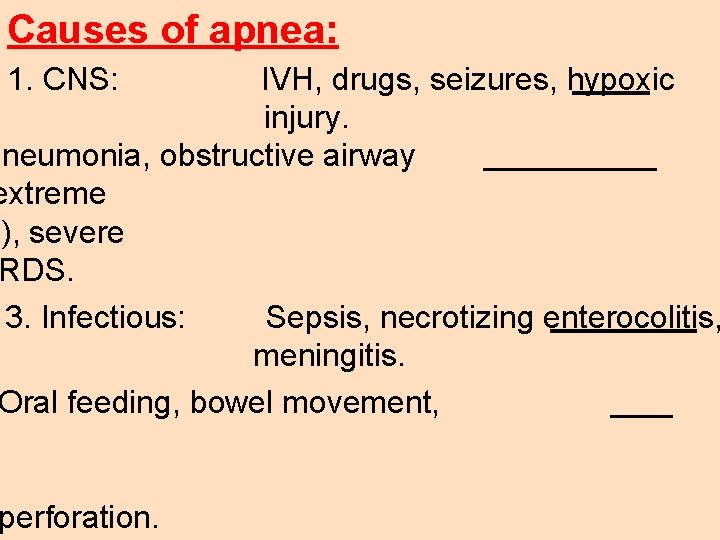
Causes of apnea: 1. CNS: IVH, drugs, seizures, hypoxic injury. pneumonia, obstructive airway extreme g), severe RDS. 3. Infectious: Sepsis, necrotizing enterocolitis, meningitis. Oral feeding, bowel movement, , perforation.
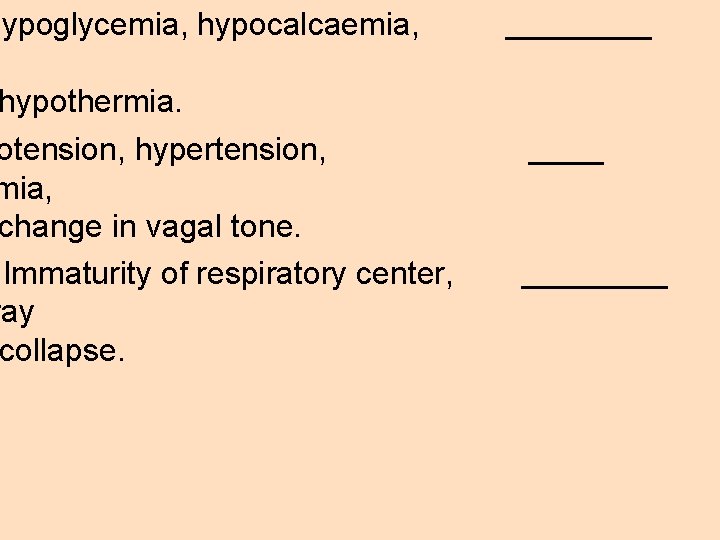
hypoglycemia, hypocalcaemia, hypothermia. otension, hypertension, mia, change in vagal tone. Immaturity of respiratory center, way collapse.
Idiopathic apnea of prematurity: It’s a disease of premature infants, appears in the absence of any other identifiable cause during the 1 st week of life and resolve by 36 wk of postconceptional age (gestational age at birth plus postnatal age). The incidence of apnea increases as the gestational age decreases, the cause is unknown but its might be due to immaturity of respiratory center.
Treatment of apnea: Gentle cutaneous stimulation is often adequate therapy for mild and intermittent apnea. 2. Bag and mask ventilation for recurrent and prolonged apnea. 3. Oxygen administration for treatment of hypoxia. Transfusion of packed RBCs for anemic infants with recurrent apnea. 5. Treatment of underlying cause. pnea of prematurity should be treated with inophylline or caffeine, they acts by CNS oving diaphragmatic strength.
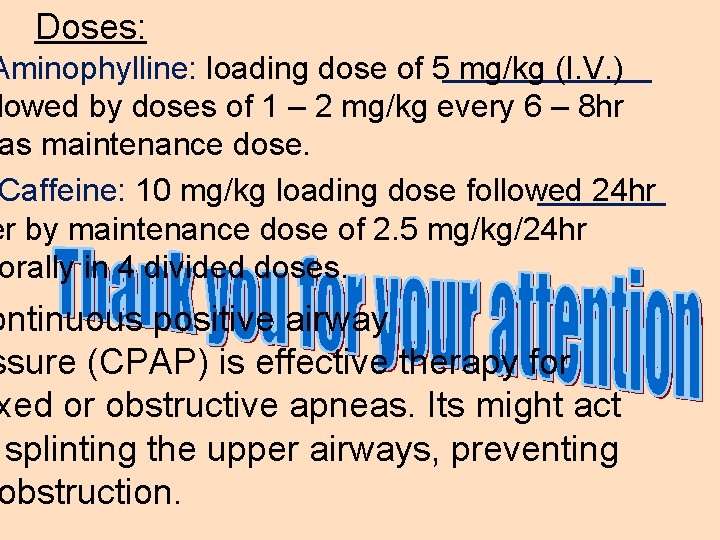
Doses: Aminophylline: loading dose of 5 mg/kg (I. V. ) lowed by doses of 1 – 2 mg/kg every 6 – 8 hr as maintenance dose. Caffeine: 10 mg/kg loading dose followed 24 hr er by maintenance dose of 2. 5 mg/kg/24 hr orally in 4 divided doses. ontinuous positive airway ssure (CPAP) is effective therapy for xed or obstructive apneas. Its might act splinting the upper airways, preventing obstruction.
- Slides: 31