
Respirators Lessons Learned Moving Forward Robin Tutor Marcom
Respirators: Lessons Learned & Moving Forward Robin Tutor Marcom, Ed. D, MPH, OTR Association of American Pesticide Compliance Officers March 6, 2018
Respirator Requirements in Revised Worker Protection Standard Rule: 170. 507(b)(10) • When a respirator is required by the labeling, handler employer must provide handlers with the following before the handler performs any activity requiring the respirator: – Medical evaluation – Fit test – Respirator training These requirements mirror OSHA 1910. • Handler employer must maintain records for 2 years documenting completion of these.
#1: Respiratory protection is complicated 3

#2: Mirror images are not identical & may be deceiving 4
Occupational Safety & Health Administration Respiratory Standard 1910. 134 Applies to employers having 10 or more full time employees year round Designed to protect employee health Requires written respiratory protection program Provides guidance for: Respirator selection Medical evaluation Fit testing Respirator use Respirator maintenance Atmosphere-supplying respirators Employee training
#3: Respiratory protection compliance begins with ‘I’ & ‘L’ not ‘M’, ‘F’ or ‘R’ 7
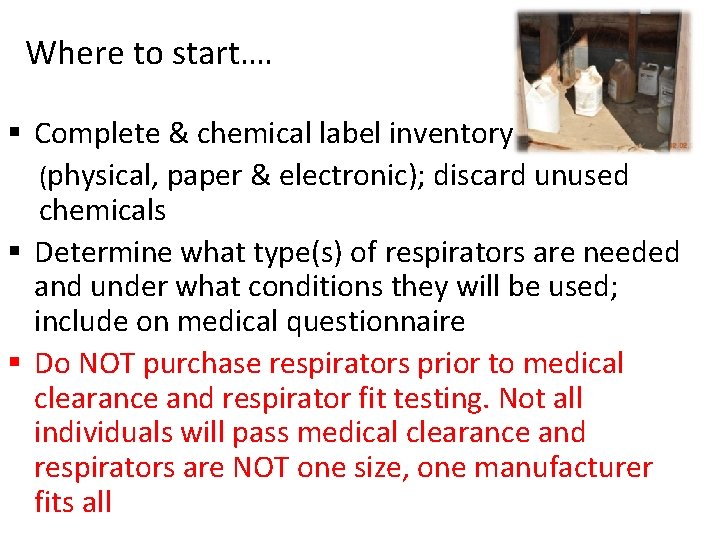
Where to start…. Complete & chemical label inventory (physical, paper & electronic); discard unused chemicals Determine what type(s) of respirators are needed and under what conditions they will be used; include on medical questionnaire Do NOT purchase respirators prior to medical clearance and respirator fit testing. Not all individuals will pass medical clearance and respirators are NOT one size, one manufacturer fits all
#4: Labels are misleading & even Pesticide Inspectors, Cooperative Extension Agents & Pesticide Safety Educators need training to interpret them 9
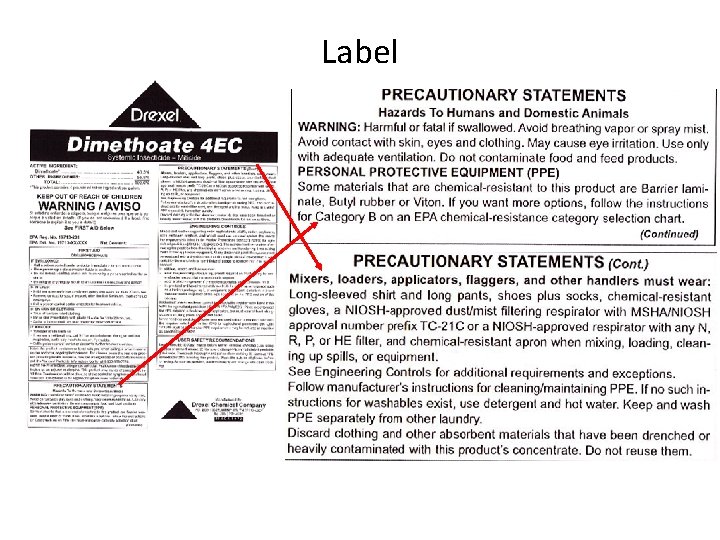
Label
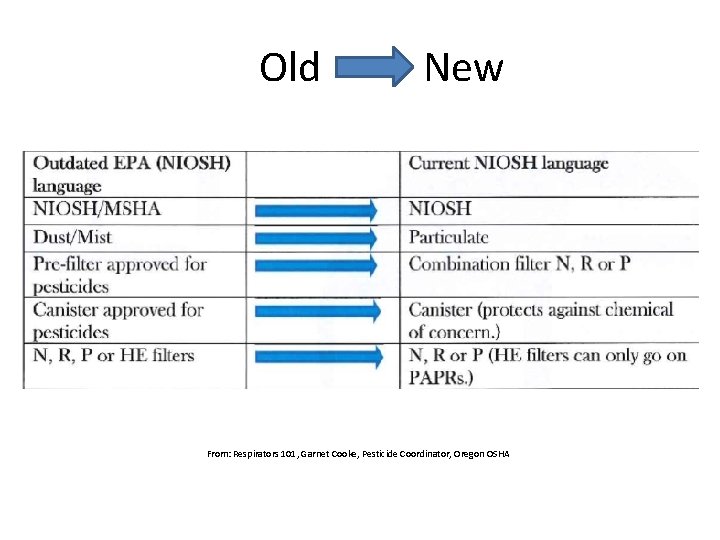
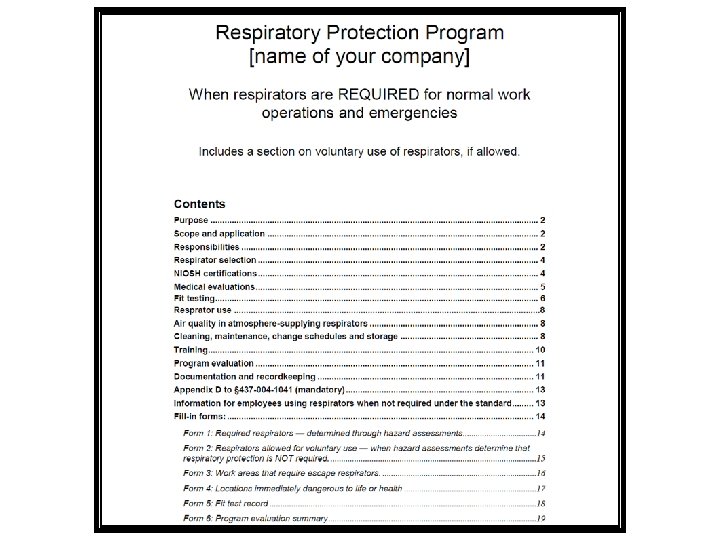
Old New From: Respirators 101, Garnet Cooke, Pesticide Coordinator, Oregon OSHA
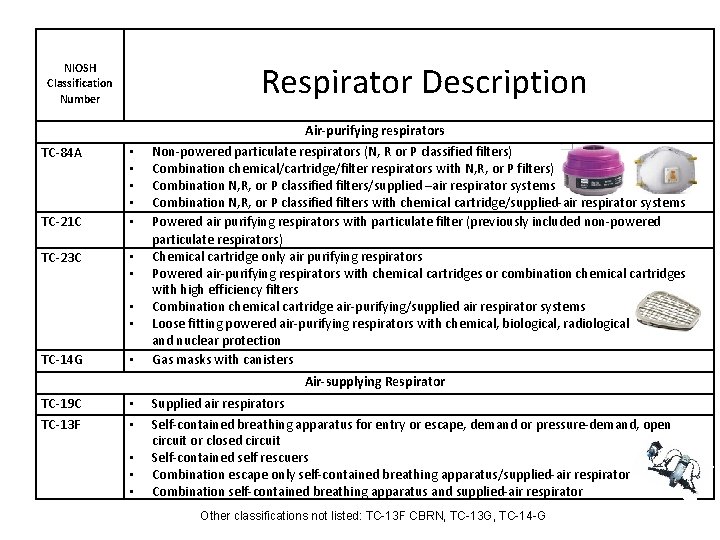
NIOSH Classification Number Respirator Description Air-purifying respirators TC-84 A TC-21 C TC-23 C TC-14 G Non-powered particulate respirators (N, R or P classified filters) Combination chemical/cartridge/filter respirators with N, R, or P filters) Combination N, R, or P classified filters/supplied –air respirator systems Combination N, R, or P classified filters with chemical cartridge/supplied-air respirator systems Powered air purifying respirators with particulate filter (previously included non-powered particulate respirators) • Chemical cartridge only air purifying respirators • Powered air-purifying respirators with chemical cartridges or combination chemical cartridges with high efficiency filters • Combination chemical cartridge air-purifying/supplied air respirator systems • Loose fitting powered air-purifying respirators with chemical, biological, radiological and nuclear protection • Gas masks with canisters • • • Air-supplying Respirator TC-19 C TC-13 F • • • Supplied air respirators Self-contained breathing apparatus for entry or escape, demand or pressure-demand, open circuit or closed circuit Self-contained self rescuers Combination escape only self-contained breathing apparatus/supplied-air respirator Combination self-contained breathing apparatus and supplied-air respirator Other classifications not listed: TC-13 F CBRN, TC-13 G, TC-14 -G
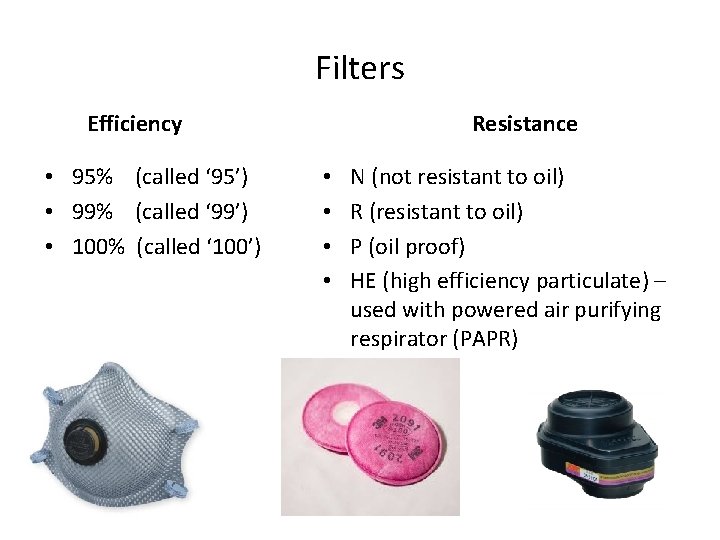
Filters Efficiency • 95% (called ‘ 95’) • 99% (called ‘ 99’) • 100% (called ‘ 100’) Resistance • • N (not resistant to oil) R (resistant to oil) P (oil proof) HE (high efficiency particulate) – used with powered air purifying respirator (PAPR)
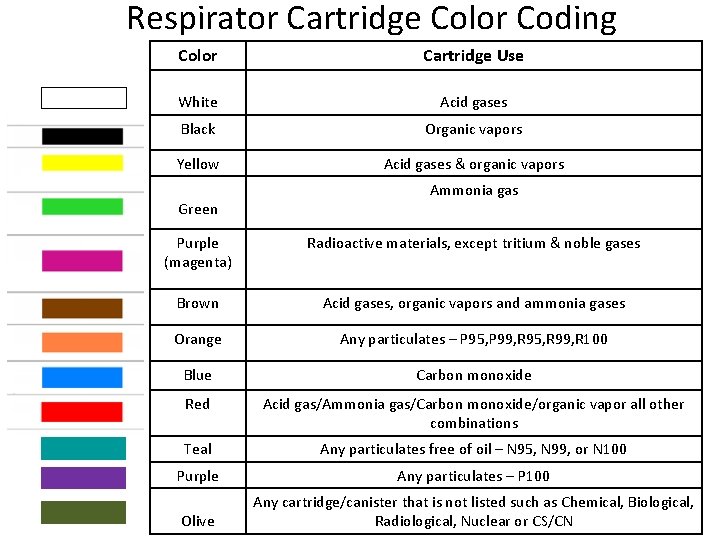
Respirator Cartridge Color Coding Color Cartridge Use White Acid gases Black Organic vapors Yellow Acid gases & organic vapors Green Ammonia gas Purple (magenta) Radioactive materials, except tritium & noble gases Brown Acid gases, organic vapors and ammonia gases Orange Any particulates – P 95, P 99, R 95, R 99, R 100 Blue Carbon monoxide Red Acid gas/Ammonia gas/Carbon monoxide/organic vapor all other combinations Teal Any particulates free of oil – N 95, N 99, or N 100 Purple Any particulates – P 100 Olive Any cartridge/canister that is not listed such as Chemical, Biological, Radiological, Nuclear or CS/CN
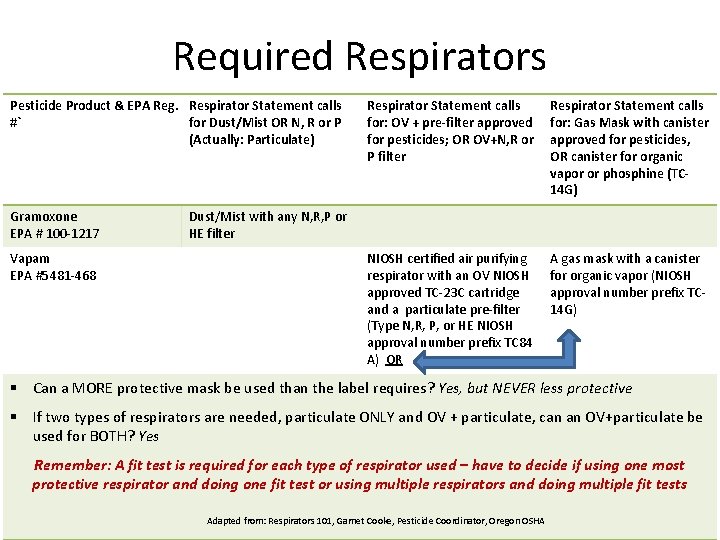
Required Respirators Pesticide Product & EPA Reg. Respirator Statement calls #` for Dust/Mist OR N, R or P (Actually: Particulate) Gramoxone EPA # 100 -1217 Vapam EPA #5481 -468 Respirator Statement calls for: OV + pre-filter approved for pesticides; OR OV+N, R or P filter Respirator Statement calls for: Gas Mask with canister approved for pesticides, OR canister for organic vapor or phosphine (TC 14 G) NIOSH certified air purifying respirator with an OV NIOSH approved TC-23 C cartridge and a particulate pre-filter (Type N, R, P, or HE NIOSH approval number prefix TC 84 A) OR A gas mask with a canister for organic vapor (NIOSH approval number prefix TC 14 G) Dust/Mist with any N, R, P or HE filter Can a MORE protective mask be used than the label requires? Yes, but NEVER less protective If two types of respirators are needed, particulate ONLY and OV + particulate, can an OV+particulate be used for BOTH? Yes Remember: A fit test is required for each type of respirator used – have to decide if using one most protective respirator and doing one fit test or using multiple respirators and doing multiple fit tests Adapted from: Respirators 101, Garnet Cooke, Pesticide Coordinator, Oregon OSHA
#5: Cartridge & filtering facepiece change requirements are costly, discouraging & confusing 16
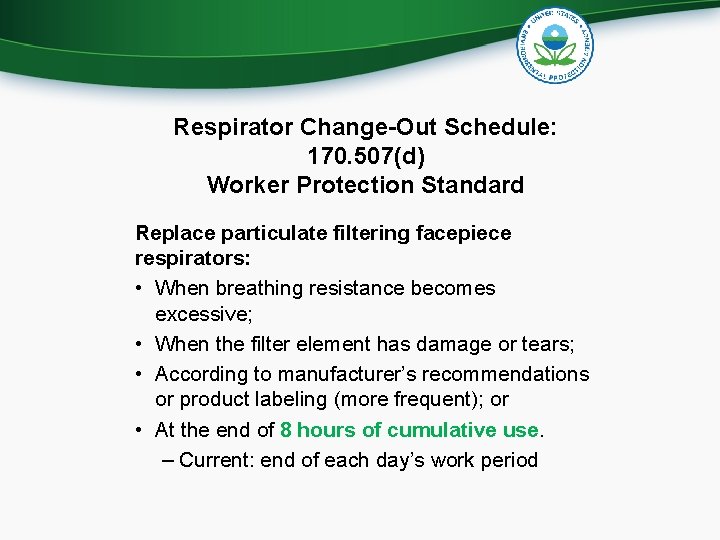
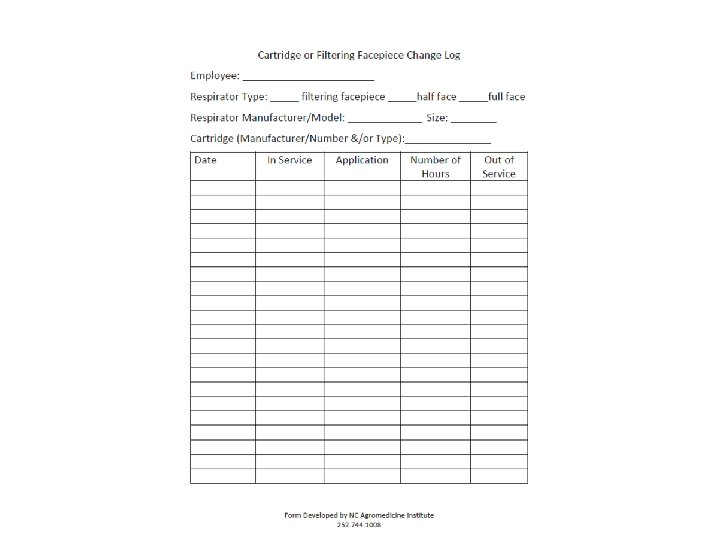
Respirator Change-Out Schedule: 170. 507(d) Worker Protection Standard Replace particulate filtering facepiece respirators: • When breathing resistance becomes excessive; • When the filter element has damage or tears; • According to manufacturer’s recommendations or product labeling (more frequent); or • At the end of 8 hours of cumulative use. – Current: end of each day’s work period
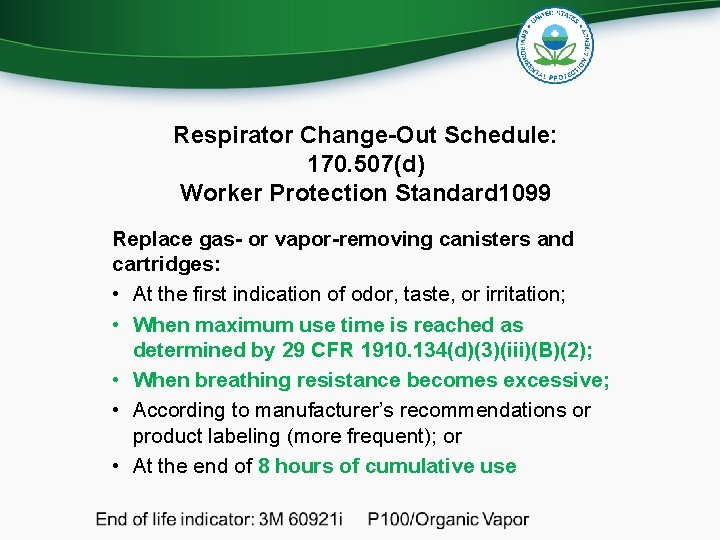
Respirator Change-Out Schedule: 170. 507(d) Worker Protection Standard 1099 Replace gas- or vapor-removing canisters and cartridges: • At the first indication of odor, taste, or irritation; • When maximum use time is reached as determined by 29 CFR 1910. 134(d)(3)(iii)(B)(2); • When breathing resistance becomes excessive; • According to manufacturer’s recommendations or product labeling (more frequent); or • At the end of 8 hours of cumulative use
#6: All medical clearances are not created equal 20
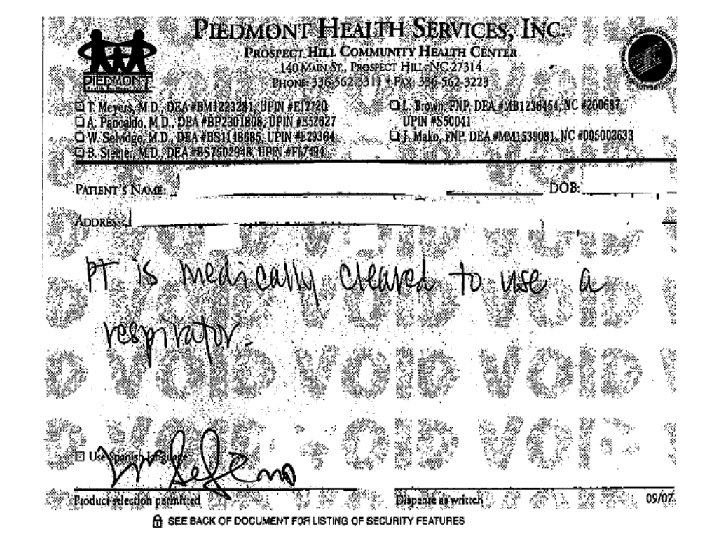
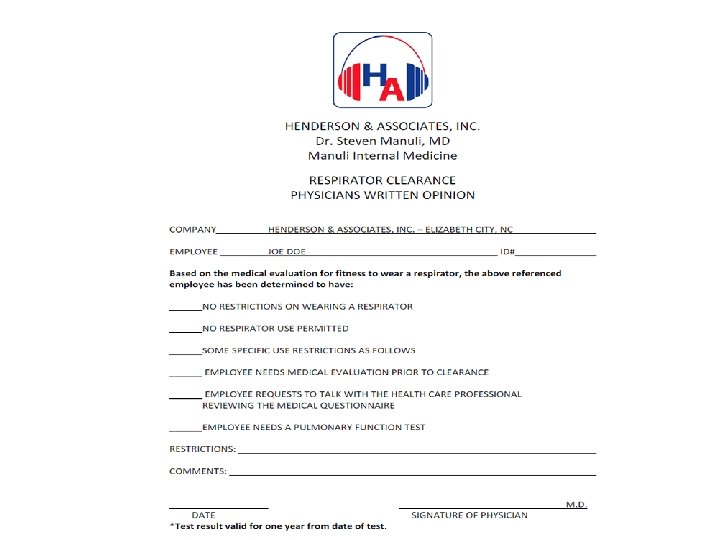
Medical Clearance • Required prior to fit testing and respirator use • Additional medical clearance is required when: – Employee reports medical signs/symptoms related to ability to use respirator; – Medical professional, program administrator or supervisor recommends medical evaluation; – Information from the respirator program, including observations made during fit testing & program evaluation indicates a needs; or – Change occurs in workplace conditions that may substantially increase physiological burden on employee – Note: annual review of medical status is not required by OSHA or WPS; however, depending on the medical provider issuing the medical clearance, medical clearance may be granted for a time limited period.
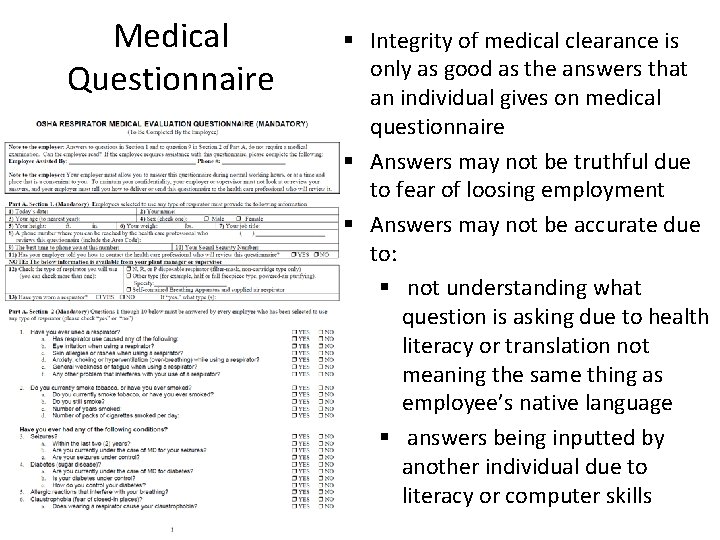
Medical Questionnaire Integrity of medical clearance is only as good as the answers that an individual gives on medical questionnaire Answers may not be truthful due to fear of loosing employment Answers may not be accurate due to: not understanding what question is asking due to health literacy or translation not meaning the same thing as employee’s native language answers being inputted by another individual due to literacy or computer skills
Options for Completing Medical Clearance • Private physician • Occupational health company (may have mobile services) • Occupational health clinic associated with a hospital • Urgent Care • On-line provider • NC Agromedicine Institute
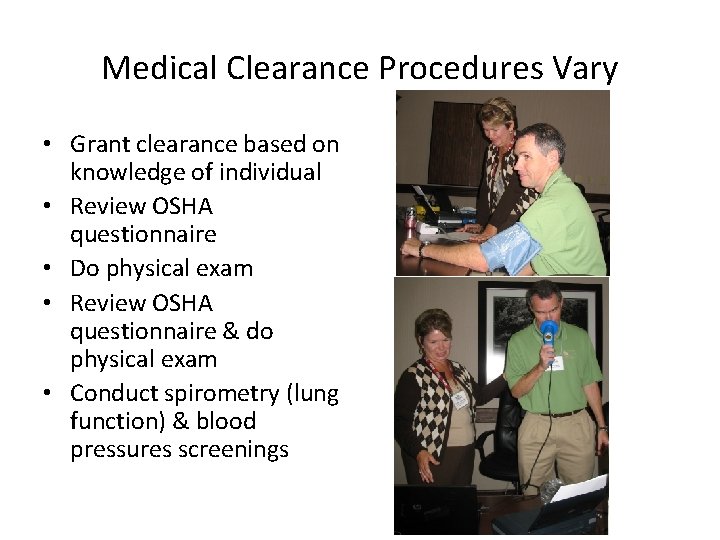
Medical Clearance Procedures Vary • Grant clearance based on knowledge of individual • Review OSHA questionnaire • Do physical exam • Review OSHA questionnaire & do physical exam • Conduct spirometry (lung function) & blood pressures screenings
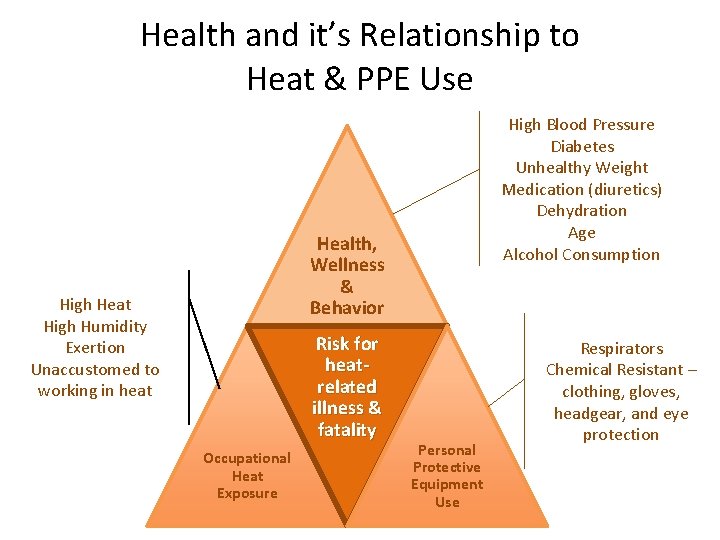
Health and it’s Relationship to Heat & PPE Use High Blood Pressure Diabetes Unhealthy Weight Medication (diuretics) Dehydration Age Alcohol Consumption Health, Wellness & Behavior High Heat High Humidity Exertion Unaccustomed to working in heat Risk for heatrelated illness & fatality Occupational Heat Exposure Personal Protective Equipment Use Respirators Chemical Resistant – clothing, gloves, headgear, and eye protection
Medical Clearance • May be granted with: – No limitations meaning no health concerns were identified by the physician or other licensed healthcare provider – Limitations meaning that the employee has a health condition that needs to be controlled when using a respirator • May be denied meaning that the employee has a health condition that would prohibit them from using a respirator safely


#7: All fit tests are not created equal 30
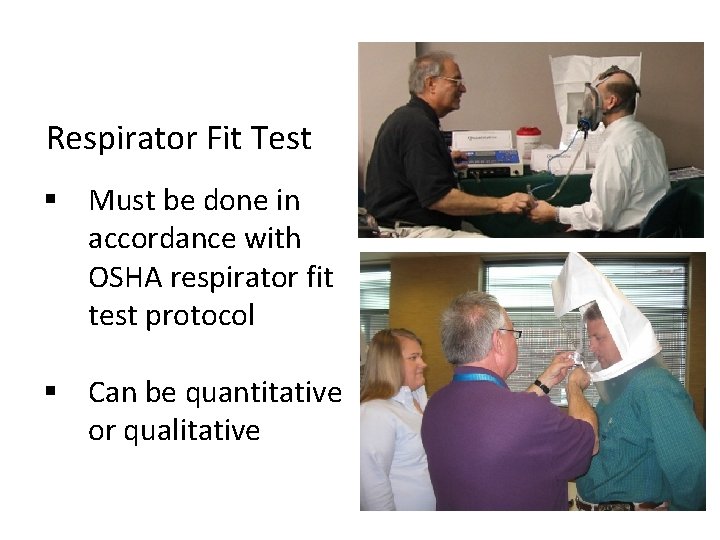
Respirator Fit Test Must be done in accordance with OSHA respirator fit test protocol Can be quantitative or qualitative
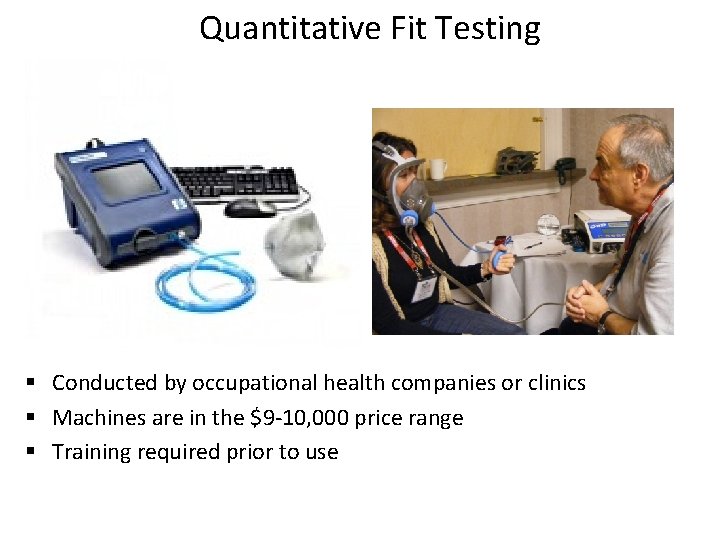
Quantitative Fit Testing Conducted by occupational health companies or clinics Machines are in the $9 -10, 000 price range Training required prior to use

Quantitative Fit Test Record
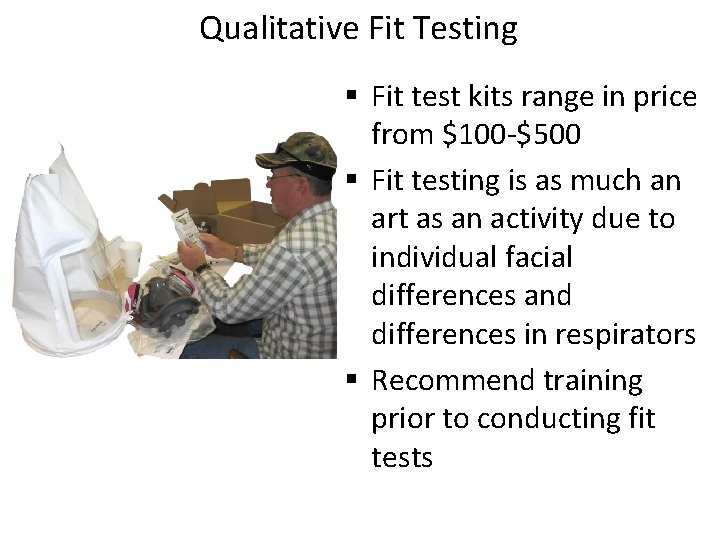
Qualitative Fit Testing Fit test kits range in price from $100 -$500 Fit testing is as much an art as an activity due to individual facial differences and differences in respirators Recommend training prior to conducting fit tests
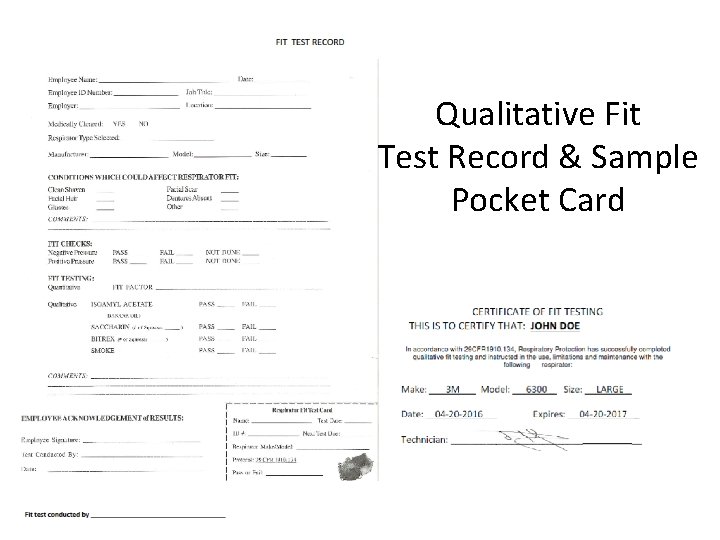
Qualitative Fit Test Record & Sample Pocket Card
#8: To be effective, training must involve a hands-on component 36
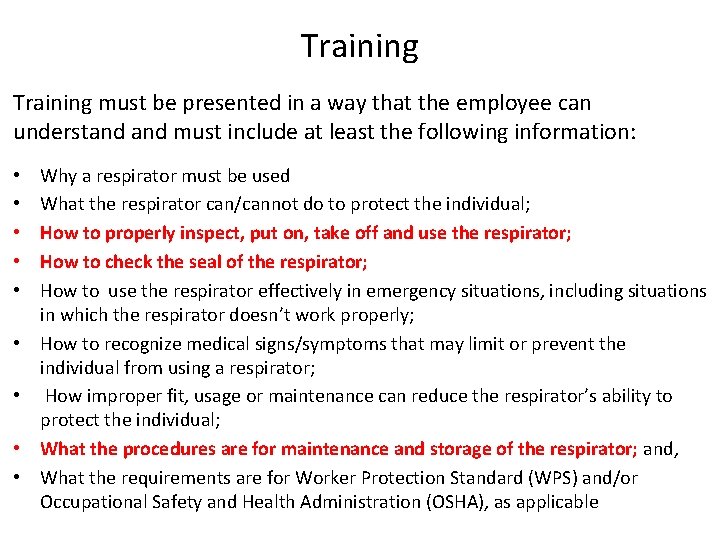
Training must be presented in a way that the employee can understand must include at least the following information: • • • Why a respirator must be used What the respirator can/cannot do to protect the individual; How to properly inspect, put on, take off and use the respirator; How to check the seal of the respirator; How to use the respirator effectively in emergency situations, including situations in which the respirator doesn’t work properly; How to recognize medical signs/symptoms that may limit or prevent the individual from using a respirator; How improper fit, usage or maintenance can reduce the respirator’s ability to protect the individual; What the procedures are for maintenance and storage of the respirator; and, What the requirements are for Worker Protection Standard (WPS) and/or Occupational Safety and Health Administration (OSHA), as applicable
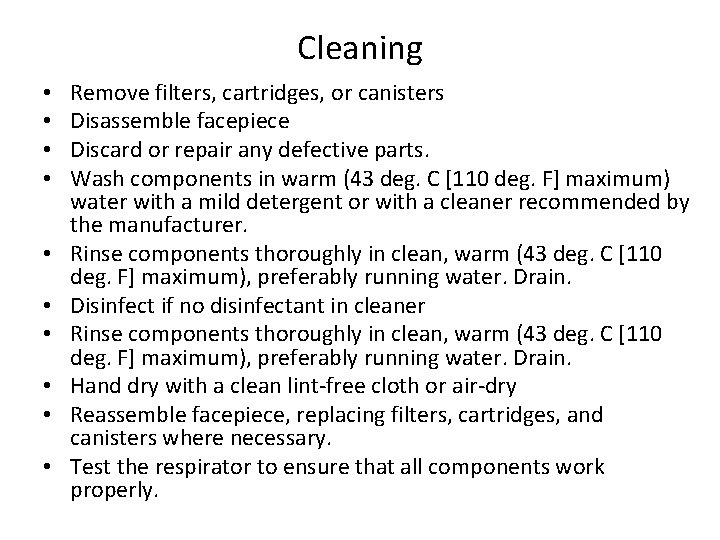
Cleaning • • • Remove filters, cartridges, or canisters Disassemble facepiece Discard or repair any defective parts. Wash components in warm (43 deg. C [110 deg. F] maximum) water with a mild detergent or with a cleaner recommended by the manufacturer. Rinse components thoroughly in clean, warm (43 deg. C [110 deg. F] maximum), preferably running water. Drain. Disinfect if no disinfectant in cleaner Rinse components thoroughly in clean, warm (43 deg. C [110 deg. F] maximum), preferably running water. Drain. Hand dry with a clean lint-free cloth or air-dry Reassemble facepiece, replacing filters, cartridges, and canisters where necessary. Test the respirator to ensure that all components work properly.
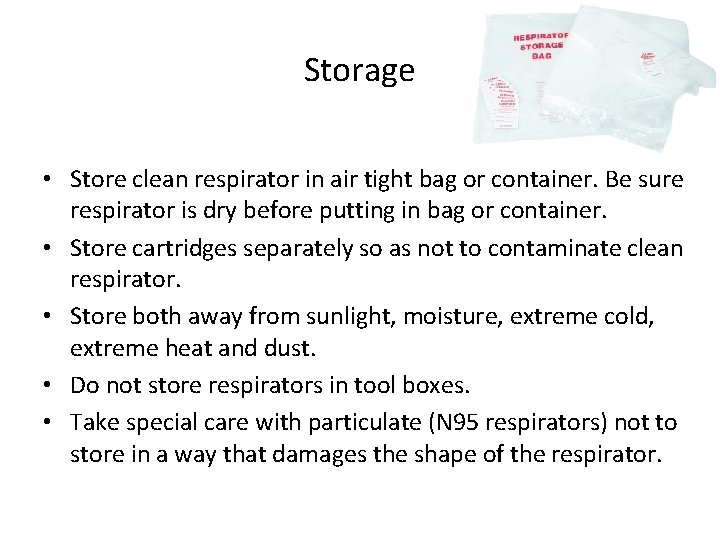
Storage • Store clean respirator in air tight bag or container. Be sure respirator is dry before putting in bag or container. • Store cartridges separately so as not to contaminate clean respirator. • Store both away from sunlight, moisture, extreme cold, extreme heat and dust. • Do not store respirators in tool boxes. • Take special care with particulate (N 95 respirators) not to store in a way that damages the shape of the respirator.
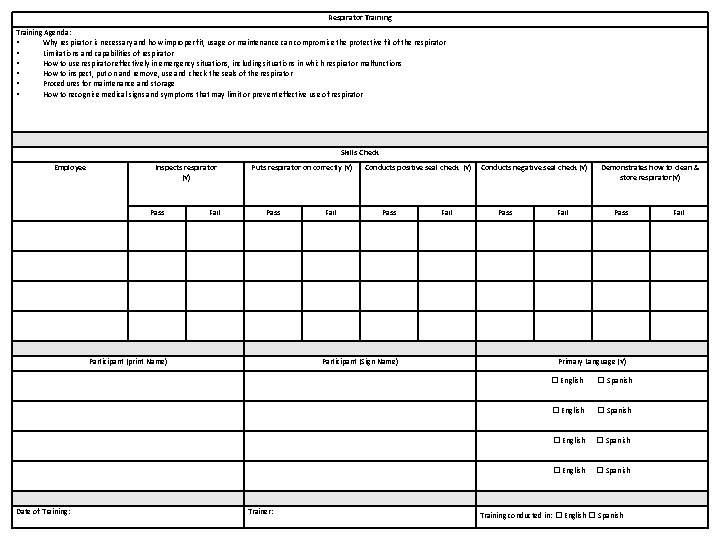
Respirator Training Agenda: Why respirator is necessary and how improper fit, usage or maintenance can compromise the protective fit of the respirator Limitations and capabilities of respirator How to use respirator effectively in emergency situations, including situations in which respirator malfunctions How to inspect, put on and remove, use and check the seals of the respirator Procedures for maintenance and storage How to recognize medical signs and symptoms that may limit or prevent effective use of respirator Skills Check Employee Inspects respirator (√) Pass Puts respirator on correctly (√) Fail Pass Conducts positive seal check (√) Fail Pass Conducts negative seal check (√) Fail Pass Demonstrates how to clean & store respirator(√) Fail Pass Fail Participant (print Name) Participant (Sign Name) Primary Language (√) □ English □ Spanish □ English □ Spanish Date of Training: Trainer: Training conducted in: □ English □ Spanish
#9: Work with vendors 41


#10: It takes a village 43
Respirator Road Trip The Passengers The Route • Rachel Maccini, Univ. of NH First Stop: Concord, New Hampshire, 22 Attendees • Kerry Richards Univ. of DL Second Stop: Haddam, Connecticut, 11 Attendees • Candace Bartholomew, Univ. of CT Third Stop: Philadelphia Airport, pick up collaborators from AZ and NB • Jan Hygnstrom, Univ. of NB Fourth Stop: Georgetown, Delaware, 16 Attendees, 3 with medical evaluations • Michael Weirda, Univ. of
Objectives/Activities v. Understand EPA & OSHA medical evaluation & respirator fit test now required under new WPS regulations v. Selection of respirator & cartridge v. Understand differences in respirators & cartridges v. Learn how to correctly select & fit respirators for yourself and employees v. Have your respirator fit tested** v. Know how to correctly clean & store respirators v. Deliver & document employee training on respirator use & care v. Prepare for pesticide inspections v. Video tape training for future use
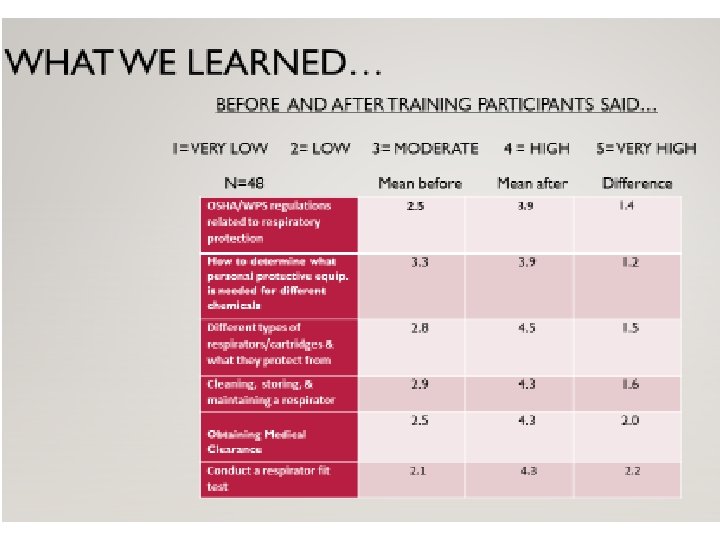

Next Stop….

Robin Tutor Marcom, Ed. D, MPH, OTR Director 252. 744. 1008 tutorr@ecu. edu
- Slides: 48