
Respirator Regulations h NIOSH h OSHA 42 CFR
- Slides: 32
Respirator Regulations h NIOSH h OSHA 42 CFR Part 84 29 CFR 1910. 134
NIOSH 42 CFR Part 84 What is NIOSH 42 CFR Part 84? h Current certification criteria for all nonpowered particulate air-purifying filters. h Classifies filters based on efficiency and resistance to the effects of oil aerosols h Replaces MSHA 30 CFR Part 11 which classified respirators by the contaminant type
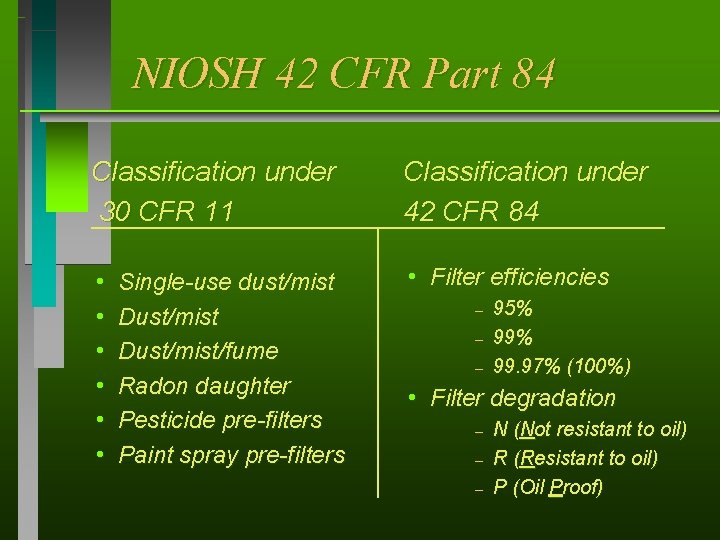
NIOSH 42 CFR Part 84 Classification under 30 CFR 11 h h h Single-use dust/mist Dust/mist/fume Radon daughter Pesticide pre-filters Paint spray pre-filters Classification under 42 CFR 84 h Filter efficiencies – – – h 95% 99. 97% (100%) Filter degradation – – – N (Not resistant to oil) R (Resistant to oil) P (Oil Proof)
NIOSH 42 CFR Part 84 h Filters can be selected without regard to particle size h Selected filter efficiency depends solely on how much filter leakage is acceptable h Selection of N, R, or P series filters depends on the presence or absence of oil particulate and length of use
NIOSH 42 CFR Part 84 What Do I Need to Do? h Reassess selection elements of respirator program – identify contaminants with respect to oil content – evaluate workplace applications h Educate employees h Revise written program
OSHA RESPIRATORY PROTECTION STANDARD 29 CFR 1910. 134
OSHA Respiratory Protection Standard h Published January 8, 1998 h Applies to General Industry, Shipyards, Marine Terminals, Longshoring, and Construction h Does not apply to agriculture or TB
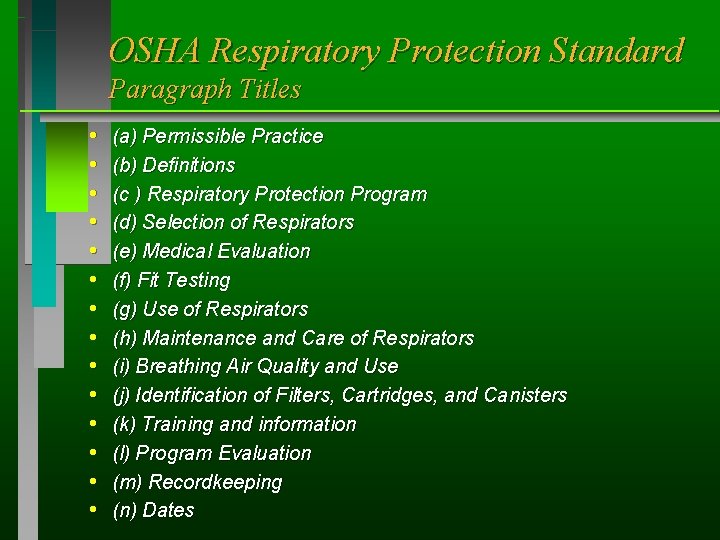
OSHA Respiratory Protection Standard Paragraph Titles h h h h (a) Permissible Practice (b) Definitions (c ) Respiratory Protection Program (d) Selection of Respirators (e) Medical Evaluation (f) Fit Testing (g) Use of Respirators (h) Maintenance and Care of Respirators (i) Breathing Air Quality and Use (j) Identification of Filters, Cartridges, and Canisters (k) Training and information (l) Program Evaluation (m) Recordkeeping (n) Dates
OSHA Respiratory Protection Standard (a) Permissible Practice • Engineering Controls • Respirators required when necessary to protect the health of the employee h Needs • • Assessment Is there a need for respirators? Do I need a program?
OSHA Respiratory Protection Standard (b) Definitions (c) Respiratory Protection Program • Written program w/ worksite specific procedures for required use • Must designate a qualified program administrator
OSHA Respiratory Protection Standard (c) Respiratory Protection Program must include (as applicable): • • Selection procedures Medical Evaluations Fit testing procedures for tight-fitting resp. Proper use procedures - routine & emergency (paragraph g) Procedures and schedules for resp. maintenance Hazards Training - routine & emergency Respirator Training Program evaluation procedures
OSHA Respiratory Protection Standard ( c ) Respiratory Protection Program (cont) h Major • Changes Required use v Voluntary h Voluntary • • Use Medical clearance Inspection / cleaning / storage Appendix D Exception for filtering facepiece (dust mask)
OSHA Respiratory Protection Standard (d) Selection • • • NIOSH certified respiratory hazards, relevant workplace and user factors reasonable estimate of exposure and chemical state, physical form h IDLH h Non-IDLH • Gas & Vapor Protection – • Atm. -supplying or ESLI or change schedule (major change) Particulates
OSHA Respiratory Protection Standard (e) Medical Evaluation • Required before fit-testing • Physician or Licensed health care professional • Medical questionnaire
OSHA Respiratory Protection Standard Subsequent examinations : h Employee h PLHCP, h Fit input / request supervisor, or program administrator testing and program evaluation h Workplace h Do changes that may increase burden not have to be annual
OSHA Respiratory Protection Standard (f) Fit-Testing • Required v Voluntary Use • Qualitative or Quantitative • Negative and Positive Pressure Resp. • Annually (or more often)
OSHA Respiratory Protection Standard (g) Use of Respirators • • • Face-to-facepiece seal User seal check Continuing respirator effectiveness IDLH areas Interior structural firefighting
OSHA Respiratory Protection Standard (h) Maintenance and care of respirators • Cleaning and Disinfecting Appendix B-2 or mfg. recommendations – Frequency – • • Individual use Shared respirators Emergency use Fit testing
OSHA Respiratory Protection Standard (h) Maintenance and care of respirators • Storage Protect from damage, contamination, dust sunlight, extreme temperatures, excessive moisture, and damaging chemicals – Prevent deformation of the facepiece and exhalation valve – • Emergency respirators
OSHA Respiratory Protection Standard (h) Maintenance and care of respirators • Inspection – Routine use - before use and during cleaning – Emergency use - at least monthly according to mfg. recommendations, and before and after each use (certified and tagged) – Emergency escape-only - before being carried into work area
OSHA Respiratory Protection Standard (h) Maintenance and care of respirators • Repairs Bad respirators removed from service and discarded or repaired – Performed by appropriately trained persons – According to mfg. recommendations – Reducing and admission valves, regulators, and alarms repaired by mfg. or mfg. trained technician –
OSHA Respiratory Protection Standard (i) Breathing air quality • • • Oxygen - U. S. P. Compressed air (Grade D) Cylinder requirements Compressor requirements Air line couplings must be incompatible with outlets for non-respirable air or other gas systems
OSHA Respiratory Protection Standard (j) Identification of filters, cartridges, and canisters • Labeled and color coded with NIOSH approval label
OSHA Respiratory Protection Standard (k) Training and Information Annually or more often if necessary What: • Why respirator is necessary and effects of poor fit, usage, or maintenance • Limitations and capabilities of respirator • Emergency use and malfunction situations • How to inspect, put on and take off, use, and check seals • Recognition of medical signs and symptoms that may limit or prevent use • General requirements of OSHA standard • h
OSHA Respiratory Protection Standard (l) Program evaluation h Workplace evaluations as necessary h Consult employees on program effectiveness • • Respirator fit Appropriate selection Proper use Proper maintenance
OSHA Respiratory Protection Standard (m) Recordkeeping • • • Medical evaluations - 29 CFR 1910. 1020 Fit testing Written program
OSHA Respiratory Protection Standard (n) Dates
OSHA Respiratory Protection Standard (o) Appendices h Mandatory • • Appendices Appendix A - Fit test procedures Appendix B-1 - User seal check procedures Appendix B-2 - Cleaning Procedures Appendix C - Medical Questionnaire h Non-Mandatory • Appendix D - Information for voluntary use
Respiratory Protection Program h DO I NEED A PROGRAM? Locate helpful information • past exposure assessment records • PPE assessments • conduct walk-through looking for respirators – note the operations where used – what type(s) are being used • reference existing programs – confined spaces, substance specific, etc. .
Respiratory Protection Program DO I NEED A PROGRAM? h Perform • • exposure assessments above PEL, TLV, or other limits irritants, sensitizers, etc. . h Are engineering controls possible? h Will other controls reduce exposures?
Respiratory Protection Program PUTTING A PROGRAM TOGETHER h If respirators needed, determine: • • who will be responsible for administration who will issue respirators who will provide training who will perform fit testing who will inspect emergency respirators who will perform repairs who will perform medical evaluations (LHCP)
Respiratory Protection Program h PUTTING A PROGRAM TOGETHER Establish applicable work-site specific procedures for: • Selection • medical evaluations • fit-testing • proper use (routine and emergency use) • inspection, cleaning, storage, and maintenance • breathing air quality and quantity for air-supplied • training • program evaluation