
RESPIRATION What is respiration The phenomenon of liberation
RESPIRATION
What is respiration. . ?
The phenomenon of liberation of energy from organic substances in a multistep enzyme mediated catabolic process is described as respiration.
TWO DEFINITIONS OF RESPIRATION BIOCHEMICAL RESPIRATON PHYSIOLOGICAL RESPIRATION • The metabolic process by which an organism obtain energy by reacting oxygen with glucose to give water , carbon dioxide & ATP. • It refers to cellular respiration which takes place in individual cell. • It concern with the bulk flow and transfer of metabolites between the organism and external environment. • Breathing is a part of physiological respiration which include exchange of gases.
RESPIRATORY QUOTIENT(RQ) Ratio of volume of CO 2 release to the volume of O 2 taken in respiration in the given period of time at standard temp. and pressure. R. Q. = Volume of CO 2 evolved Volume of O 2 absorbed
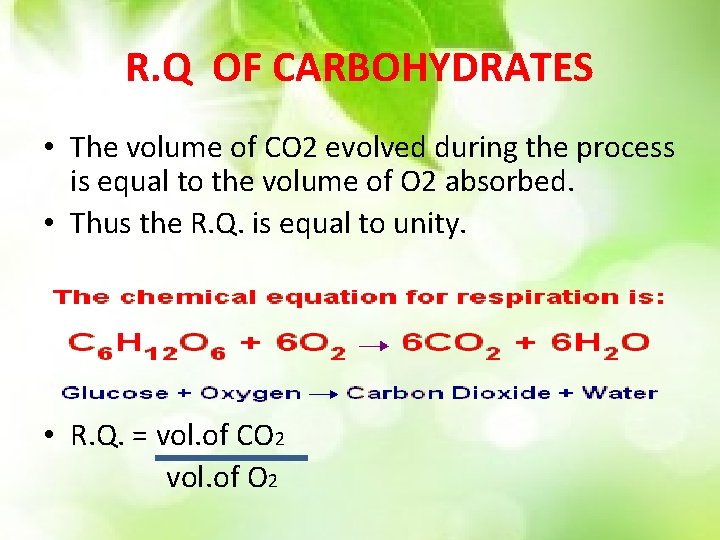
R. Q OF CARBOHYDRATES • The volume of CO 2 evolved during the process is equal to the volume of O 2 absorbed. • Thus the R. Q. is equal to unity. • R. Q. = vol. of CO 2 vol. of O 2
R. Q OF FATS • Fats are hydrolysed to fatty acids and glycerol. • Complete oxidation of glycerol results R. Q. of 0. 86. • The fatty acids, being poorer in oxygen, require more oxygen for complete oxidation as compared to CO 2. • R. Q. become less than unity.
R. Q FOR PROTEINS • Proteins are hydrolysed into amino acids. • They require more oxygen and evolve less carbon dioxide during their complete oxidation. • R. Q. become less than unity.
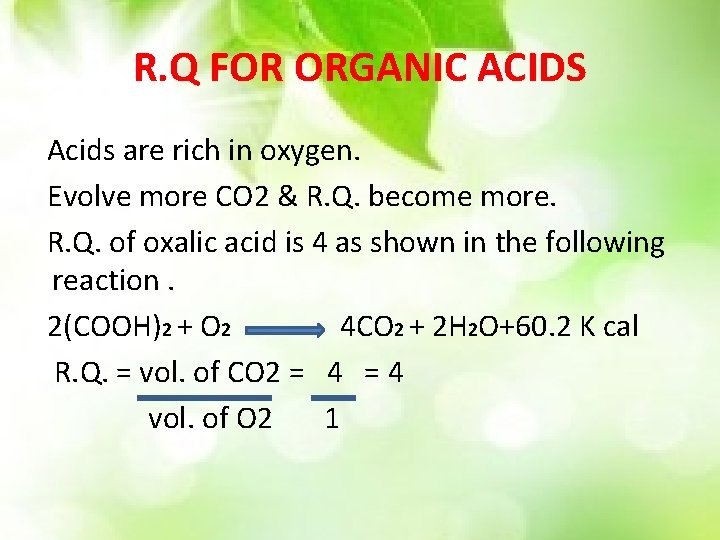
R. Q FOR ORGANIC ACIDS Acids are rich in oxygen. Evolve more CO 2 & R. Q. become more. R. Q. of oxalic acid is 4 as shown in the following reaction. 2(COOH)2 + O 2 4 CO 2 + 2 H 2 O+60. 2 K cal R. Q. = vol. of CO 2 = 4 vol. of O 2 1
RESPIRATORY SUBSTRATES • Organic nutrients which are synthesized inside the plant by anabolic processes (photosynthesis, fat synthesis and protein synthesis). • Respired completely to CO 2 and H 2 O. • Under natural conditions only carbohydrates are oxidized(floating respiration). • If carbohydrates are used up & shortage become acute then other protoplasmic structures may be catabolized (protoplasmic respiration).
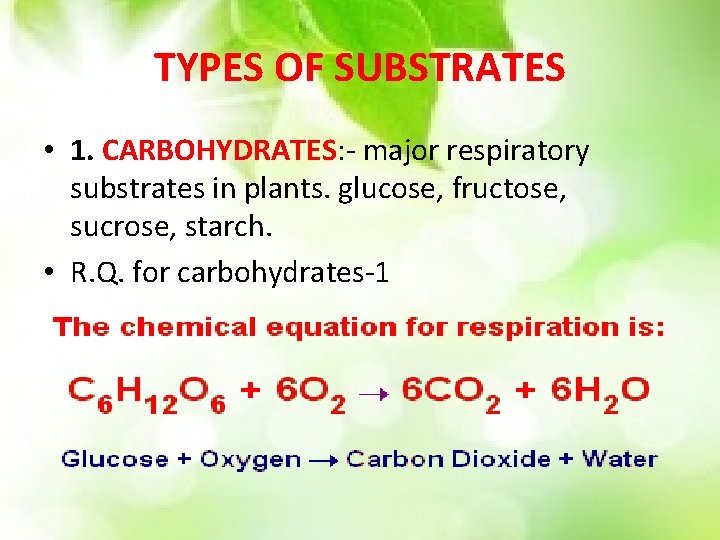
TYPES OF SUBSTRATES • 1. CARBOHYDRATES: - major respiratory substrates in plants. glucose, fructose, sucrose, starch. • R. Q. for carbohydrates-1
• (a) Starch : - a polysaccharide which is broken down into glucose-1 phosphate units by the action of enzyme starch phosphorylase. • Glucose-1 phosphate is further converted into glucose-6 phosphate by enzyme phosphoglucomutase. • Glucose-6 is an intermediate of glycolysis & oxidized completely to CO 2 & H 2 O.
• (b) Sucrose: - It is the principal soluble disaccharide which is converted into the glucose and fructose by the action of enzyme invertase. • (C) Glucose: - A monosaccharide hexose molecule which act as chief respiratory substrate. • (d)Fructose: - It is directly converted into fructose-6 -phosphate by enzyme fructokinase and then enters into the glycolysis.
2. FATS: - first convereted into fatty acids and glycerol in presence of enzyme lipase. Fatty acids being poorer in oxygen require more O 2 for complete oxidation. O 2 absorption is more and CO 2 liberation is less. R. Q. is less than unity. Glycerol + ATP Glycerol-3 phosphate + ADP Glycerol-3 phosphate+ NAD phosphate + NADH+ H+ Dihydroxy acetone Fatty acids are converted into acetyl coenzyme-A which enters into the krebs cycle.
3. PROTEINS: - R. Q is less than unity. Proteins are hydrolysed into amino acids. Require more O 2 and CO 2 liberaton is less. 4. ORGANIC ACIDS: - like malic acid accumulate in dark in some succulents plants(CAM). Under continuous dark period malic acid is converted into CO 2 & H 2 O. COOH 2 + O 2 4 CO 2+2 H 2 O+60. 2 Kcal. COOH
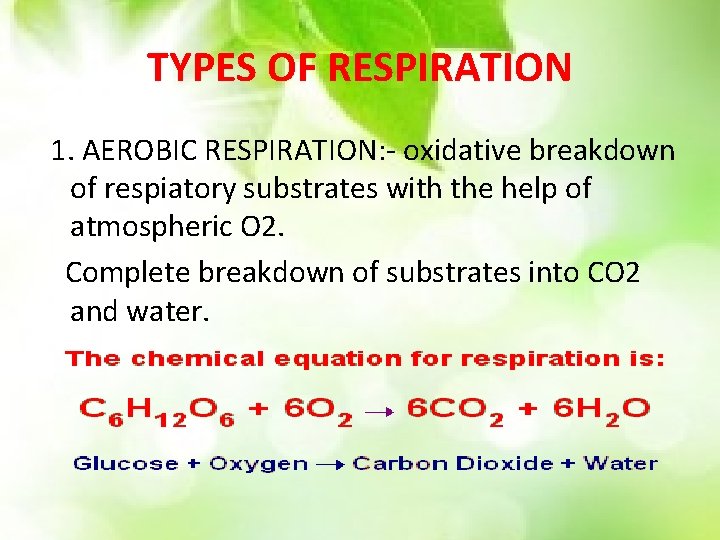
TYPES OF RESPIRATION 1. AEROBIC RESPIRATION: - oxidative breakdown of respiatory substrates with the help of atmospheric O 2. Complete breakdown of substrates into CO 2 and water.
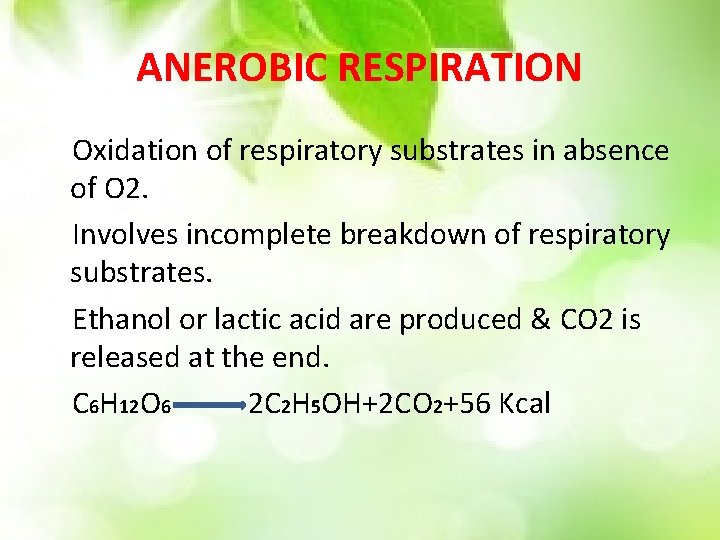
ANEROBIC RESPIRATION Oxidation of respiratory substrates in absence of O 2. Involves incomplete breakdown of respiratory substrates. Ethanol or lactic acid are produced & CO 2 is released at the end. C 6 H 12 O 6 2 C 2 H 5 OH+2 CO 2+56 Kcal
MECHANISM OF ANEROBIC RESPIRATION • Involves conversion of glucose into ethanol & CO 2 in the alcoholic fermentation and the conversion of glucose to lactic acid in the muscles of animals and certain lactic acid bacteria. • The process does not require oxygen. • First glucose is converted into pyruvic acid and then converted into ethyle alcohol or lactic acid. • Occures in cytosol.
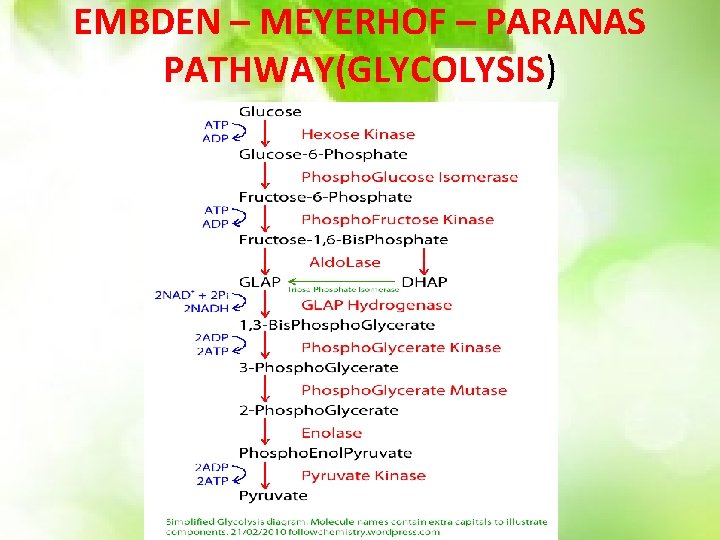
EMBDEN – MEYERHOF – PARANAS PATHWAY(GLYCOLYSIS)
• Anerobic respiration carried out by some bacteria&fungi(e. g. yeast) is termed as fermentation. • ALCOHOLIC FERMENTATION: -Occures in some fungi(e. g. yeast) and higher plants under anerobic conditions. • It occures in two steps: • The pyruvic acid is first of all decarboxylated to acetaldehyde in presence of enzyme- pyruvic acid decarboxylase.
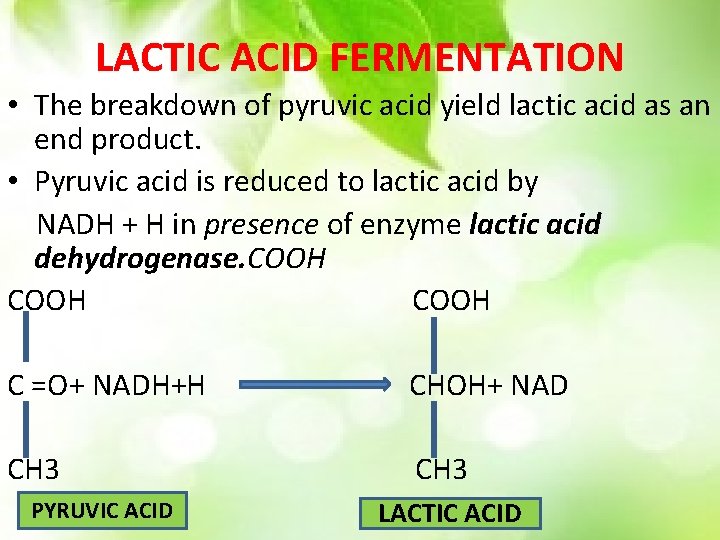
LACTIC ACID FERMENTATION • The breakdown of pyruvic acid yield lactic acid as an end product. • Pyruvic acid is reduced to lactic acid by NADH + H in presence of enzyme lactic acid dehydrogenase. COOH C =O+ NADH+H CHOH+ NAD CH 3 PYRUVIC ACID LACTIC ACID
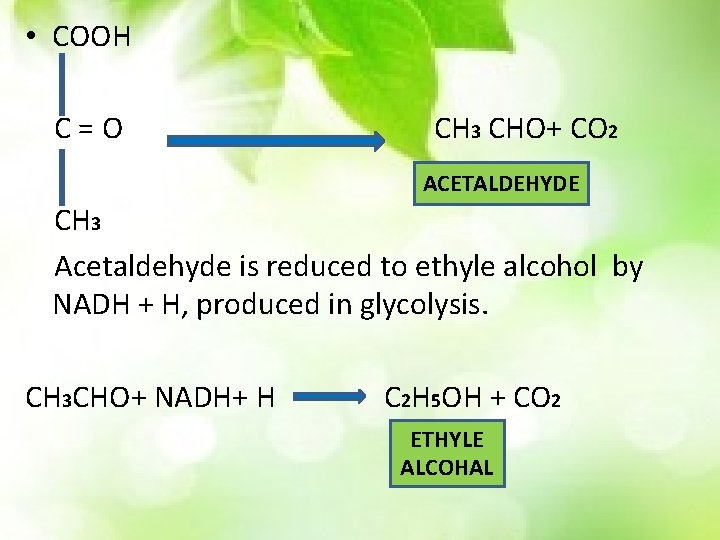
• COOH C=O CH 3 CHO+ CO 2 ACETALDEHYDE CH 3 Acetaldehyde is reduced to ethyle alcohol by NADH + H, produced in glycolysis. CH 3 CHO+ NADH+ H C 2 H 5 OH + CO 2 ETHYLE ALCOHAL
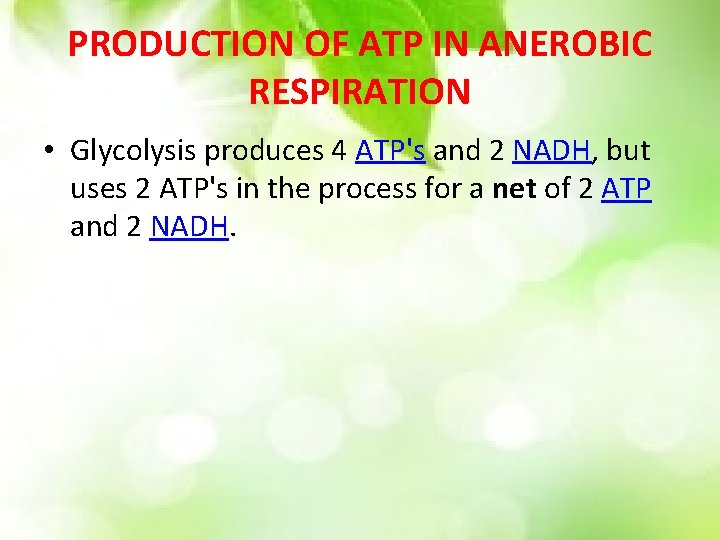
PRODUCTION OF ATP IN ANEROBIC RESPIRATION • Glycolysis produces 4 ATP's and 2 NADH, but uses 2 ATP's in the process for a net of 2 ATP and 2 NADH.
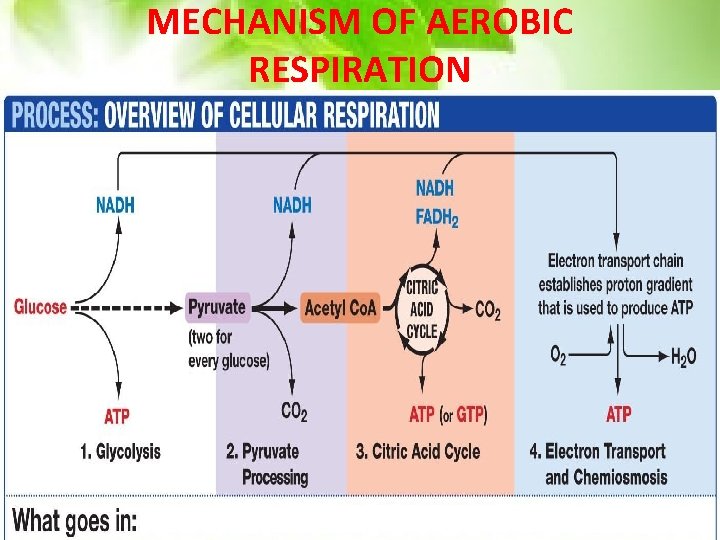
MECHANISM OF AEROBIC RESPIRATION
• Stepwise breakdown of respiratory substartes to CO 2 and H 2 O in presence of oxygen is referred to as aerobic respiration. • It involve 4 major stages: • (A) Glycolytic breakdown of glucose to pyruvic acid. • (B) Oxidative decarboxylation of pyruvic acid to acetyl Co A. • (C) Kreb’s cycle. • (D) Terminal oxidation & phosphorylation.
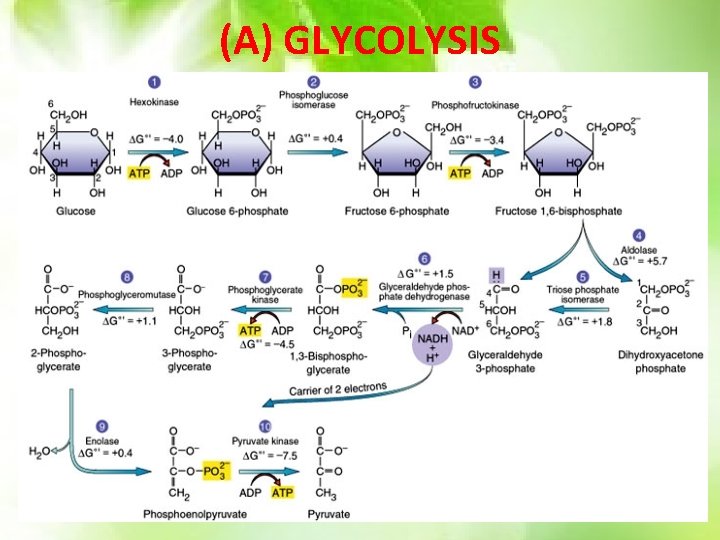
(A) GLYCOLYSIS
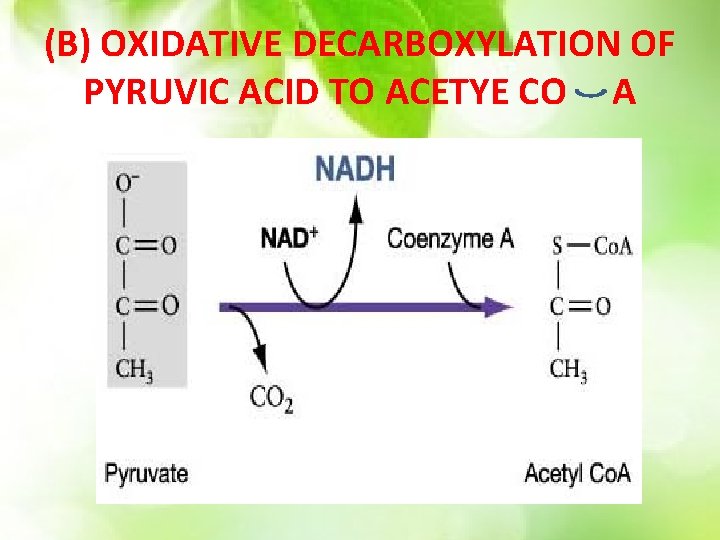
(B) OXIDATIVE DECARBOXYLATION OF PYRUVIC ACID TO ACETYE CO A
• 2 NADP are produced. ( 1 per pyruvate) • 2 CO 2 are released. ( 1 per pyruvate)
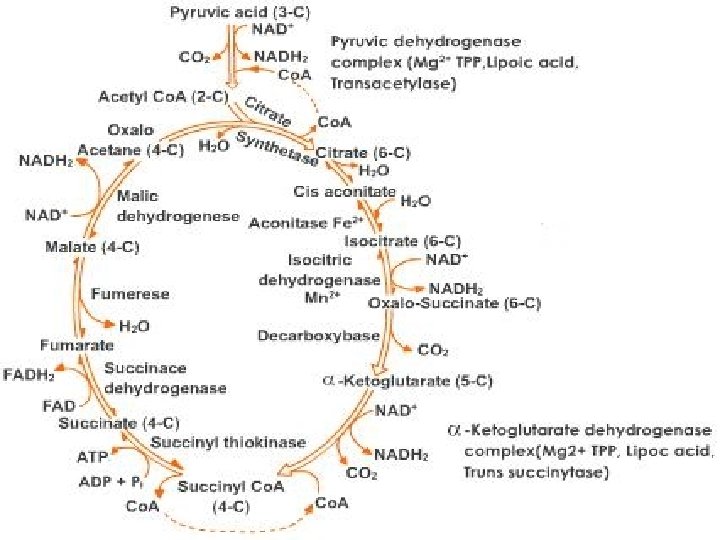
(C) KREBS CYCLE OR TCA CYCLE • Aerobic oxidation of pyruvic acid through a series of reactions was studied in detail by Hans Krebs(1937).
PRODUCTION OF ATP IN KREBS CYCLE • • 8 NADH are produced. 2 FADH 2 are produced. 2 ATP are produced. 8 NADH* 3 = 24 ATP 2 FADH 2*2 = +4 ATP 2 ATP = +2 ATP TOTAL = 30 ATP

- Slides: 32