
Respiration in bacteria Respiration Fermentation and photosynthesis Definition
Respiration in bacteria Respiration, Fermentation and photosynthesis
Definition • Metabolism refers to all the biochemical reactions that occur in a cell or organism. The study of bacterial metabolism focuses on the chemical diversity of substrate oxidations and dissimilation reactions (reactions by which substrate molecules are broken down), which normally function in bacteria to generate energy. Heterotrophic Metabolism Heterotrophic metabolism is the biologic oxidation of organic compounds, such as glucose, to yield ATP and simpler organic (or inorganic) compounds, which are needed by the bacterial cell for biosynthetic or assimilatory reactions. e. g • Respiration • Fermentation • Photosynthesis

Respiration in Bacteria • Respiration is a type of heterotrophic metabolism that uses oxygen and in which 38 moles of ATP are derived from the oxidation of 1 mole of glucose, yielding 380, 000 cal. (An additional 308, 000 cal is lost as heat. ) • Complex process accompanied with liberation of energy required by microbes for synthesis of organic compunds. (Fermentation is the energy liberation process without participation of oxygen.

• • • Types of bacteria with reference respiration Obligate aerobes Obligate anaerobes Facultative anaerobes Micro aerophilic bacteria
• Glycolysis • Kreb’s Cycle/ fermentation • Electron transport Chain
I-GLYCOLYSIS https: //tinycards. duolingo. com/decks/Jn 7 feuc 4/respiration
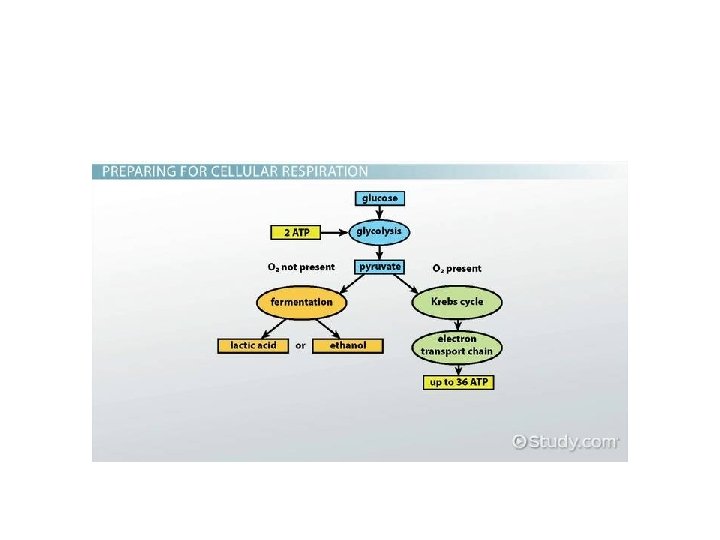
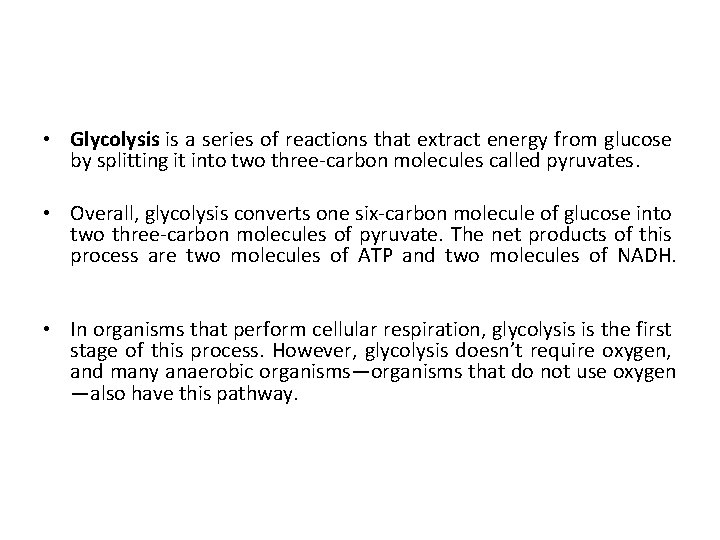
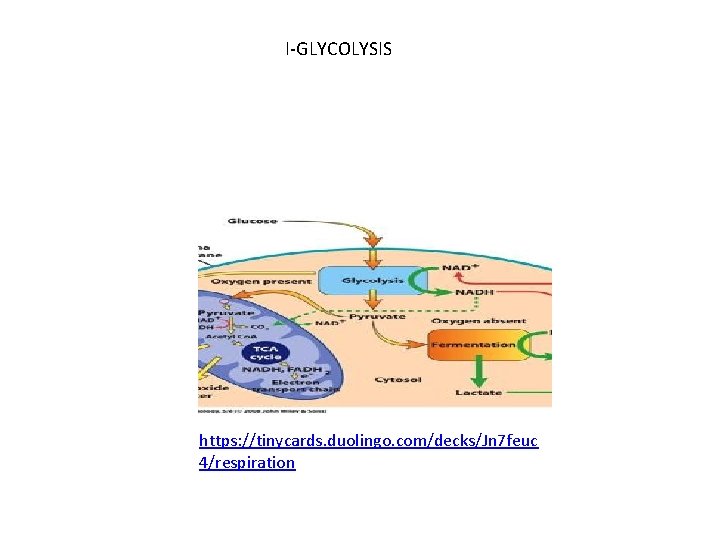
• Glycolysis is a series of reactions that extract energy from glucose by splitting it into two three-carbon molecules called pyruvates. • Overall, glycolysis converts one six-carbon molecule of glucose into two three-carbon molecules of pyruvate. The net products of this process are two molecules of ATP and two molecules of NADH. • In organisms that perform cellular respiration, glycolysis is the first stage of this process. However, glycolysis doesn’t require oxygen, and many anaerobic organisms—organisms that do not use oxygen —also have this pathway.
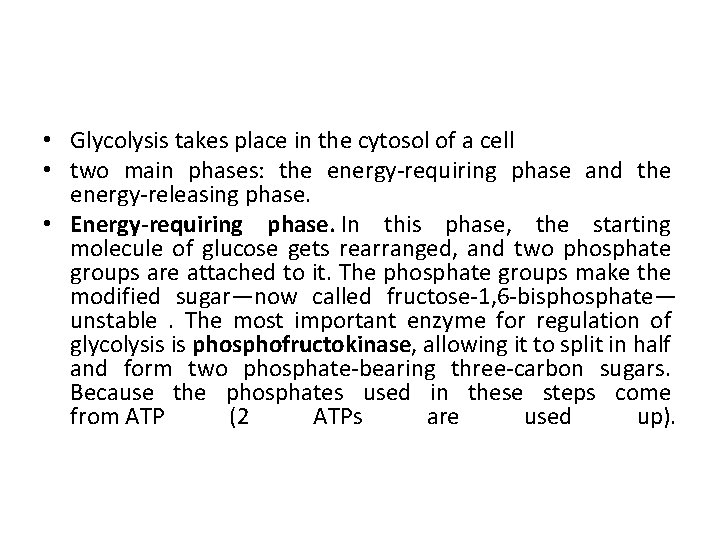
• Glycolysis takes place in the cytosol of a cell • two main phases: the energy-requiring phase and the energy-releasing phase. • Energy-requiring phase. In this phase, the starting molecule of glucose gets rearranged, and two phosphate groups are attached to it. The phosphate groups make the modified sugar—now called fructose-1, 6 -bisphosphate— unstable . The most important enzyme for regulation of glycolysis is phosphofructokinase, allowing it to split in half and form two phosphate-bearing three-carbon sugars. Because the phosphates used in these steps come from ATP (2 ATPs are used up).
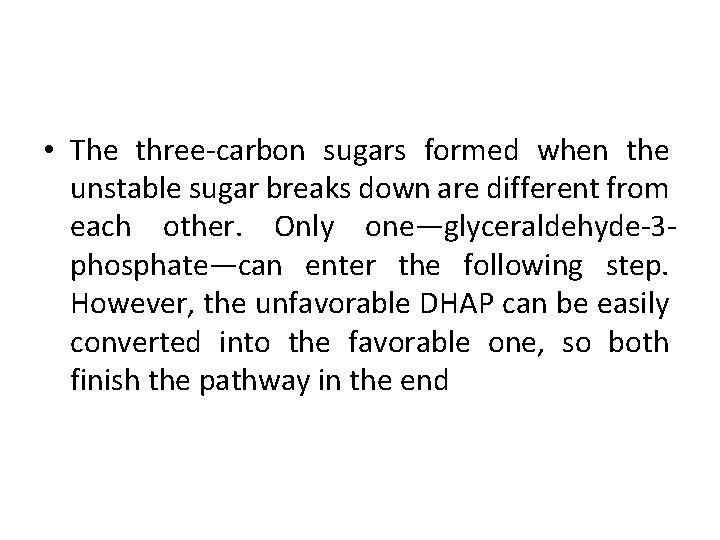
• The three-carbon sugars formed when the unstable sugar breaks down are different from each other. Only one—glyceraldehyde-3 phosphate—can enter the following step. However, the unfavorable DHAP can be easily converted into the favorable one, so both finish the pathway in the end
• Step 1. A phosphate group is transferred from ATP to glucose, making glucose-6 -phosphate. Glucose-6 -phosphate is more reactive than glucose, and the addition of the phosphate also traps glucose inside the cell since glucose with a phosphate can’t readily cross the membrane.
• Step 2. Glucose-6 -phosphate is converted into its isomer, fructose-6 -phosphate. • Step 3. A phosphate group is transferred from ATP to fructose-6 -phosphate, producing fructose-1, 6 -bisphosphate. This step is catalyzed by tphosphofructokinase, which can be regulated to speed up or slow down the glycolysis pathway.
• Step 4. Fructose-1, 6 -bisphosphate splits to form two three-carbon sugars: dihydroxyacetone phosphate DHAP and glyceraldehyde-3 -phosphate. They are isomers of each other, but only one—glyceraldehyde-3 -phosphate—can directly continue through the next steps of glycolysis. • Step 5. DHAP is converted into glyceraldehyde-3 phosphate. The two molecules exist in equilibrium, but the equilibrium is “pulled” strongly downward, as glyceraldehyde-3 -phosphate is used up. Thus, all DHAP is eventually converted.
• Energy-releasing phase. In this phase, each three-carbon sugar is converted into another three-carbon molecule, pyruvate, through a series of reactions. In these reactions, two ATP molecules and one NADH molecule are made. Because this phase takes place twice, once for each of the two three-carbon sugars, it makes four ATPs and two NADH.

Glycolysis
• Step 6. Two half reactions occur simultaneously: • 1) Glyceraldehyde-3 -phosphate (one of the threecarbon sugars formed in the initial phase) is oxidized. • 2) NAD is reduced to NADH and H. The overall reaction is exergonic, releasing energy that is then used to phosphorylate the molecule, forming 1, 3 bisphoglycerate. • Step 7. 1, 3 -bisphoglycerate donates one of its phosphate groups ADP and ATP is produced and turning into 3 -phosphoglycerate in the process. • Step 8. 3 -phosphoglycerate is converted into its isomer, 2 -phosphoglycerate.
• Step 9. 2 -phosphoglycerate loses a molecule of water, becoming phosphoenolpyruvate(PEP), an unstable molecule, lose its phosphate group in the final step of glycolysis. • Step 10. PEP readily donates its phosphate group to ADP , making a second molecule ATP. As it loses its phosphate, PEP is converted to pyruvate, the end product of glycolysis.
• Medical Microbiology. 4 th edition. Baron S, editor. Galveston (TX): University of Texas Medical Branch at Galveston; 1996. Chapter 4 Bacterial Metabolism Peter Jurtshuk, Jr.
- Slides: 18