
Respiration Fermentation EXERCISE 6 PG 53 1 What

- Slides: 20
Respiration & Fermentation EXERCISE 6 PG. 53 1
What is cellular respiration? Oxidation of organic compounds to extract energy from chemical bonds 95% of living things are heterotrophic = must intake food to make energy Other 5% (plants) can use additional method via sunlight (aka. Photosythesis) Every living thing (whether unicellular or multicellular) needs to go through respiration to produce ATP. What do cells need energy for? Survive & Thrive!!! (if your not livin’ your dyin’) 2
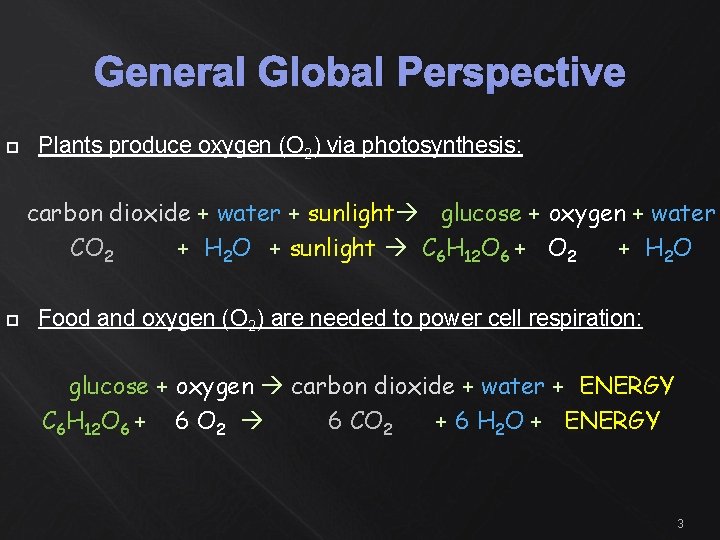
General Global Perspective Plants produce oxygen (O 2) via photosynthesis: carbon dioxide + water + sunlight glucose + oxygen + water CO 2 + H 2 O + sunlight C 6 H 12 O 6 + O 2 + H 2 O Food and oxygen (O 2) are needed to power cell respiration: glucose + oxygen carbon dioxide + water + ENERGY C 6 H 12 O 6 + 6 O 2 6 CO 2 + 6 H 2 O + ENERGY 3
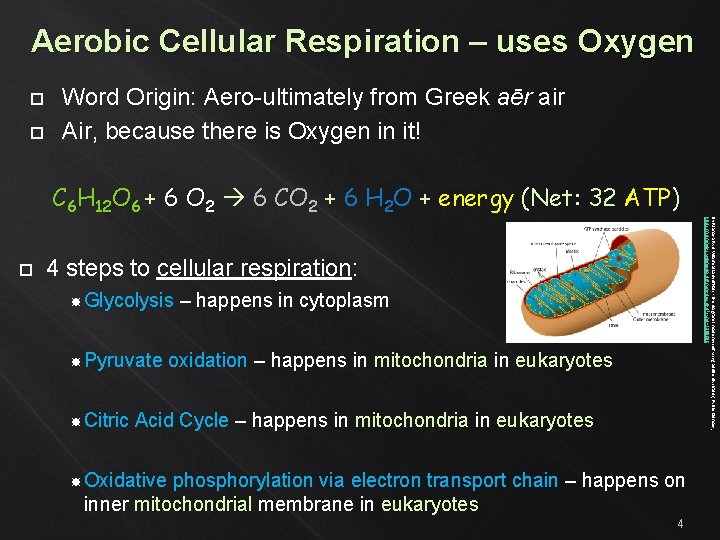
Aerobic Cellular Respiration – uses Oxygen Word Origin: Aero-ultimately from Greek aēr air Air, because there is Oxygen in it! C 6 H 12 O 6 + 6 O 2 6 CO 2 + 6 H 2 O + energy (Net: 32 ATP) By Mariana Ruiz Villarreal Ladyof. Hats - the diagram I made myself using adobe illustrator, Public Domain, https: //commons. wikimedia. org/w/index. php? curid=6195050 4 steps to cellular respiration: Glycolysis Pyruvate Citric – happens in cytoplasm oxidation – happens in mitochondria in eukaryotes Acid Cycle – happens in mitochondria in eukaryotes Oxidative phosphorylation via electron transport chain – happens on inner mitochondrial membrane in eukaryotes 4
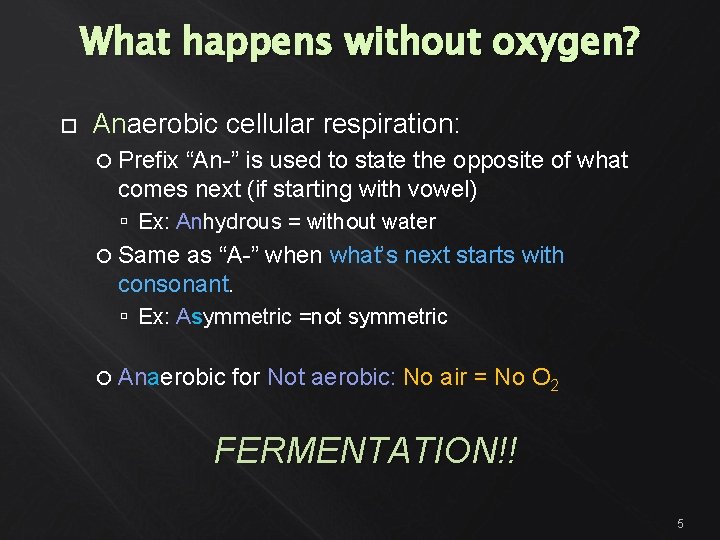
What happens without oxygen? Anaerobic cellular respiration: Prefix “An-” is used to state the opposite of what comes next (if starting with vowel) Ex: Anhydrous = without water Same as “A-” when what’s next starts with consonant. Ex: Asymmetric =not symmetric Anaerobic for Not aerobic: No air = No O 2 FERMENTATION!! 5
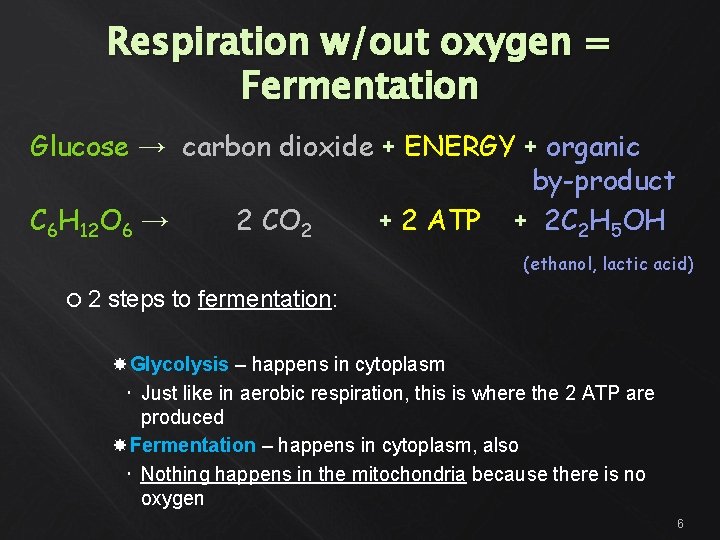
Respiration w/out oxygen = Fermentation Glucose → carbon dioxide + ENERGY + organic by-product C 6 H 12 O 6 → 2 CO 2 + 2 ATP + 2 C 2 H 5 OH (ethanol, lactic acid) 2 steps to fermentation: Glycolysis – happens in cytoplasm Just like in aerobic respiration, this is where the 2 ATP are produced Fermentation – happens in cytoplasm, also Nothing happens in the mitochondria because there is no oxygen 6
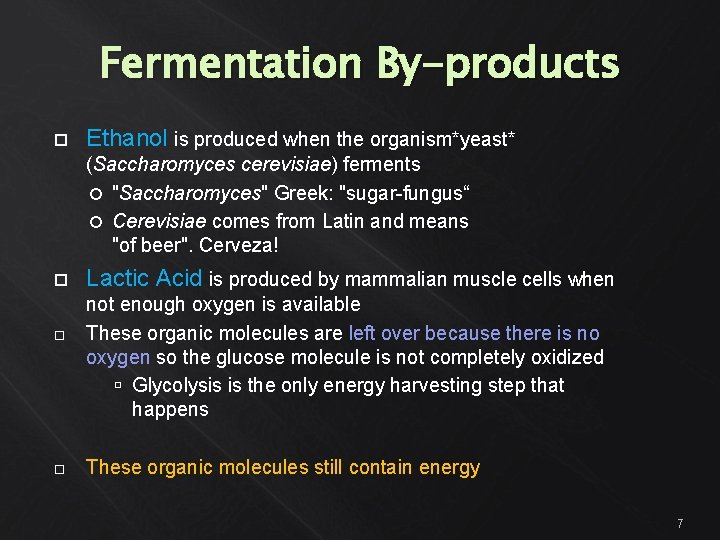
Fermentation By-products Ethanol is produced when the organism*yeast* (Saccharomyces cerevisiae) ferments "Saccharomyces" Greek: "sugar-fungus“ Cerevisiae comes from Latin and means "of beer". Cerveza! Lactic Acid is produced by mammalian muscle cells when not enough oxygen is available These organic molecules are left over because there is no oxygen so the glucose molecule is not completely oxidized Glycolysis is the only energy harvesting step that happens These organic molecules still contain energy 7
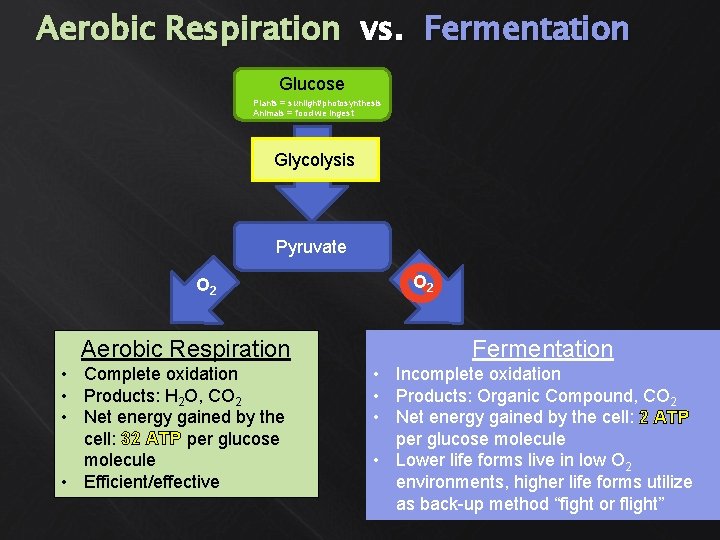
Aerobic Respiration vs. Fermentation Glucose Plants = sunlight/photosynthesis Animals = food we ingest Glycolysis Pyruvate O 2 Aerobic Respiration • Complete oxidation • Products: H 2 O, CO 2 • Net energy gained by the cell: 32 ATP per glucose molecule • Efficient/effective O 2 Fermentation • Incomplete oxidation • Products: Organic Compound, CO 2 • Net energy gained by the cell: 2 ATP per glucose molecule • Lower life forms live in low O 2 environments, higher life forms utilize as back-up method “fight or flight”
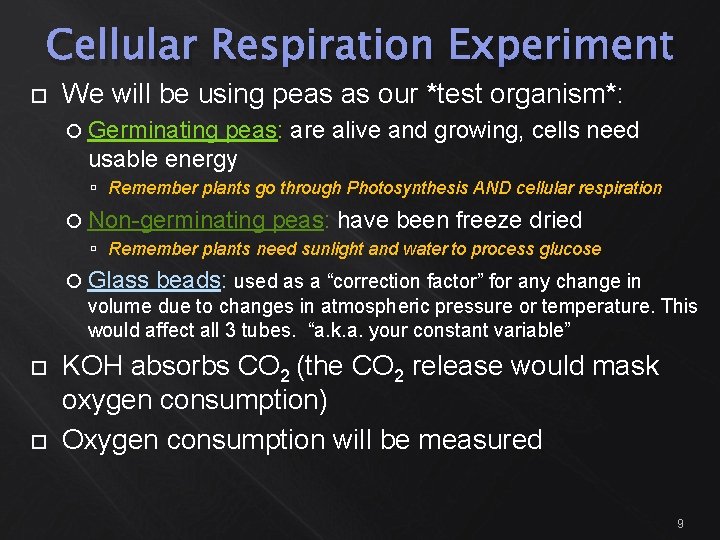
Cellular Respiration Experiment We will be using peas as our *test organism*: Germinating peas: are alive and growing, cells need usable energy Remember plants go through Photosynthesis AND cellular respiration Non-germinating peas: have been freeze dried Remember plants need sunlight and water to process glucose Glass beads: used as a “correction factor” for any change in volume due to changes in atmospheric pressure or temperature. This would affect all 3 tubes. “a. k. a. your constant variable” KOH absorbs CO 2 (the CO 2 release would mask oxygen consumption) Oxygen consumption will be measured 9
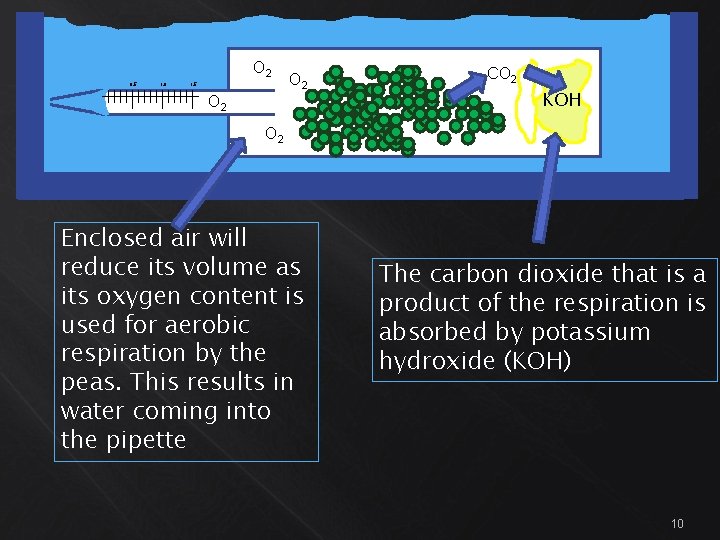
O 2 0. 5 1. 0 1. 5 O 2 CO 2 KOH O 2 Enclosed air will reduce its volume as its oxygen content is used for aerobic respiration by the peas. This results in water coming into the pipette The carbon dioxide that is a product of the respiration is absorbed by potassium hydroxide (KOH) 10
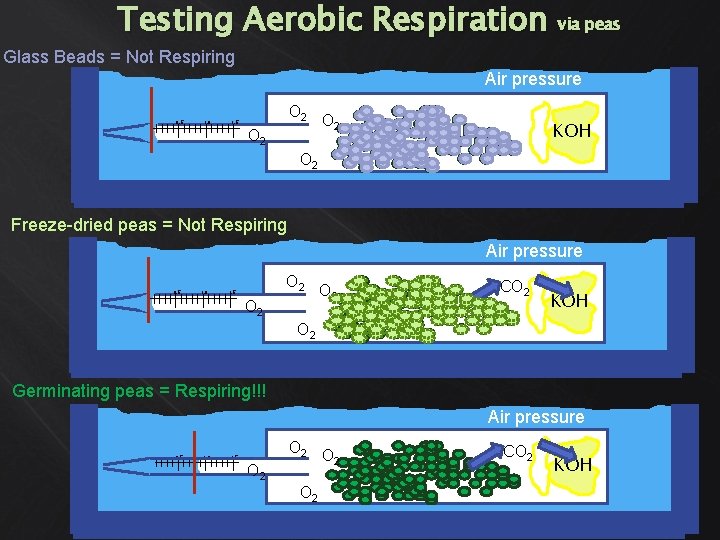
Testing Aerobic Respiration via peas Glass Beads = Not Respiring Air pressure 0. 5 1. 0 O 2 1. 5 O 2 KOH O 2 Freeze-dried peas = Not Respiring Air pressure 0. 5 1. 0 O 2 1. 5 O 2 CO 2 KOH O 2 Germinating peas = Respiring!!! Air pressure 0. 5 1. 0 O 2 1. 5 O 2 O 2 CO 2 KOH
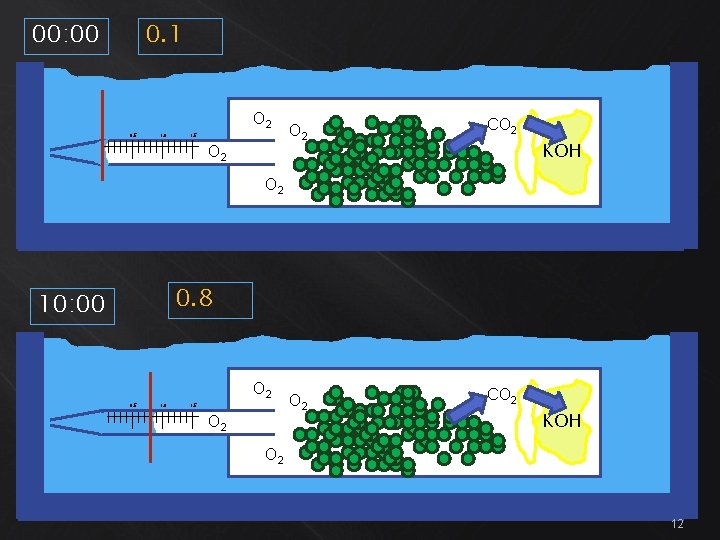
00: 00 0. 1 O 2 0. 5 1. 0 1. 5 O 2 CO 2 KOH O 2 0. 8 10: 00 O 2 0. 5 1. 0 1. 5 O 2 KOH O 2 12
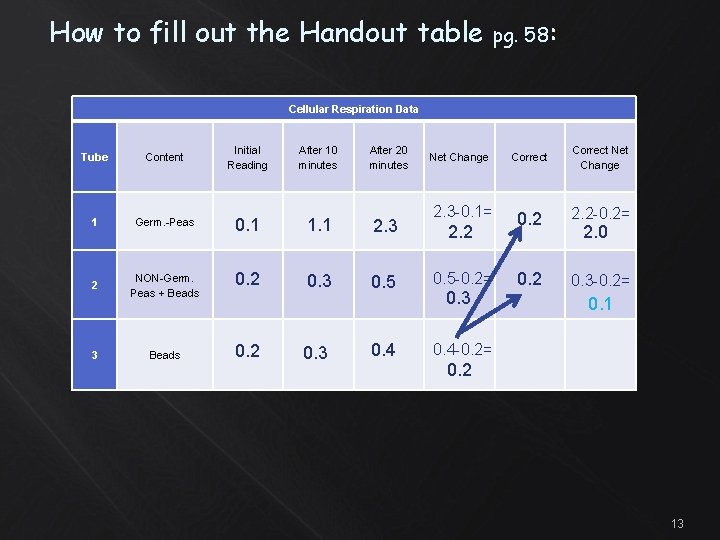
How to fill out the Handout table pg. 58: Cellular Respiration Data Tube Content Initial Reading After 10 minutes 1 Germ. -Peas 0. 1 1. 1 2. 3 2 NON-Germ. Peas + Beads 0. 2 0. 3 0. 5 3 Beads 0. 2 0. 3 After 20 minutes 0. 4 Net Change 2. 3 -0. 1= 2. 2 0. 5 -0. 2= 0. 3 Correct Net Change 0. 2 2. 2 -0. 2= 0. 2 0. 3 -0. 2= 2. 0 0. 1 0. 4 -0. 2= 0. 2 13
Testing Fermentation via Yeast We will use yeast as the *test organism* Label 4 beakers and 4 flasks (1 -4) 1 2 1 4 3 2 saccharometer NOT A BONG!!!!! 3 4
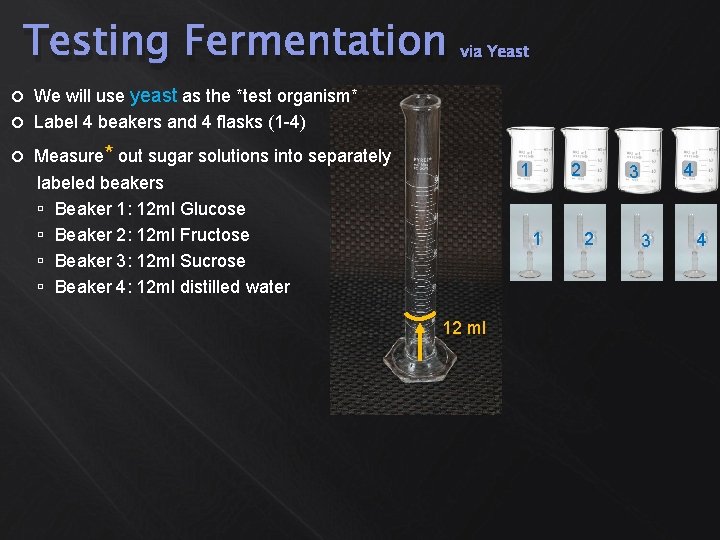
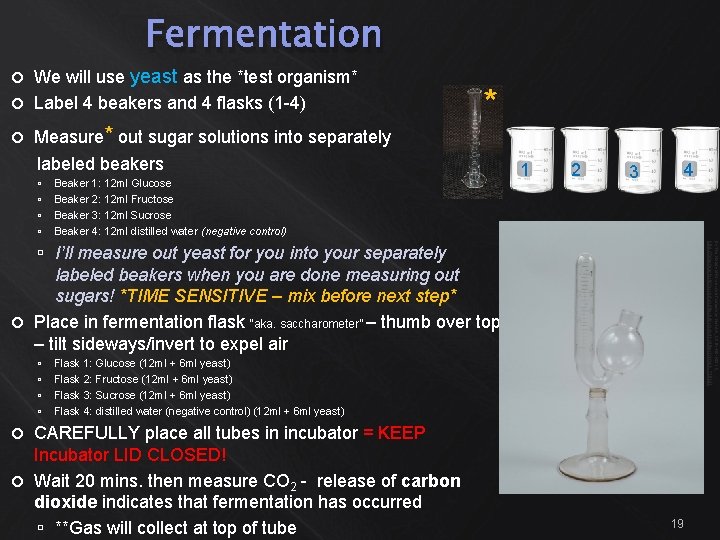
Testing Fermentation via Yeast We will use yeast as the *test organism* Label 4 beakers and 4 flasks (1 -4) Measure* out sugar solutions into separately 1 labeled beakers Beaker 1: 12 ml Glucose Beaker 2: 12 ml Fructose Beaker 3: 12 ml Sucrose Beaker 4: 12 ml distilled water 2 1 12 ml 4 3 2 3 4
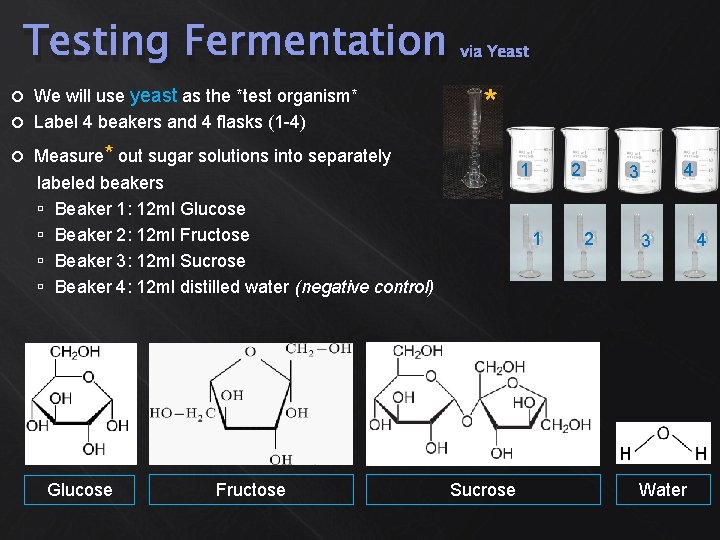
Testing Fermentation We will use yeast as the *test organism* Label 4 beakers and 4 flasks (1 -4) via Yeast * Measure* out sugar solutions into separately 1 labeled beakers Beaker 1: 12 ml Glucose Beaker 2: 12 ml Fructose Beaker 3: 12 ml Sucrose Beaker 4: 12 ml distilled water (negative control) Glucose Fructose 2 1 Sucrose 4 3 2 3 Water 4
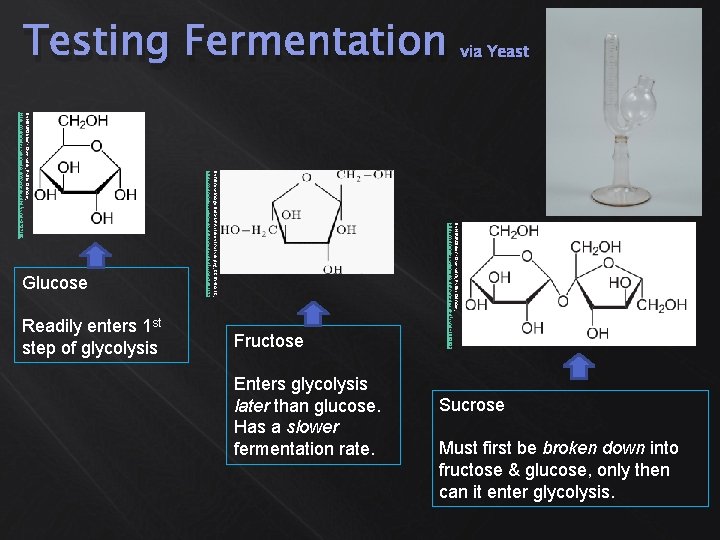
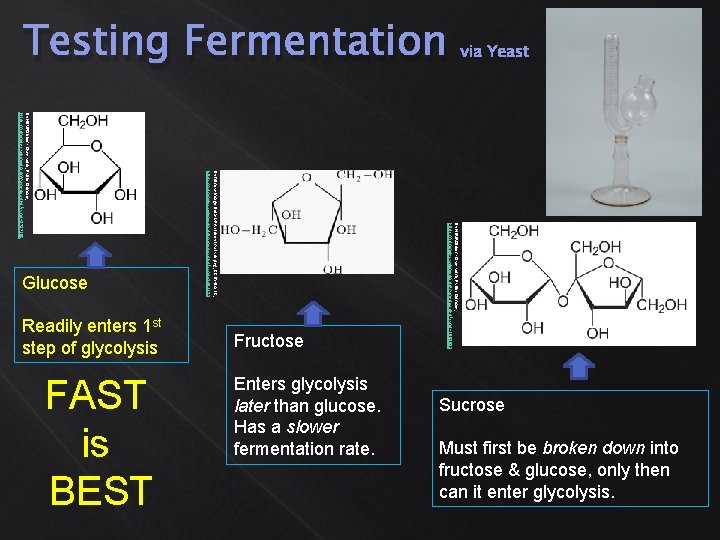
Sucrose Must first be broken down into fructose & glucose, only then can it enter glycolysis. Enters glycolysis later than glucose. Has a slower fermentation rate. By NEUROtiker - Own work, Public Domain, https: //commons. wikimedia. org/w/index. php? curid=2951918 Fructose Readily enters 1 st step of glycolysis By from w: Image: Beta-L-Fructose-structure. png, CC BY-SA 3. 0, https: //commons. wikimedia. org/w/index. php? curid=1453381 By NEUROtiker - Own work, Public Domain, https: //commons. wikimedia. org/w/index. php? curid=1787650 Glucose via Yeast Testing Fermentation
By NEUROtiker - Own work, Public Domain, https: //commons. wikimedia. org/w/index. php? curid=2951918 Sucrose Must first be broken down into fructose & glucose, only then can it enter glycolysis. Enters glycolysis later than glucose. Has a slower fermentation rate. FAST is BEST Fructose Readily enters 1 st step of glycolysis By from w: Image: Beta-L-Fructose-structure. png, CC BY-SA 3. 0, https: //commons. wikimedia. org/w/index. php? curid=1453381 By NEUROtiker - Own work, Public Domain, https: //commons. wikimedia. org/w/index. php? curid=1787650 Glucose via Yeast Testing Fermentation
Fermentation We will use yeast as the *test organism* Label 4 beakers and 4 flasks (1 -4) Measure* out sugar solutions into separately * labeled beakers Beaker 1: 12 ml Glucose Beaker 2: 12 ml Fructose Beaker 3: 12 ml Sucrose Beaker 4: 12 ml distilled water (negative control) 1 2 4 3 By The National Museum of American History, CC BY-NC-ND 2. 0, http: //americanhistory. si. edu/collections/search/object/nmah_735243 I’ll measure out yeast for you into your separately labeled beakers when you are done measuring out sugars! *TIME SENSITIVE – mix before next step* Place in fermentation flask “aka. saccharometer” – thumb over top – tilt sideways/invert to expel air Flask 1: Glucose (12 ml + 6 ml yeast) Flask 2: Fructose (12 ml + 6 ml yeast) Flask 3: Sucrose (12 ml + 6 ml yeast) Flask 4: distilled water (negative control) (12 ml + 6 ml yeast) CAREFULLY place all tubes in incubator = KEEP Incubator LID CLOSED! Wait 20 mins. then measure CO 2 - release of carbon dioxide indicates that fermentation has occurred **Gas will collect at top of tube 19
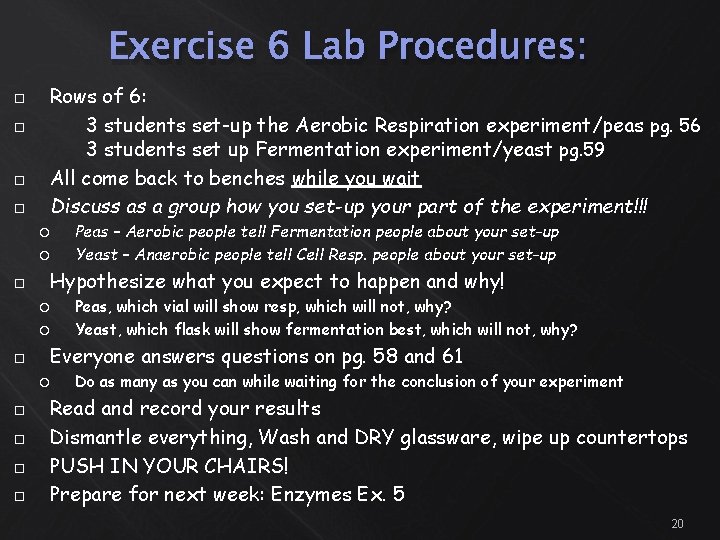
Exercise 6 Lab Procedures: Rows of 6: 3 students set-up the Aerobic Respiration experiment/peas pg. 56 3 students set up Fermentation experiment/yeast pg. 59 All come back to benches while you wait Discuss as a group how you set-up your part of the experiment!!! Hypothesize what you expect to happen and why! Peas, which vial will show resp, which will not, why? Yeast, which flask will show fermentation best, which will not, why? Everyone answers questions on pg. 58 and 61 Peas – Aerobic people tell Fermentation people about your set-up Yeast – Anaerobic people tell Cell Resp. people about your set-up Do as many as you can while waiting for the conclusion of your experiment Read and record your results Dismantle everything, Wash and DRY glassware, wipe up countertops PUSH IN YOUR CHAIRS! Prepare for next week: Enzymes Ex. 5 20