
Respirable Crystalline Silica PART 690 1926 1153 CONSTRUCTION
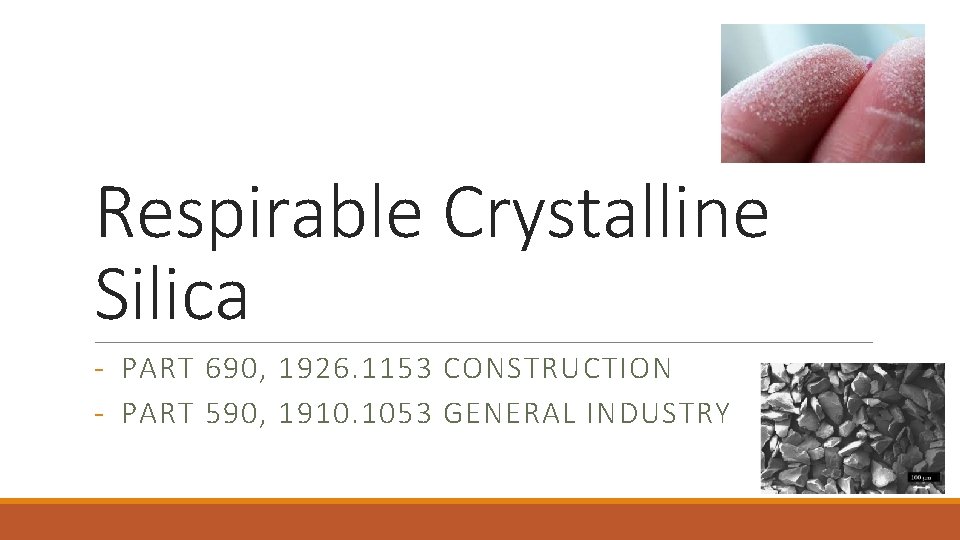
Respirable Crystalline Silica - PART 690, 1926. 1153 CONSTRUCTION - PART 590, 1910. 1053 GENERAL INDUSTRY
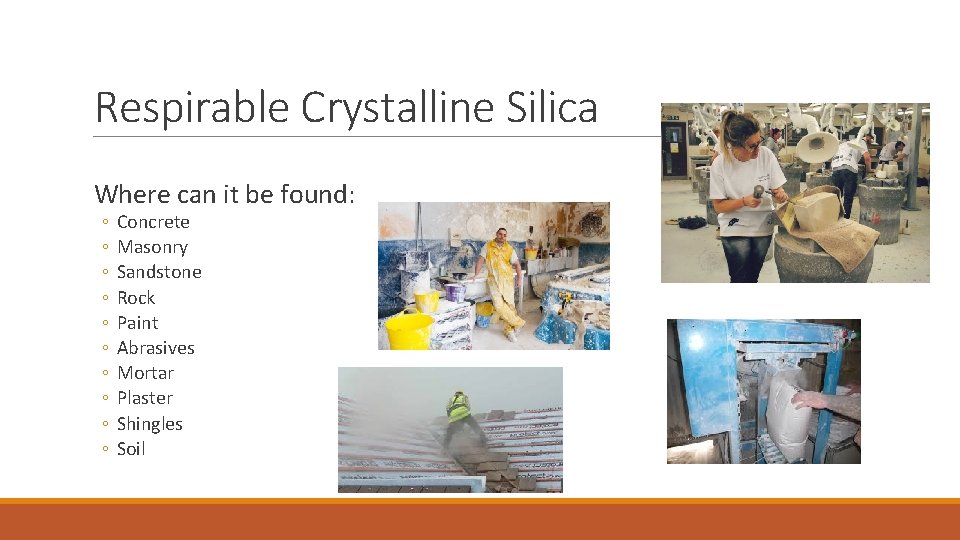
Respirable Crystalline Silica Where can it be found: ◦ ◦ ◦ ◦ ◦ Concrete Masonry Sandstone Rock Paint Abrasives Mortar Plaster Shingles Soil
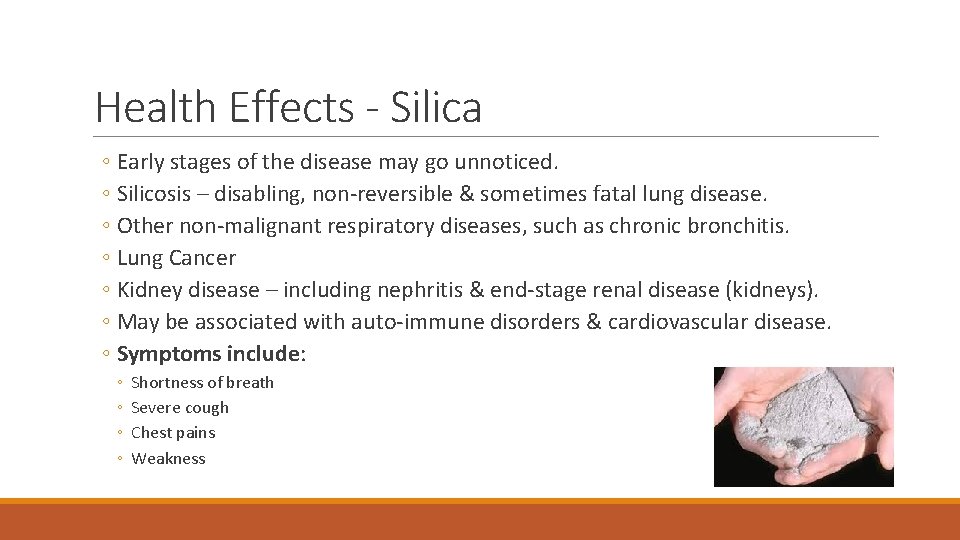
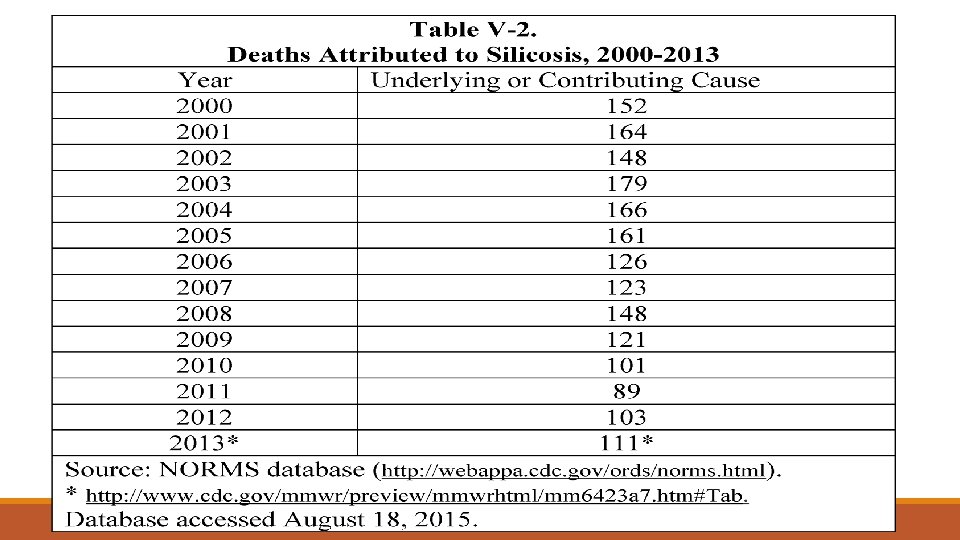
Health Effects - Silica ◦ Early stages of the disease may go unnoticed. ◦ Silicosis – disabling, non-reversible & sometimes fatal lung disease. ◦ Other non-malignant respiratory diseases, such as chronic bronchitis. ◦ Lung Cancer ◦ Kidney disease – including nephritis & end-stage renal disease (kidneys). ◦ May be associated with auto-immune disorders & cardiovascular disease. ◦ Symptoms include: ◦ ◦ Shortness of breath Severe cough Chest pains Weakness
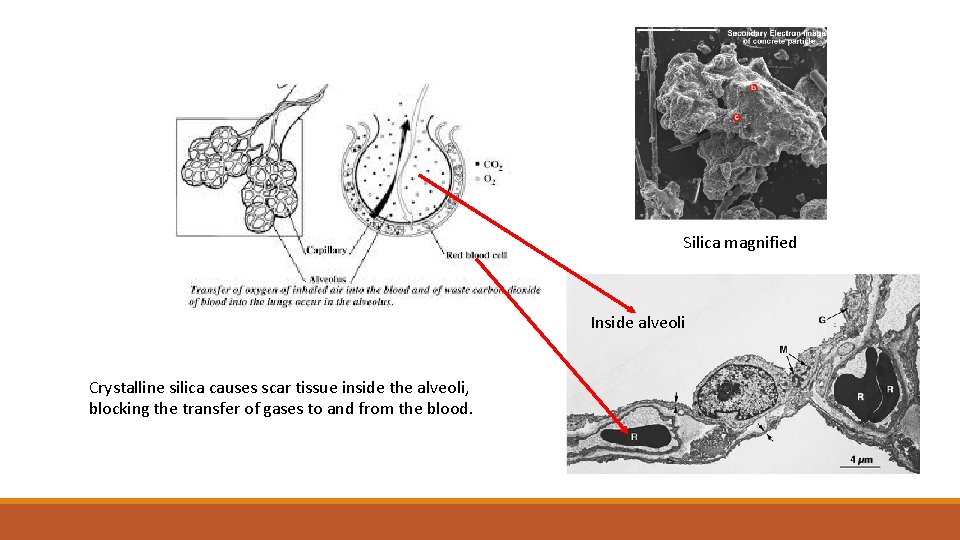
Silica magnified Inside alveoli Crystalline silica causes scar tissue inside the alveoli, blocking the transfer of gases to and from the blood.
Warning! Silicosis IS NOT CURABLE, but it IS PREVENTABLE. Don’t be like THAT guy!
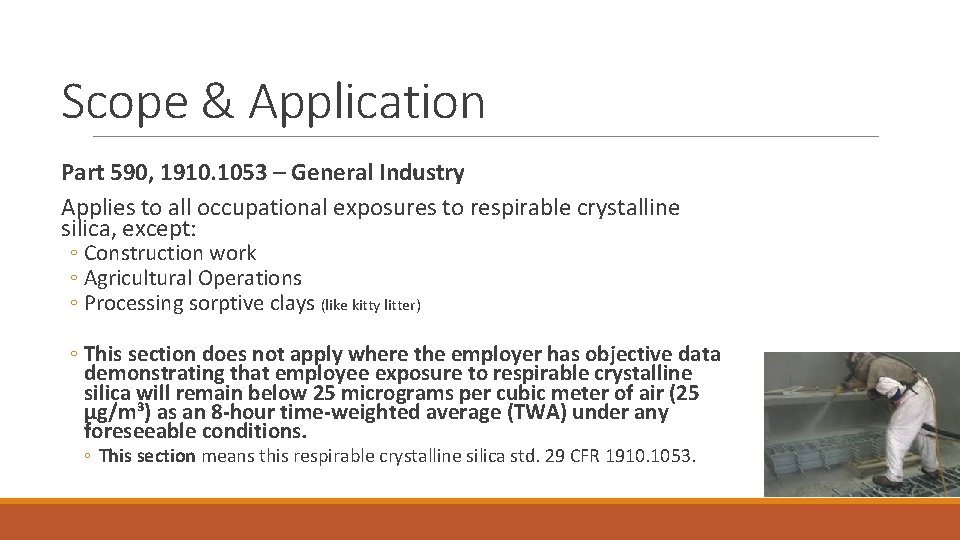
Scope & Application Part 590, 1910. 1053 – General Industry Applies to all occupational exposures to respirable crystalline silica, except: ◦ Construction work ◦ Agricultural Operations ◦ Processing sorptive clays (like kitty litter) ◦ This section does not apply where the employer has objective data demonstrating that employee exposure to respirable crystalline silica will remain below 25 micrograms per cubic meter of air (25 µg/m³) as an 8 -hour time-weighted average (TWA) under any foreseeable conditions. ◦ This section means this respirable crystalline silica std. 29 CFR 1910. 1053.
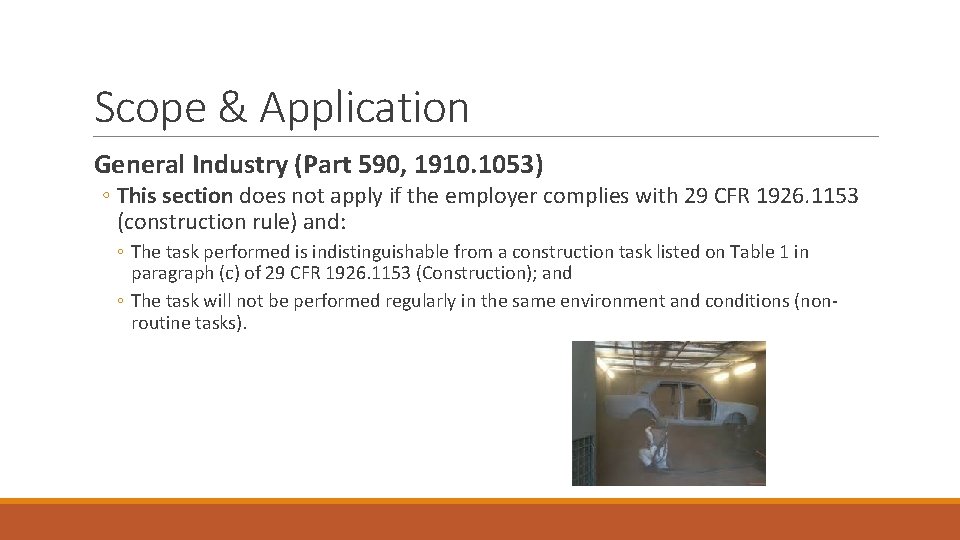
Scope & Application General Industry (Part 590, 1910. 1053) ◦ This section does not apply if the employer complies with 29 CFR 1926. 1153 (construction rule) and: ◦ The task performed is indistinguishable from a construction task listed on Table 1 in paragraph (c) of 29 CFR 1926. 1153 (Construction); and ◦ The task will not be performed regularly in the same environment and conditions (nonroutine tasks).
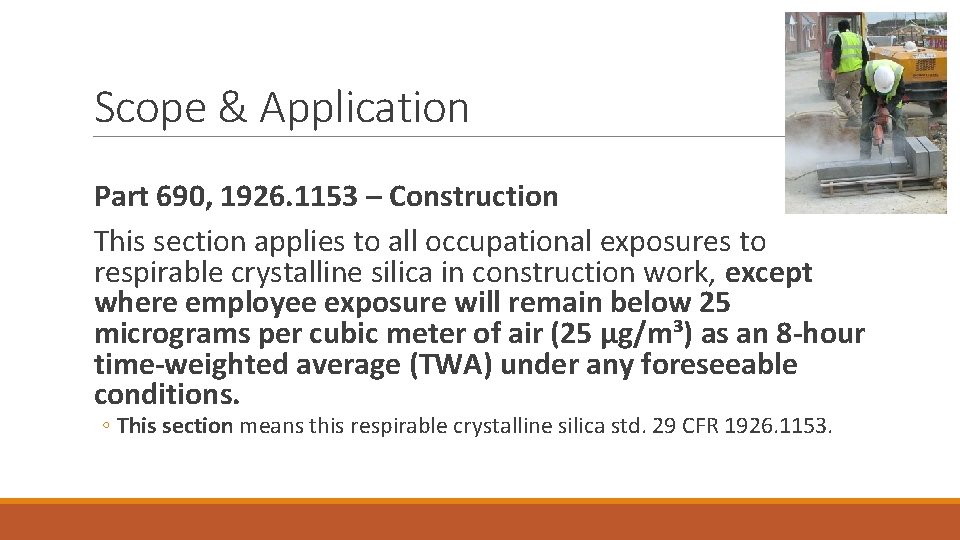
Scope & Application Part 690, 1926. 1153 – Construction This section applies to all occupational exposures to respirable crystalline silica in construction work, except where employee exposure will remain below 25 micrograms per cubic meter of air (25 µg/m³) as an 8 -hour time-weighted average (TWA) under any foreseeable conditions. ◦ This section means this respirable crystalline silica std. 29 CFR 1926. 1153.
Definitions Action Level = 25 µg/m³ (0. 025 mg/m³) Permissible exposure limit (PEL) = 50 µg/m³ (0. 050 mg/m³) Employee exposure = Means the exposure to airborne respirable crystalline silica that would occur if the employee were not using a respirator. High-efficiency particulate air [HEPA] filter = Means a filter that is at least 99. 97 percent efficient in removing mono-dispersed (a uniform collection of size) particles of 0. 3 micrometers in diameter. Objective data = means information (air monitoring data) from industry wide surveys/calculations based on the composition of a substance, demonstrating employee exposure to respirable crystalline silica associated with a particular product/material/task/activity. Data must reflect workplace conditions closely resembling or with a higher exposure potential than the processes, types of material, control methods, work practices, and environmental conditions in the employer’s current operations.
Definitions Competent person (construction) = means an individual who is capable of identifying existing and foreseeable respirable crystalline silica hazards in the workplace and who has the authorization to take prompt corrective measures to eliminate or minimize them. The competent person must have knowledge and ability necessary to fulfill the responsibilities set forth in paragraph (g) of this section. By way of training and/or experience, a competent person is knowledgeable of applicable standards, is capable of identifying workplace hazards relating to the specific operation, and has the authority to correct them. - There are currently no specific standards regarding competent person requirements.
Definitions Physician or other licensed health care professional [PLHCP] = means an individual whose legally permitted scope of practice (i. e. , license, registration, or certification) allows him or her to independently provide or be delegated the responsibility to provide some or all of the particular health care services required by paragraph (h) of this section. Regulated area (GI) = means an area, demarcated by the employer, where an employee’s exposure to airborne concentrations of respirable crystalline silica exceeds, or can reasonably be expected to exceed, the PEL. Respirable crystalline silica = means quartz, cristobalite, and/or tridymite contained in airborne particles that are determined to be respirable by a sampling device designed to meet the characteristics for respirable-particle-size-selective samplers specified in the international Organization for Standardization (ISO) 7708: 1995: Air Quality – Particle Size Fraction Definitions for Health-Related Sampling.
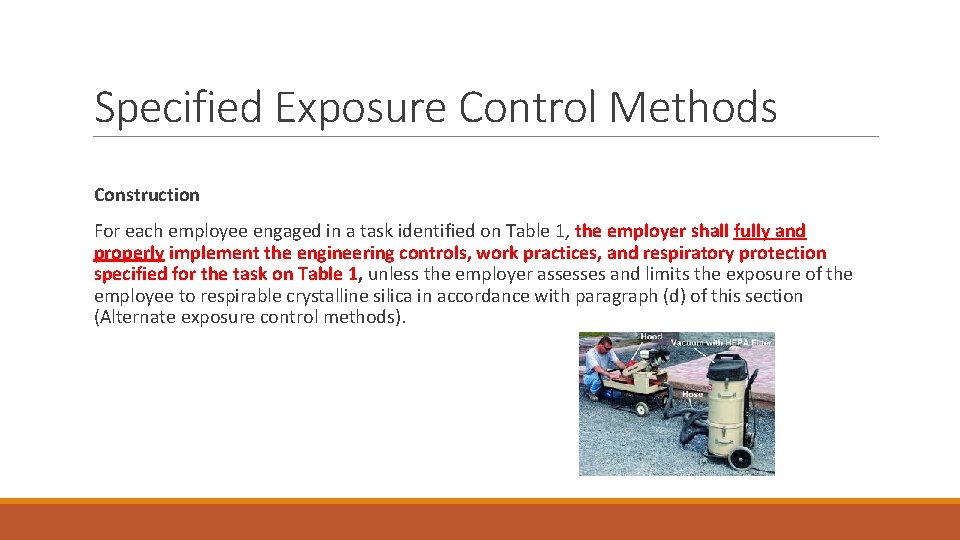
Specified Exposure Control Methods Construction For each employee engaged in a task identified on Table 1, the employer shall fully and properly implement the engineering controls, work practices, and respiratory protection specified for the task on Table 1, unless the employer assesses and limits the exposure of the employee to respirable crystalline silica in accordance with paragraph (d) of this section (Alternate exposure control methods).
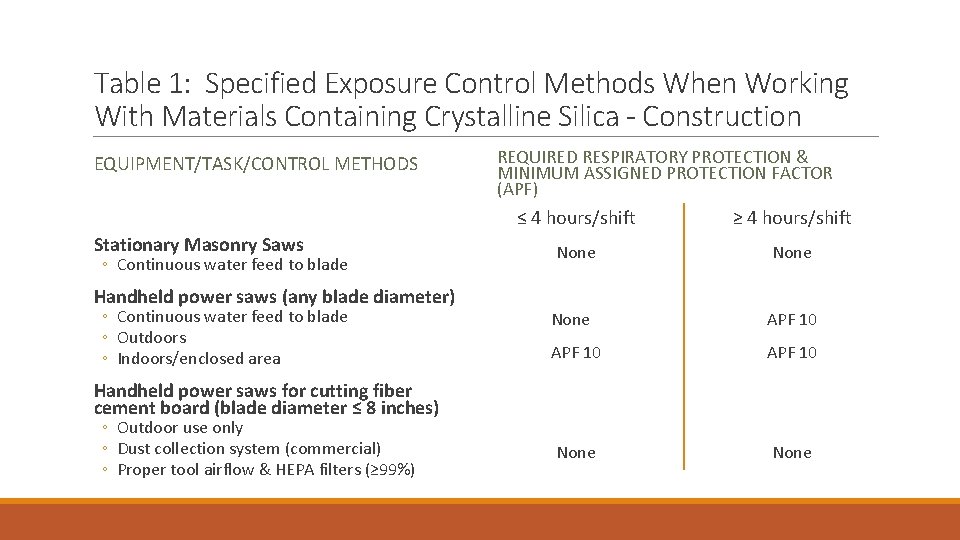
Table 1: Specified Exposure Control Methods When Working With Materials Containing Crystalline Silica - Construction EQUIPMENT/TASK/CONTROL METHODS Stationary Masonry Saws ◦ Continuous water feed to blade Handheld power saws (any blade diameter) ◦ Continuous water feed to blade ◦ Outdoors ◦ Indoors/enclosed area REQUIRED RESPIRATORY PROTECTION & MINIMUM ASSIGNED PROTECTION FACTOR (APF) ≤ 4 hours/shift ≥ 4 hours/shift None APF 10 None Handheld power saws for cutting fiber cement board (blade diameter ≤ 8 inches) ◦ Outdoor use only ◦ Dust collection system (commercial) ◦ Proper tool airflow & HEPA filters (≥ 99%)
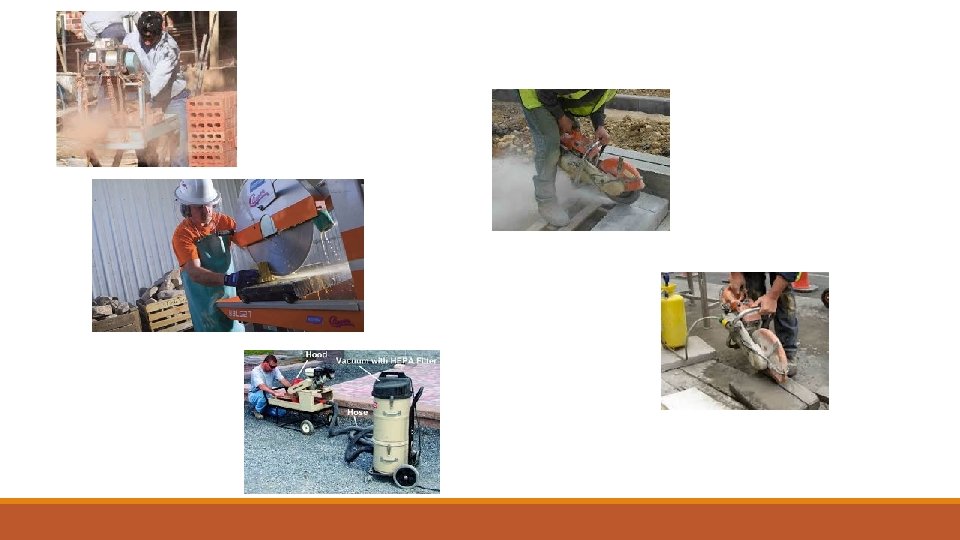
Table 1: Specified Exposure Control Methods When Working With Materials Containing Crystalline Silica EQUIPMENT/TASK/CONTROL METHODS ◦ Walk-behind saws ◦ Continuous water feed to blade ◦ Outdoors ◦ Indoors/enclosed area ◦ Drivable saws ◦ Outdoors only ◦ Continuous water feed to blade REQUIRED RESPIRATORY PROTECTION & MINIMUM ASSIGNED PROTECTION FACTOR (APF) ≤ 4 hours/shift ≥ 4 hours/shift None APF 10 None ◦ Rig-mounted core saws/drills ◦ Continuous water feed to blade
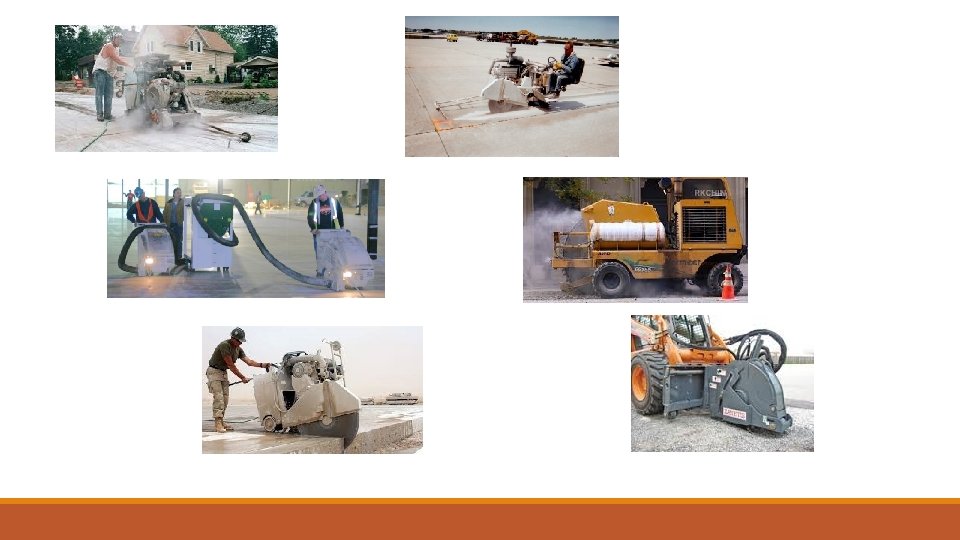
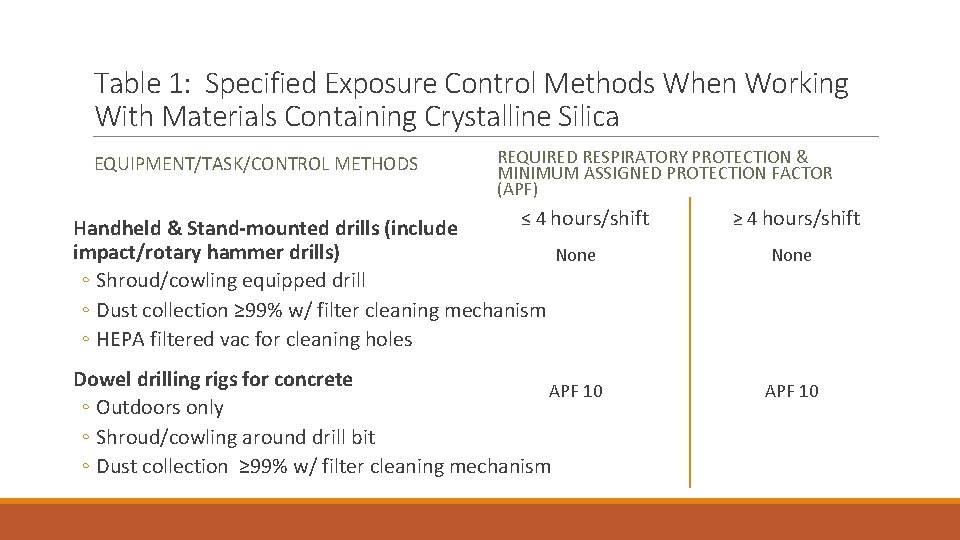
Table 1: Specified Exposure Control Methods When Working With Materials Containing Crystalline Silica EQUIPMENT/TASK/CONTROL METHODS REQUIRED RESPIRATORY PROTECTION & MINIMUM ASSIGNED PROTECTION FACTOR (APF) ≤ 4 hours/shift Handheld & Stand-mounted drills (include impact/rotary hammer drills) None ◦ Shroud/cowling equipped drill ◦ Dust collection ≥ 99% w/ filter cleaning mechanism ◦ HEPA filtered vac for cleaning holes Dowel drilling rigs for concrete APF 10 ◦ Outdoors only ◦ Shroud/cowling around drill bit ◦ Dust collection ≥ 99% w/ filter cleaning mechanism ≥ 4 hours/shift None APF 10
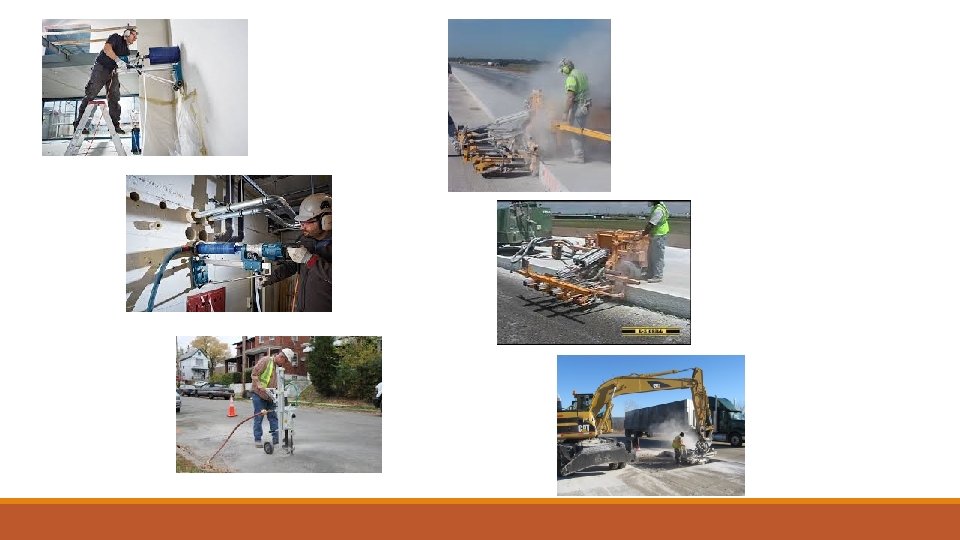
Table 1: Specified Exposure Control Methods When Working With Materials Containing Crystalline Silica EQUIPMENT/TASK/CONTROL METHODS REQUIRED RESPIRATORY PROTECTION & MINIMUM ASSIGNED PROTECTION FACTOR (APF) ≤ 4 hours/shift • Vehicle-mounted drilling rigs for rock/concrete • Dust collection system w/ close capture hood/shroud around drill bit w/ low-flow water spray to wet dust at discharge point from dust collector Or • Operate from within an enclosed cab and use water for dust suppression on drill bit ≥ 4 hours/shift None
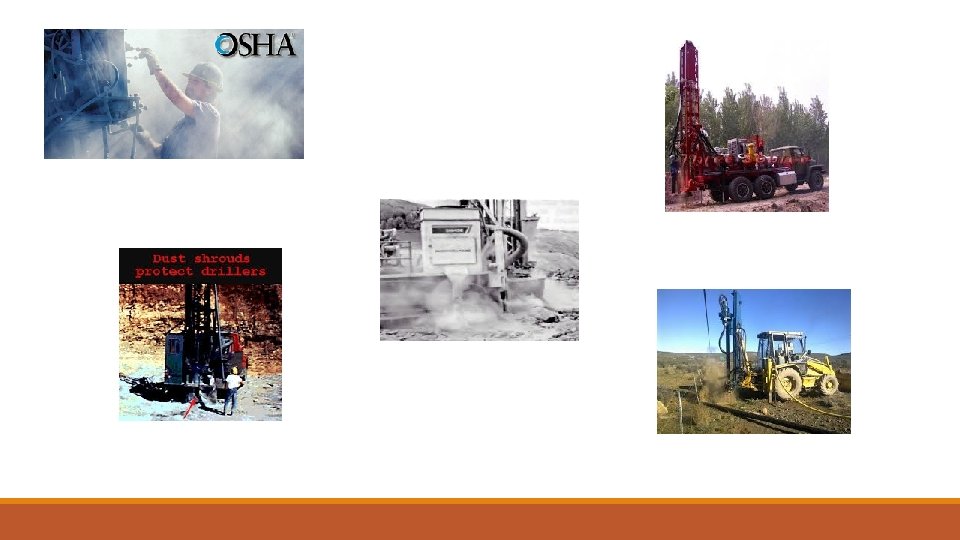
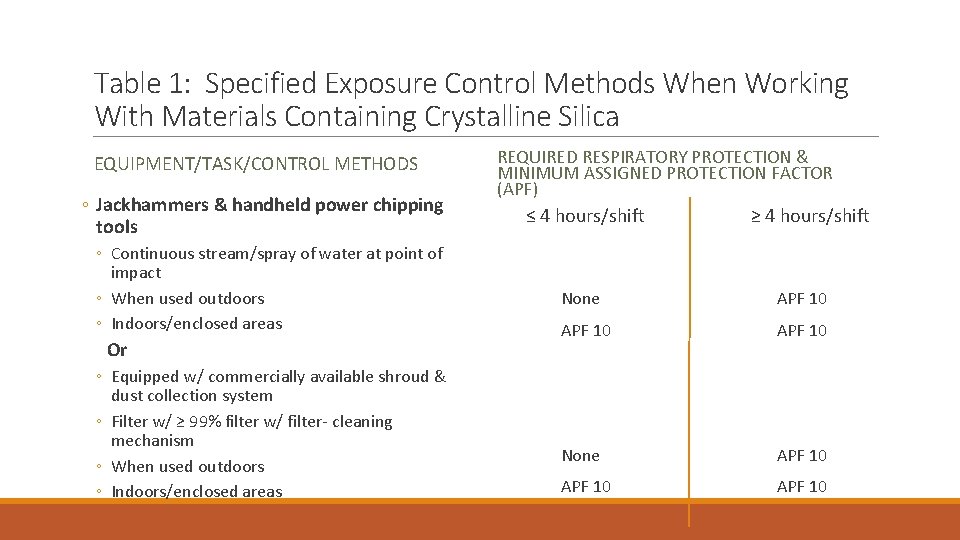
Table 1: Specified Exposure Control Methods When Working With Materials Containing Crystalline Silica EQUIPMENT/TASK/CONTROL METHODS ◦ Jackhammers & handheld power chipping tools ◦ Continuous stream/spray of water at point of impact ◦ When used outdoors ◦ Indoors/enclosed areas Or ◦ Equipped w/ commercially available shroud & dust collection system ◦ Filter w/ ≥ 99% filter w/ filter- cleaning mechanism ◦ When used outdoors ◦ Indoors/enclosed areas REQUIRED RESPIRATORY PROTECTION & MINIMUM ASSIGNED PROTECTION FACTOR (APF) ≤ 4 hours/shift ≥ 4 hours/shift None APF 10 APF 10
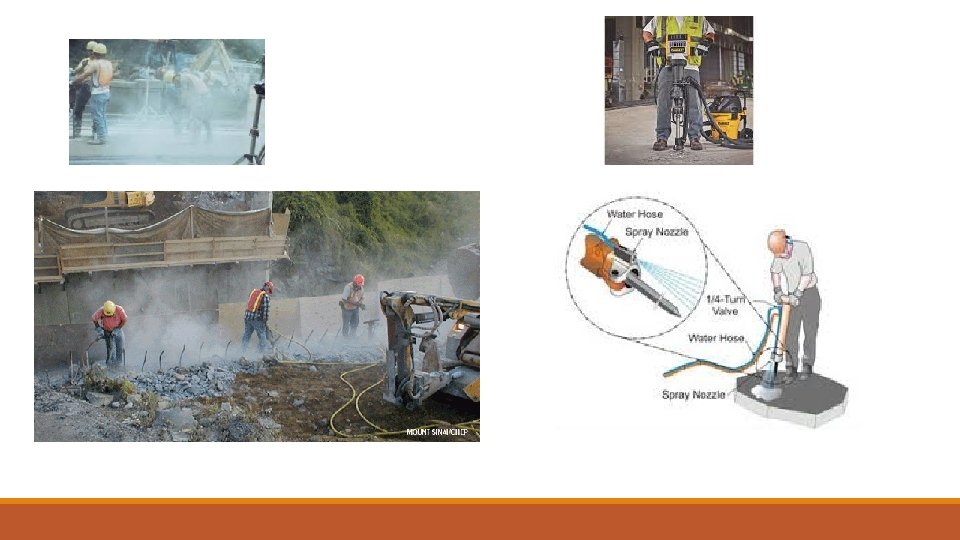
Table 1: Specified Exposure Control Methods When Working With Materials Containing Crystalline Silica EQUIPMENT/TASK/CONTROL METHODS REQUIRED RESPIRATORY PROTECTION & MINIMUM ASSIGNED PROTECTION FACTOR (APF) ≤ 4 hours/shift ≥ 4 hours/shift APF 10 APF 25 Handheld grinders for mortar removal (i. e. , tuckpointing) ◦ Equipped w/ commercially available shroud & dust collection ◦ Dust collector must provide ≥ 25 cfm per inch of wheel diameter ◦ Filter w/ ≥ 99% efficiency ◦ Cyclonic pre-separator or filter-cleaning mechanism
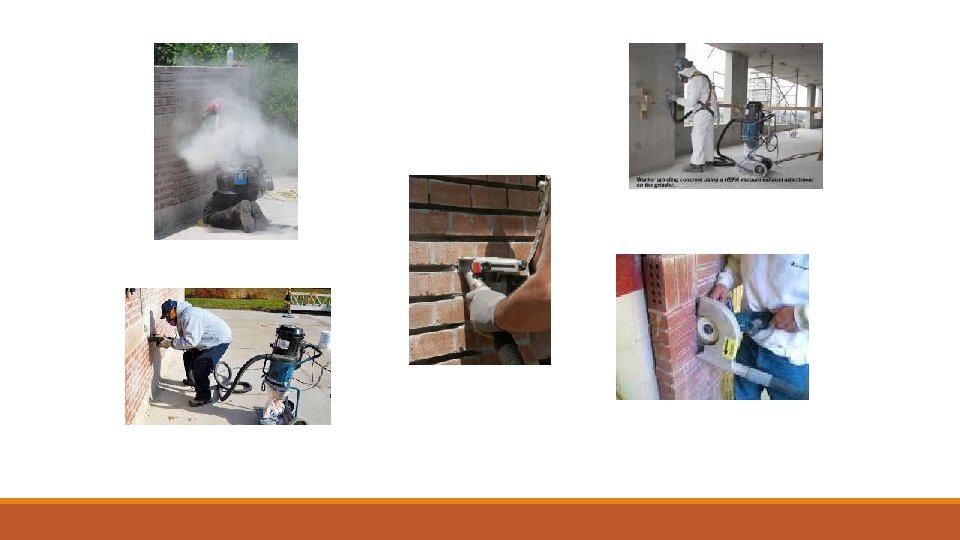
Table 1: Specified Exposure Control Methods When Working With Materials Containing Crystalline Silica EQUIPMENT/TASK/CONTROL METHODS Handheld grinders for uses other than mortar removal ◦ Performed outdoors only ◦ Equipped w/ integrated water delivery system for continuous water feed to the grinding surface Or ◦ Equipped w/ commercial shroud & dust collection ◦ Dust collector must provide ≥ 25 cfm of airflow per inch of wheel diameter ◦ Filter w/ ≥ 99% efficiency ◦ Use cyclonic pre-separator or filter cleaning mechanism ◦ When used outdoors ◦ Indoors/enclosed areas REQUIRED RESPIRATORY PROTECTION & MINIMUM ASSIGNED PROTECTION FACTOR (APF) ≤ 4 hours/shift ≥ 4 hours/shift None None APF 10
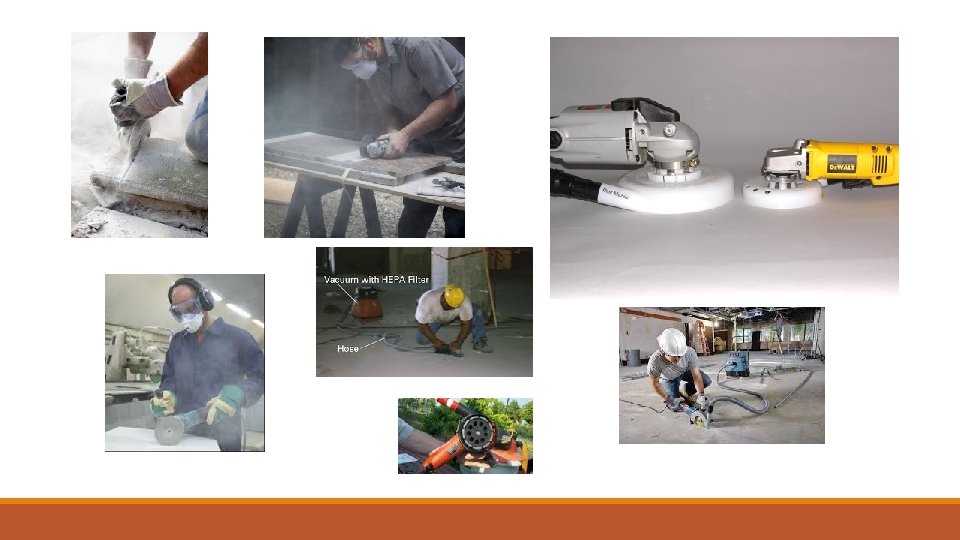
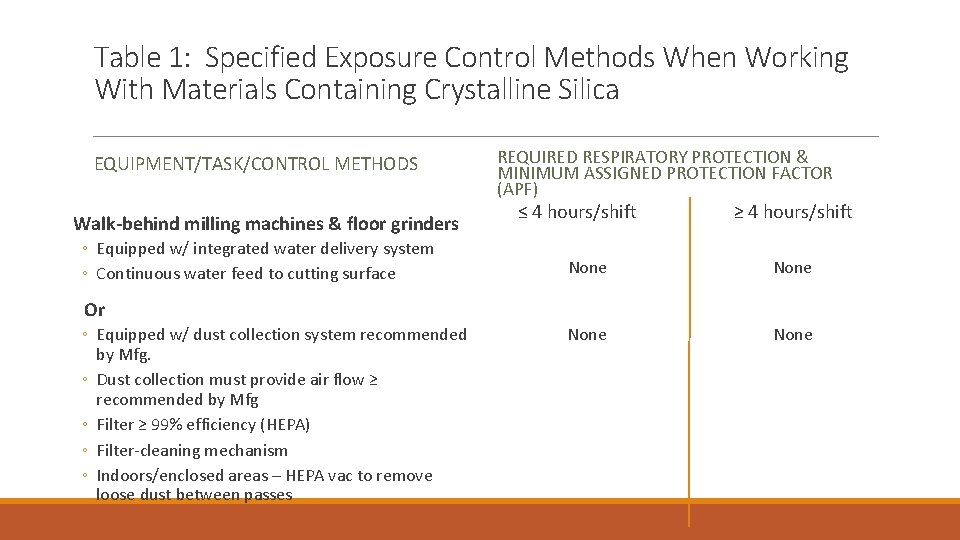
Table 1: Specified Exposure Control Methods When Working With Materials Containing Crystalline Silica EQUIPMENT/TASK/CONTROL METHODS Walk-behind milling machines & floor grinders ◦ Equipped w/ integrated water delivery system ◦ Continuous water feed to cutting surface REQUIRED RESPIRATORY PROTECTION & MINIMUM ASSIGNED PROTECTION FACTOR (APF) ≤ 4 hours/shift ≥ 4 hours/shift None Or ◦ Equipped w/ dust collection system recommended by Mfg. ◦ Dust collection must provide air flow ≥ recommended by Mfg ◦ Filter ≥ 99% efficiency (HEPA) ◦ Filter-cleaning mechanism ◦ Indoors/enclosed areas – HEPA vac to remove loose dust between passes
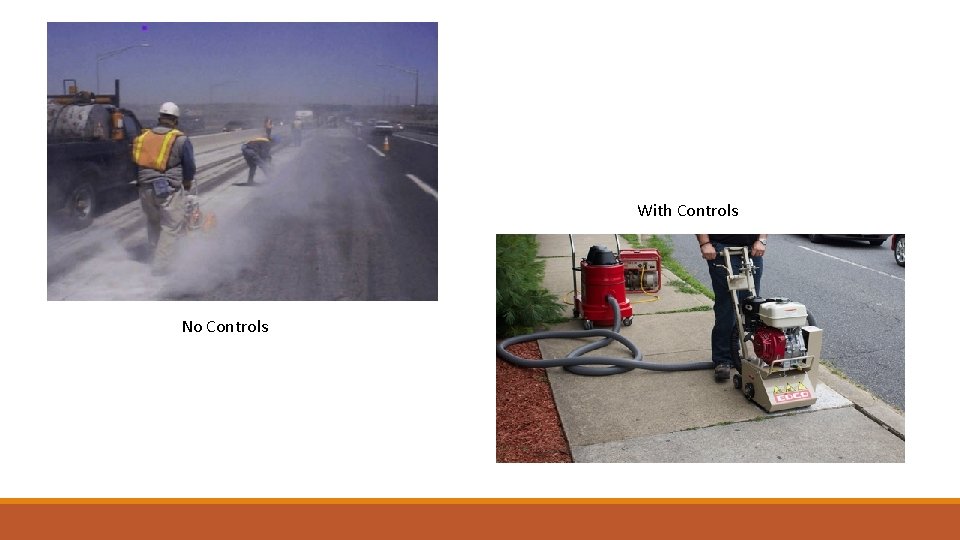
With Controls No Controls
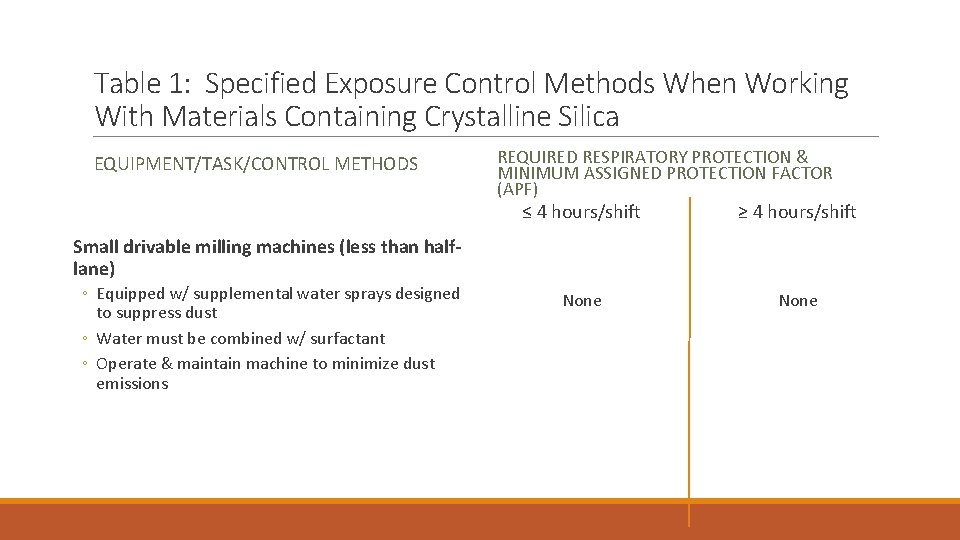
Table 1: Specified Exposure Control Methods When Working With Materials Containing Crystalline Silica EQUIPMENT/TASK/CONTROL METHODS REQUIRED RESPIRATORY PROTECTION & MINIMUM ASSIGNED PROTECTION FACTOR (APF) ≤ 4 hours/shift ≥ 4 hours/shift None Small drivable milling machines (less than halflane) ◦ Equipped w/ supplemental water sprays designed to suppress dust ◦ Water must be combined w/ surfactant ◦ Operate & maintain machine to minimize dust emissions
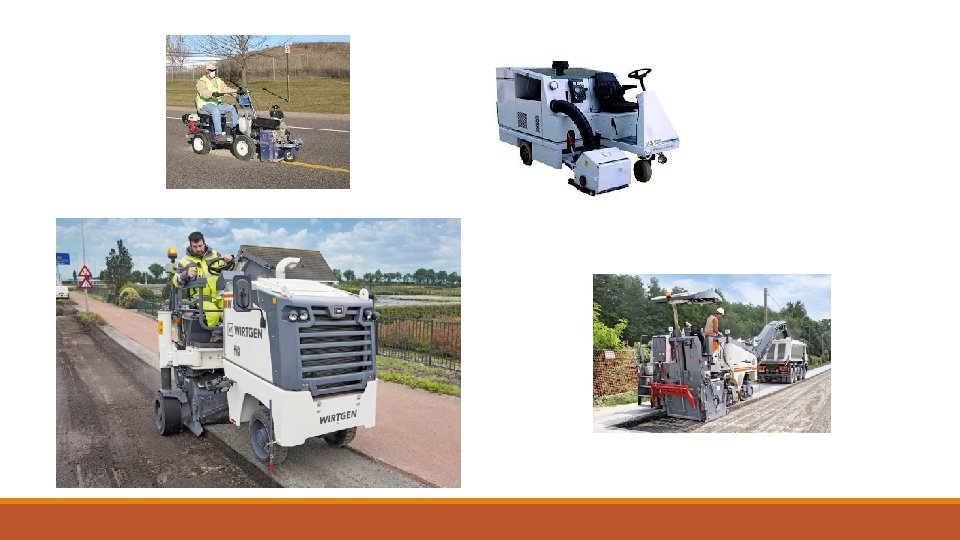
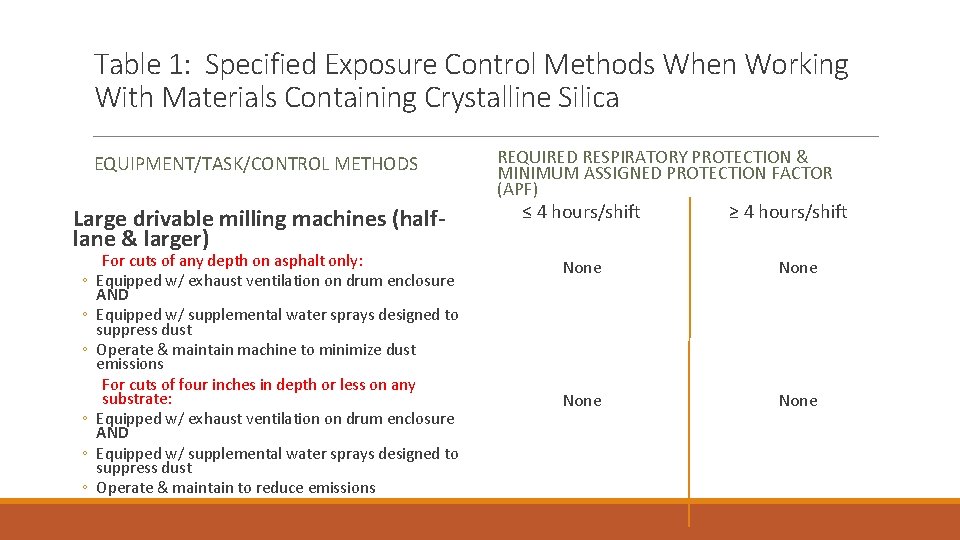
Table 1: Specified Exposure Control Methods When Working With Materials Containing Crystalline Silica EQUIPMENT/TASK/CONTROL METHODS Large drivable milling machines (halflane & larger) ◦ ◦ ◦ For cuts of any depth on asphalt only: Equipped w/ exhaust ventilation on drum enclosure AND Equipped w/ supplemental water sprays designed to suppress dust Operate & maintain machine to minimize dust emissions For cuts of four inches in depth or less on any substrate: Equipped w/ exhaust ventilation on drum enclosure AND Equipped w/ supplemental water sprays designed to suppress dust Operate & maintain to reduce emissions REQUIRED RESPIRATORY PROTECTION & MINIMUM ASSIGNED PROTECTION FACTOR (APF) ≤ 4 hours/shift ≥ 4 hours/shift None
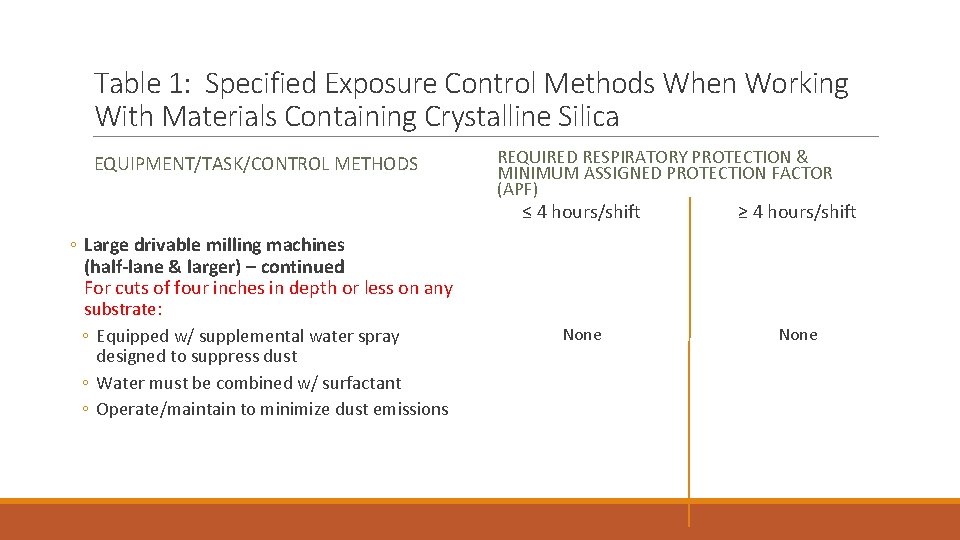
Table 1: Specified Exposure Control Methods When Working With Materials Containing Crystalline Silica EQUIPMENT/TASK/CONTROL METHODS REQUIRED RESPIRATORY PROTECTION & MINIMUM ASSIGNED PROTECTION FACTOR (APF) ≤ 4 hours/shift ≥ 4 hours/shift None ◦ Large drivable milling machines (half-lane & larger) – continued For cuts of four inches in depth or less on any substrate: ◦ Equipped w/ supplemental water spray designed to suppress dust ◦ Water must be combined w/ surfactant ◦ Operate/maintain to minimize dust emissions
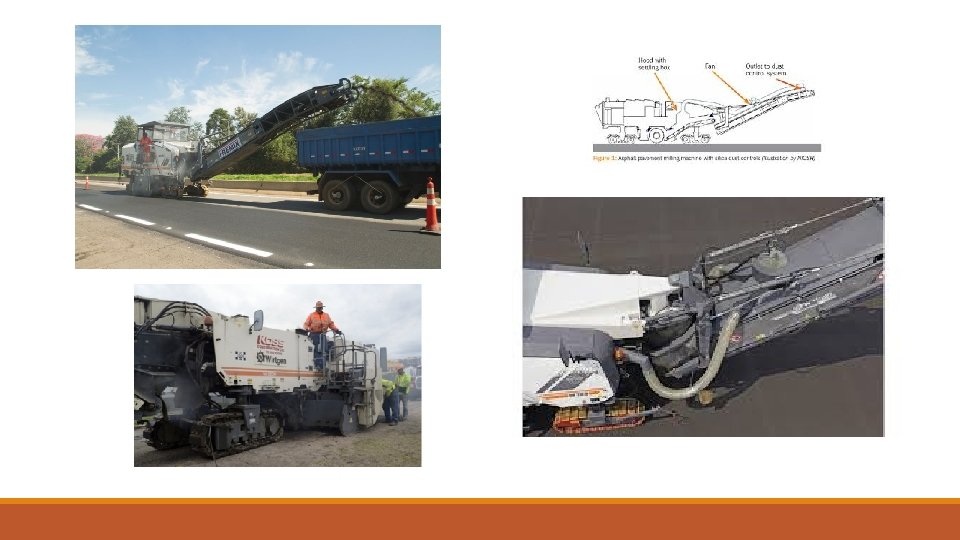
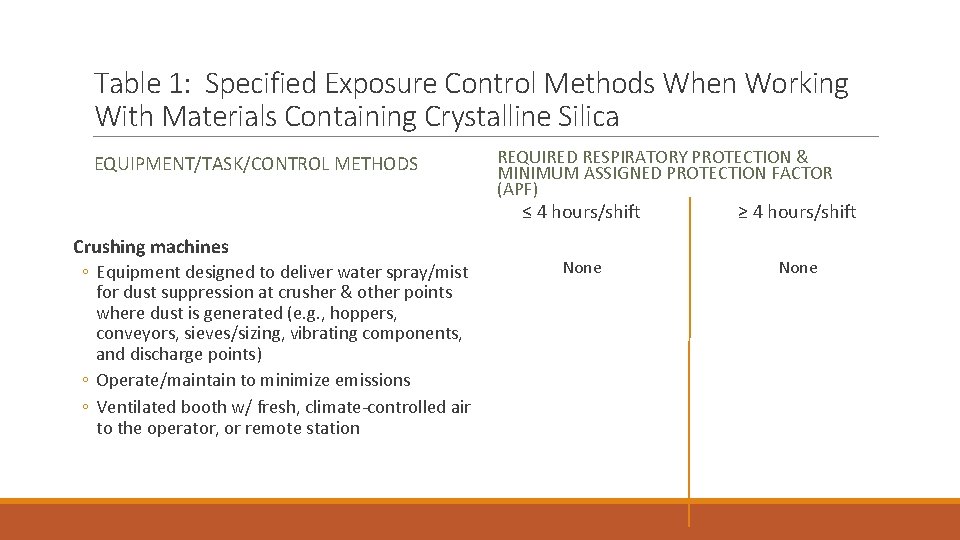
Table 1: Specified Exposure Control Methods When Working With Materials Containing Crystalline Silica EQUIPMENT/TASK/CONTROL METHODS Crushing machines ◦ Equipment designed to deliver water spray/mist for dust suppression at crusher & other points where dust is generated (e. g. , hoppers, conveyors, sieves/sizing, vibrating components, and discharge points) ◦ Operate/maintain to minimize emissions ◦ Ventilated booth w/ fresh, climate-controlled air to the operator, or remote station REQUIRED RESPIRATORY PROTECTION & MINIMUM ASSIGNED PROTECTION FACTOR (APF) ≤ 4 hours/shift ≥ 4 hours/shift None
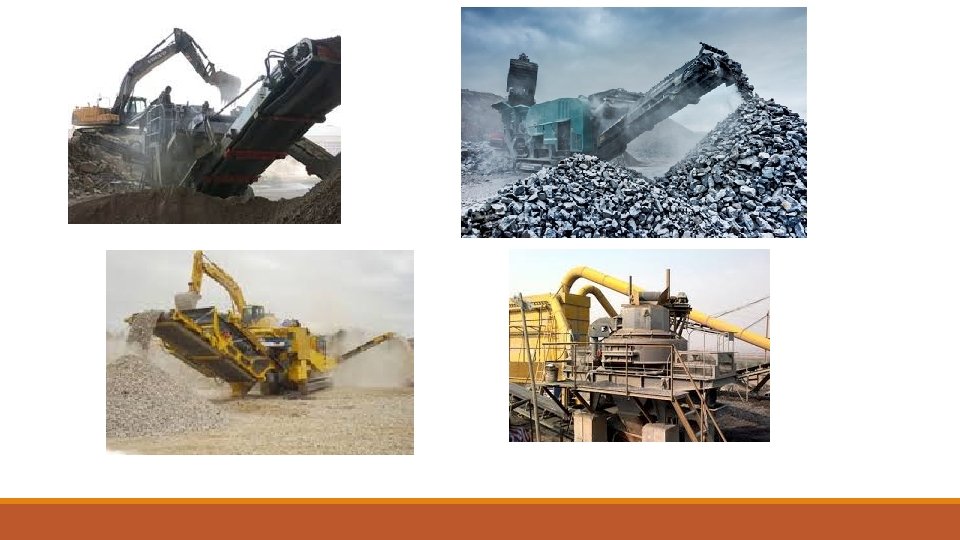
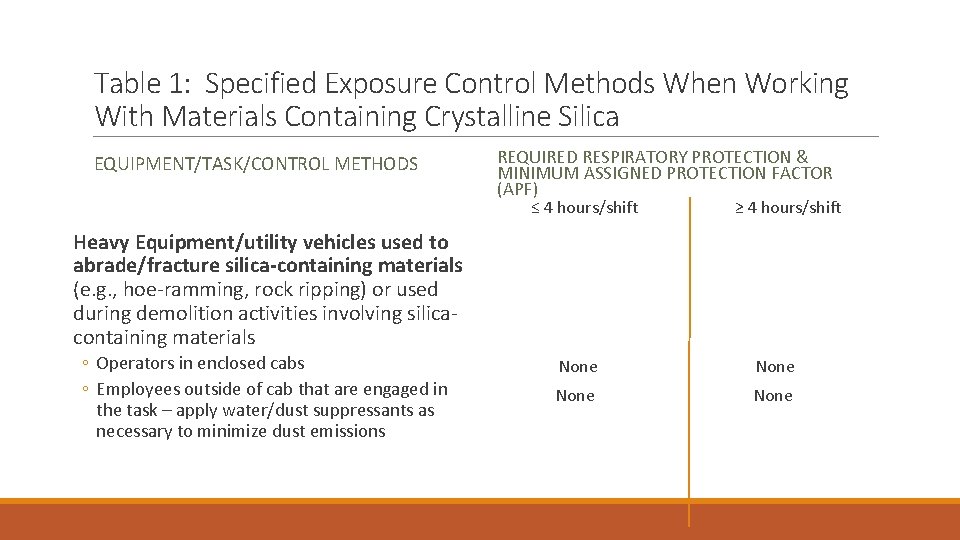
Table 1: Specified Exposure Control Methods When Working With Materials Containing Crystalline Silica EQUIPMENT/TASK/CONTROL METHODS REQUIRED RESPIRATORY PROTECTION & MINIMUM ASSIGNED PROTECTION FACTOR (APF) ≤ 4 hours/shift ≥ 4 hours/shift Heavy Equipment/utility vehicles used to abrade/fracture silica-containing materials (e. g. , hoe-ramming, rock ripping) or used during demolition activities involving silicacontaining materials ◦ Operators in enclosed cabs ◦ Employees outside of cab that are engaged in the task – apply water/dust suppressants as necessary to minimize dust emissions None
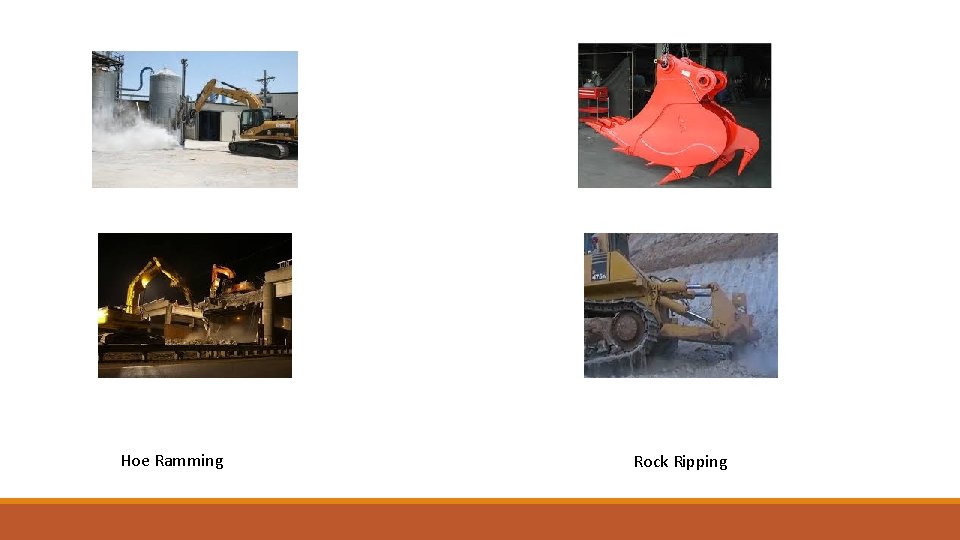
Hoe Ramming Rock Ripping
Table 1: Specified Exposure Control Methods When Working With Materials Containing Crystalline Silica EQUIPMENT/TASK/CONTROL METHODS REQUIRED RESPIRATORY PROTECTION & MINIMUM ASSIGNED PROTECTION FACTOR (APF) ≤ 4 hours/shift ≥ 4 hours/shift Heavy equipment & utility vehicles for tasks such as grading & excavating but not including: demolishing, abrading, or fracturing silica-containing materials ◦ Apply water and/or dust suppressants as necessary to minimize dust emissions Or ◦ When the equipment operator is the only employee engaged in the task, operate equipment from within an enclosed cab None
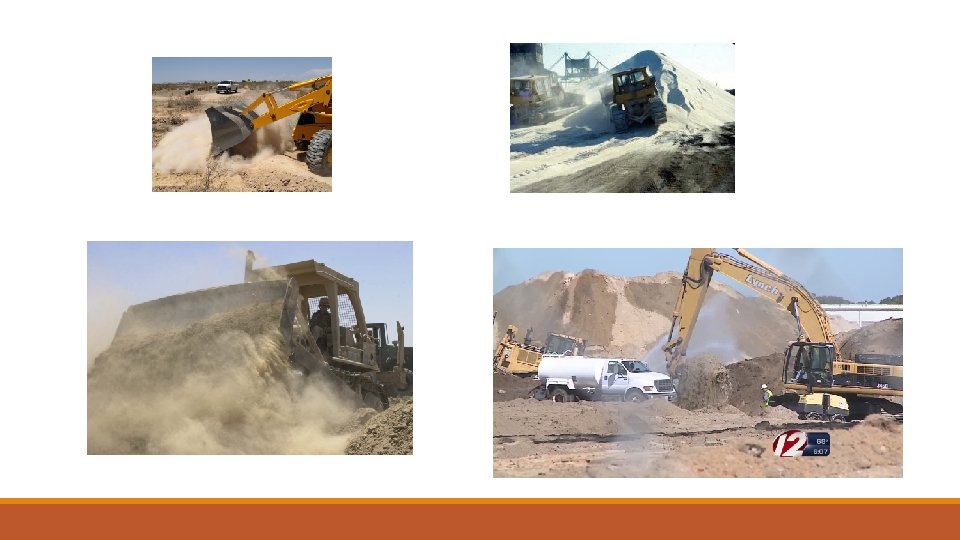
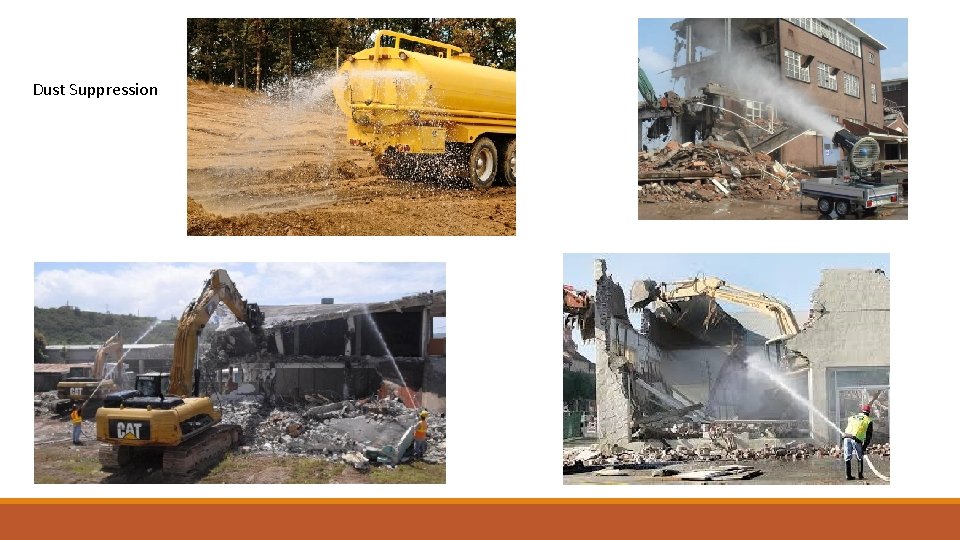
Dust Suppression
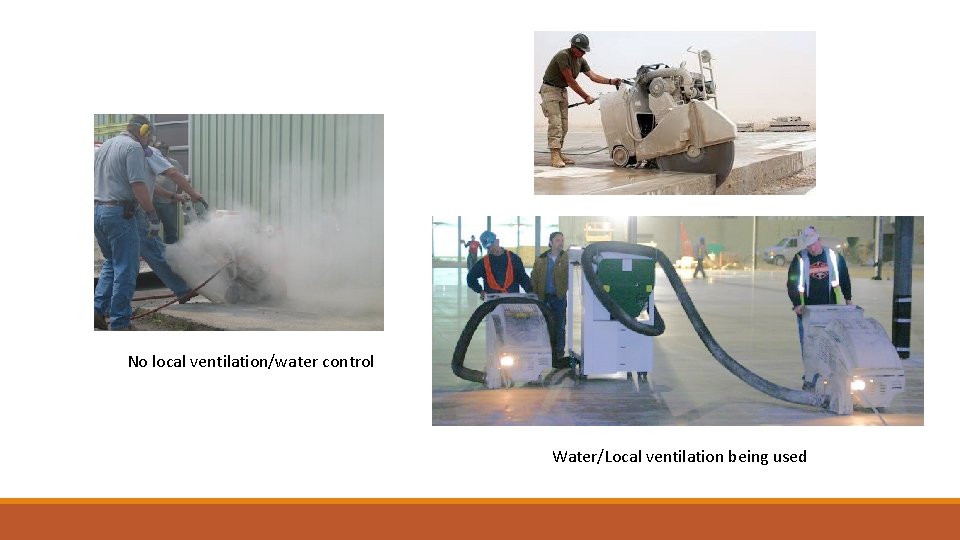
No local ventilation/water control Water/Local ventilation being used
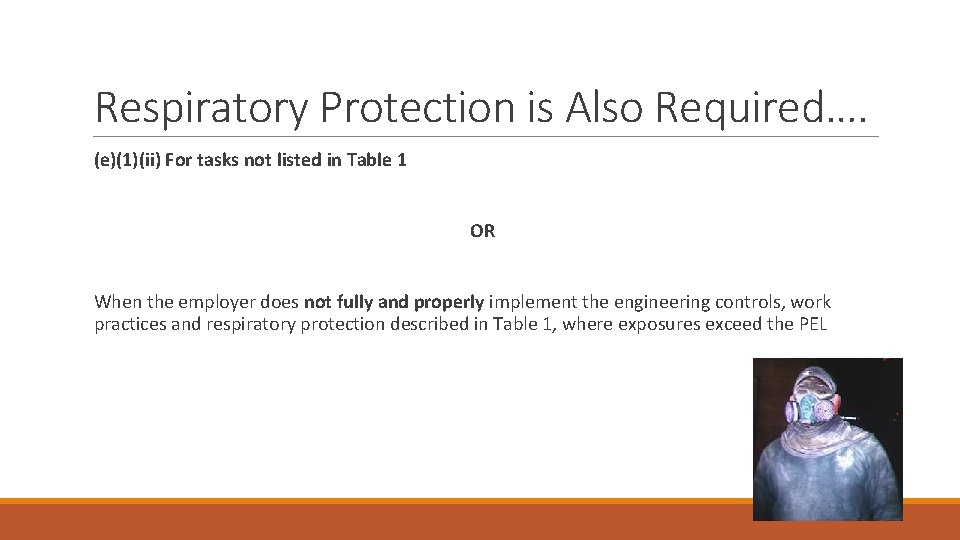
Respiratory Protection is Also Required…. (e)(1)(ii) For tasks not listed in Table 1 OR When the employer does not fully and properly implement the engineering controls, work practices and respiratory protection described in Table 1, where exposures exceed the PEL
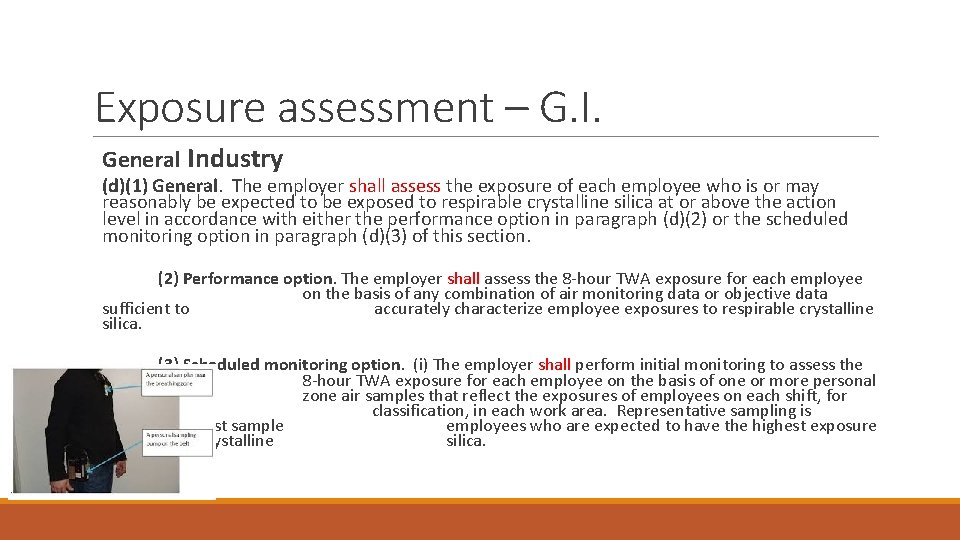
Exposure assessment – G. I. General Industry (d)(1) General. The employer shall assess the exposure of each employee who is or may reasonably be expected to be exposed to respirable crystalline silica at or above the action level in accordance with either the performance option in paragraph (d)(2) or the scheduled monitoring option in paragraph (d)(3) of this section. (2) Performance option. The employer shall assess the 8 -hour TWA exposure for each employee on the basis of any combination of air monitoring data or objective data sufficient to accurately characterize employee exposures to respirable crystalline silica. (3) Scheduled monitoring option. (i) The employer shall perform initial monitoring to assess the 8 -hour TWA exposure for each employee on the basis of one or more personal breathing zone air samples that reflect the exposures of employees on each shift, for each job classification, in each work area. Representative sampling is acceptable, must sample employees who are expected to have the highest exposure to respirable crystalline silica.
Exposure Assessment – G. I. ◦ (ii) If initial monitoring < A. L. (25 µg/m³), employer may discontinue monitoring of the represented employees for that exposure. ◦ (iii) Where the most recent exposure monitoring ≥ A. L. but ≤ PEL (50 µg/m³), the employer shall repeat such monitoring within six months of the most recent monitoring. ◦ (iv) Where the most recent exposure monitoring > PEL, repeat monitoring within 3 months of the most recent. ◦ (v) Where the most recent (non-initial) exposure monitoring < A. L. , employer shall repeat such monitoring within 6 months of the most recent monitoring until 2 consecutive measurements, taken 7 or more days apart, are < A. L. , employer may discontinue monitoring for those employees represented by such monitoring, except as otherwise provided in paragraph (d)(4) of this section. ◦ (4) Reassessment of exposures. The employer shall reassess exposures whenever a change in the production, process, control equipment, personnel, or work practices may reasonably be expected to result in new or additional exposures at or above the A. L. , or when the employer has any reason to believe that the new or additional exposures at or above the A. L. have occurred.
Employee Notification of Assessment Results Within 15 working days after completing an exposure assessment; ◦ Employer shall individually notify each affected employee in writing of the results. ◦ Employer can post results in appropriate location accessible to all affected employees. ◦ If exposures exceed the PEL, the employer shall describe in writing the corrective action being taken to reduce exposures. ◦ Observation of monitoring ◦ Affected employees or their designated reps have the option to observe the air monitoring. ◦ Observers must comply with the PPE requirements of the area.
Regulated Areas Establishment – The employer shall establish a regulated area wherever an employee’s exposure to airborne concentrations of respirable crystalline silica is, or can reasonably be expected to be, in excess of the PEL. Demarcation – The employer shall demarcate areas from the rest of the workplace in a manner that minimizes the number of employees exposed to silica within the regulated area. ◦ The employer shall post signs at all entrances to regulated areas that bear the legend specified in paragraph (j)(2) of this section. Access – The employer shall limit access to regulated areas to: Persons authorized and required by work duties to be present. Designated representatives exercising the right to observe. Any person authorized by the Occupational Safety and Health Act
Methods of Compliance Engineering & Work Practice Controls ◦ The employer shall use engineering and work practice controls to reduce and maintain employee exposures to or below the PEL – unless determined to be not feasible. ◦ Employer must use engineering controls regardless of feasibility. ◦ Employer will supplement engineering controls with respiratory protection. Written Exposure Control Plan ◦ The employer shall establish and implement a written exposure control plan that contains at least the following: ◦ A description of the tasks in the workplace that involve exposure to respirable crystalline silica. ◦ A description of engineering controls, work practices, and respiratory protection used to limit exposures to silica. ◦ A description of the housekeeping measures used to limit employee exposures. ◦ The Written Exposure Control Plan shall be review and evaluated annually ◦ The Written Exposure Control Plan shall be readily available for review and copy.
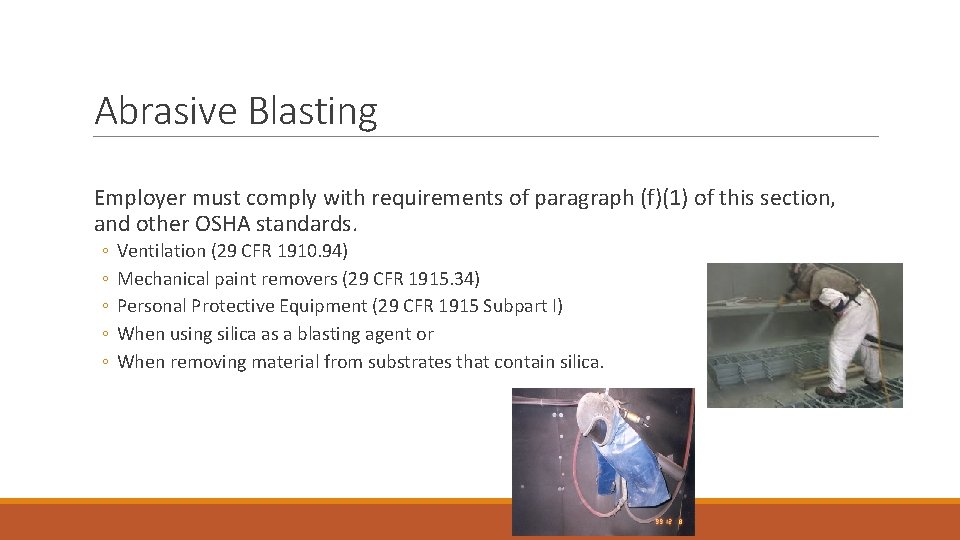
Abrasive Blasting Employer must comply with requirements of paragraph (f)(1) of this section, and other OSHA standards. ◦ ◦ ◦ Ventilation (29 CFR 1910. 94) Mechanical paint removers (29 CFR 1915. 34) Personal Protective Equipment (29 CFR 1915 Subpart I) When using silica as a blasting agent or When removing material from substrates that contain silica.
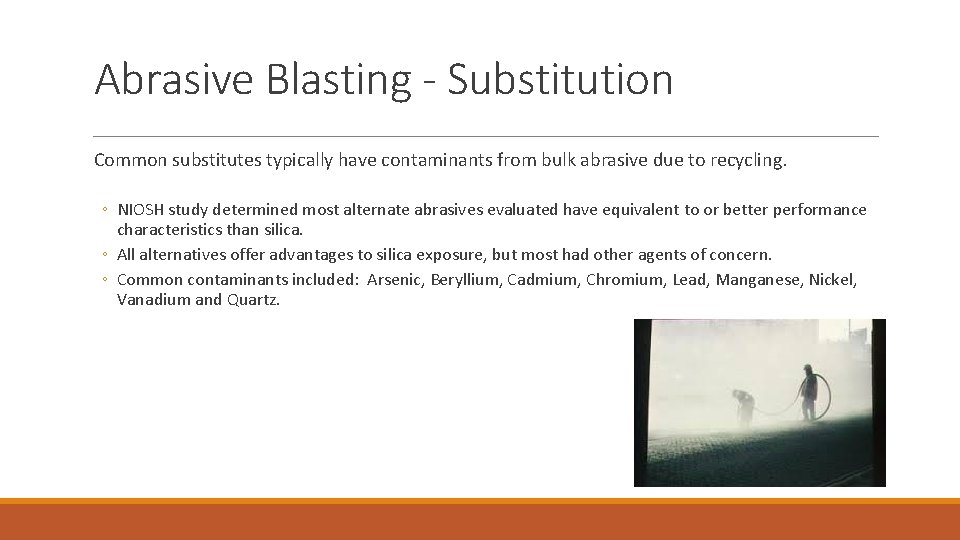
Abrasive Blasting - Substitution Common substitutes typically have contaminants from bulk abrasive due to recycling. ◦ NIOSH study determined most alternate abrasives evaluated have equivalent to or better performance characteristics than silica. ◦ All alternatives offer advantages to silica exposure, but most had other agents of concern. ◦ Common contaminants included: Arsenic, Beryllium, Cadmium, Chromium, Lead, Manganese, Nickel, Vanadium and Quartz.
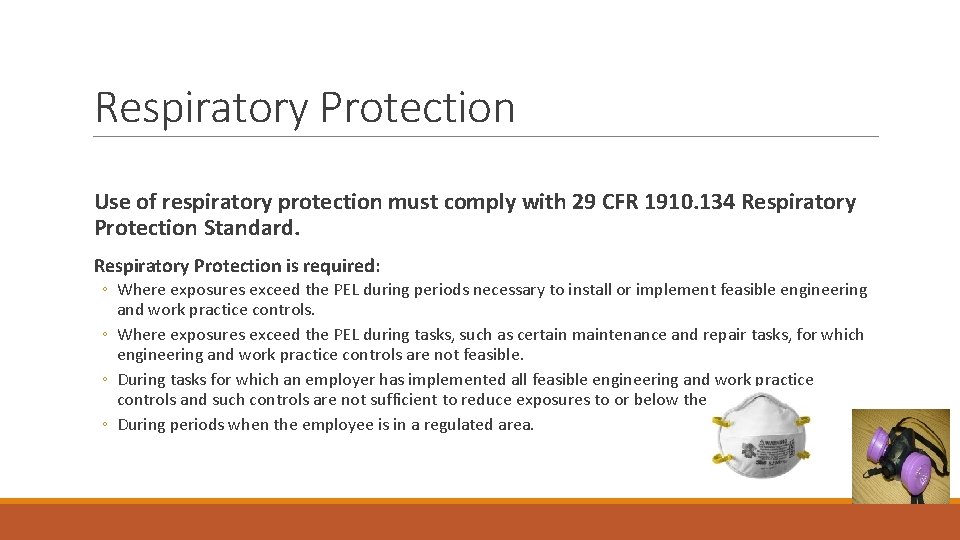
Respiratory Protection Use of respiratory protection must comply with 29 CFR 1910. 134 Respiratory Protection Standard. Respiratory Protection is required: ◦ Where exposures exceed the PEL during periods necessary to install or implement feasible engineering and work practice controls. ◦ Where exposures exceed the PEL during tasks, such as certain maintenance and repair tasks, for which engineering and work practice controls are not feasible. ◦ During tasks for which an employer has implemented all feasible engineering and work practice controls and such controls are not sufficient to reduce exposures to or below the PEL. ◦ During periods when the employee is in a regulated area.
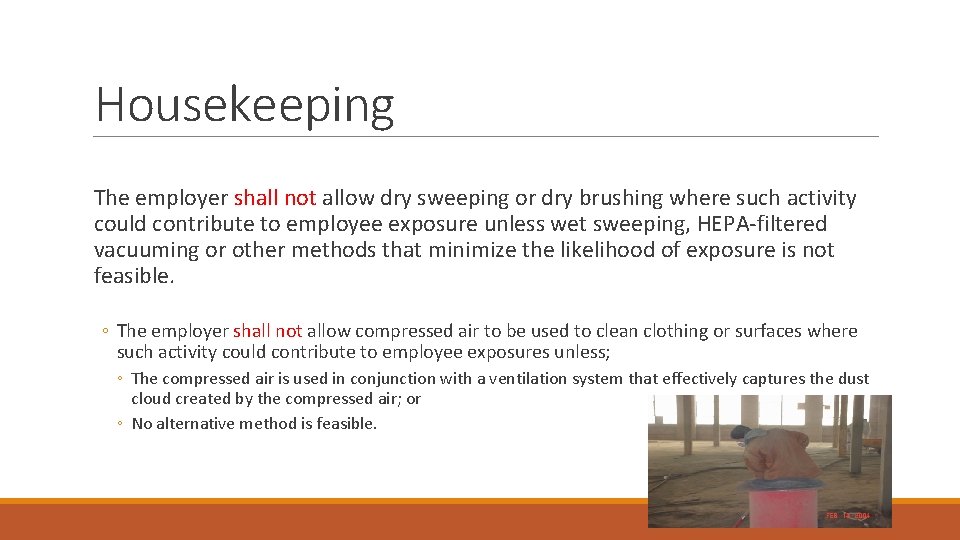
Housekeeping The employer shall not allow dry sweeping or dry brushing where such activity could contribute to employee exposure unless wet sweeping, HEPA-filtered vacuuming or other methods that minimize the likelihood of exposure is not feasible. ◦ The employer shall not allow compressed air to be used to clean clothing or surfaces where such activity could contribute to employee exposures unless; ◦ The compressed air is used in conjunction with a ventilation system that effectively captures the dust cloud created by the compressed air; or ◦ No alternative method is feasible.
Medical Surveillance General – The employer shall make medical surveillance available at no cost, at a reasonable time and place, for each employee who will be occupationally exposed to silica at or above the action level for 30 days or more per year. ◦ Performed by a PLHCP. ◦ Initial exam within 30 days of assignment or last 3 years if the exams were the same requirements. ◦ The exam will consist of: ◦ In-depth medical and work history (past, present, anticipated – silica exposures, other respiratory agents, respiratory dysfunction, TB and smoking history). ◦ Physical exam – special emphasis on the respiratory system. ◦ Chest x-rays – specific requirements see std. ◦ Pulmonary function test ◦ Testing for latent TB infection. ◦ Any other tests deemed appropriate by the PLHCP.
Medical Surveillance – cont. Periodic Exams – every 3 years, or more frequent if recommended by PLHCP. Information provided to the PLHCP ◦ ◦ Copy of the standard Description of employee’s former, current, anticipated duties related to silica exposures. Description of personal protective equipment to be used, including when and how long it is used. Information from records of employment-related medical exams previously provided to employee if possible (within the control of the employer). ◦ PLHCP’s written medical report for the employee ◦ PLHCP must explain to the employee. ◦ Provided within 30 days
Written Medical Report The written report shall contain: ◦ A statement indicating the results of the medical exam, any medical conditions that would place the employee at increased risk of material impairment to health from silica and any conditions that require further evaluation or treatment. ◦ Any recommended limitations on the employee’s use of respirators. ◦ Any recommended limitations on the employee’s exposure to silica. ◦ A statement that the employee should be examined by a specialist if the chest X-rays is classified as 1/0 or higher by the B Reader, or if a referral to a specialist is otherwise deemed appropriate by the PLHCP.
Written Medical Opinion for the Employer The employer shall obtain a written medical opinion from the PLHCP within 30 days of the medical examination. The written opinion shall contain only the following: ◦ Date of the exam; ◦ A statement that the exam has met the requirements of this section; ◦ Any recommended limitations on the employee’s use of respirators. ◦ If employee provides written authorization, written opinion shall also contain either or both of the following: ◦ Any recommended limitations on the employee’s exposure to silica; ◦ A statement that the employee should be examined by a specialist regarding X-ray results or other specialist deemed appropriate. The employer shall ensure that each employee receives a copy of the written medical opinion for the employer within 30 days of the exam.
Additional Exams If the PLHCP’s written medical opinion indicates a need to see a specialist, the employer shall make available a medical exam by a specialist within 30 days after receipt of the PLHCP’s written opinion. ◦ Employer must provide the same info that was provided to the PLHCP. ◦ Employer shall ensure the specialist explains to the employee the results of the examination. ◦ Specialist provides each employee with a written medical report within 30 days (same as other report Written Opinion for the Employee but will not include the employee authorization elements). ◦ Employer shall obtain a written opinion form the specialist within 30 days of the exam. (Same as other Written Opinion for the Employer minus employee authorization elements).
Communication of Respirable Silica Hazards The employer shall include respirable crystalline silica in their Hazard Communication Program. ◦ Employees will have access to labels on containers of crystalline silica. ◦ Employees will have access to safety data sheets. ◦ Employees will be provided training in accordance with Hazard Communication regarding silica hazards. ◦ The following silica hazards must be addressed: ◦ ◦ Cancer Lung effects Immune system effects Kidney effects
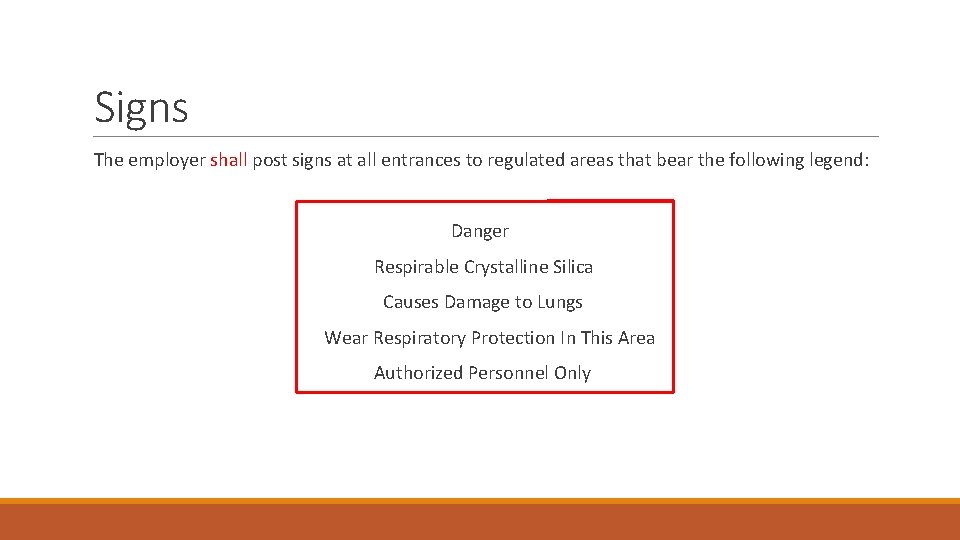
Signs The employer shall post signs at all entrances to regulated areas that bear the following legend: Danger Respirable Crystalline Silica Causes Damage to Lungs Wear Respiratory Protection In This Area Authorized Personnel Only
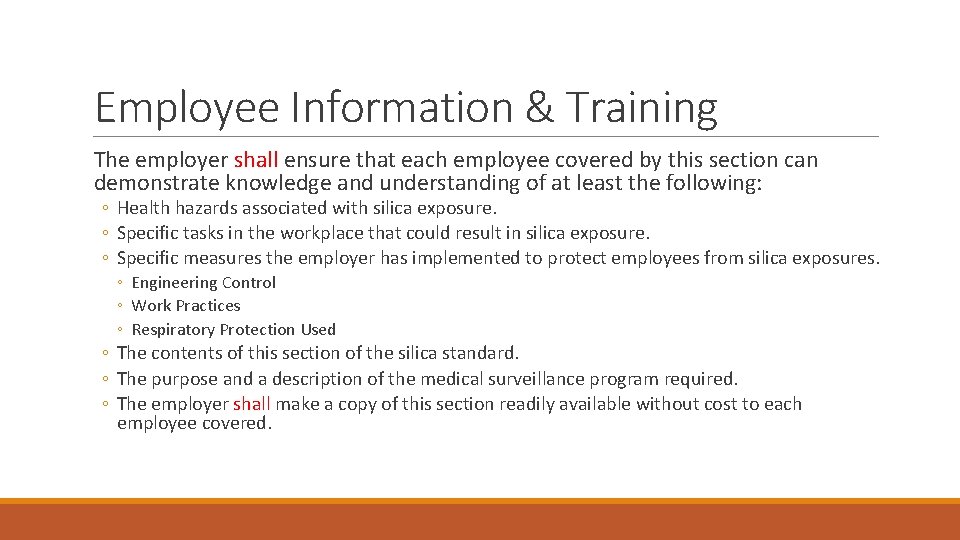
Employee Information & Training The employer shall ensure that each employee covered by this section can demonstrate knowledge and understanding of at least the following: ◦ Health hazards associated with silica exposure. ◦ Specific tasks in the workplace that could result in silica exposure. ◦ Specific measures the employer has implemented to protect employees from silica exposures. ◦ Engineering Control ◦ Work Practices ◦ Respiratory Protection Used ◦ The contents of this section of the silica standard. ◦ The purpose and a description of the medical surveillance program required. ◦ The employer shall make a copy of this section readily available without cost to each employee covered.
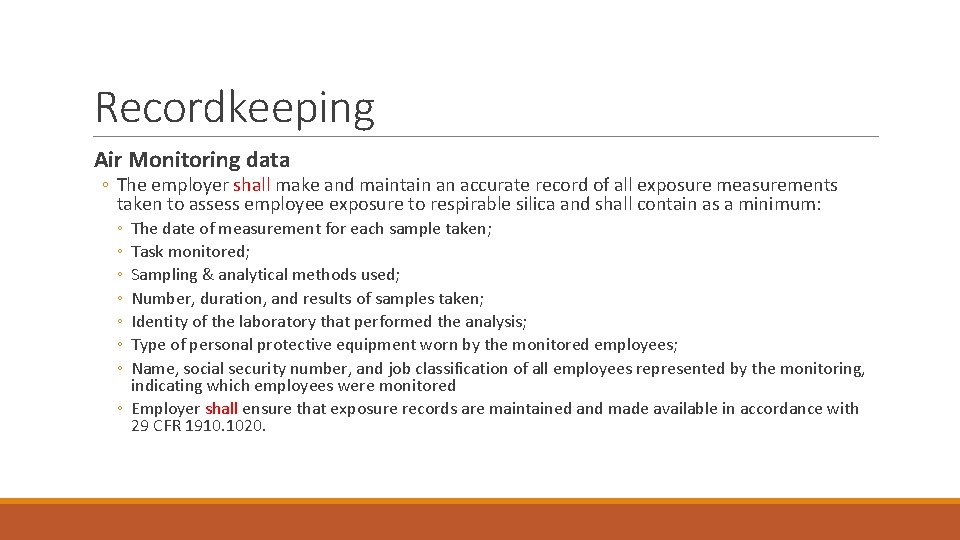
Recordkeeping Air Monitoring data ◦ The employer shall make and maintain an accurate record of all exposure measurements taken to assess employee exposure to respirable silica and shall contain as a minimum: ◦ ◦ ◦ ◦ The date of measurement for each sample taken; Task monitored; Sampling & analytical methods used; Number, duration, and results of samples taken; Identity of the laboratory that performed the analysis; Type of personal protective equipment worn by the monitored employees; Name, social security number, and job classification of all employees represented by the monitoring, indicating which employees were monitored ◦ Employer shall ensure that exposure records are maintained and made available in accordance with 29 CFR 1910. 1020.
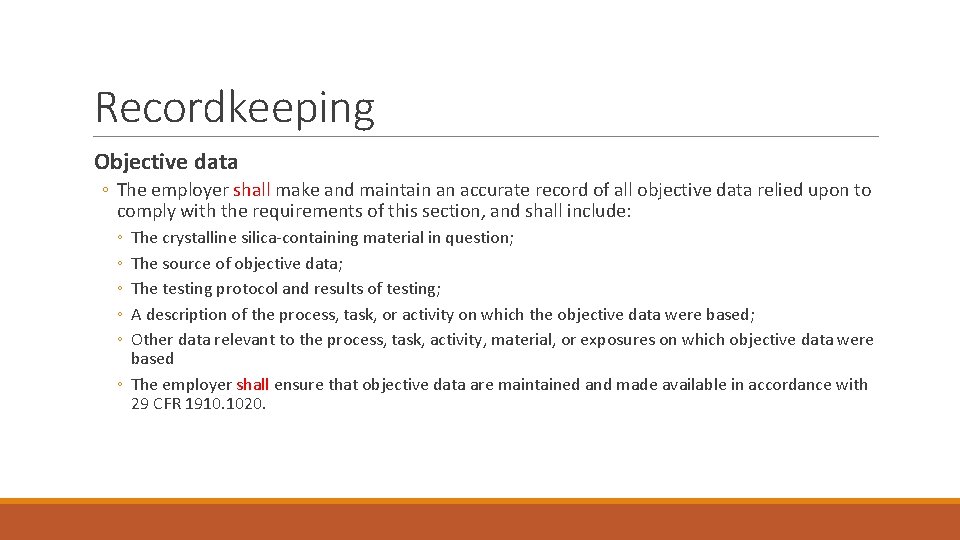
Recordkeeping Objective data ◦ The employer shall make and maintain an accurate record of all objective data relied upon to comply with the requirements of this section, and shall include: ◦ ◦ ◦ The crystalline silica-containing material in question; The source of objective data; The testing protocol and results of testing; A description of the process, task, or activity on which the objective data were based; Other data relevant to the process, task, activity, material, or exposures on which objective data were based ◦ The employer shall ensure that objective data are maintained and made available in accordance with 29 CFR 1910. 1020.
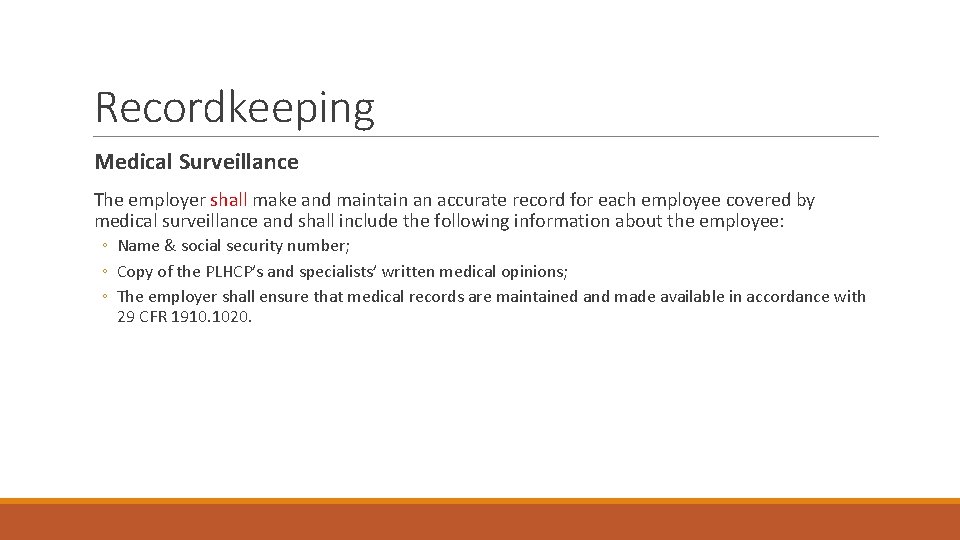
Recordkeeping Medical Surveillance The employer shall make and maintain an accurate record for each employee covered by medical surveillance and shall include the following information about the employee: ◦ Name & social security number; ◦ Copy of the PLHCP’s and specialists’ written medical opinions; ◦ The employer shall ensure that medical records are maintained and made available in accordance with 29 CFR 1910. 1020.
Effective Dates ◦ June 23, 2017 - Construction ◦ June 23, 2018 – General Industry ◦ Hydraulic fracturing in oil/gas industry. ◦ ◦ June 23, 2018 – All obligations except; June 23, 2021 – Engineering Controls. June 23, 2018 – Medical Surveillance (for employees > PEL for 30 or more days per year). June 23, 2020 – Medical Surveillance (for employees ≥ Action Level for 30 days or more per year).
Resources Silica Small Entity Compliance Guide for Construction www. osha. gov/Publications/OSHA 3902. pdf OSHA Crystalline Silica Fact Sheet osha. gov/Osh. Doc/data_General_Facts/crystalline-factsheet. pdf NIOSH Silica Information Webpage www. cdc. gov/niosh/topics/silica Center for Construction Research and Training www. silica-safe. org Federal Register – Silica Standard https: //www. federalregister. gov/documents/2016/03/25/2016 -04800/occupational-exposure-to-respirable-crystalline-silica Video clips – What’s Working http: //www. silica-safe. org/whats-working/controlling-silica-dust-learning-from-each-other Hollow drill bits for rotary hammers with local exhaust ventilation https: //www. youtube. com/watch? v=i. C-Ze 4 j. Ts 0 M
- Slides: 66