
Respect Pledge Every person has a right to
- Slides: 28
Respect Pledge • Every person has a right to participate fully in our school, to be treated with respect and to feel welcomed. Any words or actions intended to segregate, degrade, persecute, or humiliate a member of our community are hurtful to us all and will not be tolerated.
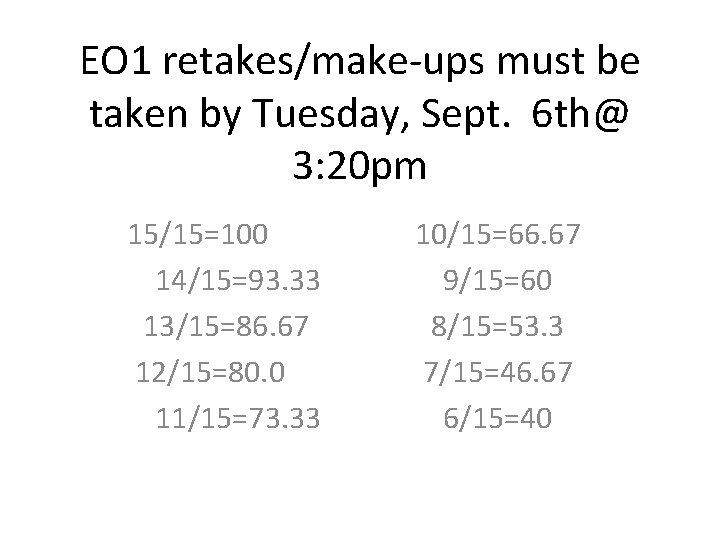
EO 1 retakes/make-ups must be taken by Tuesday, Sept. 6 th@ 3: 20 pm 15/15=100 14/15=93. 33 13/15=86. 67 12/15=80. 0 11/15=73. 33 10/15=66. 67 9/15=60 8/15=53. 3 7/15=46. 67 6/15=40
Culture Mrs. Mc. Vey
What is “Culture”? • Culture is a shared set of beliefs, values and traditions of a group of people • Culture defines how people in a society behave in relation to other people and physical objects (symbols)
Culture • Culture is learned…transmitted…passed down from generation to generation • But at the same time, culture is always evolving (changing). Why? – Technological advances – Interactions from different groups – Cultural blending
Culture People often stress differences among culture and overlook similarities. Most groups of people have the same sorts of patterns and society. What are some of the ways cultures are similar?
Components of Culture? • So what makes CULTURE? Brainstorm….
Westlandia
Language and Culture • Humans create & transmit culture • Symbols – Language
Sapir-Whorf Hypothesis • Also known as the Hypothesis of Linguistic Relativity • Language is our guide to reality—people confine themselves to language & vocab they learned from birth • People can begin to view the world differently as they learn a new language or vocablulary
Language • Vocabulary tells you about a culture— Linguistic Relativity – Before Christian missionaries went to Asia there was no work for “sin” in the Chinese language and no word to express the idea of a single, all powerful God in areas of Africa and Polynesia
Linguistic Relativity cont – Time is important in the US so we have lots of words to describe time: minutes, second, moment, hour, era, afternoon, dusk, annual, evening, etc. – English has only a few words to describe snow but Inuit (Eskimo) language has over 20 words for snow
Culture defined • Knowledge, values, customs, and physical objects that are shared by members of a society • Norms • Beliefs • Values • Materialistic objects
Norms: Rules we live by • Rules defining appropriate & inappropriate behavior —explain why people act similarly – P. 82 --Do’s and Taboos Around the World • Folkways: traditional ways of thinking/acting that lack moral reasons • Mores: norms with moral significance--taboos • Laws: formally defined & enforced by officials – P. 86 http: //www. dumblaws. com/laws/unitedstates/nebraska – http: //www. skrause. org/humor/stupidlaws. shtml
Enforcing NORMS (rules) • Sanctions are rewards and punishments used to encourage conformity to norms—can be positive or negative – Formal sanctions: imposed by people with authority – Informal sanctions: any member of a group – We sanction ourselves mentally—conform to norms because we believe that the behavior expected from us is appropriate, avoid guilt feelings, or fear social disapproval
VALUES • Broad ideas about what is good and desirable • Mostly agreed upon within society • Different groups within the same society can have different norms based on the same value • Picture on page 89—the kite • Handout
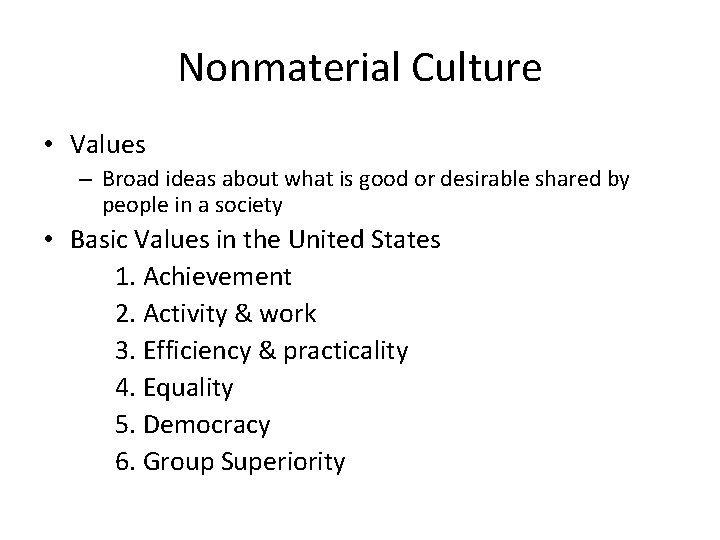
Nonmaterial Culture • Values – Broad ideas about what is good or desirable shared by people in a society • Basic Values in the United States 1. Achievement 2. Activity & work 3. Efficiency & practicality 4. Equality 5. Democracy 6. Group Superiority
American Values • Read the Article “America Values” – On the back answer the following: • Do you agree with these 10 listed values? Why or why not? Which ones would change? What would you replace it with and why?
Material V. Nonmaterial Culture • Material culture is something you can touch, see…a material object. • Nonmaterial culture is something you cannot see or feel…. What is an example of material culture in the United States? What is an example of nonmaterial American culture?
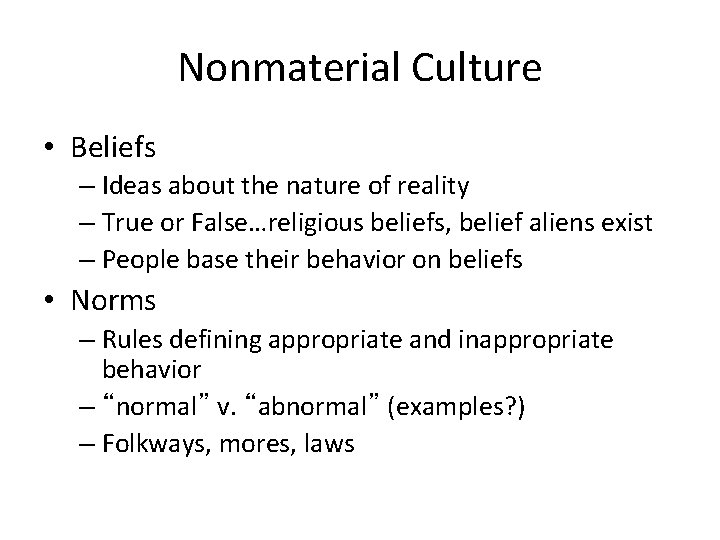
Nonmaterial Culture • Beliefs – Ideas about the nature of reality – True or False…religious beliefs, belief aliens exist – People base their behavior on beliefs • Norms – Rules defining appropriate and inappropriate behavior – “normal” v. “abnormal” (examples? ) – Folkways, mores, laws
Ideal v. Real • Real culture – actual behavior patterns of members of a group • Ideal culture – Guidelines a group of members claim to accept Picking nose, cheating, lying, etc.
Sociology • YOU NEED A BOOK!
Cultural Diversity & Similarity • Culture changes for 3 major reasons – Discovery: finding something that already exists – Invention: creation of something new – Diffusion: borrowing aspects of culture from other cultures—cultural blending
Cultural Diversity • Social categories—groups of people who share same social characteristics--can create diversity – For example: age, gender, race, religion • Subculture is part of the dominant culture but differs in some important aspects – Chinatown, Little Italy • Counterculture is deliberately & consciously opposed to certain beliefs or attitudes of the dominant culture – Hippies, Gangs, Revolutions, religious groups
Ethnocentrism • Judging others in terms of one’s own cultural standards – “They” dress weird – “They” eat crazy food – “They” drive on the wrong side of the road
Cultural Universals • Cultural universals exits because people are so similar biologically. . • Cultural universals are traits that exist in all cultures – Government, family • Cultural particulars are ways in which a culture expresses universal traits – Matriarchal vs. patriarchal – What makes them different
How Culture Changes Over time. . • http: //glo. msn. com/beauty/glo-back-8297330. gallery? gt 1=49006
• P. 102 #1 • P. 104 Thinking Critically #1 -5 only • P. 99 #1 -2