
Resources to Support the Use of DECs Recommended

- Slides: 32
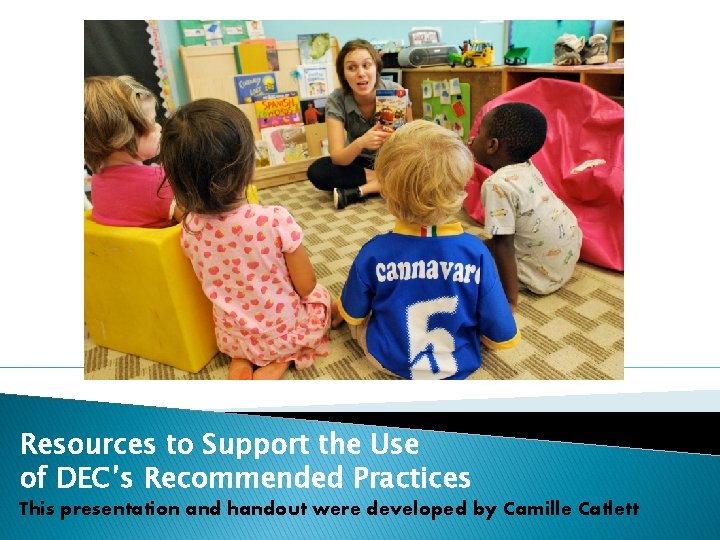
Resources to Support the Use of DEC’s Recommended Practices This presentation and handout were developed by Camille Catlett
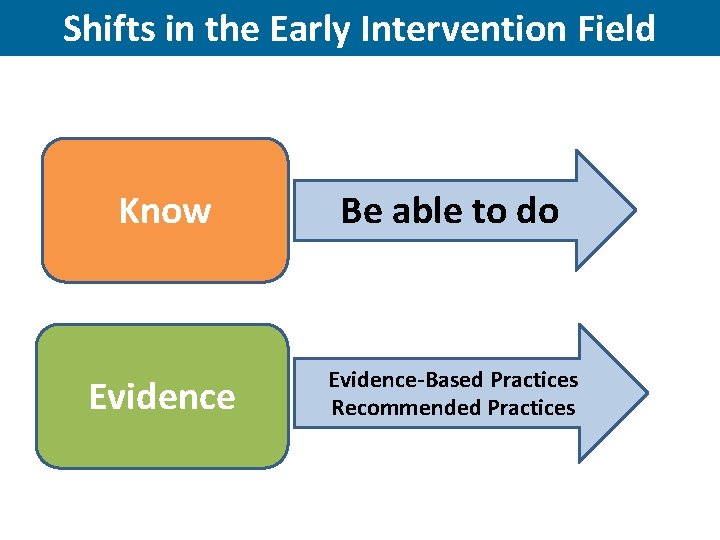
Shifts in the Early Intervention Field Know Be able to do Evidence-Based Practices Recommended Practices
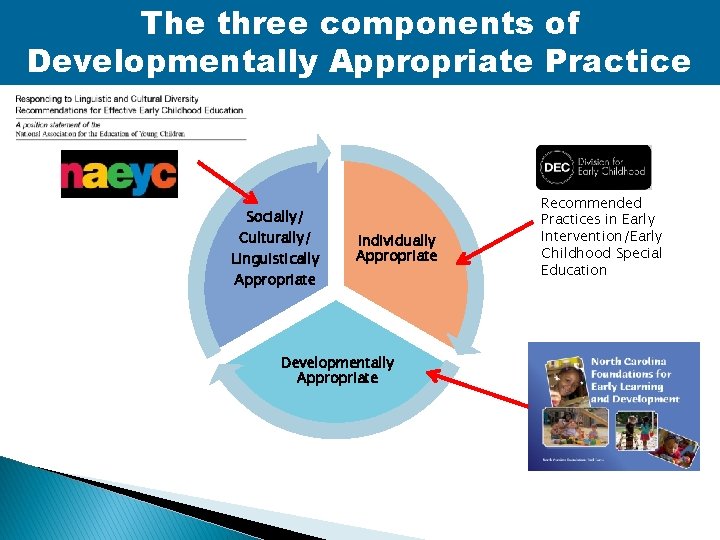
The three components of Developmentally Appropriate Practice Socially/ Culturally/ Linguistically Appropriate Individually Appropriate Developmentally Appropriate Recommended Practices in Early Intervention/Early Childhood Special Education
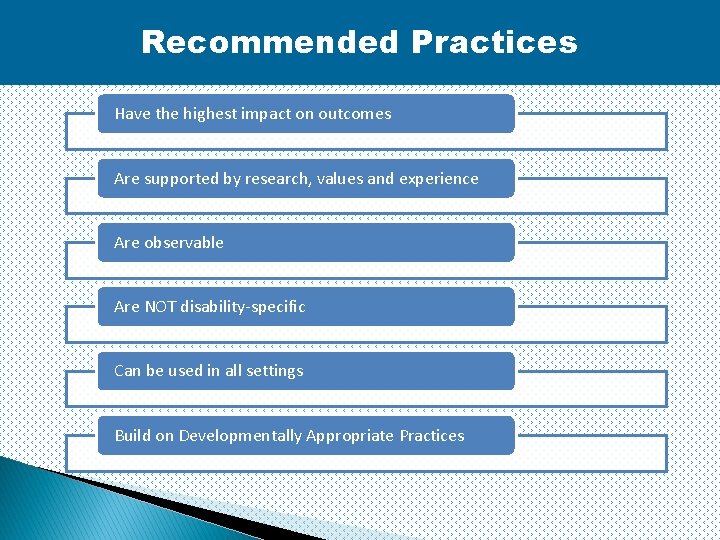
Recommended Practices Have the highest impact on outcomes Are supported by research, values and experience Are observable Are NOT disability-specific Can be used in all settings Build on Developmentally Appropriate Practices
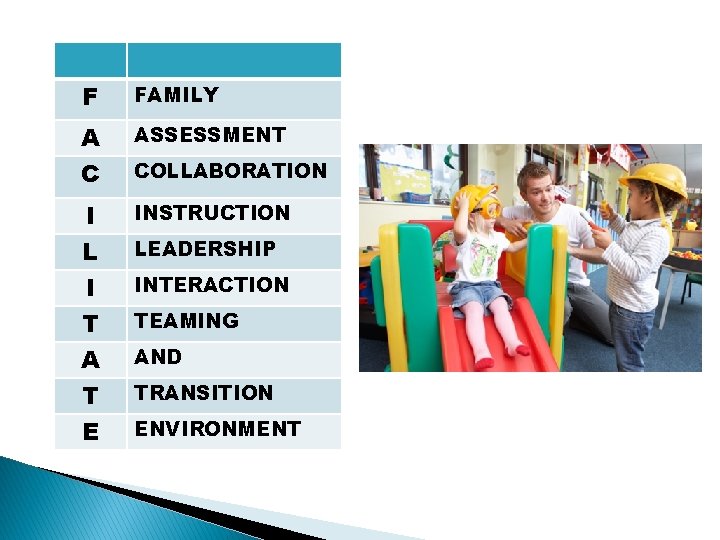
F FAMILY A C ASSESSMENT I L INSTRUCTION I T A T INTERACTION E ENVIRONMENT COLLABORATION LEADERSHIP TEAMING AND TRANSITION
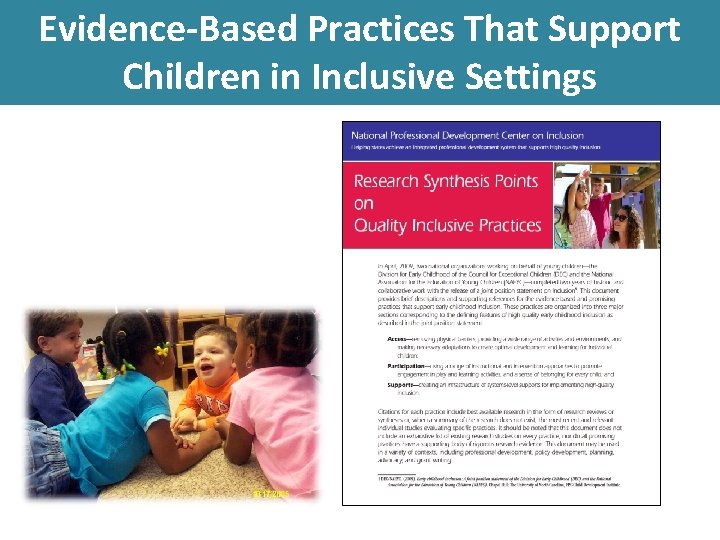
Evidence-Based Practices That Support Children in Inclusive Settings
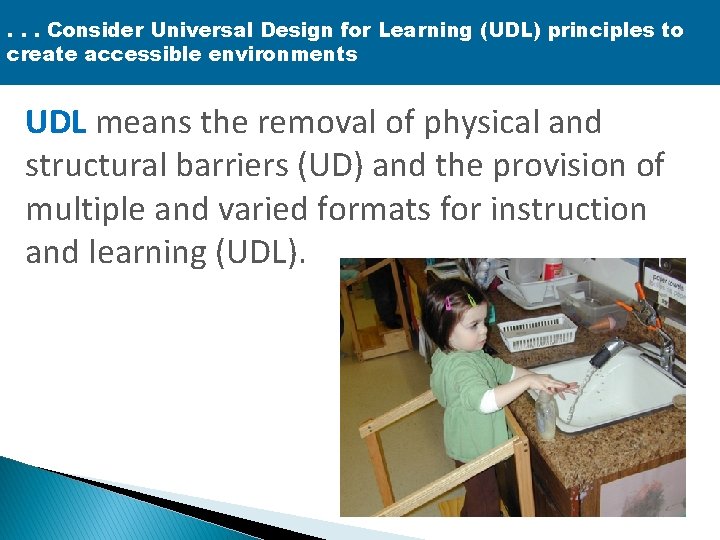
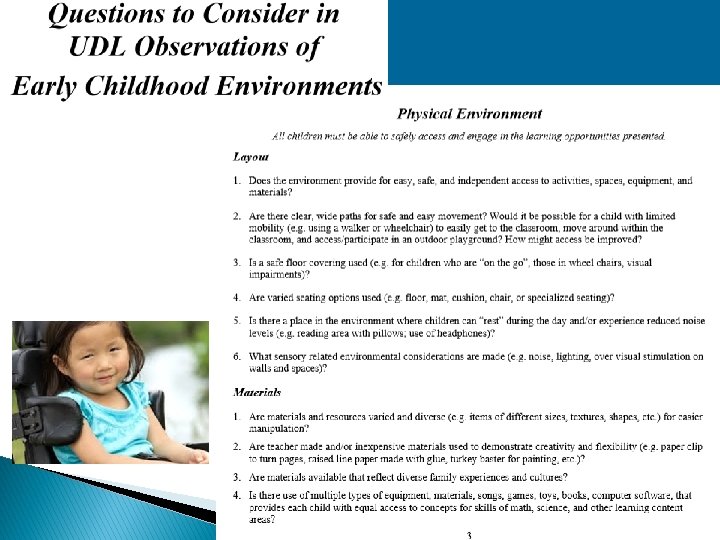
. . . Consider Universal Design for Learning (UDL) principles to create accessible environments UDL means the removal of physical and structural barriers (UD) and the provision of multiple and varied formats for instruction and learning (UDL).
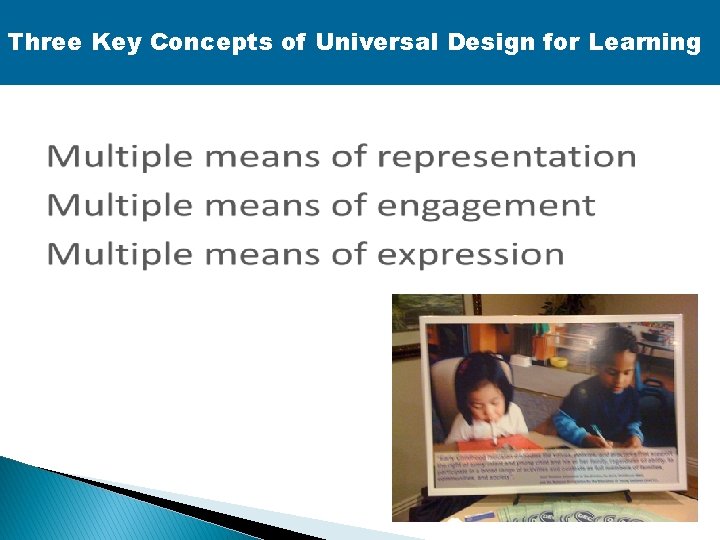
Three Key Concepts of Universal Design for Learning
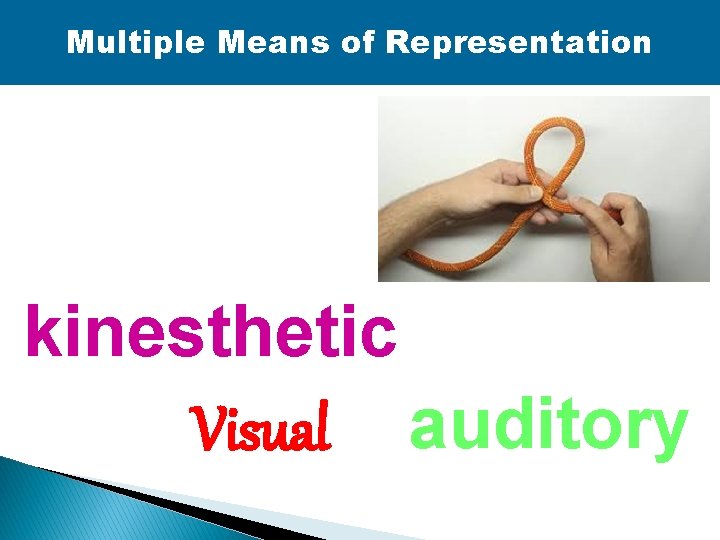
Multiple Means of Representation kinesthetic Visual auditory
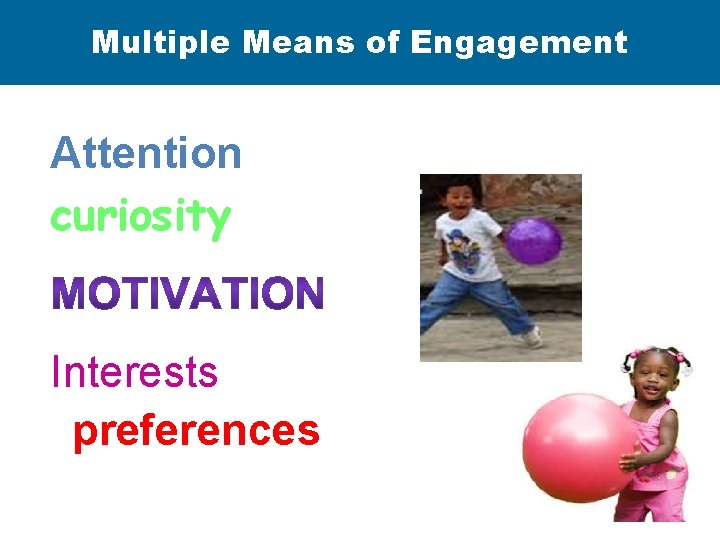
Multiple Means of Engagement UDL: Multiple Means of Engagement Attention curiosity Interests preferences
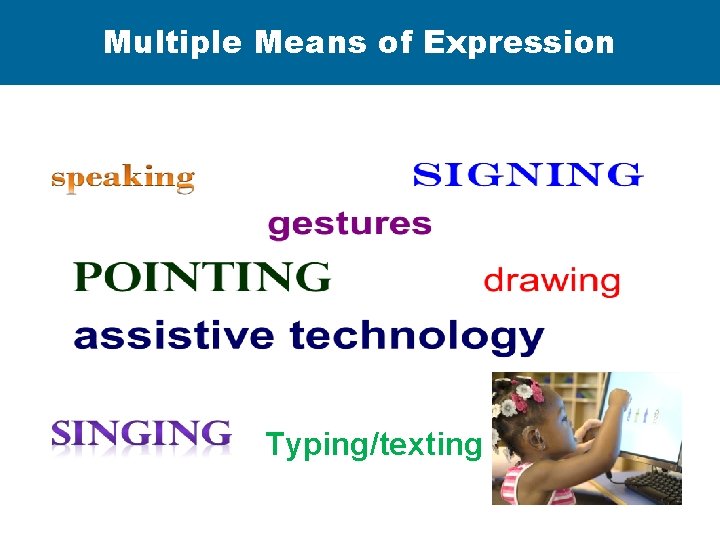
Multiple Means of Expression UDL: Multiple Means of Expression Typing/texting
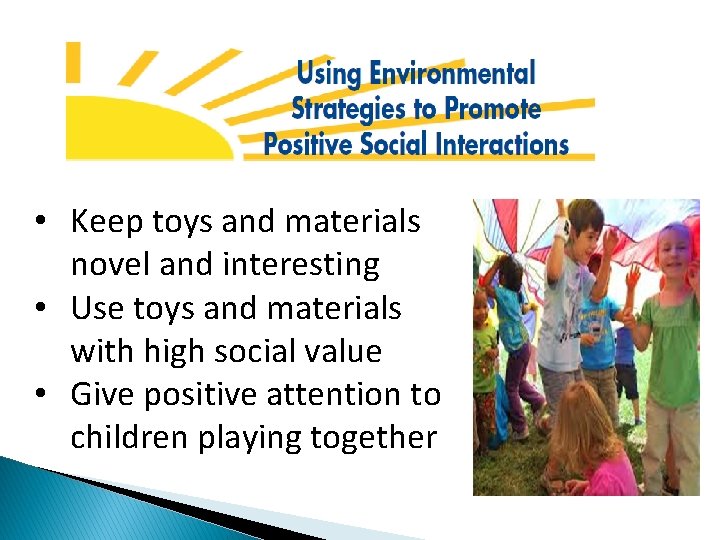
• Keep toys and materials novel and interesting • Use toys and materials with high social value • Give positive attention to children playing together
Family F 1. Practitioners build trusting and respectful partnerships with the family through interactions that are sensitive and responsive to cultural, linguistic, and socio-economic diversity. F 3. Practitioners are responsive to the family’s concerns, priorities, and changing life circumstances. F 5. Practitioners support family functioning, promote family confidence and competence, and strengthen family-child relationships by acting in ways that recognize and build on family strengths and capacities
Family F 1. Practitioners build trusting and respectful partnerships with the family through interactions that are sensitive and responsive to cultural, linguistic, and socio-economic diversity. F 3. Practitioners are responsive to the family’s concerns, priorities, and changing life circumstances. F 5. Practitioners support family functioning, promote family confidence and competence, and strengthen family-child relationships by acting in ways that recognize and build on family strengths and capacities
CONNECT The Center to Mobilize Early Childhood Knowledge http: //connect. fpg. unc. edu/
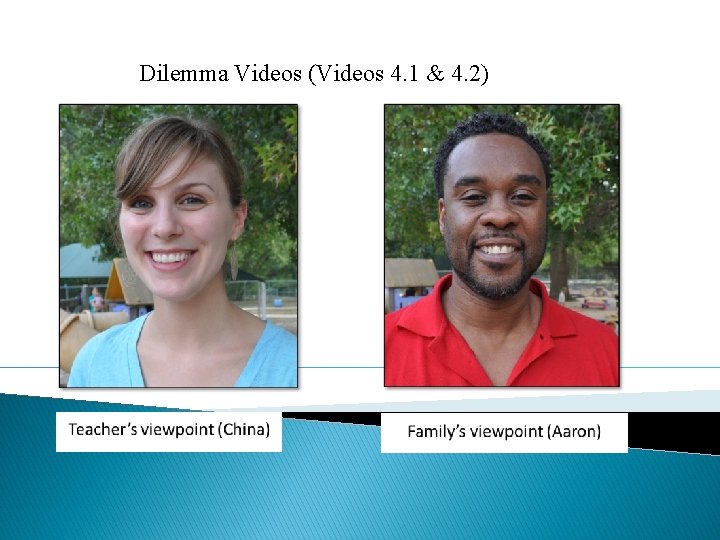
Dilemma Videos (Videos 4. 1 & 4. 2)
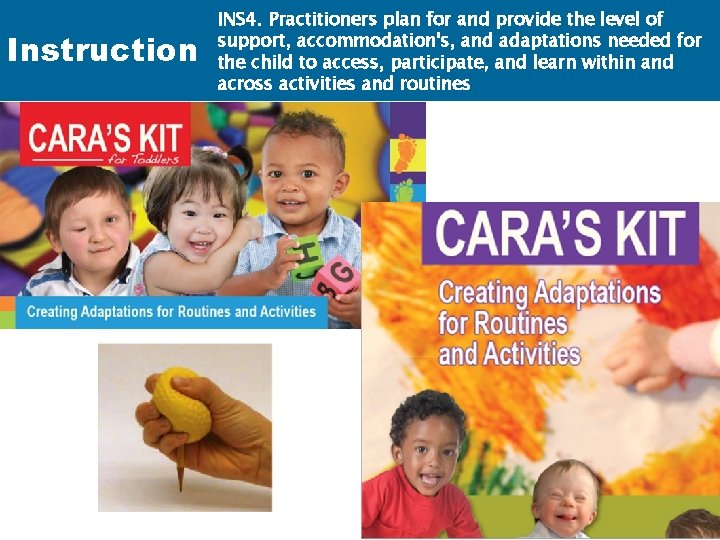
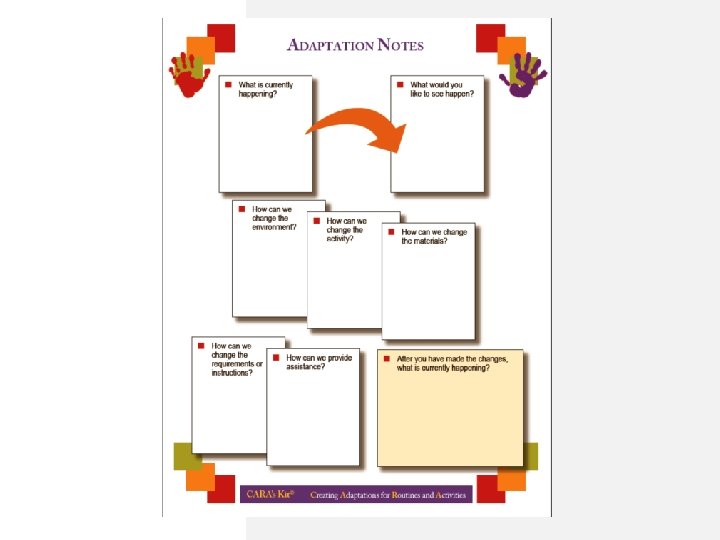
Instruction INS 4. Practitioners plan for and provide the level of support, accommodation's, and adaptations needed for the child to access, participate, and learn within and across activities and routines
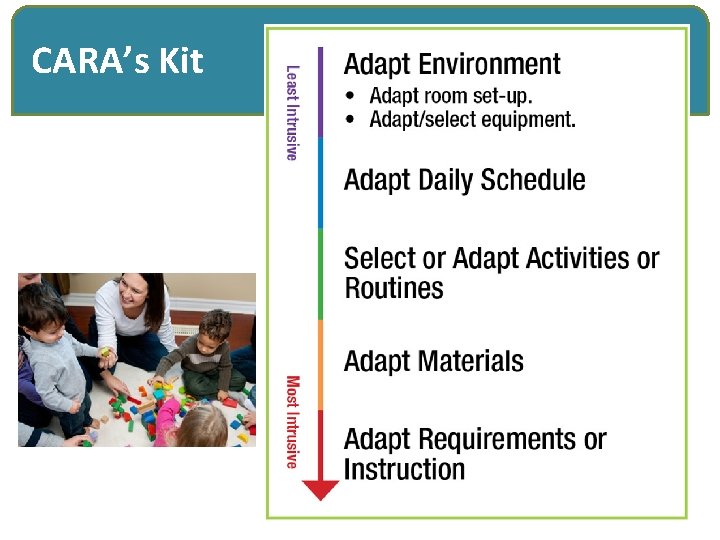
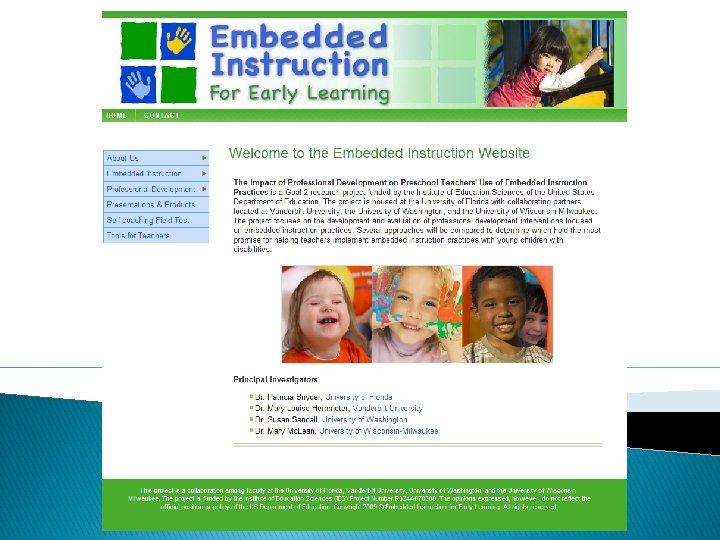
CARA’s Kit
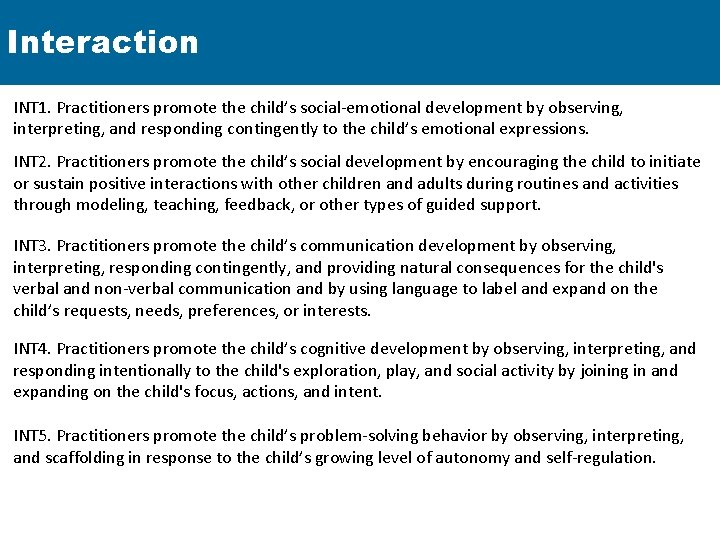
Interaction INT 1. Practitioners promote the child’s social-emotional development by observing, interpreting, and responding contingently to the child’s emotional expressions. INT 2. Practitioners promote the child’s social development by encouraging the child to initiate or sustain positive interactions with other children and adults during routines and activities through modeling, teaching, feedback, or other types of guided support. INT 3. Practitioners promote the child’s communication development by observing, interpreting, responding contingently, and providing natural consequences for the child's verbal and non-verbal communication and by using language to label and expand on the child’s requests, needs, preferences, or interests. INT 4. Practitioners promote the child’s cognitive development by observing, interpreting, and responding intentionally to the child's exploration, play, and social activity by joining in and expanding on the child's focus, actions, and intent. INT 5. Practitioners promote the child’s problem-solving behavior by observing, interpreting, and scaffolding in response to the child’s growing level of autonomy and self-regulation.
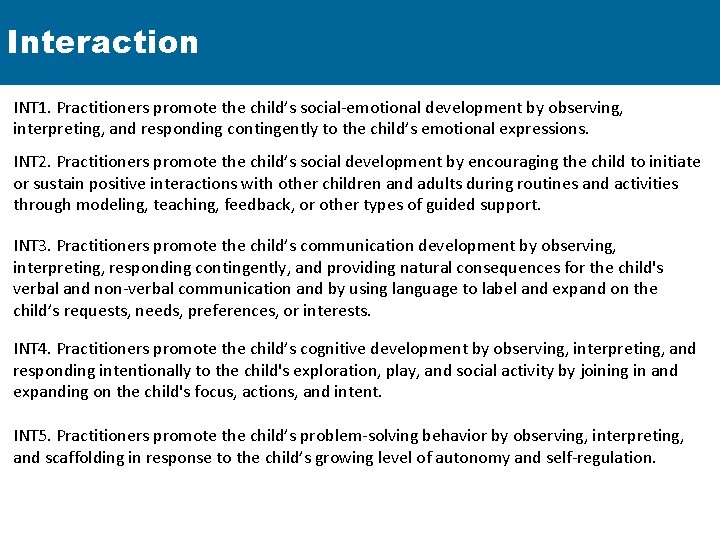
Interaction INT 1. Practitioners promote the child’s social-emotional development by observing, interpreting, and responding contingently to the child’s emotional expressions. INT 2. Practitioners promote the child’s social development by encouraging the child to initiate or sustain positive interactions with other children and adults during routines and activities through modeling, teaching, feedback, or other types of guided support. INT 3. Practitioners promote the child’s communication development by observing, interpreting, responding contingently, and providing natural consequences for the child's verbal and non-verbal communication and by using language to label and expand on the child’s requests, needs, preferences, or interests. INT 4. Practitioners promote the child’s cognitive development by observing, interpreting, and responding intentionally to the child's exploration, play, and social activity by joining in and expanding on the child's focus, actions, and intent. INT 5. Practitioners promote the child’s problem-solving behavior by observing, interpreting, and scaffolding in response to the child’s growing level of autonomy and self-regulation.
http: //www. earlyliteracylearning. org/ General Practice Guides Especially for Parents
http: //csefel. vanderbilt. edu/ • • Research syntheses Training modules Practical strategies What Works briefs Videos Family tools Decision making guides
TACSEI TECHNICAL ASSISTANCE CENTER ON SOCIAL EMOTIONAL INTERVENTION for young children
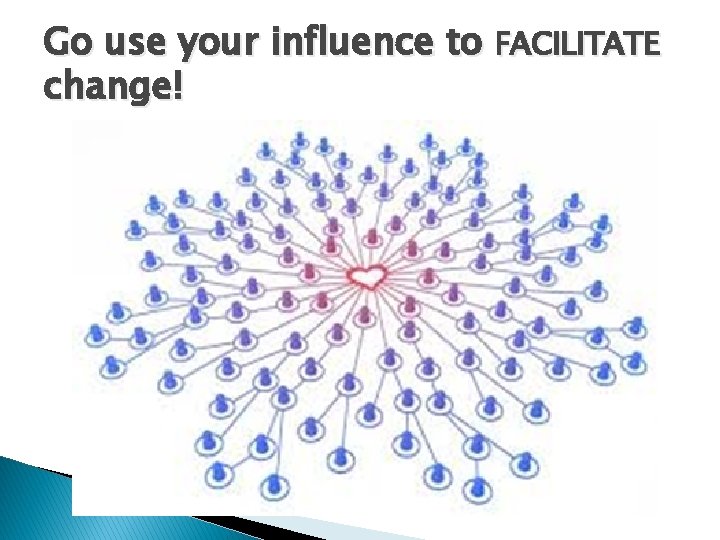
Go use your influence to FACILITATE change!