
RESOURCES for LC TEST BEAMS HUMAN and FUNDING
RESOURCES for LC TEST BEAMS (HUMAN and FUNDING) a critical look. . Aurore Savoy-Navarro, LPNHE Université Pierre et Marie Curie/CNRS-IN 2 P 3 And many thanks especially to Hitoshi Yamamoto, Lucie Linssen. Franco Bedeschi, and the ILCSC R&D panel members for useful information.
Outline ‘The organizers suggest your talk might want to take a critical look at the near and later anticipated test beam activities to understand what is being asked for and whether the groups have the personnel and financial resources needed for success. ’ Before having a “critical look” let’s define the problem we are asked to discuss/solve => • Main parameters/concerns to be taken into account • Tentative answer(s) : => available resources (people, infrastructures, funds) => tentative estimate of test beams needs in means, funds and people. Although I have been discussing and getting material from various people, the views presented here, are personal and no one else than me should be blame for them. 12/31/2021 LCTW 09, A. Savoy-Navarro 2
Main parameters/concerns/constraints • The schedule to be confronted • Some geo-science-political facts => no host Lab (yet!) => regional dependence => no R&D committee for evaluation &follow up => The global framework: contemporariness wrt LHC/s. LHC • Two detector concepts plus Dual Readout R&D • ILC & CLIC • Transversality and synergy => sharing some available facilities and tools 12/31/2021 LCTW 09, A. Savoy-Navarro 3
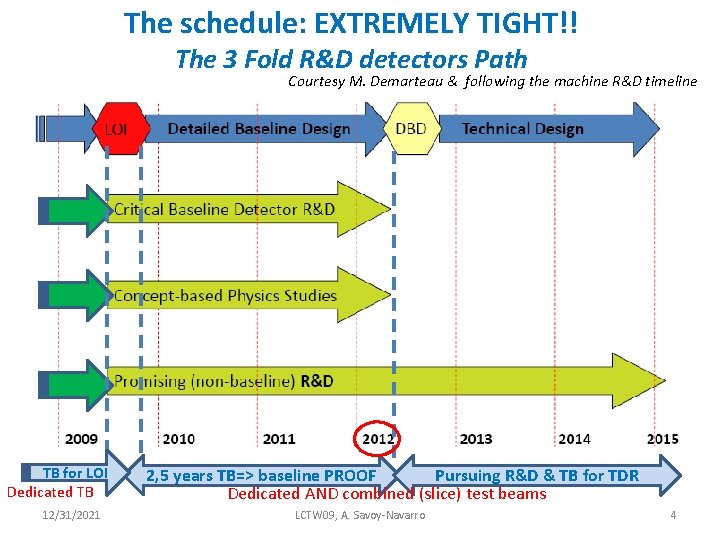
The schedule: EXTREMELY TIGHT!! The 3 Fold R&D detectors Path Courtesy M. Demarteau & following the machine R&D timeline TB for LOI Dedicated TB 12/31/2021 2, 5 years TB=> baseline PROOF Pursuing R&D & TB for TDR Dedicated AND combined (slice) test beams LCTW 09, A. Savoy-Navarro 4
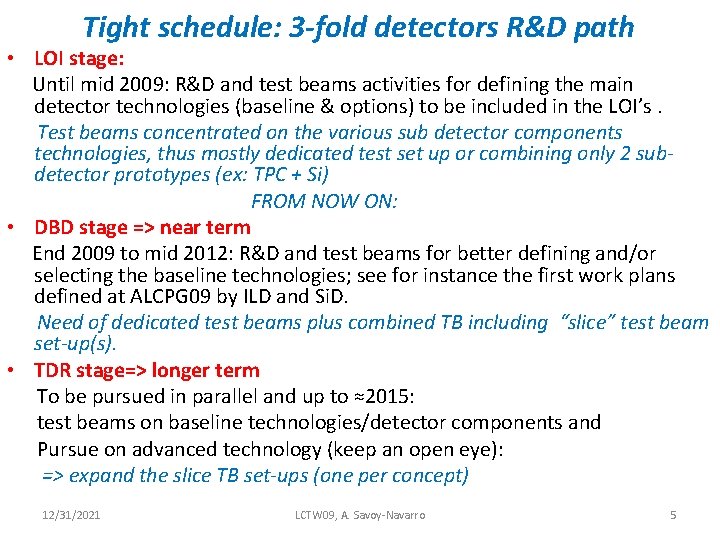
Tight schedule: 3 -fold detectors R&D path • LOI stage: Until mid 2009: R&D and test beams activities for defining the main detector technologies (baseline & options) to be included in the LOI’s. Test beams concentrated on the various sub detector components technologies, thus mostly dedicated test set up or combining only 2 subdetector prototypes (ex: TPC + Si) FROM NOW ON: • DBD stage => near term End 2009 to mid 2012: R&D and test beams for better defining and/or selecting the baseline technologies; see for instance the first work plans defined at ALCPG 09 by ILD and Si. D. Need of dedicated test beams plus combined TB including “slice” test beam set-up(s). • TDR stage=> longer term To be pursued in parallel and up to ≈2015: test beams on baseline technologies/detector components and Pursue on advanced technology (keep an open eye): => expand the slice TB set-ups (one per concept) 12/31/2021 LCTW 09, A. Savoy-Navarro 5
Some geo-science-political facts • No host Lab (yet!) no region/country has yet proposed to host the ILC project. This is a premiere in HEP and has some rather negative impacts: • The regional dependence: This is a peculiar aspect of the ILC project that impacts on various managerial aspects and ways the project is developed. • No real follow up/evaluation/decisional R&D committee There is not a unique decisional body for the evaluation , follow up & managerial process of the R&D’s and with the required authority for providing the needed means in funds and people. These are three important facts that strongly impact on the evolution of the project: CRUCIAL to solve. It causes dispersion and some unbalance in efforts and means; it weakens the project credibility. 12/31/2021 LCTW 09, A. Savoy-Navarro 6
Some geo-science-political facts (cont’d) • The contemporariness with LHC/s. LHC The LHC experiments will go through various upgrades from now on till 2020; Scheduled upgrades: -> Upgrade of the vertex detectors: ATLAS B layer, CMS vertex (2013). -> Preparation for a more important upgrade (e. g. the overall tracking system) for the upgrade in luminosity by a factor 10. These upgrades will thus follow 1) the “warming-up” of the LHC until it reaches the nominal running: 14 Te. V c. m. and 1034 cm-2 s-1 luminosity; and 2) the increase in luminosity by a factor 10 towards 2020. Synergies instead of competitiveness and sharing of people, expertise & means where possible are essential. 12/31/2021 LCTW 09, A. Savoy-Navarro 7
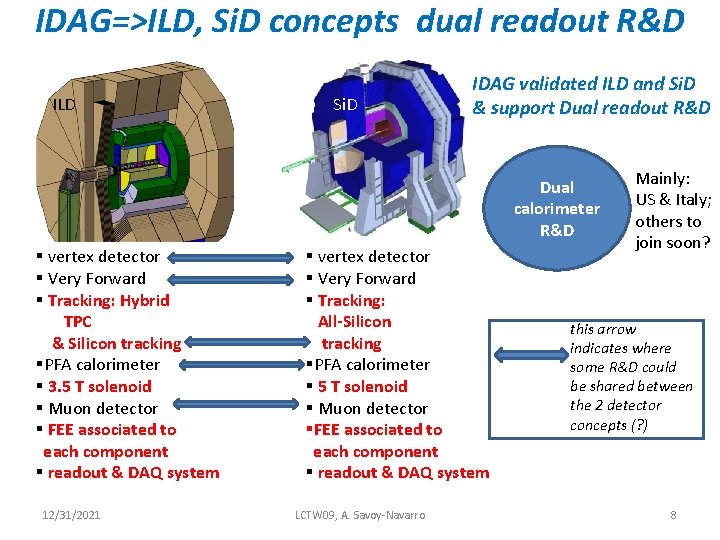
IDAG=>ILD, Si. D concepts dual readout R&D ILD Si. D IDAG validated ILD and Si. D & support Dual readout R&D Dual calorimeter R&D § vertex detector § Very Forward § Tracking: Hybrid TPC & Silicon tracking §PFA calorimeter § 3. 5 T solenoid § Muon detector § FEE associated to each component § readout & DAQ system 12/31/2021 § vertex detector § Very Forward § Tracking: All-Silicon tracking §PFA calorimeter § 5 T solenoid § Muon detector §FEE associated to each component § readout & DAQ system LCTW 09, A. Savoy-Navarro Mainly: US & Italy; others to join soon? this arrow indicates where some R&D could be shared between the 2 detector concepts (? ) 8

ILD, Si. D concepts: some major differences ILD Si. D § About 700 authors About 250 authors => unbalance in person power § Mostly EU and Asia Mostly USA & fewer => unbalance in funding EU and Asia Mainly dedicated => unbalance in means Si. D teams § Closely linked to R&D collaborations: CALICE, TPC, Si. LC, FWD § E. U framework &funds Less impact on Si. D PRESENTLY: Unbalance in people, funds & means between the 2 detector concepts 12/31/2021 LCTW 09, A. Savoy-Navarro 9
ILC and CLIC R&D’s • Not at the same stage: CLIC detector R&D just started and CERN is strengthening this detector R&D line • Differences in the two machine cycles impact on the detector design. FEE at CLIC is more similar to LHC one. • Not the same time scale => CLIC -> longer term R&D’s Important points: CERN is a partner since a few years (EUDET) CERN is strengthening the LC R&D activities and possibly opening new aspects in the very near future. Here also work a collaborative spirit ILC x CLIC should prevail. 12/31/2021 LCTW 09, A. Savoy-Navarro 10
Plans for LC hardware R&D at CERN Courtesy Lucie Linssen (CERN) In several aspects the CLIC detector will be more challenging than ILC case, due to – the higher energies involved – the higher beam-induced background – the time structure of CLIC Most of the R&D currently carried out for the ILC is most relevant for CLIC. No need to duplicate work. CERN LCD project has joined the validated ILC concepts and technology collaborations CALICE, EUDET, FCAL, LCTPC Besides extensive simulation studies and software development for the CLIC detector studies, CLIC-specific hardware and engineering development is required in a number of areas. 11
Hardware/engineering R&D Courtesy Lucie Linssen (CERN) Hardware/engineering R&D needed beyond present ILC developments: • Time stamping – Most challenging in inner tracker/vertex region; trade-off between pixel size, amount of material and timing resolution (~10 ns, better in forward region) – Needed for most other sub-detectors (e. g. calo at 10 -20 ns level) • Power pulsing and DAQ developments – In view of the CLIC time structure • Hadron calorimetry – Dense HCAL absorbers to limit radial size (PFA calo based on tungsten) • Solenoid coil – Reinforced conductor (building on CMS/ATLAS experience) – Large high-field solenoid concept • Overall engineering design and integration studies – For heavier calorimeter, larger overall CLIC detector size etc. – In view of sub-nm precision required for FF quadrupoles In addition: planned continuation of EUDET activities in TPC readout 12
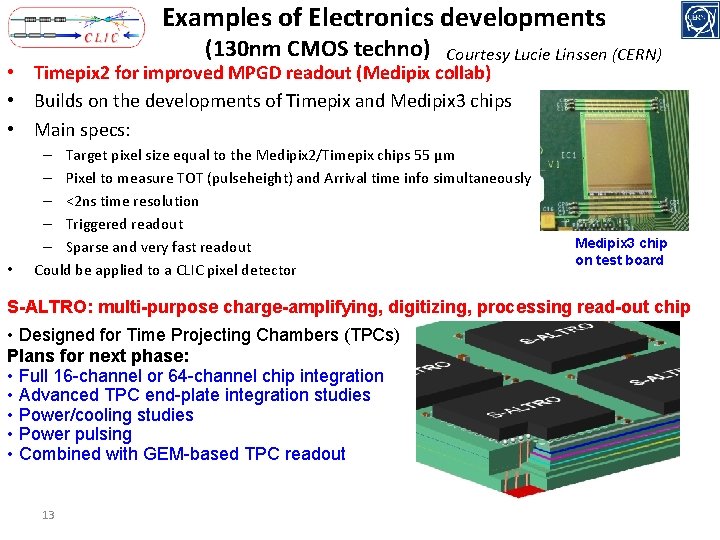
Examples of Electronics developments (130 nm CMOS techno) Courtesy Lucie Linssen (CERN) • Timepix 2 for improved MPGD readout (Medipix collab) • Builds on the developments of Timepix and Medipix 3 chips • Main specs: • – Target pixel size equal to the Medipix 2/Timepix chips 55 µm – Pixel to measure TOT (pulseheight) and Arrival time info simultaneously – <2 ns time resolution – Triggered readout – Sparse and very fast readout Could be applied to a CLIC pixel detector Medipix 3 chip on test board S-ALTRO: multi-purpose charge-amplifying, digitizing, processing read-out chip • Designed for Time Projecting Chambers (TPCs) Plans for next phase: • Full 16 -channel or 64 -channel chip integration • Advanced TPC end-plate integration studies • Power/cooling studies • Power pulsing • Combined with GEM-based TPC readout 13

Available funding and people: region dependant • Asia: LC effort led by Japan (KEK, Tohoku. . . ) (courtesy Hitoshi Yamamato) Japan: mainly ILD oriented, contributions on vertexing (FPCCD R&D), CMOS readout, SOI; TPC LPTPC +GEM tests, gate GEM and endplates; Calo (Si. PMs, scintillator ECAL and HCAL); MDI studies; Physics & detector optimisation: JSPS funds 4 M$ over 5 years until spring 2011. Will be renewed , how much? Korea: only Sci calorimeter (KNU), loss of involvement these last 2 or so years. China: PC boards for LCTPC prototype (no ICHEP in but 50 physicists in ILD) • EUROPE: Importance of E. U. Community support (see next slide) • USA & Canada: lack of support and dispersion among Institutes. Mainly FNAL with involvement in Calo, muons, vertex, test beam (MTBF), software. Also Argonne, Colorado St U. , UCSC, . . . SLAC decreased involvement over last 2 years (change in Lab priorities) 1. 3 M$ for LC R&D detectors next year!! => Pbs!! Competition wrt funds and people with: LHC, s. LHC, neutrinos, cosmos, muon collider. . ? ? 12/31/2021 LCTW 09, A. Savoy-Navarro 14
Available funding and people: region dependant • EUROPE: Importance of E. U. Community support - EUDET E. U. IFP 6 an example & a success story (06 -10): 10 M€ over 4 years => Gathering a very active R&D community in Europe (next slide) on all main items: Tracking: vertex, TPC, Si-trackers; PFA calo; Very Forward set-up + FEE & DAQ + TB (DESY, CERN and FNAL) => Providing means (test beams and test infrastructures, people and funds) access to DESY, CERN test beams => PRC-DESY plays a follow-up/recommendation panel => Visibility and credibility of the overall LC project. Countries not participating any more to LC: Italy and UK. But still at “individual (i. e. Institutes) levels” with valuable contributions. - CERN: in EUDET; DG is increasing the support to LC-CERN detector & physics R&D What’s next? ? => concerns about people and funding support AIDA nice but much larger community => much less funding per partner 12/31/2021 LCTW 09, A. Savoy-Navarro 15
Available means • • R&D Collaborations & most challenging issues Test beams infrastructures Prototypes Developed DAQ and FEE Hereafter some examples 12/31/2021 LCTW 09, A. Savoy-Navarro 16
R&D’s and more challengings issues: At ALCPG 09, ILD &Si. D defined R&D work plan s & priorities / sub-component for 2012. • Vertex: several technologies under development ; several R&D ‘s to be pursued ->2012 => DEPFET => MAPs (with several options) => ISIS (CCD’s +CMOS) mainly RAL + Oxford in UK + Industry => 3 D: worldwide general effort underway and beyond ILC • Very Forward: Dedicated R&D Among main challenges: FEE and also rad-hard detector technologies • Tracking: => TPC (ILD) LCTPC: strong effort on several R&D lines (GEM, Si. TPC, Micromegas) => challenges: techno choice and FEE => Silicon tracking (ILD & Si. D) => Si. LC (Strip baseline, FEE, direct connection strip/FEE) • Calorimetry: PFA (CALICE large collaboration) : Techno choice (ECAL and HCAL, FEE (KPi. X)) Dual Readout: Mainly DREAM => Super. DREAM: solid R&D effort and means • Magnets: 3. 5 T and 5 T =>CMS magnet expertise for 3. 5 T (ILD), but what about 5 T (Si. D)? • Muons: R&D driven mainly by FNAL, Italy, . . . is underway. To each main sub detector corresponds an R&D collaboration that achieved excellent work (mainly organized in EU + Asia (Japan); much more dispersed in US); These R&D’s have developed TEST BEAMs 12/31/2021 LCTW 09, A. Savoy-Navarro 17
Available test beam infrastructure and facilities These test facilities are mainly developed in the framework of ILD, LC R&D main collaboration and EUDET plus CERN, DESY and FNAL-MTBF Lab test beam facilities available for these tests The major worldwide Labs provide test beam facilities that already exist - Test beams at CERN PS and SPS - KEK: some e- test beam facilities or have been upgraded: - MTBF at FNAL (see next slides) - DESY electron beams (ex LPTPC test set up at DESY) Over these next few years one should mainly rely on them: Caution!! PS at CERN is going to be rebuilt (PS 2) and SPS will be upgraded both for the LHC improved running => what will be the impact on availability of present SPS test beams? 12/31/2021 LCTW 09, A. Savoy-Navarro 18
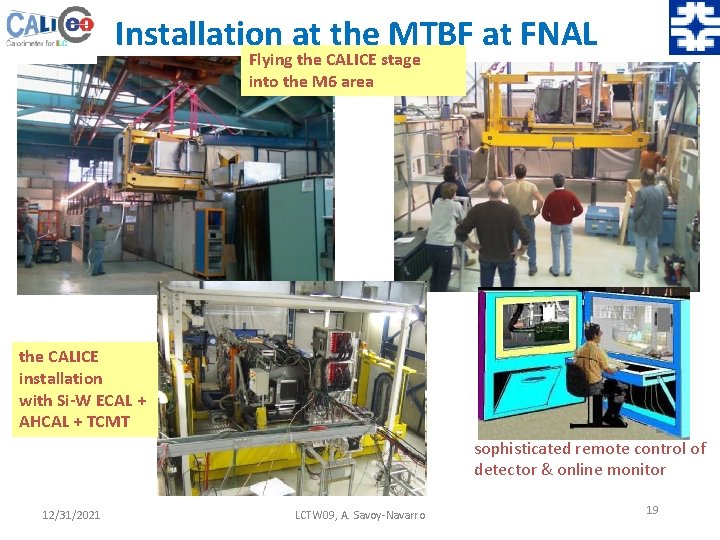
Installation at the MTBF at FNAL Flying the CALICE stage into the M 6 area the CALICE installation with Si-W ECAL + AHCAL + TCMT sophisticated remote control of detector & online monitor 12/31/2021 LCTW 09, A. Savoy-Navarro 19
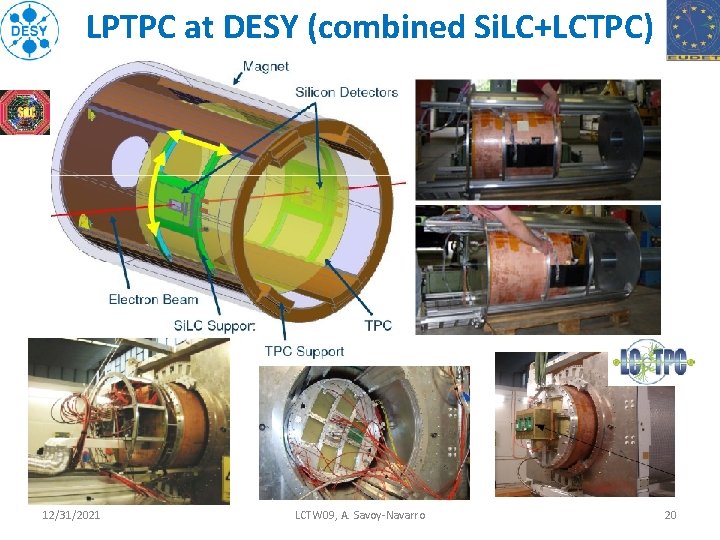
LPTPC at DESY (combined Si. LC+LCTPC) 12/31/2021 LCTW 09, A. Savoy-Navarro 20
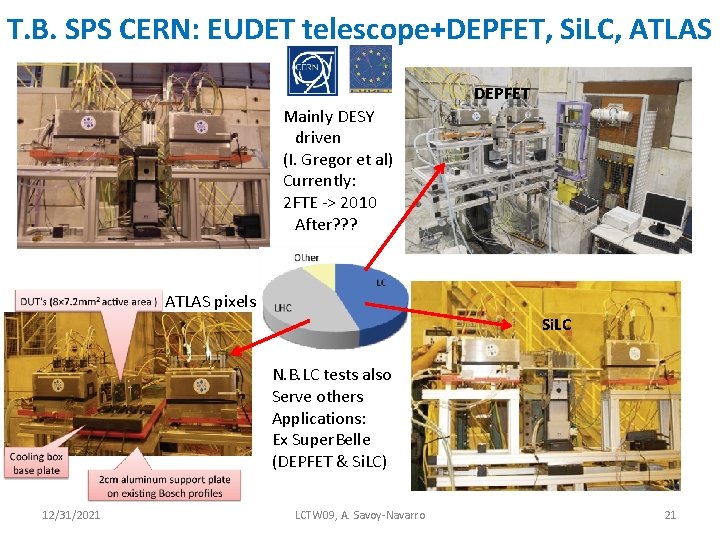
T. B. SPS CERN: EUDET telescope+DEPFET, Si. LC, ATLAS DEPFET Mainly DESY driven (I. Gregor et al) Currently: 2 FTE -> 2010 After? ? ? ATLAS pixels Si. LC N. B. LC tests also Serve others Applications: Ex Super. Belle (DEPFET & Si. LC) 12/31/2021 LCTW 09, A. Savoy-Navarro 21
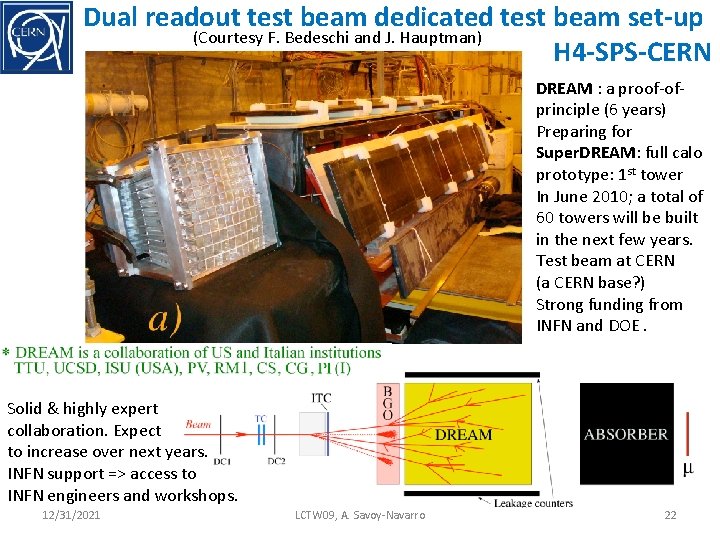
Dual readout test beam dedicated test beam set-up (Courtesy F. Bedeschi and J. Hauptman) H 4 -SPS-CERN DREAM : a proof-ofprinciple (6 years) Preparing for Super. DREAM: full calo prototype: 1 st tower In June 2010; a total of 60 towers will be built in the next few years. Test beam at CERN (a CERN base? ) Strong funding from INFN and DOE. Solid & highly expert collaboration. Expect to increase over next years. INFN support => access to INFN engineers and workshops. 12/31/2021 LCTW 09, A. Savoy-Navarro 22
LOT of gained expertise & t. b. infrastructure: • Expertise in running several dedicated and a few combined test beams • developing the corresponding t. b. infrastructures (EUDET, MTBF) • Expertise in building prototypes • Expertise on a variety of new technologies (detectors, FEE related electronics) • Developments of DAQ system (soft + hard), construction of prototypes, associated electronics etc. . . 12/31/2021 LCTW 09, A. Savoy-Navarro 23
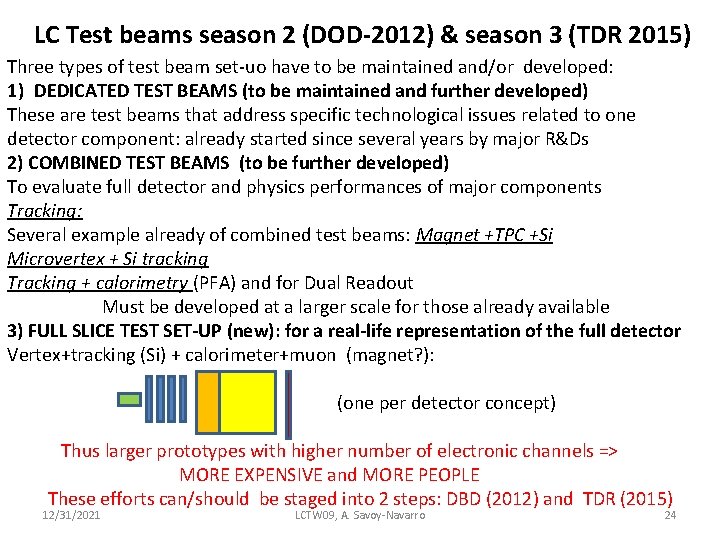
LC Test beams season 2 (DOD-2012) & season 3 (TDR 2015) Three types of test beam set-uo have to be maintained and/or developed: 1) DEDICATED TEST BEAMS (to be maintained and further developed) These are test beams that address specific technological issues related to one detector component: already started since several years by major R&Ds 2) COMBINED TEST BEAMS (to be further developed) To evaluate full detector and physics performances of major components Tracking: Several example already of combined test beams: Magnet +TPC +Si Microvertex + Si tracking Tracking + calorimetry (PFA) and for Dual Readout Must be developed at a larger scale for those already available 3) FULL SLICE TEST SET-UP (new): for a real-life representation of the full detector Vertex+tracking (Si) + calorimeter+muon (magnet? ): (one per detector concept) Thus larger prototypes with higher number of electronic channels => MORE EXPENSIVE and MORE PEOPLE These efforts can/should be staged into 2 steps: DBD (2012) and TDR (2015) 12/31/2021 LCTW 09, A. Savoy-Navarro 24
To confront the challenges ahead of us: we need • • • ! ! t boat!) To keep expertise & highly experienced people (risk of forces leavingcthe e To attract/form new generations of physicists and engineers: newjdetectors for LC o often rely on high tech solutions and thus request expert people. r p the project) A Lab to host the project (need for a country/region to endorse s s => To end up with regional aspects and related disparities e l A LC-Detector R&D Committee (LC-DRDC) in charge e of the evaluation, and follow up => with the authority for getting means & funds. m o To maintain & further exploit what is alreadyhavailable (R&Ds, TB infrastructures. . . ) nand Industry To further develop the synergies with LHC a To share common topics such as: FEEetechno, DAQ, simulations & physics studies. r A general increase in funding ando in number of people involved (at least x 2) m each other not fight each against the other We are all on the same boat: yhelp n of sub-detectors: a weak component A detector is an ensemble a t the overall detector performances. o will affect n LC 12/31/2021 LCTW 09, A. Savoy-Navarro 25
- Slides: 25