
ResourceBased View of the Firm Two perspectives The
Resource-Based View of the Firm � Two perspectives • The internal analysis of phenomena within a company • An external analysis of the industry and its competitive environment � Three key types of resources • Tangible resources • Intangible resources • Organizational capabilities
Types of Resources Tangible Resources Relatively easy to identify, and include physical and financial assets used to create value for customers • Financial resources �Firm’s cash accounts �Firm’s capacity to raise equity �Firm’s borrowing capacity • Physical resources �Modern plant and facilities �Favorable manufacturing locations �State-of-the-art machinery and equipment
Types of Resources Tangible Resources Relatively easy to identify, and include physical and financial assets used to create value for customers • Technological resources �Trade secrets �Innovative production processes �Patents, copyrights, trademarks • Organizational resources �Effective strategic planning processes �Excellent evaluation and control systems
Types of Resources Tangible Resources Intangible Resources Difficult for competitors (and the firm itself) to account for or imitate, typically embedded in unique routines and practices that have evolved over time • Human �Experience and capabilities of employees �Trust �Managerial skills �Firm-specific practices and procedures
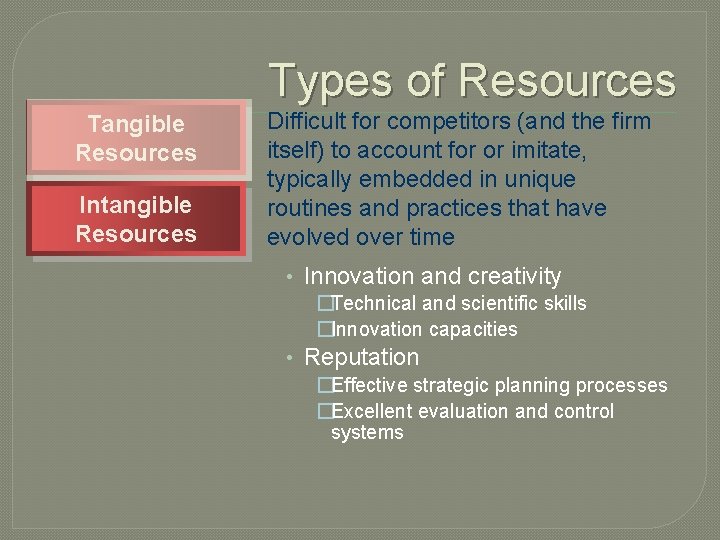
Types of Resources Tangible Resources Intangible Resources Difficult for competitors (and the firm itself) to account for or imitate, typically embedded in unique routines and practices that have evolved over time • Innovation and creativity �Technical and scientific skills �Innovation capacities • Reputation �Effective strategic planning processes �Excellent evaluation and control systems
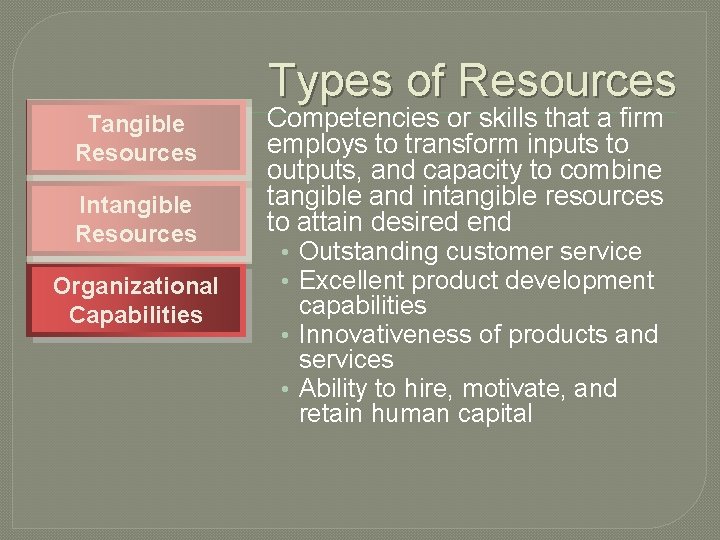
Types of Resources Tangible Resources Intangible Resources Organizational Capabilities Competencies or skills that a firm employs to transform inputs to outputs, and capacity to combine tangible and intangible resources to attain desired end • Outstanding customer service • Excellent product development capabilities • Innovativeness of products and services • Ability to hire, motivate, and retain human capital
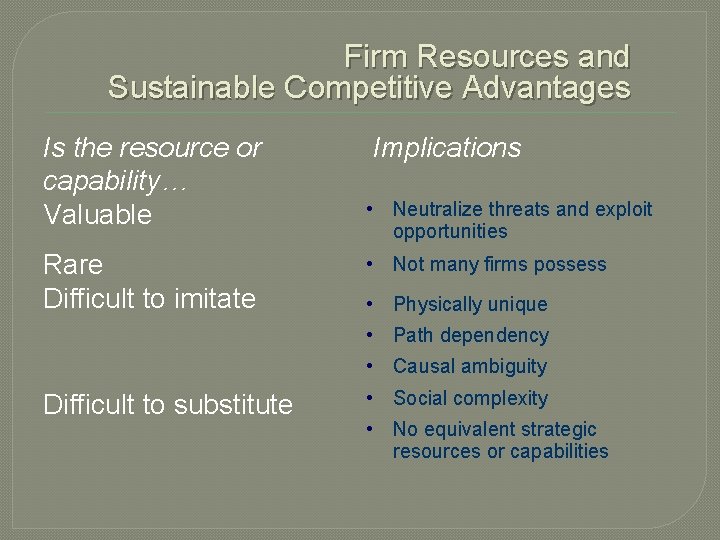
Firm Resources and Sustainable Competitive Advantages Is the resource or capability… Valuable Rare Difficult to imitate Implications • Neutralize threats and exploit opportunities • Not many firms possess • Physically unique • Path dependency • Causal ambiguity Difficult to substitute • Social complexity • No equivalent strategic resources or capabilities
Is the Resource Valuable? Organizational resources can be a source of competitive advantage only when they are valuable • Enable a firm to formulate and implement strategies that improve its efficiency or effectiveness
Is the Resource Rare? Organizational resources also possessed by competitors are not sources of competitive advantage • Common strategies based on similar resources give no one firm an advantage • Competitive advantages are gained only from uncommon resources, resources that are rare to other competitors
Can the Resource be Imitated? Difficulty in imitating resources is key to value creation because it constrains competition • Profits generated from inimitable resources are more likely to be sustainable �Physical uniqueness �Path dependency �Causal ambiguity �Social complexity
Are Substitutes Readily Available? There must be no strategically equivalent valuable resources that are themselves not rare or inimitable • Substitutability may take at least two forms �Competitor may be able to substitute a similar resource that enables it to develop and implement the same strategy �Very different firm resources can become strategic substitutes (such as e-business as a substitute for physical retail facility)
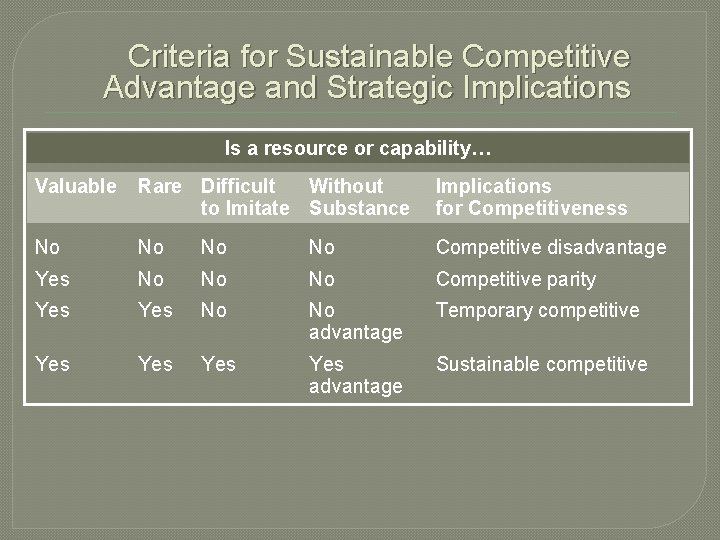
Criteria for Sustainable Competitive Advantage and Strategic Implications Is a resource or capability… Valuable Rare Difficult Without to Imitate Substance Implications for Competitiveness No No Competitive disadvantage Yes No No No Competitive parity Yes No No advantage Temporary competitive Yes Yes advantage Sustainable competitive
- Slides: 12