
ResourceBased Theory Buy or acquire resources and skills
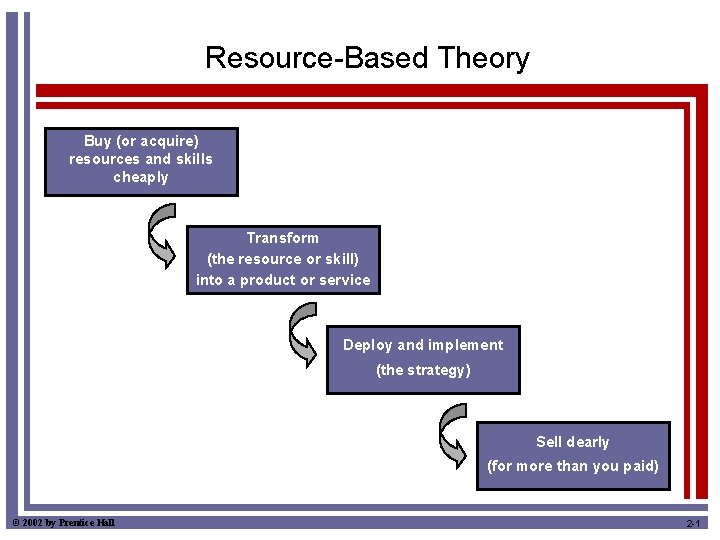
Resource-Based Theory Buy (or acquire) resources and skills cheaply Transform (the resource or skill) into a product or service Deploy and implement (the strategy) Sell dearly (for more than you paid) © 2002 by Prentice Hall 2 -1
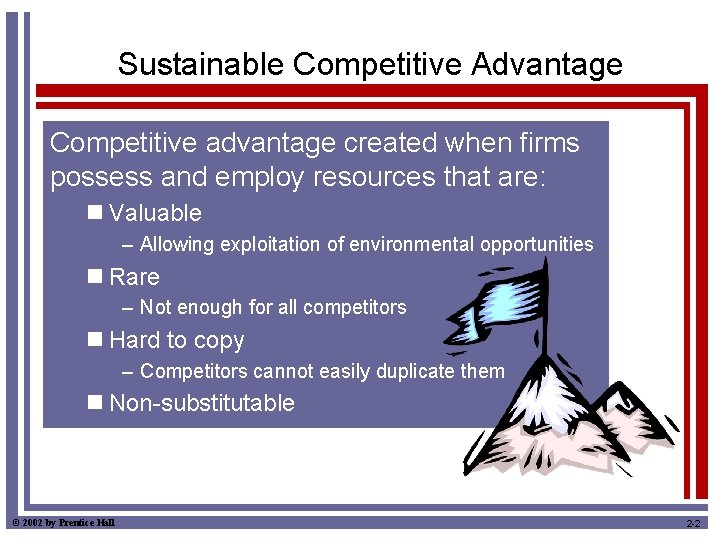
Sustainable Competitive Advantage Competitive advantage created when firms possess and employ resources that are: n Valuable – Allowing exploitation of environmental opportunities n Rare – Not enough for all competitors n Hard to copy – Competitors cannot easily duplicate them n Non-substitutable © 2002 by Prentice Hall 2 -2
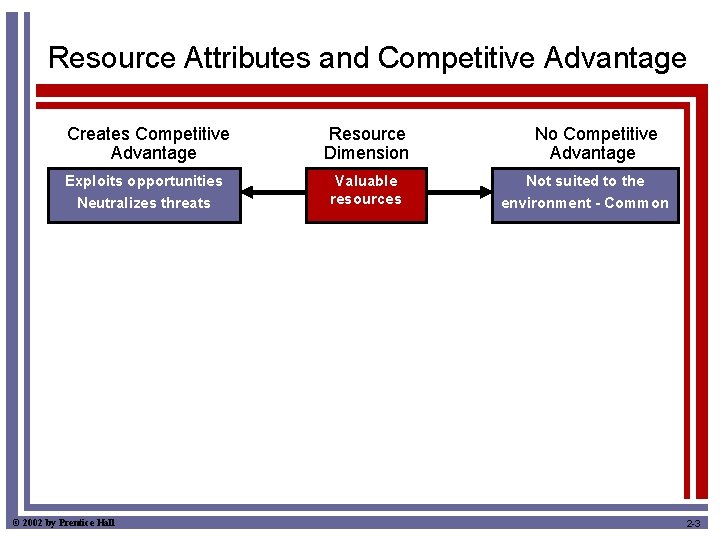
Resource Attributes and Competitive Advantage Creates Competitive Advantage Exploits opportunities Neutralizes threats © 2002 by Prentice Hall Resource Dimension Valuable resources No Competitive Advantage Not suited to the environment - Common 2 -3
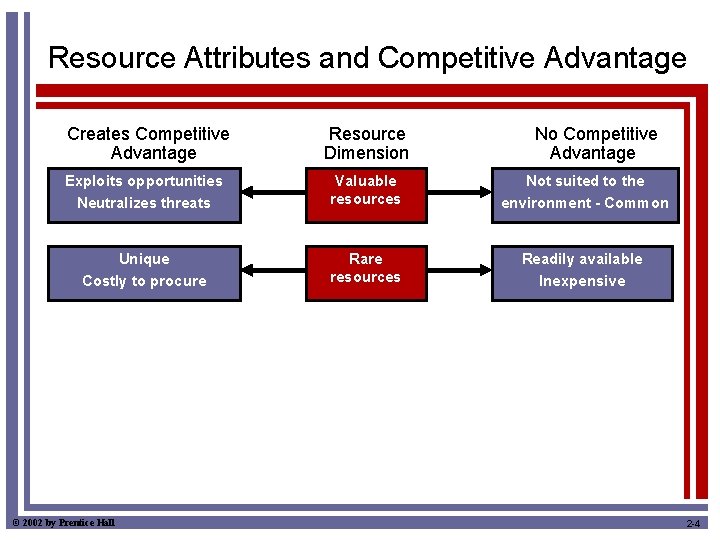
Resource Attributes and Competitive Advantage Creates Competitive Advantage Resource Dimension No Competitive Advantage Exploits opportunities Neutralizes threats Valuable resources Not suited to the environment - Common Unique Costly to procure Rare resources Readily available Inexpensive © 2002 by Prentice Hall 2 -4
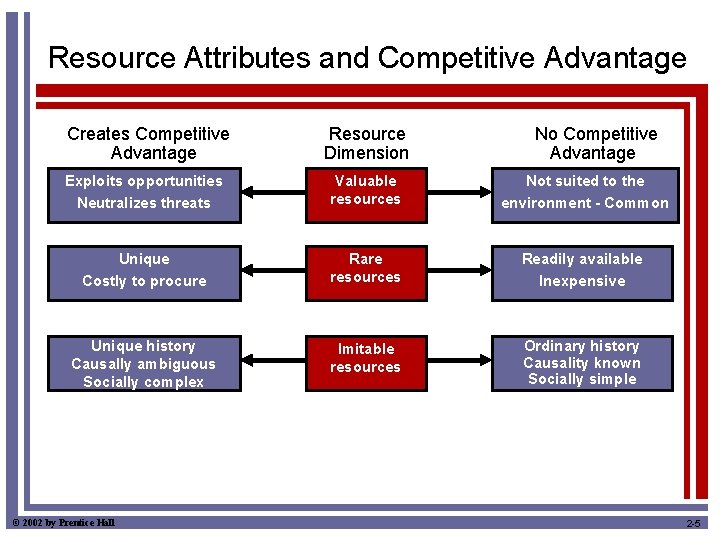
Resource Attributes and Competitive Advantage Creates Competitive Advantage Resource Dimension No Competitive Advantage Exploits opportunities Neutralizes threats Valuable resources Not suited to the environment - Common Unique Costly to procure Rare resources Readily available Inexpensive Unique history Causally ambiguous Socially complex Imitable resources Ordinary history Causality known Socially simple © 2002 by Prentice Hall 2 -5
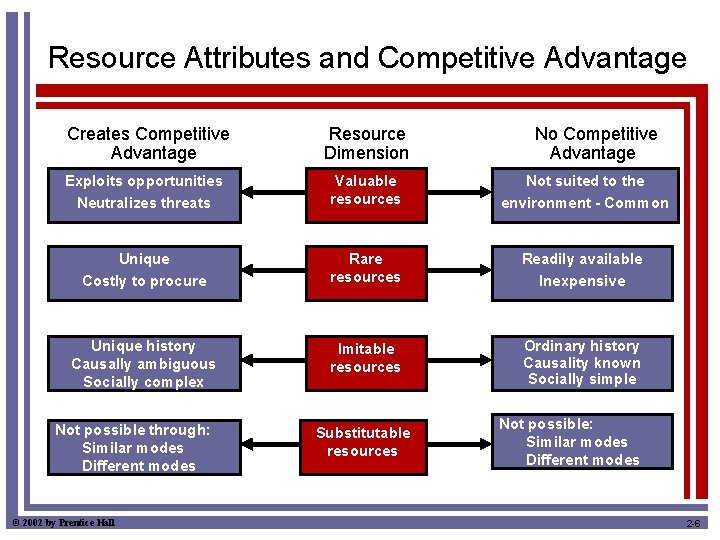
Resource Attributes and Competitive Advantage Creates Competitive Advantage Resource Dimension No Competitive Advantage Exploits opportunities Neutralizes threats Valuable resources Not suited to the environment - Common Unique Costly to procure Rare resources Readily available Inexpensive Unique history Causally ambiguous Socially complex Imitable resources Ordinary history Causality known Socially simple Not possible through: Similar modes Different modes © 2002 by Prentice Hall Substitutable resources Not possible: Similar modes Different modes 2 -6
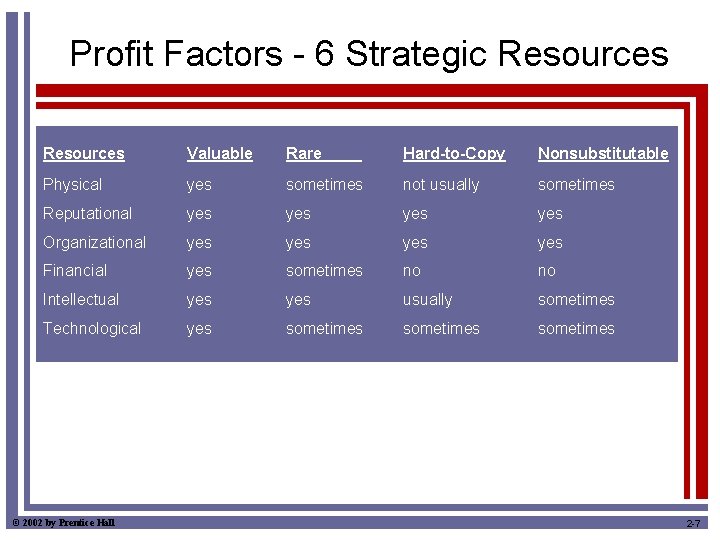
Profit Factors - 6 Strategic Resources Valuable Rare Hard-to-Copy Nonsubstitutable Physical yes sometimes not usually sometimes Reputational yes yes Organizational yes yes Financial yes sometimes no no Intellectual yes usually sometimes Technological yes sometimes © 2002 by Prentice Hall 2 -7
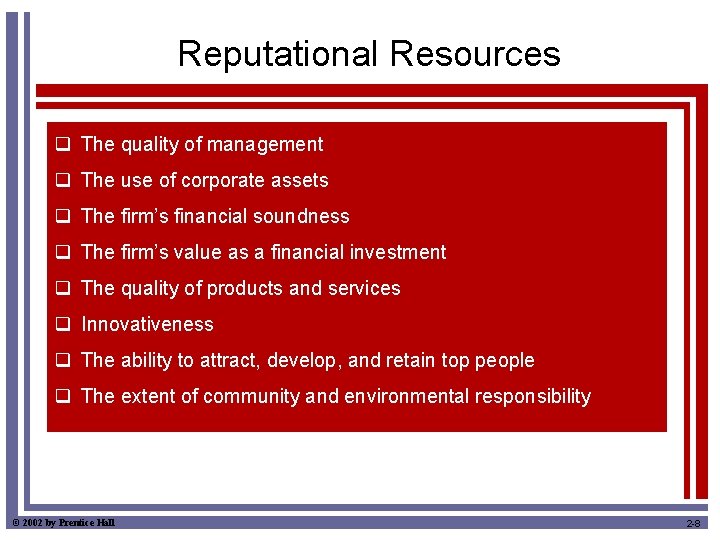
Reputational Resources q The quality of management q The use of corporate assets q The firm’s financial soundness q The firm’s value as a financial investment q The quality of products and services q Innovativeness q The ability to attract, develop, and retain top people q The extent of community and environmental responsibility © 2002 by Prentice Hall 2 -8
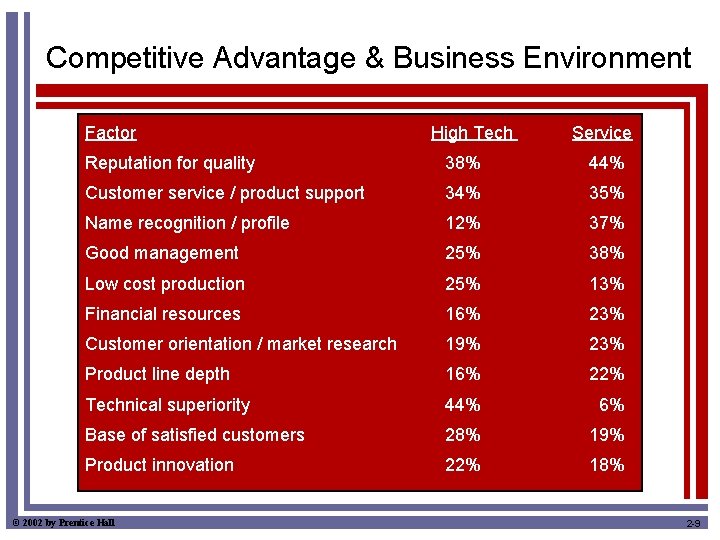
Competitive Advantage & Business Environment Factor High Tech Service Reputation for quality 38% 44% Customer service / product support 34% 35% Name recognition / profile 12% 37% Good management 25% 38% Low cost production 25% 13% Financial resources 16% 23% Customer orientation / market research 19% 23% Product line depth 16% 22% Technical superiority 44% 6% Base of satisfied customers 28% 19% Product innovation 22% 18% © 2002 by Prentice Hall 2 -9
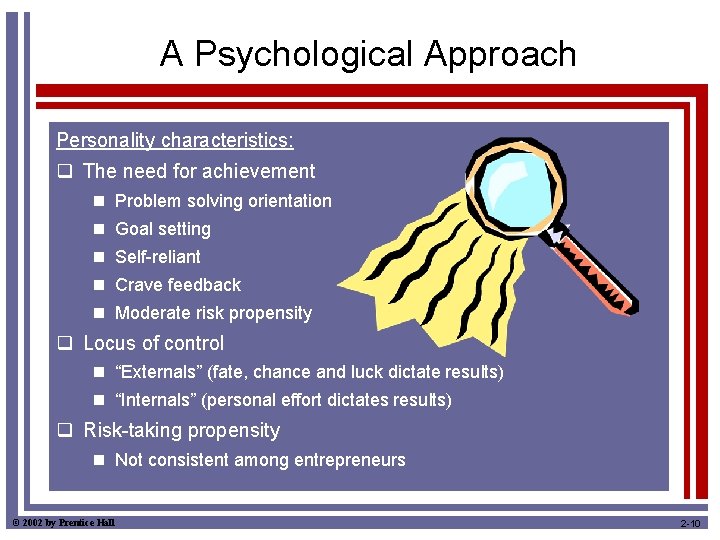
A Psychological Approach Personality characteristics: q The need for achievement n Problem solving orientation n Goal setting n Self-reliant n Crave feedback n Moderate risk propensity q Locus of control n “Externals” (fate, chance and luck dictate results) n “Internals” (personal effort dictates results) q Risk-taking propensity n Not consistent among entrepreneurs © 2002 by Prentice Hall 2 -10
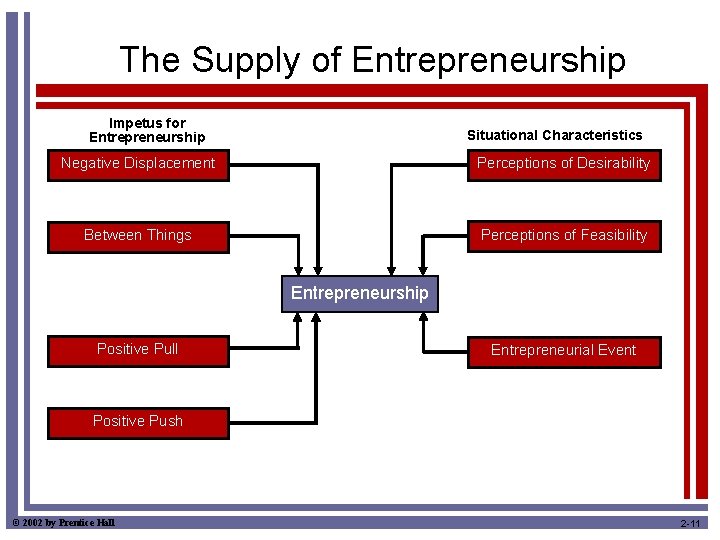
The Supply of Entrepreneurship Impetus for Entrepreneurship Situational Characteristics Negative Displacement Perceptions of Desirability Between Things Perceptions of Feasibility Entrepreneurship Positive Pull Entrepreneurial Event Positive Push © 2002 by Prentice Hall 2 -11
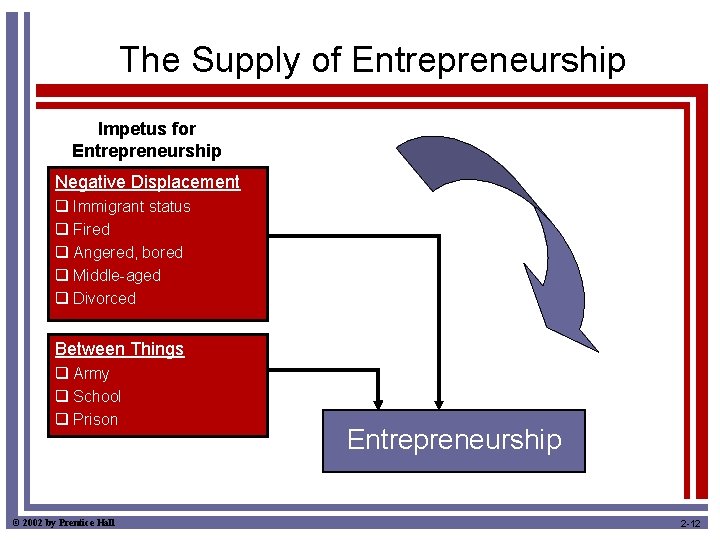
The Supply of Entrepreneurship Impetus for Entrepreneurship Negative Displacement q Immigrant status q Fired q Angered, bored q Middle-aged q Divorced Between Things q Army q School q Prison © 2002 by Prentice Hall Entrepreneurship 2 -12
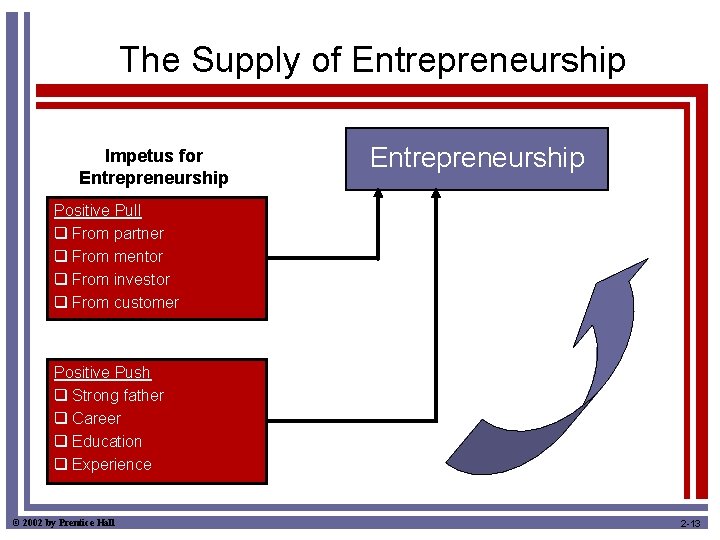
The Supply of Entrepreneurship Impetus for Entrepreneurship Positive Pull q From partner q From mentor q From investor q From customer Positive Push q Strong father q Career q Education q Experience © 2002 by Prentice Hall 2 -13
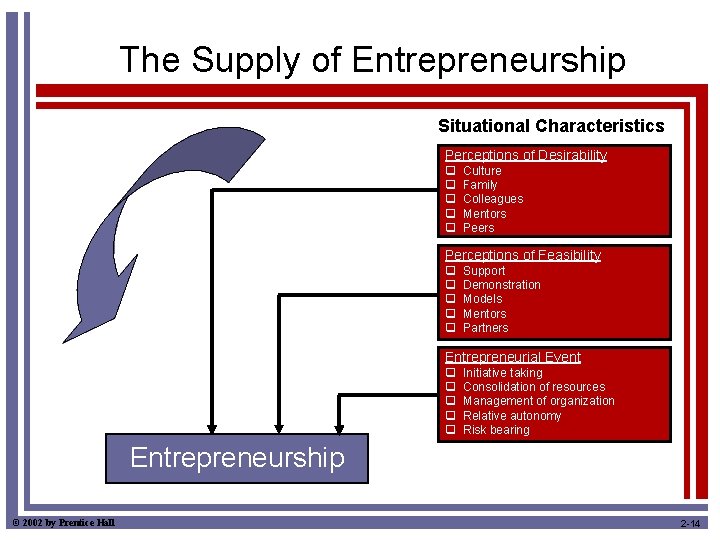
The Supply of Entrepreneurship Situational Characteristics Perceptions of Desirability q q q Culture Family Colleagues Mentors Peers Perceptions of Feasibility q q q Support Demonstration Models Mentors Partners Entrepreneurial Event q q q Initiative taking Consolidation of resources Management of organization Relative autonomy Risk bearing Entrepreneurship © 2002 by Prentice Hall 2 -14
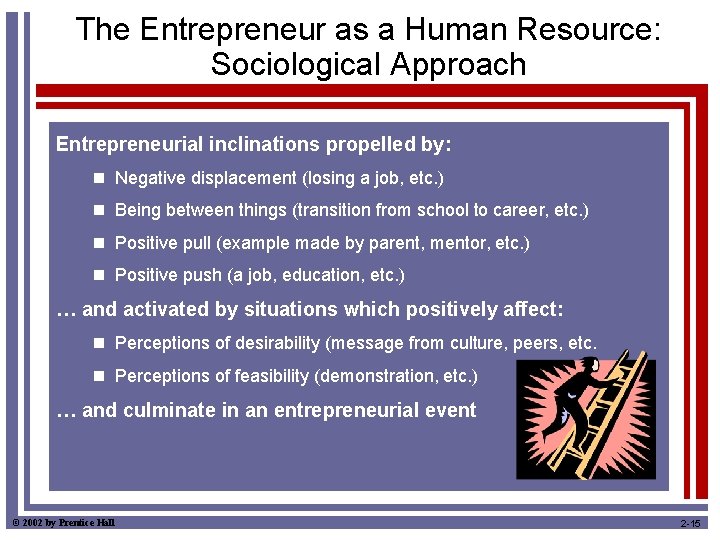
The Entrepreneur as a Human Resource: Sociological Approach Entrepreneurial inclinations propelled by: n Negative displacement (losing a job, etc. ) n Being between things (transition from school to career, etc. ) n Positive pull (example made by parent, mentor, etc. ) n Positive push (a job, education, etc. ) … and activated by situations which positively affect: n Perceptions of desirability (message from culture, peers, etc. n Perceptions of feasibility (demonstration, etc. ) … and culminate in an entrepreneurial event © 2002 by Prentice Hall 2 -15
- Slides: 15