
Resource Practices Branch Initializing TIPSY 4 3 with
Resource Practices Branch Initializing TIPSY 4. 3 with Silviculture Survey (RESULTS) Data FY 2012 -13 Consultants’ Report by: Steve Stearns-Smith, RPF and Wendy Bergerud Project Debriefing Meeting 03 April 2013
Backcasting, the opposite of forecasting. 2
Initializing TIPSY with Silv. Survey Data Forest Analysis and Branch Inventory Branch Resource Practices Project Intent l l A first approximation of standard operating procedures. Primary emphasis on initial density and spatial distribution, building on Wendy’s analyses. Other aspects secondary (OAFs, etc) i. e. , conceptual, no supporting analysis. General procedures to support TSR, SDM, FFT, etc. 3
Initializing TIPSY with Silv. Survey Data Forest Analysis and Branch Inventory Branch Resource Practices Reflects Silv. Survey Limitations l l Not designed to support TIPSY (free-growing declaration, not GY) Broader range of stand conditions than TIPSY (therefore, follow historic practice standards for other TIPSY apps) Survey Standards may sound supportive, but always check field practices (e. g. , NP) Potential for ocular surveys (no plot data) 4
Initializing TIPSY with Silv. Survey Data Forest Analysis and Branch Inventory Branch Resource Practices Reflects TIPSY Limitations l Long list in report, key limitations include: – – – l bare ground (why backcasting is required) single-species, even-age does not predict ingress or natural disturbance events regen method implications mixed-species implications OAF implications Backcasting even more limited in some areas 5
Initializing TIPSY with Silv. Survey Data Forest Analysis and Branch Inventory Branch Resource Practices Regen Method (P, N, C) Implications l l l Independent from regen delay Defines fixed seedling establishment period (EP) Planted = 1 yr Natural & Clumped =~10 yrs Defines fixed spatial distribution (SD) Planted = square spacing Natural = random Clumped = clumped random (one clumpiness) Regen method, EP & SD are not independent in TIPSY Genetic gain only applied to Planted 6
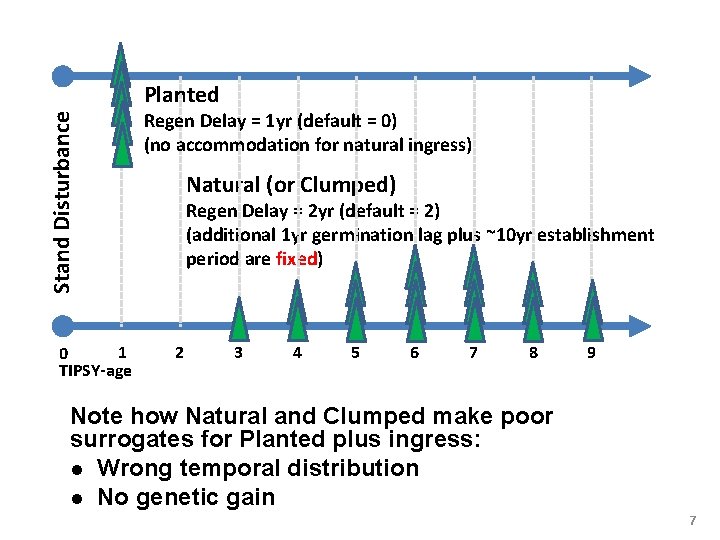
Stand Disturbance Planted 1 0 TIPSY-age Regen Delay = 1 yr (default = 0) (no accommodation for natural ingress) Natural (or Clumped) Regen Delay = 2 yr (default = 2) (additional 1 yr germination lag plus ~10 yr establishment period are fixed) 2 3 4 5 6 7 8 9 Note how Natural and Clumped make poor surrogates for Planted plus ingress: l Wrong temporal distribution l No genetic gain 7
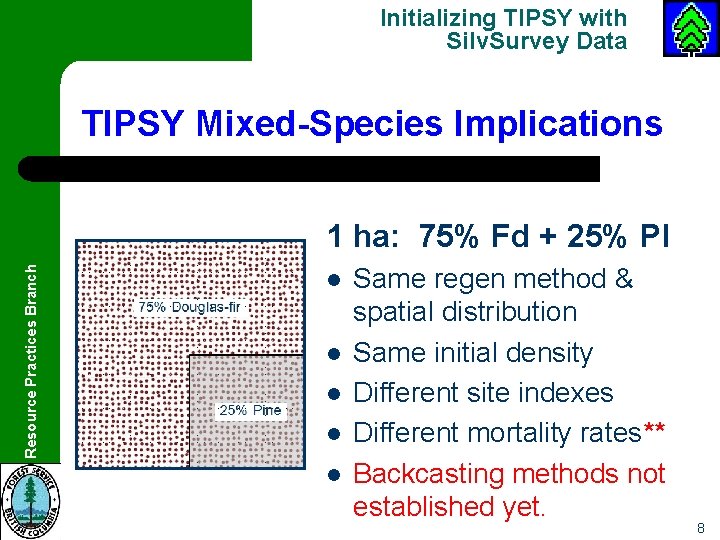
Initializing TIPSY with Silv. Survey Data Forest Analysis and Branch Inventory Branch Resource Practices TIPSY Mixed-Species Implications 1 ha: 75% Fd + 25% Pl l l Same regen method & spatial distribution Same initial density Different site indexes Different mortality rates** Backcasting methods not established yet. 8
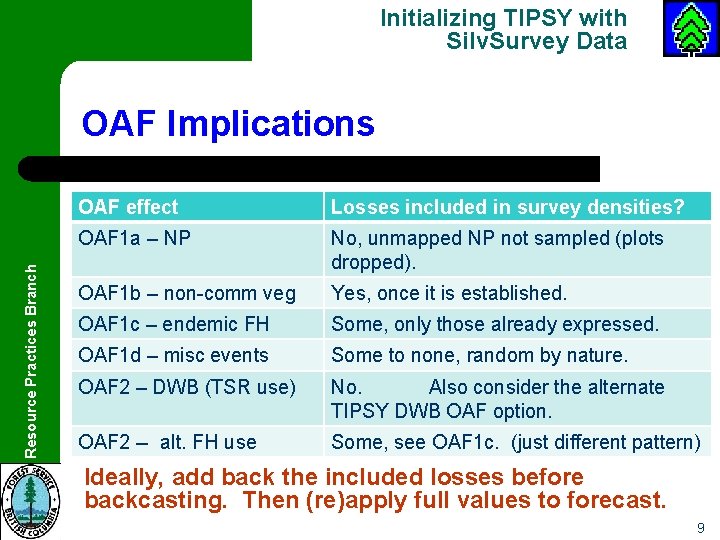
Initializing TIPSY with Silv. Survey Data Forest Analysis and Branch Inventory Branch Resource Practices OAF Implications OAF effect Losses included in survey densities? OAF 1 a – NP No, unmapped NP not sampled (plots dropped). OAF 1 b – non-comm veg Yes, once it is established. OAF 1 c – endemic FH Some, only those already expressed. OAF 1 d – misc events Some to none, random by nature. OAF 2 – DWB (TSR use) No. Also consider the alternate TIPSY DWB OAF option. OAF 2 -- alt. FH use Some, see OAF 1 c. (just different pattern) Ideally, add back the included losses before backcasting. Then (re)apply full values to forecast. 9
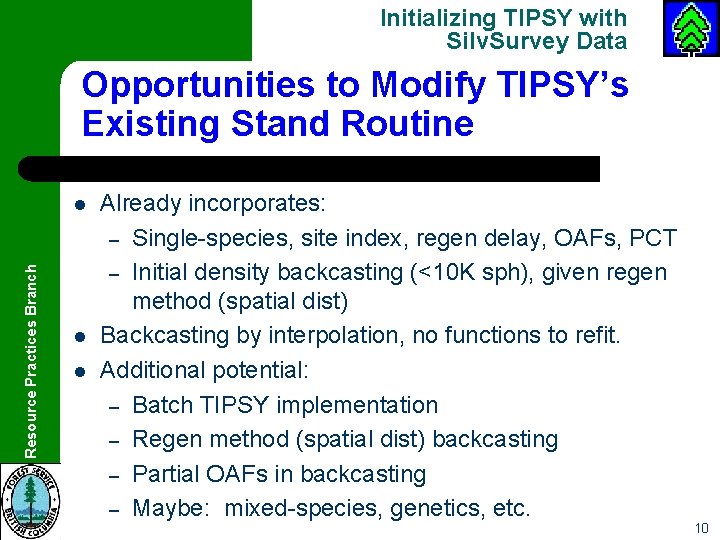
Initializing TIPSY with Silv. Survey Data Forest Analysis and Branch Inventory Branch Resource Practices Opportunities to Modify TIPSY’s Existing Stand Routine l l l Already incorporates: – Single-species, site index, regen delay, OAFs, PCT – Initial density backcasting (<10 K sph), given regen method (spatial dist) Backcasting by interpolation, no functions to refit. Additional potential: – Batch TIPSY implementation – Regen method (spatial dist) backcasting – Partial OAFs in backcasting – Maybe: mixed-species, genetics, etc. 10
Questions? 11
- Slides: 11