
RESOURCE MANAGEMENT AND TOPOLOGY EMBEDDING IN A DISTRIBUTED
RESOURCE MANAGEMENT AND TOPOLOGY EMBEDDING IN A DISTRIBUTED NETWORKED INFRASTRUCTURE ENVIRONMENT S. Papavassiliou, C. Papagianni NETMODE, NTUA I. Baldin, Y. Xin RENCI, UNC Chapel Hill
Outline • Topology Embedding: Overview, Terminology and Supporting Functions • Problem Overview and Application Domains • Intra- and Inter-domain Embedding • Coordination of Embedding Functions • Architectural Approaches • Implementation Approaches • Broker-based Architecture • Pros and Cons • Resource Delegation Options • Levels of Resource Abstraction • Topology Embedding • Enabling APIs
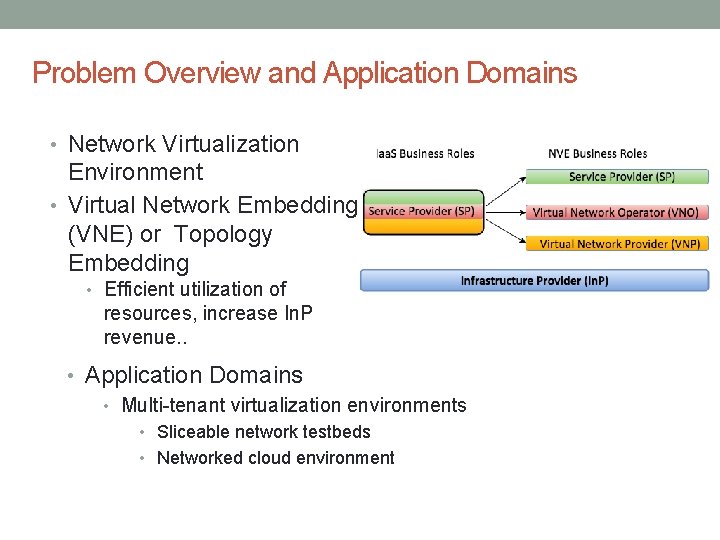
Problem Overview and Application Domains • Network Virtualization Environment • Virtual Network Embedding (VNE) or Topology Embedding • Efficient utilization of resources, increase In. P revenue. . • Application Domains • Multi-tenant virtualization environments • Sliceable network testbeds • Networked cloud environment
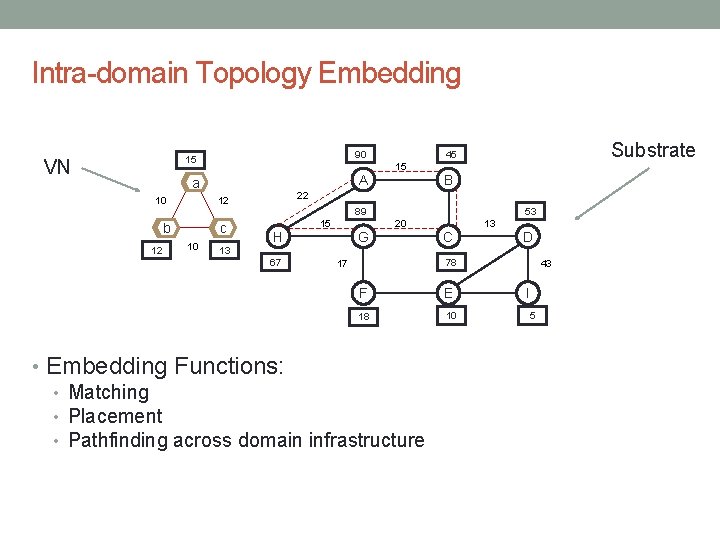
Intra-domain Topology Embedding 90 15 VN A aa 10 12 cc 10 B 22 12 bb Substrate 45 15 89 H 15 G 53 20 C 13 D 13 67 78 17 F E 18 10 • Embedding Functions: • Matching • Placement • Pathfinding across domain infrastructure 43 I 5
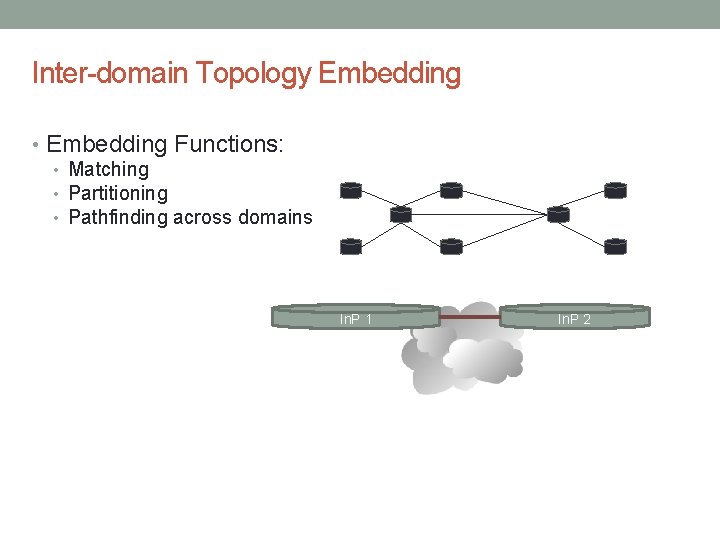
Inter-domain Topology Embedding • Embedding Functions: • Matching • Partitioning • Pathfinding across domains In. P 1 In. P 2

Coordination of Embedding and other Functions • Performing embedding requires coordination, either • Tool <-> In. Ps/aggregates • . . Or across In. Ps • Intermediary entity (broker) • Requires In. Ps make promises/delegations of resource availability to brokers • Described at the level of detail that supports embedding, but doesn’t compromise provider privacy • Logically centralized or distributed • Hierarchies of brokers

Broker-based Approach vs Tool-based Approach • Improved Scalability – take on the distributed agreement from In. Ps • Neutral PEP – implement federation-level authorization policies without the need to trust providers • Dispute resolution • Simplify User Tools development / Management SW for In. Ps • Sophisticated and Fair Embedding – implement portions of embedding logic • Exact partitioning of embedding functions between tools, brokers and In. Ps is an open problem
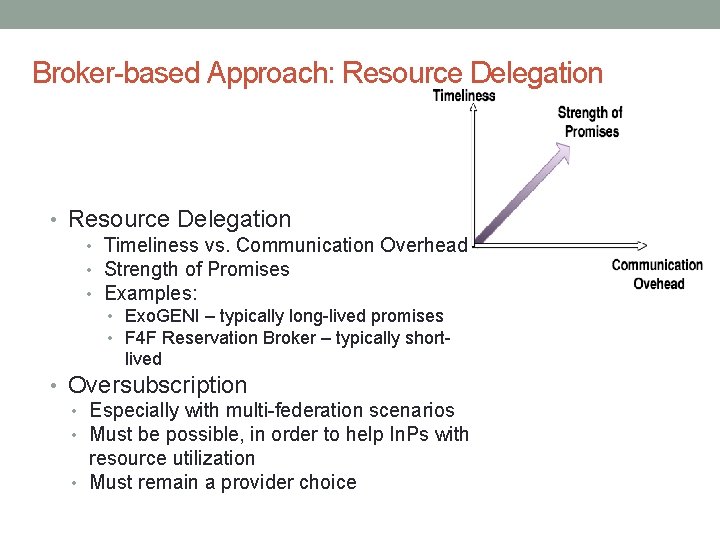
Broker-based Approach: Resource Delegation • Resource Delegation • Timeliness vs. Communication Overhead • Strength of Promises • Examples: • Exo. GENI – typically long-lived promises • F 4 F Reservation Broker – typically short- lived • Oversubscription • Especially with multi-federation scenarios • Must be possible, in order to help In. Ps with resource utilization • Must remain a provider choice
Levels of Resource Abstraction & Topology Embedding • Substrate or domain model abstraction • Information disclosure vs. Embedding efficiency • Example: domain ‘switch’ abstraction • Requirements for a Broker-based Architecture • Facilitate searching: use appropriate URIs for publishing and linking model elements across distributed models • Embedding related: • IM should support multiple levels of detail (In. P to tenant) • IM should support similarity relationships between resource descriptions for improved matching (semantics)
Enabling APIs • Broker Delegation/update • Accept resource delegations from In. Ps with different strength of promises • Digitally Signed, Validity Term • Support unsolicited updates • In. P (e. g. , AM) or In. P’s Monitoring System • Possibly all the way to the tenant • Query • Matching: Querying for resources • e. g. , closest match, through time etc. • Queries for historical information • e. g. , accounting, reputation etc. • Reservation/embedding • Support reservation process • Support embedding and reservation (single or two-step procedure) • Or support ticket issuing for the tenant

Thank you!
- Slides: 11