
Resource Description Framework RDF By David Wilczynski USC
Resource Description Framework (RDF) • By David Wilczynski, USC, dwilczyn@usc. edu • Based on: http: //www. w 3. org/TR/rdf-primer/ – which is edited by: – Frank Manola, The MITRE Corporation, fmanola@mitre. org – Eric Miller, W 3 C, em@w 3. org 1
1. Introduction • RDF is a language for: – (1) representing information about resources in the World Wide Web, – (2) presenting metadata about Web resources, such as the title and author of a Web page. • Resources are things that can be identified on the Web, even when they can't be directly retrieved on the Web. Any person is an example of a resource. • RDF is computer readable and “understandable. ” 2
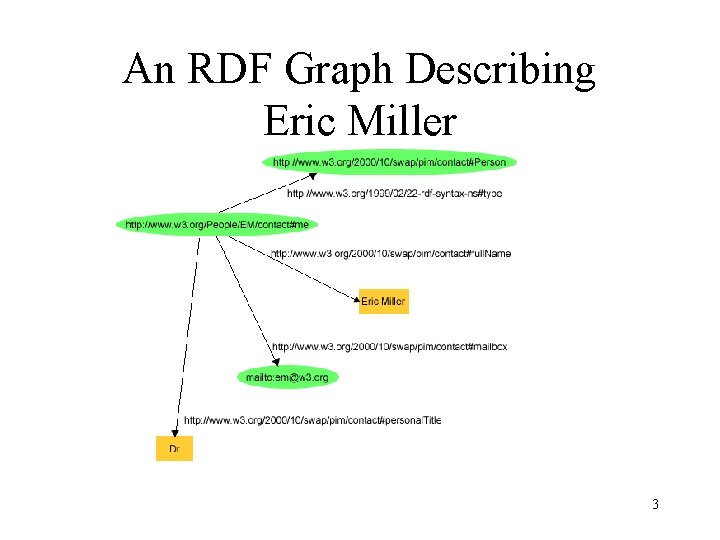
An RDF Graph Describing Eric Miller 3
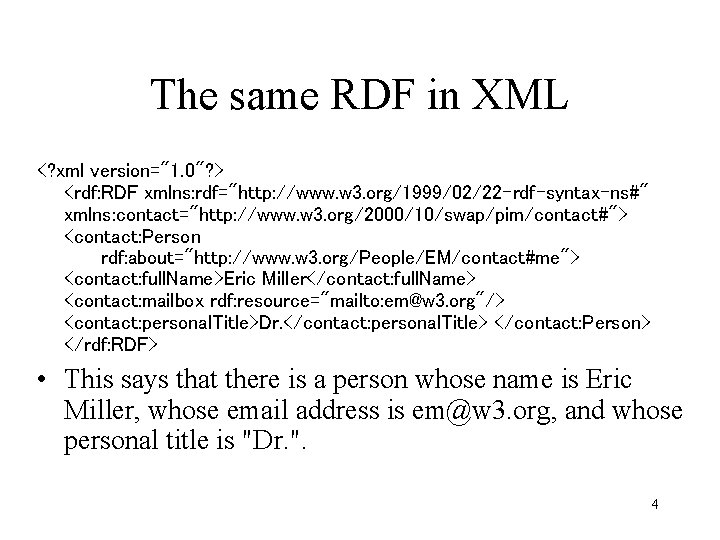
The same RDF in XML <? xml version="1. 0"? > <rdf: RDF xmlns: rdf="http: //www. w 3. org/1999/02/22 -rdf-syntax-ns#" xmlns: contact="http: //www. w 3. org/2000/10/swap/pim/contact#"> <contact: Person rdf: about="http: //www. w 3. org/People/EM/contact#me"> <contact: full. Name>Eric Miller</contact: full. Name> <contact: mailbox rdf: resource="mailto: em@w 3. org"/> <contact: personal. Title>Dr. </contact: personal. Title> </contact: Person> </rdf: RDF> • This says that there is a person whose name is Eric Miller, whose email address is em@w 3. org, and whose personal title is "Dr. ". 4
The Big Idea • Besides Web pages, we can now convey information about cars, businesses, people, news events, etc. • Further, RDF references themselves can be labeled, to indicate the kind of relationship that exists between the linked items. • Maybe Web programs can be smarter!! 5
2. Making Statements About Resources • RDF is intended to provide a simple way to make statements about Web resources, such as Web pages. • This section describes how RDF does this. 6
2. 1 Basic Concepts "http: //www. example. org/index. html has a creator whose value is John Smith" • Every RDF statement is a triple of the form: (subject, property, object) • In the example statement above: – the Web page's URL is the subject. – "creator" is a property (or predicate) of that page, – "John Smith" is the value or object of the property. 7
More Properties • We can state other properties of this Web page: – http: //www. example. org/index. html has a creationdate whose value is August 16, 1999 – http: //www. example. org/index. html has a language whose value is English • In RDF, resources are described in terms of these triples, (subject, property, object). 8
Uniform Resource Identifiers (URIs) • In real life we use names to refer to resources: "Bob", "The Moon", "373 Whitaker Ave. ", "California", "VIN 2745534", "today's weather". • But, names are ambiguous. • To resolve this problem we use URIs to name things in the Web. 9
Uniform Resource Locators (URLs) • The Web already provides one form of identifier, the Uniform Resource Locator (URL). • We used a URL in our original example to identify the Web page that John Smith created. • A URL is a character string that identifies a Web resource by its network location. • But there are lots of resources besides retrievable ones. Hence, the URI is more general. 10
There are More than Just Pages on the Web • We would like to be able to record information about many things in addition to Web pages: – For example, a human being has contact information (email, phone), medical information, hobbies, etc. • But, certainly a human has no URL, though he may have a home page with a URL. • We must try to formally identify various kinds of things that go by names such as "Social Security Number", or "Part Number" by using URIs. 11
URI to Name Anything • We can create a URI to refer to anything we want to talk about, including: – network-accessible things, such as an HTML doc. – things that are not network-accessible, such as humans, corporations, and books in a library. – abstract concepts that don't physically exist, like that of a “unicorn". • URIs constitute an infinite stock of names. 12
URIs and RDF • RDF uses URI references to define its subjects, predicates, and objects. • A URI reference (or URIref) is a URI, together with an optional fragment identifier at the end. • E. g. , the URI http: //www. example. org/index. html#section 2 consists of: – the URI http: //www. example. org/index. html – the fragment identifier: section 2. • A resource is identifiable by a URI reference 13
RDF and XML • RDF is a graph—the object of one statement can be the subject of another. • Extensible Markup Language (XML) provides us with: – a linear representation of this graph; – and, as such, a way for exchanging RDF statements between applications. 14
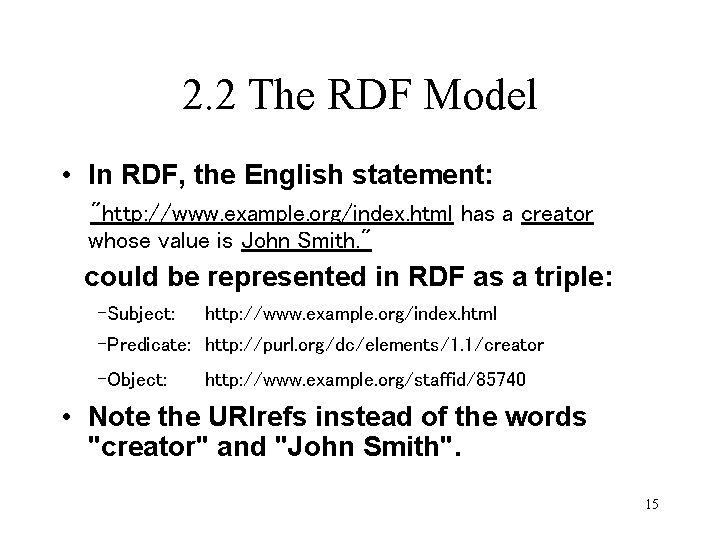
2. 2 The RDF Model • In RDF, the English statement: "http: //www. example. org/index. html has a creator whose value is John Smith. " could be represented in RDF as a triple: –Subject: http: //www. example. org/index. html –Predicate: http: //purl. org/dc/elements/1. 1/creator –Object: http: //www. example. org/staffid/85740 • Note the URIrefs instead of the words "creator" and "John Smith". 15
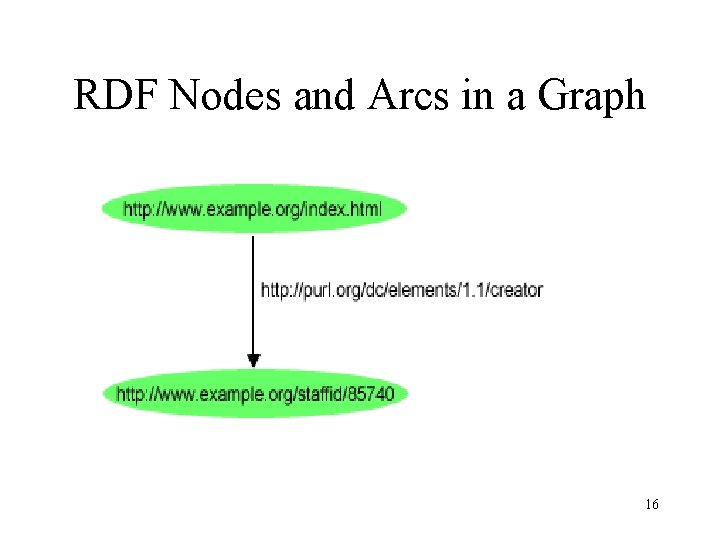
RDF Nodes and Arcs in a Graph 16
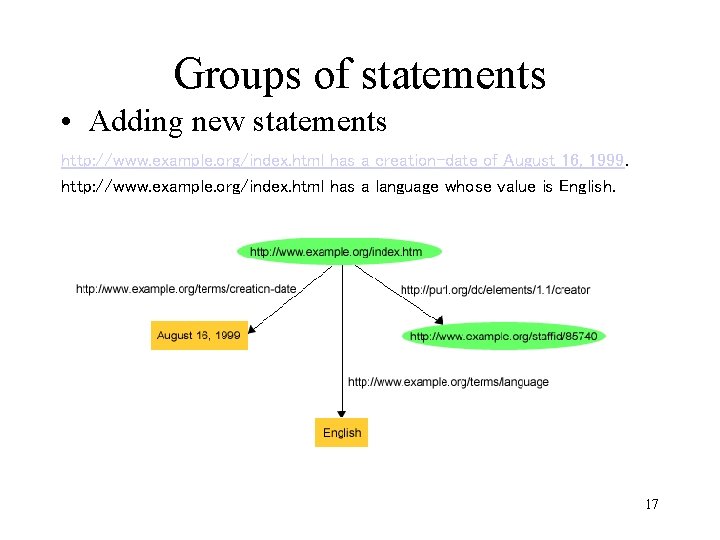
Groups of statements • Adding new statements http: //www. example. org/index. html has a creation-date of August 16, 1999. http: //www. example. org/index. html has a language whose value is English. 17
Groups of statements (cont. ) • Objects of RDF statements – may be resources identified by URIrefs, – or constant values (plain or typed literals), • Literals can't be subjects of RDF statements 18
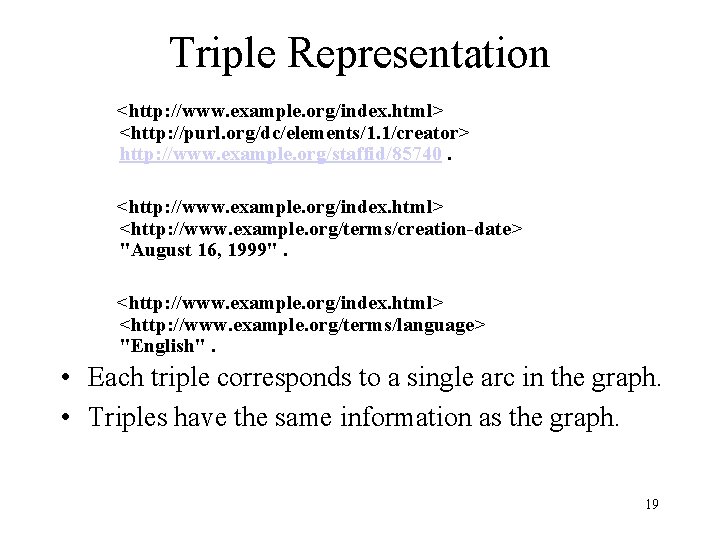
Triple Representation <http: //www. example. org/index. html> <http: //purl. org/dc/elements/1. 1/creator> http: //www. example. org/staffid/85740. <http: //www. example. org/index. html> <http: //www. example. org/terms/creation-date> "August 16, 1999". <http: //www. example. org/index. html> <http: //www. example. org/terms/language> "English". • Each triple corresponds to a single arc in the graph. • Triples have the same information as the graph. 19
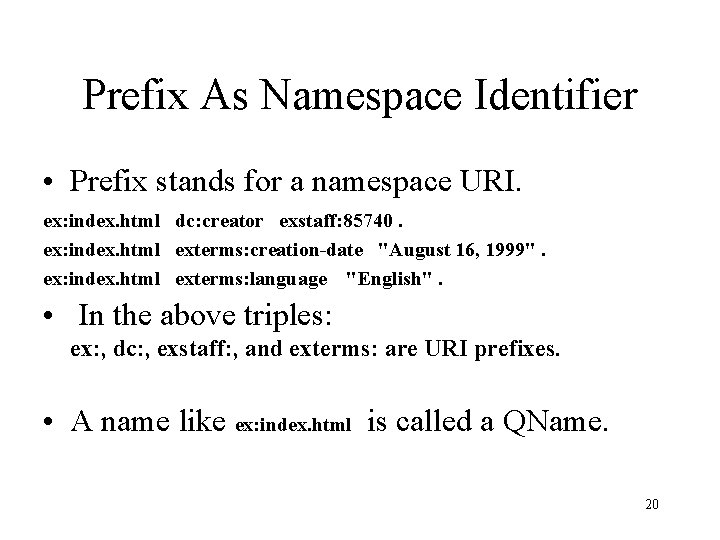
Prefix As Namespace Identifier • Prefix stands for a namespace URI. ex: index. html dc: creator exstaff: 85740. ex: index. html exterms: creation-date "August 16, 1999". ex: index. html exterms: language "English". • In the above triples: ex: , dc: , exstaff: , and exterms: are URI prefixes. • A name like ex: index. html is called a QName. 20
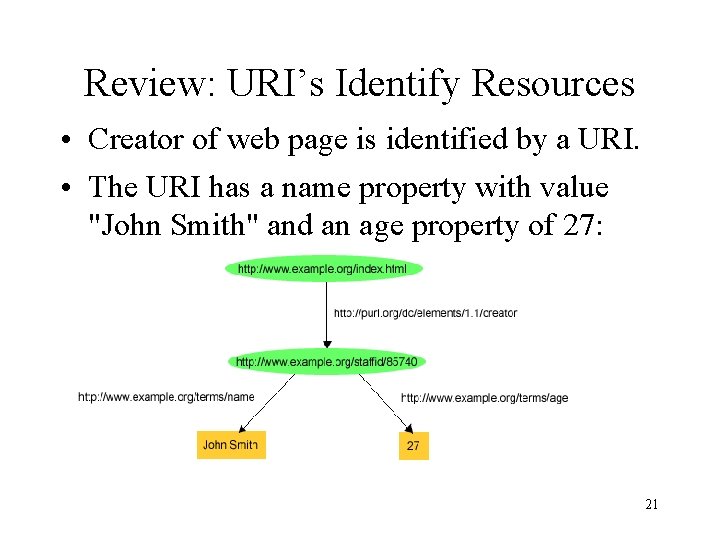
Review: URI’s Identify Resources • Creator of web page is identified by a URI. • The URI has a name property with value "John Smith" and an age property of 27: 21
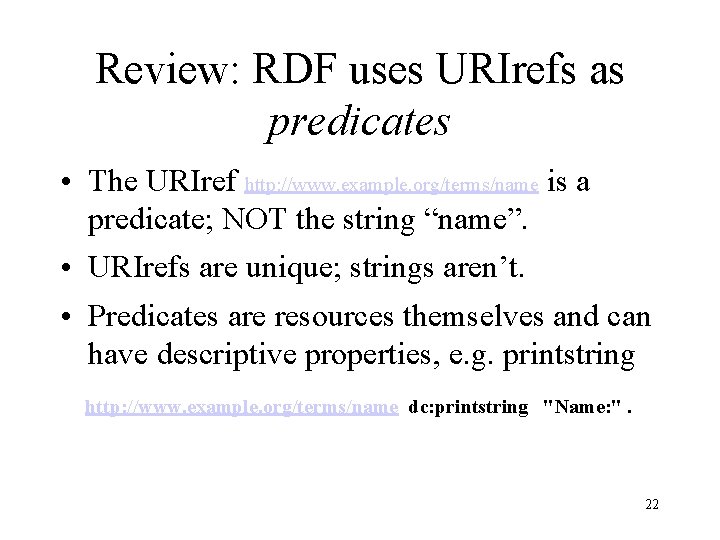
Review: RDF uses URIrefs as predicates • The URIref http: //www. example. org/terms/name is a predicate; NOT the string “name”. • URIrefs are unique; strings aren’t. • Predicates are resources themselves and can have descriptive properties, e. g. printstring http: //www. example. org/terms/name dc: printstring "Name: ". 22
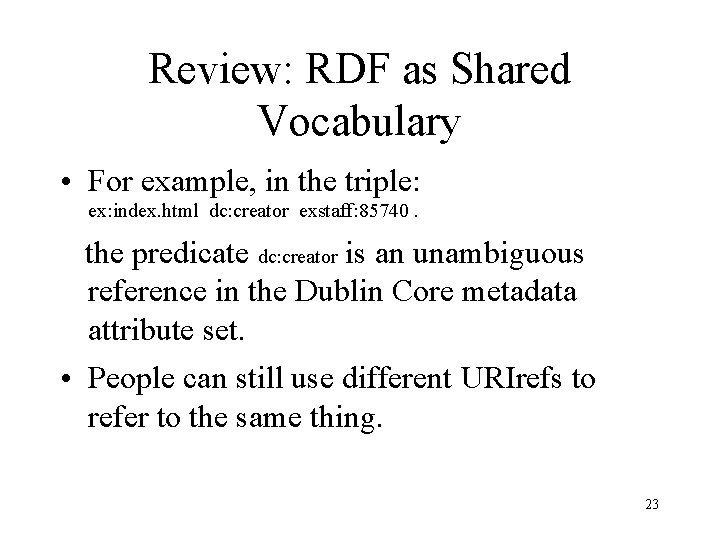
Review: RDF as Shared Vocabulary • For example, in the triple: ex: index. html dc: creator exstaff: 85740. the predicate dc: creator is an unambiguous reference in the Dublin Core metadata attribute set. • People can still use different URIrefs to refer to the same thing. 23
Review: Simpler for Applications • RDF provides a way to make statements that applications can process more easily: – A program could search the Web for all book reviews and create an average rating for each book, and put that information back on the Web. – Another site could take that list of averages and create a "Top Ten Highest Rated Books" page. • Key: a shared vocabulary about books and ratings. 24
2. 3 Structured Property Values and Blank Nodes • The exterms: address property can be filled by a literal like “ 1501 Grant Avenue, Bedford, Massachusetts 01730”. • What about a structure consisting of separate street, city, state, and zip code values? • We could model the address as a resource, give it a URIref say: http: //www. example. org/addressid/85740 and then make statements about it. 25
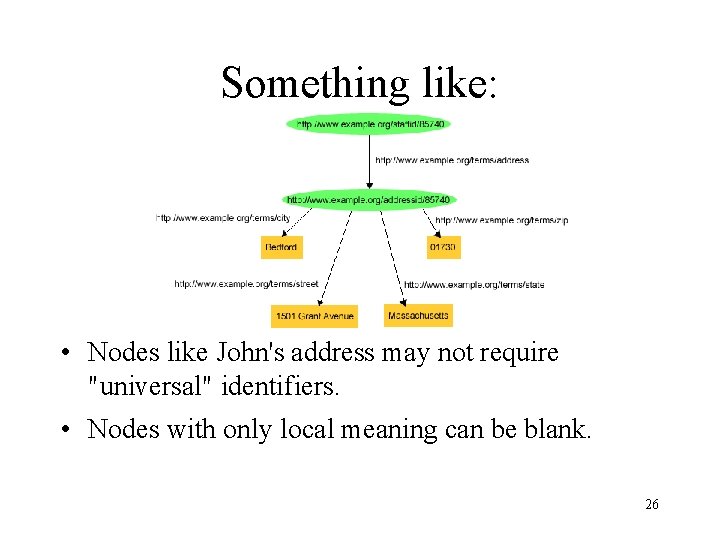
Something like: • Nodes like John's address may not require "universal" identifiers. • Nodes with only local meaning can be blank. 26
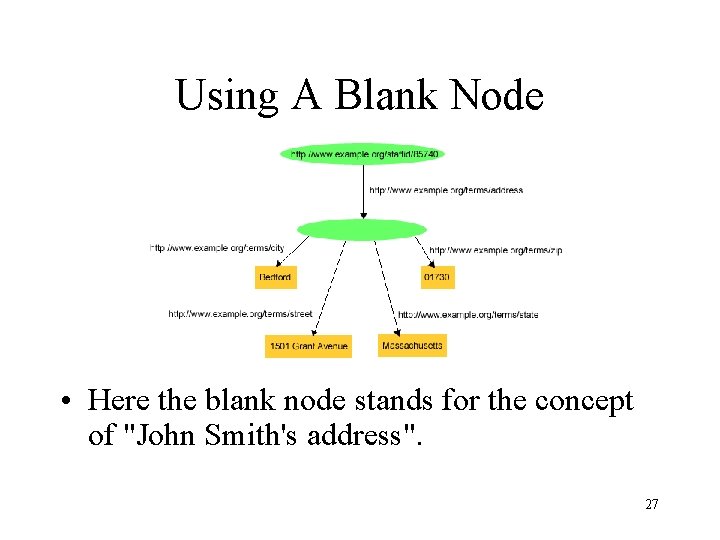
Using A Blank Node • Here the blank node stands for the concept of "John Smith's address". 27
Blank Node Identifiers • Blank nodes must have a name for triple usage. • Blank node identifiers have the form _: name exstaff: 85740 exterms: address _: johnaddress exterms: street"1501 Grant Avenue". _: johnaddress exterms: city "Bedford". _: johnaddress exterms: state "Massachusetts". _: johnaddress exterms: zip"01730". • If a node in a graph needs to be referenced from outside this context, a URIref is required. • Blank nodes make binary relationships out of an nary one (between John and the street, city, etc. ). 28
Blank Nodes For Correct Modeling • Suppose Jane Smith has no URI but has email: mailto: jane@example. org. • Should we use it as her URI? • Putting age information about Jane on this URI is plain wrong!!! 29
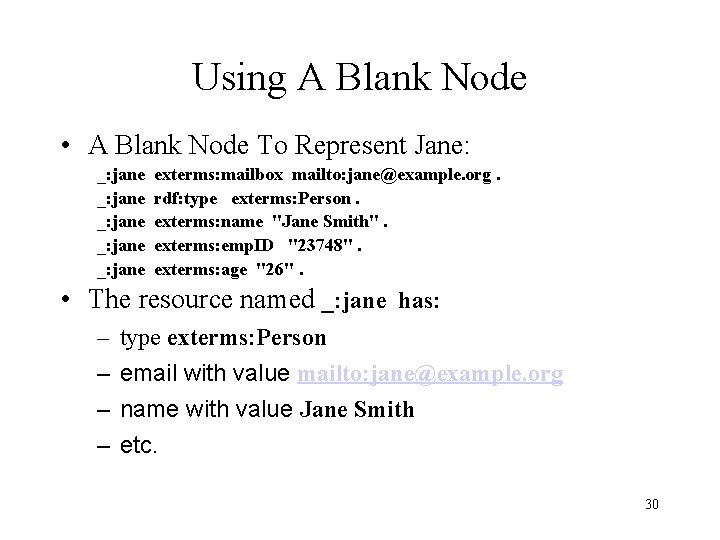
Using A Blank Node • A Blank Node To Represent Jane: _: jane _: jane exterms: mailbox mailto: jane@example. org. rdf: type exterms: Person. exterms: name "Jane Smith". exterms: emp. ID "23748". exterms: age "26". • The resource named _: jane has: – – type exterms: Person email with value mailto: jane@example. org name with value Jane Smith etc. 30
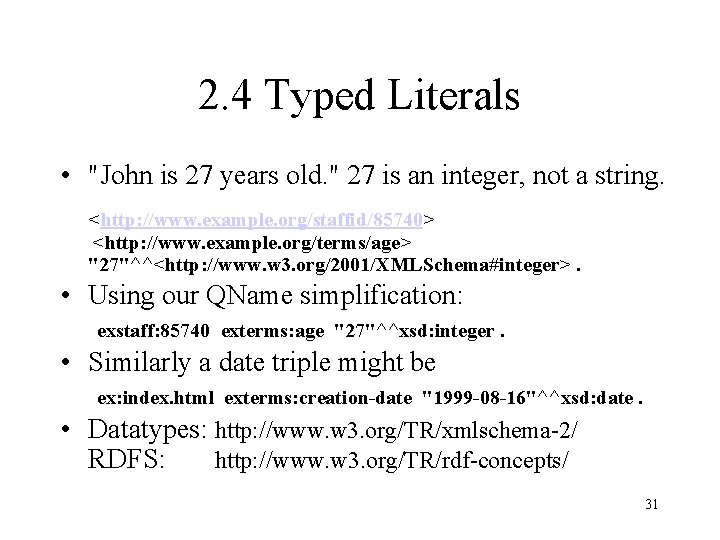
2. 4 Typed Literals • "John is 27 years old. " 27 is an integer, not a string. <http: //www. example. org/staffid/85740> <http: //www. example. org/terms/age> "27"^^<http: //www. w 3. org/2001/XMLSchema#integer>. • Using our QName simplification: exstaff: 85740 exterms: age "27"^^xsd: integer. • Similarly a date triple might be ex: index. html exterms: creation-date "1999 -08 -16"^^xsd: date. • Datatypes: http: //www. w 3. org/TR/xmlschema-2/ RDFS: http: //www. w 3. org/TR/rdf-concepts/ 31
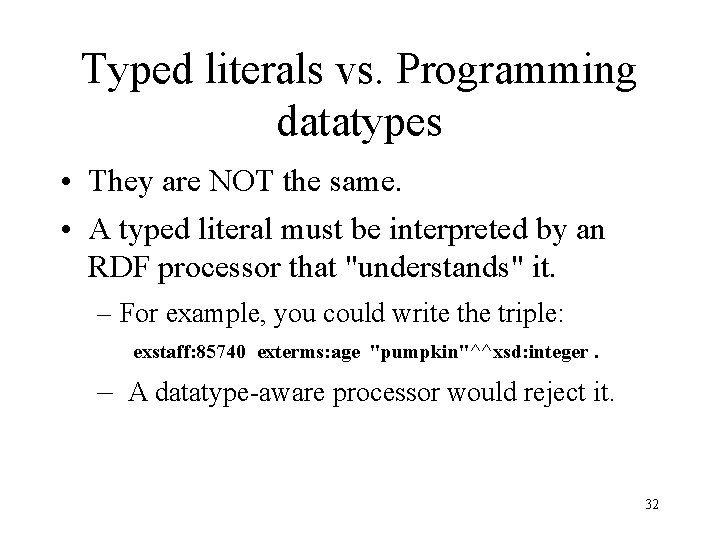
Typed literals vs. Programming datatypes • They are NOT the same. • A typed literal must be interpreted by an RDF processor that "understands" it. – For example, you could write the triple: exstaff: 85740 exterms: age "pumpkin"^^xsd: integer. – A datatype-aware processor would reject it. 32
2. 5 Summary (so far) • RDF is simple. • We need to define the vocabularies used in those statements. • RDF vocabularies (schemas) will be described later. 33
3. An XML Syntax for RDF: RDF/XML • RDF's conceptual model is a graph of nodes and arcs. • Triples are one textual, shorthand notation. • RDF/XML is the normative way of writing down and exchanging RDF graphs. 34
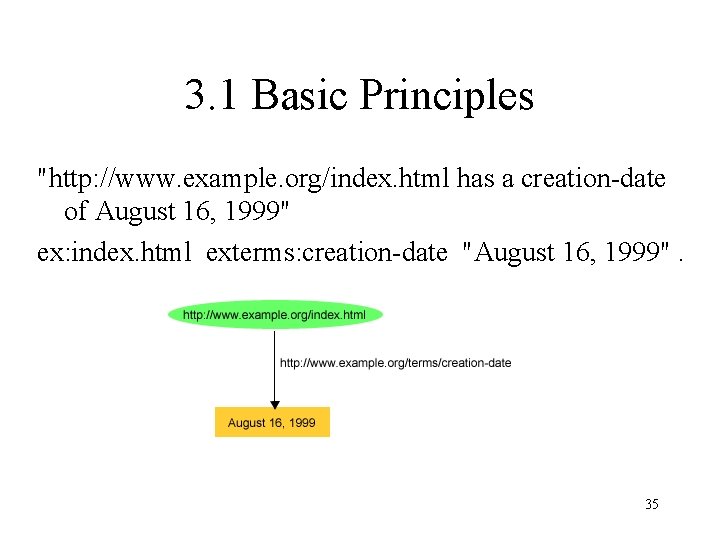
3. 1 Basic Principles "http: //www. example. org/index. html has a creation-date of August 16, 1999" ex: index. html exterms: creation-date "August 16, 1999". 35
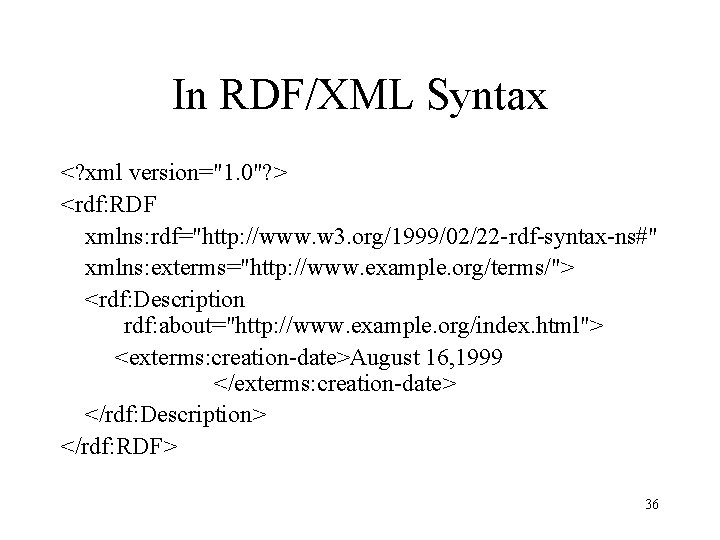
In RDF/XML Syntax <? xml version="1. 0"? > <rdf: RDF xmlns: rdf="http: //www. w 3. org/1999/02/22 -rdf-syntax-ns#" xmlns: exterms="http: //www. example. org/terms/"> <rdf: Description rdf: about="http: //www. example. org/index. html"> <exterms: creation-date>August 16, 1999 </exterms: creation-date> </rdf: Description> </rdf: RDF> 36
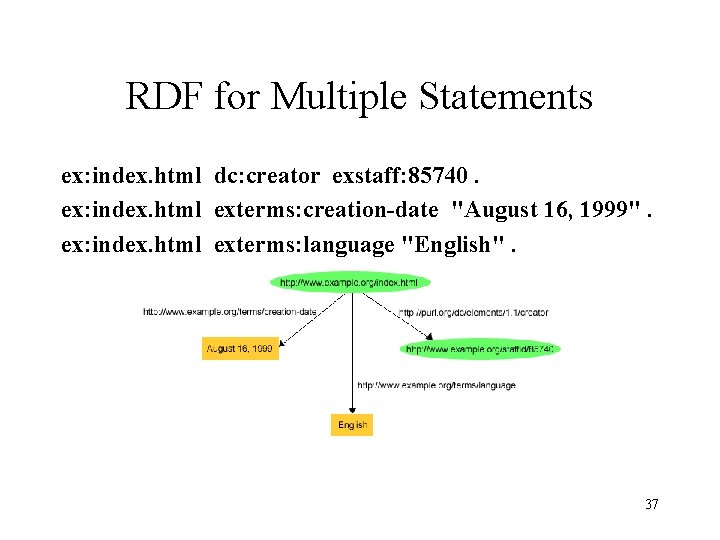
RDF for Multiple Statements ex: index. html dc: creator exstaff: 85740. ex: index. html exterms: creation-date "August 16, 1999". ex: index. html exterms: language "English". 37
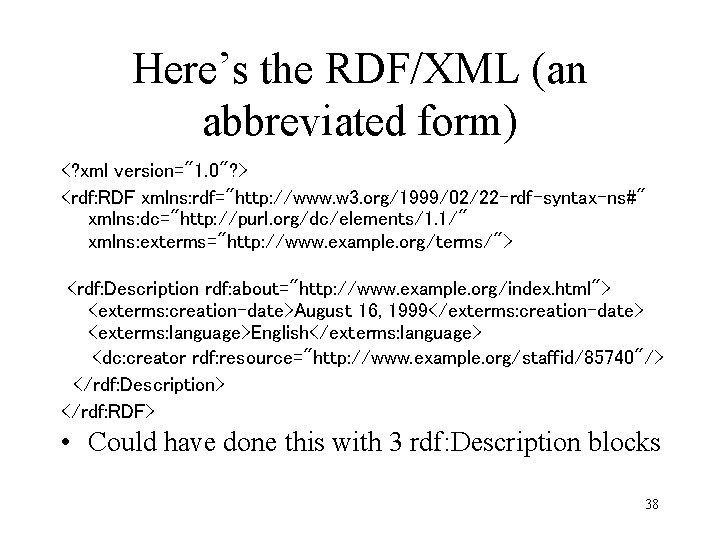
Here’s the RDF/XML (an abbreviated form) <? xml version="1. 0"? > <rdf: RDF xmlns: rdf="http: //www. w 3. org/1999/02/22 -rdf-syntax-ns#" xmlns: dc="http: //purl. org/dc/elements/1. 1/" xmlns: exterms="http: //www. example. org/terms/"> <rdf: Description rdf: about="http: //www. example. org/index. html"> <exterms: creation-date>August 16, 1999</exterms: creation-date> <exterms: language>English</exterms: language> <dc: creator rdf: resource="http: //www. example. org/staffid/85740"/> </rdf: Description> </rdf: RDF> • Could have done this with 3 rdf: Description blocks 38
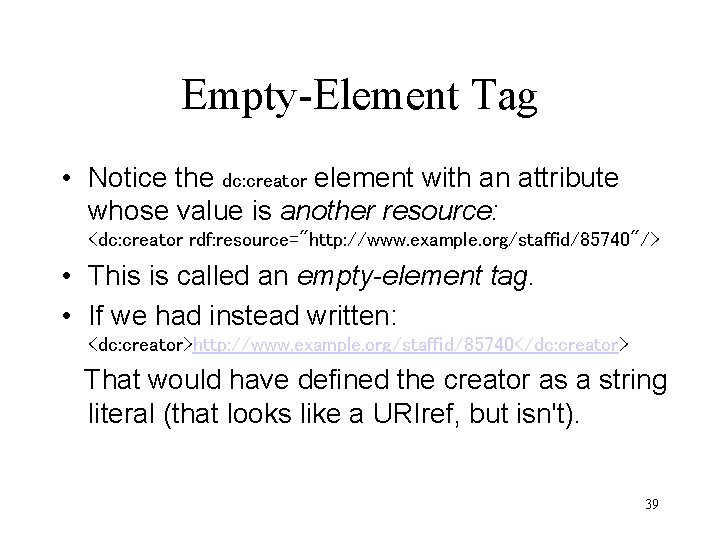
Empty-Element Tag • Notice the dc: creator element with an attribute whose value is another resource: <dc: creator rdf: resource="http: //www. example. org/staffid/85740"/> • This is called an empty-element tag. • If we had instead written: <dc: creator>http: //www. example. org/staffid/85740</dc: creator> That would have defined the creator as a string literal (that looks like a URIref, but isn't). 39
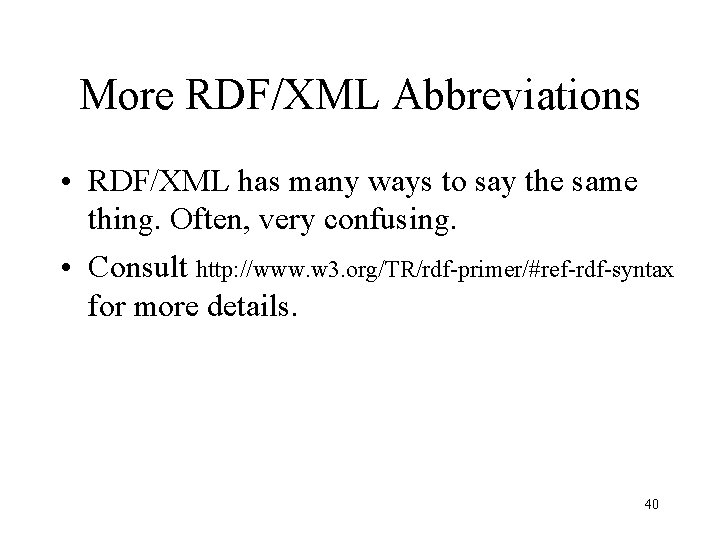
More RDF/XML Abbreviations • RDF/XML has many ways to say the same thing. Often, very confusing. • Consult http: //www. w 3. org/TR/rdf-primer/#ref-rdf-syntax for more details. 40
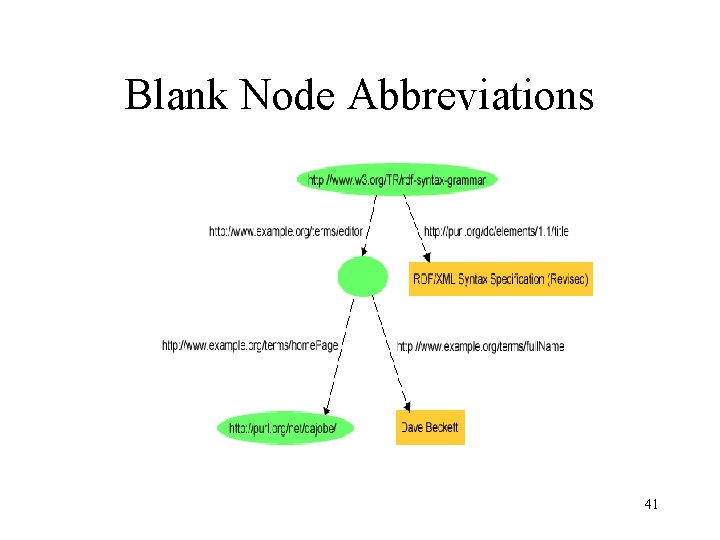
Blank Node Abbreviations 41
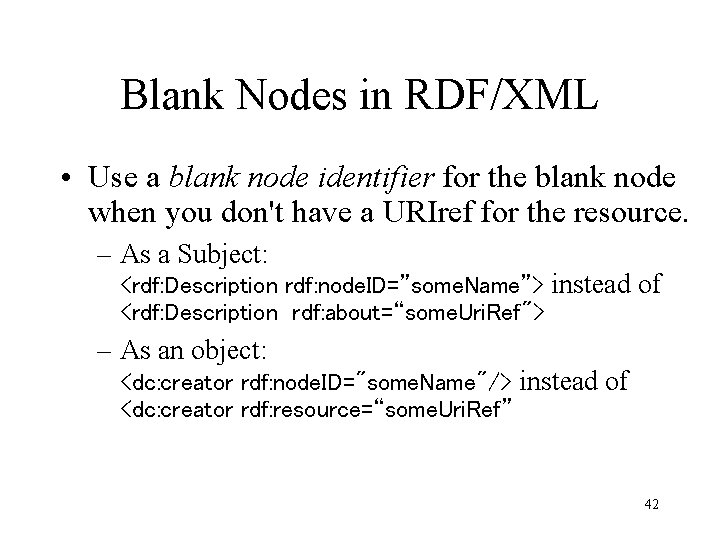
Blank Nodes in RDF/XML • Use a blank node identifier for the blank node when you don't have a URIref for the resource. – As a Subject: <rdf: Description rdf: node. ID=”some. Name”> instead of <rdf: Description rdf: about=“some. Uri. Ref"> – As an object: <dc: creator rdf: node. ID="some. Name"/> instead of <dc: creator rdf: resource=“some. Uri. Ref” 42
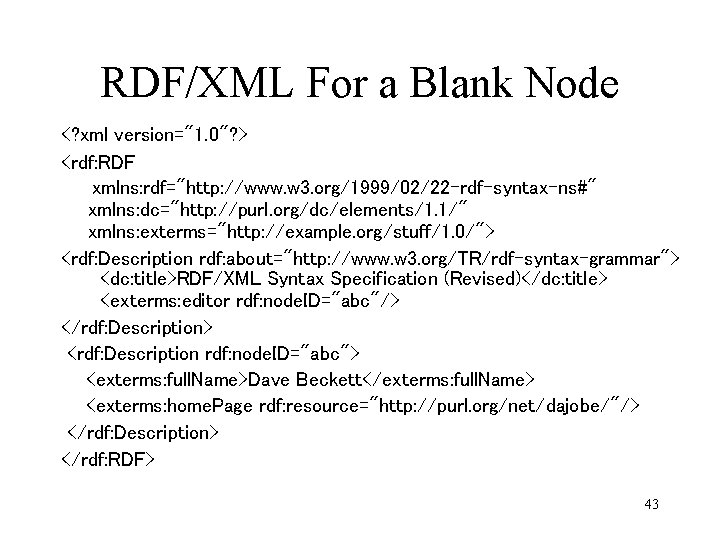
RDF/XML For a Blank Node <? xml version="1. 0"? > <rdf: RDF xmlns: rdf="http: //www. w 3. org/1999/02/22 -rdf-syntax-ns#" xmlns: dc="http: //purl. org/dc/elements/1. 1/" xmlns: exterms="http: //example. org/stuff/1. 0/"> <rdf: Description rdf: about="http: //www. w 3. org/TR/rdf-syntax-grammar"> <dc: title>RDF/XML Syntax Specification (Revised)</dc: title> <exterms: editor rdf: node. ID="abc"/> </rdf: Description> <rdf: Description rdf: node. ID="abc"> <exterms: full. Name>Dave Beckett</exterms: full. Name> <exterms: home. Page rdf: resource="http: //purl. org/net/dajobe/"/> </rdf: Description> </rdf: RDF> 43
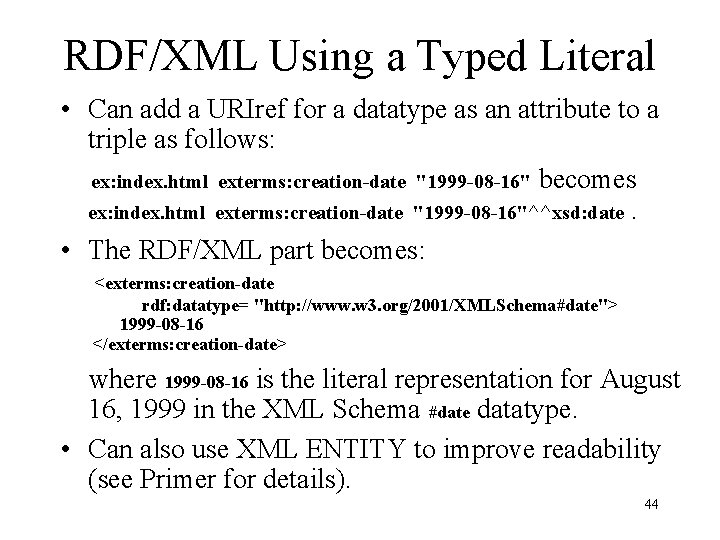
RDF/XML Using a Typed Literal • Can add a URIref for a datatype as an attribute to a triple as follows: ex: index. html exterms: creation-date "1999 -08 -16" becomes ex: index. html exterms: creation-date "1999 -08 -16"^^xsd: date. • The RDF/XML part becomes: <exterms: creation-date rdf: datatype= "http: //www. w 3. org/2001/XMLSchema#date"> 1999 -08 -16 </exterms: creation-date> where 1999 -08 -16 is the literal representation for August 16, 1999 in the XML Schema #date datatype. • Can also use XML ENTITY to improve readability (see Primer for details). 44
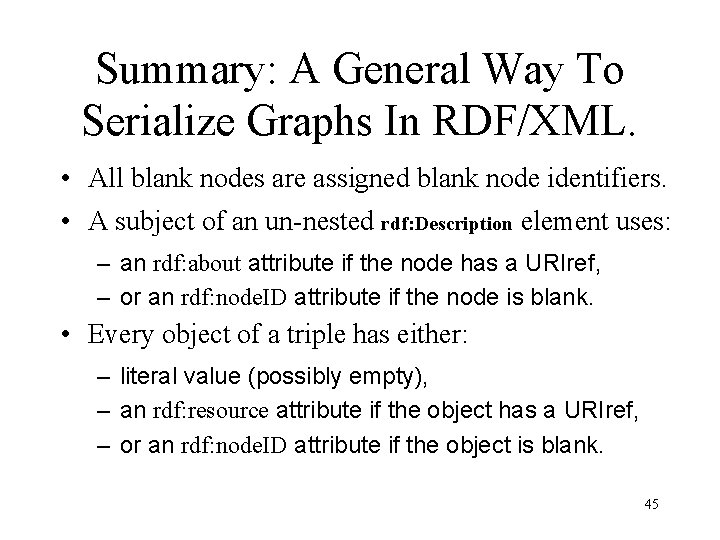
Summary: A General Way To Serialize Graphs In RDF/XML. • All blank nodes are assigned blank node identifiers. • A subject of an un-nested rdf: Description element uses: – an rdf: about attribute if the node has a URIref, – or an rdf: node. ID attribute if the node is blank. • Every object of a triple has either: – literal value (possibly empty), – an rdf: resource attribute if the object has a URIref, – or an rdf: node. ID attribute if the object is blank. 45
3. 2 Abbreviating and Organizing RDF URIrefs • Sometimes we want to achieve the effect of assigning URIrefs to resources that are part of an "organizing" resource, like a catalog. • Imagine a sporting goods company, example. com, producing an RDF-based catalog of its products. • Suppose the catalog is at: http: //www. example. com/2002/04/products • In that catalog resource, each product might be given a separate RDF description using rdf: ID. 46
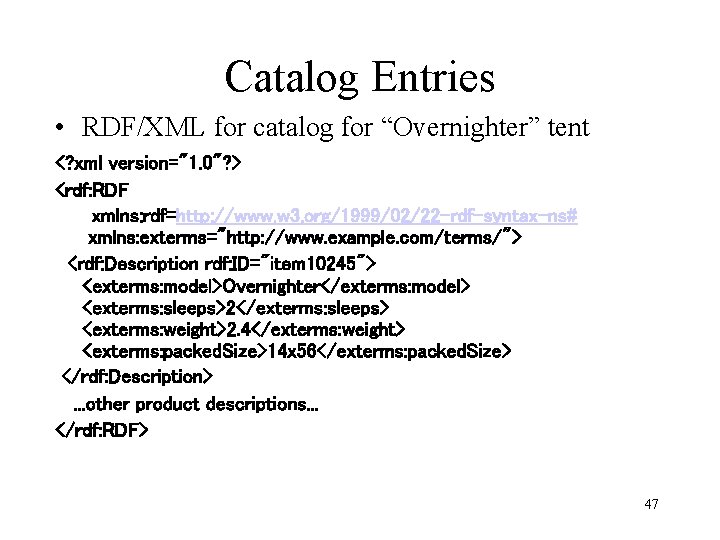
Catalog Entries • RDF/XML for catalog for “Overnighter” tent <? xml version="1. 0"? > <rdf: RDF xmlns: rdf=http: //www. w 3. org/1999/02/22 -rdf-syntax-ns# xmlns: exterms="http: //www. example. com/terms/"> <rdf: Description rdf: ID="item 10245"> <exterms: model>Overnighter</exterms: model> <exterms: sleeps>2</exterms: sleeps> <exterms: weight>2. 4</exterms: weight> <exterms: packed. Size>14 x 56</exterms: packed. Size> </rdf: Description> . . . other product descriptions. . . </rdf: RDF> 47
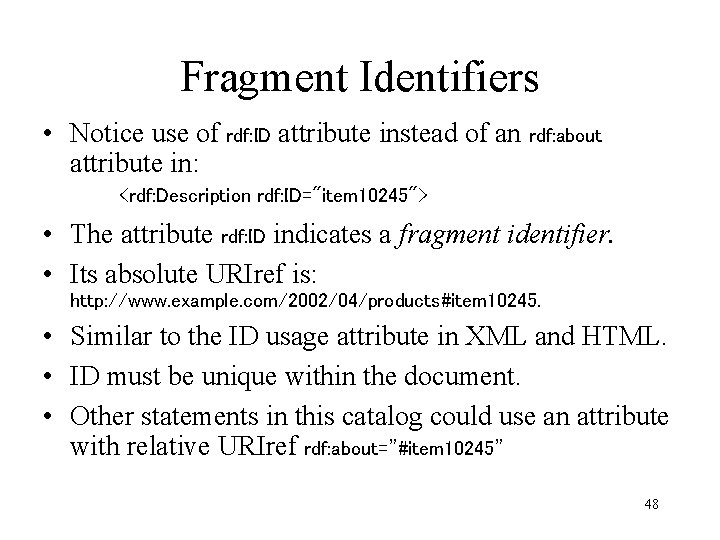
Fragment Identifiers • Notice use of rdf: ID attribute instead of an rdf: about attribute in: <rdf: Description rdf: ID="item 10245"> • The attribute rdf: ID indicates a fragment identifier. • Its absolute URIref is: http: //www. example. com/2002/04/products#item 10245. • Similar to the ID usage attribute in XML and HTML. • ID must be unique within the document. • Other statements in this catalog could use an attribute with relative URIref rdf: about=”#item 10245” 48
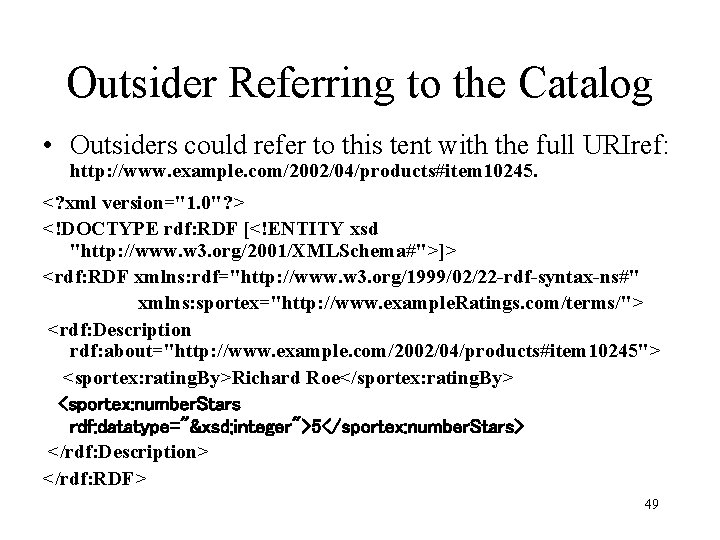
Outsider Referring to the Catalog • Outsiders could refer to this tent with the full URIref: http: //www. example. com/2002/04/products#item 10245. <? xml version="1. 0"? > <!DOCTYPE rdf: RDF [<!ENTITY xsd "http: //www. w 3. org/2001/XMLSchema#">]> <rdf: RDF xmlns: rdf="http: //www. w 3. org/1999/02/22 -rdf-syntax-ns#" xmlns: sportex="http: //www. example. Ratings. com/terms/"> <rdf: Description rdf: about="http: //www. example. com/2002/04/products#item 10245"> <sportex: rating. By>Richard Roe</sportex: rating. By> <sportex: number. Stars rdf: datatype="&xsd; integer">5</sportex: number. Stars> </rdf: Description> </rdf: RDF> 49
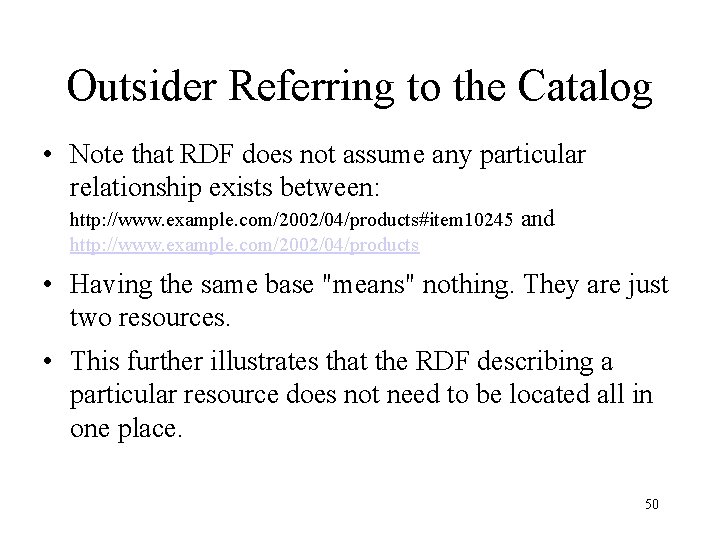
Outsider Referring to the Catalog • Note that RDF does not assume any particular relationship exists between: http: //www. example. com/2002/04/products#item 10245 http: //www. example. com/2002/04/products and • Having the same base "means" nothing. They are just two resources. • This further illustrates that the RDF describing a particular resource does not need to be located all in one place. 50
Base URI • Fragment identifiers such as #item 10245 will be interpreted relative to a base URI. • By default, this base URI is the resource in which the fragment identifier is used. • Not always desirable—Consider use of mirror sites. 51
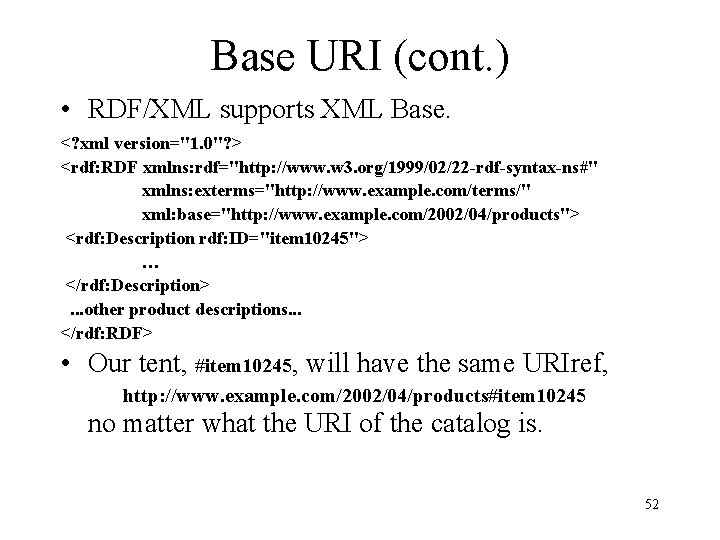
Base URI (cont. ) • RDF/XML supports XML Base. <? xml version="1. 0"? > <rdf: RDF xmlns: rdf="http: //www. w 3. org/1999/02/22 -rdf-syntax-ns#" xmlns: exterms="http: //www. example. com/terms/" xml: base="http: //www. example. com/2002/04/products"> <rdf: Description rdf: ID="item 10245"> … </rdf: Description>. . . other product descriptions. . . </rdf: RDF> • Our tent, #item 10245, will have the same URIref, http: //www. example. com/2002/04/products#item 10245 no matter what the URI of the catalog is. 52
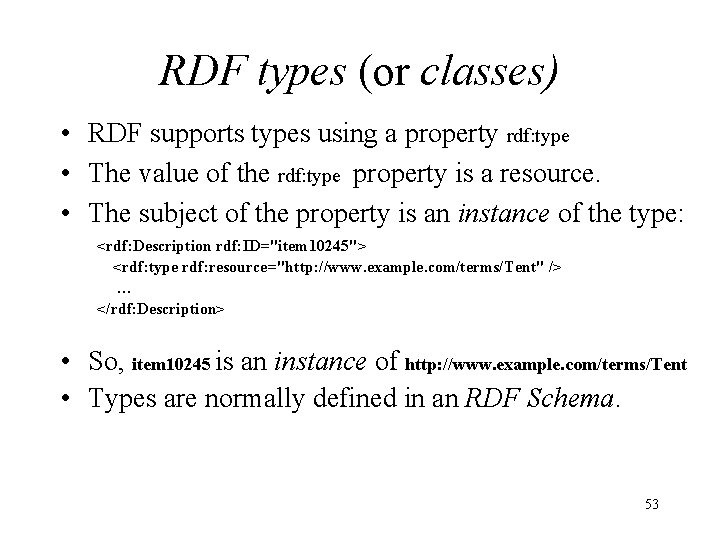
RDF types (or classes) • RDF supports types using a property rdf: type • The value of the rdf: type property is a resource. • The subject of the property is an instance of the type: <rdf: Description rdf: ID="item 10245"> <rdf: type rdf: resource="http: //www. example. com/terms/Tent" /> … </rdf: Description> • So, item 10245 is an instance of http: //www. example. com/terms/Tent • Types are normally defined in an RDF Schema. 53
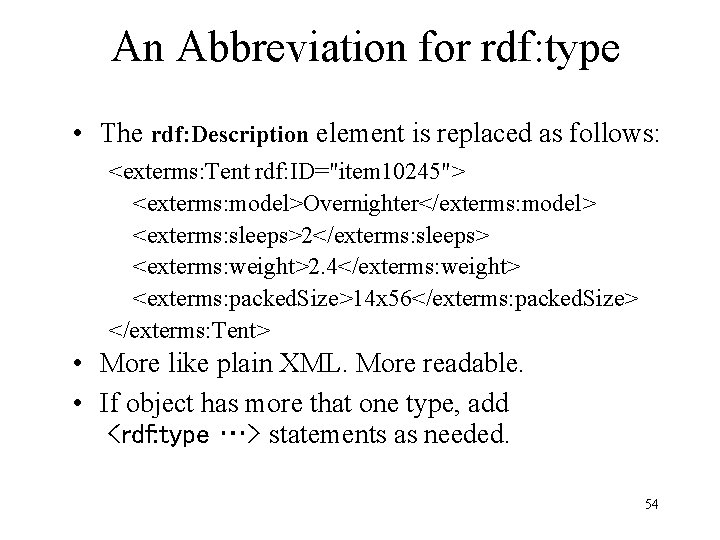
An Abbreviation for rdf: type • The rdf: Description element is replaced as follows: <exterms: Tent rdf: ID="item 10245"> <exterms: model>Overnighter</exterms: model> <exterms: sleeps>2</exterms: sleeps> <exterms: weight>2. 4</exterms: weight> <exterms: packed. Size>14 x 56</exterms: packed. Size> </exterms: Tent> • More like plain XML. More readable. • If object has more that one type, add <rdf: type …> statements as needed. 54
4. Other RDF Capabilities • • Containers Collections Reification Structured Values 55
4. 1 RDF Containers • We need to describe groups of things: – a book created by several authors, – a list of students in a course. • RDF's container vocabulary consists of bags, sequences, and alternative and some associated properties. 56
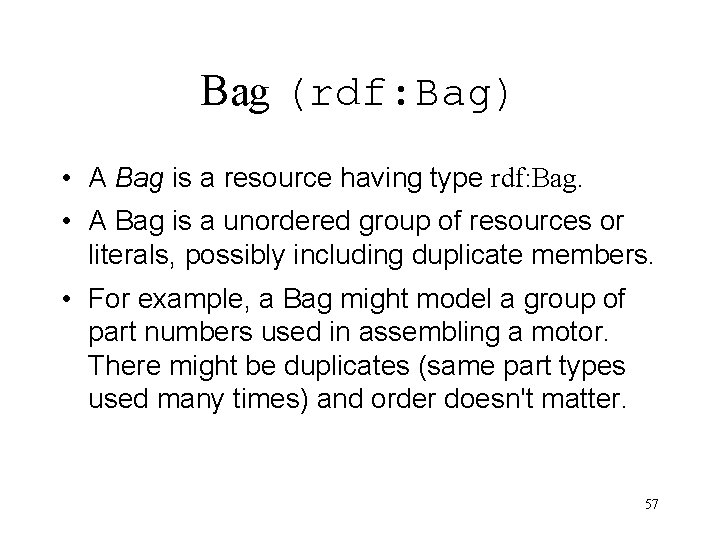
Bag (rdf: Bag) • A Bag is a resource having type rdf: Bag. • A Bag is a unordered group of resources or literals, possibly including duplicate members. • For example, a Bag might model a group of part numbers used in assembling a motor. There might be duplicates (same part types used many times) and order doesn't matter. 57
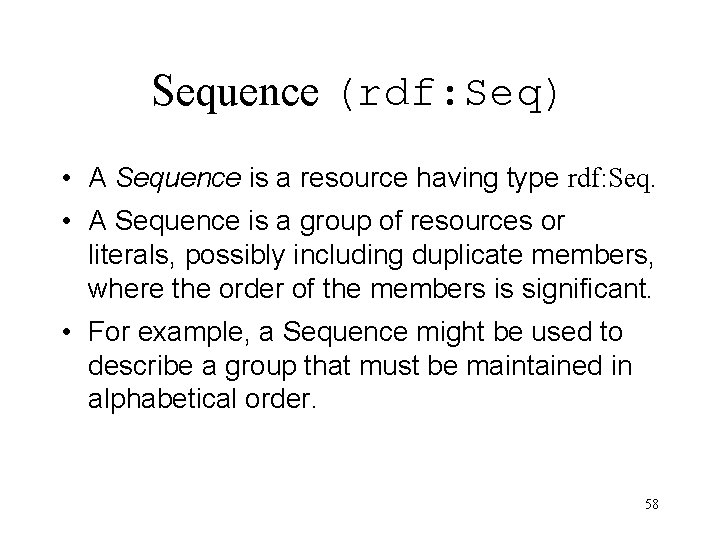
Sequence (rdf: Seq) • A Sequence is a resource having type rdf: Seq. • A Sequence is a group of resources or literals, possibly including duplicate members, where the order of the members is significant. • For example, a Sequence might be used to describe a group that must be maintained in alphabetical order. 58
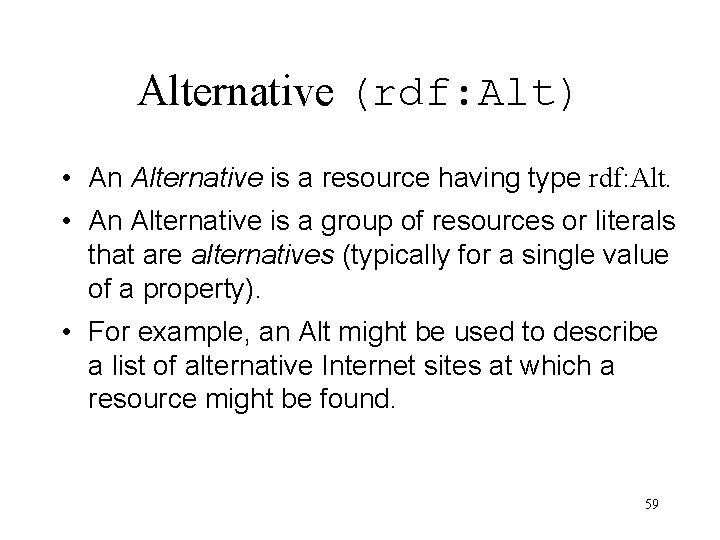
Alternative (rdf: Alt) • An Alternative is a resource having type rdf: Alt. • An Alternative is a group of resources or literals that are alternatives (typically for a single value of a property). • For example, an Alt might be used to describe a list of alternative Internet sites at which a resource might be found. 59
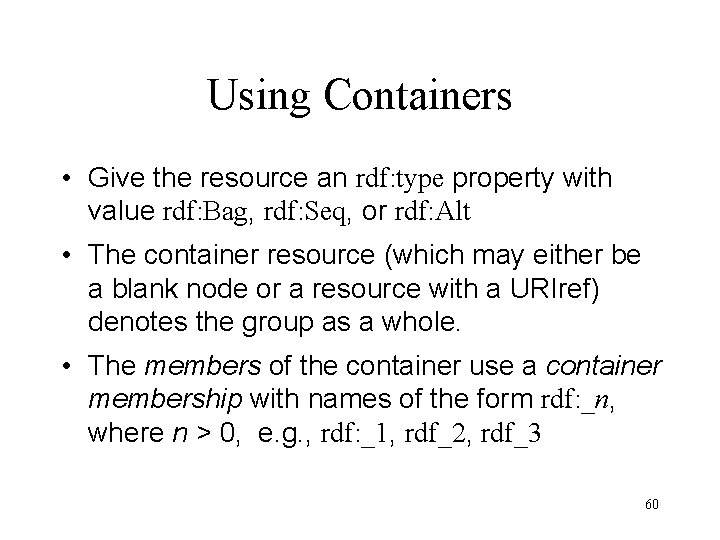
Using Containers • Give the resource an rdf: type property with value rdf: Bag, rdf: Seq, or rdf: Alt • The container resource (which may either be a blank node or a resource with a URIref) denotes the group as a whole. • The members of the container use a container membership with names of the form rdf: _n, where n > 0, e. g. , rdf: _1, rdf_2, rdf_3 60
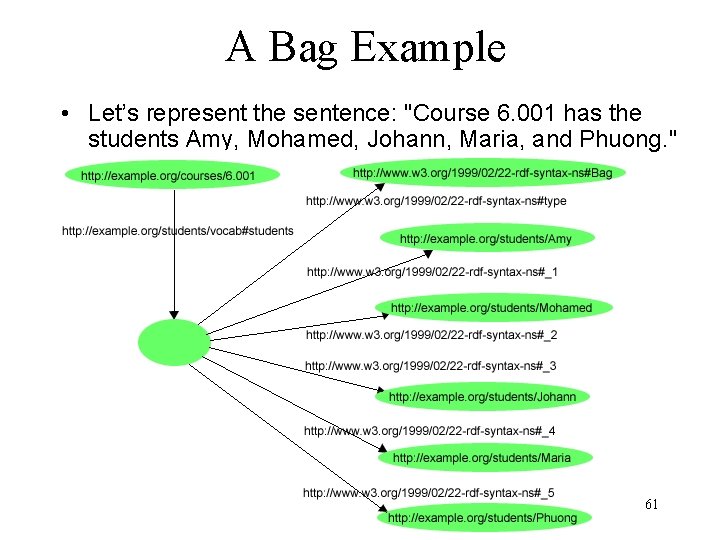
A Bag Example • Let’s represent the sentence: "Course 6. 001 has the students Amy, Mohamed, Johann, Maria, and Phuong. " • There is no significance in the student order. 61
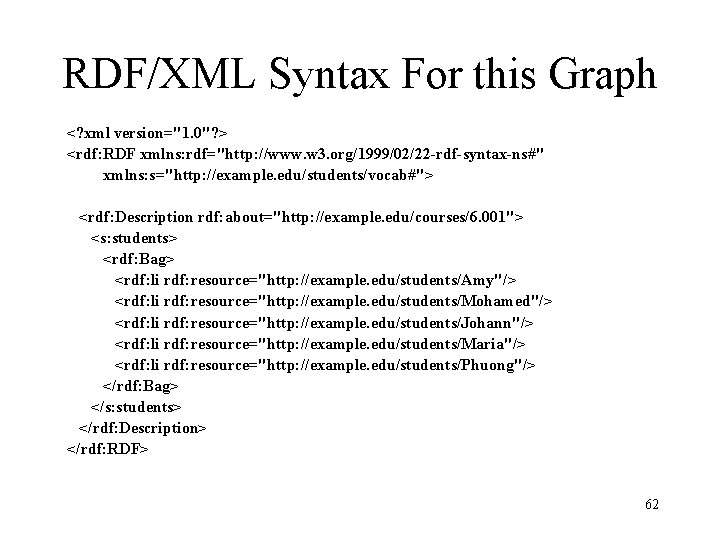
RDF/XML Syntax For this Graph <? xml version="1. 0"? > <rdf: RDF xmlns: rdf="http: //www. w 3. org/1999/02/22 -rdf-syntax-ns#" xmlns: s="http: //example. edu/students/vocab#"> <rdf: Description rdf: about="http: //example. edu/courses/6. 001"> <s: students> <rdf: Bag> <rdf: li rdf: resource="http: //example. edu/students/Amy"/> <rdf: li rdf: resource="http: //example. edu/students/Mohamed"/> <rdf: li rdf: resource="http: //example. edu/students/Johann"/> <rdf: li rdf: resource="http: //example. edu/students/Maria"/> <rdf: li rdf: resource="http: //example. edu/students/Phuong"/> </rdf: Bag> </s: students> </rdf: Description> </rdf: RDF> 62
Some Abbreviations • RDF/XML provides li as a convenience to avoid having to number each membership property. – The numbered properties rdf: _1, rdf: _2, etc. are generated from the li elements in forming the corresponding graph. • The use of a <rdf: Bag> element within the <s: students> property element. – The <rdf: Bag> element is abbreviation that lets us replace both an rdf: Description element and an rdf: type element with a single element. – The Bag is a blank node. Its nesting within the <s: students> property element is an abbreviated way of indicating it is the value of this property. 63
Sequences and Graph Structure • The graph structure for an rdf: Seq container, and the corresponding RDF/XML, are similar to those for an rdf: Bag. • The only difference is in the type, rdf: Seq. • Remember, although an rdf: Seq container is intended to describe a sequence, it is up to applications creating and processing the graph to appropriately interpret the sequence of integer-valued property names. 64
Alternatives and Graph Structure • The graph structure for an rdf: Alt container, and the corresponding RDF/XML, are similar to those for an rdf: Bag. • An Alt container has at least one member, rdf: _1, which is the default value. • Other than rdf: _1, the order of the remaining elements is not significant. 65
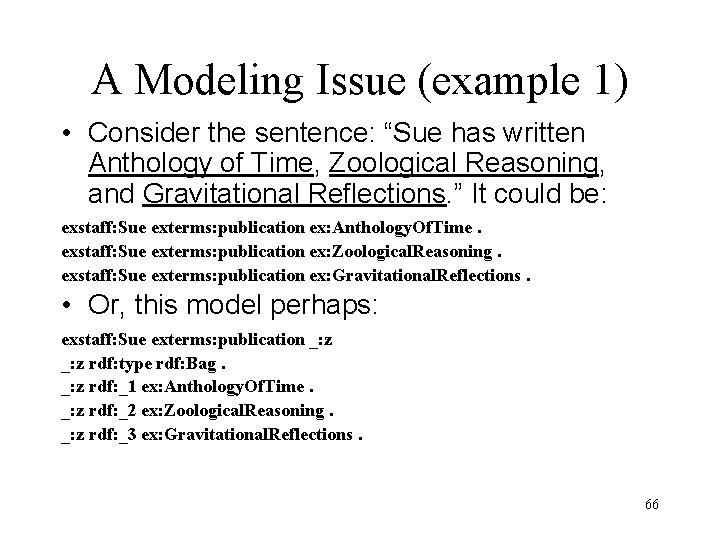
A Modeling Issue (example 1) • Consider the sentence: “Sue has written Anthology of Time, Zoological Reasoning, and Gravitational Reflections. ” It could be: exstaff: Sue exterms: publication ex: Anthology. Of. Time. exstaff: Sue exterms: publication ex: Zoological. Reasoning. exstaff: Sue exterms: publication ex: Gravitational. Reflections. • Or, this model perhaps: exstaff: Sue exterms: publication _: z rdf: type rdf: Bag. _: z rdf: _1 ex: Anthology. Of. Time. _: z rdf: _2 ex: Zoological. Reasoning. _: z rdf: _3 ex: Gravitational. Reflections. 66
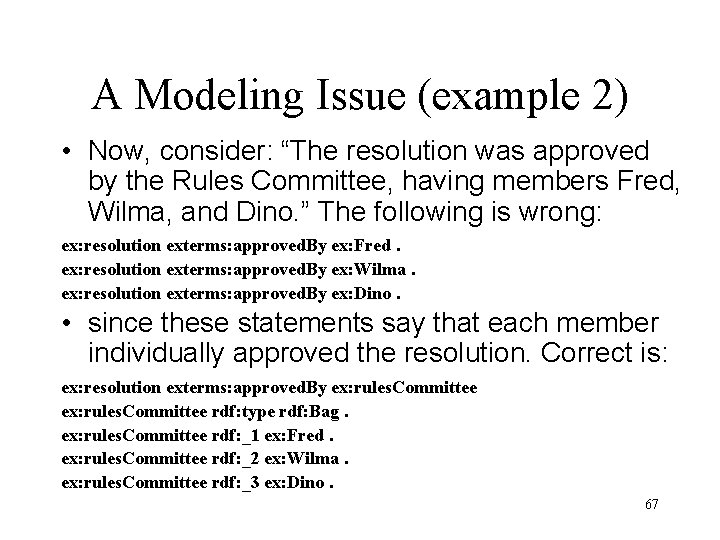
A Modeling Issue (example 2) • Now, consider: “The resolution was approved by the Rules Committee, having members Fred, Wilma, and Dino. ” The following is wrong: ex: resolution exterms: approved. By ex: Fred. ex: resolution exterms: approved. By ex: Wilma. ex: resolution exterms: approved. By ex: Dino. • since these statements say that each member individually approved the resolution. Correct is: ex: resolution exterms: approved. By ex: rules. Committee rdf: type rdf: Bag. ex: rules. Committee rdf: _1 ex: Fred. ex: rules. Committee rdf: _2 ex: Wilma. ex: rules. Committee rdf: _3 ex: Dino. 67
4. 2 RDF Collections • With containers there is no way to say that these are all the members of the container. • The graph has no way to exclude the possibility that there is another graph somewhere that describes additional members. • RDF collections can describe "closed" groups. • An RDF collection is a LISP-like list of type rdf: List, with predefined properties rdf: first and rdf: rest, and the predefined resource rdf: nil. 68
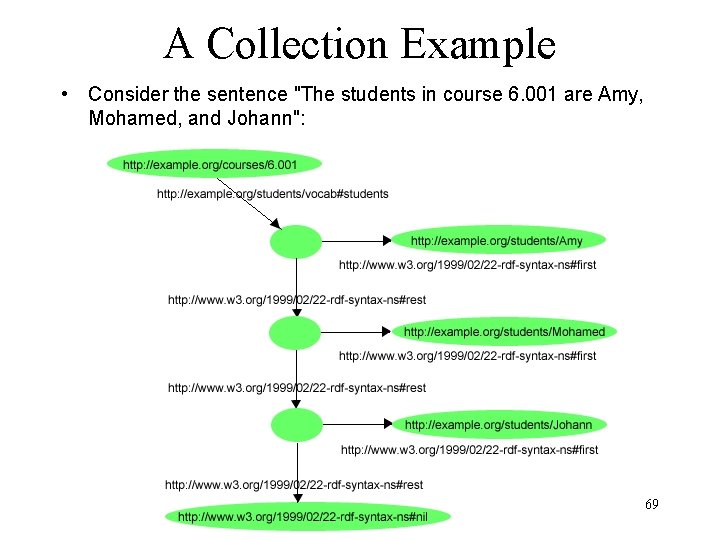
A Collection Example • Consider the sentence "The students in course 6. 001 are Amy, Mohamed, and Johann": 69
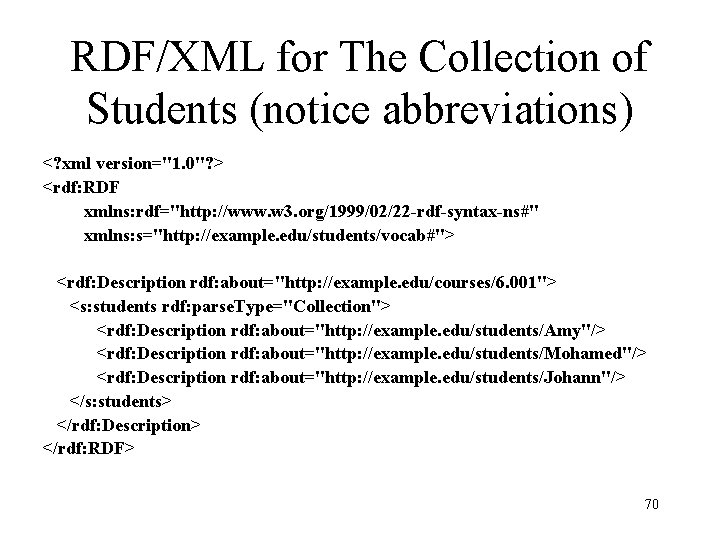
RDF/XML for The Collection of Students (notice abbreviations) <? xml version="1. 0"? > <rdf: RDF xmlns: rdf="http: //www. w 3. org/1999/02/22 -rdf-syntax-ns#" xmlns: s="http: //example. edu/students/vocab#"> <rdf: Description rdf: about="http: //example. edu/courses/6. 001"> <s: students rdf: parse. Type="Collection"> <rdf: Description rdf: about="http: //example. edu/students/Amy"/> <rdf: Description rdf: about="http: //example. edu/students/Mohamed"/> <rdf: Description rdf: about="http: //example. edu/students/Johann"/> </s: students> </rdf: Description> </rdf: RDF> 70
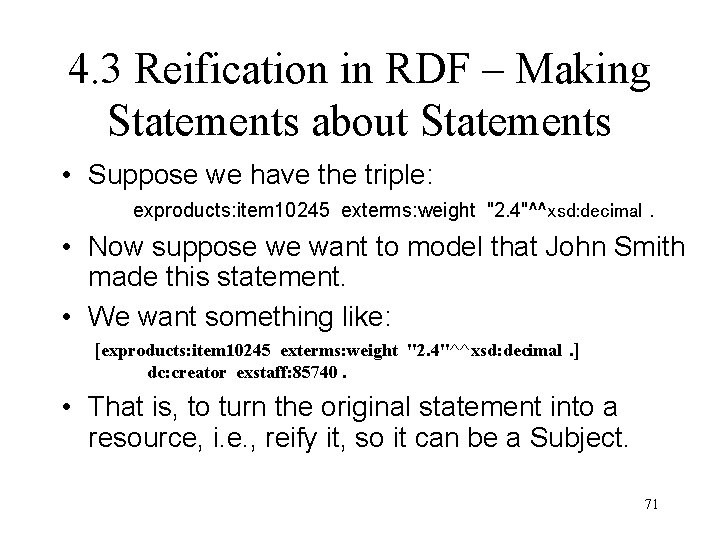
4. 3 Reification in RDF – Making Statements about Statements • Suppose we have the triple: exproducts: item 10245 exterms: weight "2. 4"^^xsd: decimal. • Now suppose we want to model that John Smith made this statement. • We want something like: [exproducts: item 10245 exterms: weight "2. 4"^^xsd: decimal. ] dc: creator exstaff: 85740. • That is, to turn the original statement into a resource, i. e. , reify it, so it can be a Subject. 71
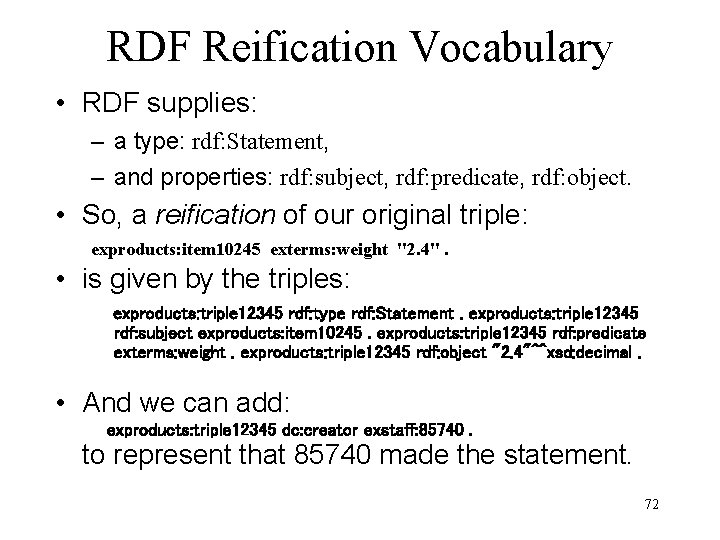
RDF Reification Vocabulary • RDF supplies: – a type: rdf: Statement, – and properties: rdf: subject, rdf: predicate, rdf: object. • So, a reification of our original triple: exproducts: item 10245 exterms: weight "2. 4". • is given by the triples: exproducts: triple 12345 rdf: type rdf: Statement. exproducts: triple 12345 rdf: subject exproducts: item 10245. exproducts: triple 12345 rdf: predicate exterms: weight. exproducts: triple 12345 rdf: object "2. 4"^^xsd: decimal. • And we can add: exproducts: triple 12345 dc: creator exstaff: 85740. to represent that 85740 made the statement. 72
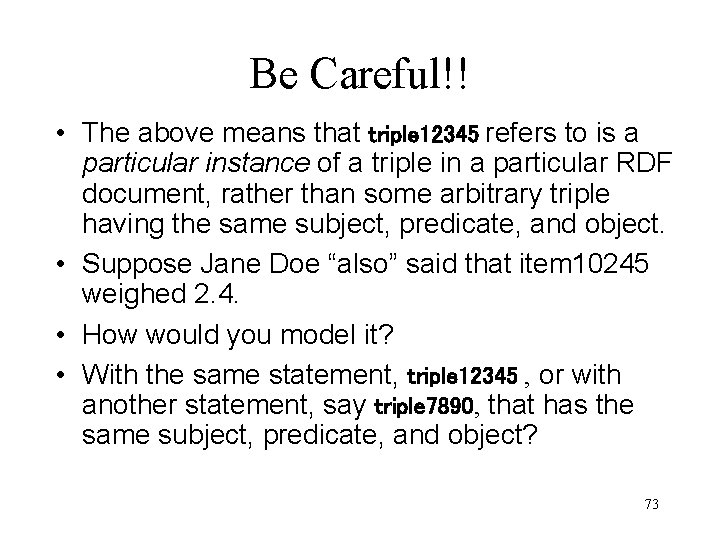
Be Careful!! • The above means that triple 12345 refers to is a particular instance of a triple in a particular RDF document, rather than some arbitrary triple having the same subject, predicate, and object. • Suppose Jane Doe “also” said that item 10245 weighed 2. 4. • How would you model it? • With the same statement, triple 12345 , or with another statement, say triple 7890, that has the same subject, predicate, and object? 73
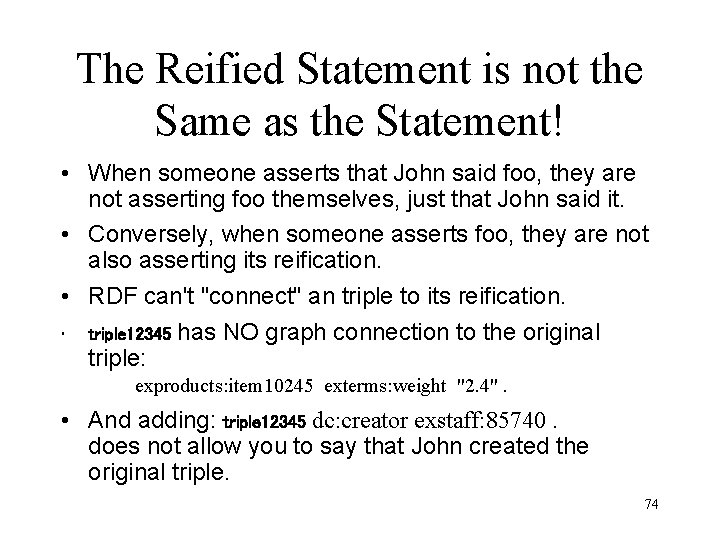
The Reified Statement is not the Same as the Statement! • When someone asserts that John said foo, they are not asserting foo themselves, just that John said it. • Conversely, when someone asserts foo, they are not also asserting its reification. • RDF can't "connect" an triple to its reification. • triple 12345 has NO graph connection to the original triple: exproducts: item 10245 exterms: weight "2. 4". • And adding: triple 12345 dc: creator exstaff: 85740. does not allow you to say that John created the original triple. 74
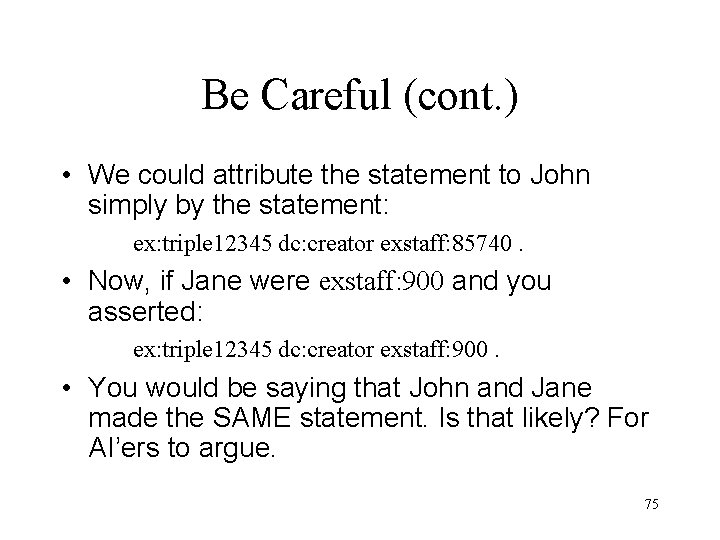
Be Careful (cont. ) • We could attribute the statement to John simply by the statement: ex: triple 12345 dc: creator exstaff: 85740. • Now, if Jane were exstaff: 900 and you asserted: ex: triple 12345 dc: creator exstaff: 900. • You would be saying that John and Jane made the SAME statement. Is that likely? For AI’ers to argue. 75
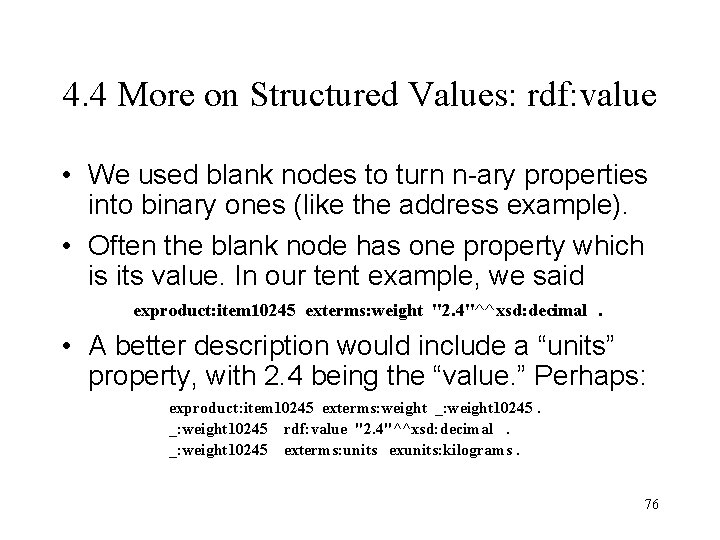
4. 4 More on Structured Values: rdf: value • We used blank nodes to turn n-ary properties into binary ones (like the address example). • Often the blank node has one property which is its value. In our tent example, we said exproduct: item 10245 exterms: weight "2. 4"^^xsd: decimal. • A better description would include a “units” property, with 2. 4 being the “value. ” Perhaps: exproduct: item 10245 exterms: weight _: weight 10245 rdf: value "2. 4"^^xsd: decimal. _: weight 10245 exterms: units exunits: kilograms. 76
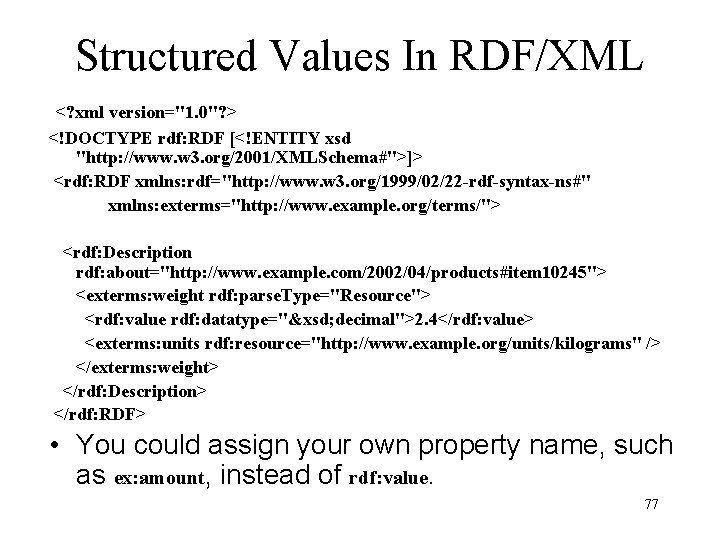
Structured Values In RDF/XML <? xml version="1. 0"? > <!DOCTYPE rdf: RDF [<!ENTITY xsd "http: //www. w 3. org/2001/XMLSchema#">]> <rdf: RDF xmlns: rdf="http: //www. w 3. org/1999/02/22 -rdf-syntax-ns#" xmlns: exterms="http: //www. example. org/terms/"> <rdf: Description rdf: about="http: //www. example. com/2002/04/products#item 10245"> <exterms: weight rdf: parse. Type="Resource"> <rdf: value rdf: datatype="&xsd; decimal">2. 4</rdf: value> <exterms: units rdf: resource="http: //www. example. org/units/kilograms" /> </exterms: weight> </rdf: Description> </rdf: RDF> • You could assign your own property name, such as ex: amount, instead of rdf: value. 77
4. 5 XML Literals • Sometimes the value of a property needs to be a fragment of XML, or text that might contain XML markup. • Giving an element the attribute rdf: parse. Type="Literal" indicates that the contents of the element are to be interpreted as an XML fragment. 78
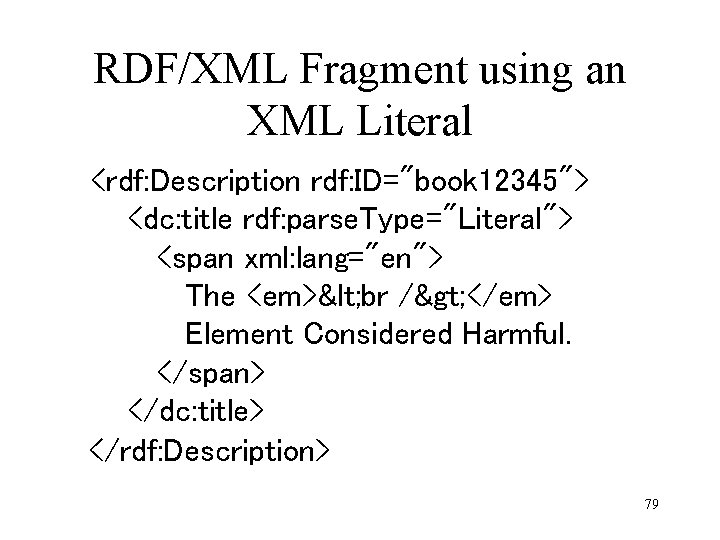
RDF/XML Fragment using an XML Literal <rdf: Description rdf: ID="book 12345"> <dc: title rdf: parse. Type="Literal"> <span xml: lang="en"> The <em>< br /> </em> Element Considered Harmful. </span> </dc: title> </rdf: Description> 79
5. Defining RDF Vocabularies: RDF Schema • RDF Schema provides a way to express: – simple statements defining classes of resources including subclass relationships, – statements defining properties including subclass relationships, – statements about domain and range of a property. 80
RDF Schema: A meta-language • RDF Schema's type system is similar to those of object-oriented programming languages. • RDF Schema allows resources to be defined as instances of one or more classes. • Classes can be organized in a hierarchical fashion; for example a class ex: Dog might be defined as a subclass of ex: Mammal, meaning that any resource which is in class ex: Dog is also in class ex: Mammal. • The RDF Schema (RDFS: ) is defined in a namespace whose URI is: http: //www. w 3. org/2000/01/rdf-schema#". 81
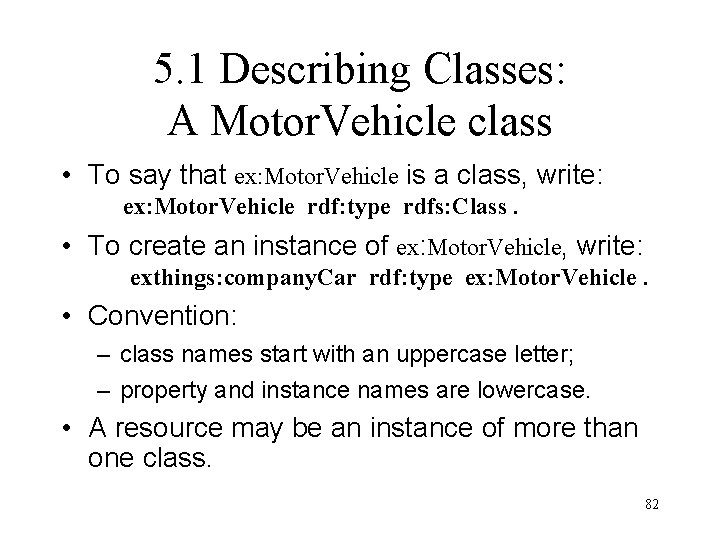
5. 1 Describing Classes: A Motor. Vehicle class • To say that ex: Motor. Vehicle is a class, write: ex: Motor. Vehicle rdf: type rdfs: Class. • To create an instance of ex: Motor. Vehicle, write: exthings: company. Car rdf: type ex: Motor. Vehicle. • Convention: – class names start with an uppercase letter; – property and instance names are lowercase. • A resource may be an instance of more than one class. 82
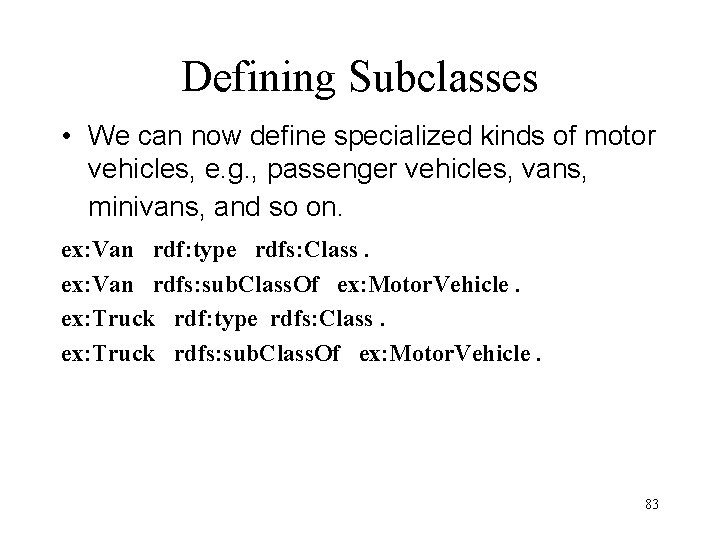
Defining Subclasses • We can now define specialized kinds of motor vehicles, e. g. , passenger vehicles, vans, minivans, and so on. ex: Van rdf: type rdfs: Class. ex: Van rdfs: sub. Class. Of ex: Motor. Vehicle. ex: Truck rdf: type rdfs: Class. ex: Truck rdfs: sub. Class. Of ex: Motor. Vehicle. 83
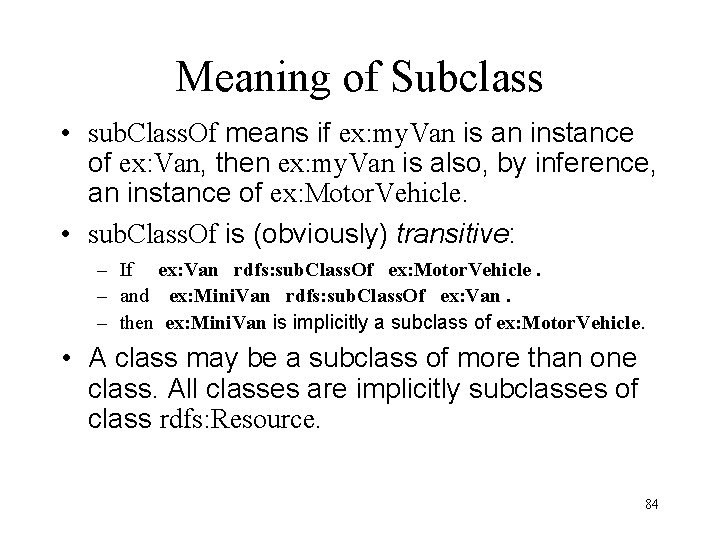
Meaning of Subclass • sub. Class. Of means if ex: my. Van is an instance of ex: Van, then ex: my. Van is also, by inference, an instance of ex: Motor. Vehicle. • sub. Class. Of is (obviously) transitive: – If ex: Van rdfs: sub. Class. Of ex: Motor. Vehicle. – and ex: Mini. Van rdfs: sub. Class. Of ex: Van. – then ex: Mini. Van is implicitly a subclass of ex: Motor. Vehicle. • A class may be a subclass of more than one class. All classes are implicitly subclasses of class rdfs: Resource. 84
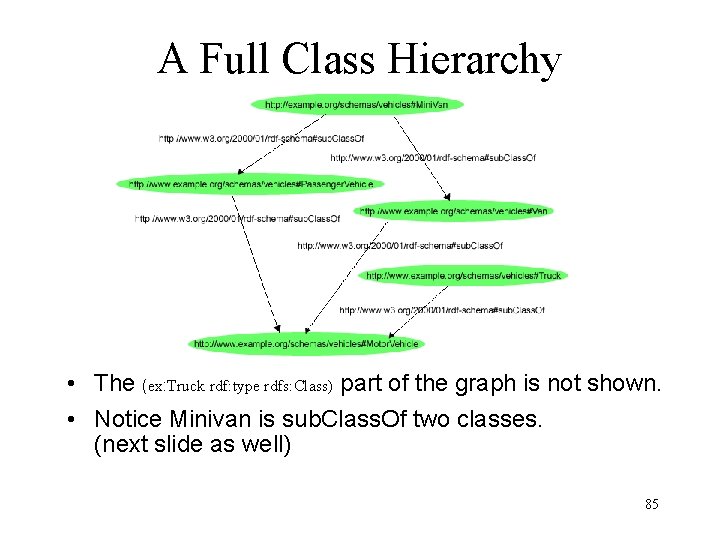
A Full Class Hierarchy • The (ex: Truck rdf: type rdfs: Class) part of the graph is not shown. • Notice Minivan is sub. Class. Of two classes. (next slide as well) 85
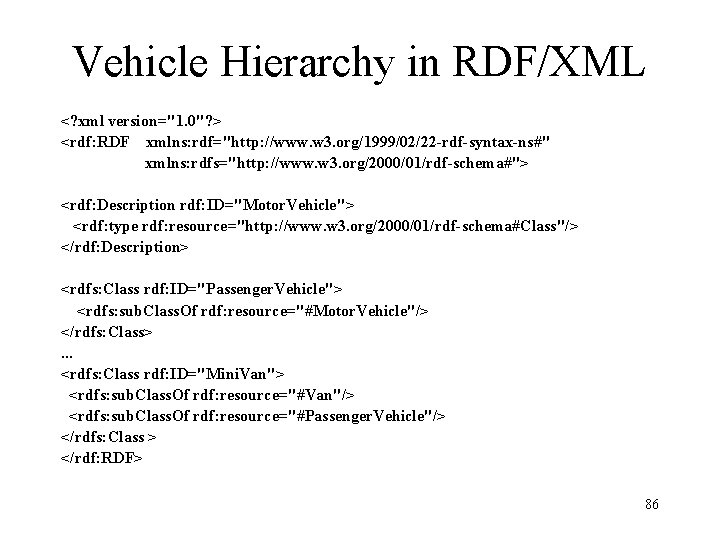
Vehicle Hierarchy in RDF/XML <? xml version="1. 0"? > <rdf: RDF xmlns: rdf="http: //www. w 3. org/1999/02/22 -rdf-syntax-ns#" xmlns: rdfs="http: //www. w 3. org/2000/01/rdf-schema#"> <rdf: Description rdf: ID="Motor. Vehicle"> <rdf: type rdf: resource="http: //www. w 3. org/2000/01/rdf-schema#Class"/> </rdf: Description> <rdfs: Class rdf: ID="Passenger. Vehicle"> <rdfs: sub. Class. Of rdf: resource="#Motor. Vehicle"/> </rdfs: Class>. . . <rdfs: Class rdf: ID="Mini. Van"> <rdfs: sub. Class. Of rdf: resource="#Van"/> <rdfs: sub. Class. Of rdf: resource="#Passenger. Vehicle"/> </rdfs: Class > </rdf: RDF> 86
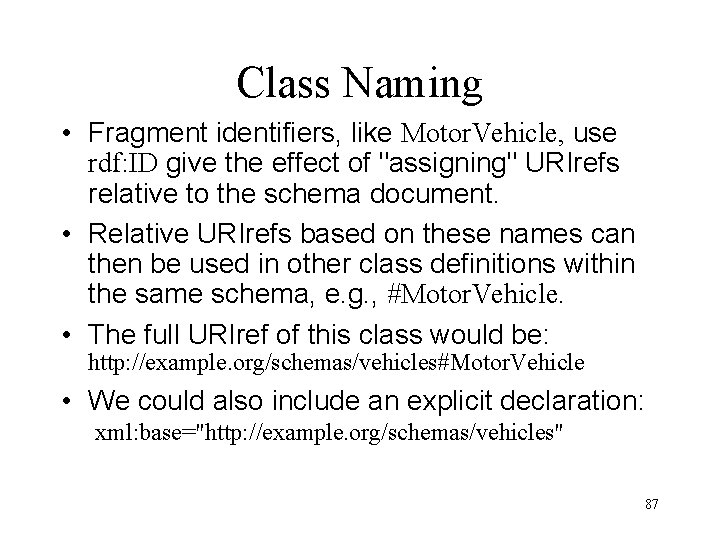
Class Naming • Fragment identifiers, like Motor. Vehicle, use rdf: ID give the effect of "assigning" URIrefs relative to the schema document. • Relative URIrefs based on these names can then be used in other class definitions within the same schema, e. g. , #Motor. Vehicle. • The full URIref of this class would be: http: //example. org/schemas/vehicles#Motor. Vehicle • We could also include an explicit declaration: xml: base="http: //example. org/schemas/vehicles" 87
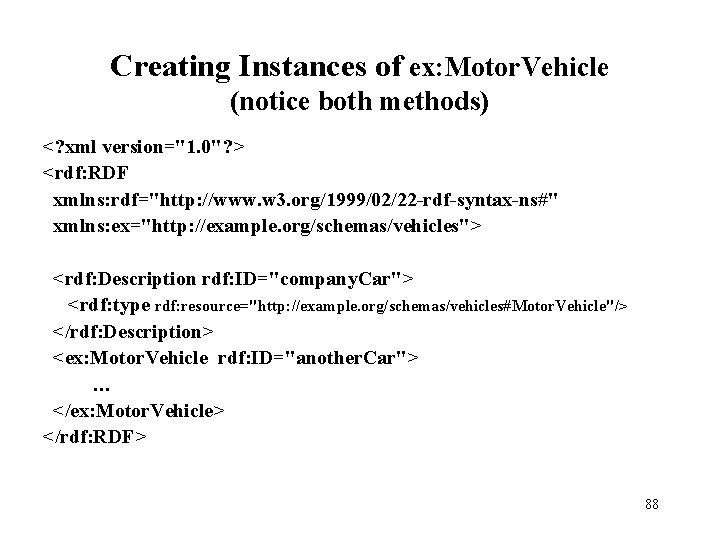
Creating Instances of ex: Motor. Vehicle (notice both methods) <? xml version="1. 0"? > <rdf: RDF xmlns: rdf="http: //www. w 3. org/1999/02/22 -rdf-syntax-ns#" xmlns: ex="http: //example. org/schemas/vehicles"> <rdf: Description rdf: ID="company. Car"> <rdf: type rdf: resource="http: //example. org/schemas/vehicles#Motor. Vehicle"/> </rdf: Description> <ex: Motor. Vehicle rdf: ID="another. Car"> … </ex: Motor. Vehicle> </rdf: RDF> 88
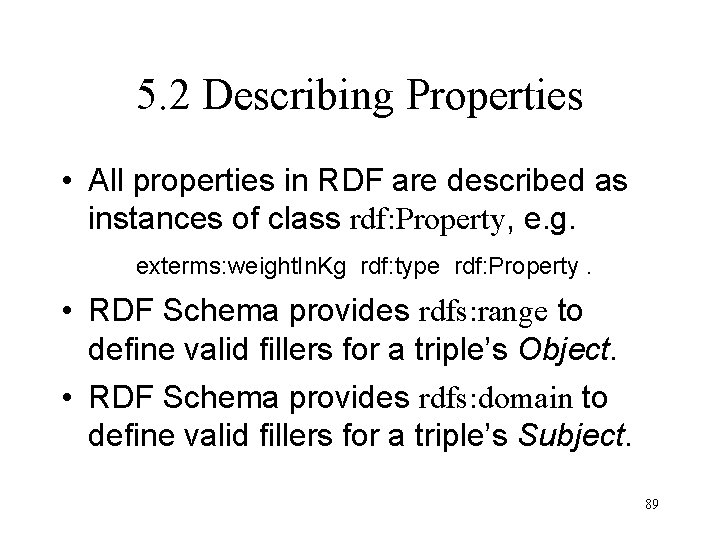
5. 2 Describing Properties • All properties in RDF are described as instances of class rdf: Property, e. g. exterms: weight. In. Kg rdf: type rdf: Property. • RDF Schema provides rdfs: range to define valid fillers for a triple’s Object. • RDF Schema provides rdfs: domain to define valid fillers for a triple’s Subject. 89
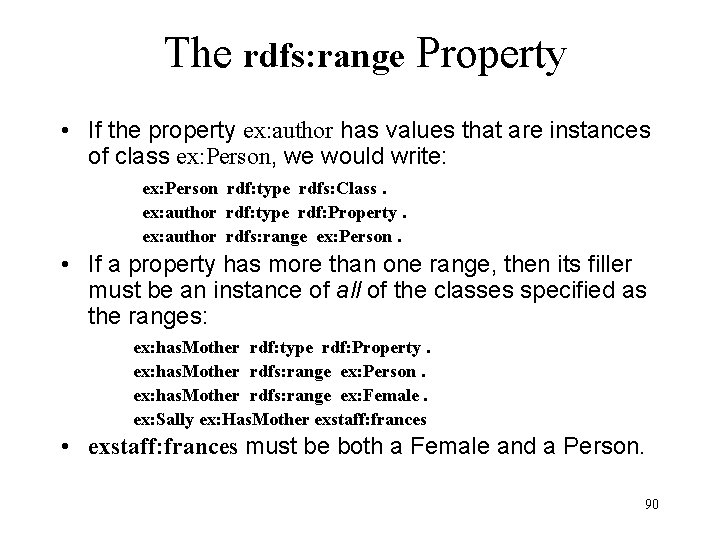
The rdfs: range Property • If the property ex: author has values that are instances of class ex: Person, we would write: ex: Person rdf: type rdfs: Class. ex: author rdf: type rdf: Property. ex: author rdfs: range ex: Person. • If a property has more than one range, then its filler must be an instance of all of the classes specified as the ranges: ex: has. Mother rdf: type rdf: Property. ex: has. Mother rdfs: range ex: Person. ex: has. Mother rdfs: range ex: Female. ex: Sally ex: Has. Mother exstaff: frances • exstaff: frances must be both a Female and a Person. 90
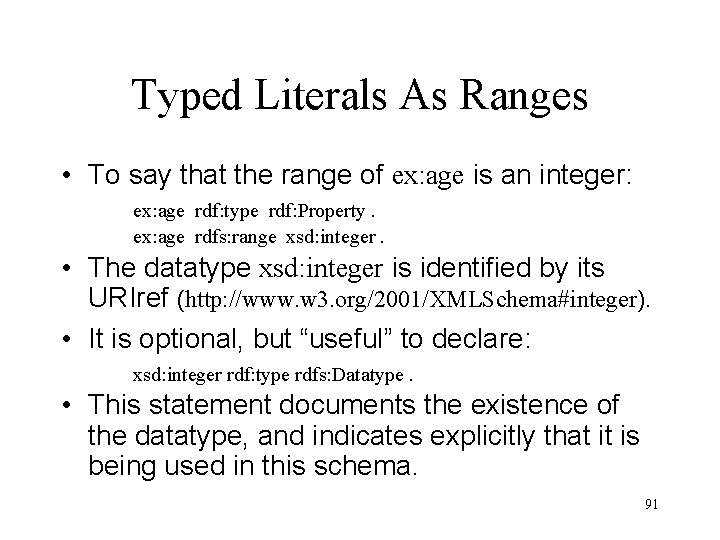
Typed Literals As Ranges • To say that the range of ex: age is an integer: ex: age rdf: type rdf: Property. ex: age rdfs: range xsd: integer. • The datatype xsd: integer is identified by its URIref (http: //www. w 3. org/2001/XMLSchema#integer). • It is optional, but “useful” to declare: xsd: integer rdf: type rdfs: Datatype. • This statement documents the existence of the datatype, and indicates explicitly that it is being used in this schema. 91
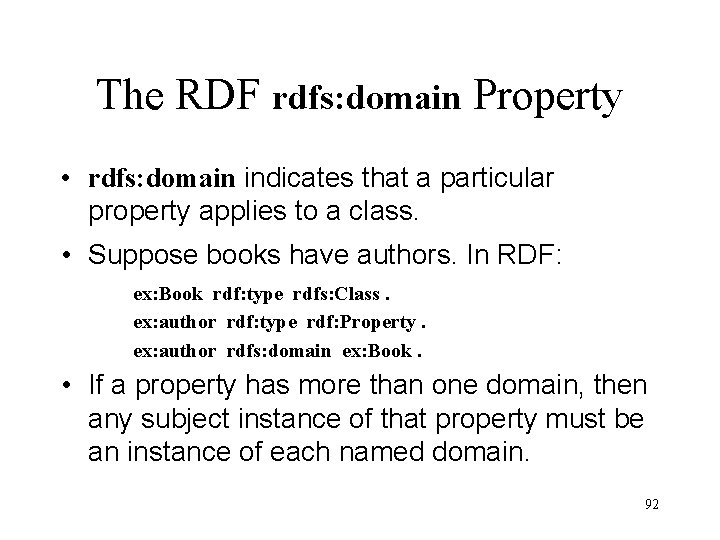
The RDF rdfs: domain Property • rdfs: domain indicates that a particular property applies to a class. • Suppose books have authors. In RDF: ex: Book rdf: type rdfs: Class. ex: author rdf: type rdf: Property. ex: author rdfs: domain ex: Book. • If a property has more than one domain, then any subject instance of that property must be an instance of each named domain. 92
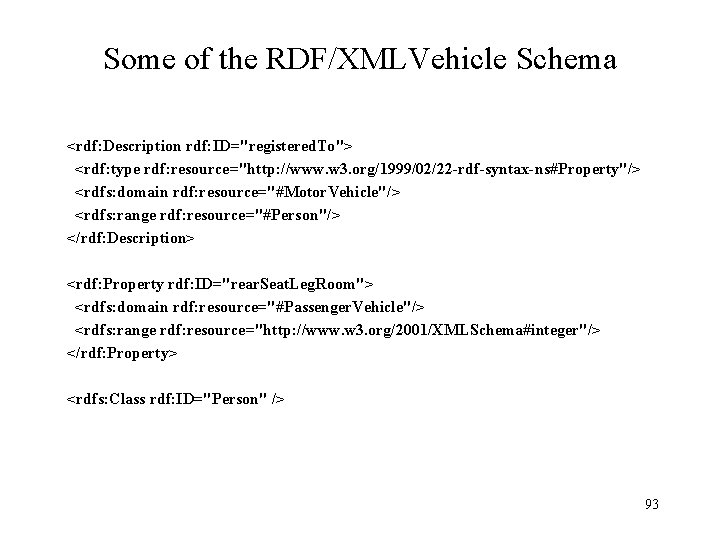
Some of the RDF/XMLVehicle Schema <rdf: Description rdf: ID="registered. To"> <rdf: type rdf: resource="http: //www. w 3. org/1999/02/22 -rdf-syntax-ns#Property"/> <rdfs: domain rdf: resource="#Motor. Vehicle"/> <rdfs: range rdf: resource="#Person"/> </rdf: Description> <rdf: Property rdf: ID="rear. Seat. Leg. Room"> <rdfs: domain rdf: resource="#Passenger. Vehicle"/> <rdfs: range rdf: resource="http: //www. w 3. org/2001/XMLSchema#integer"/> </rdf: Property> <rdfs: Class rdf: ID="Person" /> 93
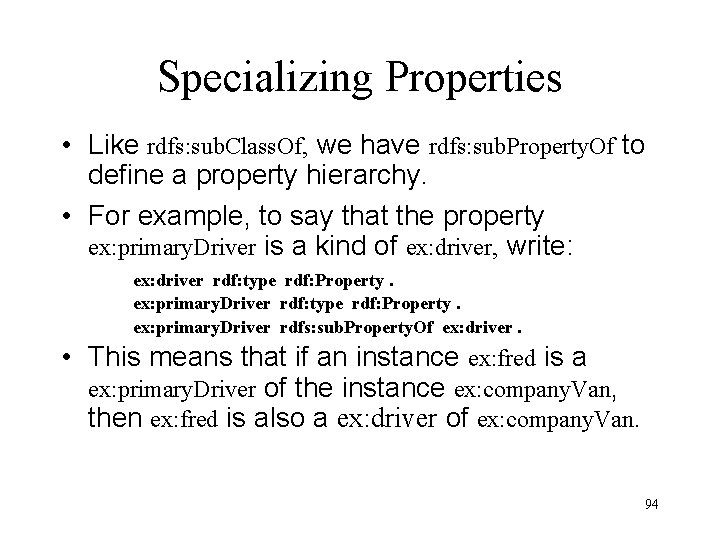
Specializing Properties • Like rdfs: sub. Class. Of, we have rdfs: sub. Property. Of to define a property hierarchy. • For example, to say that the property ex: primary. Driver is a kind of ex: driver, write: ex: driver rdf: type rdf: Property. ex: primary. Driver rdfs: sub. Property. Of ex: driver. • This means that if an instance ex: fred is a ex: primary. Driver of the instance ex: company. Van, then ex: fred is also a ex: driver of ex: company. Van. 94
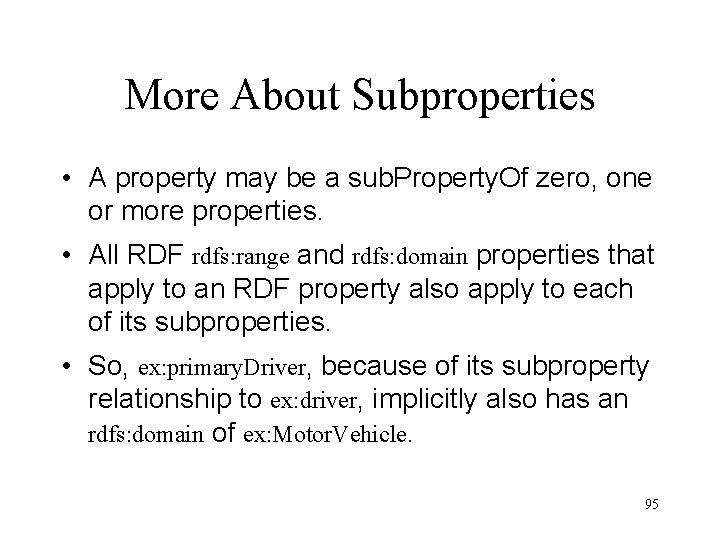
More About Subproperties • A property may be a sub. Property. Of zero, one or more properties. • All RDF rdfs: range and rdfs: domain properties that apply to an RDF property also apply to each of its subproperties. • So, ex: primary. Driver, because of its subproperty relationship to ex: driver, implicitly also has an rdfs: domain of ex: Motor. Vehicle. 95
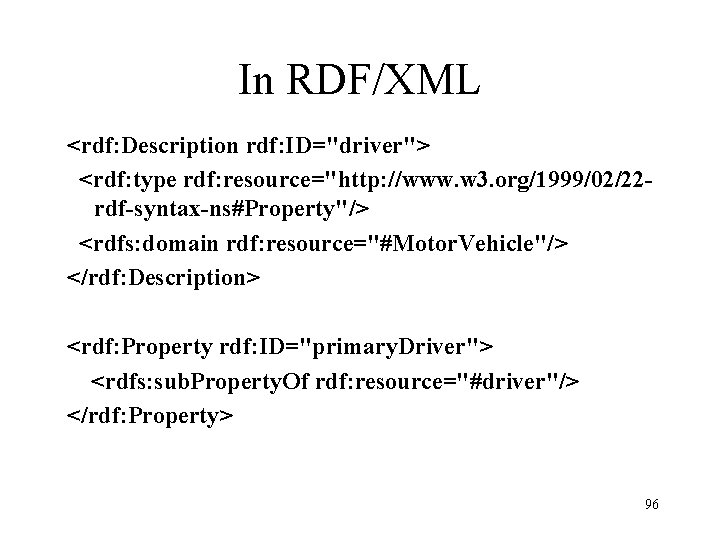
In RDF/XML <rdf: Description rdf: ID="driver"> <rdf: type rdf: resource="http: //www. w 3. org/1999/02/22 rdf-syntax-ns#Property"/> <rdfs: domain rdf: resource="#Motor. Vehicle"/> </rdf: Description> <rdf: Property rdf: ID="primary. Driver"> <rdfs: sub. Property. Of rdf: resource="#driver"/> </rdf: Property> 96
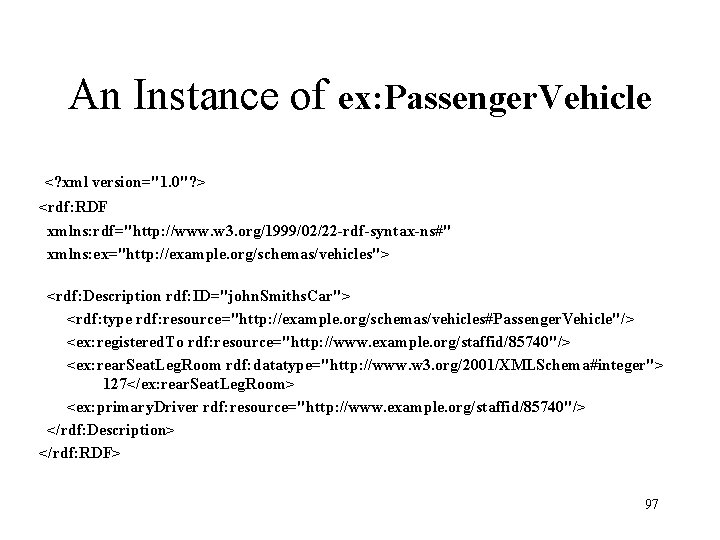
An Instance of ex: Passenger. Vehicle <? xml version="1. 0"? > <rdf: RDF xmlns: rdf="http: //www. w 3. org/1999/02/22 -rdf-syntax-ns#" xmlns: ex="http: //example. org/schemas/vehicles"> <rdf: Description rdf: ID="john. Smiths. Car"> <rdf: type rdf: resource="http: //example. org/schemas/vehicles#Passenger. Vehicle"/> <ex: registered. To rdf: resource="http: //www. example. org/staffid/85740"/> <ex: rear. Seat. Leg. Room rdf: datatype="http: //www. w 3. org/2001/XMLSchema#integer"> 127</ex: rear. Seat. Leg. Room> <ex: primary. Driver rdf: resource="http: //www. example. org/staffid/85740"/> </rdf: Description> </rdf: RDF> 97
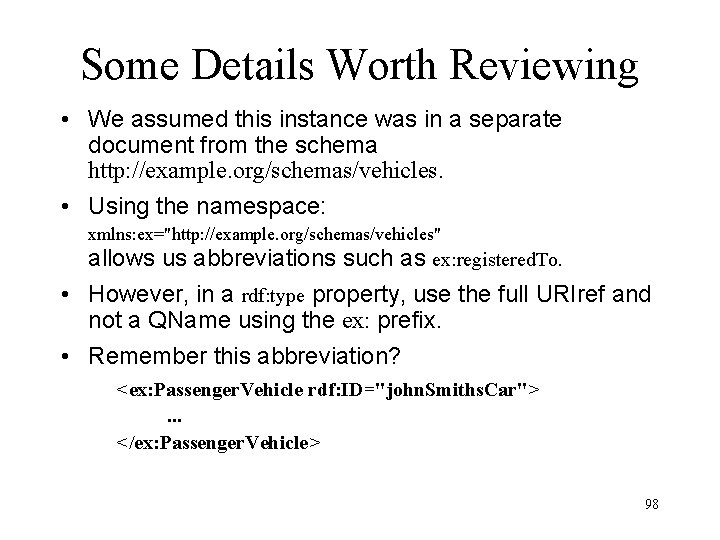
Some Details Worth Reviewing • We assumed this instance was in a separate document from the schema http: //example. org/schemas/vehicles. • Using the namespace: xmlns: ex="http: //example. org/schemas/vehicles" allows us abbreviations such as ex: registered. To. • However, in a rdf: type property, use the full URIref and not a QName using the ex: prefix. • Remember this abbreviation? <ex: Passenger. Vehicle rdf: ID="john. Smiths. Car">. . . </ex: Passenger. Vehicle> 98
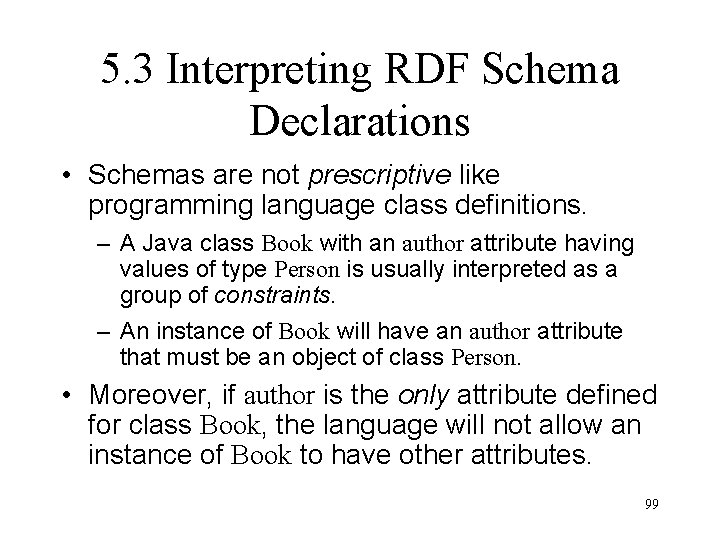
5. 3 Interpreting RDF Schema Declarations • Schemas are not prescriptive like programming language class definitions. – A Java class Book with an author attribute having values of type Person is usually interpreted as a group of constraints. – An instance of Book will have an author attribute that must be an object of class Person. • Moreover, if author is the only attribute defined for class Book, the language will not allow an instance of Book to have other attributes. 99
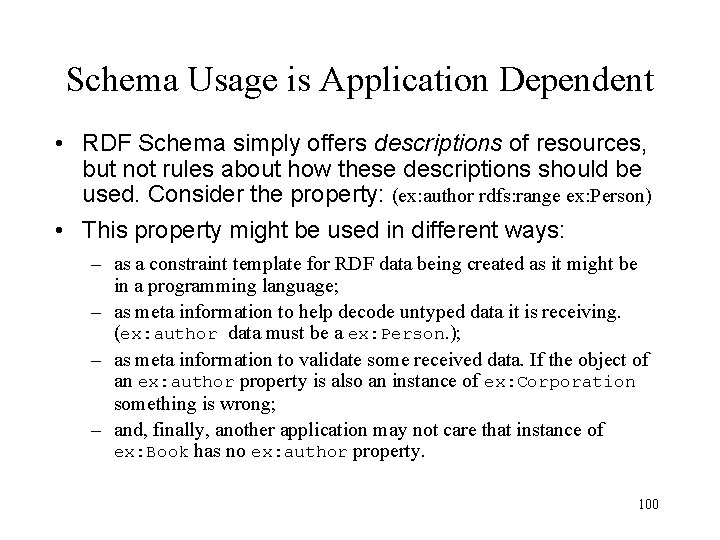
Schema Usage is Application Dependent • RDF Schema simply offers descriptions of resources, but not rules about how these descriptions should be used. Consider the property: (ex: author rdfs: range ex: Person) • This property might be used in different ways: – as a constraint template for RDF data being created as it might be in a programming language; – as meta information to help decode untyped data it is receiving. (ex: author data must be a ex: Person. ); – as meta information to validate some received data. If the object of an ex: author property is also an instance of ex: Corporation something is wrong; – and, finally, another application may not care that instance of ex: Book has no ex: author property. 100
5. 4 Other Schema Information • RDF Schema also provides documentation properties: – rdfs: comment for the obvious use. – rdfs: label to provide a more human-readable version of a resource's name. – rdfs: see. Also to indicate a resource that might provide additional information about the subject resource. – rdfs: is. Defined. By property is a subproperty of rdfs: see. Also 101
5. 5 Richer Schema Languages • RDF Schema is missing some capabilities: – cardinality constraints on properties, e. g. , that a Person has exactly one biological father. – specifying that a given property (such as has. Ancestor) is transitive, e. g. , that if A has. Ancestor B, and B has. Ancestor C, then A has. Ancestor C. – specifying that a given property is a unique identifier (or key) for instances of a particular class. – specifying that two different classes (having different URIrefs) actually represent the same concept. 102
Richer Schema Languages (cont. ) – specifying that two different instances (having different URIrefs) actually represent the same individual. – to describe new classes in terms of combinations (e. g. , unions and intersections) of other classes, – to say that two classes are disjoint (i. e. , that no resource is an instance of both classes). • These and more are the targets of ontology languages such as DAML+OIL and OWL. • Both are based on RDF and RDF Schema. • The development of such languages is a part of the Semantic Web effort. 103
6. Some RDF Applications • Dublin Core Metadata Initiative – The Dublin Core is a set of "elements" (properties) for describing documents (and hence, for recording metadata). • PRISM – Publishers want to (re)use existing content in many ways. Converting magazine articles to HTML for posting on the web is one example, reusing parts is another. • XPackage – To maintain information about structured groupings of resources and their associations that are, or may be, used as a unit. The XML Package (XPackage) specification provides a framework for defining such groupings. 104
Some More RDF Applications • RSS 1. 0: RDF Site Summary – RSS 1. 0 is a powerful and extensible way of describing, managing and making available to broad audiences relevant and timely news information. • CIM/XML – A set of common definitions of power system entities. The Electric Power Research Institute (EPRI) developed a Common Information Model (CIM). • Gene Ontology Consortium – The objective of the Gene Ontology (GO) Consortium is to provide controlled vocabularies to describe specific aspects of gene products. • Describing Device Capabilities and User Preferences – The W 3 C's Composite Capabilities/Preferences Profile (CC/PP) specification defined a generic framework for describing a delivery context for mobile devices. 105
7. Other Parts of the RDF Specification • RDF Semantics – RDF statements also have a formal meaning which determines the conclusions (or entailments) that machines can draw from an RDF graph. – The RDF Semantics defines this formal meaning, using a technique called model theory. 106
Other Parts of the RDF Specification • Test Cases – Positive and Negative Parser Tests: These test whether RDF/XML parsers produce a correct N-triples output graph from legal RDF/XML input documents, or correctly report errors if the input documents are not legal RDF/XML. – Positive and Negative Entailment Tests: These test whether proper entailments (conclusions) are or are not drawn from sets of specified RDF statements. – Datatype-aware Entailment Tests: These are positive or negative entailment tests that involve the use of datatypes, and hence require additional support for the specific datatypes involved in the tests. – Miscellaneous Tests: These are tests that do not fall into one of the other categories. 107
Appendix A – More about URIs 108
URI Schemes • Different URI schemes already exist: – http: (Hypertext Transfer Protocol for Web pages) – mailto: (email addresses), e. g. , mailto: em@w 3. org – ftp: (File Transfer Protocol) • urn: Uniform Resource Names are persistent location-independent resource identifiers, e. g. , urn: isbn: 0 -520 -02356 -0 (for a book) • No one person or organization controls who makes URIs or how they can be used. • URIs are defined in RFC 2396 109
Who controls URIs? • No one person or organization controls who makes URIs or how they can be used. • Some URI schemes, such as URL's http domain name, depend on centralized systems such as DNS, others, such as freenet: , are decentralized. • This means that, as with any other kind of name, you don't need special authority to create a URI for something, even if you don’t own it. 110
Relative and Absolute URIrefs • An absolute URIref refers to a resource independently of the context in which the URIref appears, e. g. , the URIref http: //www. example. org/index. html. • A relative URIref has its prefix come from context – otherpage. html has the absolute URIref http: //www. example. org/otherpage. html. – #section 2 is equivalent to the absolute URIref http: //www. example. org/index. html#section 2. 111
URIs and Retrievability • RDF use URIrefs to identify things. • Web browsers may use URIrefs to retrieve things. • However, a URIref may identify something, such as a person, that cannot be retrieved on the web. • There a convention that a page containing descriptive information about a resource is retrievable "at" its URI. 112
Browsers and Fragment Identifiers • Browsers handle fragment identifiers differently. • Fragment identifiers in HTML documents identify a specific place within the document. – http: //www. example. org/index. html#Section 2 • As far as RDF is concerned, these two URI references are syntactically different, and hence may refer to unrelated things. 113
- Slides: 113