
Resource Description Framework Model Syntax and Schema Specifications
![Basic RDF-in-XML Syntax z A Description block about a Resource z z z [1]](https://slidetodoc.com/presentation_image_h2/9507a0fcab99e6601afebc305adaedc0/image-24.jpg "Basic RDF-in-XML Syntax z A Description block about a Resource z z z [1]")
![Collected BNF Grammar 1/2 z [6. 1] RDF : : = '< rdf: RDF>'](https://slidetodoc.com/presentation_image_h2/9507a0fcab99e6601afebc305adaedc0/image-31.jpg "Collected BNF Grammar 1/2 z [6. 1] RDF : : = '< rdf: RDF>'")
![Collected BNF Grammar z z z z z 2/2 [6. 13] prop. Name :](https://slidetodoc.com/presentation_image_h2/9507a0fcab99e6601afebc305adaedc0/image-32.jpg "Collected BNF Grammar z z z z z 2/2 [6. 13] prop. Name :")
- Slides: 50
Resource Description Framework Model, Syntax, and Schema Specifications Rohit Khare Adam Rifkin CSCW'98 Introduction to Resource Description Framework 4 K Associates
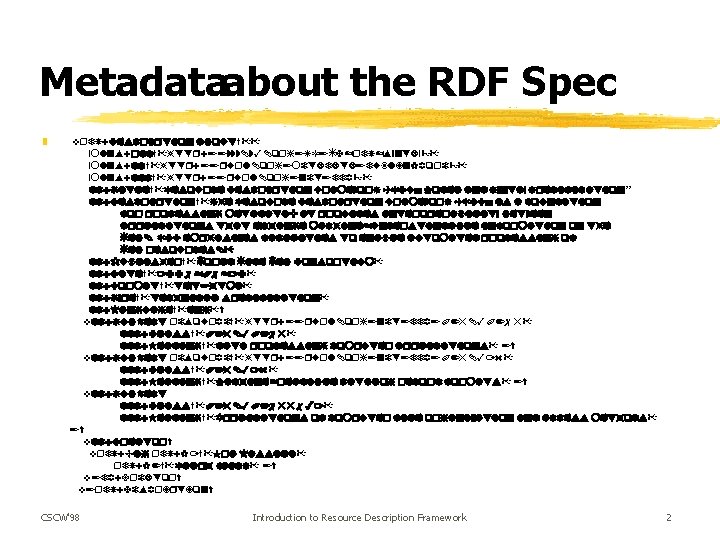
Metadataabout the RDF Spec z <rdf: Description about="" xmlns: rdf="http: //www. w 3. org/TR/WD-rdf-syntax#" xmlns: dc="http: //purl. org/metadata/dublin_core#" xmlns: ddc="http: //purl. org/net/ddc#" dc: Title="Resource Description Framework (RDF) Model and Syntax Specification” dc: Description="The Resource Description Framework (RDF) is a foundation for processing metadata; it provides interoperability between applications that exchange machine-understandable information on the Web. RDF emphasizes facilities to enable automated processing of Web resources. " dc: Publisher="World Wide Web Consortium" dc: Date="1998 -08 -19" dc: Format="text/html" dc: Type="technical specification" dc: Language="eng"> <dc: Subject resource="http: //purl. org/net/ddc/025. 30285" ddc: Class="025. 30285" ddc: Heading="data processing computer applications" /> <dc: Subject resource="http: //purl. org/net/ddc/025. 316" ddc: Class="025. 316" ddc: Heading="Machine-readable catalog record formats" /> <dc: Subject ddc: Class="025. 302855741" ddc: Heading="Applications of computer file organization and access methods" /> <dc: Creator> <rdf: Bag rdf: _1="Ora Lassila" rdf: _2="Ralph Swick" /> </dc: Creator> </rdf: Description> CSCW'98 Introduction to Resource Description Framework 2
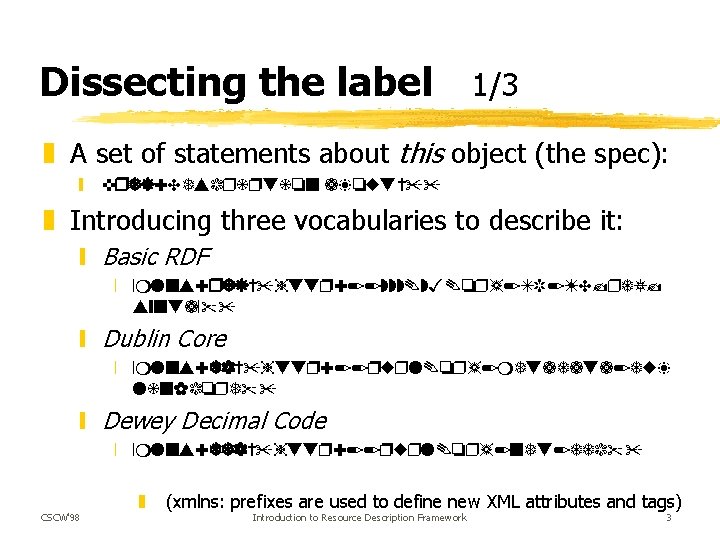
Dissecting the label 1/3 z A set of statements about this object (the spec): y <rdf: Description about="" z Introducing three vocabularies to describe it: y Basic RDF x xmlns: rdf="http: //www. w 3. org/TR/WD-rdfsyntax#" y Dublin Core x xmlns: dc="http: //purl. org/metadata/dub lin_core#" y Dewey Decimal Code x xmlns: ddc="http: //purl. org/net/ddc#" CSCW'98 z (xmlns: prefixes are used to define new XML attributes and tags) Introduction to Resource Description Framework 3
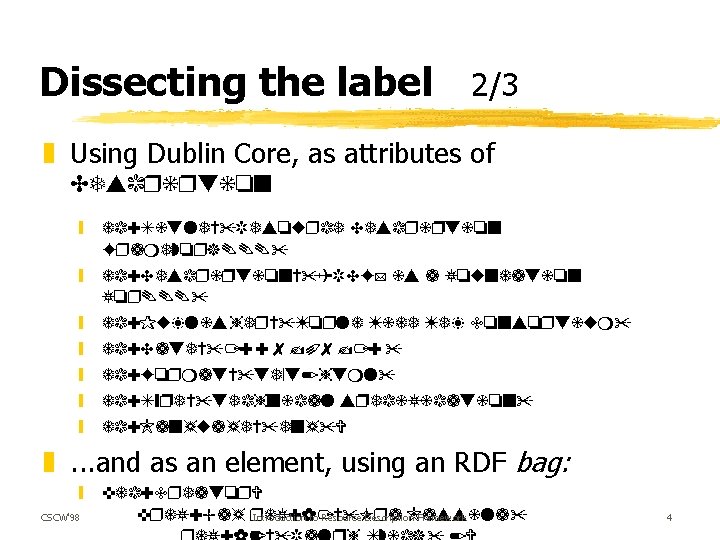
Dissecting the label 2/3 z Using Dublin Core, as attributes of Description y dc: Title="Resource Description Framework. . . " y dc: Description="(RDF) is a foundation for. . . " y dc: Publisher="World Wide Web Consortium" y dc: Date="1998 -08 -19" y dc: Format="text/html" y dc: Type="technical specification" y dc: Language="eng"> z. . . and as an element, using an RDF bag: y <dc: Creator> <rdf: Bag rdf: _1="Ora Lassila" CSCW'98 Introduction to Resource Description Framework 4
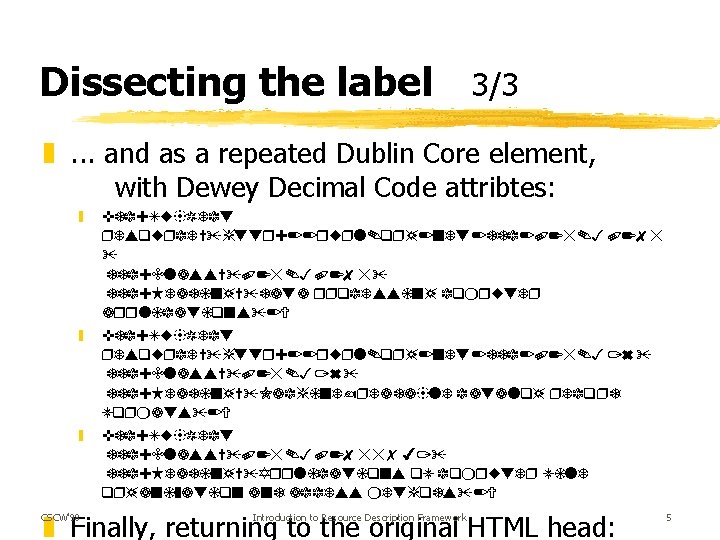
Dissecting the label 3/3 z. . . and as a repeated Dublin Core element, with Dewey Decimal Code attribtes: y y y <dc: Subject resource="http: //purl. org/net/ddc/025. 30285 " ddc: Class="025. 30285" ddc: Heading="data processing computer applications"/> <dc: Subject resource="http: //purl. org/net/ddc/025. 316" ddc: Class="025. 316" ddc: Heading="Machine-readable catalog record formats"/> <dc: Subject ddc: Class="025. 302855741" ddc: Heading="Applications of computer file organization and access methods"/> z Finally, returning to the original HTML head: CSCW'98 Introduction to Resource Description Framework 5
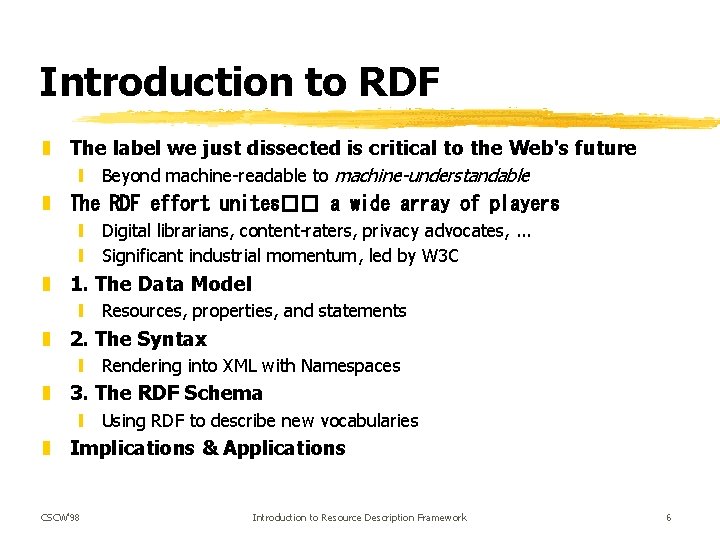
Introduction to RDF z The label we just dissected is critical to the Web's future y Beyond machine-readable to machine-understandable z The RDF effort unites�� a wide array of players y Digital librarians, content-raters, privacy advocates, . . . y Significant industrial momentum, led by W 3 C z 1. The Data Model y Resources, properties, and statements z 2. The Syntax y Rendering into XML with Namespaces z 3. The RDF Schema y Using RDF to describe new vocabularies z Implications & Applications CSCW'98 Introduction to Resource Description Framework 6
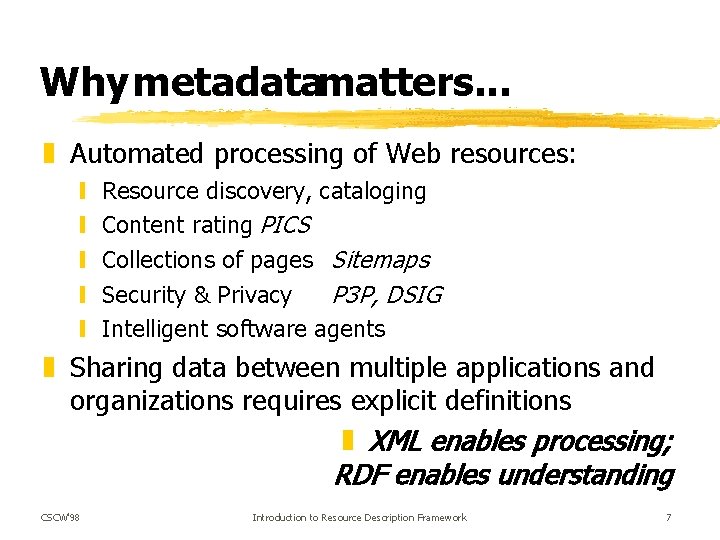
Why metadatamatters. . . z Automated processing of Web resources: y y y Resource discovery, cataloging Content rating PICS Collections of pages Sitemaps Security & Privacy P 3 P, DSIG Intelligent software agents z Sharing data between multiple applications and organizations requires explicit definitions z XML enables processing; RDF enables understanding CSCW'98 Introduction to Resource Description Framework 7
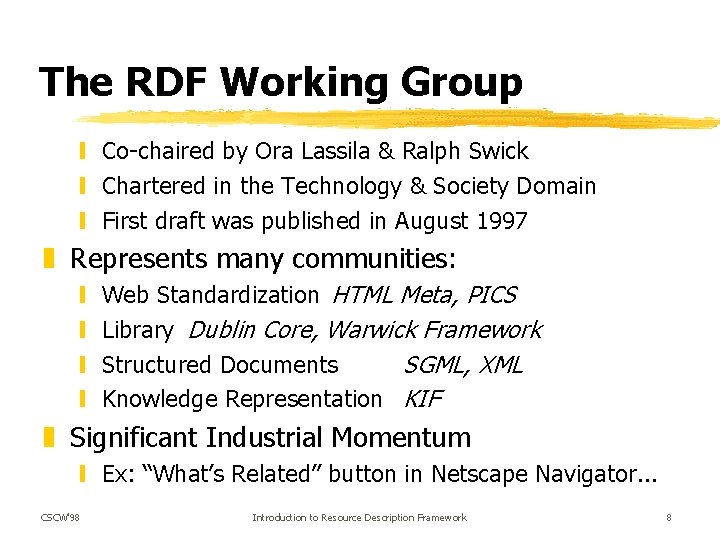
The RDF Working Group y Co-chaired by Ora Lassila & Ralph Swick y Chartered in the Technology & Society Domain y First draft was published in August 1997 z Represents many communities: y y Web Standardization HTML Meta, PICS Library Dublin Core, Warwick Framework Structured Documents SGML, XML Knowledge Representation KIF z Significant Industrial Momentum y Ex: “What’s Related” button in Netscape Navigator. . . CSCW'98 Introduction to Resource Description Framework 8
1. The Data Model z Resources y Any URI reference, from a fragment to a site. z Property Types y Named type defines meaning, permitted values, and relationship to other types. y (Types are also resources) z Statements (a. k. a. Properties) y “Resource has Property with Value” y (Values can be resources or atomic XML data) CSCW'98 Introduction to Resource Description Framework 9
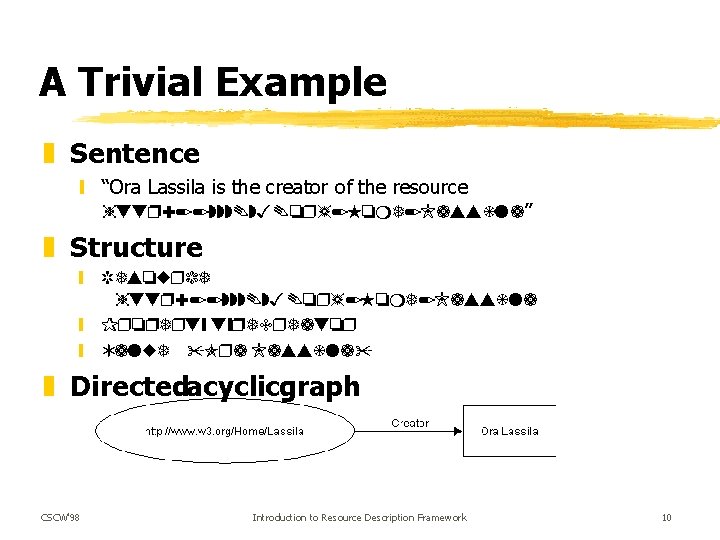
A Trivial Example z Sentence y “Ora Lassila is the creator of the resource http: //www. w 3. org/Home/Lassila” z Structure y Resource http: //www. w 3. org/Home/Lassila y Property type. Creator y Value "Ora Lassila" z Directedacyclicgraph CSCW'98 Introduction to Resource Description Framework 10
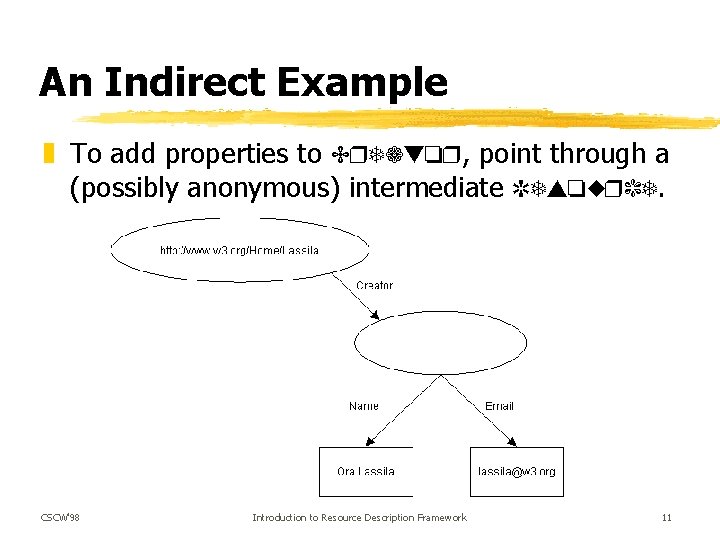
An Indirect Example z To add properties to Creator, point through a (possibly anonymous) intermediate Resource. CSCW'98 Introduction to Resource Description Framework 11
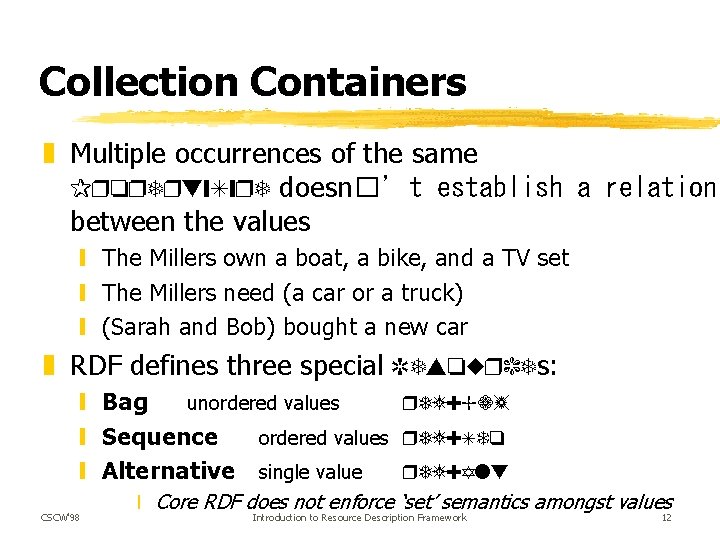
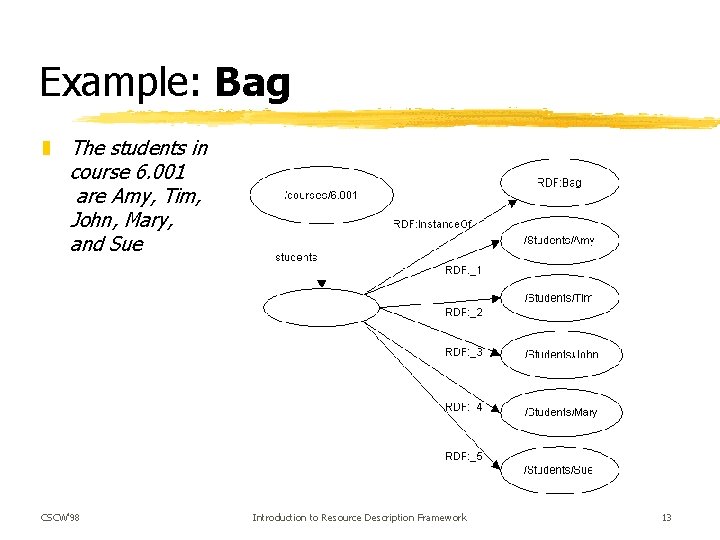
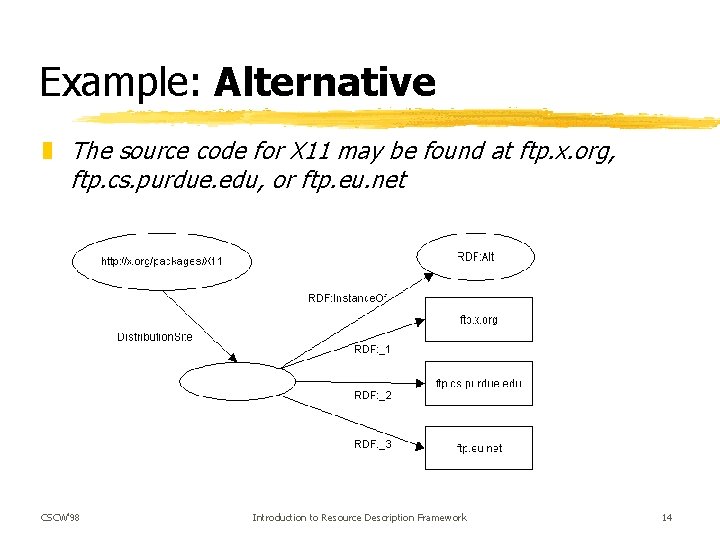
Collection Containers z Multiple occurrences of the same Property. Type doesn�’t establish a relation between the values y The Millers own a boat, a bike, and a TV set y The Millers need (a car or a truck) y (Sarah and Bob) bought a new car z RDF defines three special Resources: y Bag unordered values rdf: Bag y Sequence ordered values rdf: Seq y Alternative single value rdf: Alt CSCW'98 x Core RDF does not enforce ‘set’ semantics amongst values Introduction to Resource Description Framework 12
Example: Bag z The students in course 6. 001 are Amy, Tim, John, Mary, and Sue CSCW'98 Introduction to Resource Description Framework 13
Example: Alternative z The source code for X 11 may be found at ftp. x. org, ftp. cs. purdue. edu, or ftp. eu. net CSCW'98 Introduction to Resource Description Framework 14
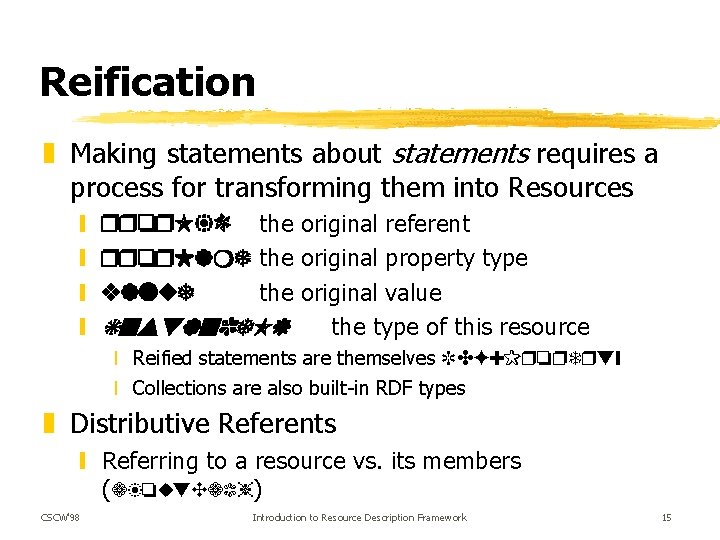
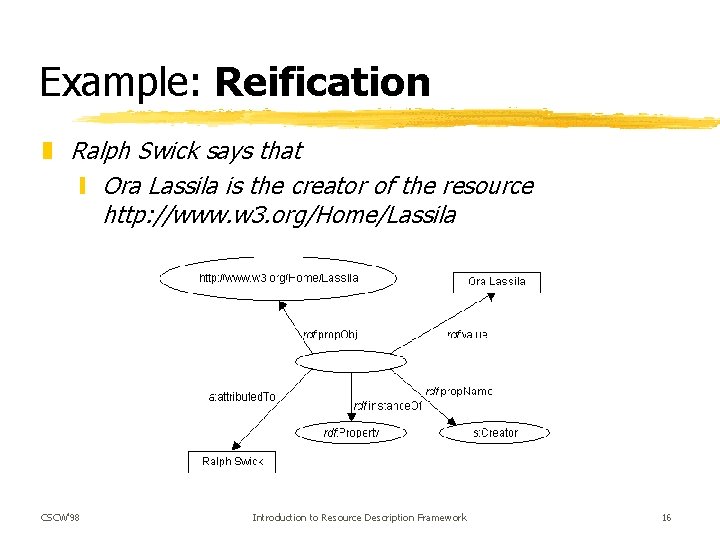
Reification z Making statements about statements requires a process for transforming them into Resources y y prop. Obj the original referent prop. Name the original property type value the original value instance. Of the type of this resource x Reified statements are themselves RDF: Property x Collections are also built-in RDF types z Distributive Referents y Referring to a resource vs. its members (about. Each) CSCW'98 Introduction to Resource Description Framework 15
Example: Reification z Ralph Swick says that y Ora Lassila is the creator of the resource http: //www. w 3. org/Home/Lassila CSCW'98 Introduction to Resource Description Framework 16
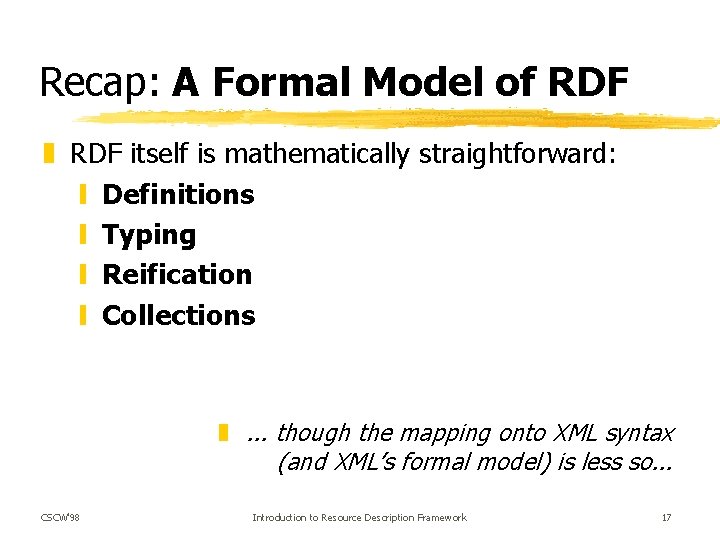
Recap: A Formal Model of RDF z RDF itself is mathematically straightforward: y Definitions y Typing y Reification y Collections z. . . though the mapping onto XML syntax (and XML’s formal model) is less so. . . CSCW'98 Introduction to Resource Description Framework 17
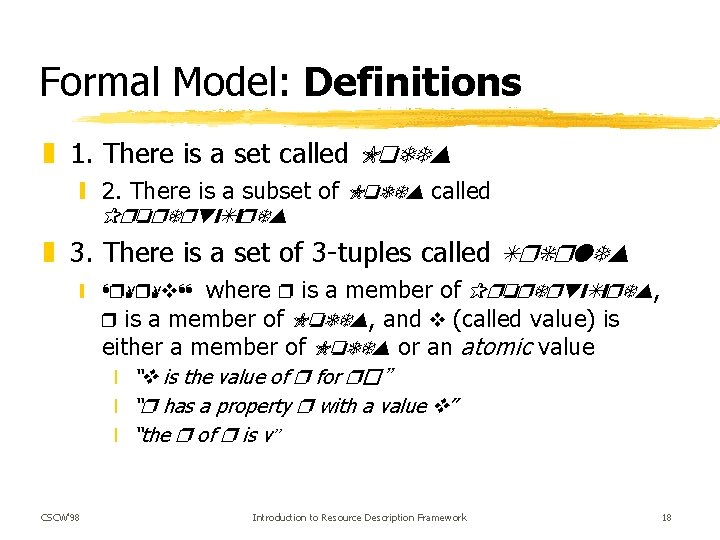
Formal Model: Definitions z 1. There is a set called Nodes y 2. There is a subset of Nodes called Property. Types z 3. There is a set of 3 -tuples called Triples y {p, r, v} where p is a member of Property. Types, r is a member of Nodes, and v (called value) is either a member of Nodes or an atomic value x “v is the value of p for r�” x “r has a property p with a value v” x “the p of r is v” CSCW'98 Introduction to Resource Description Framework 18
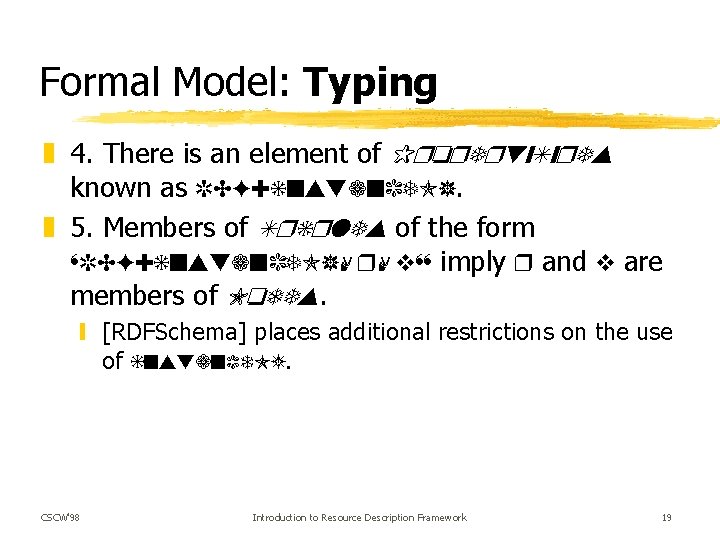
Formal Model: Typing z 4. There is an element of Property. Types known as RDF: instance. Of. z 5. Members of Triples of the form {RDF: instance. Of, r, v} imply r and v are members of Nodes. y [RDFSchema] places additional restrictions on the use of instance. Of. CSCW'98 Introduction to Resource Description Framework 19
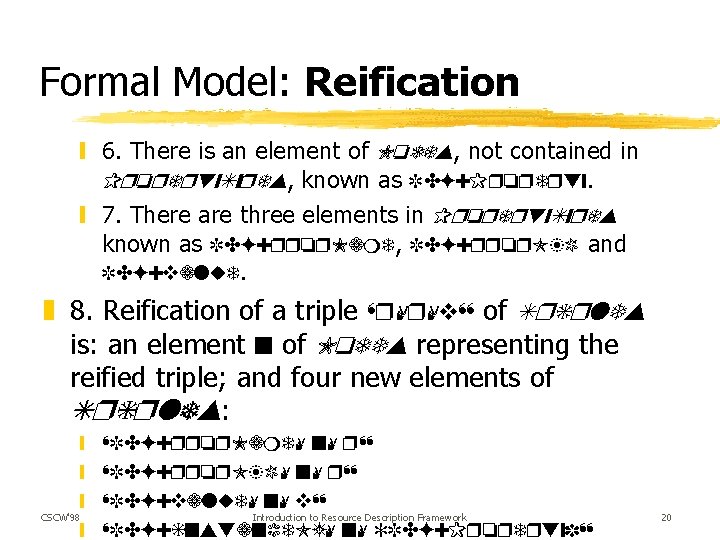
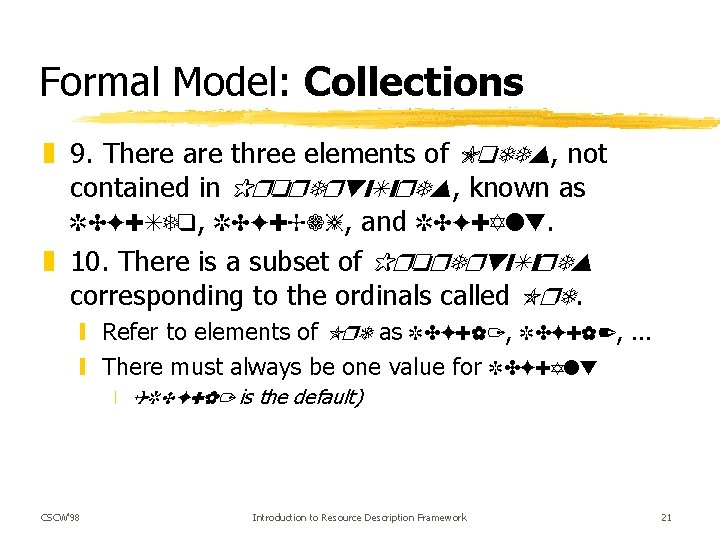
Formal Model: Reification y 6. There is an element of Nodes, not contained in Property. Types, known as RDF: Property. y 7. There are three elements in Property. Types known as RDF: prop. Name, RDF: prop. Obj and RDF: value. z 8. Reification of a triple {p, r, v} of Triples is: an element n of Nodes representing the reified triple; and four new elements of Triples: y y y CSCW'98 y {RDF: prop. Name, n, p} {RDF: prop. Obj, n, r} {RDF: value, n, v} Introduction to Resource Description Framework {RDF: instance. Of, n, [RDF: Property]} 20
Formal Model: Collections z 9. There are three elements of Nodes, not contained in Property. Types, known as RDF: Seq, RDF: Bag, and RDF: Alt. z 10. There is a subset of Property. Types corresponding to the ordinals called Ord. y Refer to elements of Ord as RDF: _1, RDF: _2, . . . y There must always be one value for RDF: Alt x (RDF: _1 is the default) CSCW'98 Introduction to Resource Description Framework 21
2. The Syntax z z z Why XML alone does not suffice Basic RDF-in-XML Syntax Abbreviated Forms Distributing RDF metadata Collected BNF Grammar Formal mapping to XML CSCW'98 Introduction to Resource Description Framework 22
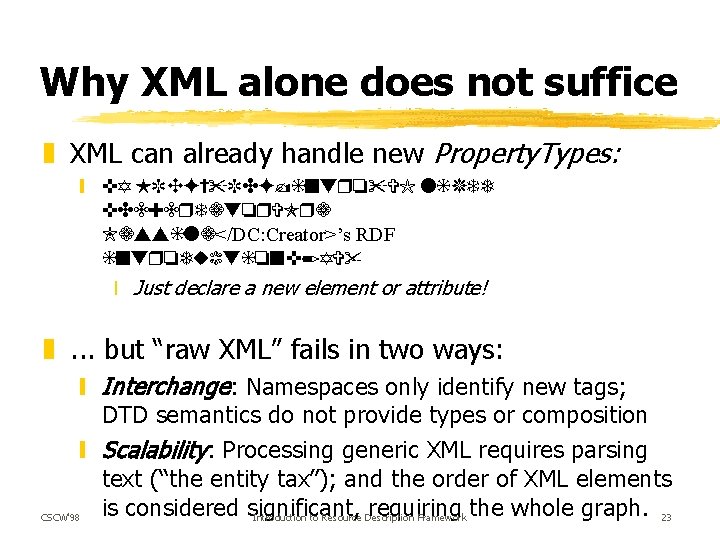
Why XML alone does not suffice z XML can already handle new Property. Types: y <A HREF="RDF-intro">I liked <DC: Creator>Ora Lassila</DC: Creator>’s RDF introduction</A>! x Just declare a new element or attribute! z. . . but “raw XML” fails in two ways: y Interchange: Namespaces only identify new tags; DTD semantics do not provide types or composition y Scalability: Processing generic XML requires parsing text (“the entity tax”); and the order of XML elements is considered significant, requiring the whole graph. 23 CSCW'98 Introduction to Resource Description Framework
Basic RDF-in-XML Syntax z A Description block about a Resource z z z [1] RDF : : = ['<rdf: RDF>'] description* ['</rdf: RDF>'] [2] description : : = '<rdf: Description' id. About. Attr? '>' property* '</rdf: Description>' [3] id. About. Attr : : = id. Attr | about. Attr [4] about. Attr : : = 'about="' URI-reference '"' [5] id. Attr : : = 'ID="' IDsymbol '"' z contains Property. Name block or empty elements z [6] property : : = '<' prop. Name '>' value '</' prop. Name '>' | '<' prop. Name resource. Attr '/>' z using fully-qualified XML Namespaces on each tag z [7] prop. Name : : = Qname z and allows values to be XML data, RDF, or external links z z [8] value : : = description | string [9] resource. Attr : : = 'resource="' URI-reference '"' CSCW'98 Introduction to Resource Description Framework 24
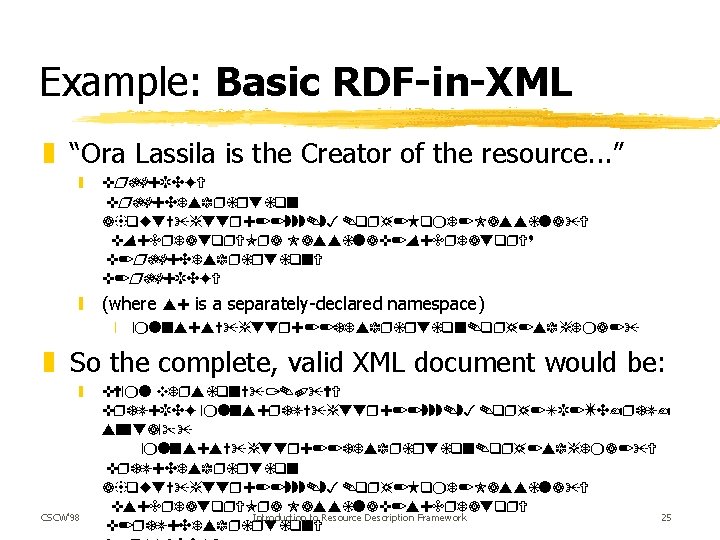
Example: Basic RDF-in-XML z “Ora Lassila is the Creator of the resource. . . ” y <rdf: RDF> <rdf: Description about="http: //www. w 3. org/Home/Lassila"> <s: Creator>Ora Lassila</s: Creator>| </rdf: Description> </rdf: RDF> y (where s: is a separately-declared namespace) x xmlns: s="http: //description. org/schema/" z So the complete, valid XML document would be: y CSCW'98 <? xml version="1. 0"? > <rdf: RDF xmlns: rdf="http: //www. w 3. org/TR/WD-rdfsyntax#" xmlns: s="http: //description. org/schema/"> <rdf: Description about="http: //www. w 3. org/Home/Lassila"> <s: Creator>Ora Lassila</s: Creator> Introduction to Resource Description Framework 25 </rdf: Description>
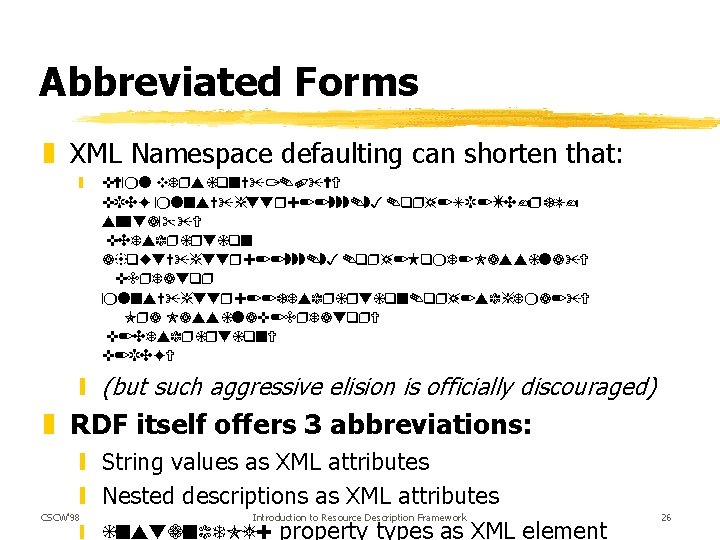
Abbreviated Forms z XML Namespace defaulting can shorten that: y <? xml version="1. 0"? > <RDF xmlns="http: //www. w 3. org/TR/WD-rdfsyntax#"> <Description about="http: //www. w 3. org/Home/Lassila"> <Creator xmlns="http: //description. org/schema/"> Ora Lassila</Creator> </Description> </RDF> y (but such aggressive elision is officially discouraged) z RDF itself offers 3 abbreviations: y String values as XML attributes y Nested descriptions as XML attributes CSCW'98 Introduction to Resource Description Framework y instance. Of: property types as XML element 26
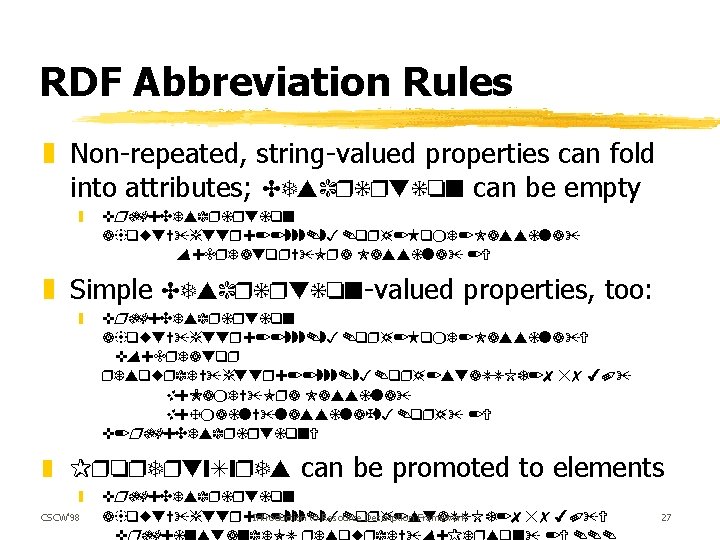
RDF Abbreviation Rules z Non-repeated, string-valued properties can fold into attributes; Description can be empty y <rdf: Description about="http: //www. w 3. org/Home/Lassila" s: Creator="Ora Lassila" /> z Simple Description-valued properties, too: y <rdf: Description about="http: //www. w 3. org/Home/Lassila"> <s: Creator resource="http: //www. w 3. org/staff. Id/85740" v: Name="Ora Lassila" v: Email="lassila@w 3. org" /> </rdf: Description> z Property. Types can be promoted to elements y CSCW'98 <rdf: Description Introduction to Resource Description Framework about="http: //www. w 3. org/staff. Id/85740"> 27
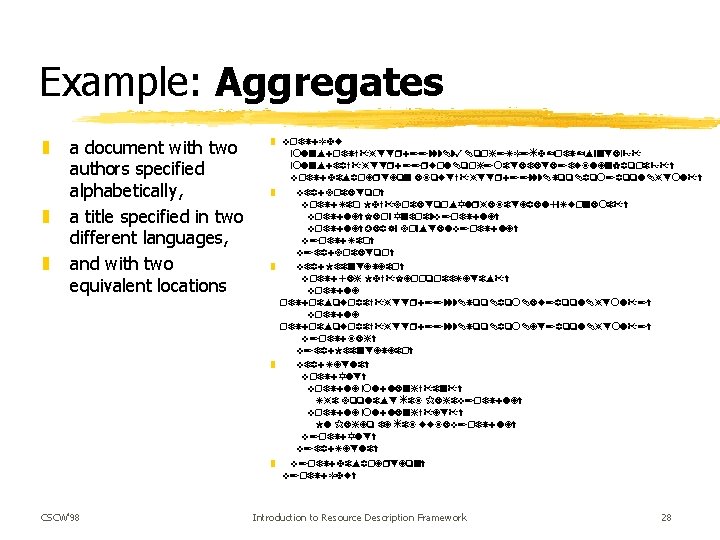
Example: Aggregates z z z a document with two authors specified alphabetically, a title specified in two different languages, and with two equivalent locations CSCW'98 z <rdf: RDF xmlns: rdf="http: //www. w 3. org/TR/WD-rdf-syntax#" xmlns: dc="http: //purl. org/metadata/dublin_core#"> <rdf: Description about="http: //www. foo. com/cool. html"> z <dc: Creator> <rdf: Seq ID="Creators. Alphabetical. By. Surname"> <rdf: li>Mary Andrew</rdf: li> <rdf: li>Jacky Crystal</rdf: li> </rdf: Seq> </dc: Creator> z <dc: Identifier> <rdf: Bag ID="Mirrored. Sites"> <rdf: li rdf: resource="http: //www. foo. com. au/cool. html"/> <rdf: li rdf: resource="http: //www. foo. com. it/cool. html"/> </rdf: bag> </dc: Identifier> z <dc: Title> <rdf: Alt> <rdf: li xml: lang="en"> The Coolest Web Page</rdf: li> <rdf: li xml: lang="it"> Il Pagio di Web Fuba</rdf: li> </rdf: Alt> </dc: Title> z </rdf: Description> </rdf: RDF> Introduction to Resource Description Framework 28
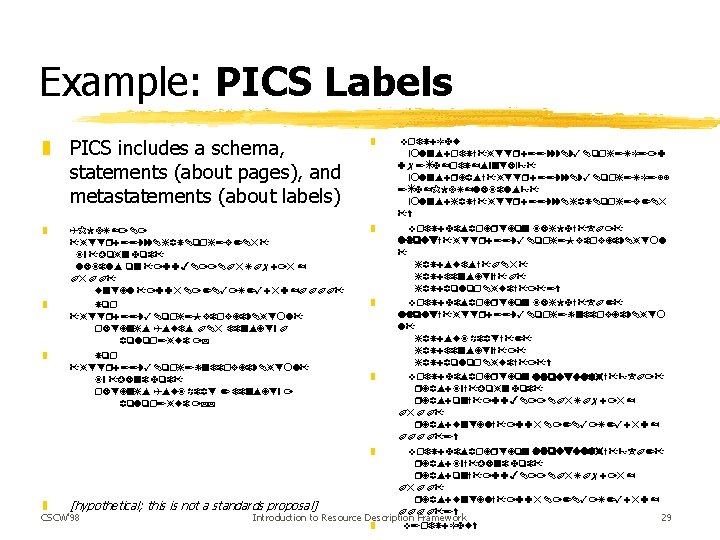
Example: PICS Labels z PICS includes a schema, statements (about pages), and metastatements (about labels) z <rdf: RDF xmlns: rdf="http: //www. w 3. org/TR/19 98/WD-rdf-syntax#" xmlns: pics="http: //www. w 3. org/TR/@@ /WD-PICS-labels#" xmlns: gcf="http: //www. gcf. org/v 2. 5 "> z <rdf: Description bag. ID="L 01" z (PICS-1. 1 about="http: //w 3. org/Overview. html "http: //www. gcf. org/v 2. 5" " by "John Doe" gcf: suds="0. 5" labels on "1994. 11. 05 T 08: 15 gcf: density="0" 0500" gcf: color. hue="1"/> until "1995. 12. 31 T 23: 59 -0000" z <rdf: Description bag. ID="L 02" z for about="http: //w 3. org/Underview. htm "http: //w 3. org/Overview. html" l" ratings (suds 0. 5 density 0 gcf: subject="2" color/hue 1) gcf: density="1" z for gcf: color. hue="1"> "http: //w 3. org/Underview. html" z <rdf: Description about. Each="#L 01" by "Jane Doe" pics: by="John Doe" ratings (subject 2 density 1 pics: on="1994. 11. 05 T 08: 15 color/hue 1)) 0500" pics: until="1995. 12. 31 T 23: 590000"/> z <rdf: Description about. Each="#L 02" pics: by="Jane Doe" pics: on="1994. 11. 05 T 08: 150500" pics: until="1995. 12. 31 T 23: 59 z [hypothetical; this is not a standards proposal] 0000"/> CSCW'98 Introduction to Resource Description Framework 29 z </rdf: RDF>
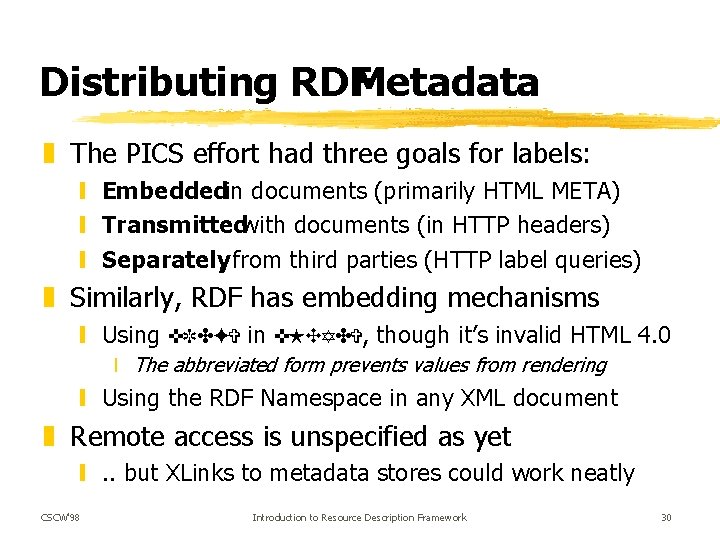
Distributing RDF Metadata z The PICS effort had three goals for labels: y Embeddedin documents (primarily HTML META) y Transmittedwith documents (in HTTP headers) y Separately , from third parties (HTTP label queries) z Similarly, RDF has embedding mechanisms y Using <RDF> in <HEAD>, though it’s invalid HTML 4. 0 x The abbreviated form prevents values from rendering y Using the RDF Namespace in any XML document z Remote access is unspecified as yet y. . but XLinks to metadata stores could work neatly CSCW'98 Introduction to Resource Description Framework 30
Collected BNF Grammar 1/2 z [6. 1] RDF : : = '< rdf: RDF>' obj* '</rdf: RDF>' z [6. 2] obj : : = description | container z [6. 3] description : : = '<rdf: Description' id. About. Attr? bag. Id. Attr? prop. Attr* '/>' | '< rdf: Description' id. About. Attr? bag. Id. Attr? prop. Attr* '>' property* '</ rdf: Description>' | typed. Node z [6. 4] container : : = sequence | bag | alternative z [6. 5] id. About. Attr : : = id. Attr | about. Each. Attr z [6. 6] id. Attr : : = 'ID="' IDsymbol '"' z [6. 7] about. Attr : : = 'about="' URI-reference '"' z [6. 8] about. Each. Attr : : = 'about. Each="' URI-reference '"' z [6. 9] bag. Id. Attr : : = 'bag. ID="' IDsymbol '"' z [6. 10] prop. Attr : : = prop. Name '="' string '"' (with embedded quotes escaped) z [6. 11] property : : = '<' prop. Name id. Attr? '>' value '</' prop. Name '>' | '<' prop. Name id. Ref. Attr? bag. Id. Attr? prop. Attr* '/>' z [6. 12] typed. Node : : = '<' type. Name id. About. Attr? bag. Id. Attr? prop. Attr* '/>' | '<' type. Name id. About. Attr? bag. Id. Attr? prop. Attr* '>' property* '</' type. Name '>' CSCW'98 Introduction to Resource Description Framework 31
Collected BNF Grammar z z z z z 2/2 [6. 13] prop. Name : : = Qname [6. 14] type. Name : : = Qname [6. 15] id. Ref. Attr : : = id. Attr | resource. Attr [6. 16] value : : = obj | string [6. 17] resource. Attr : : = 'resource="' URI-reference '"' [6. 18] Qname : : = [ NSname ': ' ] name [6. 19] URI-reference : : = (see RFC 1738, RFC 1808, [URI]) [6. 20] IDsymbol : : = (any legal XML name symbol) [6. 21] name : : = (any legal XML name symbol) [6. 22] NSname : : = (any legal XML namespace prefix) [6. 23] string : : = (any XML text, with "<", ">", and "&" escaped) [6. 24] sequence : : = '< rdf: Seq' id. Attr? '>' member* '</ rdf: Seq>' [6. 25] bag : : = '< rdf: Bag' id. Attr? '>' member* '</ rdf: Bag>' [6. 26] alternative : : = '<rdf: Alt' id. Attr? '>' member+ '</ rdf: Alt>' [6. 27] member : : = referenced. Item | inline. Item [6. 28] referenced. Item : : = '<rdf: li' resource. Attr '/>' [6. 29] inline. Item : : = '<rdf: li>' value </rdf: li>' CSCW'98 Introduction to Resource Description Framework 32
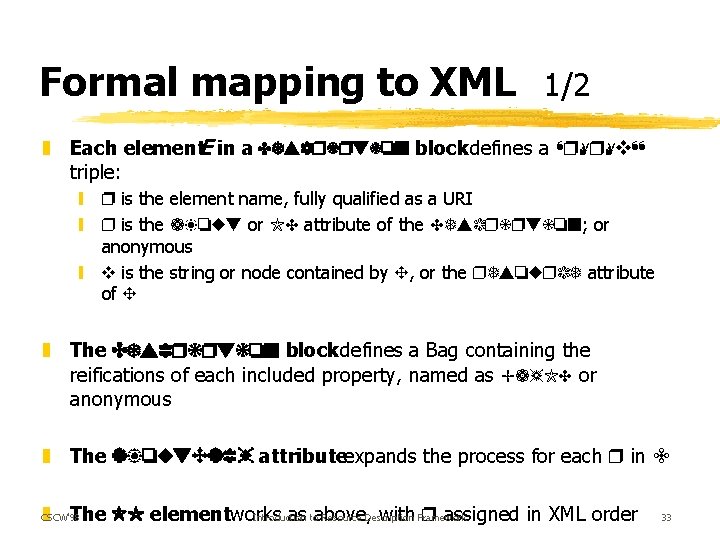
Formal mapping to XML 1/2 z Each element. E in a Description block defines a {p, r, v} triple: y p is the element name, fully qualified as a URI y r is the about or ID attribute of the Description; or anonymous y v is the string or node contained by E, or the resource attribute of E z The Description block defines a Bag containing the reifications of each included property, named as Bag. ID or anonymous z The about. Each attributeexpands the process for each r in C z The LI elementworks as toabove, with Framework p assigned in XML order Introduction Resource Description CSCW'98 33
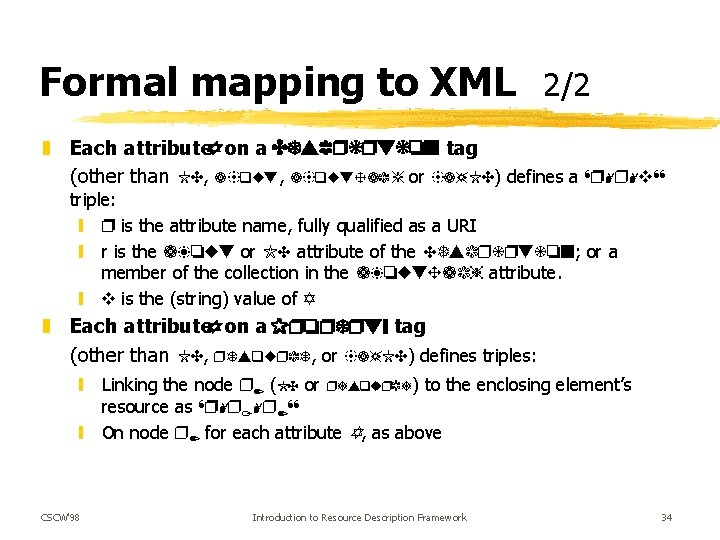
Formal mapping to XML 2/2 z Each attribute. A on a Description tag (other than ID, about. Each or bag. ID) defines a {p, r, v} triple: y p is the attribute name, fully qualified as a URI y r is the about or ID attribute of the Description; or a member of the collection in the about. Each attribute. y v is the (string) value of A z Each attribute. A on a Property tag (other than ID, resource, or bag. ID) defines triples: y Linking the node r 2 (ID or resource) to the enclosing element’s resource as {p, r 1, r 2} y On node r 2 for each attribute A, as above CSCW'98 Introduction to Resource Description Framework 34
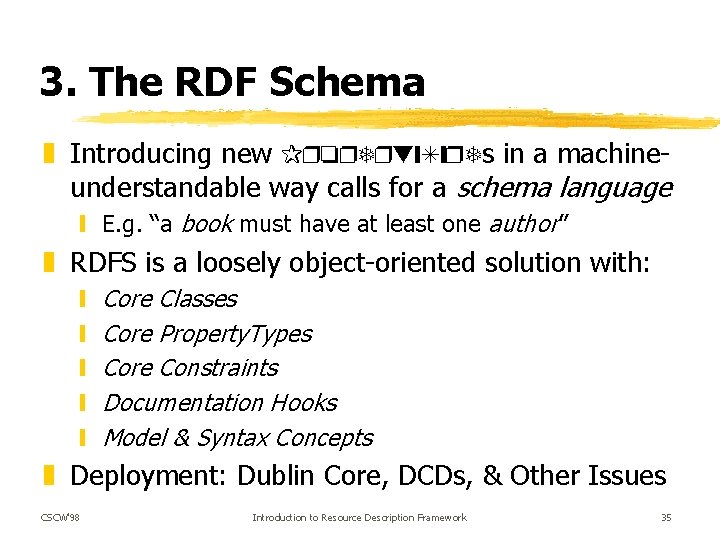
3. The RDF Schema z Introducing new Property. Types in a machineunderstandable way calls for a schema language y E. g. “a book must have at least one author” z RDFS is a loosely object-oriented solution with: y y y Core Classes Core Property. Types Core Constraints Documentation Hooks Model & Syntax Concepts z Deployment: Dublin Core, DCDs, & Other Issues CSCW'98 Introduction to Resource Description Framework 35
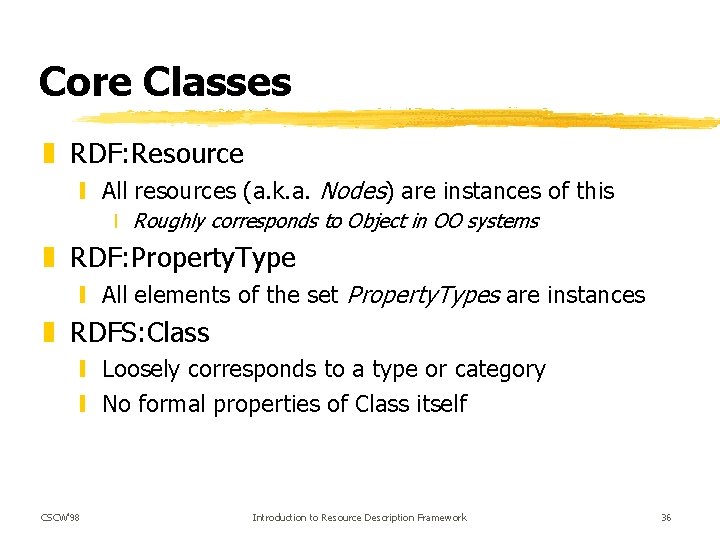
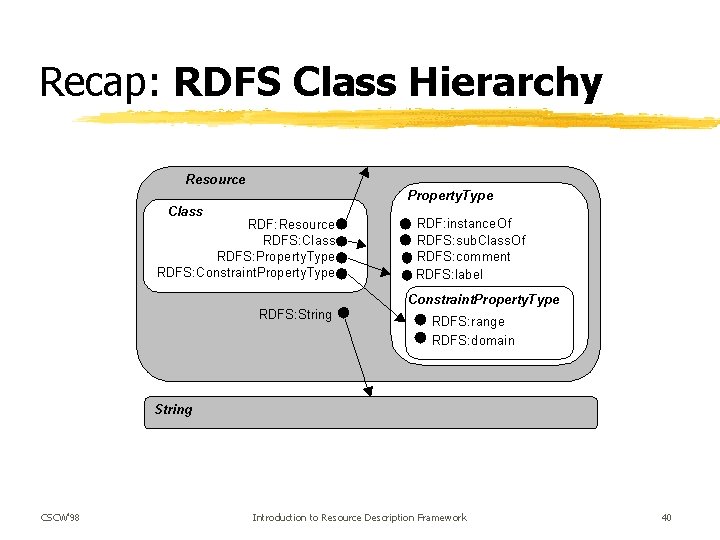
Core Classes z RDF: Resource y All resources (a. k. a. Nodes) are instances of this x Roughly corresponds to Object in OO systems z RDF: Property. Type y All elements of the set Property. Types are instances z RDFS: Class y Loosely corresponds to a type or category y No formal properties of Class itself CSCW'98 Introduction to Resource Description Framework 36
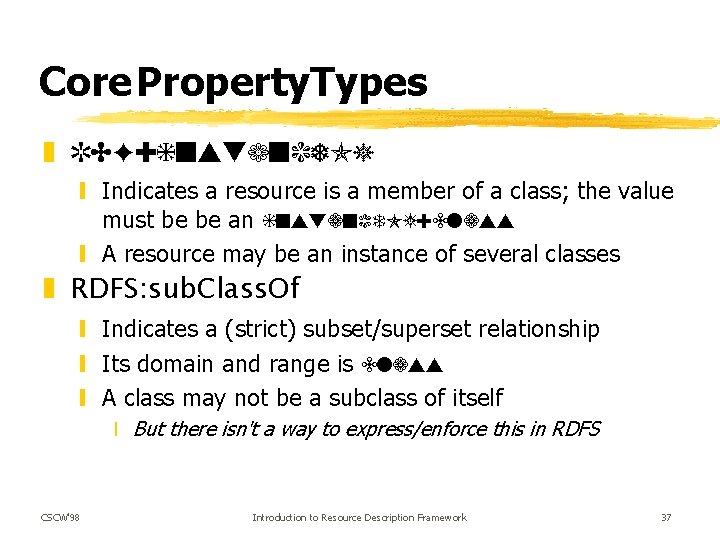
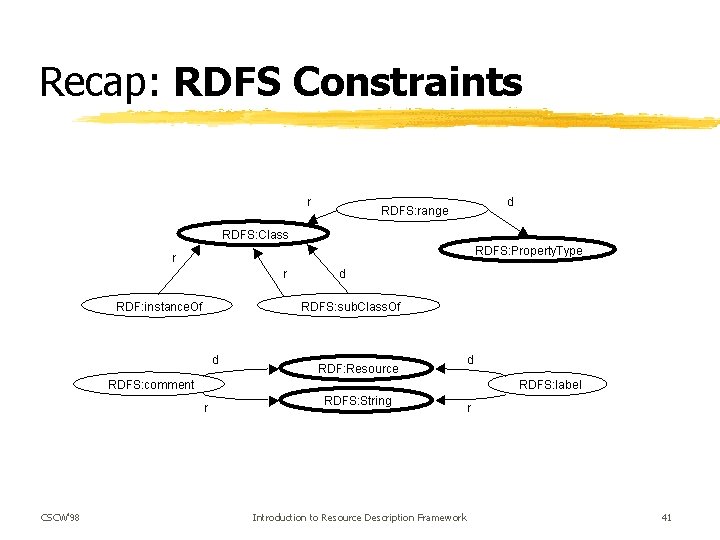
Core Property. Types z RDF: instance. Of y Indicates a resource is a member of a class; the value must be be an instance. Of: Class y A resource may be an instance of several classes z RDFS: sub. Class. Of y Indicates a (strict) subset/superset relationship y Its domain and range is Class y A class may not be a subclass of itself x But there isn't a way to express/enforce this in RDFS CSCW'98 Introduction to Resource Description Framework 37
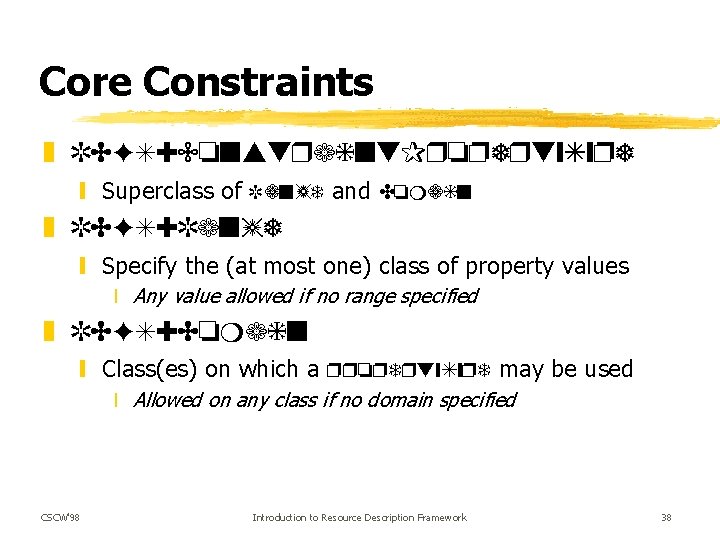
Core Constraints z RDFS: Constraint. Property. Type y Superclass of Range and Domain z RDFS: Range y Specify the (at most one) class of property values x Any value allowed if no range specified z RDFS: Domain y Class(es) on which a property. Type may be used x Allowed on any class if no domain specified CSCW'98 Introduction to Resource Description Framework 38
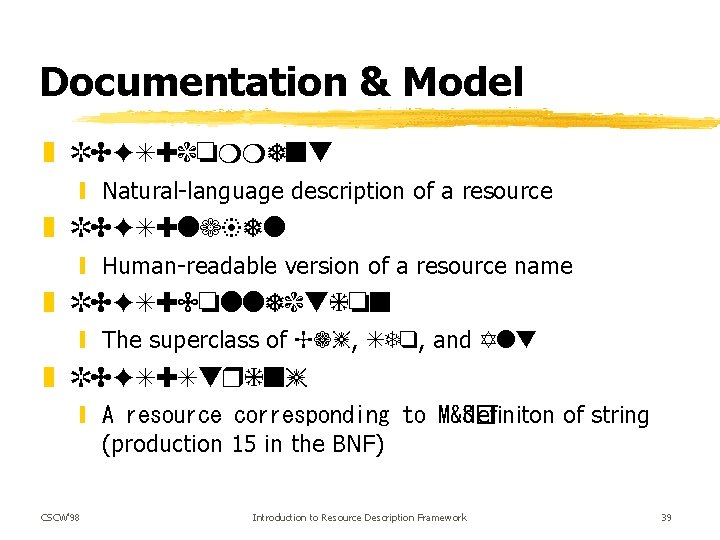
Documentation & Model z RDFS: comment y Natural-language description of a resource z RDFS: label y Human-readable version of a resource name z RDFS: Collection y The superclass of Bag, Seq, and Alt z RDFS: String y A resource corresponding to M&S� definiton of string (production 15 in the BNF) CSCW'98 Introduction to Resource Description Framework 39
Recap: RDFS Class Hierarchy CSCW'98 Introduction to Resource Description Framework 40
Recap: RDFS Constraints CSCW'98 Introduction to Resource Description Framework 41
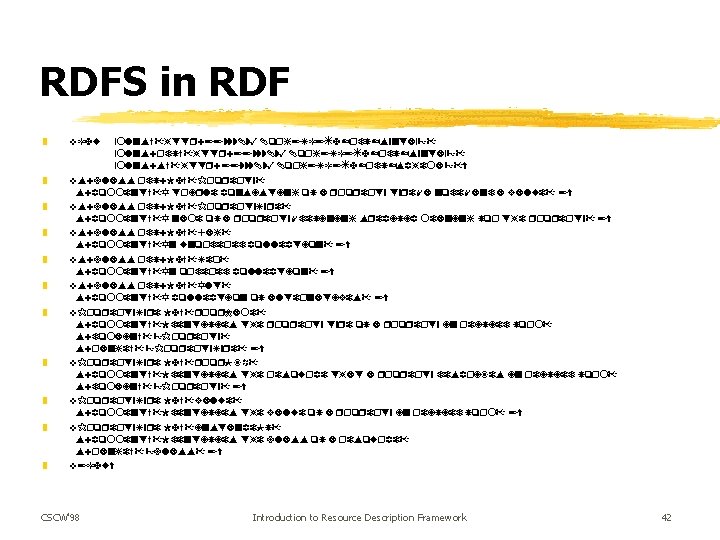
RDFS in RDF z z z <RDF xmlns="http: //www. w 3. org/TR/WD-rdf-syntax#" xmlns: rdf="http: //www. w 3. org/TR/WD-rdf-syntax#" xmlns: s="http: //www. w 3. org/TR/WD-rdf-schema#"> <s: Class rdf: ID="Property" s: comment="A triple consisting of a property type, a node, and a value" /> <s: Class rdf: ID="Property. Type" s: comment="A name of a property, defining specific meaning for the property" /> <s: Class rdf: ID="Bag" s: comment="An unordered collection" /> <s: Class rdf: ID="Seq" s: comment="An ordered collection" /> <s: Class rdf: ID="Alt" s: comment="A collection of alternatives" /> <Property. Type ID="prop. Name" s: comment="Identifies the property type of a property in reified form" s: domain="#Property" s: range="#Property. Type" /> <Property. Type ID="prop. Obj" s: comment="Identifies the resource that a property describes in reified form" s: domain="#Property" /> <Property. Type ID="value" s: comment="Identifies the value of a property in reified form" /> <Property. Type ID="instance. Of" s: comment="Identifies the Class of a resource" s: range="#Class" /> </RDF> CSCW'98 Introduction to Resource Description Framework 42
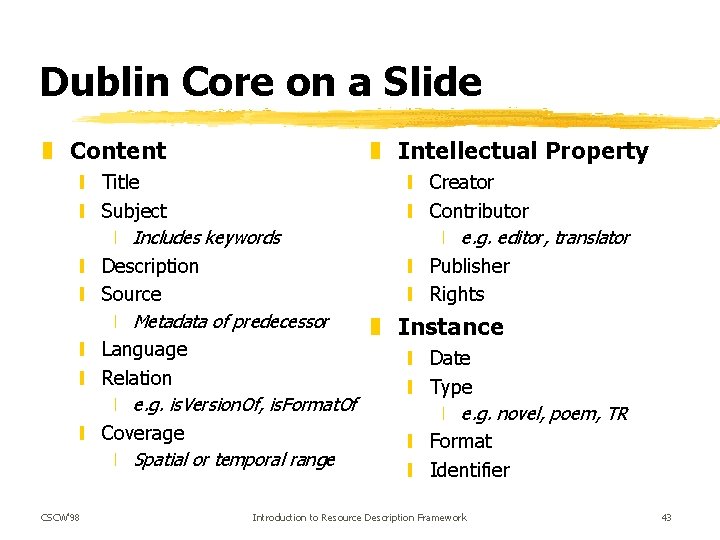
Dublin Core on a Slide z Content z Intellectual Property y Title y Subject y Creator y Contributor x Includes keywords y Description y Source y Publisher y Rights x Metadata of predecessor y Language y Relation x e. g. is. Version. Of, is. Format. Of y Coverage x Spatial or temporal range CSCW'98 x e. g. editor, translator z Instance y Date y Type x e. g. novel, poem, TR y Format y Identifier Introduction to Resource Description Framework 43
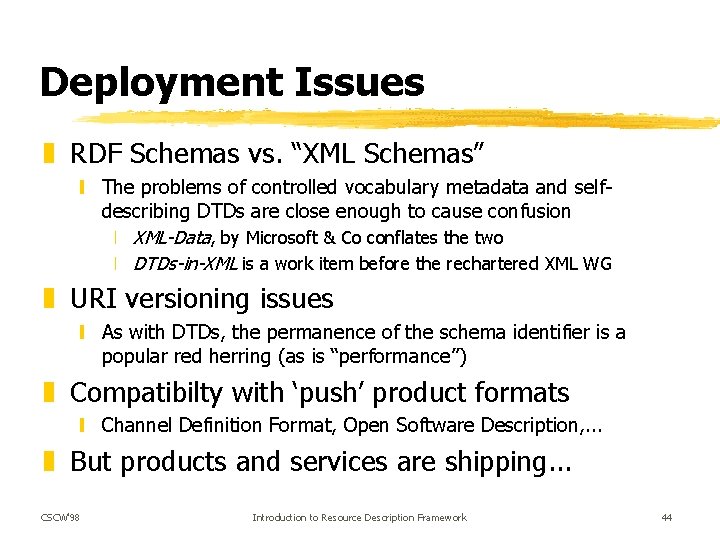
Deployment Issues z RDF Schemas vs. “XML Schemas” y The problems of controlled vocabulary metadata and selfdescribing DTDs are close enough to cause confusion x XML-Data, by Microsoft & Co conflates the two x DTDs-in-XML is a work item before the rechartered XML WG z URI versioning issues y As with DTDs, the permanence of the schema identifier is a popular red herring (as is “performance”) z Compatibilty with ‘push’ product formats y Channel Definition Format, Open Software Description, . . . z But products and services are shipping. . . CSCW'98 Introduction to Resource Description Framework 44
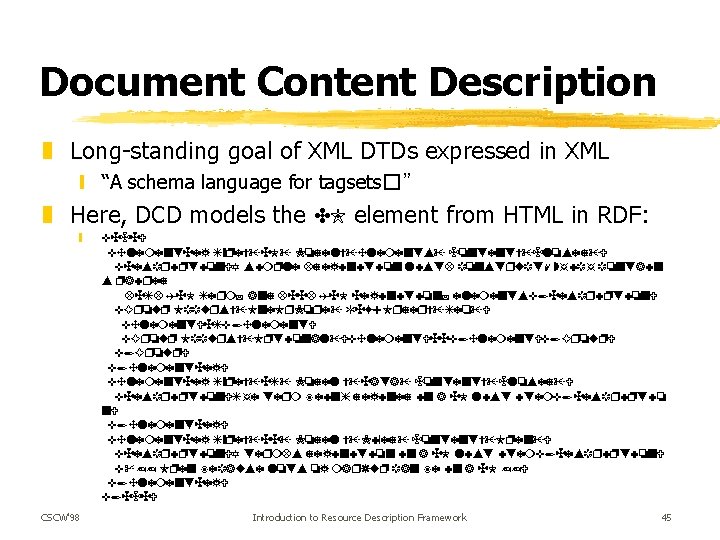
Document Content Description z Long-standing goal of XML DTDs expressed in XML y “A schema language for tagsets�” z Here, DCD models the DL element from HTML in RDF: y CSCW'98 <DCD> <Element. Def Type="DL" Model="Elements" Content="Closed"> <Description>A simple 'definition list' construct, which contain s paired 'DT' (DL Term) and 'DD' (DL Definition) elements</Description> <Group Occurs="One. Or. More" RDF: Order="Seq"> <Element>DT</Element> <Group Occurs="Optional"><Element>DD</Element></Group> </Element. Def> <Element. Def Type="DT" Model ="Data" Content="Closed"> <Description>The term being defined in a DL list item</Descriptio n> </Element. Def> <Element. Def Type="DD" Model ="Mixed" Content="Open"> <Description>A term's definition in a DL list item</Description> <!-- Open because lots of markup can be in a DL --> </Element. Def> </DCD> Introduction to Resource Description Framework 45
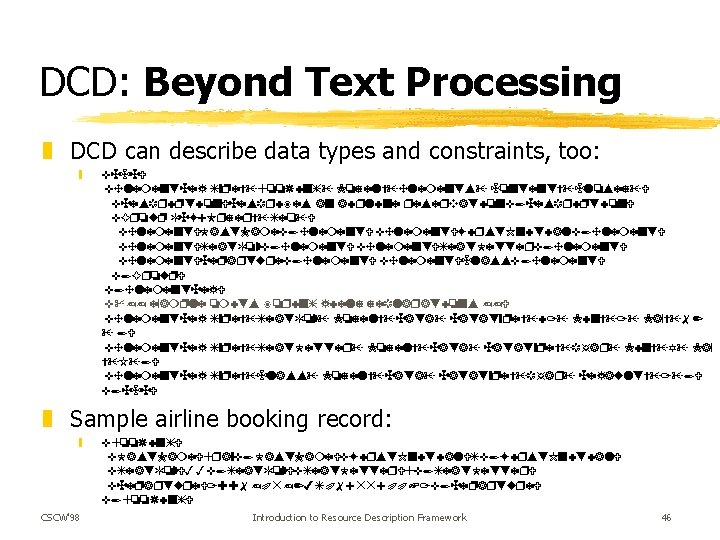
DCD: Beyond Text Processing z DCD can describe data types and constraints, too: y <DCD> <Element. Def Type="Booking" Model="Elements" Content="Closed"> <Description>Describes an airline reservation</Description> <Group RDF: Order="Seq"> <Element>Last. Name</Element> <Element>First. Initial</Element> <Element>Seat. Row</Element> <Element>Seat. Letter</Element> <Element>Departure</Element> <Element>Class</Element> </Group> </Element. Def> <!-- example omits boring field declarations --> <Element. Def Type="Seat. Row" Model="Data" Datatype="i 1" Min="1" Max="72 " /> <Element. Def Type="Seat. Letter" Model="Data" Datatype="char" Min="A" Max ="K"/> <Element. Def Type="Class" Model="Data" Datatype="char" Default="1"/> </DCD> z Sample airline booking record: y CSCW'98 <Booking> <Last. Name>Bray</Last. Name><First. Initial>T</First. Initial> <Seat. Row>33</Seat. Row><Seat. Letter>B</Seat. Letter> <Departure>1997 -05 -24 T 07: 55: 00+1</Departure> </Booking> Introduction to Resource Description Framework 46
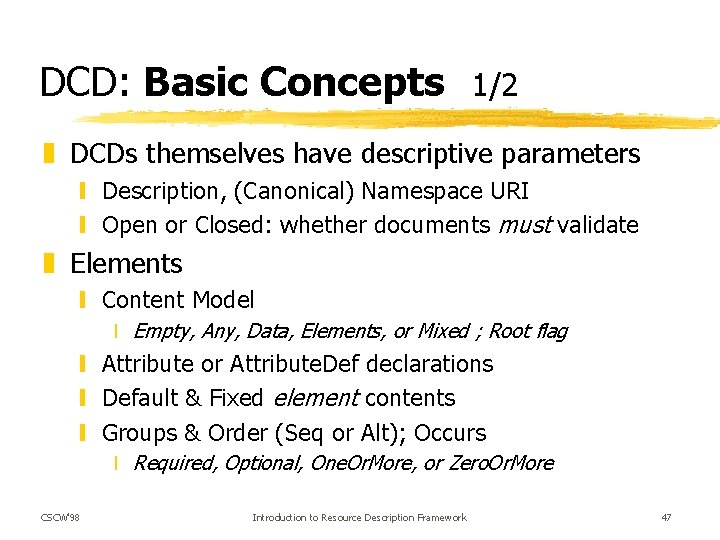
DCD: Basic Concepts 1/2 z DCDs themselves have descriptive parameters y Description, (Canonical) Namespace URI y Open or Closed: whether documents must validate z Elements y Content Model x Empty, Any, Data, Elements, or Mixed ; Root flag y Attribute or Attribute. Def declarations y Default & Fixed element contents y Groups & Order (Seq or Alt); Occurs x Required, Optional, One. Or. More, or Zero. Or. More CSCW'98 Introduction to Resource Description Framework 47
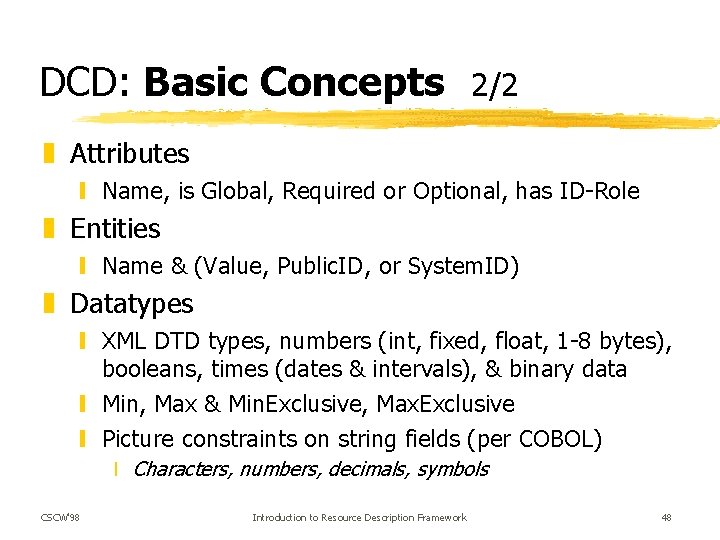
DCD: Basic Concepts 2/2 z Attributes y Name, is Global, Required or Optional, has ID-Role z Entities y Name & (Value, Public. ID, or System. ID) z Datatypes y XML DTD types, numbers (int, fixed, float, 1 -8 bytes), booleans, times (dates & intervals), & binary data y Min, Max & Min. Exclusive, Max. Exclusive y Picture constraints on string fields (per COBOL) x Characters, numbers, decimals, symbols CSCW'98 Introduction to Resource Description Framework 48
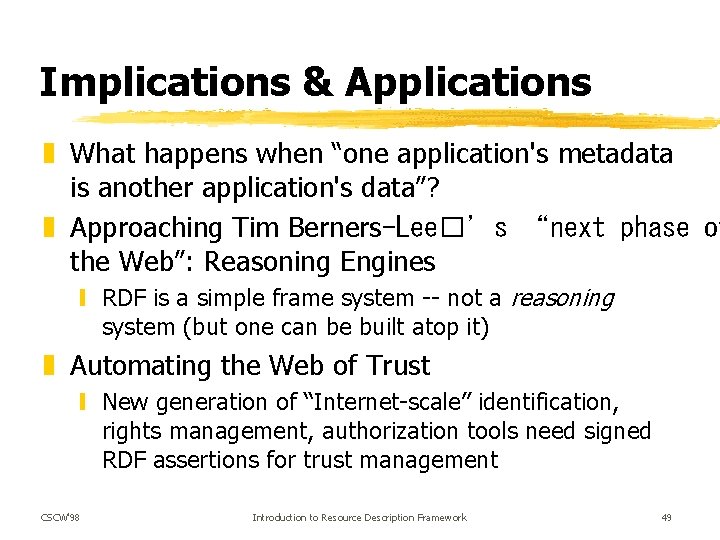
Implications & Applications z What happens when “one application's metadata is another application's data”? z Approaching Tim Berners-Lee�’s “next phase of the Web”: Reasoning Engines y RDF is a simple frame system -- not a reasoning system (but one can be built atop it) z Automating the Web of Trust y New generation of “Internet-scale” identification, rights management, authorization tools need signed RDF assertions for trust management CSCW'98 Introduction to Resource Description Framework 49
For more information. . . z The Specifications y http: //www. w 3. org/TR/WD-rdf-syntax & WD-rdf-schema z W 3 C�’s RDF Metadata & home pages y http: //www. w 3. org/Metadata/ & /RDF/ z Eric Miller’s introduction y http: //www. dlib. org/dlib/may 98/miller/05 miller. html y http: //purl. oclc. org/~emiller/talks/www 7/tutorial z Dave Beckett’s RDF Resources y http: //www. cs. ukc. ac. uk/people/staff/djb 1/ research/metadata/rdf. shtml z This talk is at http: //www. ics. uci. edu/~rohit/cscw 98/rdf/ CSCW'98 Introduction to Resource Description Framework 50