
Resource Dependencies A dependency is a relationship between
Resource Dependencies

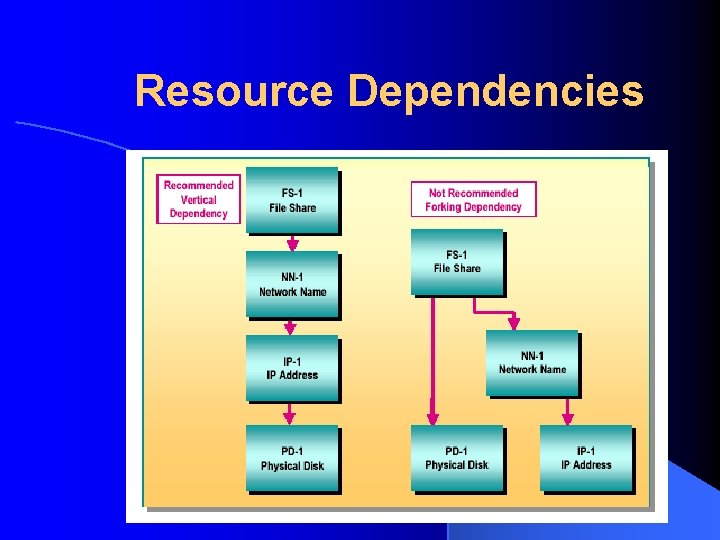
A dependency is a relationship between two resources in which one resource depends upon the other to be online before it can be brought online. For example, a network name cannot be brought online before an IP address. This relationship requires that dependent resources reside in the same group on the same node. l The administrator establishes resource dependencies within a group to ensure availability of specific resources before other resources attempt to go online. For troubleshooting purposes, it is recommended that you create vertical dependencies for all of the cluster resources. Forking dependencies provide multiple paths to troubleshoot when a resource does not come online. A vertical dependency requires that all of the dependent resources come online in sequence, starting with the resource that is at the bottom of the dependency tree. l
Resource Dependency Tree l The dependency tree is a useful diagram for visualizing the dependency relationships between resources and determining how they will interact. For example, if a resource must be taken offline for an administrative task, its location in the dependency tree will show what other resources will be affected. The dependency tree indicates the relative order in which resources will be taken offline and brought online. Note that dependency tree diagrams are a useful tool for designing and documenting a cluster configuration, but you are not required to create these diagrams to manage the server cluster. This is an optional planning activity.
l Resource Dependencies in Groups The resources belonging to a dependency tree must all be contained in the same Cluster service group. All of the resources in a group move between nodes as a unit. Dependent or related resources never span a single group boundary because they cannot be dependent on resources in other groups. If this were possible, then all of the groups contained in a dependency tree would have to fail over to the other node as a unit. Because groups are the basic unit of failover in Cluster service, resources in a dependency tree will always be online on the same node and will fail over together. l Note: It is recommended that you do not use the cluster network name and IP address resources, which are created automatically during installation, as part of a user-defined dependency tree or group. These two resources should be left in the default cluster group that is created on installation of Cluster service.

Dependency Rules The only dependency relationships that Cluster service recognizes are relationships between resources. The following rules govern dependency relationships: – The resources of a dependency tree are wholly contained in – – – one, and only one, cluster group. A resource can depend on any number of other resources in the same group. Resources in the same dependency tree must all be online on the same node of a cluster. A resource can be active or online on only one node in the cluster at a given time. A resource is brought online only after all of the resources on which it depends are brought online. A resource is taken offline before any resource on which it depends is taken offline.
- Slides: 5